Landbase Alternatives: 9 AI GTM Tools Compared for 2026
Landbase bundles data, AI copy and campaign execution into one agentic platform. That bundle is convenient until you need better contact data or a smaller bill. Here are nine alternatives, priced and pressure-tested.
TL;DR
- Landbase sells an "agentic" GTM platform: it researches accounts, writes campaigns, and runs outbound from one place. The convenience is real; the lock-in and the opaque pricing are too.
- Most teams that leave Landbase don't replace it with one tool. They unbundle it into a data layer, a sequencing layer, and an AI copy layer — usually for less money and with better contact accuracy.
- The strongest 2026 alternatives are Clay (orchestration), Apollo (all-in-one), Tomba (data and verification), BookYourData (pay-as-you-go lists), Instantly (sending), Amplemarket, Regie.ai, Artisan, and ZoomInfo Copilot.
- Data quality — not AI copy — is the variable that decides whether outbound works. Bounce rate is the number to benchmark before you sign anything.
- If your gap is "we can't reliably get verified work emails," a $49/mo data tool fixes it faster than a platform migration.
What is Landbase, and what does it actually do?#
Landbase is an applied-AI go-to-market platform. It positions itself around agentic workflows: you describe a campaign goal, and its models handle audience building, messaging, channel selection, and iteration, with humans reviewing rather than assembling. Its pitch on landbase.com leans on an in-house GTM model trained on campaign outcome data, which is a genuinely different bet from "we bolted GPT onto a sequencer."
In practice it occupies the same shelf as an AI SDR: replace several point tools and part of a headcount with one system that plans and executes outbound. That works best when you have a broad, repeatable ICP and you want volume without hiring.
It stops working well in three situations. Your ICP is narrow and the bundled database doesn't cover it. Your team already owns sequencing and CRM workflows and only needs better data. Or procurement asks for a per-unit price and you can't produce one, because the platform is sold through demos and annual contracts rather than a public pricing page.
What does Landbase bundle, and what can you buy separately?#
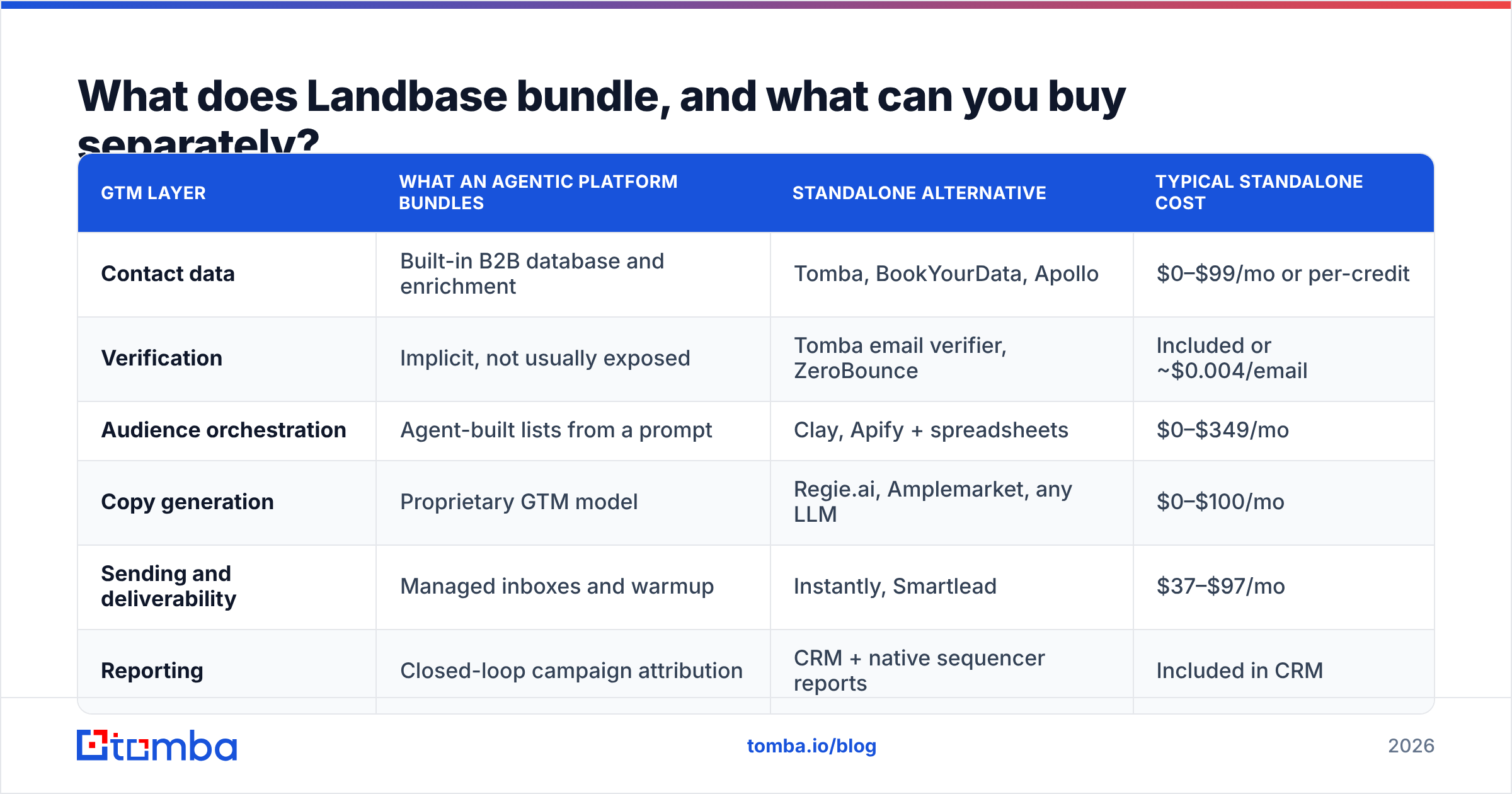
Before you shop for a replacement, separate the bundle into layers. Almost every "Landbase alternative" is really a best-in-class version of one row below.
| GTM layer | What an agentic platform bundles | Standalone alternative | Typical standalone cost |
|---|---|---|---|
| Contact data | Built-in B2B database and enrichment | Tomba, BookYourData, Apollo | $0–$99/mo or per-credit |
| Verification | Implicit, not usually exposed | Tomba email verifier, ZeroBounce | Included or ~$0.004/email |
| Audience orchestration | Agent-built lists from a prompt | Clay, Apify + spreadsheets | $0–$349/mo |
| Copy generation | Proprietary GTM model | Regie.ai, Amplemarket, any LLM | $0–$100/mo |
| Sending and deliverability | Managed inboxes and warmup | Instantly, Smartlead | $37–$97/mo |
| Reporting | Closed-loop campaign attribution | CRM + native sequencer reports | Included in CRM |
Add the right-hand column for a two-person outbound team and you land between $150 and $400 per month. That's the number to hold up against any enterprise quote — not because cheap wins, but because it prices the convenience you're buying.
Why do teams look for Landbase alternatives?#
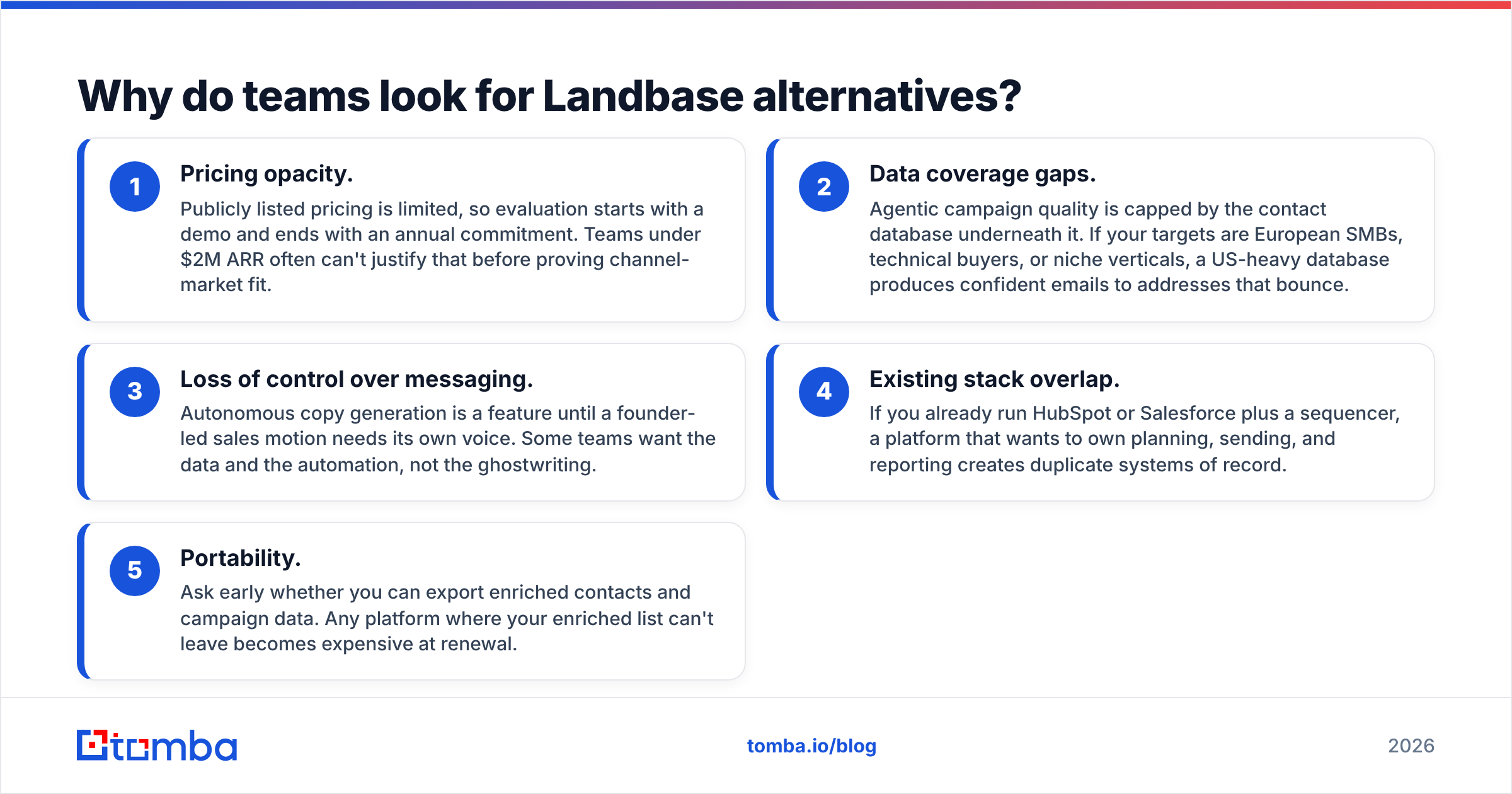
Five reasons show up repeatedly in reviews on G2 and in migration conversations:
- Pricing opacity. Publicly listed pricing is limited, so evaluation starts with a demo and ends with an annual commitment. Teams under $2M ARR often can't justify that before proving channel-market fit.
- Data coverage gaps. Agentic campaign quality is capped by the contact database underneath it. If your targets are European SMBs, technical buyers, or niche verticals, a US-heavy database produces confident emails to addresses that bounce.
- Loss of control over messaging. Autonomous copy generation is a feature until a founder-led sales motion needs its own voice. Some teams want the data and the automation, not the ghostwriting.
- Existing stack overlap. If you already run HubSpot or Salesforce plus a sequencer, a platform that wants to own planning, sending, and reporting creates duplicate systems of record.
- Portability. Ask early whether you can export enriched contacts and campaign data. Any platform where your enriched list can't leave becomes expensive at renewal.
None of these make Landbase a bad product. They make it a specific product, sized for teams that want an outsourced GTM engine rather than a toolkit.
What are the best Landbase alternatives in 2026?#
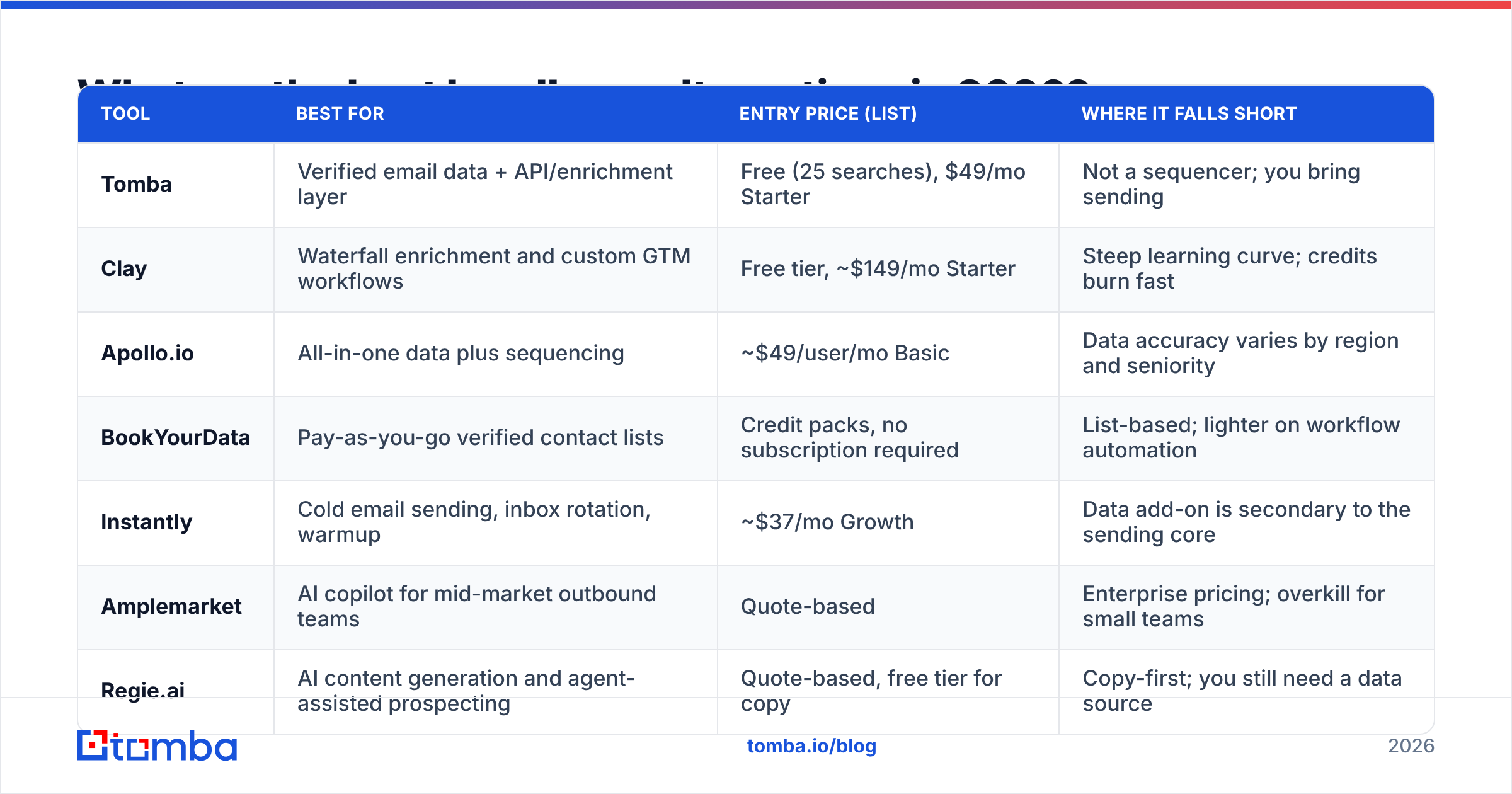
| Tool | Best for | Entry price (list) | Where it falls short |
|---|---|---|---|
| Tomba | Verified email data + API/enrichment layer | Free (25 searches), $49/mo Starter | Not a sequencer; you bring sending |
| Clay | Waterfall enrichment and custom GTM workflows | Free tier, ~$149/mo Starter | Steep learning curve; credits burn fast |
| Apollo.io | All-in-one data plus sequencing | ~$49/user/mo Basic | Data accuracy varies by region and seniority |
| BookYourData | Pay-as-you-go verified contact lists | Credit packs, no subscription required | List-based; lighter on workflow automation |
| Instantly | Cold email sending, inbox rotation, warmup | ~$37/mo Growth | Data add-on is secondary to the sending core |
| Amplemarket | AI copilot for mid-market outbound teams | Quote-based | Enterprise pricing; overkill for small teams |
| Regie.ai | AI content generation and agent-assisted prospecting | Quote-based, free tier for copy | Copy-first; you still need a data source |
| Artisan | Autonomous AI SDR ("Ava") | Quote-based, annual | Closest to Landbase — same lock-in trade-offs |
| ZoomInfo Copilot | Enterprise intent data and account intelligence | Custom, typically five figures/yr | Contract minimums and long sales cycles |
Prices are list prices at the time of writing and move often. Verify on each vendor's own page before you budget.
Is Clay the closest alternative to Landbase?#
Clay is the closest philosophical alternative: both assume AI should assemble the list and the message. The difference is who holds the wheel. Clay gives you a spreadsheet-shaped canvas where you chain enrichment providers, scrapers, and LLM prompts into a waterfall — you get more control, you also get more homework. Budget two weeks before a Clay table is producing something a rep would send.
Clay is right if you have an ops person. It is wrong if your outbound owner is also your only AE.
Is Apollo a real replacement?#
Apollo replaces the bundle rather than a layer: database, sequencer, dialer, and basic enrichment in one seat-priced product. For teams under ten reps it's usually the cheapest path from zero to running campaigns.
The trade-off is data. Apollo's coverage is broad but uneven — strong on US tech, weaker on EMEA mid-market and non-English markets, and its "verified" status is not a guarantee. Plenty of teams keep Apollo for sequencing and route contacts through a dedicated email verifier before sending. If you're weighing that path, our breakdown of Apollo alternatives covers the seat-cost math in more detail.
Where does Tomba fit?#
Tomba replaces the data layer, not the whole platform. It's an email finder with domain search, catch-all verification, phone lookup, and enrichment sitting alongside it, exposed through both a UI and an API.
That narrowness is the point. If your agentic platform is producing good targeting but 12% of sends bounce, the fix is a better source of verified addresses — not a new campaign engine. Tomba's free tier runs 25 searches a month, Starter is $49/mo, Growth $99/mo, and Pro $249/mo; full Tomba pricing is public, which alone solves the procurement problem teams hit with quote-based platforms. Developers building their own GTM agents typically skip the UI entirely and call the Tomba API from whatever orchestration layer they already run.
What about BookYourData?#
BookYourData takes a different and refreshingly simple position: buy verified B2B contacts in credit packs, no subscription, with an accuracy guarantee attached. If your motion is campaign-based rather than always-on — you run three big pushes a year — paying per contact beats paying monthly for a seat you don't touch in Q3. It's also a clean fit for agencies that need to hand a client a list without provisioning platform access. See bookyourdata.com for current credit pricing.
What about the AI SDR category?#
Artisan, Regie.ai, and Amplemarket all overlap with Landbase's promise: agents that research, write, and send. Choosing between them is less about features and more about how much autonomy you're comfortable granting. Regie.ai is the softest landing — strong content generation, optional agent execution. Artisan is the most autonomous. Amplemarket sits in the middle with a copilot model aimed at teams that already have reps.
All three share Landbase's structural trade-offs: quote-based pricing, annual terms, and a database you don't control.
How should you evaluate data quality before switching?#
Run the same test on every vendor, including the incumbent. It takes an afternoon.
- Build a 100-row control list from your actual ICP — real companies, real named people, pulled from LinkedIn or a customer list.
- Ask each vendor to enrich it during the trial. Measure match rate: how many rows came back with an email at all.
- Verify the output independently. Push every returned address through a neutral checker such as a free email checker so you're not grading a vendor with its own answer key.
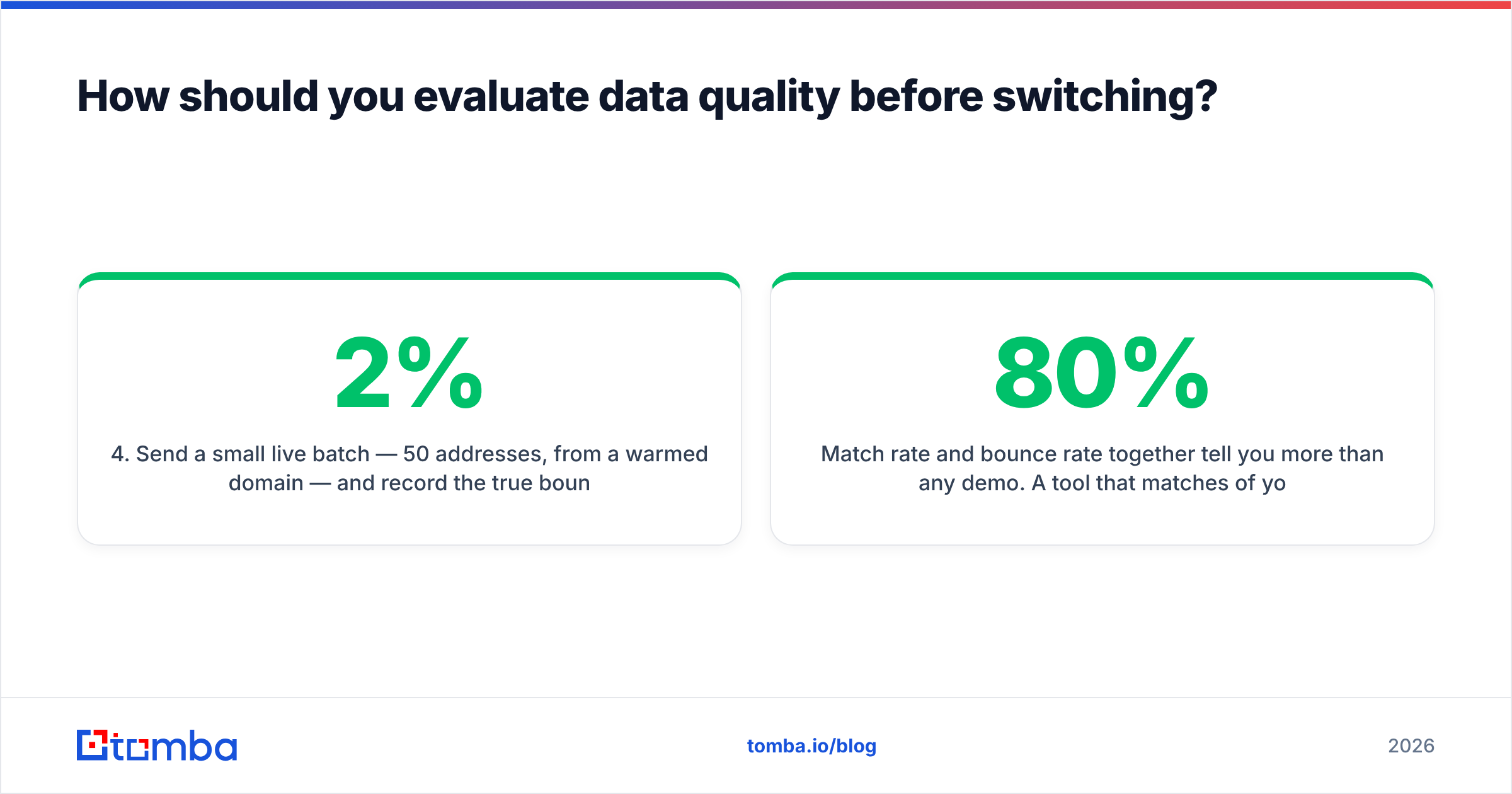
- Send a small live batch — 50 addresses, from a warmed domain — and record the true bounce rate. Under 2% is healthy; over 5% will damage sender reputation within weeks.
- Check catch-all handling. Ask directly how the vendor classifies catch-all domains. Silent inclusion inflates match rates and quietly wrecks deliverability.
- Test exportability. Pull the enriched list out as CSV. If you can't, you've learned the most important thing about the contract.
Match rate and bounce rate together tell you more than any demo. A tool that matches 80% of your list with a 1% bounce rate beats one that matches 95% with 9% bounces — the second option is selling you guesses.
Which Landbase alternative is right for your team?#
- Solo founder or two-person team, pre-product-market-fit: Tomba for data plus Instantly for sending. Roughly $90/month, no contract, full control of voice.
- Seed-stage team with an ops hire: Clay for orchestration, a verified data source underneath it, and your existing CRM for reporting.
- Ten-plus reps needing one system: Apollo, or keep Landbase if the agentic layer is genuinely closing meetings and you can justify the renewal.
- Campaign-based or agency motion: BookYourData credit packs, so spend tracks with active campaigns instead of idle months.
- Enterprise with intent-data requirements: ZoomInfo Copilot or Demandbase. Nothing in the lower tiers replaces account-level intent signals at that scale.
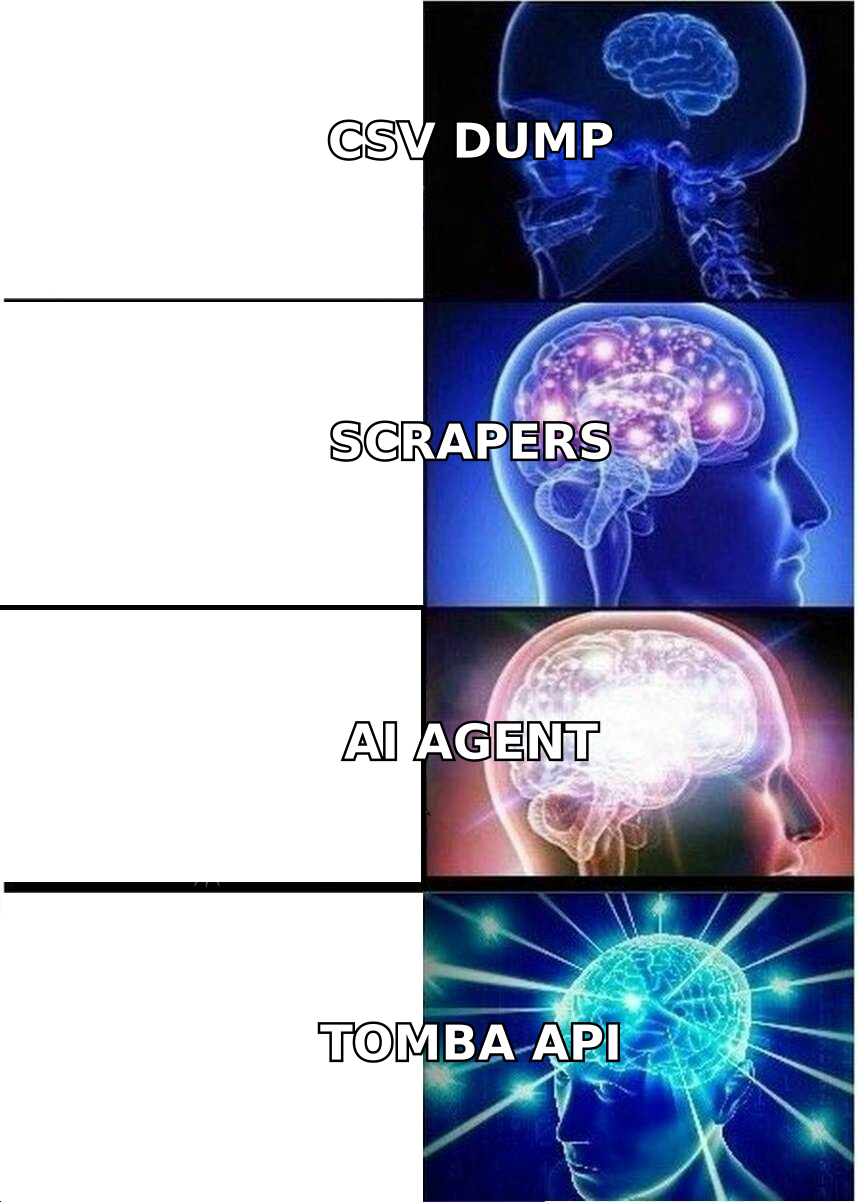
- Building your own agents: an API-first data provider plus your own orchestration. This is the fastest-growing pattern of 2026 and the reason bundled platforms are under pricing pressure.
What does switching actually cost you?#
Three things, and only one is money.
The first is campaign history. Outcome data that lives inside a closed platform usually doesn't migrate; export what you can before the final billing cycle.
The second is warmup. If your sending moves to new inboxes or a new domain, you restart reputation from scratch. Plan a three-week ramp and run the numbers through a warmup calculator before you promise pipeline for the quarter.
The third is the copy itself. AI-generated sequences tuned to one platform's model rarely transfer cleanly. Treat the migration as a rewrite, which is usually an improvement — most teams find their manually rewritten sequences outperform the generated ones once a human owns the first line again.
Money is the easy part. Unbundling typically cuts spend 40–70% versus a platform contract, but only if someone owns the glue between tools. If nobody owns it, pay for the bundle.
Ready to fix the data layer first?#
Most outbound problems people blame on AI are data problems. Before you sign another annual contract, find out how many of your target contacts you can actually reach. Run your ICP list through the Tomba Email Finder — 25 free searches, no card, public pricing from $49/mo if you keep going — and compare the bounce rate against whatever you're paying for today. If the verified addresses land, you may not need a new platform at all. If they don't, at least you'll know which layer to replace.
Related guides#
// get started
Find, verify and enrich your first contacts today
Start on the free plan with 25 searches a month, then scale when your team is ready.
Free plan · No credit card required · GDPR & CCPA
// about the author