Landbase Pros and Cons: An Honest 2026 Review for GTM Teams
Landbase promises an agentic AI that runs your whole go-to-market motion. Here is a neutral breakdown of where it genuinely earns its keep, where it falls short, and what to check before you sign.
TL;DR — the Landbase pros and cons in one screen:
- Landbase is an agentic AI go-to-market platform built around its own GTM-1 model family — it tries to plan campaigns, build lists, write copy, and send, all in one loop.
- The strongest pro is consolidation: one system replaces a data vendor, a copywriter, a sequencer, and part of an RevOps analyst's week.
- The biggest con is opacity. You get outcomes, not inputs — which makes it hard to audit data quality, attribute wins, or fix a campaign that quietly stops working.
- Pricing is not published publicly, so budget comparison against transparent tools (Clay, Apollo, Tomba) requires a sales call.
- Best fit: small GTM teams with no data engineer and a tolerance for a black box. Worst fit: teams that already own their data layer and just need accurate contacts.
What is Landbase, exactly?#
Landbase is an AI go-to-market platform that calls itself an agent, not a tool. The usual flow is to log in, build a list, export it, write a sequence, and launch. Landbase asks you to skip all of that. You describe an outcome — "book meetings with heads of finance at US manufacturing companies over 200 employees" — and the system handles the mechanics.
Under the hood sits GTM-1, a model family Landbase trained on go-to-market data rather than general web text. That is the real differentiator, and it is worth taking seriously. Most "AI SDR" products in 2026 are a thin prompt layer over GPT-class models plus a bought-in database. Landbase built its own model instead, and it uses campaign results from the platform as the training signal. You can read their own framing on landbase.com.
The category it sits in — agentic GTM — is still new. Gartner and other analysts are arguing about what belongs in it. That matters for your evaluation, because there is no settled benchmark to hold a vendor against. You buy on demo quality and reference calls, not on a mature scorecard.
One honest caveat up front: Landbase does not publish pricing on its site. Everything in this post about cost is directional. It is based on where similar agentic-GTM products land. Confirm the numbers with their sales team before you plan a budget.
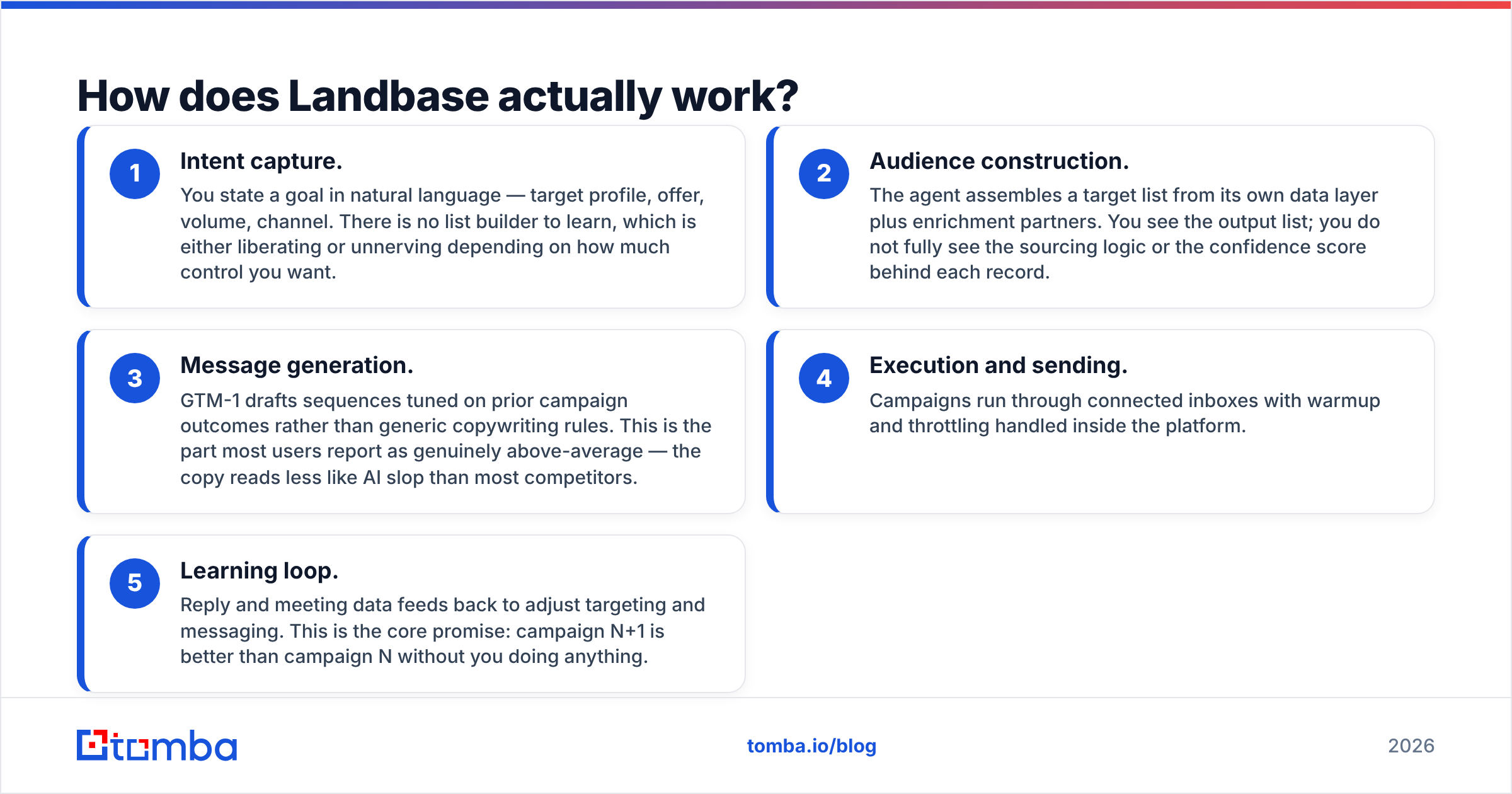
How does Landbase actually work?#
The workflow is where the Landbase pros and cons become concrete. Broken into stages:
- Intent capture. You state a goal in plain language — target profile, offer, volume, channel. There is no list builder to learn. That is either freeing or unnerving.
- Audience construction. The agent builds a target list from its own data layer plus enrichment partners. You see the list. You do not see the sourcing logic or the confidence score behind each record.
- Message generation. GTM-1 drafts sequences tuned on past campaign results, not generic copywriting rules. Most users rate this part above average. The copy reads less like AI slop than most rivals.
- Execution and sending. Campaigns run through connected inboxes. Warmup and throttling are handled inside the platform.
- Learning loop. Reply and meeting data feeds back to adjust targeting and messaging. That is the core promise: campaign N+1 beats campaign N without extra work from you.
Stages 1, 3, and 5 are where Landbase is strong. Stage 2 is where every serious evaluation should focus, because list quality caps the ceiling of everything downstream. A brilliant sequence sent to a stale list is still a bounce.
Landbase pros and cons: the biggest pros#
It collapses the stack. A typical outbound setup in 2026 runs four to six vendors: a contact database, an email verifier, an enrichment layer, a sequencer, a warmup service, and something to stitch them together. Landbase replaces most of that with one contract. For a five-person GTM team, the savings are real and immediate — fewer integrations to break, one bill, one support thread.
The copy is measurably better than the category average. Training on outcome data rather than prose quality yields sequences built to earn replies, not to read well. In practice that means shorter emails, odder subject lines, and fewer of the "I hope this finds you well" tells that get messages filtered. If a generic LLM wrapper writes your cold email today, the upgrade is easy to see.
Time to first campaign is genuinely fast. You can go from signup to a live sequence in a day rather than the two-week ramp that a Clay-style builder demands. For a founder doing outbound between product calls, that speed is the whole value proposition.
The feedback loop compounds. Most tools are static — they perform the same on day 200 as day 1. A system that adjusts targeting based on who actually replied should drift toward your real ICP. Several users report exactly that. It is the most defensible part of the product.
It reduces headcount pressure. Not eliminates — reduces. Teams using it tend to keep their SDRs but move them from list-building and sequence-writing to calls and replies. That is a real productivity story, and a more honest one than the "replace your SDR" marketing you will hear on the demo.
What are the real Landbase cons?#
Opacity is the dominant complaint. When a campaign underperforms, you need to know whether the problem was the list, the copy, the inbox, or the offer. An agentic system that abstracts all four gives you one number and no diagnostic path. Experienced RevOps leads find this maddening. You cannot fix what you cannot inspect.
Data provenance is thin. Landbase does not document its sources the way a dedicated data vendor does. If you sell into the EU or into a regulated industry, your legal team will ask where a contact record came from. "The agent found it" is not an answer that survives review. Compare that with vendors who publish data sources openly.
No published pricing. Every purchase starts with a call, which means your price depends on your negotiating position rather than a rate card. That is normal for enterprise software and irritating for a team of eight trying to model CAC.
Deliverability control is partial. The platform handles warmup and throttling, but you are trusting someone else's sending logic with your domain. If you have spent two years building sender reputation, handing the throttle to a black box is a real risk. The damage also shows up only after the fact.
Verification is bundled, not exposed. You cannot easily run your own validation pass on the list before it sends. Bounce rate is the first thing that kills a domain. The standard hygiene workflow — export, verify, suppress risky records, then send — is not natural in an agent-first product.
Vendor lock-in is structural. The learning loop is the product. If you leave after twelve months, you take your contact list but not the accumulated targeting intelligence. That switching cost is intentional and worth pricing into the decision.

How does Landbase compare to the alternatives?#
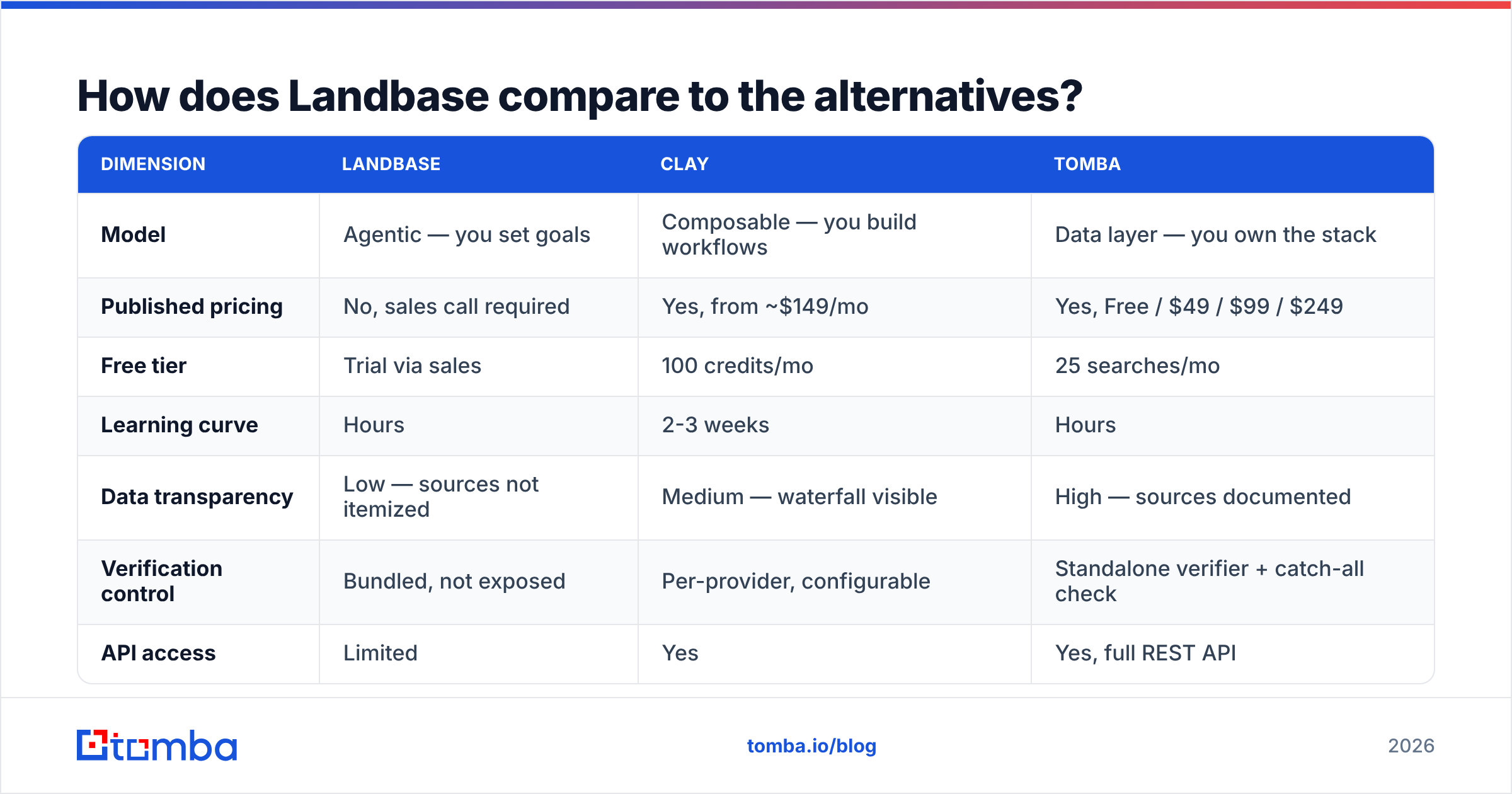
Three credible categories compete for the same budget: the agentic platform (Landbase), the composable data workbench (Clay), and the transparent data layer plus your own sequencer (Tomba, Apollo, and similar).
| Dimension | Landbase | Clay | Tomba |
|---|---|---|---|
| Model | Agentic — you set goals | Composable — you build workflows | Data layer — you own the stack |
| Published pricing | No, sales call required | Yes, from ~$149/mo | Yes, Free / $49 / $99 / $249 |
| Free tier | Trial via sales | 100 credits/mo | 25 searches/mo |
| Learning curve | Hours | 2-3 weeks | Hours |
| Data transparency | Low — sources not itemized | Medium — waterfall visible | High — sources documented |
| Verification control | Bundled, not exposed | Per-provider, configurable | Standalone verifier + catch-all check |
| API access | Limited | Yes | Yes, full REST API |
| Copy generation | Native, outcome-trained | Via integrations | Not core — pairs with your sequencer |
| Best for | Small teams, no RevOps | Data-native GTM teams | Teams needing accurate contacts at low cost |
| Lock-in risk | High | Medium | Low |
A few honest notes on that table. Clay's ceiling is higher than Landbase's if someone on the team will learn it, because every step is visible and replaceable. Apollo wins on all-in-one convenience at the low end, but it has a long-standing reputation problem with data freshness on smaller companies. BookYourData takes a different route — pay-as-you-go verified lists with an accuracy guarantee. That works well when you want a clean list without a subscription. And a dedicated email finder does one narrow job well for $49/mo rather than attempting the whole funnel.
The real question is not "which is best" but "what is your bottleneck?" If your bottleneck is that nobody on the team knows how to build a list, Landbase solves it. If your bottleneck is that your contact data is 30% stale, an agent layered on top of the same bad data changes nothing.
Who is Landbase actually right for?#
Good fit:
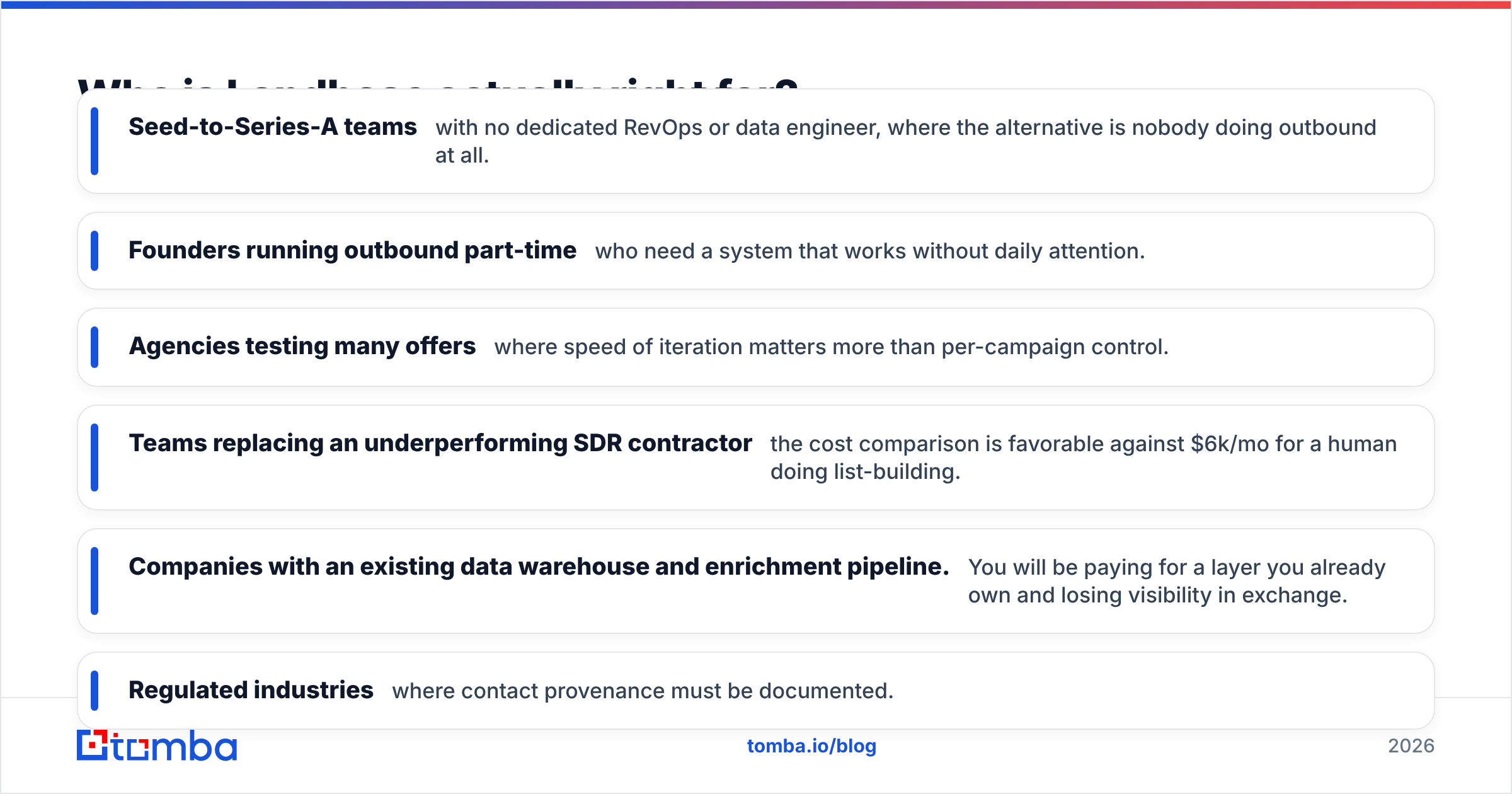
- Seed-to-Series-A teams with no dedicated RevOps or data engineer, where the alternative is nobody doing outbound at all.
- Founders running outbound part-time who need a system that works without daily attention.
- Agencies testing many offers where speed of iteration matters more than per-campaign control.
- Teams replacing an underperforming SDR contractor — the cost comparison is favorable against $6k/mo for a human doing list-building.
Poor fit:
- Companies with an existing data warehouse and enrichment pipeline. You will be paying for a layer you already own and losing visibility in exchange.
- Regulated industries where contact provenance must be documented.
- Teams whose problem is deliverability, not volume. Sending more from a damaged domain makes things worse. Fix SPF, DKIM, DMARC, and warmup first.
- Anyone who needs programmatic access. If your workflow is API-first, a platform with full API access and predictable per-credit costs is the saner architecture.
What should you check before signing?#
Your own Landbase pros and cons list should come from the trial, not the demo. Run these five checks, in this order:
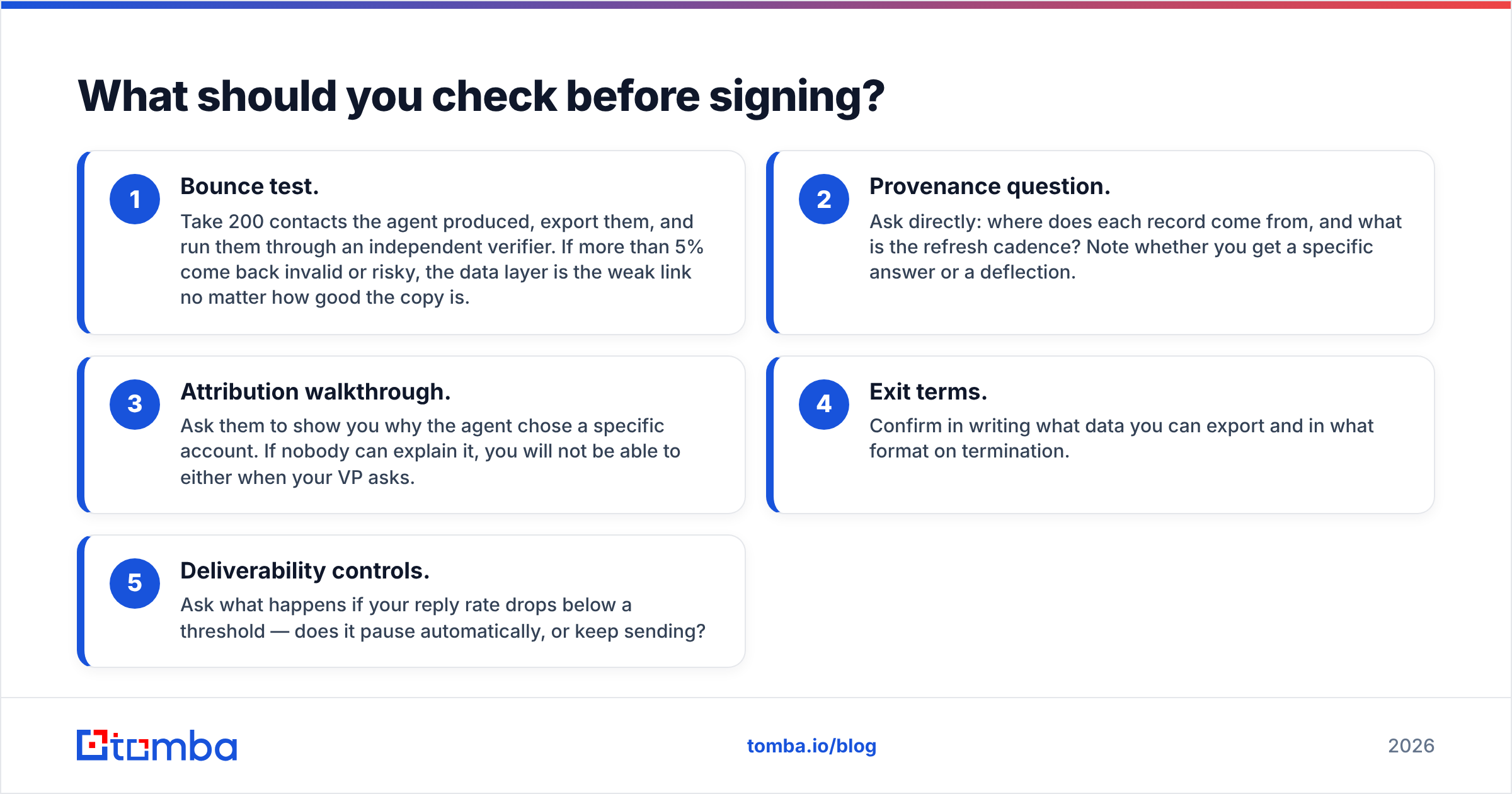
- Bounce test. Take 200 contacts the agent produced, export them, and run them through an independent verifier. If more than 5% come back invalid or risky, the data layer is the weak link no matter how good the copy is.
- Provenance question. Ask directly: where does each record come from, and what is the refresh cadence? Note whether you get a specific answer or a deflection.
- Attribution walkthrough. Ask them to show you why the agent chose a specific account. If nobody can explain it, you will not be able to either when your VP asks.
- Exit terms. Confirm in writing what data you can export and in what format on termination.
- Deliverability controls. Ask what happens if your reply rate drops below a threshold — does it pause automatically, or keep sending?
Any vendor worth buying from answers all five without friction. Reference reviews on G2 are useful for sentiment but rarely cover these specifics, so ask directly.
Is Landbase worth it in 2026?#
Weighing the Landbase pros and cons, the answer is conditionally yes — for a narrow band of buyers. If you have no GTM infrastructure, no RevOps hire, and a real need to start outbound this month, Landbase compresses six weeks of setup into a day. The copy quality is above category average too. That is worth paying for.
If you already have a stack, the math changes. You would pay a premium to hand over the one thing you can actually optimize: your data. In exchange you get automation you could assemble yourself for less. The agentic pitch is strongest where expertise is absent and weakest where it exists.
The middle path most teams land on: keep your own transparent data layer, and use AI where it is genuinely additive — copy, prioritization, research summaries. That way you can audit every bounce, swap any component, and never wonder why a campaign stopped working.
If accurate contact data is what is actually blocking you, start there. The Tomba Email Finder surfaces verified professional emails by domain, name, or company, with documented sources and a real free tier: 25 searches a month at no cost, then $49/mo on Starter. Check the full Tomba pricing before your next sales call. Then you will know what a transparent alternative costs when the agentic quote lands in your inbox.
Related guides#
// get started
Find, verify and enrich your first contacts today
Start on the free plan with 25 searches a month, then scale when your team is ready.
Free plan · No credit card required · GDPR & CCPA
// about the author