Landbase Reviews 2026: Features, Pricing, Pros and Cons
Landbase promises an AI agent that plans, builds and runs your outbound for you. Here is what it actually does well, where the data layer gets thin, and who should skip it.

TL;DR
- Landbase is an agentic go-to-market platform built around its own action model, GTM-1 Omni. You describe a campaign in plain language; the agent researches, builds a list, writes sequences and executes across email and LinkedIn.
- It is strongest for small GTM teams that want one system instead of six, and weakest if you already have a mature stack with a data provider, a sequencer and a RevOps person who tunes it.
- Pricing is quote-based. There is no public price list, which means demos, annual commitments, and a slower path to "is this worth it" than self-serve tools.
- The agent layer is genuinely good. The data layer underneath is the part you should stress-test hardest — bring your own verification before you send at volume.
- Verdict: worth a pilot if you are a 2-15 person revenue team drowning in tool sprawl. Overkill and under-controlled if you run high-volume outbound with your own deliverability discipline.
What is Landbase, and who is it actually for?#
Landbase is an AI go-to-market platform founded in 2024 by Daniel Saks, previously co-founder and co-CEO of AppDirect. The pitch is straightforward: instead of buying a data tool, a sequencer, a copywriting assistant and an analytics layer, you give one agent a campaign goal and it handles the chain end to end. You can see the current positioning on landbase.com.
Think of it like hiring a contractor instead of buying lumber. A traditional stack hands you materials — records, templates, send infrastructure — and expects you to assemble them. Landbase's model is "tell me what you want built." That framing matters, because it determines who benefits and who gets frustrated.
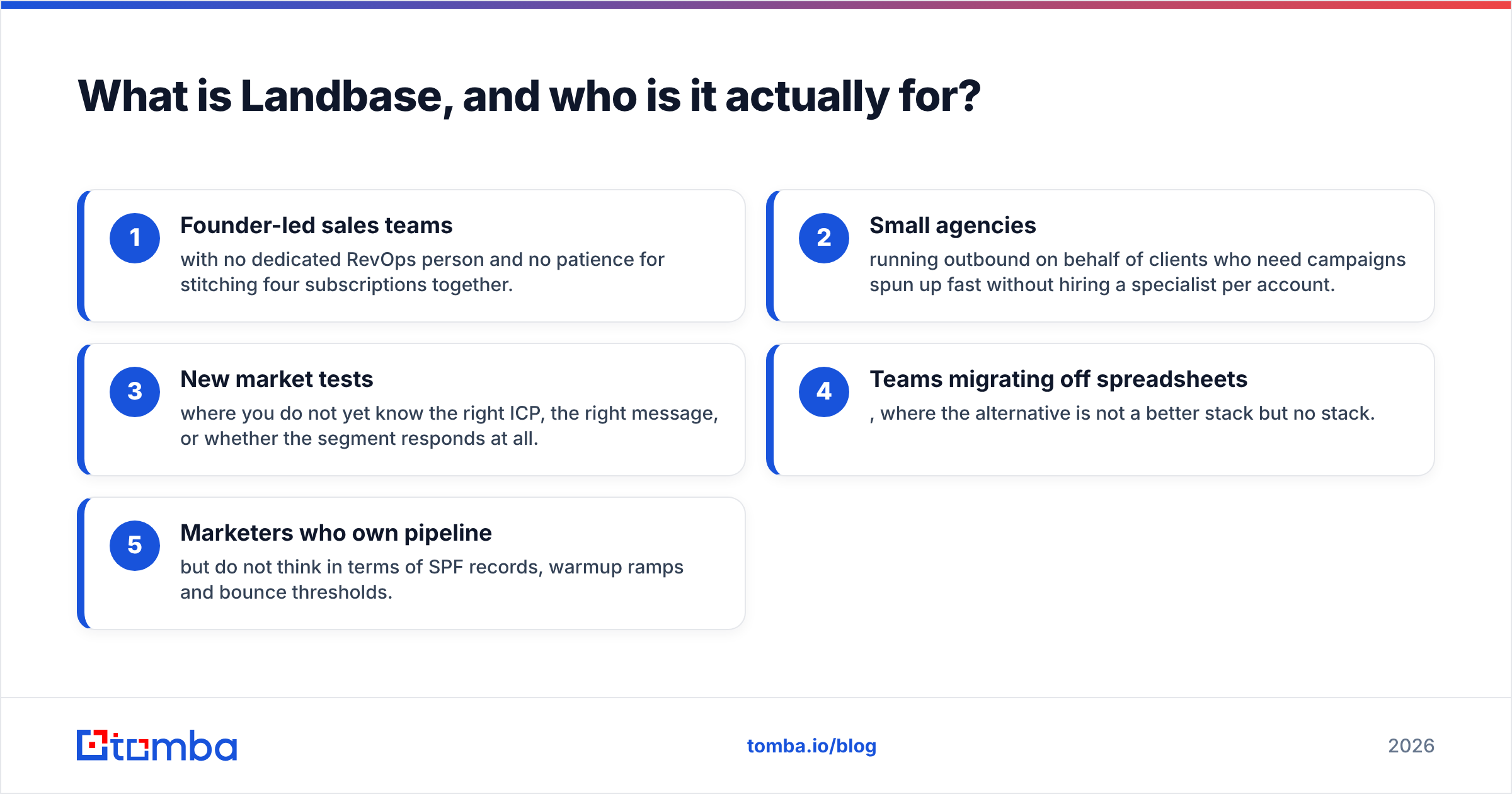
The sweet spot, based on how the product is structured and what early users describe:
- Founder-led sales teams with no dedicated RevOps person and no patience for stitching four subscriptions together.
- Small agencies running outbound on behalf of clients who need campaigns spun up fast without hiring a specialist per account.
- New market tests where you do not yet know the right ICP, the right message, or whether the segment responds at all.
- Teams migrating off spreadsheets, where the alternative is not a better stack but no stack.
- Marketers who own pipeline but do not think in terms of SPF records, warmup ramps and bounce thresholds.
The people it does not fit: outbound teams sending tens of thousands of emails a month with their own domain rotation, their own verification step, and opinions about every variable in the funnel. For them, an opinionated agent is friction, not leverage.
How does the GTM-1 Omni model actually work?#
Landbase's differentiator is that it trained a model specifically on go-to-market outcomes rather than wrapping a general LLM in a UI. The company calls it an "action model" — the claim is that it is optimized to decide and execute, not just to generate text.
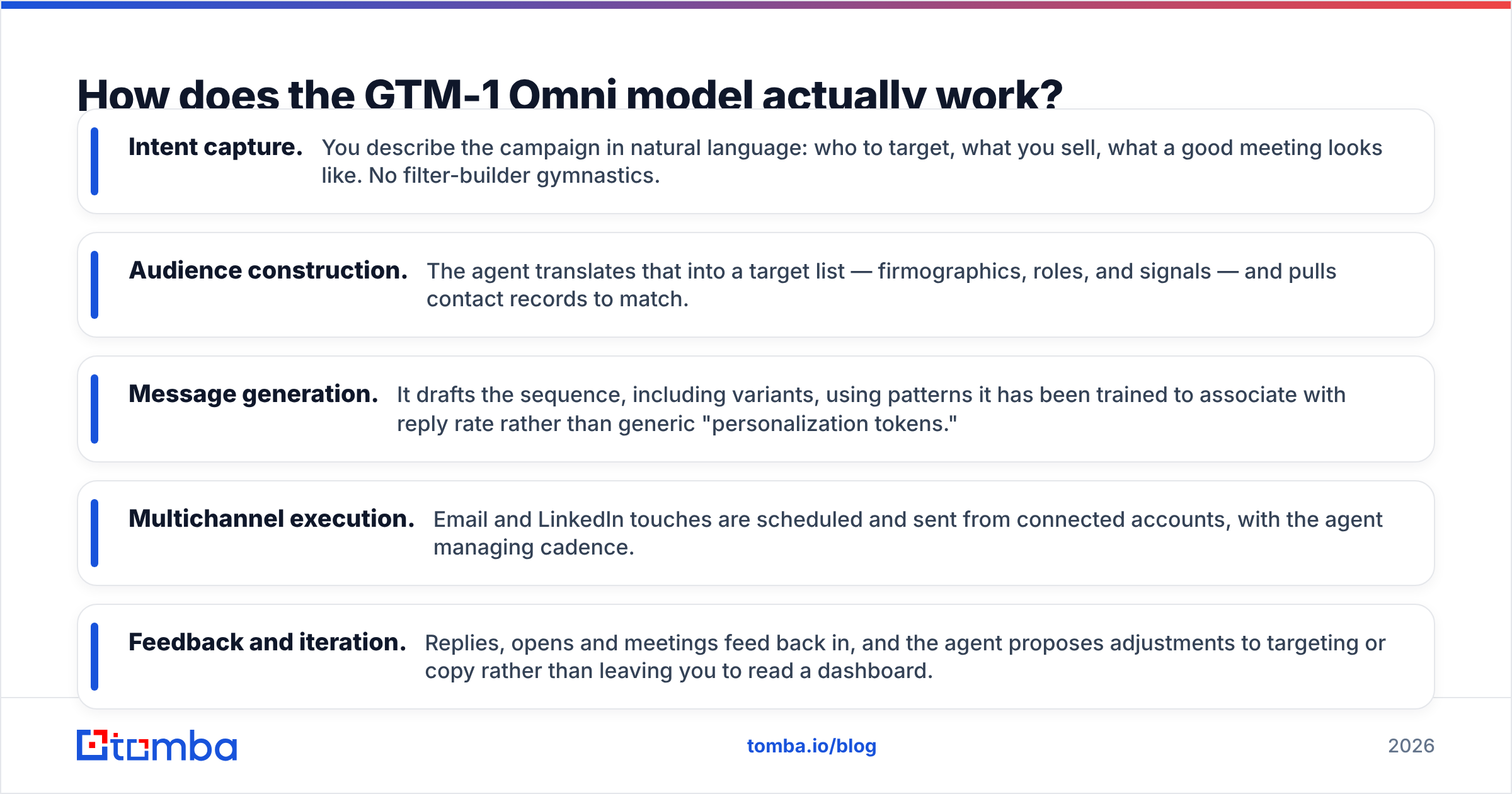
Here is the practical loop, stage by stage:
- Intent capture. You describe the campaign in natural language: who to target, what you sell, what a good meeting looks like. No filter-builder gymnastics.
- Audience construction. The agent translates that into a target list — firmographics, roles, and signals — and pulls contact records to match.
- Message generation. It drafts the sequence, including variants, using patterns it has been trained to associate with reply rate rather than generic "personalization tokens."
- Multichannel execution. Email and LinkedIn touches are scheduled and sent from connected accounts, with the agent managing cadence.
- Feedback and iteration. Replies, opens and meetings feed back in, and the agent proposes adjustments to targeting or copy rather than leaving you to read a dashboard.
The interesting design choice is that Landbase collapses steps most teams keep separate. That is the whole value proposition and also the whole risk: when the agent picks a segment you would not have picked, or writes an angle you would not have approved, you find out after the sends, not before. Most reviews that praise Landbase are praising speed to first campaign. Most reviews that criticize it are criticizing control.

What do Landbase reviews say about real results?#
Public review volume on Landbase is still thin compared with entrenched categories — it is a 2024-founded company, and aggregator listings on sites like G2 reflect that. Treat any headline number you see with the usual caution: early reviews skew toward design partners and enthusiasts.
Across what is publicly available and what practitioners report, three consistent themes show up.
The praise is about time. Teams describe going from campaign idea to live sequence in an afternoon instead of a week. If your current process involves exporting a list, cleaning it in a spreadsheet, writing five emails, and loading a sequencer, removing that work is a real, measurable win.
The criticism is about data depth. Agentic execution is only as good as the contact records underneath it. Where reviewers push back, it is usually here: records that are stale, roles that no longer match, or missing coverage in non-US markets and smaller companies. This is not unique to Landbase — every platform that bundles data has this pressure — but bundling makes it harder to diagnose, because you cannot tell whether a flat campaign failed on targeting, copy, or the email address itself.
The uncertainty is about attribution. When one system chooses the audience, writes the copy and reports the results, you are grading its own homework. Serious buyers should insist on exporting raw send-and-reply data into their own CRM so the numbers survive independent inspection.
If a campaign underperforms, the first thing to isolate is bounce rate. A 6% bounce rate means a list problem, not a message problem, and no amount of copy iteration will fix it. Running your list through an independent email verifier before the first send removes that variable entirely and costs a fraction of one wasted week.
What does Landbase cost compared with a assembled stack?#
Landbase does not publish a public price list. Pricing is quote-based, typically demo-led, and generally structured as an annual commitment. That is normal for platforms selling into revenue teams, but it has consequences: you cannot benchmark it in ten minutes, you cannot start for free, and you cannot easily scale down if a quarter goes badly.
The honest comparison is not Landbase versus one competitor. It is Landbase versus the stack you would build yourself.
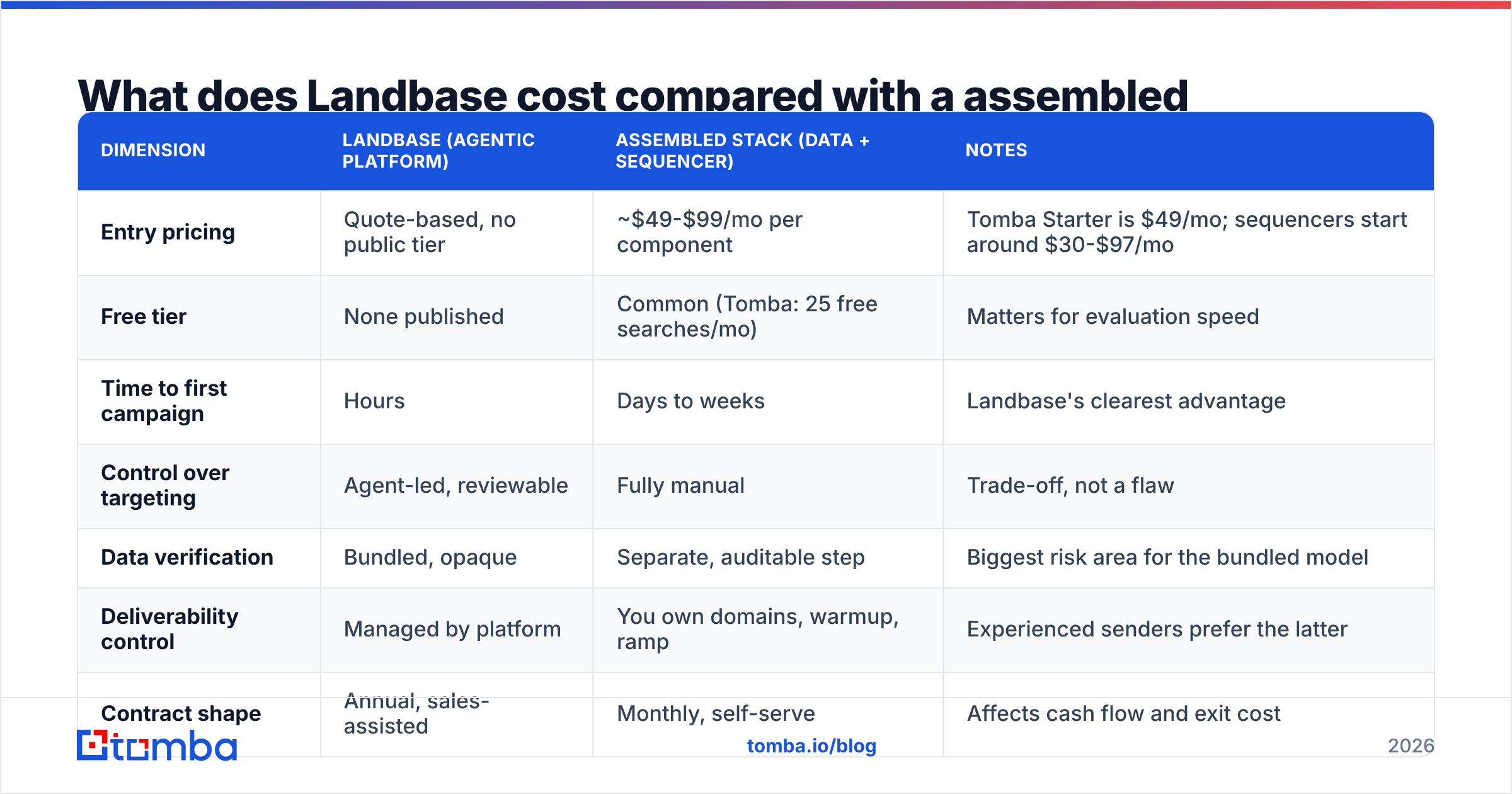
| Dimension | Landbase (agentic platform) | Assembled stack (data + sequencer) | Notes |
|---|---|---|---|
| Entry pricing | Quote-based, no public tier | ~$49-$99/mo per component | Tomba Starter is $49/mo; sequencers start around $30-$97/mo |
| Free tier | None published | Common (Tomba: 25 free searches/mo) | Matters for evaluation speed |
| Time to first campaign | Hours | Days to weeks | Landbase's clearest advantage |
| Control over targeting | Agent-led, reviewable | Fully manual | Trade-off, not a flaw |
| Data verification | Bundled, opaque | Separate, auditable step | Biggest risk area for the bundled model |
| Deliverability control | Managed by platform | You own domains, warmup, ramp | Experienced senders prefer the latter |
| Contract shape | Annual, sales-assisted | Monthly, self-serve | Affects cash flow and exit cost |
| Best fit | 2-15 person GTM team | Dedicated outbound function | — |
The stack side of that table is not hypothetical. A data layer, a verification layer and a sending layer bought separately land in the $150-$300/mo range for a small team, and every component is swappable. You can check Tomba pricing for the data-and-verification half of it. The question is whether Landbase's consolidation saves you more than the flexibility you give up.

What are Landbase's real limitations?#
Four limits are worth naming before you sign anything.
1. You cannot audit the data source easily. When a platform owns both the list and the sending, a bad address looks like a bad campaign. Independent providers publish where their data comes from precisely so you can separate those failure modes. Ask Landbase directly how records are sourced, how often they are refreshed, and what their verified-bounce guarantee is in writing.
2. Catch-all domains remain hard for everyone. A large share of B2B domains accept all mail at the SMTP layer, which means "valid" is not a binary. If a meaningful part of your ICP sits on catch-all infrastructure, an agent reporting a clean list may still be handing you dead addresses. A dedicated catch-all verifier is the only reliable way to grade those, and it is not something bundled platforms typically expose.
3. Agentic copy converges. Models trained on what worked produce what worked. That is useful in month one and a liability in month twelve, when your prospects have received four structurally identical emails from four different agentic platforms. Teams that win on outbound long-term keep a human writing the angle even when the machine writes the draft.
4. Migration cost is real. Consolidating into one platform means your audience definitions, sequences and reply history live inside it. Getting them out later is harder than cancelling a $49 subscription. Ask about data export format before you commit, not after.
None of these disqualify Landbase. They are the standard costs of the bundled model, and the bundled model genuinely wins on speed. You just want to price those costs in rather than discover them in quarter three.
Is Landbase better than building your own GTM stack?#
It depends on which resource is actually scarce for you: time or control.
Choose Landbase if your bottleneck is that nobody on the team has hours to run outbound properly. One agent producing a mediocre-but-live campaign beats a perfect campaign that never ships. Founders and small agencies routinely fall in this bucket, and consolidation is a legitimate answer to tool sprawl — a point go-to-market strategy literature has made for decades in other contexts.
Build your own stack if you have someone who owns outbound as a job. At that point every layer benefits from being best-in-class and independently swappable: a data provider you can audit, a verification step you control, and a sequencer whose deliverability settings you tune yourself. HubSpot's own sales blog has documented the same pattern repeatedly — the teams with the highest reply rates are the ones with the tightest feedback loop on list quality, not the ones with the fanciest automation.
Run both is the answer more teams land on than vendors like to admit. Use an agentic platform for exploratory campaigns into new segments, and a controlled stack for your core ICP where every send matters. The two are not mutually exclusive, and the data layer can be shared: pull and verify contacts independently, then feed them into whichever execution system you are testing.
A practical hybrid that works: use domain search to map every relevant contact at a target account, verify the addresses, enrich them, and hand the clean list to your execution tool. You keep the audit trail on the part that determines whether anything lands at all, and let the agent do the assembly work you were never going to do by hand.
What should you ask on the Landbase demo?#
Bring this list. The answers separate a good fit from an expensive lesson.
- What is the guaranteed maximum bounce rate, and what happens contractually if it is exceeded?
- Can I import my own verified list, or must audiences be agent-generated?
- What is the coverage rate for my specific geography and company-size band — not the global average?
- How do I export raw campaign data, and in what format?
- What is the minimum contract term, and is there a monthly option at any tier?
- Who owns domain reputation if deliverability degrades — you or me?
Any vendor that answers those cleanly is worth piloting. Any vendor that deflects on the first or the last one is telling you something.
The bottom line#
Landbase is a credible, well-designed answer to a real problem: small revenue teams cannot operate a six-tool stack. The agentic execution is the most interesting part of the product and the reason to take a demo. The data layer underneath is where you should apply pressure, and the quote-based pricing means you should apply that pressure before signing, not after.
Whichever way you go, the cheapest insurance in outbound is knowing your addresses are real before you send. Start with the Tomba Email Finder — 25 free searches a month, $49/mo on Starter, and a verification step you can audit line by line. Clean data makes every downstream tool look smarter, including an AI agent.
Related guides#
// get started
Find, verify and enrich your first contacts today
Start on the free plan with 25 searches a month, then scale when your team is ready.
Free plan · No credit card required · GDPR & CCPA
// about the author