Landbot Pricing Pros and Cons: An Honest 2026 Breakdown
Landbot's sticker price looks friendly until you hit the chat cap. Here's what the plans really cost in 2026, what reviewers praise, where it breaks down, and the cheaper stack that covers most B2B use cases.
Here are the Landbot pricing pros and cons in one line: the builder earns its price, and the chat-volume billing is the part to watch.
TL;DR
- Landbot is a no-code chatbot builder. It bills per chat volume, not per seat. That one design choice decides whether it is cheap or costly for you.
- Expect roughly: Free/Sandbox tier, Starter around €40/mo (annual), Pro around €100/mo (annual), Business from ~€400/mo. WhatsApp plans are a separate, pricier ladder.
- Reviewers praise the visual builder and the WhatsApp/web widget. The recurring complaints: chat-volume caps, feature gating on higher tiers, and analytics that stop short of real revenue data.
- Landbot captures inbound demand. It does not generate outbound pipeline — a chatbot only talks to people who already found you.
- If your goal is B2B leads rather than support deflection, the cheaper mix is a modest Landbot tier for inbound plus a dedicated contact-data tool for outbound.
What is Landbot, and who actually uses it?#
Landbot is a no-code chatbot builder. You drag blocks onto a canvas and wire them together with simple logic. Then you publish the result as a website widget, a standalone landing page, a WhatsApp flow, or a Facebook Messenger bot. No developer required for the basic build.
Think of it like a flowchart that answers the door. A static contact form just sits at the bottom of your pricing page. A Landbot flow asks two or three questions, routes the visitor, and drops the answers into your CRM.
The three groups getting real value from it:
- Marketing teams replacing forms. Chat capture usually beats a five-field static form, especially on mobile.
- Support teams deflecting tier-1 tickets. FAQ routing before a human ever sees the conversation.
- WhatsApp-first businesses in LATAM, Spain and India. There WhatsApp is the default sales channel, and Landbot's official Business API support matters.
Who it's wrong for: anyone hoping a chatbot will fill an empty pipeline. Landbot is a conversion tool, not a demand-generation tool. If 200 people visit your site a month, a better bot converts a handful more of those 200. It does not find you the other 5,000.
How much does Landbot cost in 2026?#
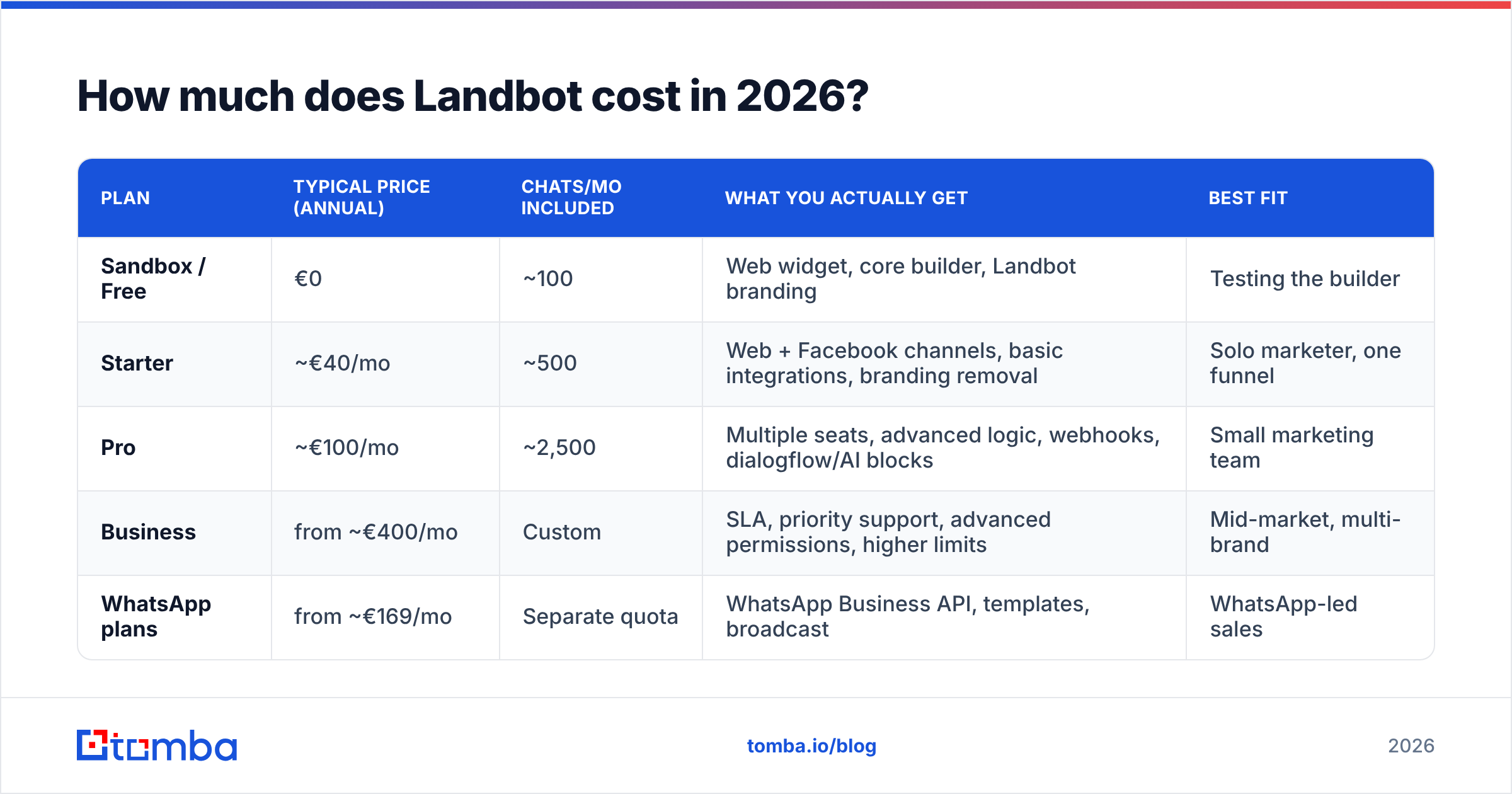
Landbot prices in euros and bills on chats per month. A "chat" is one conversation, not one message. Plans also gate features, so you often upgrade for a feature rather than for volume.
Here's the shape of the ladder. Always confirm current numbers on the official Landbot pricing page, since chatbot vendors reprice more often than most SaaS categories.
| Plan | Typical price (annual) | Chats/mo included | What you actually get | Best fit |
|---|---|---|---|---|
| Sandbox / Free | €0 | ~100 | Web widget, core builder, Landbot branding | Testing the builder |
| Starter | ~€40/mo | ~500 | Web + Facebook channels, basic integrations, branding removal | Solo marketer, one funnel |
| Pro | ~€100/mo | ~2,500 | Multiple seats, advanced logic, webhooks, dialogflow/AI blocks | Small marketing team |
| Business | from ~€400/mo | Custom | SLA, priority support, advanced permissions, higher limits | Mid-market, multi-brand |
| WhatsApp plans | from ~€169/mo | Separate quota | WhatsApp Business API, templates, broadcast | WhatsApp-led sales |
Three things that catch buyers out:
- Monthly billing costs a lot more than annual. The headline numbers you see quoted are almost always the annual-commit price.
- Chat overages are real. Blow past your quota and you either buy an add-on pack or the bot stops greeting people. That is the worst way for a lead-capture asset to fail.
- WhatsApp conversation fees are Meta's, not Landbot's. Meta charges per conversation window on top of what you pay Landbot. Budget both.
What do Landbot reviews actually say?#
Scores on G2's Landbot reviews and similar directories land in the 4.4–4.6 range. That is good for the category. The useful signal is in the patterns, not the score.
What reviewers praise, consistently:
- The builder is the best part. Even non-technical marketers ship a working flow in an afternoon. Branching logic stays visual and easy to read three months later, which is rare in this category.
- The web widget looks good out of the box. Minimal design work needed before it matches a decent site.
- WhatsApp implementation is solid. Official API access, template handling, and a support team that knows Meta's approval process.
- Support responsiveness gets called out repeatedly on the paid tiers.
What reviewers complain about, consistently:
- Chat-based pricing creates anxiety. Teams throttle their own bot to protect quota. They hide it on low-intent pages. That is a pricing model working against the product's own purpose.
- The jump from Pro to Business is steep. Going from ~€100 to ~€400+ for one gated feature is the most common upgrade grievance.
- Analytics are shallow. You see completion rates and drop-off points, not revenue. You will be exporting to a BI tool or your CRM anyway.
- Native AI blocks feel bolted on. In 2026, buyers compare every chatbot to an LLM-native one. Rule-based flows with an AI block attached do not clear that bar.
- Integrations are good but not deep. Landbot connects to HubSpot, Salesforce, Slack and Zapier. But field-level mapping and two-way sync often need a webhook and a middleware step.
Landbot pricing pros and cons: the honest list#
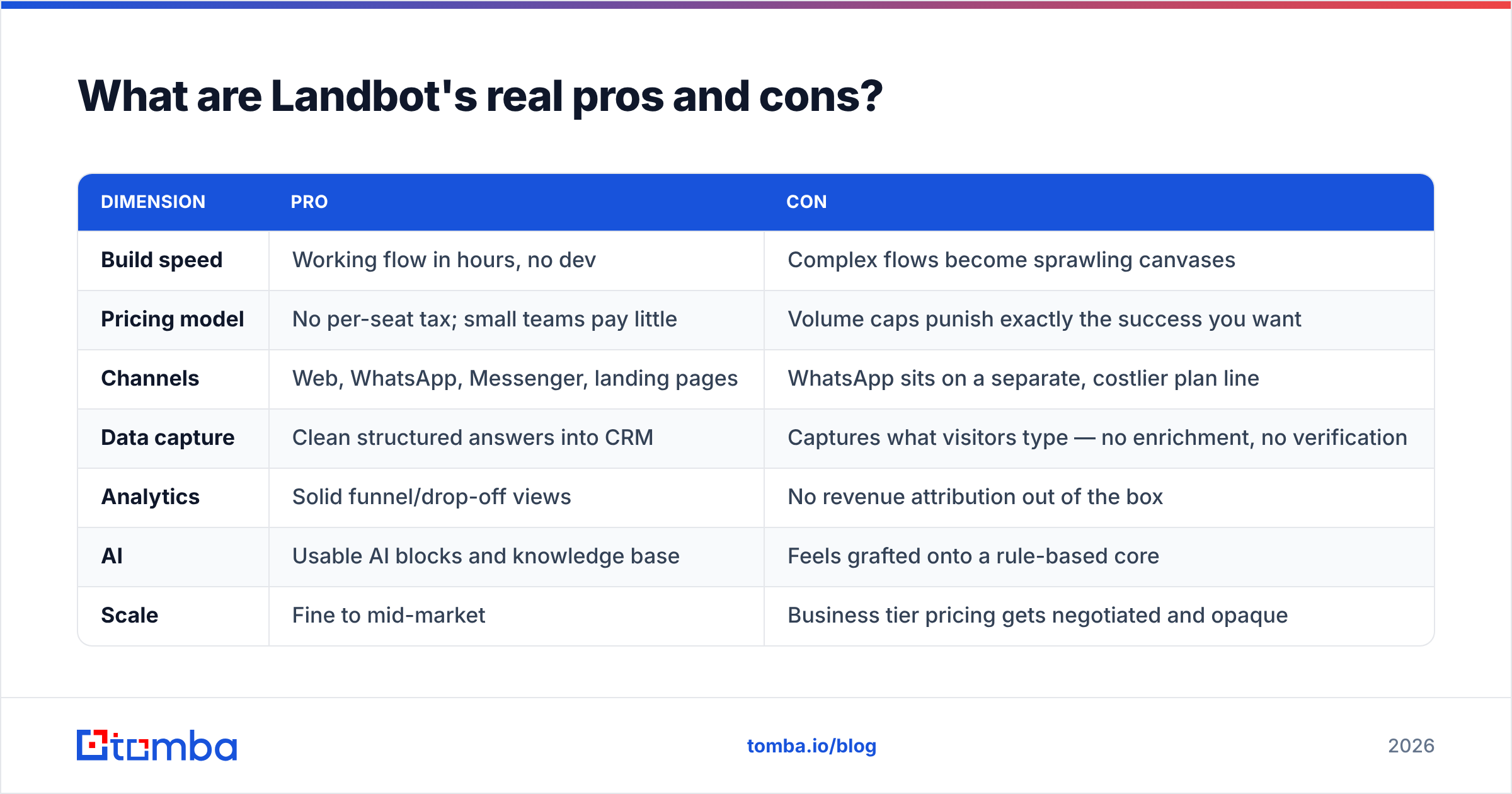
Stripped of marketing language, here are the Landbot pricing pros and cons side by side:
| Dimension | Pro | Con |
|---|---|---|
| Build speed | Working flow in hours, no dev | Complex flows become sprawling canvases |
| Pricing model | No per-seat tax; small teams pay little | Volume caps punish exactly the success you want |
| Channels | Web, WhatsApp, Messenger, landing pages | WhatsApp sits on a separate, costlier plan line |
| Data capture | Clean structured answers into CRM | Captures what visitors type — no enrichment, no verification |
| Analytics | Solid funnel/drop-off views | No revenue attribution out of the box |
| AI | Usable AI blocks and knowledge base | Feels grafted onto a rule-based core |
| Scale | Fine to mid-market | Business tier pricing gets negotiated and opaque |
The data-capture row is the one most B2B teams underestimate. A chatbot collects whatever the visitor typed. That includes asdf@gmail.com, personal addresses, and plain typos. Check the data before any of it reaches a sequence. That is why a bot deployment and an email verifier tend to get bought in the same quarter.
Is Landbot worth it for B2B lead generation?#
Conclusion first: worth it if you already have real inbound traffic, questionable if you don't.
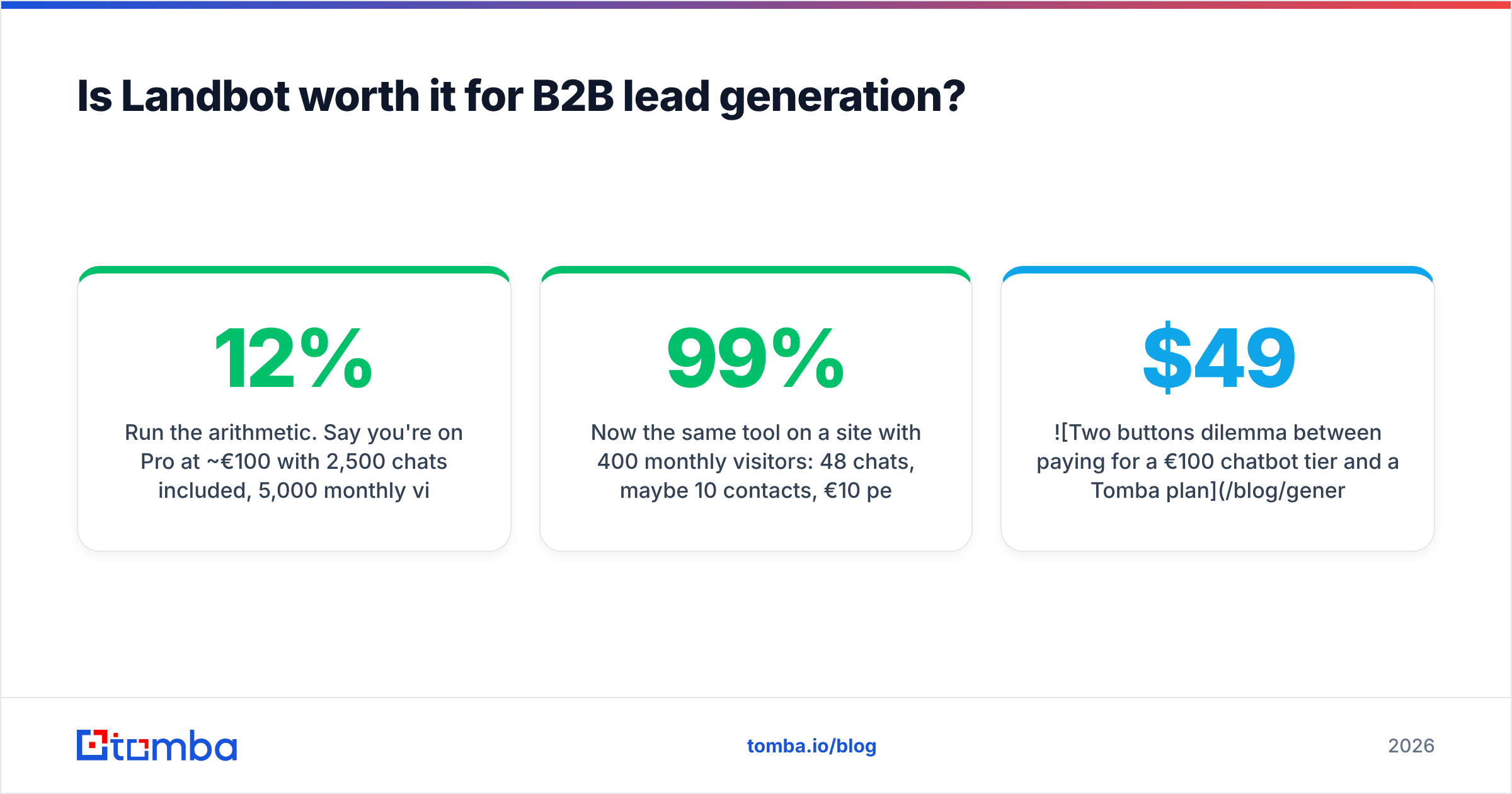
Run the arithmetic. Say you are on Pro at ~€100/mo with 2,500 chats included. You get 5,000 monthly visitors, and 12% of them start a bot conversation. That is 600 chats, well inside quota. If 20% of those finish qualification, you get 120 captured contacts. Roughly €0.83 per contact — excellent, assuming the contacts are real.
Now the same tool on a site with 400 monthly visitors: 48 chats, maybe 10 contacts, €10 per contact for a tool that sits idle 99% of the time. The bot did not fail. There was nothing for it to do.
This is the honest limit of any chat tool. It multiplies attention you already have. Outbound prospecting creates attention that did not exist. Most teams need both. They are separate line items, and that is the real decision in front of you.

How does Landbot compare to the alternatives?#
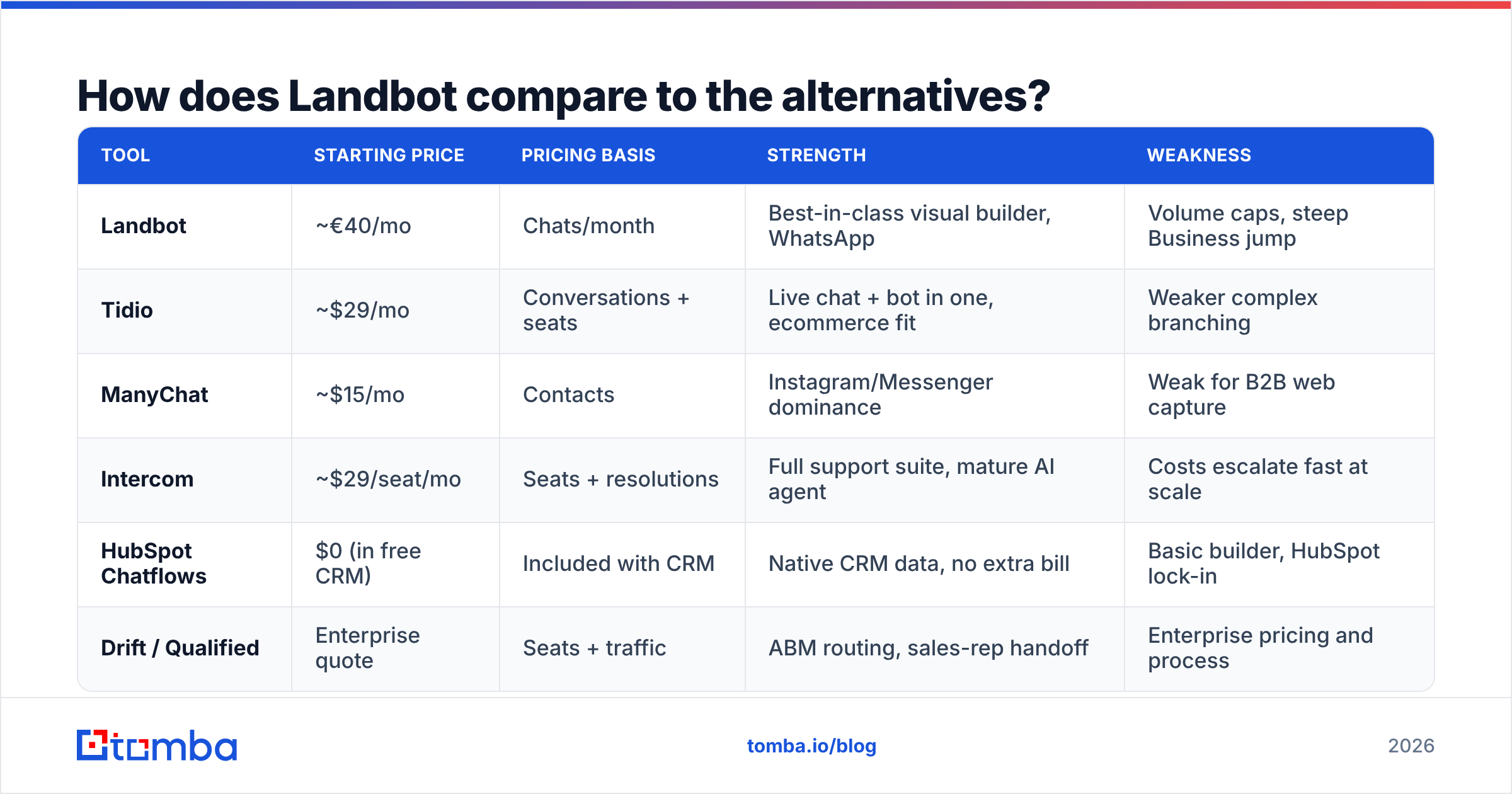
| Tool | Starting price | Pricing basis | Strength | Weakness |
|---|---|---|---|---|
| Landbot | ~€40/mo | Chats/month | Best-in-class visual builder, WhatsApp | Volume caps, steep Business jump |
| Tidio | ~$29/mo | Conversations + seats | Live chat + bot in one, ecommerce fit | Weaker complex branching |
| ManyChat | ~$15/mo | Contacts | Instagram/Messenger dominance | Weak for B2B web capture |
| Intercom | ~$29/seat/mo | Seats + resolutions | Full support suite, mature AI agent | Costs escalate fast at scale |
| HubSpot Chatflows | $0 (in free CRM) | Included with CRM | Native CRM data, no extra bill | Basic builder, HubSpot lock-in |
| Drift / Qualified | Enterprise quote | Seats + traffic | ABM routing, sales-rep handoff | Enterprise pricing and process |
The comparison most B2B teams should run is Landbot versus HubSpot Chatflows. If you already pay for HubSpot and you just need to qualify inbound and route to a rep, the free chatflow may cover 80% of it. Landbot earns its line item when you need WhatsApp, a truly conversational UX, or flows too branched for a CRM-native tool. Check the HubSpot integration path early if that is your stack. How cleanly captured fields land in your CRM matters more than which builder has nicer blocks.
What should a complete 2026 lead stack look like?#
Landbot handles one stage. Here's the full picture, with the gaps named:
- Attention (top): SEO, ads, outbound email, LinkedIn. Landbot does none of this.
- Capture (Landbot's job): turn arriving attention into a structured conversation and a contact record.
- Validation: confirm captured addresses are deliverable before they enter any sequence. Bot-captured data is self-reported and error-prone.
- Enrichment: turn a bare email into company, role, seniority and firmographics, so routing and scoring actually work. Data enrichment closes the gap between "someone chatted" and "a VP of Ops at a 200-person logistics firm chatted."
- Outbound: most of your ICP will never visit your site this quarter. You have to go find them. That is a domain search and finder problem, not a chatbot problem.
A team spending €100/mo on Landbot and nothing on outbound data has bought a very good door for a building nobody walks past.
Who should buy Landbot, and who should skip it?#
Buy it if:
- You get 3,000+ monthly visitors and your current form conversion is under 3%.
- WhatsApp is a real sales channel for your market.
- You need flows with branching logic a CRM-native widget cannot express.
- You have someone who will actually maintain the flows. Bots rot faster than landing pages.
Skip it if:
- Your traffic is under ~1,000/mo. Fix demand first. The conversion tooling can wait.
- You already pay for HubSpot or Intercom and your needs are basic.
- Your growth problem is "not enough people know we exist." No chatbot solves that.
- You need per-seat predictability for finance. Volume-based billing makes forecasting harder.
Negotiating tips if you do buy:
- Ask for the chat quota you will need in month 9, not month 1, and negotiate it into the annual commit.
- Get overage pricing in writing before signing.
- Pilot on the free tier against one high-intent page for 30 days. Real chat volume beats any estimate you make in a spreadsheet.
What's the verdict on Landbot pricing pros and cons?#
Landbot is a well-built product. Its pricing model creates friction at exactly the wrong moment. The builder deserves its reviews. The Starter and Pro tiers are fairly priced for what they do. The Pro-to-Business cliff and the chat-cap worry are fair reasons to shop the category. Treat the WhatsApp plan line as a separate purchase, and add Meta's conversation fees to the budget.
The bigger point: Landbot competes for budget with tools that solve a different problem. Say you plan to jump from €100 to €400/mo to lift a chat cap you are not hitting. Ask first whether that €300 would buy more pipeline at the top of the funnel.
If your bottleneck is finding the right people rather than converting the ones who already arrived, start there. Tomba's Email Finder finds verified work email addresses by name, domain or company. Your outbound then reaches real inboxes instead of bouncing. The free tier covers 25 searches a month, and paid plans start at $49/mo — see the full Tomba pricing breakdown. Pair it with a lean Landbot tier for inbound, and you cover both halves of the funnel for less than one Business-plan invoice.
Related guides#
// get started
Find, verify and enrich your first contacts today
Start on the free plan with 25 searches a month, then scale when your team is ready.
Free plan · No credit card required · GDPR & CCPA
// about the author