Launching a New Sales Territory: A 90-Day Playbook for 2026
Most new territories miss their first-year number for reasons that were decided before day one: fuzzy boundaries, borrowed data, and a quota set from a spreadsheet nobody stress-tested. Here is the 90-day version that works.

TL;DR
- A territory launch fails or succeeds in the planning phase, not in month six. Boundary rules, TAM math, and contact data quality are decided before the first call.
- Size the territory from accounts you can actually name and reach, not from an analyst's market-size PDF. If you can't list 400 qualified accounts with reachable contacts, the quota is fiction.
- Run the first 90 days as three gates: prove reachability (days 1-30), prove message-market fit (days 31-60), prove pipeline math (days 61-90).
- Contact data is the single biggest cost lever. A purchased static list ages at roughly 2-2.5% per month; on-demand finding plus verification keeps bounce rates under 3%.
- Don't hire a full pod before gate two. One rep or one founder proving the motion is cheaper than three reps proving nothing.
Launching a new sales territory is the most expensive experiment most revenue teams run without calling it an experiment. You commit headcount, comp, tooling, and a number on the board — usually before anyone has confirmed that the accounts in that territory are reachable at all.
This guide is the version I wish more teams ran: boundary definition, honest market sizing, a 90-day gated plan, and the data layer that makes or breaks all of it.
What does "launching a new sales territory" actually mean?#
A sales territory is a defined slice of the market that one rep or one team owns exclusively. The slice can be drawn by geography (DACH, Midwest US), by segment (Series B fintech, 200-1,000 employees), by industry (logistics, healthcare SaaS), by named-account list, or by a hybrid of those.
Launching one means four distinct commitments, and teams routinely confuse them:
- Defining the boundary — an unambiguous rule that decides, for any account, whether it belongs to this territory or another one. "European expansion" is not a boundary. "Companies HQ'd in Germany, Austria, or Switzerland with 100+ employees" is.
- Sizing the opportunity — how many accounts exist inside the boundary, how many are qualified, and what an achievable share of them is in 12 months.
- Building the coverage model — how many reps, what motion (outbound, partner, inbound, hybrid), and what the contact-per-account ratio needs to be.
- Standing up the data and tooling layer — the account list, the contacts inside those accounts, verified email and phone, CRM fields, and routing rules so nothing leaks.
Most launch plans spend 80% of their energy on #1 and #3 and almost none on #4. That is backwards. Boundaries can be redrawn in an afternoon. A territory with unreachable contacts burns an entire quarter before anyone admits it.
Why do most new territories miss their first-year number?#
The failure modes are boringly consistent. From post-mortems, these five account for the large majority:
- The TAM was borrowed, not built. Someone took a total addressable market figure from a market report and divided it by an average contract value. Nobody ever produced the actual list of accounts that number implies.
- Contact data was recycled. The team exported an old CRM segment or bought a list that was assembled 18 months ago. Bounce rates hit 12-20%, sender reputation tanks in week three, and the rep's domain is effectively dead by day 45.
- The quota was set by symmetry. "Our existing reps carry $800K, so the new territory carries $800K." Existing reps have referrals, case studies, and warm CRM history. A new territory has none of that. Ramped quota is not the same as launch quota.
- No named owner for the boundary disputes. Two reps both claim a multinational with offices in three territories. Three weeks of Slack arguments and a burned relationship later, the account goes cold.
- Headcount was hired ahead of proof. Three reps were hired for a motion that hadn't produced a single qualified meeting. Now the launch has a payroll clock on it.
Every one of these is preventable in the planning phase, which is where the rest of this guide lives.
What should you decide before day one?#
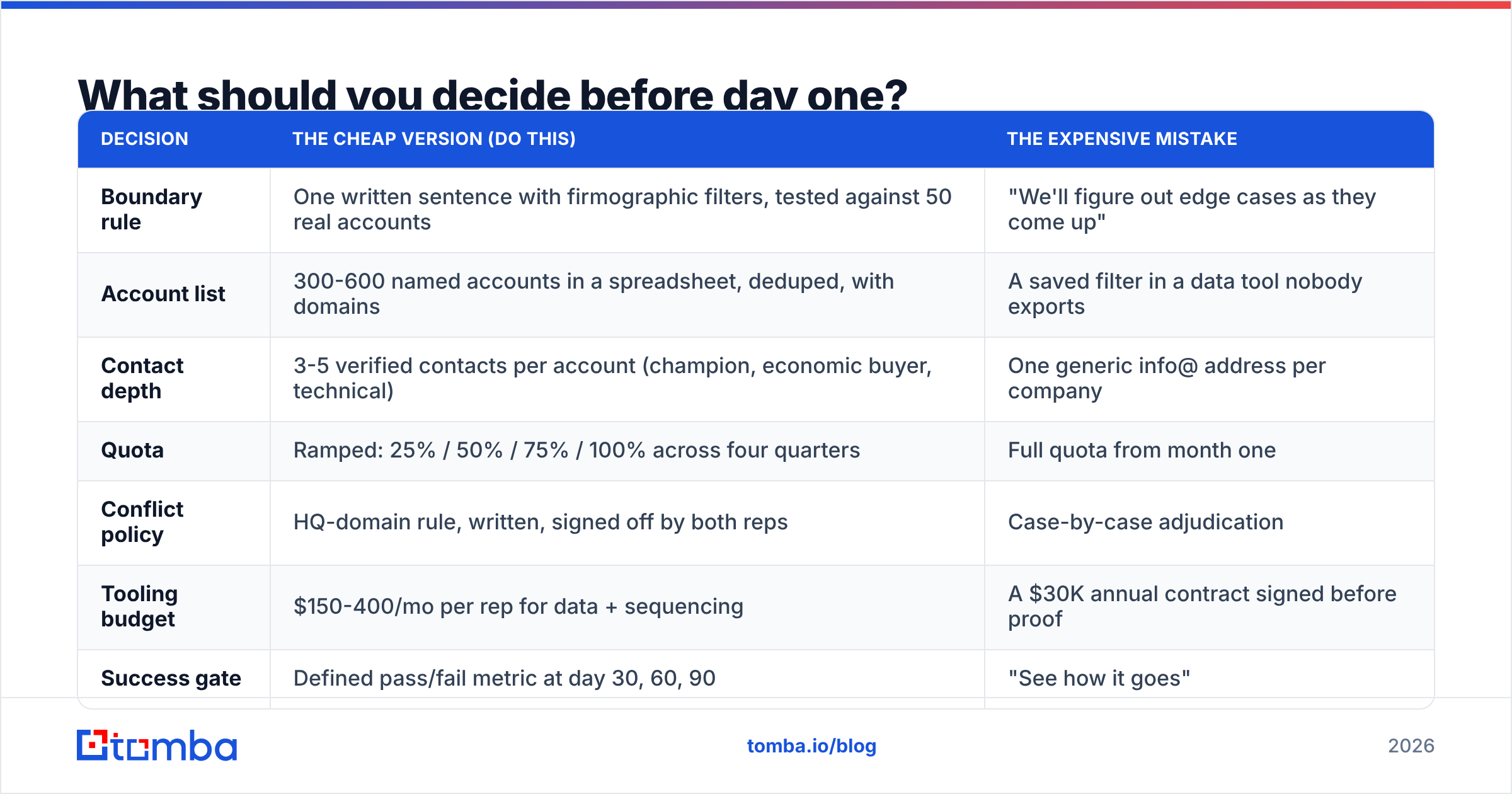
Here is the pre-launch decision set. The middle column is the cheap, fast version; the right column is what it costs when you skip it.
| Decision | The cheap version (do this) | The expensive mistake |
|---|---|---|
| Boundary rule | One written sentence with firmographic filters, tested against 50 real accounts | "We'll figure out edge cases as they come up" |
| Account list | 300-600 named accounts in a spreadsheet, deduped, with domains | A saved filter in a data tool nobody exports |
| Contact depth | 3-5 verified contacts per account (champion, economic buyer, technical) | One generic info@ address per company |
| Quota | Ramped: 25% / 50% / 75% / 100% across four quarters | Full quota from month one |
| Conflict policy | HQ-domain rule, written, signed off by both reps | Case-by-case adjudication |
| Tooling budget | $150-400/mo per rep for data + sequencing | A $30K annual contract signed before proof |
| Success gate | Defined pass/fail metric at day 30, 60, 90 | "See how it goes" |
Write these down in one page. If a stakeholder can't answer all seven from memory after reading it, the plan isn't tight enough yet.
How do you size a new territory without guessing?#
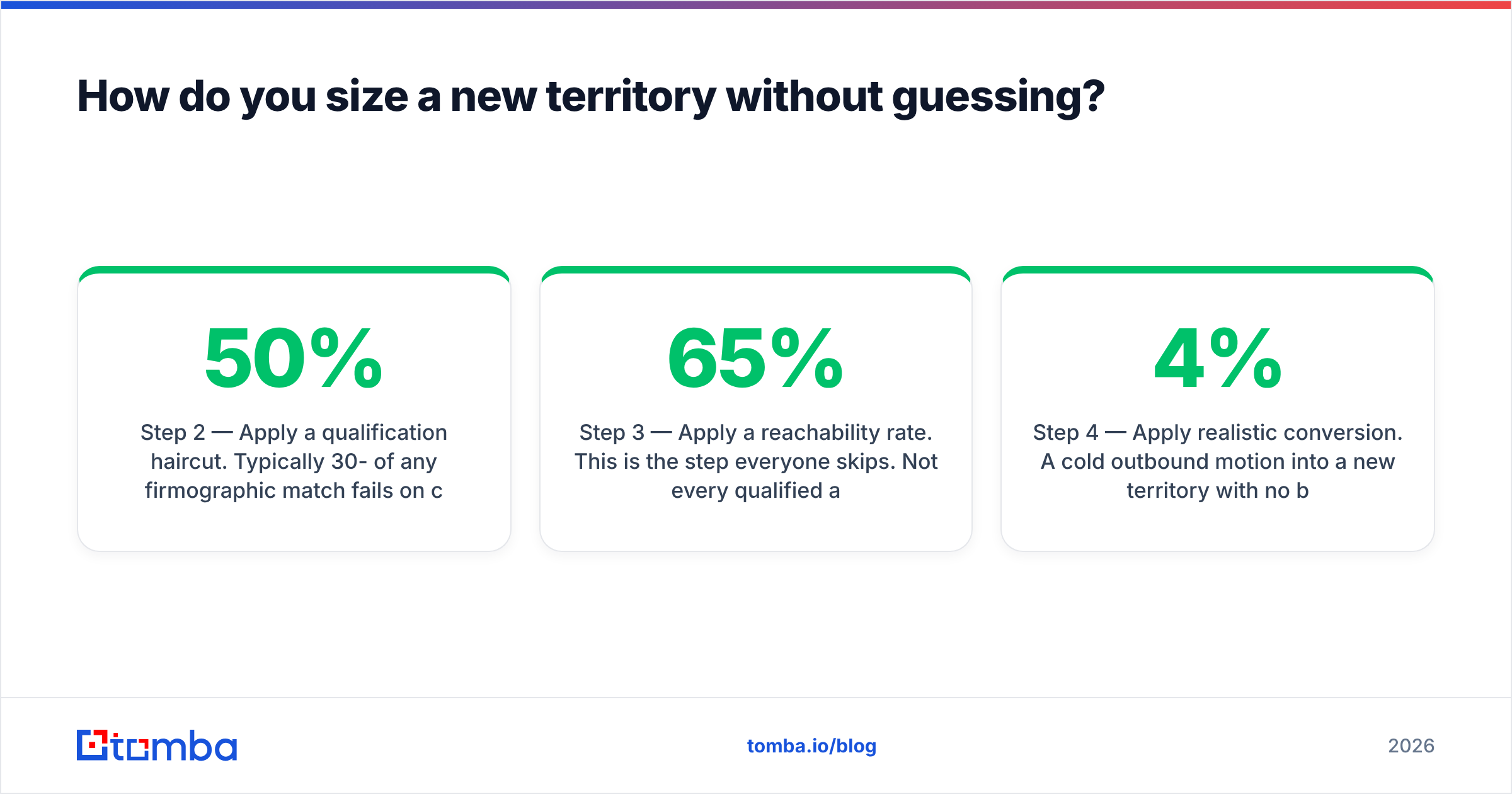
Build the number from the bottom up. The arithmetic takes an afternoon and it will be more accurate than any top-down estimate.
Step 1 — Count the accounts that match your boundary. Use firmographic filters on a B2B database or a market-intelligence tool. You want a real count, not a range. Say you get 2,400 companies in DACH with 100+ employees in your ICP industries.
Step 2 — Apply a qualification haircut. Typically 30-50% of any firmographic match fails on closer inspection: wrong tech stack, already a customer of an incumbent on a five-year contract, in an unservable sub-segment. Take 2,400 × 0.4 = 960 qualified accounts.
Step 3 — Apply a reachability rate. This is the step everyone skips. Not every qualified account yields a contactable decision-maker. Run a sample: take 100 domains through a domain search and count how many return at least two verified, role-relevant contacts. In most B2B segments this lands between 65% and 85%. At 75%, you have 720 truly workable accounts.
Step 4 — Apply realistic conversion. A cold outbound motion into a new territory with no brand recognition converts roughly 2-4% of accounts to an opportunity in year one; with a partner or inbound assist, 5-8%. At 3%, 720 accounts produce about 22 opportunities. At a 22% win rate and a $35K ACV, that is roughly $170K in first-year closed-won.
If that final number embarrasses the plan, you now know it in week one instead of month nine. You can respond by widening the boundary, raising ACV assumptions with evidence, adding a partner motion, or delaying the hire. All of those are cheaper than missing a number.

What does a 90-day territory launch plan look like?#
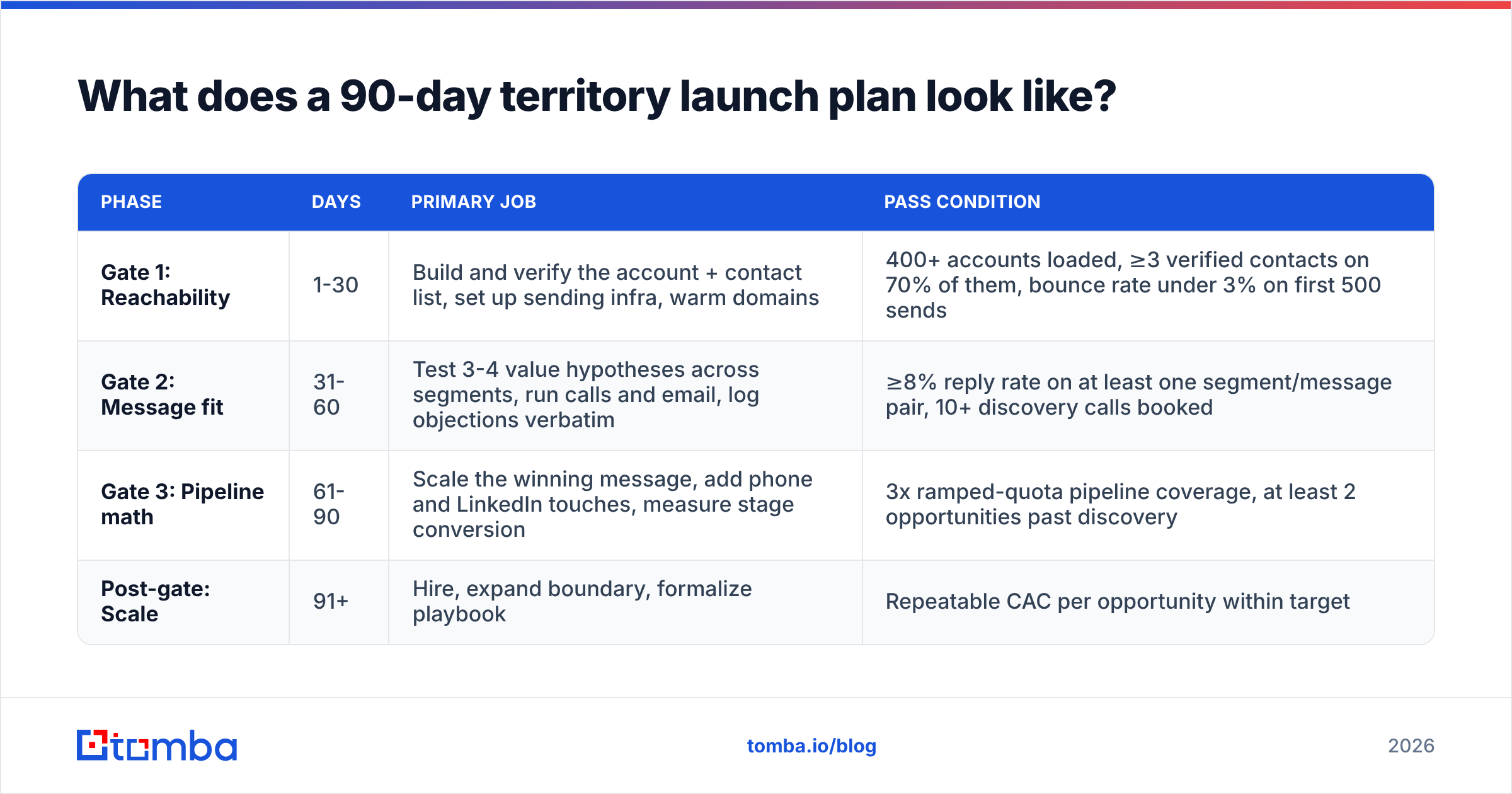
Treat the first quarter as three gates. Each gate has an explicit pass condition. If a gate fails, you fix it before spending the next 30 days — you do not "push through."
| Phase | Days | Primary job | Pass condition |
|---|---|---|---|
| Gate 1: Reachability | 1-30 | Build and verify the account + contact list, set up sending infra, warm domains | 400+ accounts loaded, ≥3 verified contacts on 70% of them, bounce rate under 3% on first 500 sends |
| Gate 2: Message fit | 31-60 | Test 3-4 value hypotheses across segments, run calls and email, log objections verbatim | ≥8% reply rate on at least one segment/message pair, 10+ discovery calls booked |
| Gate 3: Pipeline math | 61-90 | Scale the winning message, add phone and LinkedIn touches, measure stage conversion | 3x ramped-quota pipeline coverage, at least 2 opportunities past discovery |
| Post-gate: Scale | 91+ | Hire, expand boundary, formalize playbook | Repeatable CAC per opportunity within target |
Two notes on this table. First, gate 1 is deliberately unglamorous — a month of list building and infrastructure feels slow, and it is the highest-ROI month of the year. Second, the pass conditions are examples; set yours from your own historical benchmarks if you have them. What matters is that they exist in writing before day one, so nobody renegotiates them at day 29.
How should you source contact data for a new territory?#
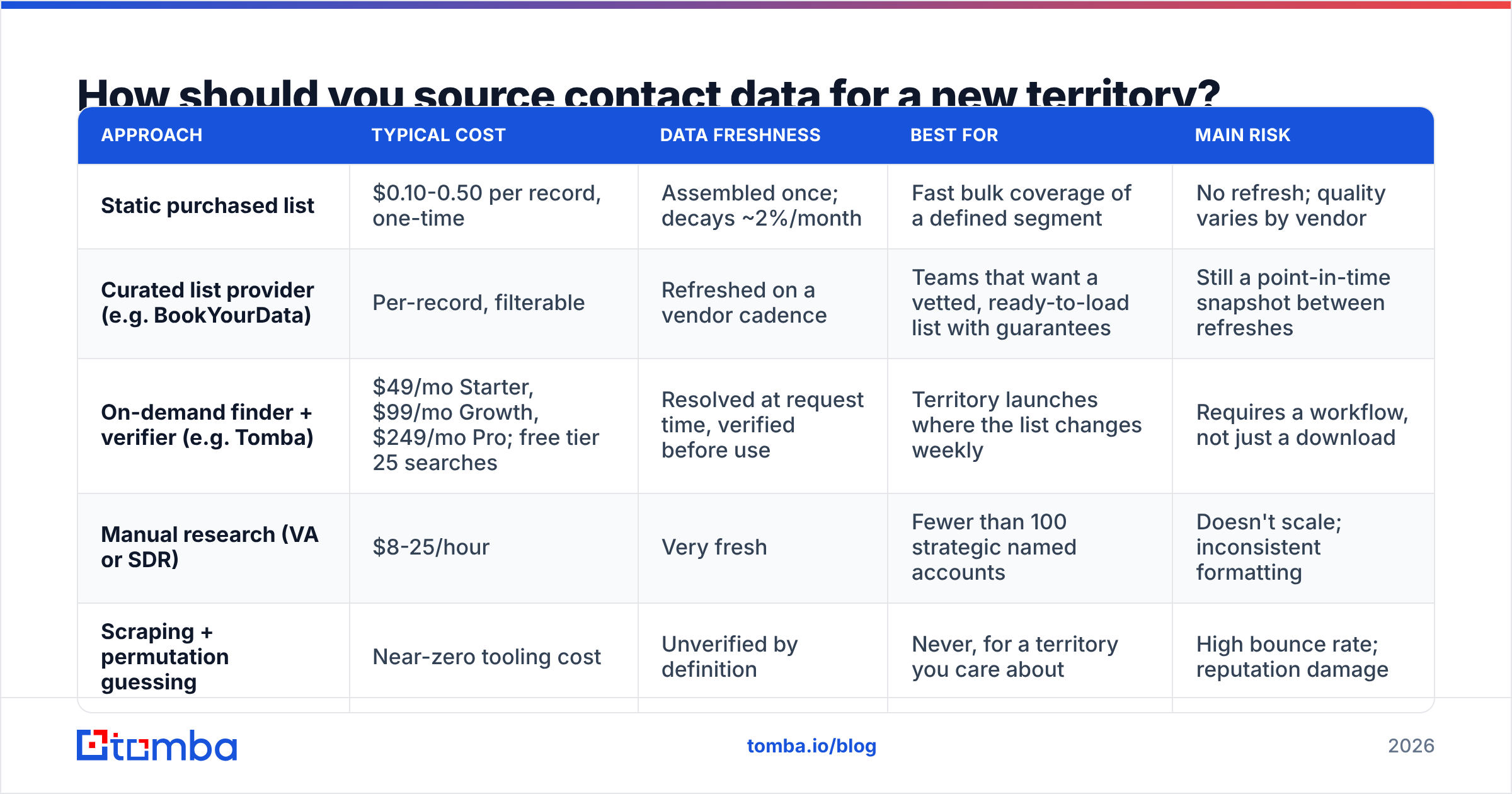
This is the decision with the widest cost spread, so compare the options directly rather than defaulting to whatever your last company used.
| Approach | Typical cost | Data freshness | Best for | Main risk |
|---|---|---|---|---|
| Static purchased list | $0.10-0.50 per record, one-time | Assembled once; decays ~2%/month | Fast bulk coverage of a defined segment | No refresh; quality varies by vendor |
| Curated list provider (e.g. BookYourData) | Per-record, filterable | Refreshed on a vendor cadence | Teams that want a vetted, ready-to-load list with guarantees | Still a point-in-time snapshot between refreshes |
| On-demand finder + verifier (e.g. Tomba) | $49/mo Starter, $99/mo Growth, $249/mo Pro; free tier 25 searches | Resolved at request time, verified before use | Territory launches where the list changes weekly | Requires a workflow, not just a download |
| Manual research (VA or SDR) | $8-25/hour | Very fresh | Fewer than 100 strategic named accounts | Doesn't scale; inconsistent formatting |
| Scraping + permutation guessing | Near-zero tooling cost | Unverified by definition | Never, for a territory you care about | High bounce rate; reputation damage |
For most territory launches the practical answer is a blend: a curated or purchased base list for breadth, then an on-demand email finder and email verifier pass to refresh contacts and fill gaps as accounts move through the funnel. Add a phone finder layer for the top 20% of accounts where a call is worth ten emails.
One rule that pays for itself: never send to an unverified address in a new territory. A brand-new sending domain has zero reputation history, which means a 10% bounce rate is not a minor inefficiency — it is an early death sentence for that domain. Verify, suppress catch-alls you can't confirm, and ramp volume slowly. Google and Microsoft both tightened bulk-sender requirements in recent years, and new domains get the least benefit of the doubt.

How many reps should you hire for a new territory?#
Fewer than you think, later than you want.
The standard mistake is hiring a pod — two SDRs and an AE — on the theory that a territory needs coverage from day one. But days 1-60 are discovery work: which segment responds, which message lands, which channel converts. That work is done best by one senior person with high context, often a founder, a sales lead, or your strongest existing rep on a temporary assignment.
Hire against gate 3, not gate 1. Once you have a message that produces an 8%+ reply rate and a repeatable path from reply to discovery call, you have something to hand a new hire. Before that, you are paying a new rep to run an experiment they lack the context to interpret.
A useful framing from Gartner's sales research and echoed across most enterprise sales orgs: territory design should follow demonstrated coverage capacity, not aspiration. If one person can meaningfully work 250 accounts per quarter, a 720-account territory implies three quarters of single-rep coverage or a second head — but only once the motion is proven.
What should you measure in the first 90 days?#
Revenue is a lagging indicator that won't exist yet. Measure the leading chain instead, in this order:
- Data quality — bounce rate, verified-contact coverage per account, duplicate rate. Target: under 3% bounce, 70%+ of accounts with 3+ contacts.
- Reach rate — percentage of targeted contacts who actually receive and open. If this is low, it's an infrastructure or data problem, not a copy problem.
- Reply rate by segment and message — segment it. An aggregate 4% reply rate can hide a 9% segment and a 1% segment, and the whole point of the first 60 days is finding the 9%.
- Meeting-held rate — booked-to-held. Below 60% means you're booking the wrong people or the value promise doesn't survive a calendar invite.
- Opportunity creation rate — meetings that become a real pipeline stage. This is the first metric that tells you the territory is commercially real.
- Stage-to-stage conversion — compare against your existing territories. Meaningful divergence tells you whether this market buys differently, which changes the playbook.
Log all six weekly. A new territory has too little volume for monthly reporting to catch problems in time.
What are the most common territory launch mistakes?#
Redrawing boundaries mid-quarter. It destroys the data you were collecting and poisons rep trust. Commit to the boundary for a full quarter, then revise with evidence.
Copy-pasting the playbook from your home market. Buying committees, objection patterns, and even acceptable outreach cadences differ across regions and segments. Import the structure, rewrite the content.
Treating the CRM as the source of truth on day one. In a new territory the CRM is empty by definition. Build the account list externally, enrich it, then load it — with ownership and routing rules set before the first record lands. Ongoing data enrichment keeps those records from rotting in place.
Ignoring the compliance layer. GDPR in the EU, PECR in the UK, and various state-level rules in the US change what outbound is permissible. Get this reviewed before sending, not after a complaint. HubSpot's sales resources and your own counsel are better starting points than a forum thread.
Declaring success on activity. "We sent 4,000 emails" is not a gate. Opportunities created is.
Where should you start this week?#
Pick the boundary, write it in one sentence, and build the account list. Then run the reachability sample before you commit to a quota — 100 domains, count the verified contacts, and let that number tell you whether the plan is real.
If you want the fastest version of that test: run your candidate account list through Tomba's Email Finder to see how deep the contact coverage actually goes inside your territory. The free tier gives you 25 searches to sanity-check a sample; Starter is $49/mo and Growth is $99/mo when you're ready to build the full list, with pricing details laid out per tier. A territory you can reach is a territory you can sell into — everything else in the launch plan depends on getting that part right first.
Related guides#
// get started
Find, verify and enrich your first contacts today
Start on the free plan with 25 searches a month, then scale when your team is ready.
Free plan · No credit card required · GDPR & CCPA
Get the Tomba newsletter
Product and data updates
// about the author