Lead Aggregators in 2026: How They Work and What They Cost
Lead aggregators promise instant pipeline, but the data underneath varies wildly in freshness, exclusivity, and legal standing. Here is how they actually work, what they cost, and when a self-sourced list beats a bought one.
TL;DR
- A lead aggregator collects contact and intent data from many sources — forms, publishers, partner sites, public records, scraped directories — then resells it as leads, usually priced per lead or per credit.
- The economics hinge on one variable most buyers ignore: exclusivity. A shared lead resold to five vendors is not 1/5 as valuable as an exclusive one, it is closer to 1/15, because you also pay a response-rate penalty for being fifth to call.
- Aggregated B2B data decays at roughly 22-30% per year as people change jobs. Anything sold without a verification timestamp should be treated as a hypothesis, not a contact.
- Consumer-lead aggregation (mortgage, insurance, home services) and B2B contact aggregation are different businesses with different rules — TCPA and consent chains matter enormously in the first, less in the second.
- For most B2B teams the honest answer is hybrid: use aggregators for discovery and market mapping, then re-resolve and verify contact data yourself before it touches a sequence.
What is a lead aggregator?#
A lead aggregator is a middleman that buys, collects, or generates contact records in bulk and resells them to the companies that want to sell something to those contacts.
Think of it like a wholesale fish market. Boats (publishers, comparison sites, form farms, data scrapers) bring in catch of wildly varying freshness. The market floor sorts, boxes, and prices it. Restaurants (you) buy by the crate. The good aggregators tell you which boat, which day, and how it was stored. The bad ones repack yesterday's catch and hope you do not notice until service.
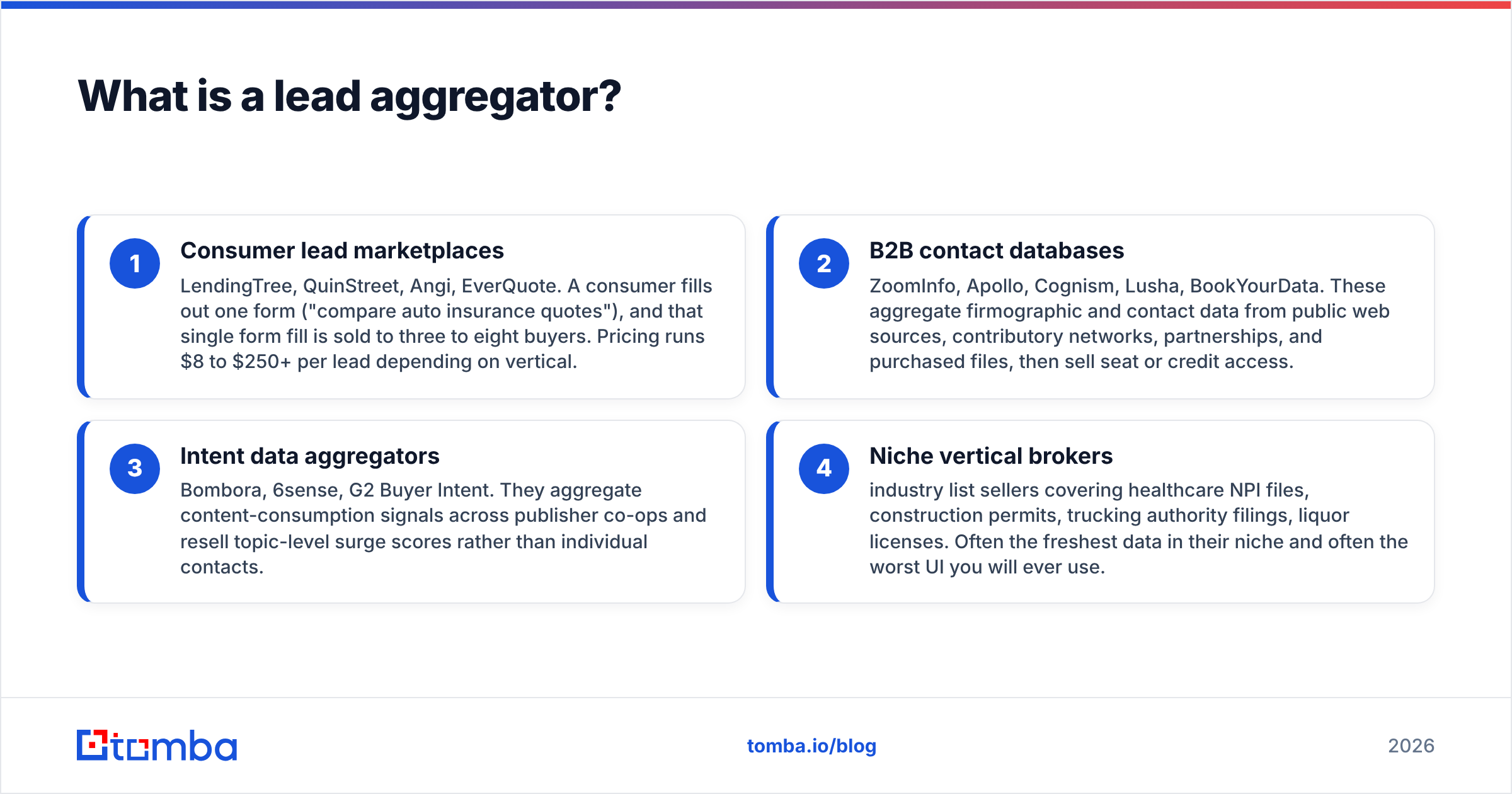
Practically, aggregators fall into four families:
- Consumer lead marketplaces — LendingTree, QuinStreet, Angi, EverQuote. A consumer fills out one form ("compare auto insurance quotes"), and that single form fill is sold to three to eight buyers. Pricing runs $8 to $250+ per lead depending on vertical.
- B2B contact databases — ZoomInfo, Apollo, Cognism, Lusha, BookYourData. These aggregate firmographic and contact data from public web sources, contributory networks, partnerships, and purchased files, then sell seat or credit access.
- Intent data aggregators — Bombora, 6sense, G2 Buyer Intent. They aggregate content-consumption signals across publisher co-ops and resell topic-level surge scores rather than individual contacts.
- Niche vertical brokers — industry list sellers covering healthcare NPI files, construction permits, trucking authority filings, liquor licenses. Often the freshest data in their niche and often the worst UI you will ever use.
The line between these blurs. Most B2B platforms now bundle intent. Most consumer marketplaces now sell "calls" and "clicks" alongside leads. But the underlying question is identical across all four: where did this record come from, when, and who else has it?

How do lead aggregators actually source their data?#
Six mechanisms cover almost everything on the market. Knowing which one produced your file tells you more about quality than any vendor accuracy claim.
- Owned form fills — the aggregator runs the comparison site or calculator itself. Highest consent quality, highest cost, usually exclusive or limited-share.
- Publisher networks and affiliates — third parties drive the form fill and sell it upstream. Quality swings from excellent to fraudulent depending on how hard the aggregator polices its affiliates. This is where incentivized traffic and co-registration junk enters the supply chain.
- Contributory / give-to-get networks — users install an extension or connect an inbox, and their contact data flows back into the shared pool. This powers a surprising share of B2B contact coverage. It is also the mechanism most exposed to privacy regulation.
- Public web crawling — company sites, press releases, staff directories, conference speaker lists, GitHub, job boards. Cheap, broad, and legally defensible; freshness varies by how often the crawler revisits.
- Licensed and purchased files — bulk acquisition from other data brokers, professional associations, or bankrupt competitors. Cheap per record, ancient in practice.
- Pattern inference + verification — the record is not "found," it is deduced (first.last@domain from a known company email pattern) and then SMTP-verified. This is how most modern email finders, including Tomba's email finder, resolve contacts that appear nowhere on the public web.
That last mechanism matters because it changes the decay math. A crawled record was true whenever the crawl ran. An inferred-and-verified record was true at the moment you requested it. When you run a domain search against a company today, you are not reading a cached row from 2024 — you are resolving the current pattern against live mail servers.
What do lead aggregators cost in 2026?#
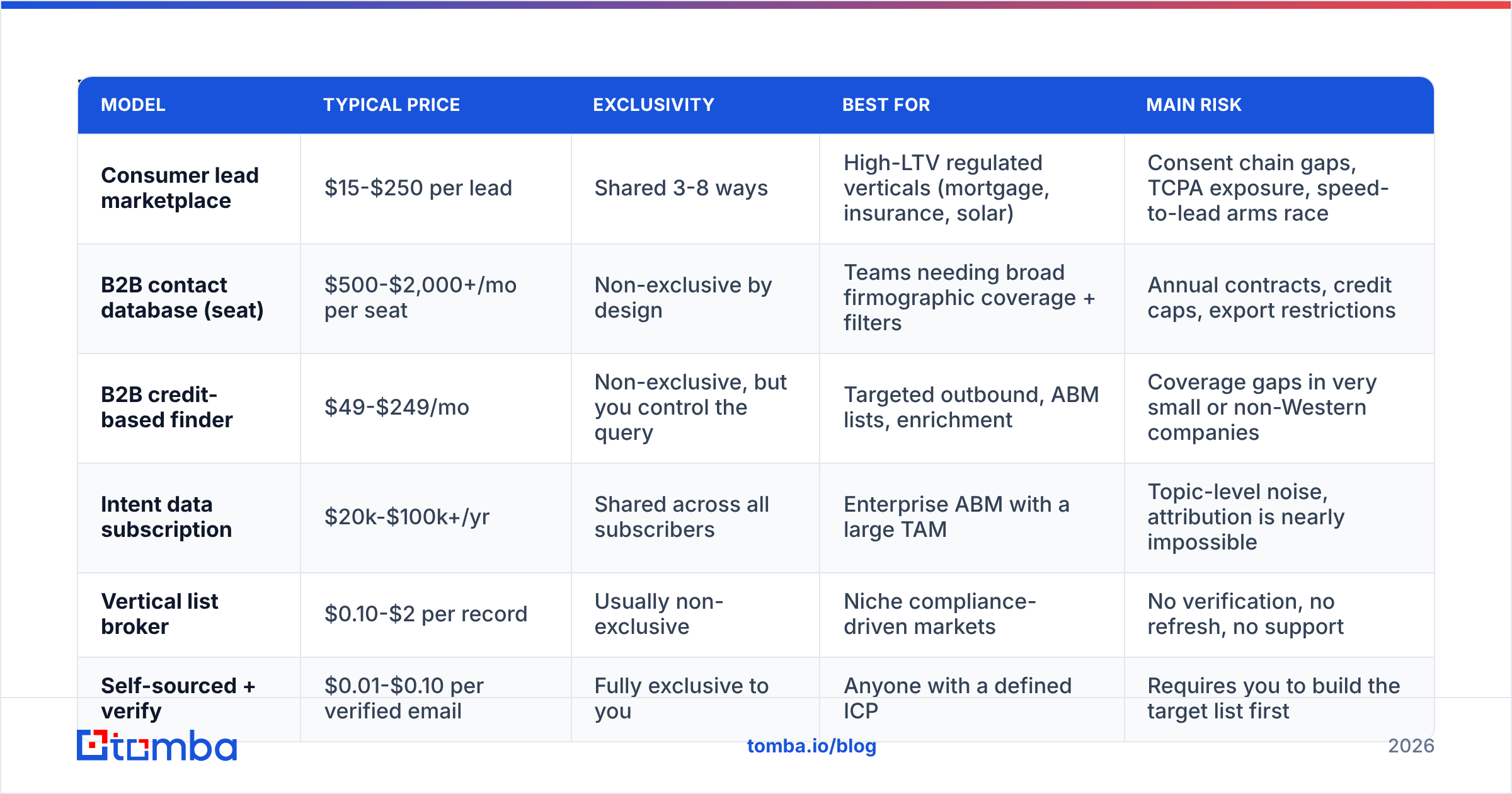
Prices vary by vertical more than by vendor, but here is the realistic landscape.
| Model | Typical price | Exclusivity | Best for | Main risk |
|---|---|---|---|---|
| Consumer lead marketplace | $15-$250 per lead | Shared 3-8 ways | High-LTV regulated verticals (mortgage, insurance, solar) | Consent chain gaps, TCPA exposure, speed-to-lead arms race |
| B2B contact database (seat) | $500-$2,000+/mo per seat | Non-exclusive by design | Teams needing broad firmographic coverage + filters | Annual contracts, credit caps, export restrictions |
| B2B credit-based finder | $49-$249/mo | Non-exclusive, but you control the query | Targeted outbound, ABM lists, enrichment | Coverage gaps in very small or non-Western companies |
| Intent data subscription | $20k-$100k+/yr | Shared across all subscribers | Enterprise ABM with a large TAM | Topic-level noise, attribution is nearly impossible |
| Vertical list broker | $0.10-$2 per record | Usually non-exclusive | Niche compliance-driven markets | No verification, no refresh, no support |
| Self-sourced + verify | $0.01-$0.10 per verified email | Fully exclusive to you | Anyone with a defined ICP | Requires you to build the target list first |
Two numbers reframe that table.
First, cost per meeting, not cost per lead. A $40 shared insurance lead with a 2% contact-to-appointment rate costs $2,000 per appointment. A $0.05 verified B2B email at a 1% meeting rate from a 300-email sequence costs $15 in data plus your rep's time. The absolute price per record is nearly irrelevant.
Second, the resale penalty. HubSpot's sales research and broad industry benchmarking both point the same direction: the first vendor to respond to a shared inbound lead captures a disproportionate share of the business. If you are buying shared leads without a sub-60-second dial system, you are funding your competitors' pipeline.
For reference, Tomba's own pricing sits in the credit-based row — free tier at 25 searches per month, Starter at $49/mo, Growth at $99/mo, Pro at $249/mo, Enterprise custom. That structure exists precisely because you should be paying for resolution requests you chose to make, not for a bulk file someone else assembled.
Are aggregated leads better than self-sourced leads?#
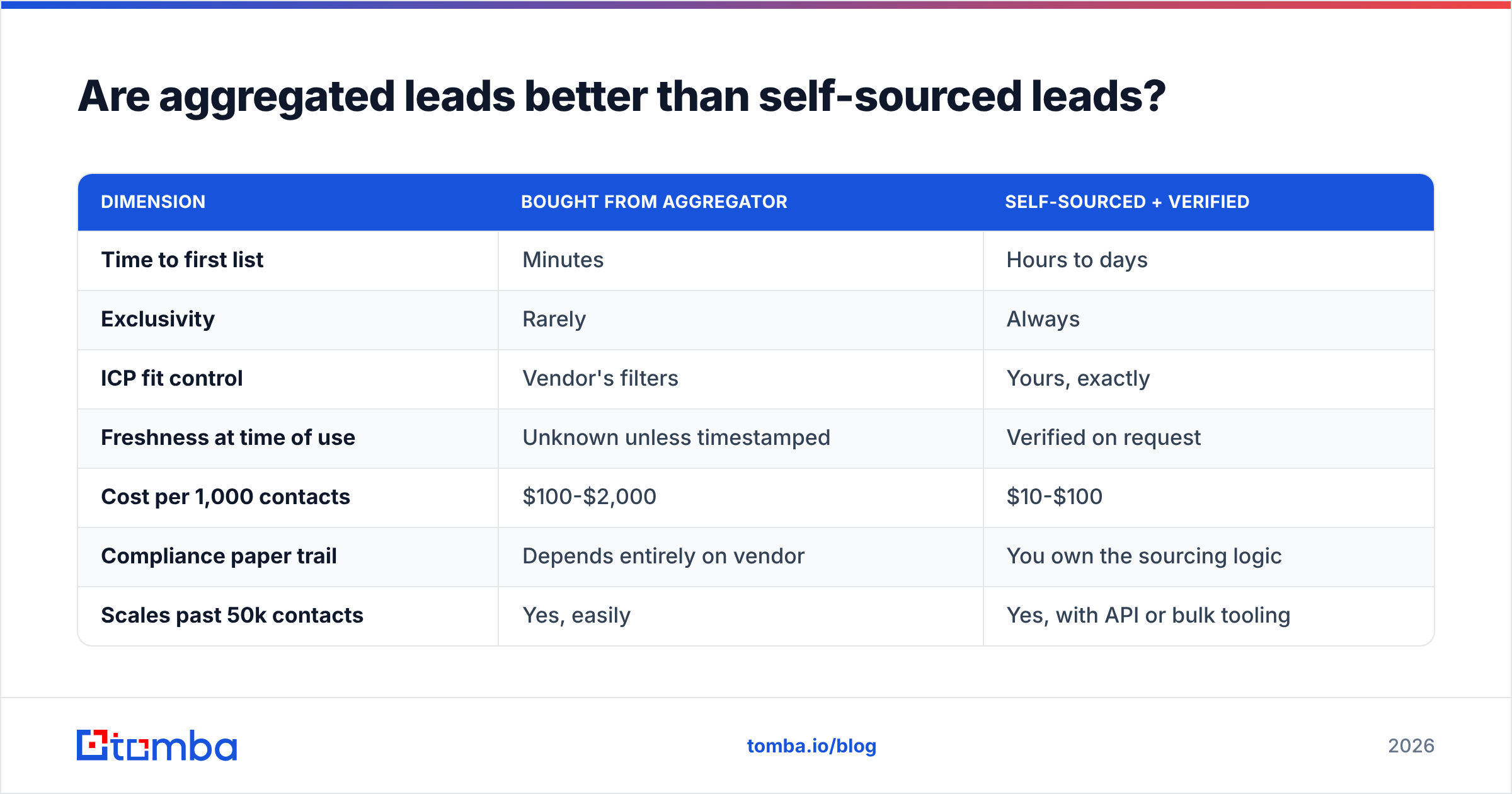
Neither wins outright. They fail differently, and that is the useful distinction.
Aggregated leads fail on exclusivity and intent authenticity. You inherit someone else's definition of a qualified prospect, and you share it. Self-sourced leads fail on coverage and effort — you only find what you know to look for, and building the target universe takes work.
| Dimension | Bought from aggregator | Self-sourced + verified |
|---|---|---|
| Time to first list | Minutes | Hours to days |
| Exclusivity | Rarely | Always |
| ICP fit control | Vendor's filters | Yours, exactly |
| Freshness at time of use | Unknown unless timestamped | Verified on request |
| Cost per 1,000 contacts | $100-$2,000 | $10-$100 |
| Compliance paper trail | Depends entirely on vendor | You own the sourcing logic |
| Scales past 50k contacts | Yes, easily | Yes, with API or bulk tooling |
| Enriches existing CRM rows | Sometimes | Yes, via enrichment endpoints |
The practical read: aggregators are a discovery tool, not a contactability tool. Use them to answer "which 400 companies in this segment exist and which look like they are in market?" Then resolve the actual humans yourself. Running an aggregator export through an email verifier before a sequence typically strips 15-30% of the file as invalid, catch-all-unknown, or role-based — and that strip is the difference between a 0.3% bounce rate and a domain reputation problem.

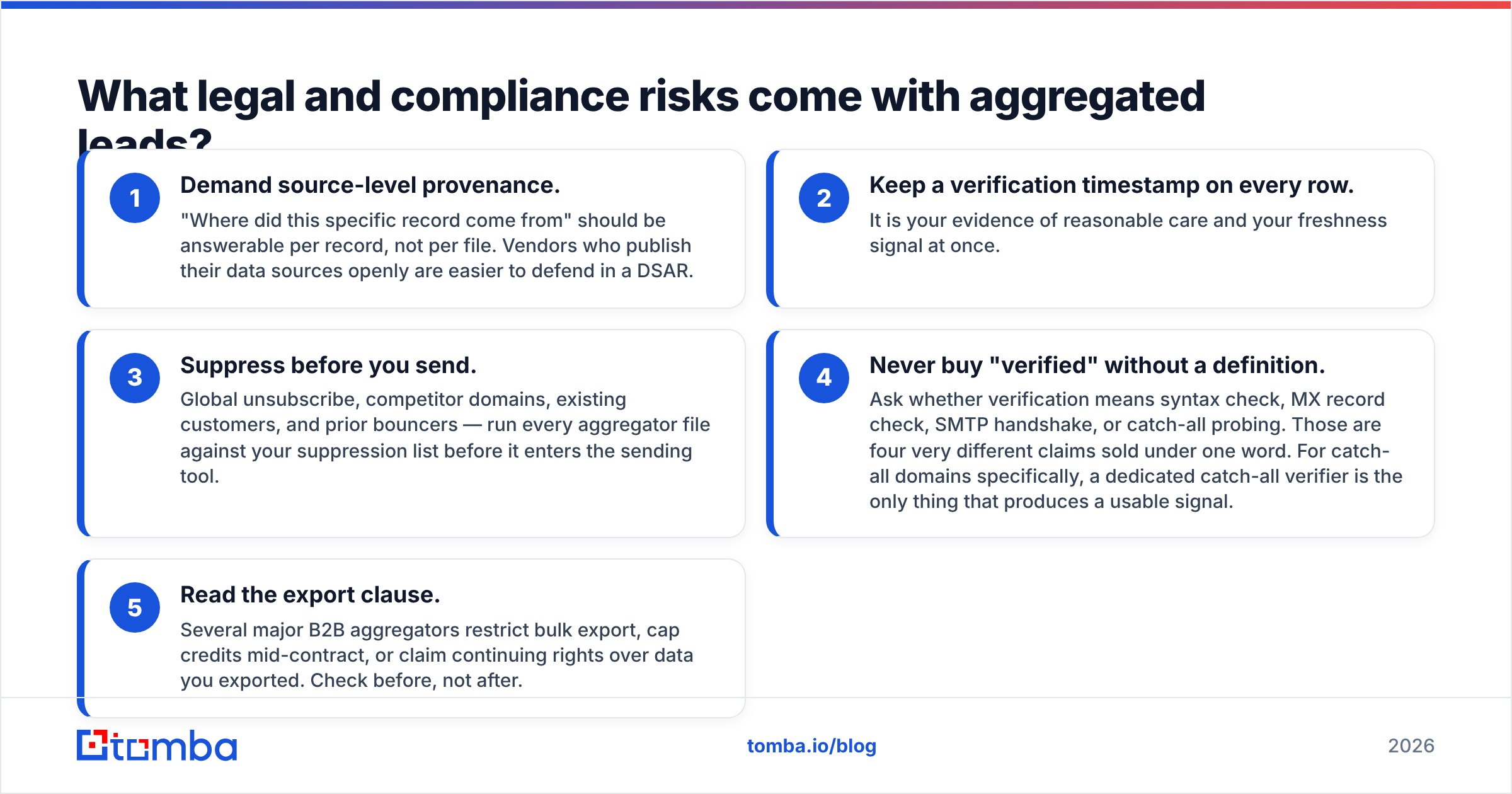
What legal and compliance risks come with aggregated leads?#
Conclusion first: in B2B you are mostly managing data-protection risk; in consumer verticals you are managing consent risk, and consent risk is the expensive one.
Consumer (TCPA / one-to-one consent). The FCC's push toward one-to-one consent fundamentally reshaped the shared-lead business. A single form fill can no longer blanket-authorize an unlimited list of "marketing partners" in the way the industry relied on for a decade. If you buy consumer leads, you need the full consent artifact — the exact page copy, the timestamp, the IP, the checkbox state — retained and retrievable. Vendors that cannot produce it on demand are selling you liability with a contact record attached.
B2B (GDPR / CCPA / CASL). Legitimate interest gives EU B2B outreach a workable basis, but it is conditional: relevance to the recipient's professional role, a transparent source disclosure, and a working opt-out. CASL in Canada is stricter and treats B2B email closer to consumer email. California's CPRA gives individuals deletion rights that propagate to your CRM whether or not you bought the record in good faith.
Practical mitigations:
- Demand source-level provenance. "Where did this specific record come from" should be answerable per record, not per file. Vendors who publish their data sources openly are easier to defend in a DSAR.
- Keep a verification timestamp on every row. It is your evidence of reasonable care and your freshness signal at once.
- Suppress before you send. Global unsubscribe, competitor domains, existing customers, and prior bouncers — run every aggregator file against your suppression list before it enters the sending tool.
- Never buy "verified" without a definition. Ask whether verification means syntax check, MX record check, SMTP handshake, or catch-all probing. Those are four very different claims sold under one word. For catch-all domains specifically, a dedicated catch-all verifier is the only thing that produces a usable signal.
- Read the export clause. Several major B2B aggregators restrict bulk export, cap credits mid-contract, or claim continuing rights over data you exported. Check before, not after.
How should you evaluate a lead aggregator before buying?#
Run a paid pilot, never a vendor-selected sample. Vendors curate samples; they cannot curate your test.
The seven-question diligence list:
- What percentage of my exact ICP do you cover? Give them 50 real target companies from your CRM and ask for match rates. Coverage claims of "275M contacts" are meaningless against your specific segment.
- How many other buyers receive this record? Get it in writing. "Limited share" is not a number.
- When was this record last verified, and by what method? If the answer is a range rather than a per-record timestamp, discount accordingly.
- What is your bounce guarantee and how do I claim it? Credit-back policies that require a support ticket per bounce are designed not to be used.
- Can I test 500 records before an annual commitment? Refusal is itself an answer.
- What happens to my data? Some contributory models feed your CRM exports back into the shared pool. Read the DPA.
- What is the real renewal price? First-year discounting followed by a 40% year-two increase is standard practice in this category, not an anomaly. G2's category reviews are more useful for renewal-pricing complaints than for feature comparison.
Then measure the pilot on three metrics only: valid-contact rate (what share actually resolves and does not bounce), ICP-match rate (what share fits your definition, not theirs), and cost per booked meeting. Everything else is vendor marketing.
When does buying from a lead aggregator make sense?#
It makes sense in four specific situations.
- Your TAM is genuinely enormous and undifferentiated. Selling payroll software to any US company with 10-200 employees? A broad aggregator saves months of list building.
- You are entering a market you know nothing about. Buying a firmographic snapshot to map the segment is cheap research, even if you never email a single row.
- You have a sub-minute speed-to-lead motion and a staffed dial team. Shared consumer leads are a real business for operators who win on response time. If your reps call within 24 hours, do not enter this market.
- You need intent signal you cannot generate yourself. Third-party topic surge is imperfect, but you cannot manufacture a co-op of publisher data on your own.
It stops making sense when your ICP is narrow, your ACV is under a few thousand dollars, or your differentiation is message relevance rather than raw reach. In those cases, a tightly built list of 300 verified contacts at companies you actually understand outperforms 30,000 bought rows every single time — and it costs less.
The hybrid pattern most efficient teams land on looks like this: aggregator or public source defines the account universe, an email finder resolves the specific decision-makers, verification runs immediately before send, and the whole thing flows into the CRM through an API rather than a CSV someone re-uploads every Monday. Discovery from the wholesale market, contactability resolved fresh.
Get the contact layer right before you buy volume#
If your current problem is that you do not know who to talk to, an aggregator can help. If your problem is that you know exactly who to talk to but cannot reach them, buying a bigger list makes it worse — you add cost, bounces, and shared competition without adding a single relevant conversation.
Start with the contact layer. Point the Tomba Email Finder at the companies already on your target list, verify every address before it enters a sequence, and measure cost per booked meeting rather than cost per record. The free tier gives you 25 searches a month to test the match rate against your own ICP before spending anything — which is exactly the pilot discipline you should demand from every aggregator you evaluate.
Related guides#
// get started
Find, verify and enrich your first contacts today
Start on the free plan with 25 searches a month, then scale when your team is ready.
Free plan · No credit card required · GDPR & CCPA
// about the author