Lead Capture Services in 2026: How to Choose the Right One
Lead capture services promise pipeline and deliver spreadsheets. Here's how agencies, forms-and-chat software, data vendors, and in-house stacks actually compare on cost, ownership, and lead quality.
TL;DR
- "Lead capture services" is a catch-all for four very different things: agencies, on-site capture software, data vendors, and in-house data stacks. Pricing ranges from $0 to $8,000/mo for the same stated outcome.
- Agencies are the fastest way to get leads and the slowest way to build an asset — when the retainer ends, so does the pipeline.
- On-site capture tools (forms, chat, visitor reveal) only work if you already have traffic. Below roughly 5,000 monthly visitors, the math rarely clears.
- Data-first stacks — find, verify, enrich, own — cost the least per usable contact but require someone internally to run them.
- Judge every vendor on verified deliverable contacts, not raw records. A 40% bounce rate turns a $0.10 lead into a $0.17 lead and torches your sender reputation.
What are lead capture services?#
Lead capture services are any paid offering that turns anonymous demand into a contactable record you own. That's the whole category, and it's why the term is so slippery — a $50/mo popup tool and a $6,000/mo demand-gen agency both describe themselves this way.
Underneath the marketing, every provider is doing one of two jobs:
- Converting traffic you already have into identified contacts (forms, chat widgets, gated content, visitor identification).
- Sourcing contacts you don't have from databases, scraping, research teams, or find-and-verify APIs.
Those are different problems with different economics. Mixing them up is the single most common reason teams overpay. If your site gets 800 visitors a month, no popup vendor can save you — you have a traffic problem, not a capture problem. If you get 60,000 visitors and only collect 90 emails, buying a contact database is treating a conversion problem with a volume solution.
Before you evaluate a single vendor, write down which of those two jobs you're actually buying. The rest of this guide assumes you've done that.
What are the four main types of lead capture services?#
Nearly every provider on G2's lead capture category falls into one of these buckets. The differences that matter are ownership, ramp time, and cost per usable contact.
- Full-service demand-gen agencies — They run ads, build landing pages, write the nurture sequence, and hand you MQLs. Typical retainer: $3,000–$12,000/mo plus ad spend. Ramp: 4–8 weeks. You own the leads but not the machine; cancel and output goes to zero within a month.
- On-site capture software — Forms, popups, chat, quizzes, and visitor-identification tools that convert existing traffic. Typical cost: $0–$500/mo. Ramp: days. Excellent ROI above ~5,000 monthly visitors, close to worthless below it.
- B2B contact databases and list vendors — Pre-built records you filter and export. Typical cost: $50–$1,000/mo, or per-record. Ramp: minutes. Quality varies more than price does, so verification is non-negotiable.
- Find-verify-enrich APIs and tools — You define the target account list, then resolve it into verified contacts on demand. Typical cost: $49–$249/mo. Ramp: a day. Lowest cost per usable contact, highest internal effort.
- Appointment-setting / SDR-as-a-service — Not strictly capture, but often sold alongside it. $4,000–$10,000/mo or per-meeting. Buy this when you have the data and lack the headcount, not the reverse.
- Hybrid managed data services — A vendor builds and refreshes a custom list to your ICP spec on a schedule. $500–$3,000/mo. Good middle ground for teams with a narrow niche and no data ops person.
Most companies end up running two of these simultaneously. The failure mode is running four.

How do lead capture services compare on cost and ownership?#
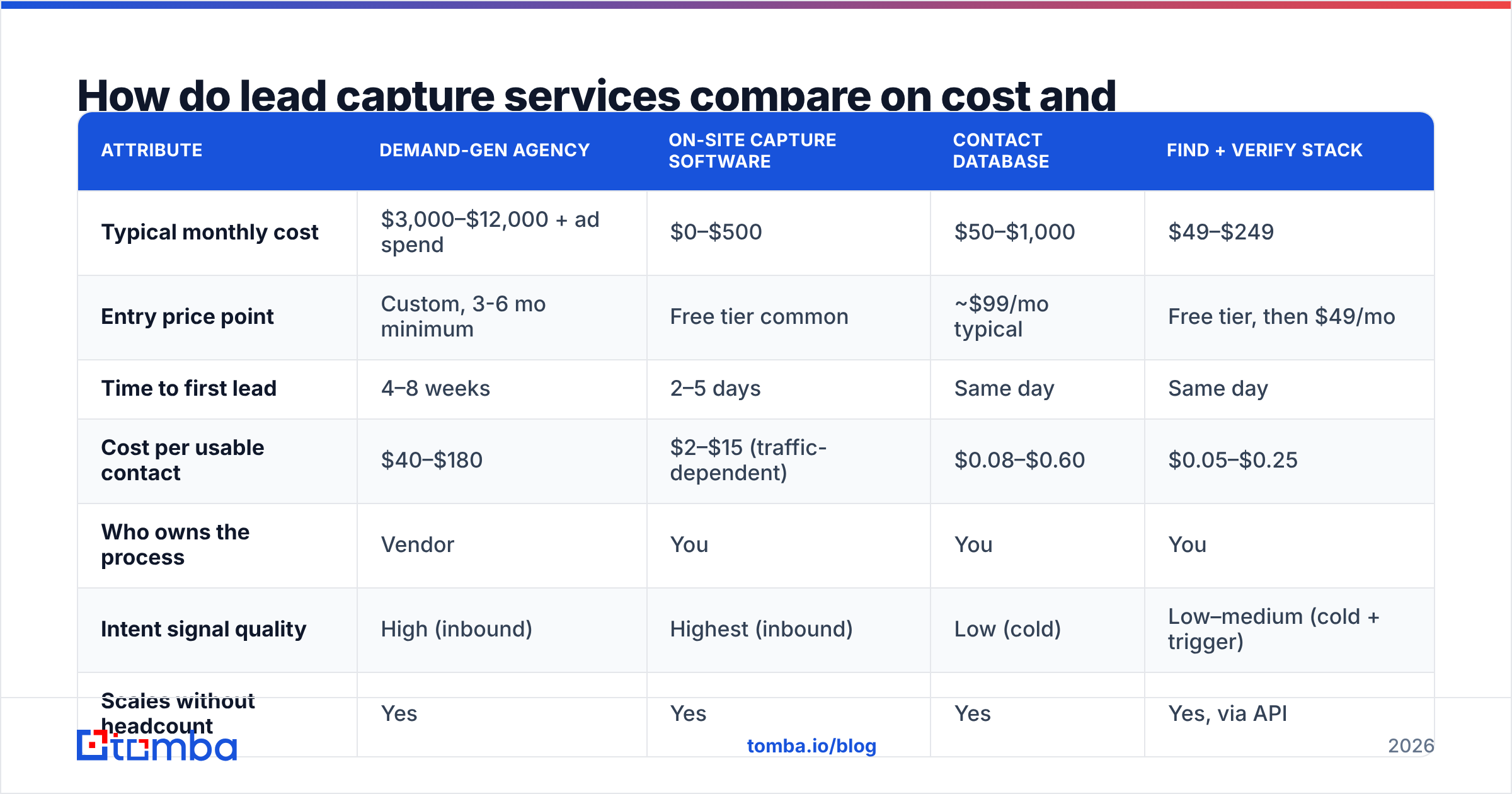
The table below uses realistic 2026 mid-market numbers. "Cost per usable contact" assumes usable means verified, deliverable, and inside your ICP — not simply present in the export.
| Attribute | Demand-gen agency | On-site capture software | Contact database | Find + verify stack |
|---|---|---|---|---|
| Typical monthly cost | $3,000–$12,000 + ad spend | $0–$500 | $50–$1,000 | $49–$249 |
| Entry price point | Custom, 3-6 mo minimum | Free tier common | ~$99/mo typical | Free tier, then $49/mo |
| Time to first lead | 4–8 weeks | 2–5 days | Same day | Same day |
| Cost per usable contact | $40–$180 | $2–$15 (traffic-dependent) | $0.08–$0.60 | $0.05–$0.25 |
| Who owns the process | Vendor | You | You | You |
| Intent signal quality | High (inbound) | Highest (inbound) | Low (cold) | Low–medium (cold + trigger) |
| Scales without headcount | Yes | Yes | Yes | Yes, via API |
| Contract lock-in | 3–12 months | Monthly | Annual common | Monthly |
| Best for | Funded teams buying speed | Sites with 5k+ visitors/mo | Broad TAM, volume plays | Narrow ICP, precision plays |
Read that cost-per-contact row carefully. An agency lead costs roughly 500x a find-and-verify lead — and that can still be correct, because an inbound demo request converts at 8–15% while a cold verified email converts at 0.5–2%. The comparison only works when you multiply by close rate.
Rough math on a $20,000 ACV product:
- Agency: $120 per MQL, 10% close → $1,200 CAC.
- Find + verify outbound: $0.15 per contact, 0.8% meeting rate, 25% close → about $75 in data cost per customer, plus SDR time.
Data cost is almost never the expensive part of outbound. Labor is. Which is exactly why buying cheap, dirty data is such a bad trade — you pay for it in wasted rep hours, not in the invoice.
Is a lead capture agency better than an in-house stack?#
Buy the agency when speed matters more than margin. If you have a funding round, a new product line, or a quarter to prove a channel, four weeks to pipeline is worth real money. Agencies also bring pattern-matching you can't hire quickly — they've seen what works in your vertical across a dozen accounts.
Build in-house when repeatability matters more than speed. The core objection to agencies isn't cost, it's that the asset evaporates. Twelve months and $60,000 later you have a list of leads and no capability. The in-house version of the same spend buys a data stack, a sequencing tool, and an SDR who still works there in month 13.
The honest middle path most teams land on:
- Keep paid acquisition and creative with an agency, where specialist skill compounds.
- Bring contact data and enrichment in-house, where the work is mechanical and the tooling is cheap.
That split works because contact resolution has genuinely commoditized. What used to require a research VA now runs as an API call: you give a domain and a name, you get back a verified address. Tomba's email finder and data enrichment endpoints are one implementation of that pattern; several vendors do the same job competently. The point is that this layer no longer justifies a retainer.
How do you judge data quality before you sign?#
Vendors quote accuracy the way restaurants quote portion size — technically true, methodologically silent. Here's how to test it in an afternoon.
Run a blind sample. Ask for 200 records against your exact ICP filters before you pay. Any vendor confident in their data will do this. Refusal is an answer.
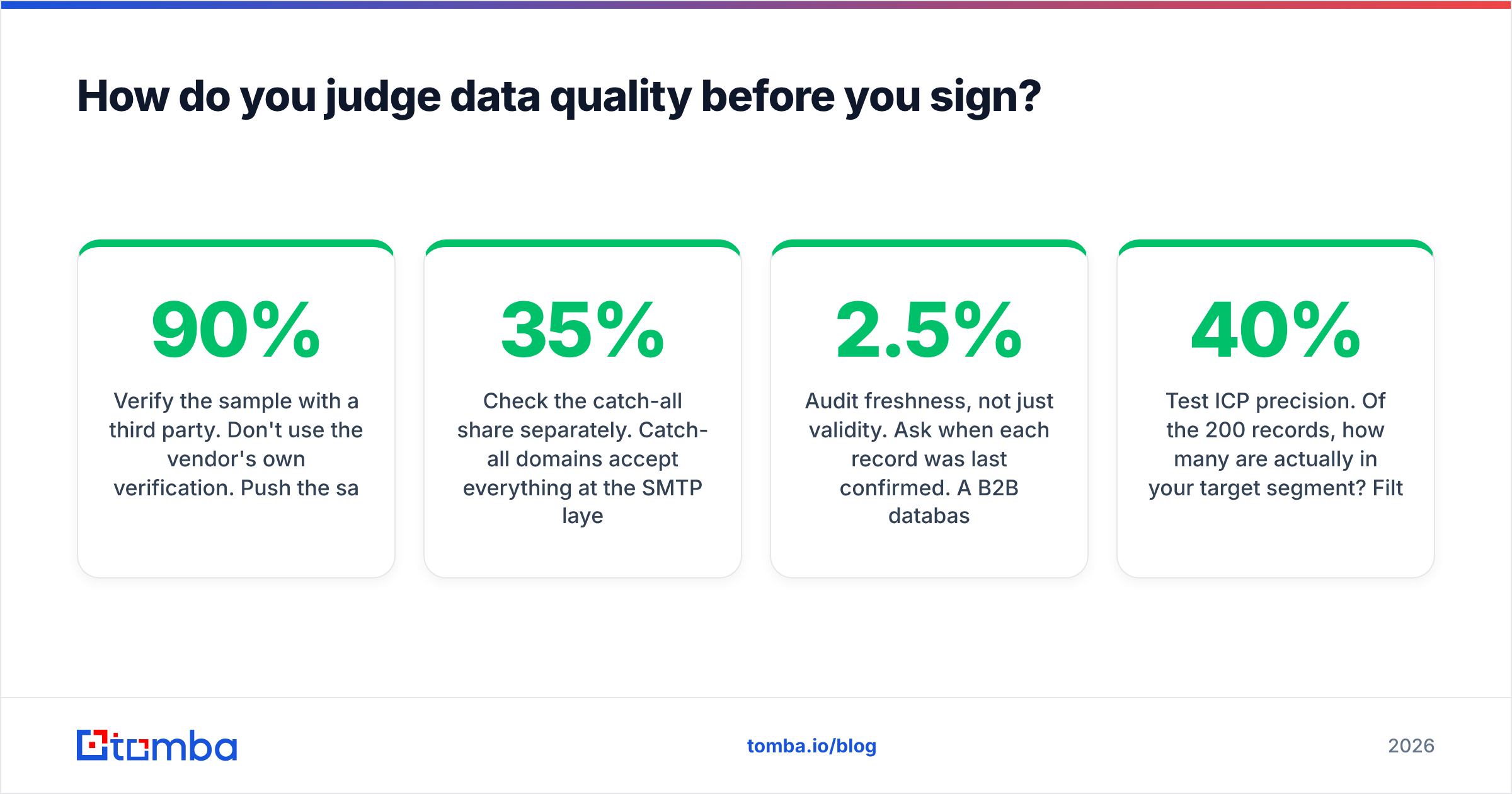
Verify the sample with a third party. Don't use the vendor's own verification. Push the sample through an independent email verifier and count four buckets: valid, invalid, catch-all, and unknown. A good B2B list returns 90%+ valid with under 5% hard-invalid. Anything above 10% invalid is a list you'll pay for twice.
Check the catch-all share separately. Catch-all domains accept everything at the SMTP layer, so standard verification can't confirm them. Vendors love to count these as "valid." If 35% of your sample is catch-all and the vendor calls it 95% deliverable, they're rounding in their own favor. A dedicated catch-all verifier resolves most of that ambiguity.
Audit freshness, not just validity. Ask when each record was last confirmed. A B2B database decays at roughly 2–2.5% per month as people change jobs — a list refreshed 18 months ago is a third wrong no matter how clean it looked on day one.
Test ICP precision. Of the 200 records, how many are actually in your target segment? Filters like "company size 50–200" are frequently populated from stale sources. If 40% of the sample is out of ICP, your real cost per usable contact is 1.7x the quoted price.
Confirm compliance posture. Ask directly where data is sourced, whether GDPR legitimate-interest documentation exists, and how opt-out requests propagate. Established providers like BookYourData publish their sourcing and compliance approach openly — treat that transparency as the baseline you expect from everyone, not as a bonus.
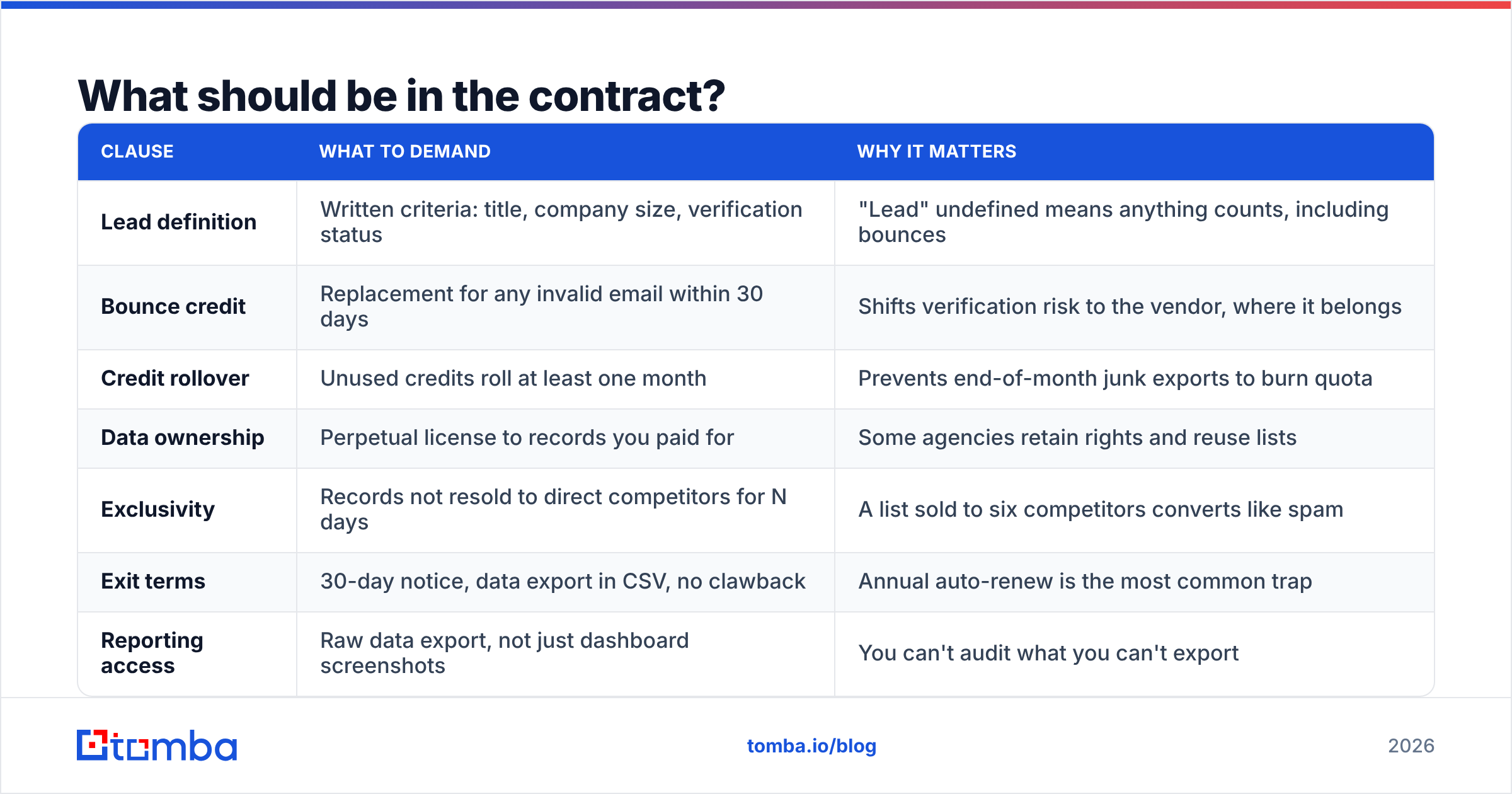
What should be in the contract?#
Lead capture contracts hide their real cost in three places: definitions, credit mechanics, and exit terms.
| Clause | What to demand | Why it matters |
|---|---|---|
| Lead definition | Written criteria: title, company size, verification status | "Lead" undefined means anything counts, including bounces |
| Bounce credit | Replacement for any invalid email within 30 days | Shifts verification risk to the vendor, where it belongs |
| Credit rollover | Unused credits roll at least one month | Prevents end-of-month junk exports to burn quota |
| Data ownership | Perpetual license to records you paid for | Some agencies retain rights and reuse lists |
| Exclusivity | Records not resold to direct competitors for N days | A list sold to six competitors converts like spam |
| Exit terms | 30-day notice, data export in CSV, no clawback | Annual auto-renew is the most common trap |
| Reporting access | Raw data export, not just dashboard screenshots | You can't audit what you can't export |
One more: insist that credits are consumed only on successful results. Several vendors charge a credit whether or not an email is found. At scale that's a silent 20–30% price increase. Check how your shortlist handles this — Tomba's pricing runs Free (25 searches/mo), Starter at $49/mo, Growth at $99/mo, and Pro at $249/mo, and the credit-consumption rule is the number you should be comparing across every vendor on your list, not the headline price.
How do you measure whether a lead capture service is working?#
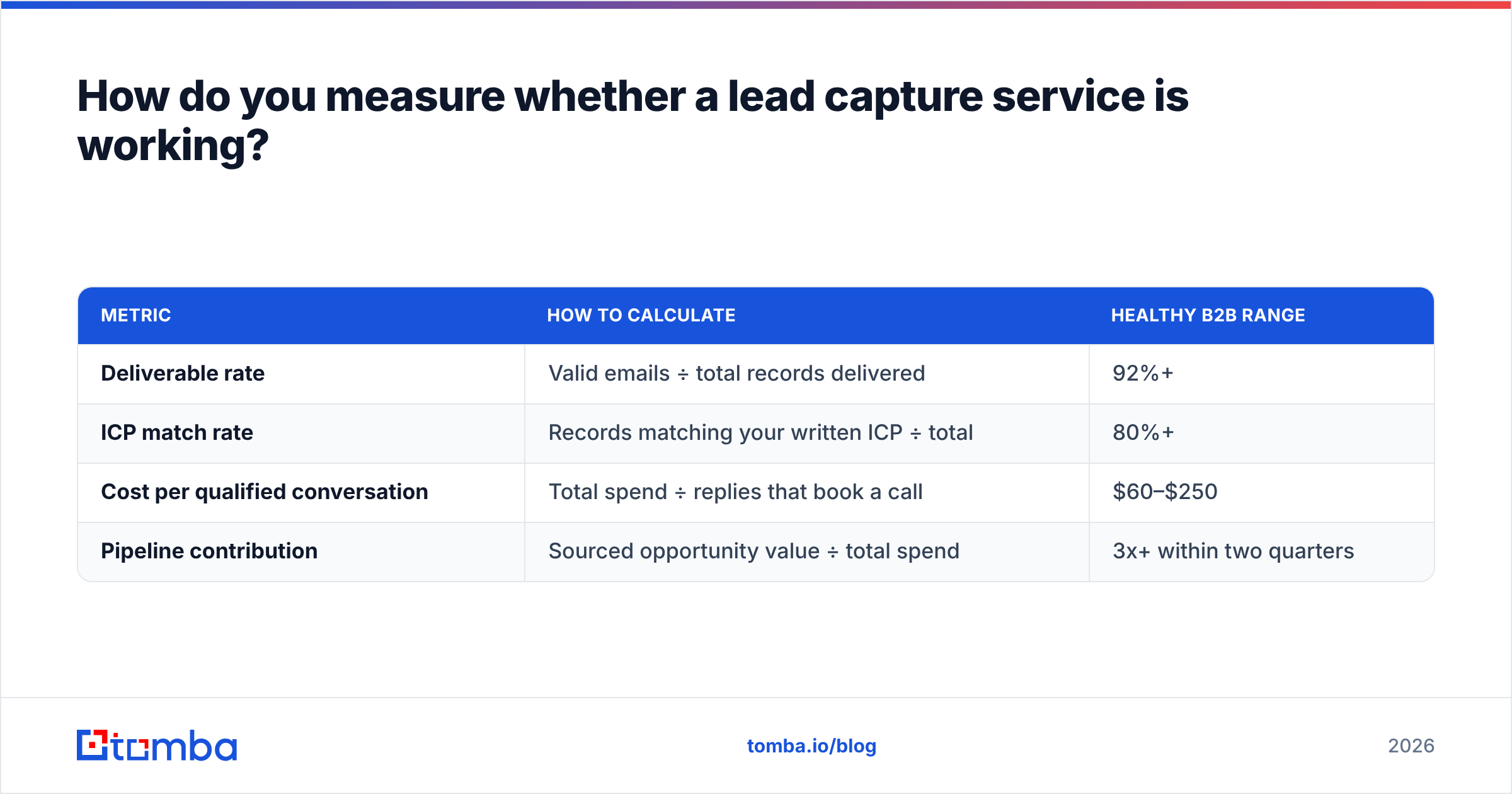
Most reporting from lead capture services is engineered to look good. Replace their metrics with these four, measured monthly:
| Metric | How to calculate | Healthy B2B range |
|---|---|---|
| Deliverable rate | Valid emails ÷ total records delivered | 92%+ |
| ICP match rate | Records matching your written ICP ÷ total | 80%+ |
| Cost per qualified conversation | Total spend ÷ replies that book a call | $60–$250 |
| Pipeline contribution | Sourced opportunity value ÷ total spend | 3x+ within two quarters |
Track deliverable rate weekly, not monthly. It's the earliest warning signal you have — a list quality drop shows up in bounce rate two weeks before it shows up in reply rate, and one bad send can cost you months of sender reputation recovery. Google and Yahoo's bulk-sender requirements put the hard-bounce ceiling at 0.3%; blow past it consistently and inbox placement degrades across every domain you send from.
Also separate sourced from influenced pipeline. Agencies report influenced numbers because they're larger and nearly impossible to disprove. Sourced pipeline — first touch attributable to the service — is the only figure that answers "should we renew."
When does each model actually make sense?#
- Under 1,000 monthly visitors, narrow ICP, under 5,000 target accounts: skip agencies and databases entirely. Build the account list manually, resolve contacts with a find-and-verify tool, and run it yourself. Monthly cost under $100.
- 5,000–50,000 monthly visitors: on-site capture plus visitor identification is your highest-ROI spend. Converting 2% of traffic you already paid for beats any cold list.
- Broad TAM, high-velocity, low ACV: databases win. You need volume, and per-record economics matter more than precision.
- Enterprise ACV above $50,000: precision wins. Twenty right contacts beat 20,000 wrong ones, and manual research plus verification is entirely defensible at that deal size.
- No internal owner for data ops: an agency or managed data service is the honest answer. Self-serve tools that nobody runs are just a recurring charge.
For a deeper look at how inbound capture and outbound sourcing feed each other, HubSpot's lead generation guide covers the inbound half well, and the Wikipedia entry on lead generation is a surprisingly clear primer on how the industry's terminology evolved into today's mess.
What's the fastest way to test this yourself?#
Pick 100 target accounts you'd genuinely want as customers. Don't buy a list — write them down. Then resolve decision-maker contacts for each one, verify every address before it enters your sequencer, and send. You'll know inside three weeks whether your offer, your targeting, or your data was the problem. Every agency you evaluate afterward has to beat that baseline, and now you'll have the numbers to check whether they do.
If you want to run that test without a procurement cycle, start with the Tomba Email Finder. The free tier covers 25 searches a month — enough to validate your ICP and your messaging before you commit budget — and Starter at $49/mo handles a full outbound motion with verification built into the same workflow. Own the data layer first; decide what to outsource second.
Related guides#
// get started
Find, verify and enrich your first contacts today
Start on the free plan with 25 searches a month, then scale when your team is ready.
Free plan · No credit card required · GDPR & CCPA
Get the Tomba newsletter
Product and data updates
// about the author