Lead Carrot vs RocketReach: Which B2B Lead Tool Wins in 2026?
Lead Carrot scrapes local business leads. RocketReach queries a 700M-contact database. They solve different problems badly if you pick the wrong one — here is the honest breakdown, with pricing, coverage and accuracy.
TL;DR
- They are not really competitors. Lead Carrot builds local-business prospect lists (Google Maps-style scraping, website audits, agency-friendly). RocketReach queries a massive people database of professionals at named companies.
- Pick Lead Carrot if you sell services to plumbers, dentists, gyms and restaurants and need a list of "businesses in this city with a bad website."
- Pick RocketReach if you sell to job titles — "VP Engineering at a 500-person SaaS company" — and need direct emails plus mobile numbers.
- Both get expensive per verified contact. RocketReach's mid tier lands near $99/month, and Lead Carrot's agency tiers climb fast once you need volume.
- If your real need is just accurate work emails at scale, a dedicated finder-plus-verifier stack (Tomba's Starter plan is $49/mo) usually costs less than either and plugs straight into your CRM.
What is Lead Carrot and who actually uses it?#
Lead Carrot is a lead-generation tool built for agencies and local service sellers. You search by business category and geography — "roofers in Phoenix," "med spas in Austin" — and it returns business listings with contact details, website status, social profiles and rough technology signals. Its strongest selling point has always been the audit angle: it flags businesses with no website, no SSL, poor mobile rendering or missing Google presence, which gives an agency an instant pitch hook.
That makes it a SMB-first, geography-first tool. It thinks in terms of places, not people. You get "Main Street Dental, info@mainstreetdental.com, no mobile site." You do not get "Dr. Sarah Chen, Practice Owner, sarah@mainstreetdental.com."
Typical Lead Carrot buyers:
- Web design and SEO agencies cold-calling local businesses
- Marketing consultants running "free audit" outreach campaigns
- Franchise and local-services sales reps working defined territories
- Solo operators who want a list without building a scraping stack
Check current plans on the official Lead Carrot site — its tiering has changed more than once, and lifetime-deal-era pricing no longer reflects what new buyers pay.
What is RocketReach and what is it actually good at?#
RocketReach is a contact-intelligence database. It claims coverage of hundreds of millions of professionals and tens of millions of companies, and it surfaces work emails, personal emails, direct dials and mobile numbers alongside LinkedIn profiles and job history.
The workflow is the inverse of Lead Carrot's. You start from a person or a company, not a map pin. Search filters include title, seniority, function, company size, industry, revenue and location. A Chrome extension pulls contact data while you browse LinkedIn, and an API lets engineering teams enrich records programmatically.
RocketReach is the better fit when:
- Your ICP is defined by role, not by street address
- You need mobile numbers for a calling motion, not just a generic inbox
- You're enriching an existing CRM list rather than building one from zero
- Your reps live in LinkedIn Sales Navigator and want one-click reveal
Where it gets criticized — consistently, across G2 reviews — is credit burn. Lookups consume credits whether or not the returned email is usable, and users report wasted pulls on stale or catch-all addresses.

Lead Carrot vs RocketReach: how do they compare head-to-head?#
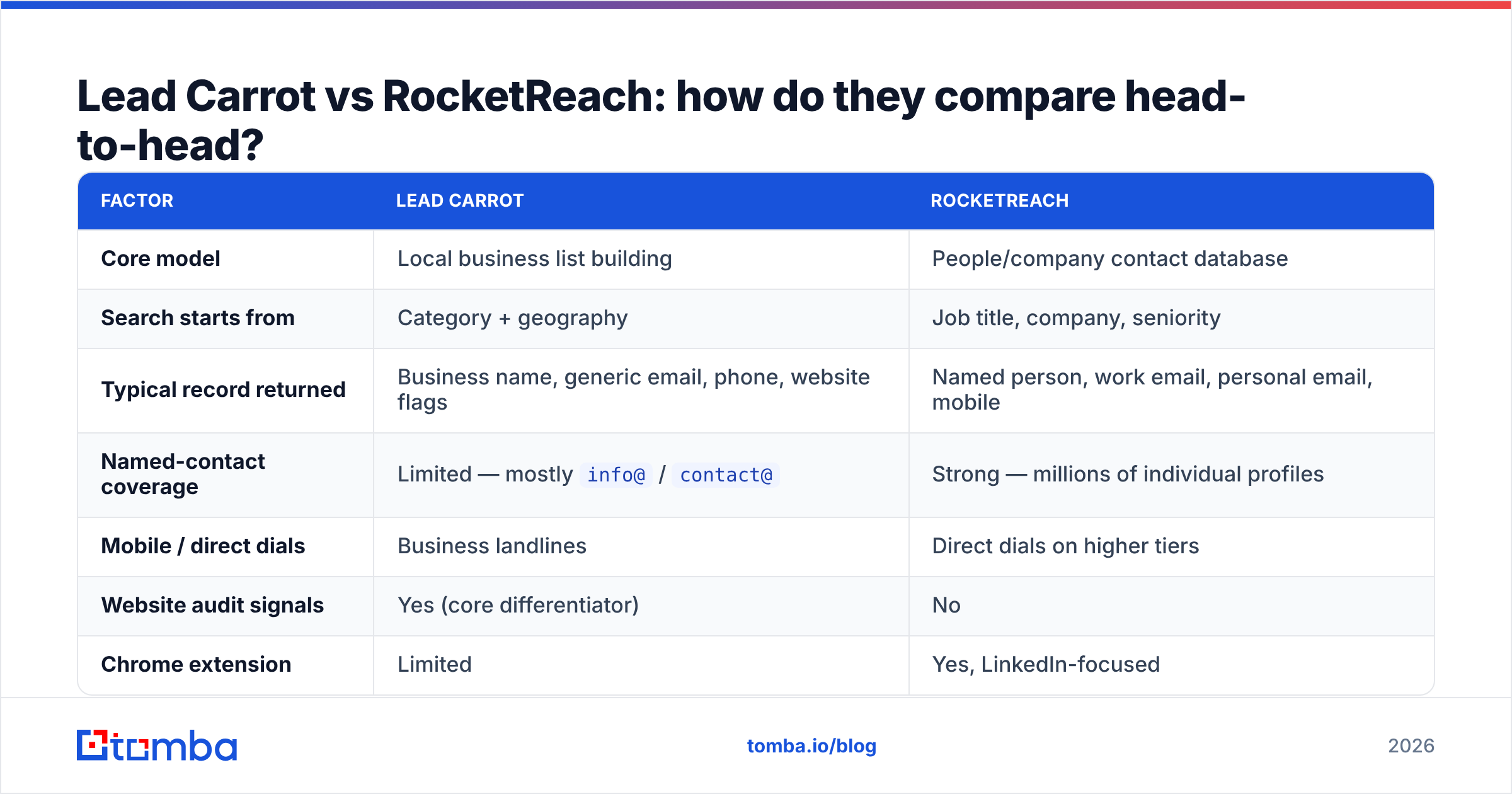
Here is the practical breakdown. Treat pricing as directional — both vendors adjust tiers, and annual billing changes the math substantially.
| Factor | Lead Carrot | RocketReach |
|---|---|---|
| Core model | Local business list building | People/company contact database |
| Search starts from | Category + geography | Job title, company, seniority |
| Typical record returned | Business name, generic email, phone, website flags | Named person, work email, personal email, mobile |
| Named-contact coverage | Limited — mostly info@ / contact@ |
Strong — millions of individual profiles |
| Mobile / direct dials | Business landlines | Direct dials on higher tiers |
| Website audit signals | Yes (core differentiator) | No |
| Chrome extension | Limited | Yes, LinkedIn-focused |
| API access | Minimal | Yes, documented REST API |
| Entry price (at time of writing) | Roughly $47–$97/mo by tier | Around $40/mo Essentials, billed annually |
| Mid tier | Agency tiers climb steeply | Approximately $99/mo Pro |
| Best for | Agencies selling to local SMBs | Reps and RevOps targeting job titles |
| Weakest at | Enterprise and named-contact targeting | Local SMBs with no digital footprint |
The pattern is clear: Lead Carrot wins breadth in the SMB long tail, RocketReach wins depth on named professionals. If you try to force either into the other's job, you will pay for a lot of unusable rows.
How accurate is the data in each tool?#
Accuracy is where most head-to-head comparisons get lazy, so be precise about what you're measuring. There are three different numbers people conflate:
- Match rate — how often the tool returns any contact for your input.
- Deliverability rate — how many of those returned addresses actually accept mail.
- Relevance rate — how many belong to a person who can buy from you.
Lead Carrot usually posts a high match rate and a low relevance rate. Scraped business listings almost always include something — a phone number, a generic inbox — but info@ addresses route to a shared mailbox that a receptionist skims. Your email lands. Nobody with budget reads it.
RocketReach inverts that. Match rates on obscure SMB contacts are weaker, but when it returns a named person's work email, the address is far more likely to reach a decision-maker. The trade-off is credit waste on the misses, and a meaningful share of returned addresses that are catch-all or long-stale.

Whichever tool you pick, run the output through an independent email verifier before your sequencing platform touches it. Neither Lead Carrot nor RocketReach guarantees a bounce-safe list, and a 6% bounce rate is enough to damage email deliverability across your whole domain. Catch-all domains in particular need a dedicated catch-all verifier — a standard SMTP ping just returns "accepted" for every address on those domains, which is why unverified catch-alls quietly inflate your bounce numbers weeks later.
How does the pricing really compare per usable contact?#
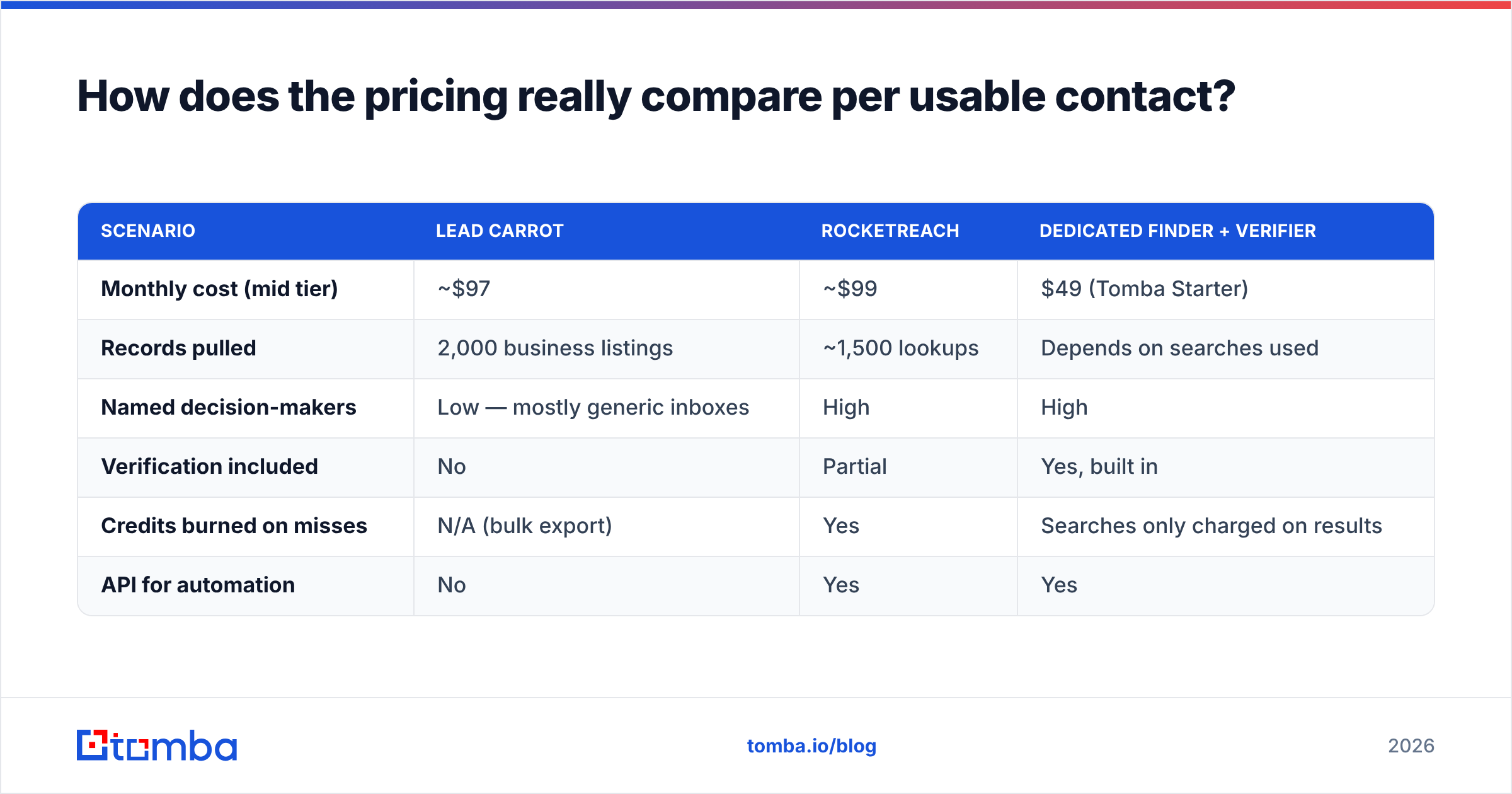
Sticker price is the wrong unit. Cost per usable, verified, decision-maker contact is the right one. Run a rough model:
| Scenario | Lead Carrot | RocketReach | Dedicated finder + verifier |
|---|---|---|---|
| Monthly cost (mid tier) | ~$97 | ~$99 | $49 (Tomba Starter) |
| Records pulled | 2,000 business listings | ~1,500 lookups | Depends on searches used |
| Named decision-makers | Low — mostly generic inboxes | High | High |
| Verification included | No | Partial | Yes, built in |
| Credits burned on misses | N/A (bulk export) | Yes | Searches only charged on results |
| API for automation | No | Yes | Yes |
Two things fall out of this. First, if your motion depends on reaching a named person, generic-inbox volume is close to worthless no matter how cheap it is per row. Second, if you're paying database prices and then paying again for verification, you are running two line items where one integrated stack would do.
Compare the numbers against Tomba pricing before you commit annually to either vendor. The free tier gives 25 searches a month, which is enough to sanity-check match quality on your own ICP rather than trusting anyone's marketing page — including this one.
Which tool fits your use case?#
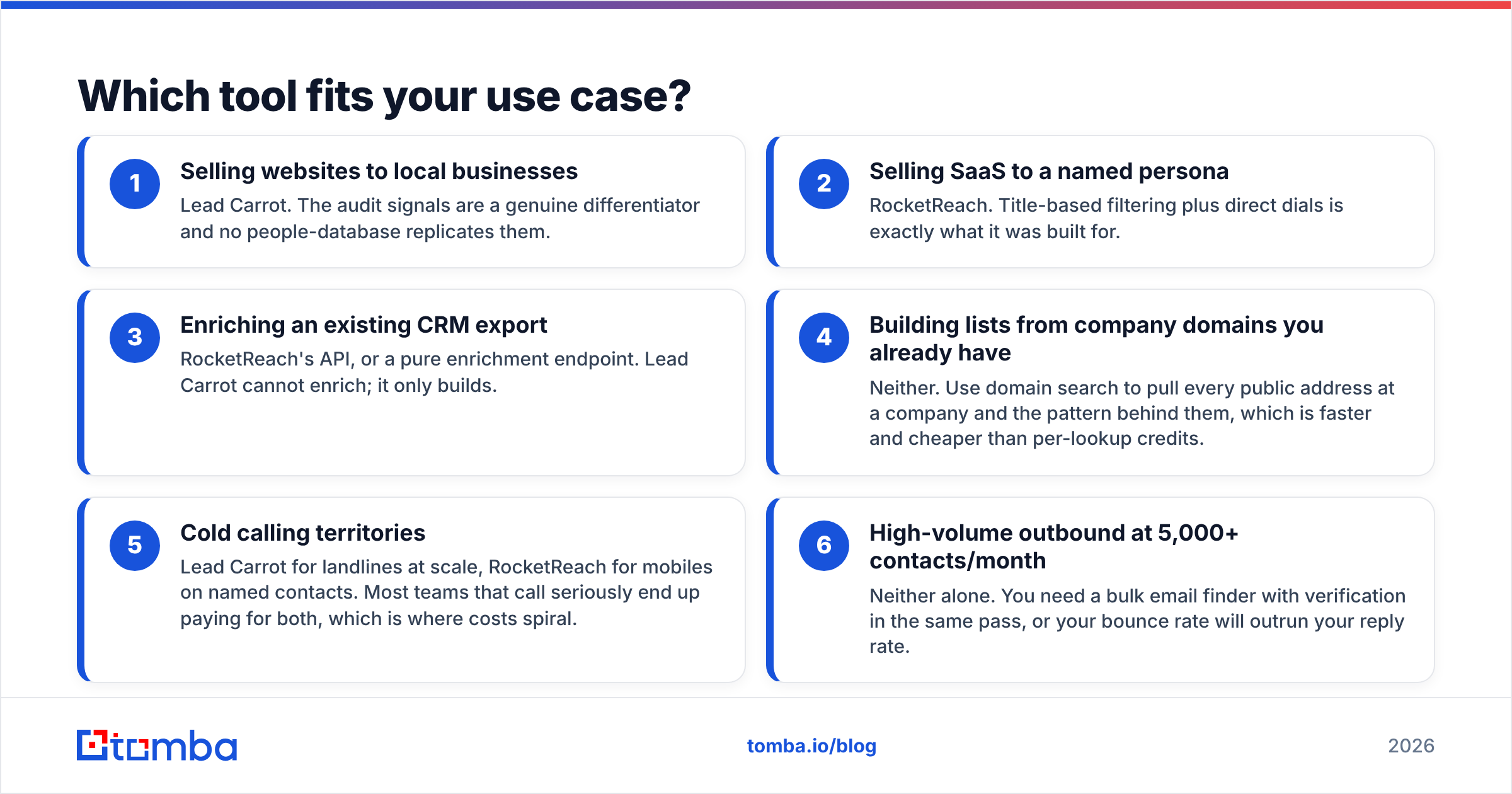
Match the tool to the shape of your target list, not to the feature count:
- Selling websites to local businesses — Lead Carrot. The audit signals are a genuine differentiator and no people-database replicates them.
- Selling SaaS to a named persona — RocketReach. Title-based filtering plus direct dials is exactly what it was built for.
- Enriching an existing CRM export — RocketReach's API, or a pure enrichment endpoint. Lead Carrot cannot enrich; it only builds.
- Building lists from company domains you already have — Neither. Use domain search to pull every public address at a company and the pattern behind them, which is faster and cheaper than per-lookup credits.
- Cold calling territories — Lead Carrot for landlines at scale, RocketReach for mobiles on named contacts. Most teams that call seriously end up paying for both, which is where costs spiral.
- High-volume outbound at 5,000+ contacts/month — Neither alone. You need a bulk email finder with verification in the same pass, or your bounce rate will outrun your reply rate.

Where do both tools fall short?#
Lead Carrot's ceiling is the generic inbox. You can pull thousands of local businesses, but if your offer needs an owner's direct address, you will be doing manual research on top of the export. That research time is real cost, and it scales linearly with list size.
RocketReach's ceiling is credit economics. Users repeatedly report that lookups consume credits even when the returned data is thin, and that plan limits reset in ways that punish bursty prospecting. It's a fine tool when your rep pulls 30 contacts a day; it's an expensive one when RevOps needs 10,000 enrichments before a quarterly campaign.
Both share a verification gap. Neither is primarily a deliverability product. Their job ends when a string that looks like an email appears on screen. Yours begins there. If you are sending from a domain you care about, treat every exported address as unverified until an independent checker says otherwise — start with a free email checker on a sample before you trust a full export.
Both also struggle with the same edge cases: recently-changed roles, companies using non-obvious email patterns, and catch-all domains that accept everything and deliver nothing.
What are the alternatives worth testing?#
If the head-to-head above didn't produce an obvious winner, that's usually a sign your actual requirement is "accurate work emails, at volume, without two subscriptions."

Worth putting in the same trial cycle:
- Tomba — email finder plus verifier, domain search, catch-all handling and phone lookup in one plan. Starter is $49/mo, Growth $99/mo, Pro $249/mo, and there's a free tier at 25 searches. See the RocketReach alternative breakdown for a feature-by-feature view.
- BookYourData — a strong pay-as-you-go option if you prefer buying verified lists outright rather than renting database access. Useful when your buying committee won't approve a recurring seat.
- Apollo — bundles data with sequencing, which is either a huge simplification or vendor lock-in depending on your stack.
For teams with engineers, the deciding factor is often programmatic access. A documented email finder API means enrichment runs inside your pipeline on a schedule instead of a human exporting CSVs every Monday. Lead Carrot cannot do this at all; RocketReach can, but the credit model makes automated enrichment expensive to leave running.
So which one should you buy?#
Buy Lead Carrot if your list is defined by a map. Local services, geographic territories, audit-led pitches. Nothing in RocketReach's product replaces the "this dentist has no mobile site" hook.
Buy RocketReach if your list is defined by a job title. Named professionals at identifiable companies, especially when you need mobile numbers for a calling motion.
Buy neither if what you actually need is accurate work emails at volume. That's a finder-and-verifier problem, not a database-subscription problem, and paying database prices for it is how outbound budgets quietly double.
Run all three on the same 100-row test list. Same ICP, same week, same verification standard. Count how many contacts survive to a delivered email and a named decision-maker. That number — not the feature grid — settles the argument.
Start with the list you already have. Take 25 target company domains, run them through the Tomba Email Finder on the free tier, and check the verified match rate against whatever Lead Carrot or RocketReach returns for the same set. If Tomba's verified output beats theirs on your own ICP, the $49/mo Starter plan replaces a subscription costing twice as much — and the verification is already in the box.
Related guides#
Ready to find emails that actually work?
Join 150,000+ professionals who stopped guessing and started sending. Free credits on signup — no credit card required.
Get the Tomba newsletter
Practical outbound tactics and product updates — once every two weeks.
About the author