Lead Carrot vs Seamlessai: Which B2B Data Tool Wins in 2026?
Lead Carrot vs Seamlessai, compared on data accuracy, real pricing, and export limits. Lead Carrot sells flat-fee local lists. Seamless.AI sells an AI contact engine on credits. Plus where a dedicated email finder beats both.
Lead Carrot vs Seamlessai is the wrong fight for most buyers. One tool sells local business lists. The other sells an AI contact engine for B2B sales teams. Here is what each one does well, where each one breaks, and what to buy if you only need emails that land.
TL;DR
- Lead Carrot is a flat-fee list builder for local businesses. It fits agencies that sell to plumbers, dentists, and restaurants. It is not a tech contact database.
- Seamless.AI is an AI contact engine for B2B sales. It claims a huge record count and adds intent and enrichment tools. It also runs on credits and annual deals, which many teams find rigid.
- The two are barely rivals. The real choice is local SMB prospecting or mid-market B2B prospecting.
- Both fail at the same point: verified, deliverable email addresses at the moment you send. Lists go stale fast.
- If your problem is bounce rate rather than list size, a finder and verifier stack is cheaper. Tomba starts free at 25 searches a month, then $49/mo.
Lead Carrot vs Seamlessai: what does each tool do?#
Short answer: one sells a static map of local businesses. The other sells a search engine that builds contact records on the fly.
Lead Carrot is a lead database for agencies and local-service sellers. You pick a business type and a place — "chiropractors in Phoenix," "roofers in Leeds." It returns businesses with a website, phone, social profiles, and often a generic or owner email.
The packaging is the pitch. You pay a flat monthly fee with generous export limits instead of per-record credits. You also get filters that agencies care about. Does the site have a Facebook pixel? Is it mobile friendly? Is there a chat widget?
That filter set is the real product. You are not buying contacts. You are buying reasons to rule a business in or out.
Seamless.AI works the other way around. It does not ship a fixed dataset. It searches the public web live, then uses AI to build and check each contact record on demand. Its own product site leans on the "real-time search engine" framing. The platform wraps enrichment, buyer intent, a Chrome extension, and writing tools around that search.
It sells mostly to SaaS, staffing, and mid-market B2B teams. Those teams need named decision-makers at named accounts.
The practical split is simple. Lead Carrot answers "who are all the HVAC firms within 40 miles?" Seamless.AI answers "who runs revenue operations at these 300 software companies?" Very few teams need both.
Lead Carrot vs Seamlessai: how do they compare head-to-head?#
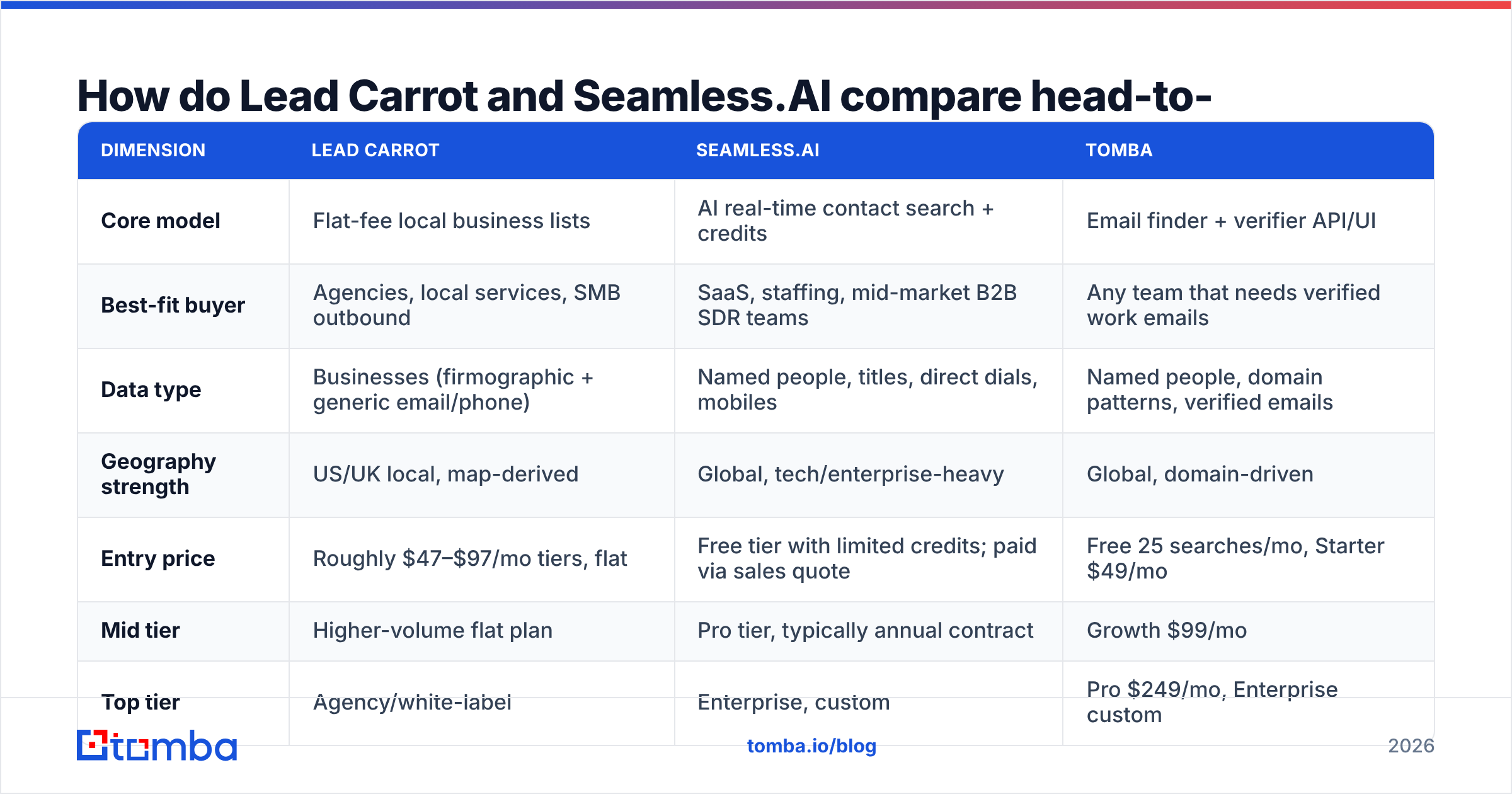
Here is the comparison that drives the decision. Published prices move, so check both vendor pages before you sign. Seamless.AI in particular quotes through sales for anything above the free tier.
| Dimension | Lead Carrot | Seamless.AI | Tomba |
|---|---|---|---|
| Core model | Flat-fee local business lists | AI real-time contact search + credits | Email finder + verifier API/UI |
| Best-fit buyer | Agencies, local services, SMB outbound | SaaS, staffing, mid-market B2B SDR teams | Any team that needs verified work emails |
| Data type | Businesses (firmographic + generic email/phone) | Named people, titles, direct dials, mobiles | Named people, domain patterns, verified emails |
| Geography strength | US/UK local, map-derived | Global, tech/enterprise-heavy | Global, domain-driven |
| Entry price | Roughly $47–$97/mo tiers, flat | Free tier with limited credits; paid via sales quote | Free 25 searches/mo, Starter $49/mo |
| Mid tier | Higher-volume flat plan | Pro tier, typically annual contract | Growth $99/mo |
| Top tier | Agency/white-label | Enterprise, custom | Pro $249/mo, Enterprise custom |
| Credit rollover | N/A (flat exports) | Generally no; unused credits expire | Plan-based monthly allowance |
| Contract flexibility | Month-to-month typical | Annual commitment common | Monthly, cancel anytime |
| Real-time verification | Minimal | Basic validation | Dedicated SMTP + catch-all verification |
| API access | Limited | Available on higher tiers | Full Tomba API on all paid tiers |
Read that table as three lanes, not two. Lead Carrot and Seamless.AI rarely chase the same deal. Both compete with a third option: build the list yourself with a finder and a verifier.
Lead Carrot vs Seamlessai: which one has better data accuracy?#
Neither wins outright. They fail in different ways.
Lead Carrot pulls from business listings and website crawls. Company fields hold up well: name, address, phone, category, website. Businesses publish those, and they rarely change.
The weak spot is the person. You often get info@, contact@, or a form link instead of the owner's inbox. Generic inboxes still work for local outbound. The owner of a five-person roofing firm does read info@. But reply rates drop fast once a receptionist stands in the way.
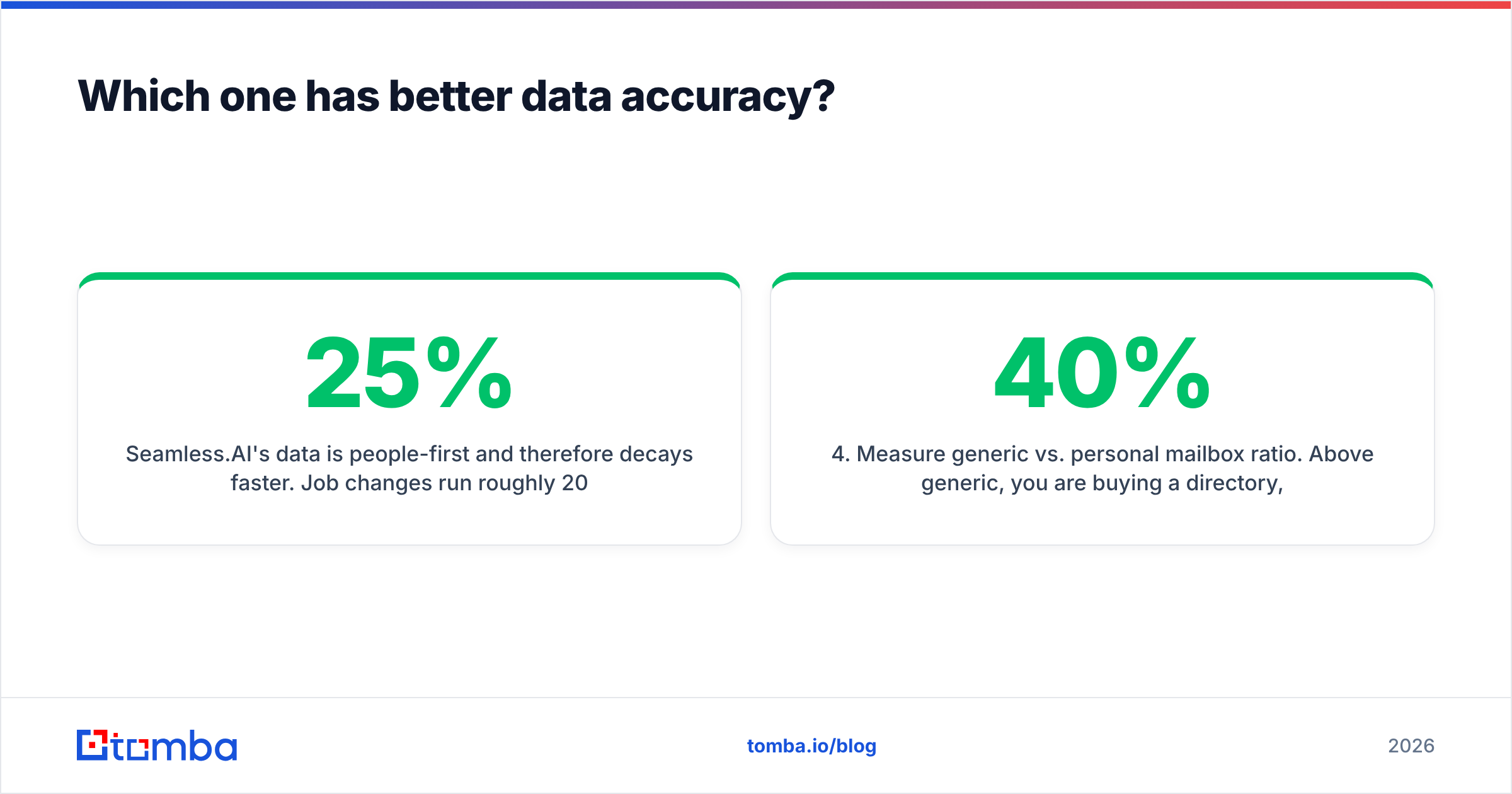
Seamless.AI is people-first, so its data ages faster. Job changes run about 20–25% a year in B2B sales roles. Any record built from a stale source inherits that rot.
Reviews on G2 split along the same line. Reps like the volume and the Chrome extension. The repeat complaint is bounced sends and credits burned on records that turn out to be wrong.
Vendors in this category advertise 95%+ accuracy. Real bounce tests on live sends land lower. The gap is worst on mobile numbers and at companies with catch-all mail servers.
That last point matters more than most buyers think. A catch-all domain accepts every address, so simple checks mark bad guesses as "valid." You learn the truth after your sequence sends, and your domain reputation takes the hit. That is why a catch-all verifier is its own product. Never assume a list tool's "verified" flag means what you think it means.
Four accuracy checks to run before you buy either tool:
- Pull a 100-record sample in your real ICP, not the vendor's demo vertical.
- Run it through an independent email verifier and count hard-invalid and catch-all records apart.
- Check title freshness against LinkedIn for 20 random rows. Anything over 18 months stale points to a refresh problem.
- Measure generic vs. personal inbox ratio. Above 40% generic, you bought a directory, not a contact list.
Is Lead Carrot better than Seamless.AI for agencies?#
Yes, if your agency sells to local businesses. It is not close.
The reason is the filter set. Lead Carrot lets you search for businesses that are missing something. No SSL certificate. No mobile site. No Google Business profile. No reviews in six months.
If you sell web design, SEO, or reputation work, that is your whole qualification list written as a query. Seamless.AI has no match for it. It can name the marketing director at a 3,000-person firm, which helps nobody selling to a dentist who also answers the phone.
The flat fee adds to the edge. Agency prospecting is high volume and low value per record. You might pull 5,000 businesses to find 40 worth a call. Paying per credit for that hurts. A flat plan with near-unlimited exports fits the math.
Lead Carrot falls down when you move upmarket. Say your ICP shifts from "local dentist" to "regional dental group with a marketing team." Now you need named contacts, and Lead Carrot stops helping. Teams at that point either add Seamless.AI or, for far less money, add a domain search tool that returns every inbox at a company plus its email pattern.
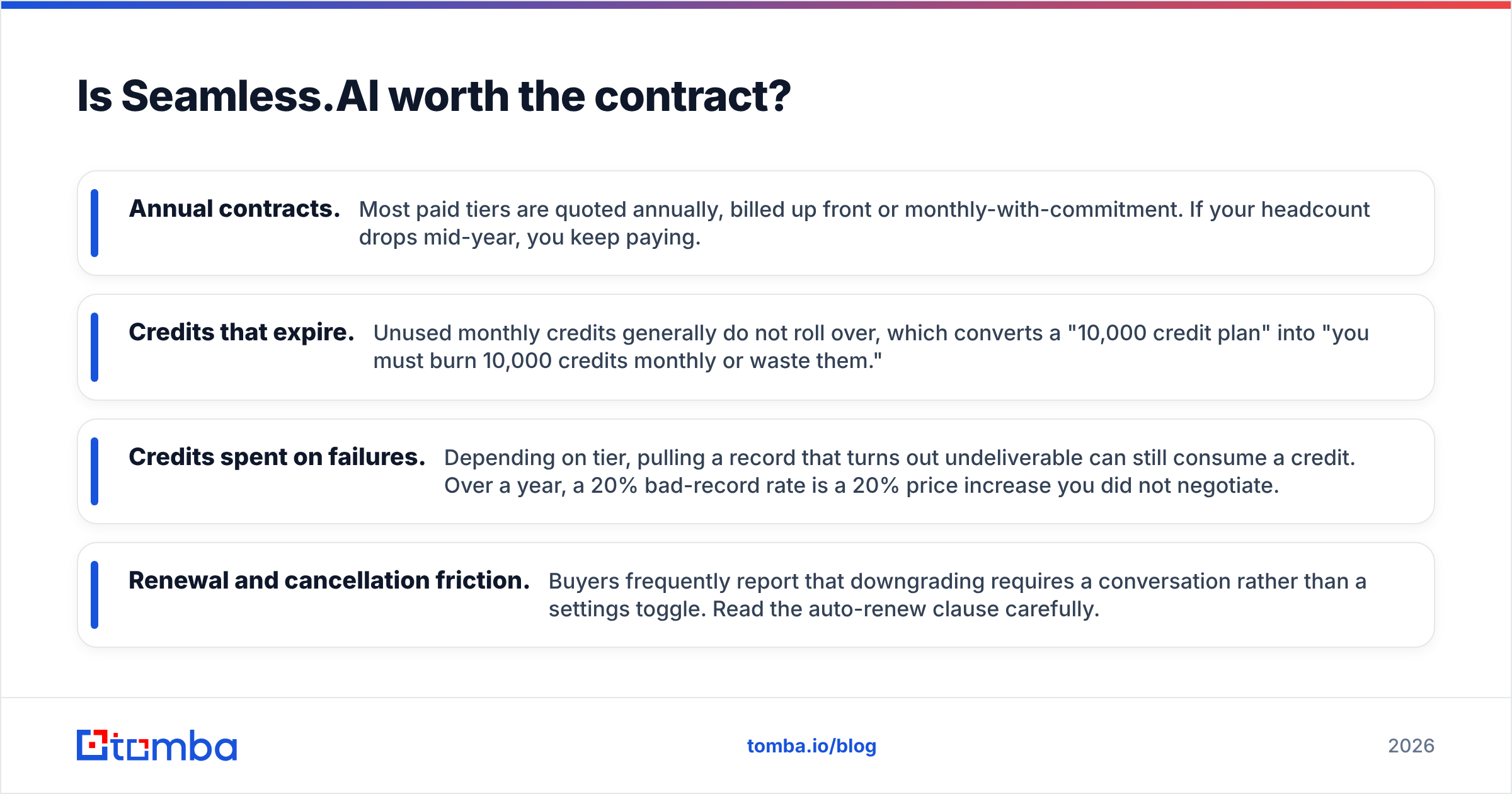
Is Seamless.AI worth the contract?#
It depends on whether you can live with the annual deal and the credit rules.
The strongest case is coverage plus workflow. The Chrome extension lets a rep enrich a LinkedIn profile without leaving the tab. Intent data flags accounts in market. The writer tool drafts the first email. For a 10-rep SDR team, that bundle really does replace three subscriptions.
The friction shows up in the same places across review sites and buyer forums:
- Annual contracts. Most paid tiers are quoted by the year. If your headcount drops mid-year, you keep paying.
- Credits that expire. Unused monthly credits rarely roll over. A "10,000 credit plan" means you burn 10,000 credits a month or waste them.
- Credits spent on failures. On some tiers, a bad record still costs a credit. Over a year, a 20% bad-record rate is a 20% price rise you never agreed to.
- Renewal friction. Buyers report that a downgrade needs a call, not a settings toggle. Read the auto-renew clause closely.
None of that makes it a bad product. It makes it a procurement product. If you are a two-person team testing a market, the shape of the deal is wrong no matter how good the data is. Teams in that spot often pair a lighter tool with a Seamless.AI alternative and keep spend variable until the motion works.

What are the real alternatives to both?#
Here is the honest framing. "Lead Carrot vs Seamlessai" is a false choice. Most buyers land on one of them after naming a symptom instead of the real problem.
Symptom: "I can't find local businesses to call." Look at Lead Carrot, Google Maps scrapers, or a data seller like BookYourData. It sells pay-as-you-go verified B2B lists with no subscription. That fits when you want to buy one defined list rather than rent a platform.
Symptom: "I can't find the right person at a target account." Look at Seamless.AI, Apollo, or ZoomInfo, based on budget. Apollo bundles sequencing. ZoomInfo wins on coverage and loses on price.
Symptom: "I have the companies, I just need emails that land." This is the most common case and the cheapest to fix. You already know your accounts from your CRM, a conference list, a funding round, or a rival's customer page. You do not need a database subscription. You need an email finder that turns a name plus a domain into a verified address, plus bulk verification before you load the sequence.
That third path is where the money leaks. Teams buy a $12,000 a year platform to fix a 9% bounce rate. A finder and verifier stack costs a fraction of that. It also works with any list you already own, including exports from either tool here.
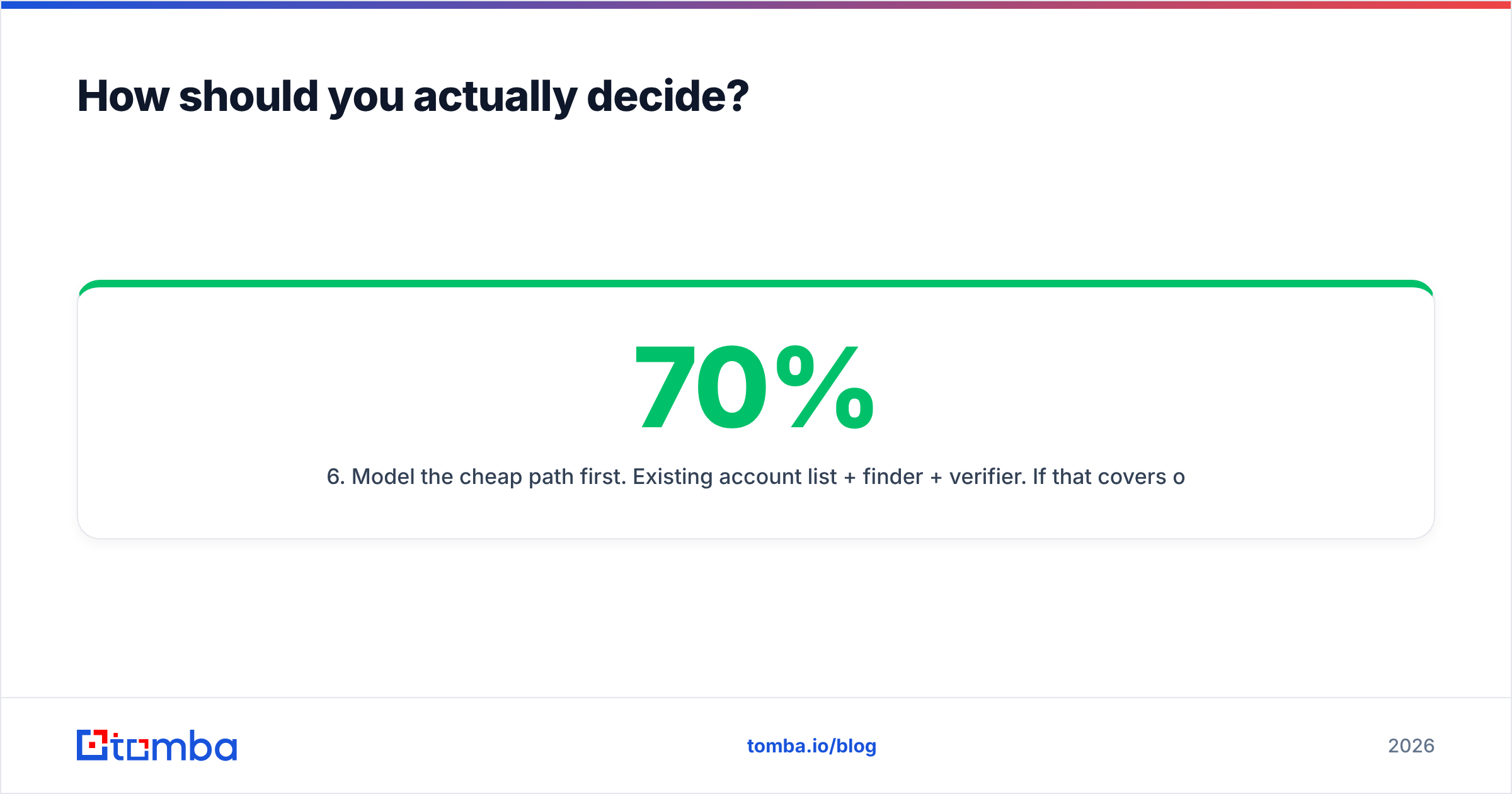
Lead Carrot vs Seamlessai: how should you decide?#
Run these steps in order. It takes an afternoon and saves you a year of regret.
- Write your ICP in one sentence. A local trade or a radius points to Lead Carrot. A job title and a company size band point to Seamless.AI.
- Count the records you need each month. Under 2,000, credits are fine and flat fees cost too much. Over 20,000, flat fees win.
- Test deliverability first. Export the trial data, verify it yourself, and measure the usable share. Compare cost per usable record, not cost per record.
- Get the contract terms in writing. Term length, auto-renew window, credit rollover, per-seat pricing, and what happens to your exports if you cancel.
- Decide if you buy data or workflow. If sequencing, intent, and the extension are the draw, price them on their own. You may already own them.
- Model the cheap path first. Your account list plus a finder plus a verifier. If that covers 70% of the need, the platform is a $10K fix for a $600 problem.
One more thing to check either way: your own sending setup. Perfect data still lands in spam if your SPF record is wrong or your domain is cold. HubSpot's research on email deliverability benchmarks shows what normal looks like before you blame a vendor.
Frequently asked questions#
Does Lead Carrot have a free trial? Lead Carrot has offered a low-cost trial rather than a permanent free tier. Check current terms on their site. Trial structures in this category change often.
Does Seamless.AI have a free plan? Yes. It is a limited free tier with a small monthly credit allowance. That is enough to test data quality on a sample, which is exactly what you should do with it.
Can I use both together? You can, but the overlap is near zero. You would pay two subscriptions for two motions. If you truly run local and enterprise outbound, ask whether one finder layer over both lists is simpler.
In Lead Carrot vs Seamlessai, which has better email accuracy? Neither publishes audited numbers. In practice, Lead Carrot returns more generic inboxes. Seamless.AI returns more personal inboxes with a higher stale rate. Verify both before you send.
What about phone numbers? Seamless.AI is stronger on direct dials and mobiles. Lead Carrot returns published business lines. If dialing is your main motion, test mobile connect rates. A dedicated phone finder often beats a bundled field.
The bottom line#
Lead Carrot vs Seamlessai comes down to your lane. Lead Carrot wins for local prospecting by agencies. Seamless.AI wins for named-account B2B prospecting by SDR teams with budget and a procurement process. Both are fine inside their lane. Both are the wrong buy if your real problem is that the emails you already have keep bouncing.
If that sounds like you, start narrow instead of broad. The Tomba Email Finder turns a name and a domain into a verified, deliverable address. The free tier gives you 25 searches a month to test against your own list. Paid plans run $49/mo for Starter and $99/mo for Growth, month to month, with no annual lock-in.
Run your current prospect list through it and measure the bounce rate you actually get. Let that number decide whether you need a database subscription at all. Check full Tomba pricing before you sign anything longer than a month.
Related guides#
// get started
Find, verify and enrich your first contacts today
Start on the free plan with 25 searches a month, then scale when your team is ready.
Free plan · No credit card required · GDPR & CCPA
Get the Tomba newsletter
Product and data updates
// about the author