Lead Development Representative: Role, Pay, and Workflow
An LDR is not a junior SDR. Here is what the lead development representative role actually owns in 2026, how it differs from SDR and BDR, what it pays, and the exact daily workflow that makes it work.
TL;DR
- A lead development representative (LDR) works the inbound side of the funnel: they qualify, enrich, and route leads that already raised a hand, rather than cold-prospecting from scratch.
- The LDR vs SDR line is about lead source, not seniority. SDRs generate demand outbound; LDRs convert existing demand into meetings.
- US base pay for LDRs in 2026 typically runs $48K–$62K base / $65K–$85K OTE — below an experienced SDR, above a marketing coordinator.
- The role only pays for itself when your inbound volume clears roughly 150–300 qualifying-worthy leads per month. Below that, give the leads to an SDR.
- The single highest-leverage LDR upgrade is data enrichment before the first touch — a form fill with a personal Gmail and no company context is a dead lead until you resolve it.
What Is a Lead Development Representative?#
A lead development representative is the person who decides whether a raised hand is worth a rep's calendar slot.
Think of your funnel as an emergency room. Marketing is the front door — it brings people in. Account executives are the surgeons — expensive, scheduled, and you do not want them triaging walk-ins. The LDR is the triage nurse: they take everyone who walked through the door, ask a short set of questions, pull the chart, and decide who goes to surgery, who goes to the waiting room, and who should have gone to a pharmacy instead.
Concretely, the LDR owns the window between "lead enters the CRM" and "meeting is accepted on an AE's calendar." That covers:
- Speed-to-lead response — first touch on new inbound within minutes, not hours. Response inside five minutes is still the single biggest lever on inbound conversion, and it has been since the original Lead Response Management study.
- Enrichment and identity resolution — turning
jsmith@gmail.com, company: "—"into a named person at a named company with a real work email, title, and headcount band. - Qualification against a written rubric — fit (ICP match), intent (what they did), and authority (can they buy or influence).
- Routing and handoff — assigning to the right AE with context attached, not just a lead owner change.
- Nurture recycling — sending the "not now" leads back to marketing with a reason code instead of letting them rot at Working status.
- Feedback to demand gen — reporting which campaigns produce leads that book and which produce leads that ghost.
That last one is why LDRs sit in a strange org position. Most report to marketing or to a demand-gen leader, not to a sales manager, even though their output is measured in sales meetings. That reporting line is the defining structural feature of the role.

Is an LDR Different From an SDR or a BDR?#
Yes, and conflating them is how teams end up paying SDR comp for inbound triage work.
The titles are used loosely across the industry, but in companies that run both functions, the split is consistent and it is based on where the lead came from.
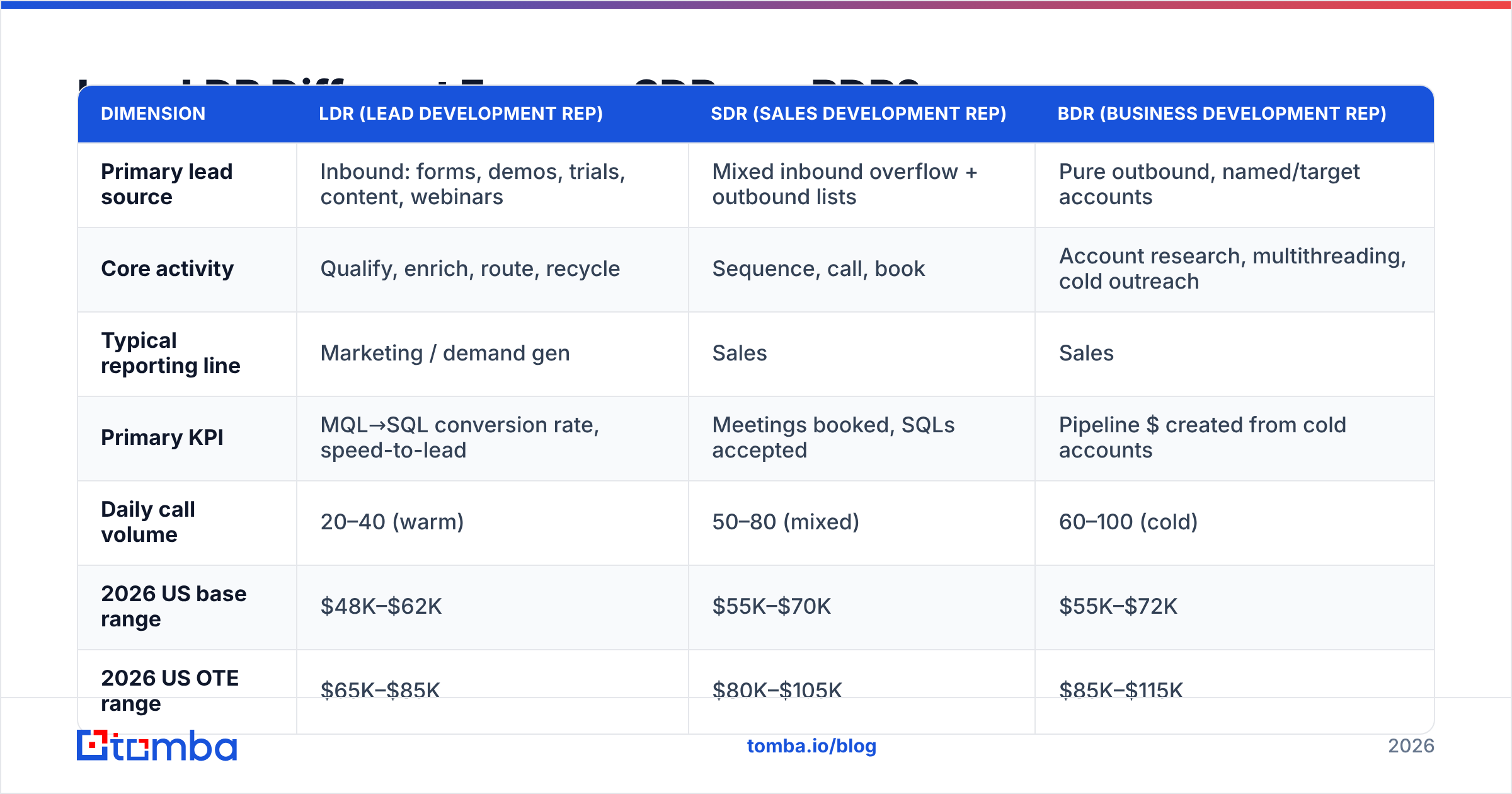
| Dimension | LDR (Lead Development Rep) | SDR (Sales Development Rep) | BDR (Business Development Rep) |
|---|---|---|---|
| Primary lead source | Inbound: forms, demos, trials, content, webinars | Mixed inbound overflow + outbound lists | Pure outbound, named/target accounts |
| Core activity | Qualify, enrich, route, recycle | Sequence, call, book | Account research, multithreading, cold outreach |
| Typical reporting line | Marketing / demand gen | Sales | Sales |
| Primary KPI | MQL→SQL conversion rate, speed-to-lead | Meetings booked, SQLs accepted | Pipeline $ created from cold accounts |
| Daily call volume | 20–40 (warm) | 50–80 (mixed) | 60–100 (cold) |
| 2026 US base range | $48K–$62K | $55K–$70K | $55K–$72K |
| 2026 US OTE range | $65K–$85K | $80K–$105K | $85K–$115K |
| Ramp to full productivity | 3–5 weeks | 6–10 weeks | 8–12 weeks |
| Typical tenure before promotion | 9–14 months | 12–18 months | 12–20 months |
A few things fall out of that table.
LDR is a better entry point than SDR. Shorter ramp, warmer conversations, faster feedback loops. Teams that hire LDRs first and promote into SDR roles get reps who already understand the ICP and the CRM before they have to cold call. The promotion path LDR → SDR → AE is a real, functioning ladder at most mid-market SaaS companies.
LDR is not "SDR-lite." The skill set overlaps but does not match. An LDR who is great at rubric discipline and fast disqualification may be mediocre at cold outbound, and that is fine — you are optimizing different things. Ask any sales automation leader who has tried to convert their whole inbound team to outbound in a quarter.
The comp gap is real and defensible. Outbound is harder, so it pays more. If you pay LDRs at SDR rates, your best LDRs will just ask to move outbound, which is exactly what you wanted anyway — but pay for the move, not before it.
When Does Hiring an LDR Actually Make Sense?#
Hire an LDR when inbound volume is high enough to be a bottleneck, but not so qualified that AEs can take it raw.
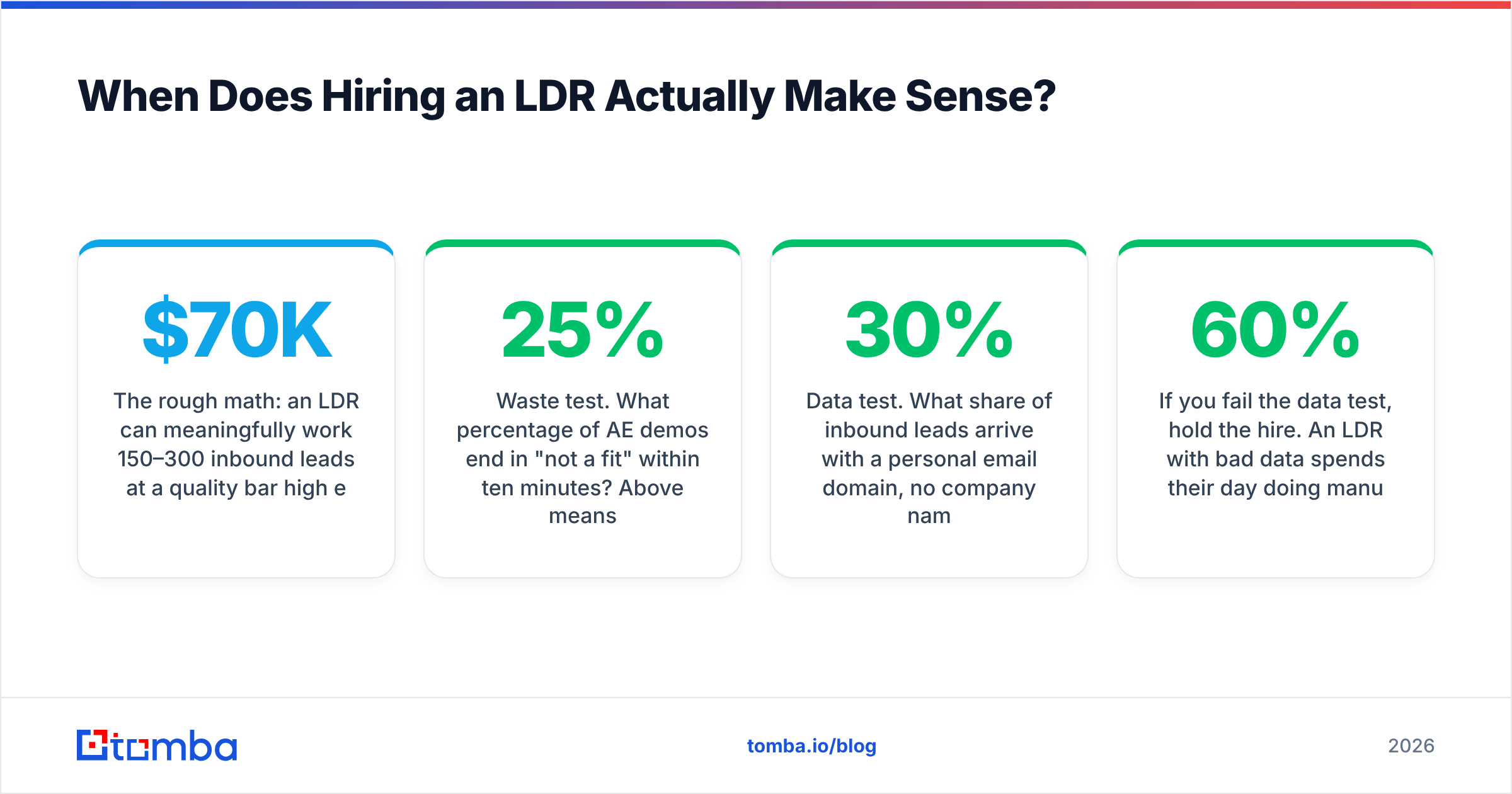
The rough math: an LDR can meaningfully work 150–300 inbound leads per month at a quality bar high enough to matter. Fewer than that and you are paying $70K for someone who is idle by Wednesday. More than 400 and you either need a second LDR or better scoring upstream.
Run this check before you open the req:
- Volume test. Are you getting 150+ hand-raises a month that are not auto-qualified? If no, your AEs or an existing SDR can absorb them.
- Latency test. What is your median time from form fill to first human touch? If it is over an hour, you have an LDR-shaped problem regardless of volume.
- Waste test. What percentage of AE demos end in "not a fit" within ten minutes? Above 25% means triage is missing.
- Data test. What share of inbound leads arrive with a personal email domain, no company name, or a blank title? Above 30% and your bottleneck is enrichment, not headcount — fix the data layer first.
- Recycle test. How many leads sit in "Working" status for more than 30 days? A pile of stale Working leads is the clearest signal nobody owns the middle of the funnel.
If you fail the data test, hold the hire. An LDR with bad data spends their day doing manual research instead of talking to humans, which is the single most common way this role fails. Fix identity resolution first — a data enrichment pass on inbound records typically recovers 40–60% of the "unknown company" leads that would otherwise be manually researched or ignored.
What Does an LDR's Day Actually Look Like?#
The good version of this job is 60% conversation and 40% system work. The bad version inverts that.
Here is a workable structure for an LDR working a mid-market inbound motion:
8:30–9:00 — Overnight queue triage. Everything that came in after hours gets scored, enriched, and prioritized. High-intent (pricing page + demo request) goes to the top of the call list. Low-intent (ebook download from a personal Gmail) goes to nurture or to an enrichment queue.
9:00–11:30 — Speed block one. Call and email the fresh queue. Live inbound that arrives during this window jumps the line and gets called inside five minutes, every time. Nothing outranks a fresh hand-raise.
11:30–12:30 — Enrichment and research. Clear the records the automated pass could not resolve. This is where a bulk email finder run against the morning's unresolved list beats forty tabs of LinkedIn.
1:00–3:30 — Speed block two. Second attempts, callbacks, booked-meeting confirmations, and multithreading on accounts where the form-filler is clearly not the buyer.
3:30–4:30 — Recycle and handoff hygiene. Disposition everything touched today. Write the handoff notes AEs will actually read: what they did on the site, what they said on the phone, what they are trying to solve, and what they are using today.
4:30–5:00 — Loop-back. Flag campaigns producing junk. Two lines in Slack to demand gen beats a monthly report nobody opens.
Notice what is not on that list: building lists, writing cold sequences from scratch, and prospecting into accounts that have never heard of you. That is SDR work. If it creeps into the LDR's calendar, your titles have drifted.
How Do You Measure a Lead Development Representative?#
Measure conversion and latency, not activity.
Activity metrics (dials, emails sent) are useful for coaching a new hire in week two and actively harmful after week eight. An LDR optimizing for dial count will burn through the queue without enriching anything, and your MQL→SQL rate will quietly sink.
The metrics that matter:
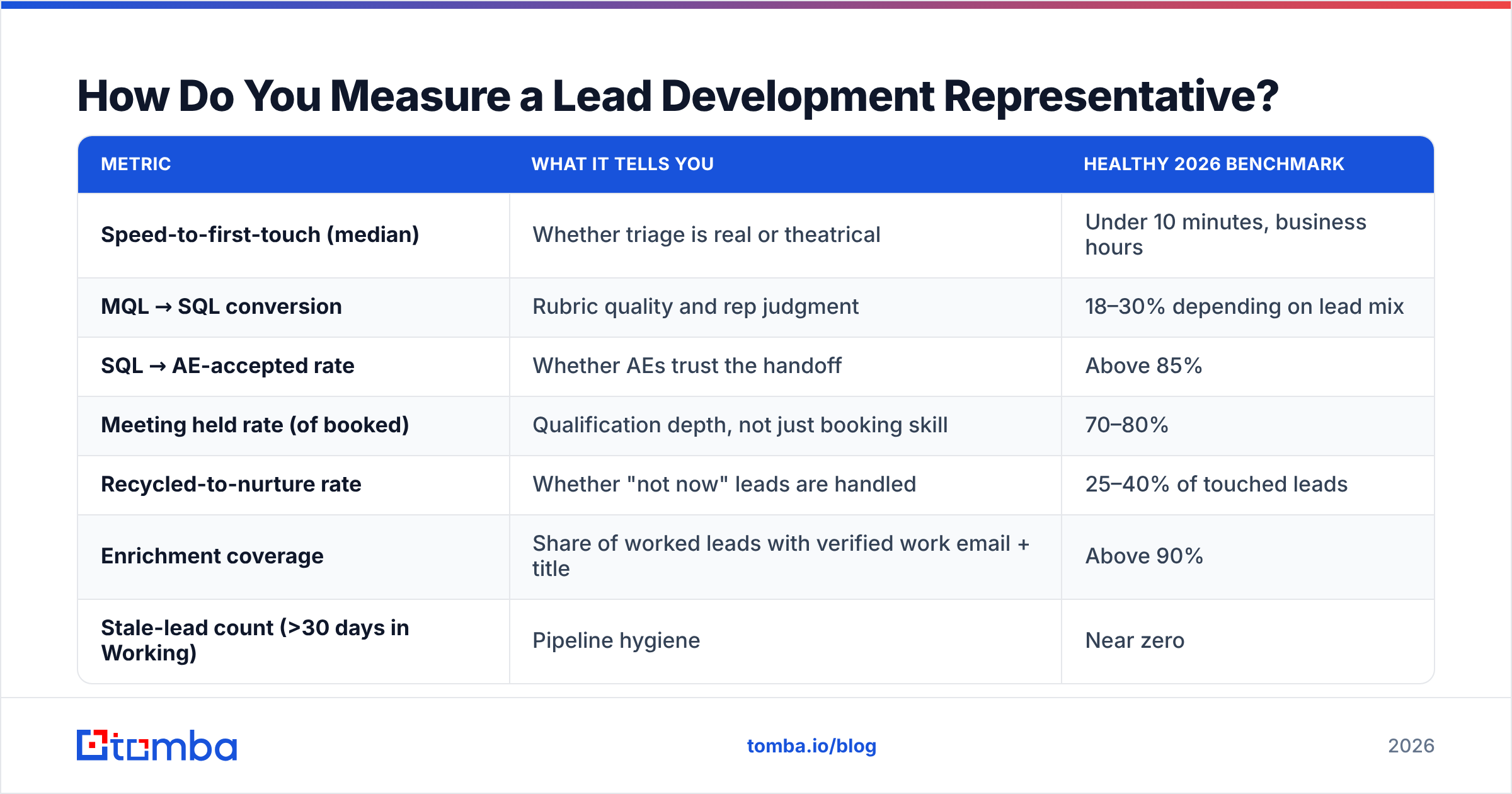
| Metric | What it tells you | Healthy 2026 benchmark |
|---|---|---|
| Speed-to-first-touch (median) | Whether triage is real or theatrical | Under 10 minutes, business hours |
| MQL → SQL conversion | Rubric quality and rep judgment | 18–30% depending on lead mix |
| SQL → AE-accepted rate | Whether AEs trust the handoff | Above 85% |
| Meeting held rate (of booked) | Qualification depth, not just booking skill | 70–80% |
| Recycled-to-nurture rate | Whether "not now" leads are handled | 25–40% of touched leads |
| Enrichment coverage | Share of worked leads with verified work email + title | Above 90% |
| Stale-lead count (>30 days in Working) | Pipeline hygiene | Near zero |
The two I would watch hardest are SQL → AE-accepted and meeting held rate. Together they tell you whether the LDR is qualifying or just forwarding. A rep who books a lot of meetings that nobody shows up to is producing negative value — they are consuming AE calendar slots and training your sales team to ignore inbound.
For a shared definition of the handoff boundary, keep your marketing qualified lead criteria written down and versioned. Undocumented rubrics are how sales and marketing end up arguing about lead quality for three quarters straight.

What Tools Does an LDR Need?#
Fewer than vendors will tell you, but the data layer is non-negotiable.
A functional LDR stack has four pieces:
- CRM with routing rules — HubSpot or Salesforce handle this natively. The routing logic matters more than the brand.
- Enrichment and contact resolution — turning partial form data into a complete, reachable record. This is where most inbound motions leak.
- A calling and sequencing tool — for the two-to-three-touch cadence on warm leads. You do not need an enterprise sales engagement platform for a warm inbound motion.
- Intent or visitor signal — optional, but useful when your form volume is low relative to site traffic. Website visitor reveal surfaces accounts that researched you without filling anything out.
On the enrichment piece specifically: the failure mode is not "we have no data," it is "we have a personal email and a first name." The fix is deterministic. Take the company domain (from the form, the email, or the visitor signal), run a domain search to get the company's email pattern and known contacts, resolve the specific person, and then verify before anyone sends anything. Verification matters because a bounced first touch on an inbound lead is worse than no touch — it damages sender reputation on the exact domain your marketing emails also use.
If you are evaluating vendors for that layer, the honest comparison is on three axes: match rate on your specific ICP (not their marketing number), verification quality on catch-all domains, and price per resolved record. Run a 200-row sample through two or three tools against records where you already know the right answer. Peer reviews on G2 are a reasonable starting shortlist, but the sample test is the only thing that settles it. Tomba's Tomba pricing starts with a free tier at 25 searches/month, then $49/mo Starter, $99/mo Growth, and $249/mo Pro — which for a single LDR working 200–300 leads a month usually lands in the Starter or Growth band. BookYourData is a solid alternative if your motion needs pre-built, pay-as-you-go list volume rather than on-demand lookups; the two solve genuinely different problems and plenty of teams run both.
What Are the Most Common Ways the LDR Role Fails?#
Four failure modes account for most of them.
Failure one: the LDR becomes a router with no judgment. If the rubric says "anyone from a company over 50 employees books a meeting," you did not need a human. Either give the LDR real discretion or automate the routing and spend the headcount elsewhere.
Failure two: no shared definition of qualified. Marketing counts MQLs, sales counts accepted meetings, and the LDR is judged on whichever number looks worse this month. Write the definition, get both leaders to sign it, review it quarterly.
Failure three: the enrichment tax. The rep spends three hours a day on manual research because the data layer is broken. Symptom: high activity, low conversation count. Fix: automate resolution before the lead hits the queue, not after.
Failure four: no promotion path. LDR is an entry-level role. If there is no defined move to SDR or AE at 9–14 months, your best people leave at month ten and you restart ramp forever. Publish the criteria on day one.
There is a fifth, softer failure: treating the LDR as a cost center because they do not "create" pipeline. They do — they just create it from demand marketing already paid for, which is the cheapest pipeline in the building. A 5-point improvement in MQL→SQL conversion on 250 leads a month is worth more than most outbound hires, and it costs less.
Should You Hire an LDR in 2026?#
Hire one if inbound is your largest underworked asset. Skip it if your data is broken or your volume is thin.
The role has held up well through the shift toward AI-assisted prospecting, for a specific reason: the hard part of inbound is not writing the message, it is judging intent and resolving identity. Automation has gotten very good at the first and genuinely useful at the second, but a human still closes the gap between "this person downloaded a whitepaper" and "this person has a budget, a timeline, and a problem we solve." That judgment is what you are buying.
The sequencing that works:
- Fix identity resolution and verification on inbound records.
- Write the qualification rubric and get sales and marketing to sign it.
- Measure your current MQL→SQL rate as a baseline.
- Hire the LDR.
- Re-measure at 90 days against the baseline, not against a benchmark from someone else's funnel.
Do it in that order and the hire is defensible in your next board meeting. Do it backwards and you will spend a year arguing about lead quality.
Give your LDR data they can act on. Most inbound leads arrive half-identified — a personal email, a blank company field, a title nobody filled in. Tomba Email Finder resolves those records into verified work emails, company context, and reachable contacts before your rep picks up the phone, so the hour they would have spent in browser tabs goes into conversations instead. Start on the free tier at 25 searches a month, or run a bulk pass across last month's unresolved inbound and see how much pipeline was sitting in records you already paid to acquire.
Related guides#
// get started
Find, verify and enrich your first contacts today
Start on the free plan with 25 searches a month, then scale when your team is ready.
Free plan · No credit card required · GDPR & CCPA
Get the Tomba newsletter
Product and data updates
// about the author