Lead Forensics vs ZoomInfo: Which B2B Data Tool Wins?
Lead Forensics identifies anonymous website visitors. ZoomInfo sells a contact database. They solve different halves of the same problem — and both cost five figures. Here is how they compare, and when a leaner stack beats both.
TL;DR
- They are not the same category. Lead Forensics is a website visitor identification tool. ZoomInfo is a contact and company database with a sales engagement layer bolted on. Comparing them is comparing a motion sensor to a phone book.
- Both are annual-contract, quote-only, five-figure purchases. Neither publishes pricing. Buyer reports on G2 and Capterra cluster Lead Forensics around $8K–$25K/year and ZoomInfo around $15K–$40K+/year depending on seats and modules.
- Lead Forensics wins if your problem is "we get 6,000 monthly visitors and know nothing about them." ZoomInfo wins if your problem is "we need 50,000 verified contacts in a defined ICP, plus intent signals."
- Neither wins on price-per-usable-contact. Both identify companies well and people imperfectly. You still need an email verification step before you send anything.
- A leaner stack often beats both for teams under 20 reps: visitor reveal plus a pay-as-you-go email finder covers 80% of the workflow at roughly 5% of the cost.
What problem does each tool actually solve?#
Start here, because most "Lead Forensics vs ZoomInfo" comparisons skip it and end up comparing feature checklists that do not overlap.
Lead Forensics is a reverse-IP and identity-graph product. It sits on your website, watches anonymous traffic, matches the visitor's network fingerprint against a database of company IP ranges and device signals, and tells you which company just read your pricing page. It is a demand-capture tool. It only works on traffic you already have.
ZoomInfo is a B2B data platform. It sells you a searchable database of roughly 100M+ business contacts and 100M+ company profiles, with filters for title, headcount, tech stack, funding, and intent topics. It is a demand-generation tool. It works whether or not anyone has ever visited your site.
The practical difference:
- Lead Forensics answers "who is already interested?" — high intent, low volume. You might surface 200–600 identified companies a month from typical mid-market traffic.
- ZoomInfo answers "who could be interested?" — low intent, high volume. You can export tens of thousands of matching contacts on day one.
- Lead Forensics gives you companies, not people. It infers the organization from the IP or identity graph. Contact-level data is a secondary lookup, usually generic role-based contacts unless you upgrade.
- ZoomInfo gives you people, not intent. Its intent product (formerly Clickagy-derived) is a bidstream signal, not first-party behavior on your own domain.
- Both need a verification layer. Company-level identification is reliable; the email address attached to a named human is where accuracy collapses in both products.
- Both are sold on annual contracts with auto-renewal clauses that buyers consistently flag in reviews as the biggest post-purchase regret.
If you only read one paragraph: these tools are complements far more often than substitutes. The real question is which one you buy first with a finite budget.

How does Lead Forensics identify anonymous visitors?#
A tracking script fires on page load and captures the visitor's IP address plus a bundle of secondary signals — reverse DNS, ASN, autonomous system ownership, and in newer versions cookie-based and identity-graph matching. That fingerprint is checked against a proprietary database mapping IP ranges to registered businesses.
Where it works well: companies on corporate networks, in offices, with static IP allocations. Think enterprise buyers, government, healthcare, manufacturing, universities.
Where it degrades badly:
- Remote and hybrid workers. A VP of Ops on home fiber resolves to Comcast, not to her employer. Post-2020 this is the single biggest hit to match rates.
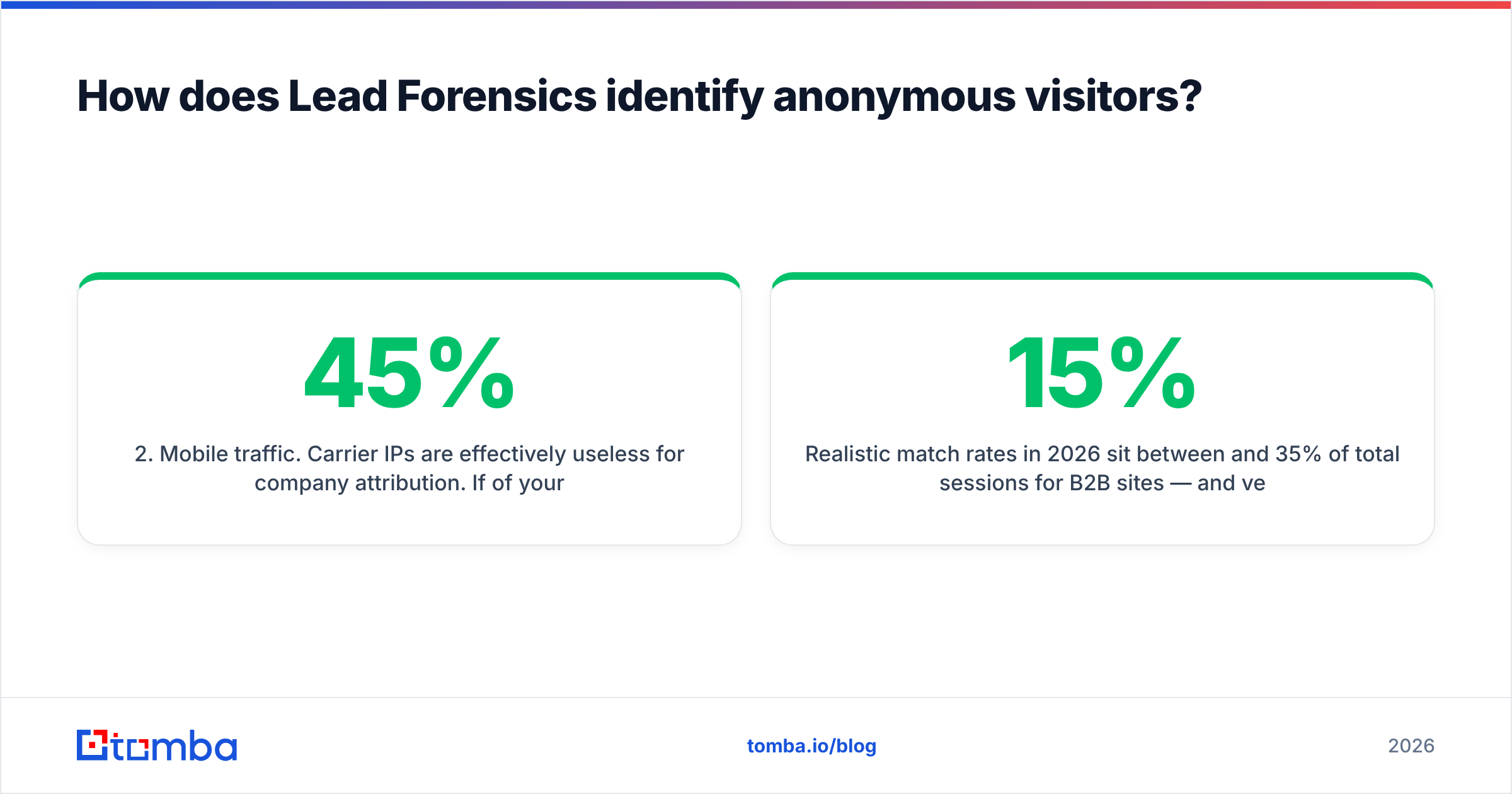
- Mobile traffic. Carrier IPs are effectively useless for company attribution. If 45% of your traffic is mobile, write off most of it.
- VPNs and zero-trust networks. Corporate VPN egress can either help (consistent corporate IP) or actively mislead (cloud egress in a different country).
- Small businesses. Sub-20-person companies on consumer ISP plans rarely appear in IP-to-company databases at all.
Realistic match rates in 2026 sit between 15% and 35% of total sessions for B2B sites — and vendors quoting "we identify up to 70% of your visitors" are quoting the best-case enterprise-traffic scenario, not yours. Run a two-week trial and measure it against your own analytics before signing anything.
The output is a dashboard of company names, firmographics, pages viewed, session duration, and return visits. You then have to find an actual human at that company to contact — which is exactly where an email finder enters the workflow, regardless of which platform you buy.
How does ZoomInfo's database compare?#
ZoomInfo's core asset is scale plus refresh cadence. Data comes from a mix of contributory networks (users install a Chrome extension or sync an inbox and their contact graph flows in), web crawling, public filings, and acquired datasets. That contributory model is the reason coverage of North American mid-market and enterprise is genuinely strong — and the reason coverage of European SMBs and non-English markets is noticeably thinner.
Strengths that hold up under scrutiny:
- Direct dials. ZoomInfo's phone coverage is better than most competitors, which matters if your motion is calling rather than emailing.
- Org charts and reporting lines. Useful for multi-threading enterprise deals.
- Technographics and funding filters. Narrowing to "Salesforce + Marketo + Series B in the last 18 months" is fast and reasonably accurate.
- Workflow depth. Engage (sequencing), Chat, Copilot, and the Salesforce/HubSpot sync mean it can replace three tools at once — if you pay for the modules.
Weaknesses that buyers report consistently:
- Stale records at the person level. With B2B job-change rates running around 20–25% annually, any static database decays fast. Expect a meaningful share of exported emails to be role-changed or departed.
- Credit mechanics. Bulk export credits, seat limits, and module gating make the real cost hard to model before you sign.
- Renewal pressure. This is the most common complaint theme in ZoomInfo reviews on G2 — not data quality, but contract and renewal experience.
Lead Forensics vs ZoomInfo: how do they compare head-to-head?#
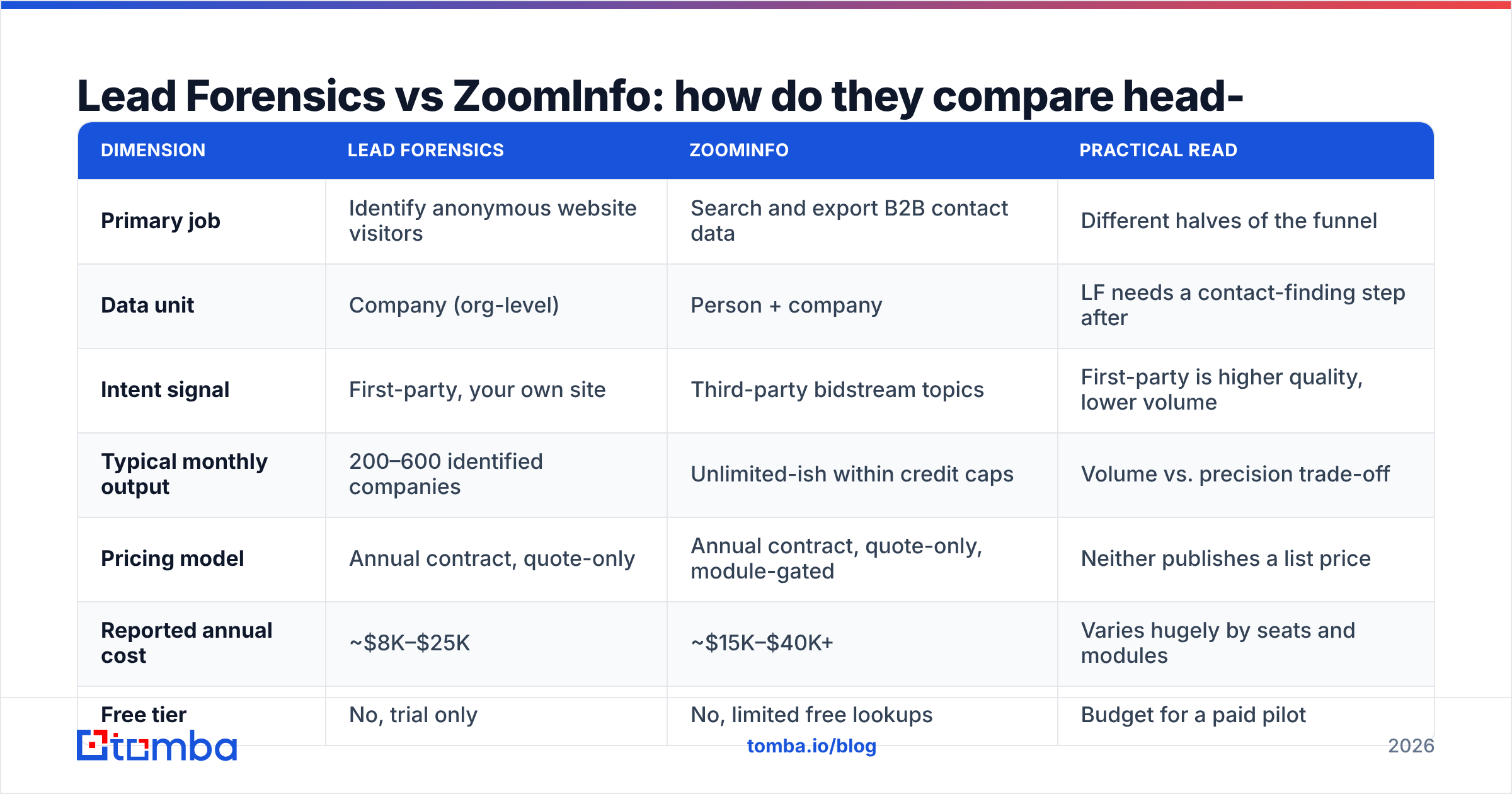
| Dimension | Lead Forensics | ZoomInfo | Practical read |
|---|---|---|---|
| Primary job | Identify anonymous website visitors | Search and export B2B contact data | Different halves of the funnel |
| Data unit | Company (org-level) | Person + company | LF needs a contact-finding step after |
| Intent signal | First-party, your own site | Third-party bidstream topics | First-party is higher quality, lower volume |
| Typical monthly output | 200–600 identified companies | Unlimited-ish within credit caps | Volume vs. precision trade-off |
| Pricing model | Annual contract, quote-only | Annual contract, quote-only, module-gated | Neither publishes a list price |
| Reported annual cost | ~$8K–$25K | ~$15K–$40K+ | Varies hugely by seats and modules |
| Free tier | No, trial only | No, limited free lookups | Budget for a paid pilot |
| Best geography | UK, US, EU enterprise | North America first, EU second | Check your ICP's region in trial |
| Email verification included | Minimal | Basic validity flags | Verify externally either way |
| Contract flexibility | Low — annual, auto-renew | Low — annual, auto-renew | Negotiate opt-out terms up front |
| Time to first value | 2–4 weeks (traffic must accumulate) | Same day | LF is slower to prove ROI |
| Best fit | Sites with 5K+ monthly B2B sessions | Outbound teams with a defined ICP | Traffic-rich vs. traffic-poor |
The table makes the real decision rule obvious: your traffic volume decides it. If you do not have at least 3,000–5,000 monthly business sessions, Lead Forensics has nothing to work with and a database tool is the only rational first purchase. If you have heavy traffic and a small outbound team, Lead Forensics converts existing attention into pipeline faster.
What do they actually cost in 2026?#
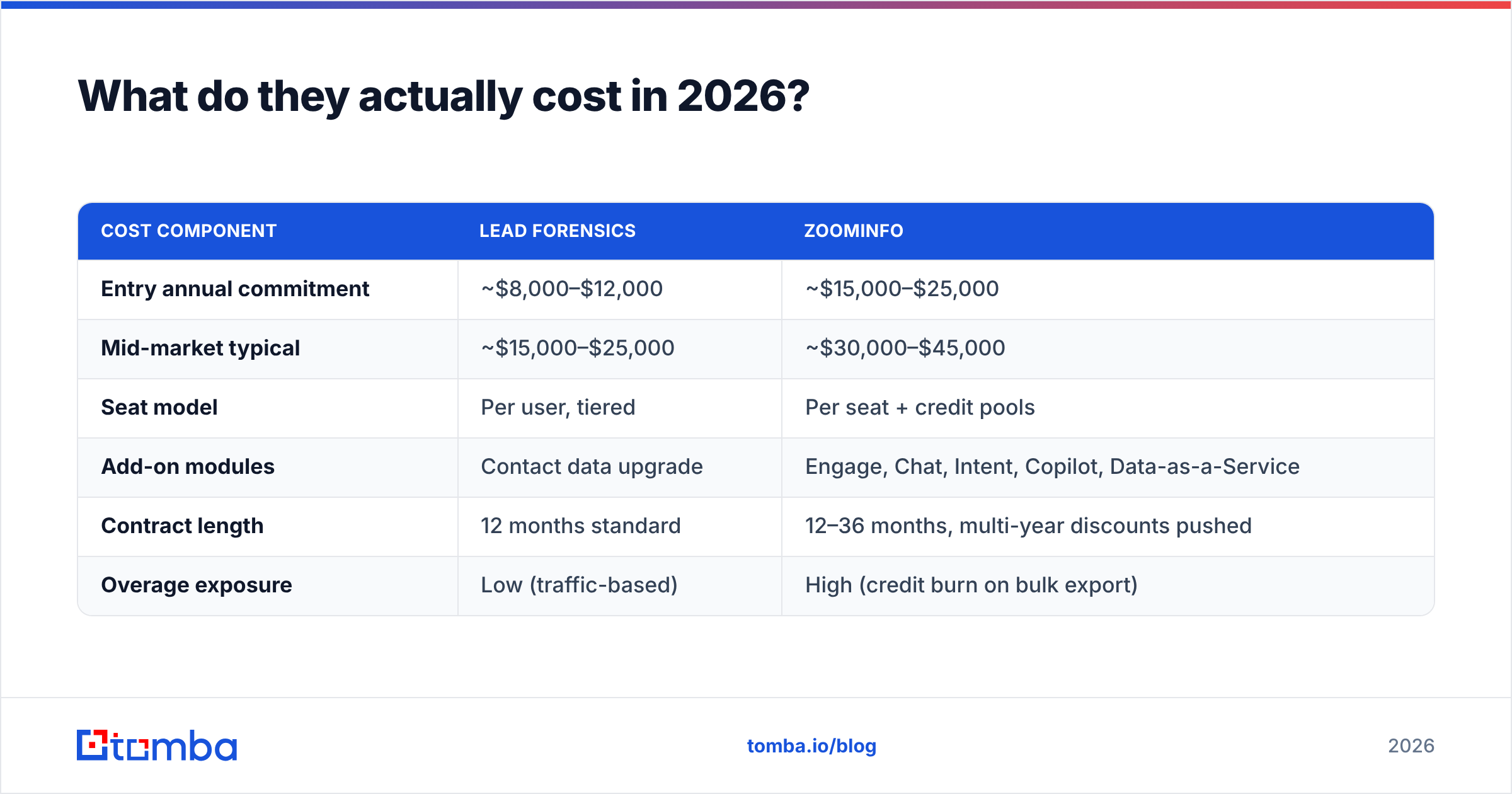
Neither vendor publishes pricing, which is itself a data point about the sales motion you are signing up for. What buyers report:
| Cost component | Lead Forensics | ZoomInfo |
|---|---|---|
| Entry annual commitment | ~$8,000–$12,000 | ~$15,000–$25,000 |
| Mid-market typical | ~$15,000–$25,000 | ~$30,000–$45,000 |
| Seat model | Per user, tiered | Per seat + credit pools |
| Add-on modules | Contact data upgrade | Engage, Chat, Intent, Copilot, Data-as-a-Service |
| Contract length | 12 months standard | 12–36 months, multi-year discounts pushed |
| Overage exposure | Low (traffic-based) | High (credit burn on bulk export) |
Two cost traps worth naming. First, ZoomInfo credit burn: bulk exporting 10,000 contacts to test a segment can consume a quarter's credits in an afternoon. Second, Lead Forensics idle spend: if your site traffic dips or your content engine stalls, you are still paying the annual fee for a dashboard with nothing in it.
Compare that to transparent, usage-based tooling. Tomba pricing runs a free tier at 25 searches/month, Starter at $49/mo, Growth at $99/mo, and Pro at $249/mo. That is not a like-for-like feature comparison — Tomba is not a visitor-ID platform or an intent-data vendor — but it reframes the budget question: a full year of Tomba Pro costs less than one month of a mid-market ZoomInfo contract.

Which one has better data accuracy?#
Different question for each, so answer them separately.
Lead Forensics accuracy means: when it says "Siemens visited your pricing page," was it actually Siemens? Company-level attribution on corporate networks is generally solid — reverse-IP is a mature technique. The failure mode is not false positives so much as silence: the visitors it cannot identify simply never appear. Judge it on coverage, not correctness.
ZoomInfo accuracy means: is this person still in this role, and does this email still deliver? Here the failure mode is the opposite — you get a confident-looking record that is 14 months stale. Any provider selling a static snapshot of a moving population has this problem; ZoomInfo's scale makes it more visible, not uniquely worse.
The operational fix is the same in both cases: never send to an unverified address. Run every extracted contact through an email verifier before it enters a sequence, and treat catch-all domains as a separate bucket requiring a catch-all verifier rather than a coin flip. A 4% bounce rate on a 5,000-address send is enough to damage domain reputation for weeks.
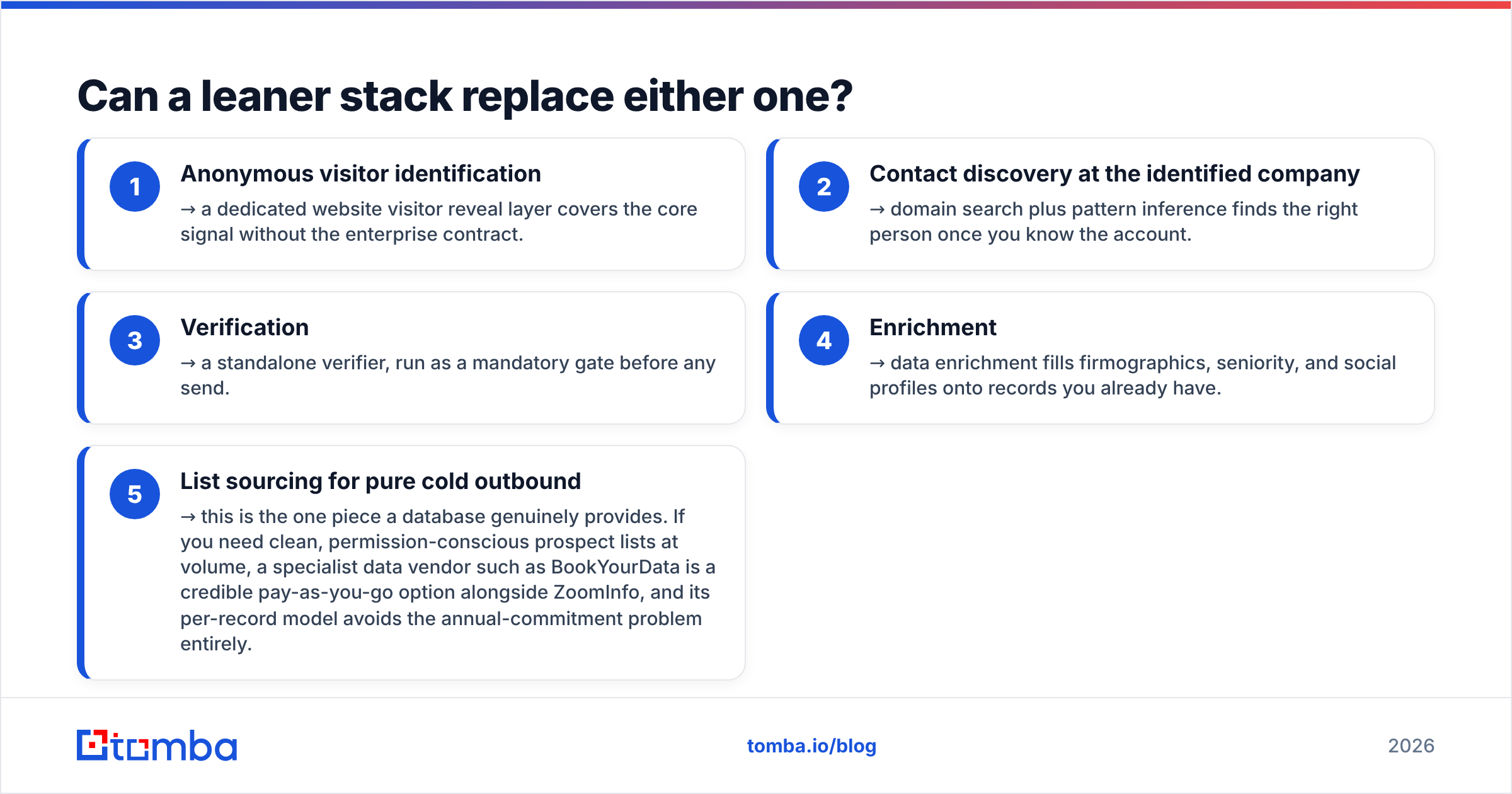
Can a leaner stack replace either one?#
Partly — and honestly, for teams under roughly 20 reps, usually yes.
Deconstruct what you are buying:
- Anonymous visitor identification → a dedicated website visitor reveal layer covers the core signal without the enterprise contract.
- Contact discovery at the identified company → domain search plus pattern inference finds the right person once you know the account.
- Verification → a standalone verifier, run as a mandatory gate before any send.
- Enrichment → data enrichment fills firmographics, seniority, and social profiles onto records you already have.
- List sourcing for pure cold outbound → this is the one piece a database genuinely provides. If you need clean, permission-conscious prospect lists at volume, a specialist data vendor such as BookYourData is a credible pay-as-you-go option alongside ZoomInfo, and its per-record model avoids the annual-commitment problem entirely.
Where the lean stack genuinely loses: org charts for enterprise multi-threading, direct-dial phone density, and third-party intent topics at scale. If those three are core to how you sell, ZoomInfo earns its price and a cheaper stack will frustrate you.
What about GDPR and compliance?#
Both vendors have compliance postures, and both require work on your side.
Lead Forensics processes IP addresses, which EU regulators generally treat as personal data. You need a lawful basis, a cookie/consent banner that accurately describes the tracking, and a privacy policy that discloses visitor identification. Consent-mode changes across major analytics platforms have made this stricter, not looser.
ZoomInfo maintains notification and opt-out mechanisms for the individuals in its database, but as the sender you are the controller for your outreach. Legitimate-interest assessments, suppression lists, and one-click unsubscribe on cold B2B email are your responsibility, not the data vendor's. Review the current GDPR overview with your counsel rather than relying on a vendor's compliance badge.
Practical rule: whichever tool you buy, keep a suppression list, honor opt-outs across every system, and never treat "the vendor is compliant" as meaning "my campaign is compliant."
So which should you choose?#
Choose Lead Forensics if you run 5,000+ monthly business sessions, your ICP skews toward office-based enterprise buyers, and your bottleneck is that marketing generates traffic sales never sees. The ROI story is concrete and measurable inside one quarter.
Choose ZoomInfo if your traffic is thin, your motion is outbound-first, you sell into North American mid-market or enterprise, and direct dials plus org charts are load-bearing. Budget for the modules you actually need and negotiate the renewal clause before, not after.
Choose neither yet if you are under 20 reps, your ICP is well defined, and your real gap is "we cannot reliably reach the people we already know about." Buy the cheap, transparent pieces first, prove the motion, then upgrade into an enterprise contract with usage data in hand instead of a vendor's projection.
Run both only if you have a mature demand engine where Lead Forensics identifies the account and ZoomInfo supplies the buying committee. That is a real, defensible stack — it is also a $40K+ annual line item, so make sure the pipeline math supports it.
Start with the contact layer#
Whichever platform you land on, both leave you at the same place: you know a company, and you need a verified human inbox to reach. That gap is where deals stall.
Tomba Email Finder closes it — find professional email addresses by domain, name, or company, verify them before they enter a sequence, and do it on a free tier of 25 searches a month or a $49/mo Starter plan with no annual contract. Test it against a sample of accounts from your Lead Forensics dashboard or your last ZoomInfo export, compare bounce rates, and let the numbers pick your stack.
Related guides#
// get started
Find, verify and enrich your first contacts today
Start on the free plan with 25 searches a month, then scale when your team is ready.
Free plan · No credit card required · GDPR & CCPA
// about the author