Lead411 Reviews (2026): Pricing, Data Accuracy & Real Limits
Lead411 sells unlimited B2B contacts plus Bombora intent data, but the annual contract and export caps are where buyers get stung. Here is an unvarnished 2026 review with real alternatives.
TL;DR
- Lead411 is a US-centric B2B contact database with verified emails, direct dials, Bombora-powered buyer intent, and growth triggers. It is strongest for mid-market SDR teams selling into North American tech and services.
- Public pricing starts around $99 per user per month on an annual commitment. "Unlimited" refers to viewing and searching, not unlimited exports. Read the export cap in your order form before signing.
- Reviewers consistently praise the intent data and the responsiveness of support. They consistently complain about auto-renewal, annual lock-in, and thin coverage outside the US.
- Email accuracy is good but not magic. Any database, Lead411 included, decays roughly 2-3% per month, so a separate verification step before send is non-negotiable.
- If you only need accurate work emails at volume without a contract, a pay-as-you-go email finder is dramatically cheaper. If you need intent signals plus direct dials in one seat, Lead411 earns its price.
What is Lead411, and who actually uses it?#
Lead411 is a B2B sales intelligence platform that sells access to a contact and company database rather than a sending tool. You search for accounts, filter by firmographics and technographics, surface the decision makers, and push the contacts into your CRM or sequencer. The company has been around since the early 2000s, which matters more than it sounds: older databases tend to have deep US coverage and shallower international coverage, and Lead411 fits that pattern.
The typical buyer is a 5 to 50 seat sales team that wants three things in one login: verified work emails, mobile numbers, and a reason to call this week. That last part is the differentiator. Lead411 layers Bombora intent topics on top of its contact records, plus "growth intent" triggers like recent funding rounds, hiring surges, and executive changes.
If you are evaluating it, be honest about which of those three you actually need. Teams that buy Lead411 for emails alone almost always overpay, because the intent layer is a meaningful chunk of the price.

Here is how the product breaks down in practice:
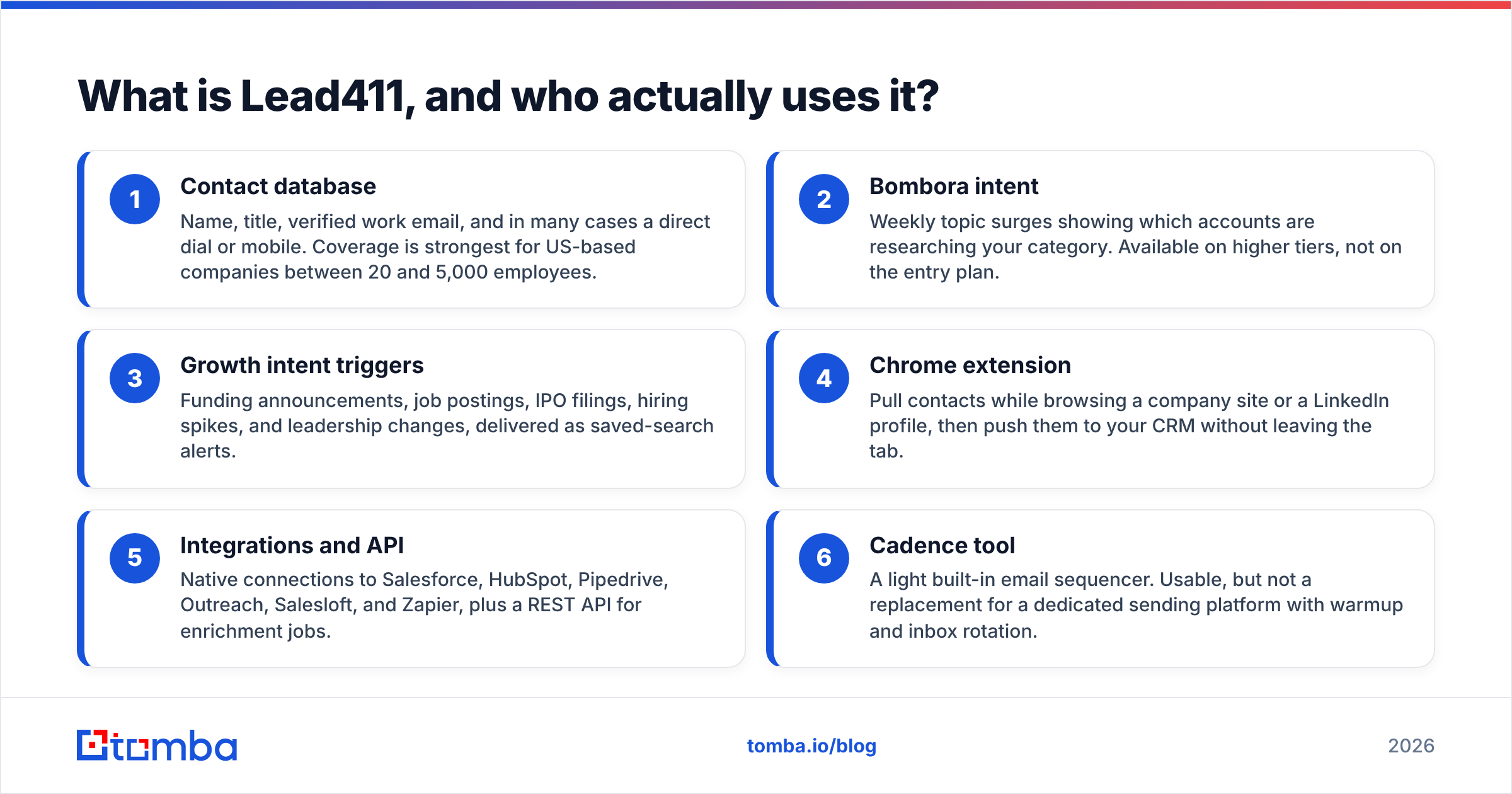
- Contact database — Name, title, verified work email, and in many cases a direct dial or mobile. Coverage is strongest for US-based companies between 20 and 5,000 employees.
- Bombora intent — Weekly topic surges showing which accounts are researching your category. Available on higher tiers, not on the entry plan.
- Growth intent triggers — Funding announcements, job postings, IPO filings, hiring spikes, and leadership changes, delivered as saved-search alerts.
- Chrome extension — Pull contacts while browsing a company site or a LinkedIn profile, then push them to your CRM without leaving the tab.
- Integrations and API — Native connections to Salesforce, HubSpot, Pipedrive, Outreach, Salesloft, and Zapier, plus a REST API for enrichment jobs.
- Cadence tool — A light built-in email sequencer. Usable, but not a replacement for a dedicated sending platform with warmup and inbox rotation.
What do Lead411 reviews say about data accuracy?#
The consensus across G2 and Capterra is that Lead411 emails land in the "good, occasionally great" band, and that phone numbers are more variable than the marketing suggests. Reviewers selling into US software, staffing, logistics, and professional services report usable bounce rates. Reviewers selling into EMEA, APAC, or very small businesses report noticeably thinner records.

Three things are worth understanding before you judge any vendor's accuracy claim, including this one:
- "Verified" has no standard definition. Some vendors verify at the time of collection and never again. Others re-verify on export. Ask Lead411 which one applies to the specific records you are pulling, and when the record was last touched.
- B2B data decays constantly. Industry estimates put contact decay around 2-3% per month once you account for job changes and company churn. A list you exported in January is measurably worse in June. That is physics, not vendor incompetence.
- Catch-all domains distort every benchmark. A large share of enterprise domains accept all mail at the SMTP layer, so no provider can confirm the mailbox exists. Vendors differ enormously in whether they mark those as valid, risky, or unknown. Run them through a dedicated catch-all verifier before you decide a list is bad.
The practical takeaway from most Lead411 reviews: treat the export as a starting point, not a finished list. Teams that run every export through an independent email verifier before loading it into a sequencer report bounce rates in the low single digits. Teams that send straight from the export do not.
What does Lead411 cost in 2026, and where do the surprises hide?#
Lead411's published entry plan sits around $99 per user per month, billed annually, and is marketed as unlimited. The word "unlimited" is doing a lot of work there. In practice, unlimited applies to viewing and searching records. Exports are capped, and the cap is defined in your order form rather than splashed across the pricing page. Intent data and larger export allowances move you into a custom-quoted tier, which in most reported cases lands in the several-thousand-dollars-per-year range for a small team.
The recurring complaints in user reviews are almost never about the data. They are about the commercial terms:
- Annual commitments with limited or no month-to-month option on the advertised price.
- Auto-renewal clauses that require written notice inside a specific window before the term ends.
- Export caps that surprise teams who read "unlimited" and planned a big list build.
- Per-seat pricing that punishes teams wanting occasional access for marketing or RevOps.
None of that makes Lead411 a bad product. It makes it a product you should buy deliberately, with the renewal terms in front of you. Always confirm current numbers directly on lead411.com before budgeting, since sales-intelligence pricing moves every few quarters.
How does Lead411 compare to other B2B data tools?#
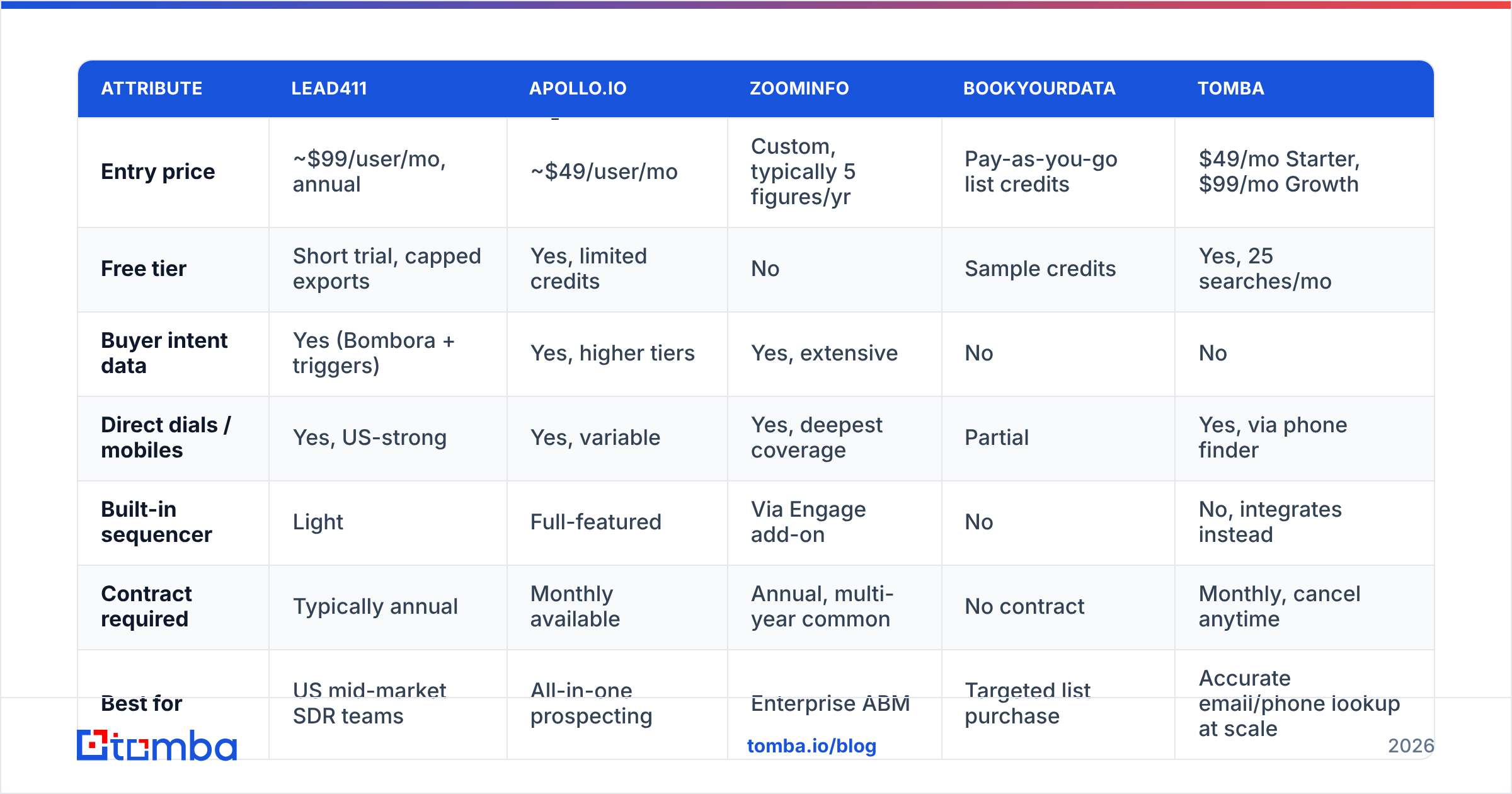
The honest comparison depends on whether you are buying intent data or buying contact records. Here is how the main options line up on the attributes buyers actually negotiate over.
| Attribute | Lead411 | Apollo.io | ZoomInfo | BookYourData | Tomba |
|---|---|---|---|---|---|
| Entry price | ~$99/user/mo, annual | ~$49/user/mo | Custom, typically 5 figures/yr | Pay-as-you-go list credits | $49/mo Starter, $99/mo Growth |
| Free tier | Short trial, capped exports | Yes, limited credits | No | Sample credits | Yes, 25 searches/mo |
| Buyer intent data | Yes (Bombora + triggers) | Yes, higher tiers | Yes, extensive | No | No |
| Direct dials / mobiles | Yes, US-strong | Yes, variable | Yes, deepest coverage | Partial | Yes, via phone finder |
| Built-in sequencer | Light | Full-featured | Via Engage add-on | No | No, integrates instead |
| Contract required | Typically annual | Monthly available | Annual, multi-year common | No contract | Monthly, cancel anytime |
| Best for | US mid-market SDR teams | All-in-one prospecting | Enterprise ABM | Targeted list purchase | Accurate email/phone lookup at scale |

A few notes on that table. ZoomInfo remains the coverage leader and prices like it; most teams under 20 reps cannot justify it. Apollo bundles sending, which is convenient but makes deliverability your problem in the same seat as your data. BookYourData is a genuinely good option when you want a clean, targeted list without committing to a platform subscription, and its pay-per-list model avoids the renewal trap entirely. Tomba sits at the other end: no database subscription theater, just find email addresses by domain or name, verify them, and enrich, on a plan you can cancel.

What do users complain about most?#
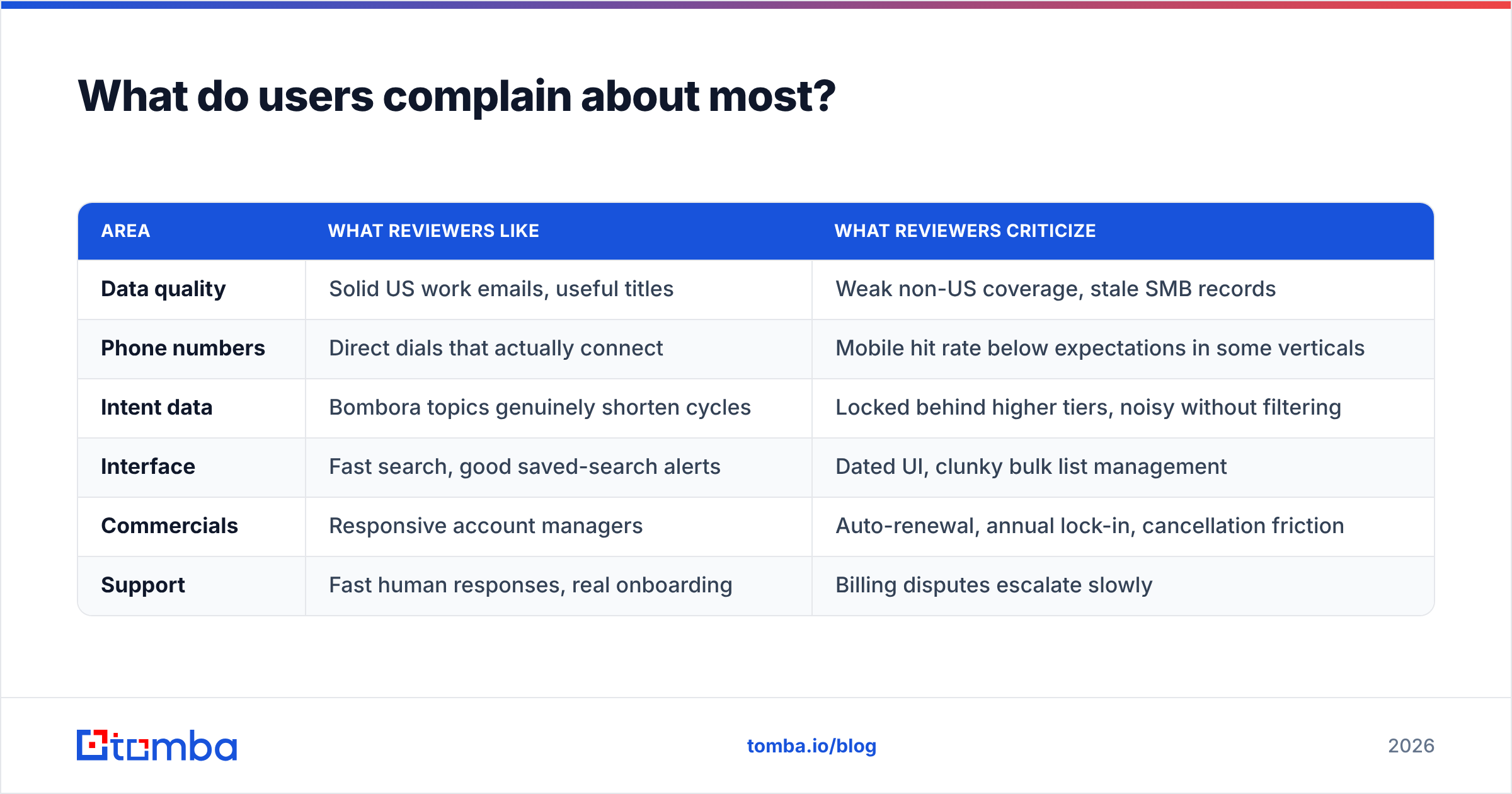
Pulling the recurring themes out of public reviews rather than cherry-picking quotes, the pattern looks like this.
| Area | What reviewers like | What reviewers criticize |
|---|---|---|
| Data quality | Solid US work emails, useful titles | Weak non-US coverage, stale SMB records |
| Phone numbers | Direct dials that actually connect | Mobile hit rate below expectations in some verticals |
| Intent data | Bombora topics genuinely shorten cycles | Locked behind higher tiers, noisy without filtering |
| Interface | Fast search, good saved-search alerts | Dated UI, clunky bulk list management |
| Commercials | Responsive account managers | Auto-renewal, annual lock-in, cancellation friction |
| Support | Fast human responses, real onboarding | Billing disputes escalate slowly |
The intent-data criticism deserves a note. Bombora surges are directional, not deterministic. An account showing a topic spike may have one intern reading a comparison page. Teams that get value from intent use it to reprioritize an existing target list, not to generate a new one. If you do not already have a defined ICP and an account list, the intent layer will mostly generate noise you pay for.
Is Lead411 worth it for your team?#
Yes, if three things are true: you sell primarily into the US, you need phones and emails in the same record, and your motion genuinely uses timing signals. Under those conditions the price per closed opportunity holds up well against the alternatives.
It is a poor fit in these situations:
- You only need work emails. Paying for an intent-enabled seat to get email addresses is the most common way teams overspend here. A dedicated domain search plus verification does that job for a fraction of the cost.
- Your ICP is outside North America. Coverage drops noticeably. Run a trial search on 50 of your real target accounts before you believe any coverage claim.
- You want month-to-month flexibility. The advertised price generally assumes an annual term. If cash flexibility matters more than intent data, look elsewhere.
- You are a solo founder or a two-person team. Per-seat pricing at this level rarely pencils out below roughly five active reps.
- You need developer-level access. If your workflow is "enrich rows in a pipeline," an email finder API priced per request beats a per-seat database subscription.
How do you run a trial that actually tells you something?#
Most teams waste their trial searching for companies they already know. Do this instead.
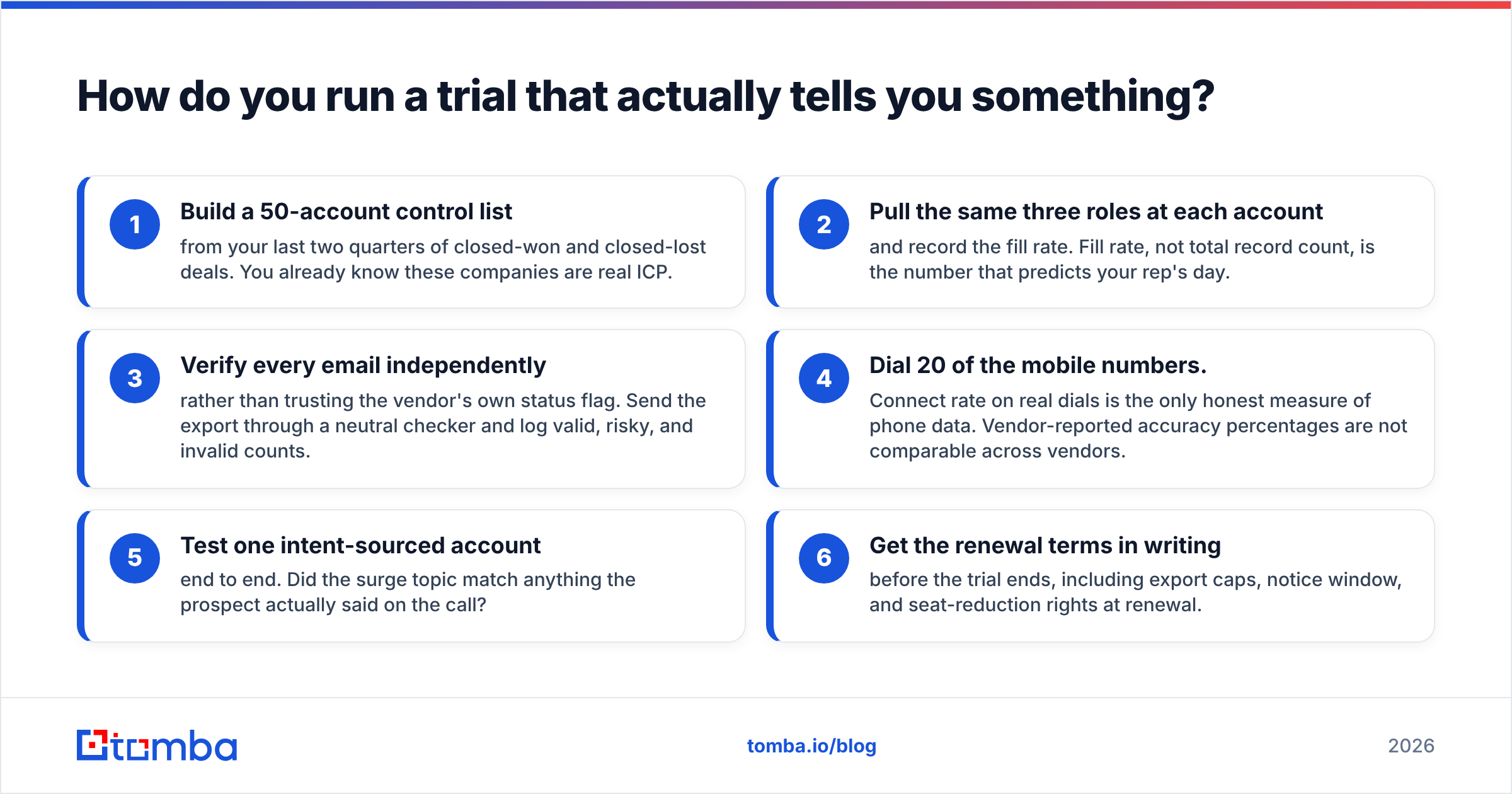
- Build a 50-account control list from your last two quarters of closed-won and closed-lost deals. You already know these companies are real ICP.
- Pull the same three roles at each account and record the fill rate. Fill rate, not total record count, is the number that predicts your rep's day.
- Verify every email independently rather than trusting the vendor's own status flag. Send the export through a neutral checker and log valid, risky, and invalid counts.
- Dial 20 of the mobile numbers. Connect rate on real dials is the only honest measure of phone data. Vendor-reported accuracy percentages are not comparable across vendors.
- Test one intent-sourced account end to end. Did the surge topic match anything the prospect actually said on the call?
- Get the renewal terms in writing before the trial ends, including export caps, notice window, and seat-reduction rights at renewal.
Run that same protocol against two vendors and the decision usually makes itself within a week. If you are comparing data providers seriously, it is also worth reading how each one sources records, since sourcing method predicts decay rate better than any accuracy badge. Tomba publishes its approach on its data sources page, and most reputable vendors will explain theirs if you ask.
What is the final verdict on Lead411?#
Lead411 is a competent, US-focused sales intelligence platform that is priced like a platform and contracted like one. The data is good enough for serious outbound in North America, the intent layer is a real advantage for teams with a mature ICP, and support is better than the category average. The friction is entirely commercial: annual terms, auto-renewal, and export caps hiding under the word unlimited.
Buy it if you need intent plus phones plus emails in a single seat and you have the rep headcount to amortize it. Skip it if what you actually needed all along was accurate, verified work email addresses at volume.
If it is the second one, start with Tomba. The Tomba Email Finder resolves work emails by domain, name, or company with confidence scoring and source attribution, backed by built-in verification so your list is clean before it ever reaches a sequencer. The free tier covers 25 searches a month, Starter is $49/mo and Growth is $99/mo with no annual lock-in, and you can compare full Tomba pricing in about thirty seconds. Test it against your own control list of 50 accounts, side by side with whatever you are paying for now, and let the fill rate decide.
Related guides#
// get started
Find, verify and enrich your first contacts today
Start on the free plan with 25 searches a month, then scale when your team is ready.
Free plan · No credit card required · GDPR & CCPA
Get the Tomba newsletter
Product and data updates
// about the author