Lead411 vs Lead Carrot: Which B2B Lead Tool Wins in 2026?
Lead411 sells enterprise sales intelligence with intent data. Lead Carrot sells cheap local-business lists. They barely compete — and picking the wrong one wastes a year of budget. Here's the honest breakdown.
TL;DR
- These two tools are not really competitors. Lead411 is a full sales intelligence platform (verified emails, direct dials, Bombora intent data, CRM sync). Lead Carrot is a low-cost local-business list builder aimed at agencies selling to SMBs.
- Lead411 costs roughly 2x more per seat and is typically sold on annual contracts with per-user pricing. Lead Carrot sits in the sub-$100/month bracket with no seat tax.
- Pick Lead411 if you sell mid-market/enterprise software, need direct dials and buying-intent signals, and have a CRM worth syncing to.
- Pick Lead Carrot if you run a marketing/web agency and need thousands of plumbers, dentists, and roofers with a phone number and a bad website.
- Pick neither if what you actually need is accurate email addresses on demand — a dedicated email finder does that job cheaper and with an API you can automate.
What are Lead411 and Lead Carrot, exactly?#
Lead411 has been around since 2001 and positions itself in the same bracket as ZoomInfo and Apollo: a B2B contact database with technographics, company triggers (funding, hiring, new-hire alerts), verified emails, mobile direct dials, and intent data licensed from Bombora. It's sold per seat, usually on annual terms, and it lives in the sales intelligence category on G2 alongside the other enterprise-priced players. You can see their published plans on lead411.com.
Lead Carrot is a different animal. It's a lead-generation tool built primarily for agencies and local-service sellers: you pick a niche and a geography, and it returns business listings scraped and enriched from public web sources — company name, phone, website, sometimes an owner name and a generic inbox. Its selling point is filtering by website weakness — no site, no SSL, no mobile responsiveness, missing Google Business Profile — so an agency can pitch a fix. You can check the current offer at leadcarrot.io.
That difference in DNA shapes everything else:
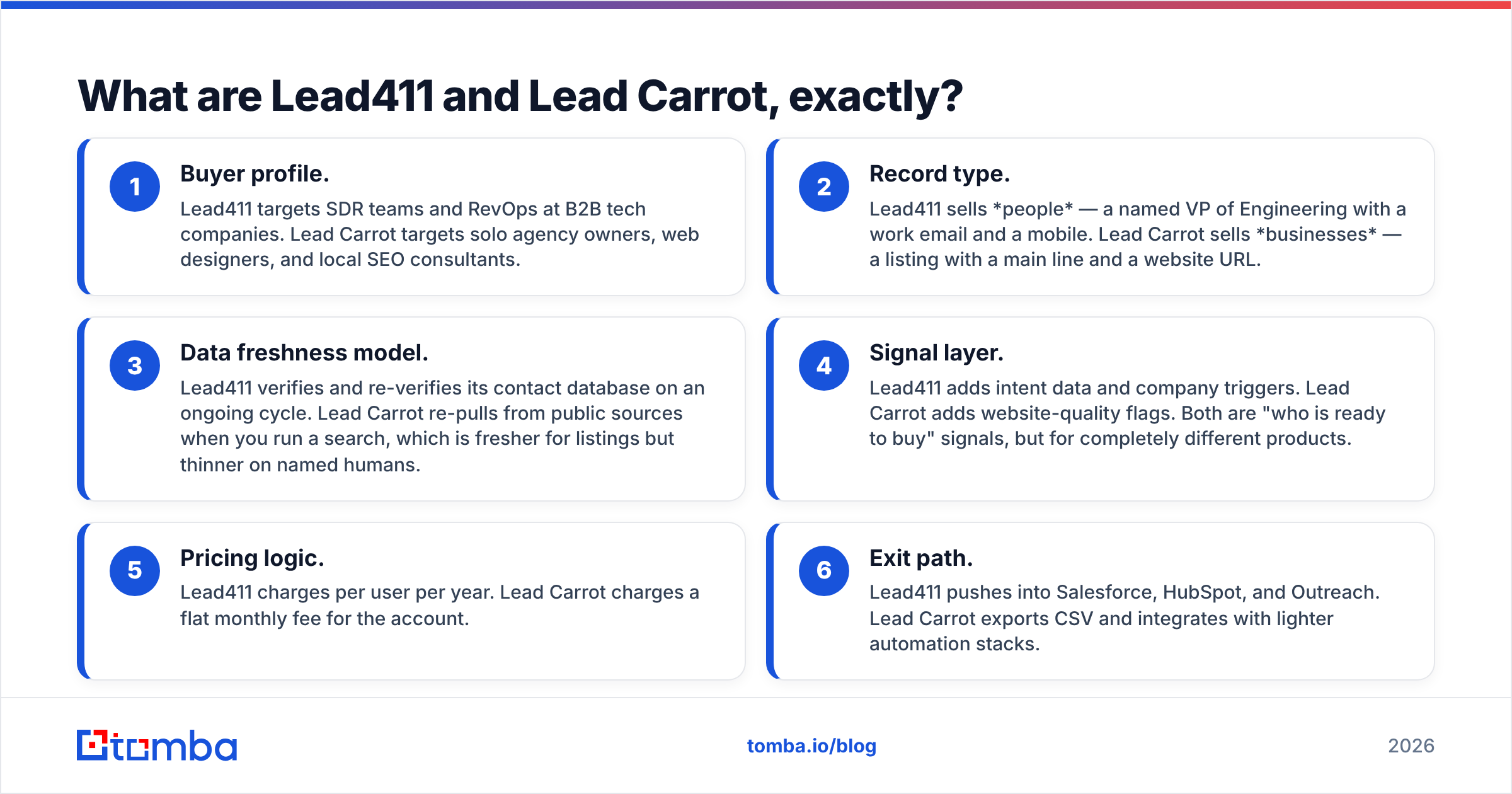
- Buyer profile. Lead411 targets SDR teams and RevOps at B2B tech companies. Lead Carrot targets solo agency owners, web designers, and local SEO consultants.
- Record type. Lead411 sells people — a named VP of Engineering with a work email and a mobile. Lead Carrot sells businesses — a listing with a main line and a website URL.
- Data freshness model. Lead411 verifies and re-verifies its contact database on an ongoing cycle. Lead Carrot re-pulls from public sources when you run a search, which is fresher for listings but thinner on named humans.
- Signal layer. Lead411 adds intent data and company triggers. Lead Carrot adds website-quality flags. Both are "who is ready to buy" signals, but for completely different products.
- Pricing logic. Lead411 charges per user per year. Lead Carrot charges a flat monthly fee for the account.
- Exit path. Lead411 pushes into Salesforce, HubSpot, and Outreach. Lead Carrot exports CSV and integrates with lighter automation stacks.

How do Lead411 and Lead Carrot compare on price and features?#
Pricing on both sides moves, and Lead411 in particular quotes rather than publishes its upper tiers. Treat the numbers below as the shape of the market at the time of writing and verify on each vendor's page before you sign anything. We've added Tomba as a third column because a lot of teams evaluating these two are really shopping for contact data, not a platform.
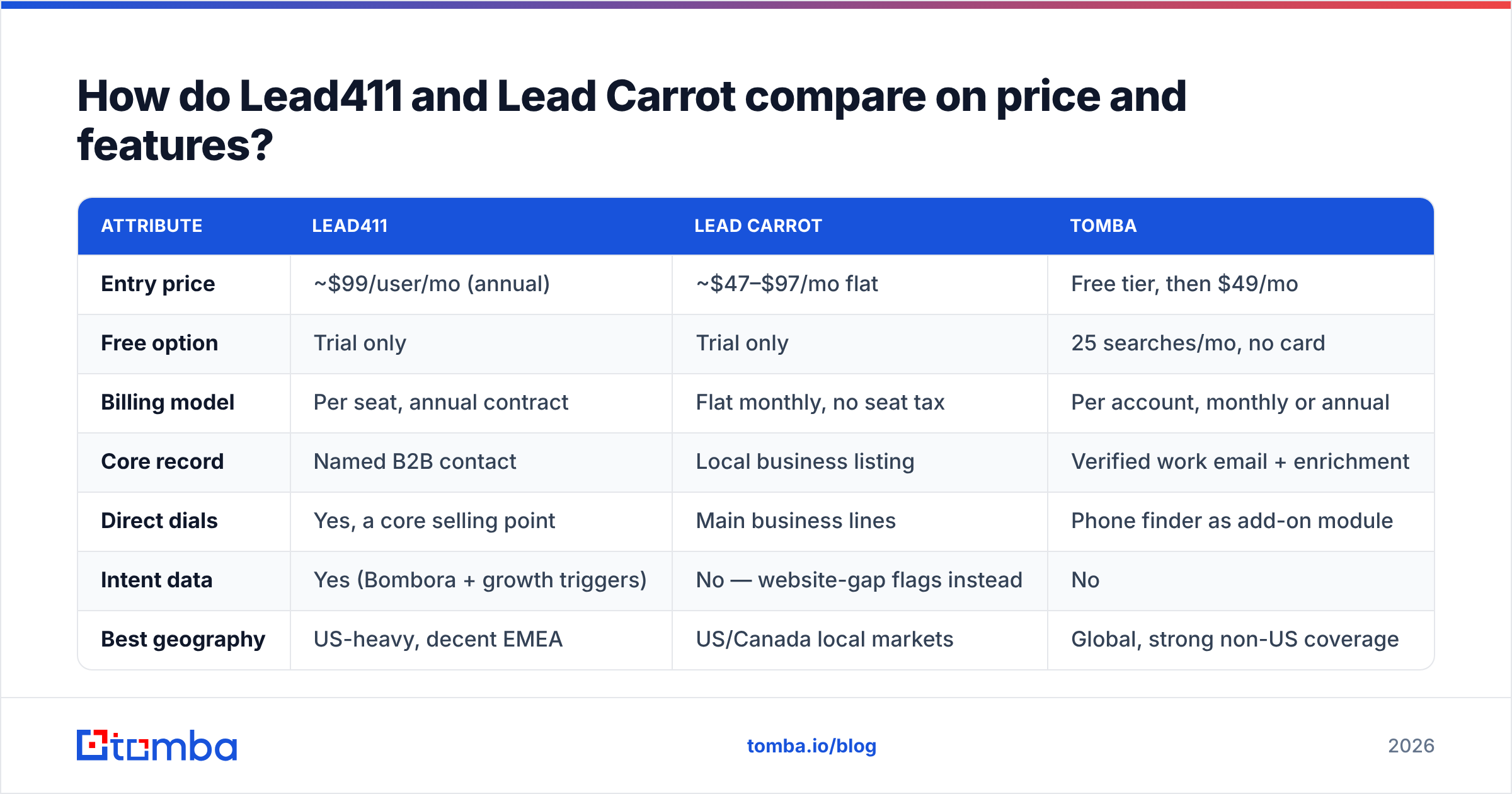
| Attribute | Lead411 | Lead Carrot | Tomba |
|---|---|---|---|
| Entry price | ~$99/user/mo (annual) | ~$47–$97/mo flat | Free tier, then $49/mo |
| Free option | Trial only | Trial only | 25 searches/mo, no card |
| Billing model | Per seat, annual contract | Flat monthly, no seat tax | Per account, monthly or annual |
| Core record | Named B2B contact | Local business listing | Verified work email + enrichment |
| Direct dials | Yes, a core selling point | Main business lines | Phone finder as add-on module |
| Intent data | Yes (Bombora + growth triggers) | No — website-gap flags instead | No |
| Best geography | US-heavy, decent EMEA | US/Canada local markets | Global, strong non-US coverage |
| API access | Available on higher tiers | Limited | Included on all paid plans |
| CRM integrations | Salesforce, HubSpot, Outreach, Salesloft | CSV + light automations | HubSpot, Salesforce, Pipedrive, Zapier, Make |
| Sweet spot | Mid-market/enterprise B2B outbound | Agencies selling to local SMBs | Teams that need accurate emails at scale |
The honest read on price: Lead411 is expensive for what most small teams use it for. If you buy three seats on an annual plan, you're committing to roughly $3,500+ before you've sent a single email. That's defensible when your ACV is $30k and direct dials shorten your cycle. It's indefensible when you're a two-person startup that just wants 500 correct email addresses a month.
Lead Carrot is cheap, and it's cheap for a reason — you're getting listing data, not a curated contact graph. If your offer is "I'll rebuild your website," a listing plus a phone number is a complete lead. If your offer is "our platform saves your engineering team 20 hours a week," a listing is the start of research, not the end.
Which one has better data accuracy?#
Different questions, different answers.
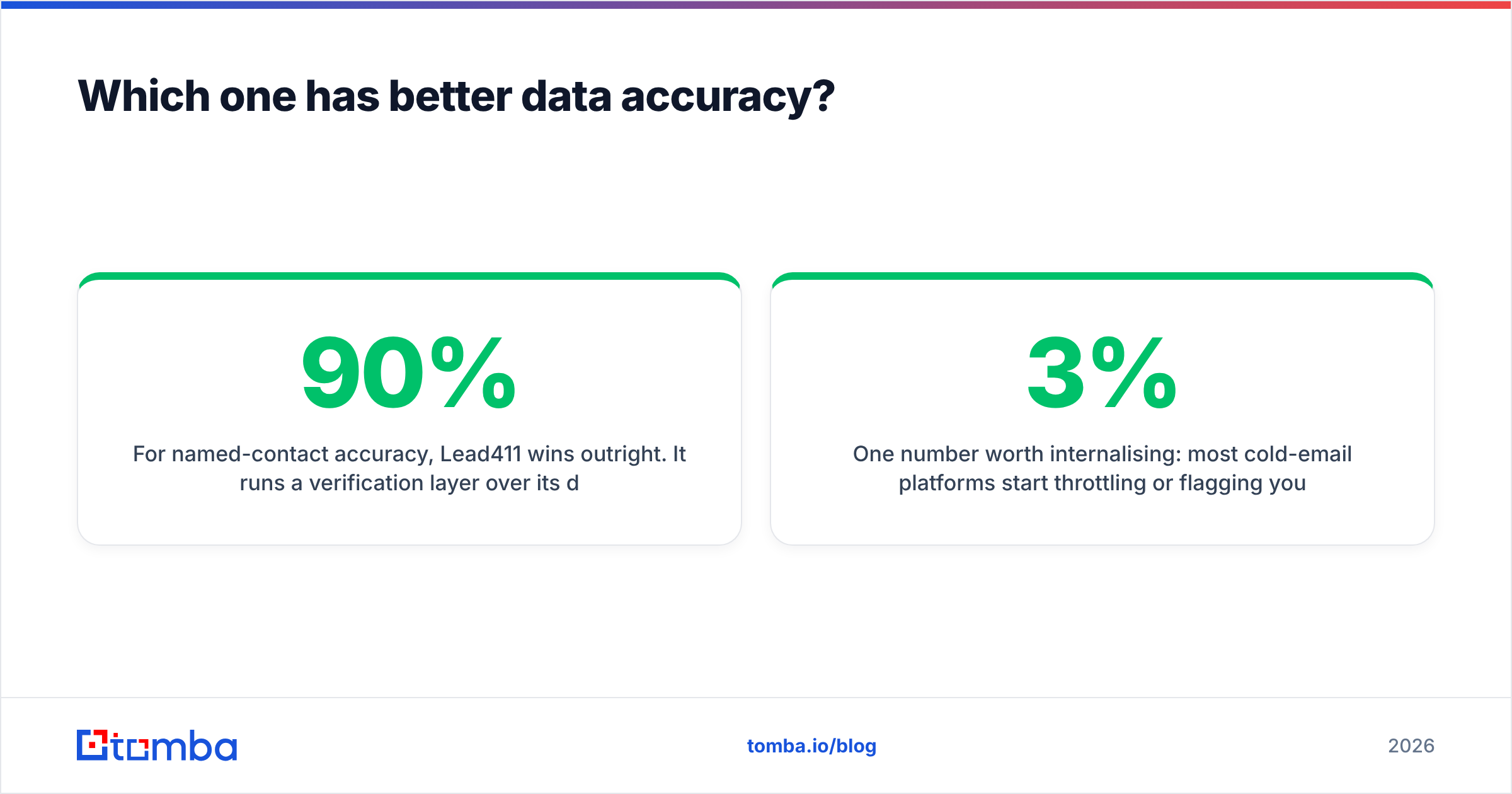
For named-contact accuracy, Lead411 wins outright. It runs a verification layer over its database and publishes accuracy claims in the 90%+ range for emails. Independent reviewer sentiment on G2 is broadly consistent with that for US-based contacts at companies over ~50 employees. Coverage thins out noticeably for European and APAC mid-market, and for companies under 20 headcount — a common pattern across every US-first database.
For local business coverage, Lead Carrot wins. Because it pulls from public listing sources at query time, you'll find the three-person HVAC company that no enterprise database has ever indexed. The trade-off is that the "contact" is usually info@ or a contact-form URL, and the owner's name may be missing or wrong.
The thing neither tool solves well is the specific person problem: you know the company, you know the role, you need the human's direct work email today. Lead411 covers that only if the person is already in its database. Lead Carrot mostly doesn't attempt it. This is where a real-time lookup tool earns its keep — domain search plus pattern detection finds the address even when no database has the record, and an email verifier tells you whether it's safe to send before you burn your sender reputation on a bounce.
One number worth internalising: most cold-email platforms start throttling or flagging your domain once bounce rates cross 2–3%. HubSpot's own deliverability guidance is blunt about the compounding cost of dirty lists. That means a database with "95% accuracy" still hands you a 5% bounce rate if you send blind — comfortably above the danger line. Verification isn't optional with either vendor.
Is Lead411's intent data worth the premium?#
Sometimes. Here's the sober version.
Intent data — Bombora-style topic surges across a publisher co-op — is a prioritisation tool, not a targeting tool. It's genuinely useful when:
- You already have a large TAM and need to rank 5,000 accounts into a weekly call list.
- Your buying cycle is long and you benefit from catching research behaviour months before an RFP.
- You have enough volume that a 15–20% lift in connect rate pays for the seat cost several times over.
It's mostly wasted money when:
- Your TAM is under a few hundred accounts. Just work them all. You don't need a model to tell you which of 200 accounts to call.
- You sell to SMBs, where intent signal density is too low to be reliable.
- You can't act on the signal fast. Intent decays. If your SDR team works a two-week-old list, the surge is over.
Analyst coverage from firms like Gartner consistently lands in the same place: intent improves targeting efficiency for teams that already have disciplined outbound process, and does roughly nothing for teams that don't. If your reps aren't hitting activity targets today, intent data won't fix it — it'll just be a more expensive way to not call people.
Lead Carrot's equivalent signal — "this business has no SSL certificate" — is cruder but arguably converts better for its audience, because it maps directly to a purchasable fix.
Who should choose Lead411?#
Choose Lead411 if most of these are true:
- You sell B2B software or services with an ACV above ~$10k. The seat cost amortises.
- You need mobile direct dials. This is one of Lead411's genuine strengths and a big gap in the cheap tools.
- Your market is US-centric. Coverage is best there.
- You run a real CRM and a real sequencing tool. The value is in the sync, not the exports.
- You have 2+ full-time SDRs. Per-seat pricing punishes part-time usage hard.
Skip it if you're pre-revenue, if your buyers are outside the US, or if you'd be buying one seat and exporting CSVs — you'd be paying platform prices for database access you can get for a third of the cost elsewhere.
Who should choose Lead Carrot?#
Choose Lead Carrot if:
- You sell websites, SEO, ads, or reputation management to local businesses. This is exactly what it was built for.
- You need volume over precision. 2,000 mediocre listings you can call beats 200 perfect contacts when your sales motion is a phone blitz.
- You want a flat monthly cost without a procurement conversation.
- Your offer is tied to a visible defect — no site, slow site, no Google listing. The filters do real work here.
Skip it if you sell to anyone with a job title more specific than "owner," or if you need to reach a named decision-maker inside a 500-person company. It's the wrong shape of data for that job.

What if you just need the emails?#
This is the fork in the road most teams miss. Sales intelligence platforms bundle three things — a contact database, a signal layer, and a workflow layer — and charge you for all three whether or not you use them. A large share of Lead411 evaluations end with the buyer admitting they mainly wanted verified email addresses at a predictable cost.
If that's you, the stack looks different:
- Source your account list from wherever it's cheapest — Lead Carrot for local, LinkedIn Sales Navigator for B2B, or your own ICP research.
- Find the people with an email finder that works by name plus domain, rather than hoping a static database already has the record.
- Verify before sending, including catch-all domains, which are where most "verified" lists quietly fail.
- Enrich what you keep — job title, company size, tech stack — so your sequencing has something to personalise on.
- Automate it through an API or a bulk upload instead of paying a human to copy-paste.
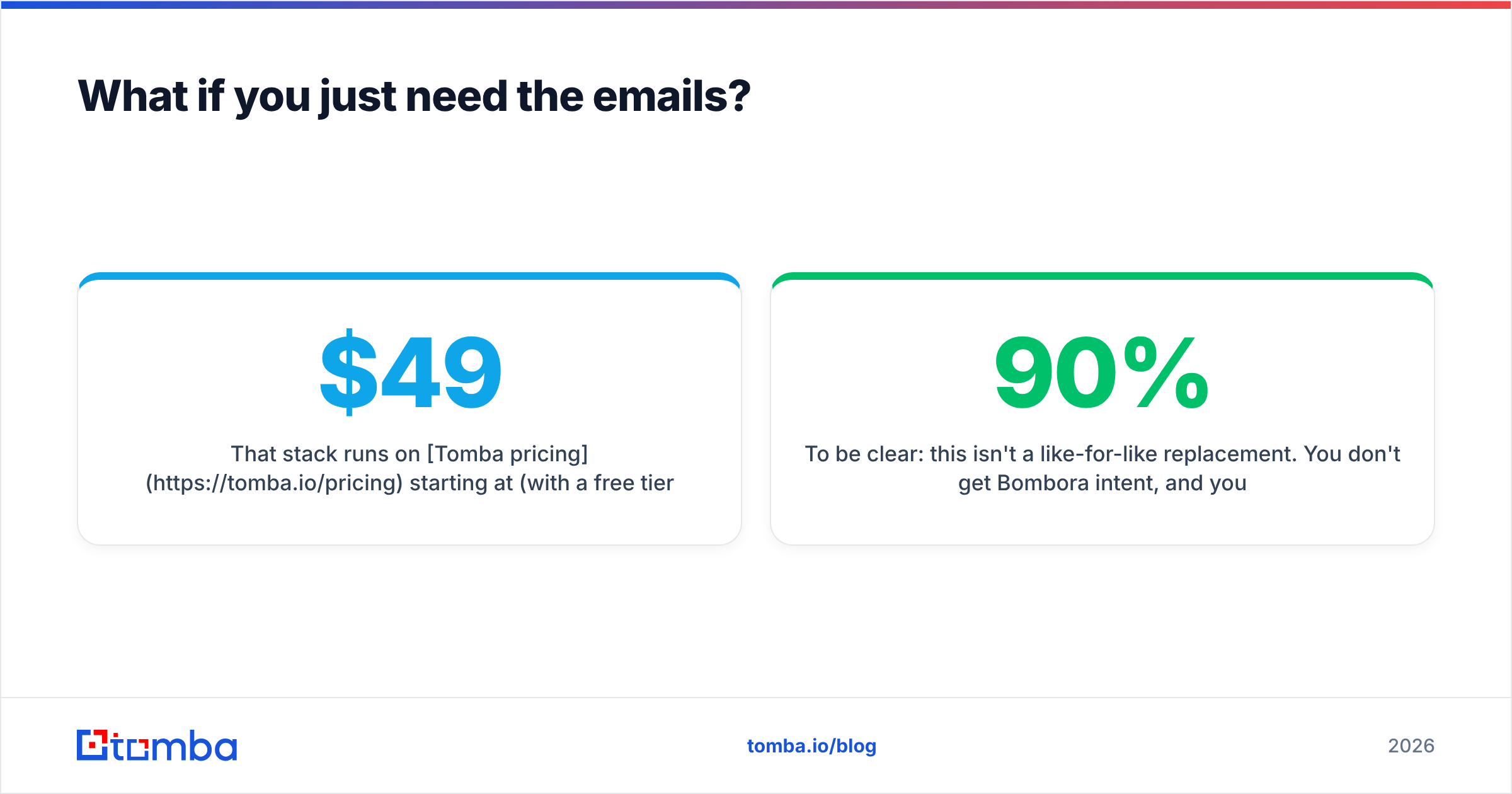
That stack runs on Tomba pricing starting at $49/mo (with a free tier at 25 searches/month to sanity-check accuracy on your own list before you pay anyone). Compared against a multi-seat annual Lead411 contract, it's a different order of magnitude — and for data enrichment you're not locked into a 12-month commitment to find out whether the coverage works for your market.
To be clear: this isn't a like-for-like replacement. You don't get Bombora intent, and you don't get a native Outreach integration on the entry tier. You get contact data and an API. For a lot of teams, that's 90% of the value at 20% of the price.
What's the verdict on Lead411 vs Lead Carrot?#
They're not substitutes, so the real question is which problem you have.
- Selling enterprise B2B with a funded SDR team and a US focus → Lead411. The direct dials and intent layer justify the seat cost at that motion.
- Selling services to local businesses at volume → Lead Carrot. Cheaper, better-shaped data, no seat tax.
- Needing accurate, verified work emails across global domains with an API and no annual lock-in → neither, and that's fine. Use a dedicated finder and keep the budget.
The expensive mistake is buying Lead411 for a Lead Carrot problem — paying enterprise seat prices to export local business listings — or buying Lead Carrot for a Lead411 problem and wondering why you can't reach a single VP.
Run a 100-record test on your actual ICP before committing to either. Pull the same 100 target companies through both trials, then push the results through a verifier and count what survives. That number — deliverable, correct, reachable contacts per dollar — is the only benchmark that matters, and it will differ wildly by industry and geography from whatever any vendor's marketing page claims.
Ready to test coverage on your own list? Start with the Tomba Email Finder — 25 free searches a month, no card required. Drop in a domain and a name, see whether the address comes back verified, and compare it directly against whatever Lead411 or Lead Carrot returns for the same target. If the accuracy holds on your market, plans start at $49/mo with full API access included on every paid tier.
Related guides#
// get started
Find, verify and enrich your first contacts today
Start on the free plan with 25 searches a month, then scale when your team is ready.
Free plan · No credit card required · GDPR & CCPA
// about the author