Lead411 vs LeadIQ (2026): Which B2B Data Tool Wins?
Lead411 and LeadIQ sell the same promise — verified emails and direct dials — but they solve different problems. Here's the honest breakdown on data quality, export limits, real per-seat cost, and when neither one is the right buy.
TL;DR
- Lead411 is a sales-intelligence database built around bulk list building, growth-intent triggers, and direct-dial phone coverage. It suits teams that want to pull a territory list and work it.
- LeadIQ is a prospecting-workflow tool built around a browser extension and one-click capture into Salesforce, Outreach, and Salesloft. It suits reps who live on LinkedIn and hate copy-paste.
- Data quality is close enough that it shouldn't decide the purchase. Export limits, seat pricing, and CRM sync behavior will.
- Both are priced per seat, and both meter exports — so a 6-person team's real annual cost lands far above the sticker price on the pricing page.
- If all you actually need is verified work emails at scale, a dedicated email finder like Tomba costs a fraction of either and plugs into the same CRMs through an API.
What are Lead411 and LeadIQ, exactly?#
They get compared constantly because they overlap on one output — a contact record with an email and a phone number — but they were built for different jobs.
Lead411 is a B2B database company that has been around since the early 2000s. You search a database of companies and people, filter by firmographics, technographics, and growth signals (funding rounds, hiring spikes, IPO news), then export a list. Its marquee differentiators are Bombora-powered intent data and a heavy emphasis on verified direct-dial mobile numbers. The mental model is a warehouse: you walk in, filter the shelves, and leave with a crate.
LeadIQ is a prospecting workflow layer. The primary interface isn't a search page — it's a Chrome extension that sits on top of LinkedIn Sales Navigator. You browse a list, click capture, and the contact lands in Salesforce or your sequencer already mapped to the right fields. It also ships "Scribe," an AI writer that drafts personalized openers from the prospect's profile and recent activity. The mental model is a conveyor belt: contacts move from research to sequence without you touching a CSV.
That difference explains most of the disagreement in reviews. A demand-gen manager who needs 4,000 records for a campaign will find LeadIQ slow. An AE running 30 accounts by hand will find Lead411's export flow clunky.

How do Lead411 and LeadIQ compare head-to-head?#
Here's the practical comparison — the attributes that actually change day-to-day work, not the feature checkboxes both vendors list.
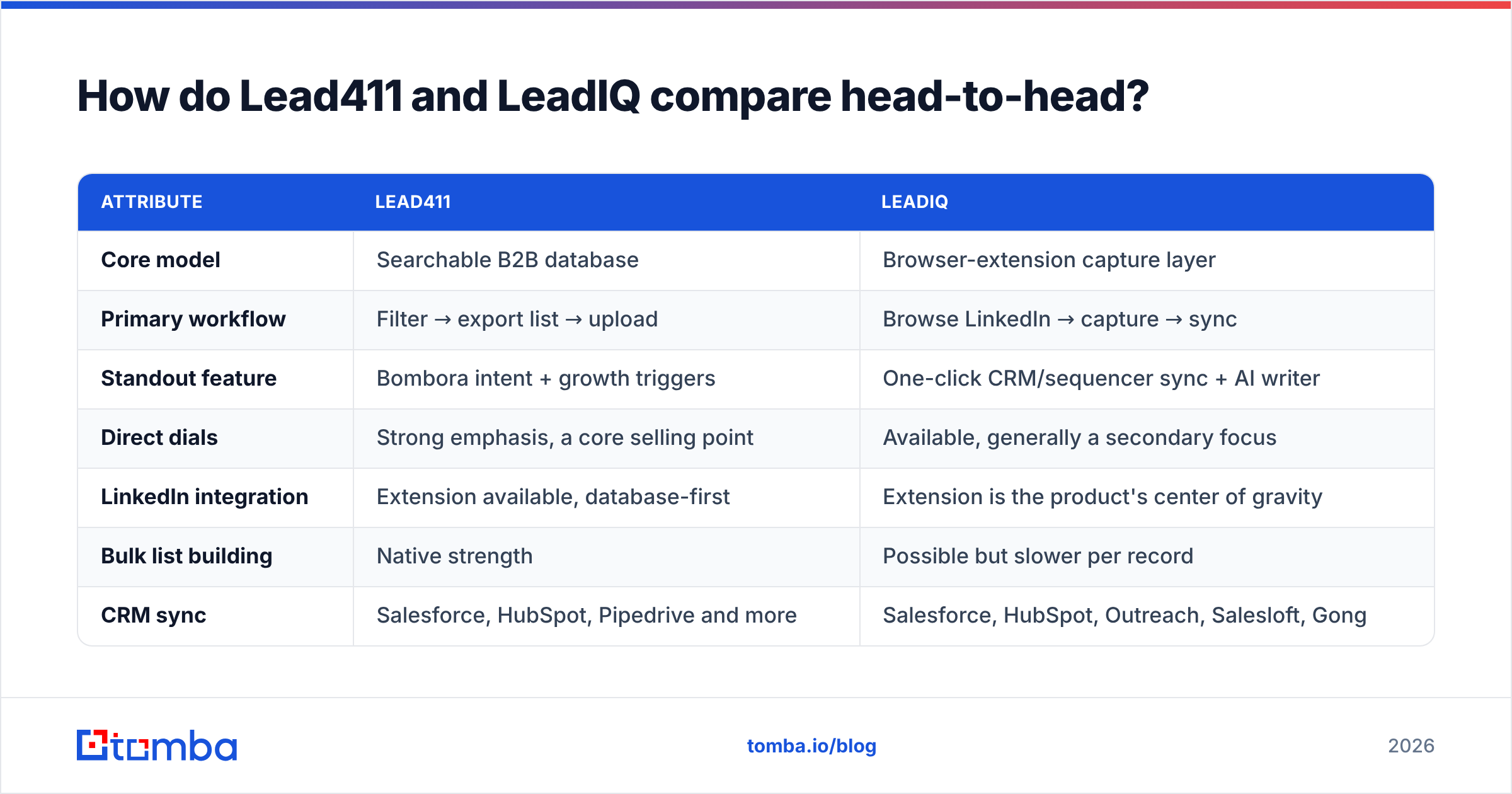
| Attribute | Lead411 | LeadIQ |
|---|---|---|
| Core model | Searchable B2B database | Browser-extension capture layer |
| Primary workflow | Filter → export list → upload | Browse LinkedIn → capture → sync |
| Standout feature | Bombora intent + growth triggers | One-click CRM/sequencer sync + AI writer |
| Direct dials | Strong emphasis, a core selling point | Available, generally a secondary focus |
| LinkedIn integration | Extension available, database-first | Extension is the product's center of gravity |
| Bulk list building | Native strength | Possible but slower per record |
| CRM sync | Salesforce, HubSpot, Pipedrive and more | Salesforce, HubSpot, Outreach, Salesloft, Gong |
| Email verification | Bundled in the record | Bundled, with validity status flags |
| Free tier | Free trial, time-limited | Free plan with limited weekly credits |
| Best-fit buyer | Demand gen, SDR leadership, list builders | Individual AEs and SDRs working named accounts |
| Learning curve | Moderate — filter syntax takes practice | Low — install extension and go |

If you strip the marketing away, the question isn't "which has better data." It's "do you build lists, or do you work accounts?" Teams that do both usually end up paying for two tools, which is exactly the trap this comparison should help you avoid.
Which one has better data accuracy?#
Neither one wins cleanly, and anyone who tells you otherwise is quoting a vendor deck.
Both companies publish accuracy claims in the 90%+ range for verified emails. Both numbers are real — for the segment each vendor measures. Coverage is what varies, and it varies by segment in ways that make blanket claims useless:
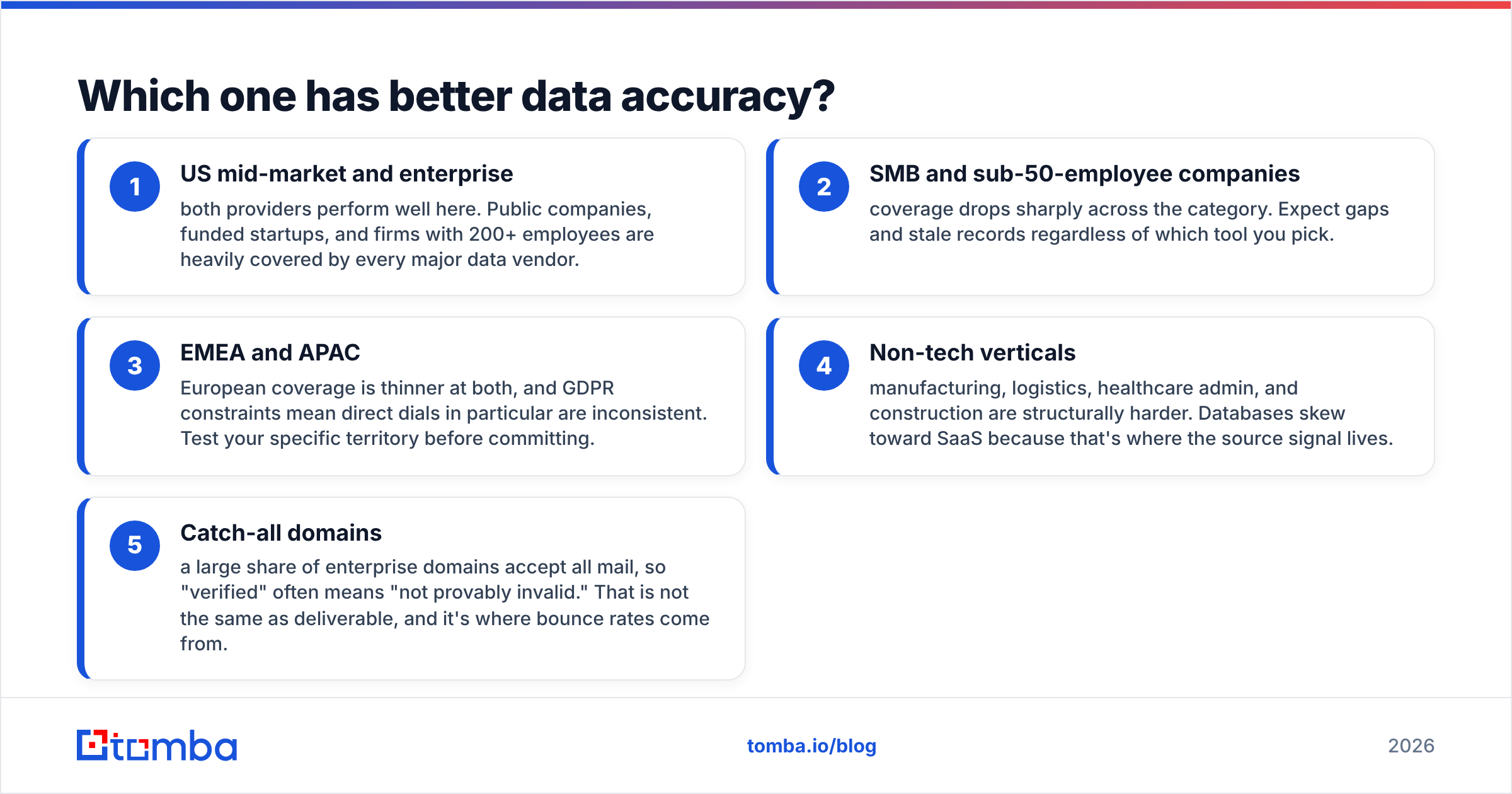
- US mid-market and enterprise — both providers perform well here. Public companies, funded startups, and firms with 200+ employees are heavily covered by every major data vendor.
- SMB and sub-50-employee companies — coverage drops sharply across the category. Expect gaps and stale records regardless of which tool you pick.
- EMEA and APAC — European coverage is thinner at both, and GDPR constraints mean direct dials in particular are inconsistent. Test your specific territory before committing.
- Non-tech verticals — manufacturing, logistics, healthcare admin, and construction are structurally harder. Databases skew toward SaaS because that's where the source signal lives.
- Catch-all domains — a large share of enterprise domains accept all mail, so "verified" often means "not provably invalid." That is not the same as deliverable, and it's where bounce rates come from.

The practical move: run the same 100-contact sample list through both trials, then push the results through an independent email verifier before you send anything. Vendor-side verification and third-party verification disagree more often than you'd expect, and the disagreement is concentrated in exactly those catch-all domains. If catch-alls are a meaningful chunk of your list, a dedicated catch-all verifier will tell you more than either platform's status flag.
How does pricing really work for Lead411 vs LeadIQ?#
Both publish entry prices that look reasonable and both bill per seat annually, which is where the number on the pricing page stops matching the number on the invoice.
Lead411 sells tiered per-user plans with an "unlimited views" positioning, but exports are capped monthly on lower tiers, and intent data typically sits on a higher tier or a custom quote. LeadIQ sells a free plan with small weekly credit limits, a mid-tier per-user plan, and a pro tier that unlocks higher credit ceilings plus advanced integrations.
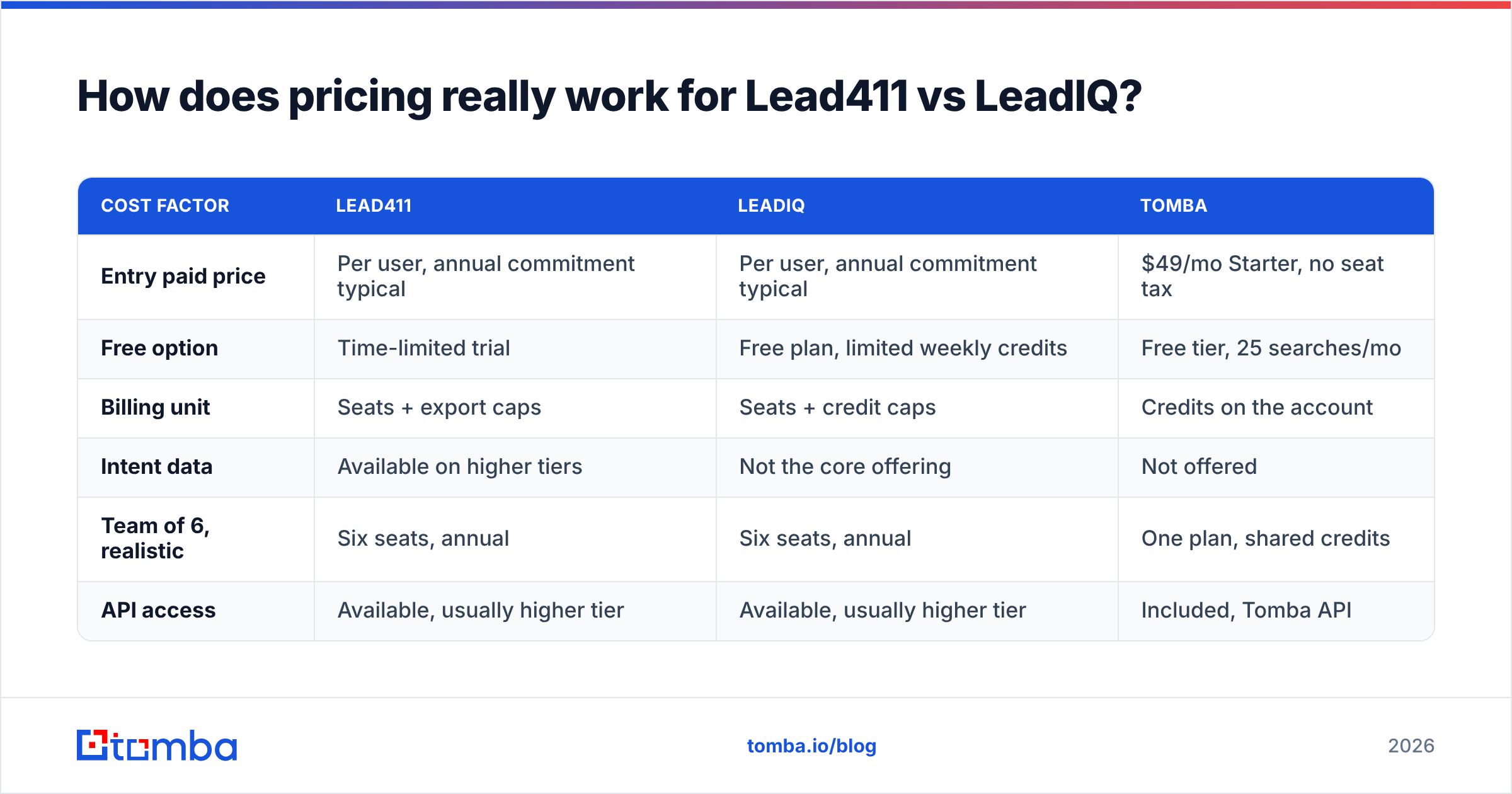
| Cost factor | Lead411 | LeadIQ | Tomba |
|---|---|---|---|
| Entry paid price | Per user, annual commitment typical | Per user, annual commitment typical | $49/mo Starter, no seat tax |
| Free option | Time-limited trial | Free plan, limited weekly credits | Free tier, 25 searches/mo |
| Billing unit | Seats + export caps | Seats + credit caps | Credits on the account |
| Intent data | Available on higher tiers | Not the core offering | Not offered |
| Team of 6, realistic | Six seats, annual | Six seats, annual | One plan, shared credits |
| API access | Available, usually higher tier | Available, usually higher tier | Included, Tomba API |
Check current numbers on each vendor's own pricing page before you budget — both revise tiers regularly, and reseller quotes differ from list. The structural point holds regardless of the exact figures: seat-based data tools scale their cost with headcount, not with usage. A 6-person SDR team where only two people build lists still pays for six seats at both vendors. That's the single biggest reason teams churn off sales-intelligence platforms at renewal, and it shows up clearly in the user reviews on G2's sales intelligence category.

Which tool fits your workflow?#
Match the tool to how your team actually finds prospects, not to the feature list.
- You run outbound campaigns from lists. Lead411. You need filtering, bulk export, and triggers that tell you which accounts are in-market. The intent layer earns its keep when you're deciding which 500 of 5,000 accounts to work this quarter.
- Your reps prospect inside LinkedIn all day. LeadIQ. The capture-to-sequence flow removes real friction, and reps adopt it because it fits the behavior they already have. Tools that fight rep habits don't get used, no matter how good the data is.
- You're RevOps enriching a CRM. Neither, primarily. You want an enrichment API that runs on a schedule against records you already own — that's a data enrichment job, not a seat license.
- You need emails, not a platform. Neither. A dedicated email finder covers the actual requirement at a fraction of the cost.
- You're doing ABM with a tight named-account list. LeadIQ for the contact-level work, plus a phone data source. Lead411's breadth is wasted when your universe is 150 accounts.
- You need mobile numbers above all else. Lead411 leans harder into direct dials, but validate a sample in your territory first — mobile coverage is the most volatile data type in B2B and no vendor's average tells you about your slice.
What about intent data, dialers, and the rest of the stack?#
Intent data is Lead411's clearest differentiator in this matchup, and it's worth being blunt about what it does. Bombora-style intent tells you that someone at a company has been consuming content about a topic. It is account-level, not person-level, and it's directional. It's genuinely useful for prioritization — working accounts showing a surge beats working accounts alphabetically. It is not a buying signal you can quote in a cold email without sounding like you've been reading their browser history.
LeadIQ's answer to differentiation is workflow depth: tighter integrations with Outreach, Salesloft, and Gong, plus AI-drafted openers. If your team already runs one of those sequencers, that integration quality compounds daily. If you run a lighter stack — say HubSpot plus a simple sender — you're paying for plumbing you won't connect.
Neither is a dialer, neither is a sequencer, and neither replaces your CRM. Budget accordingly: a full outbound stack in 2026 typically runs a data source, a sequencer, a dialer, and a CRM, and the data layer is usually the easiest one to over-buy.
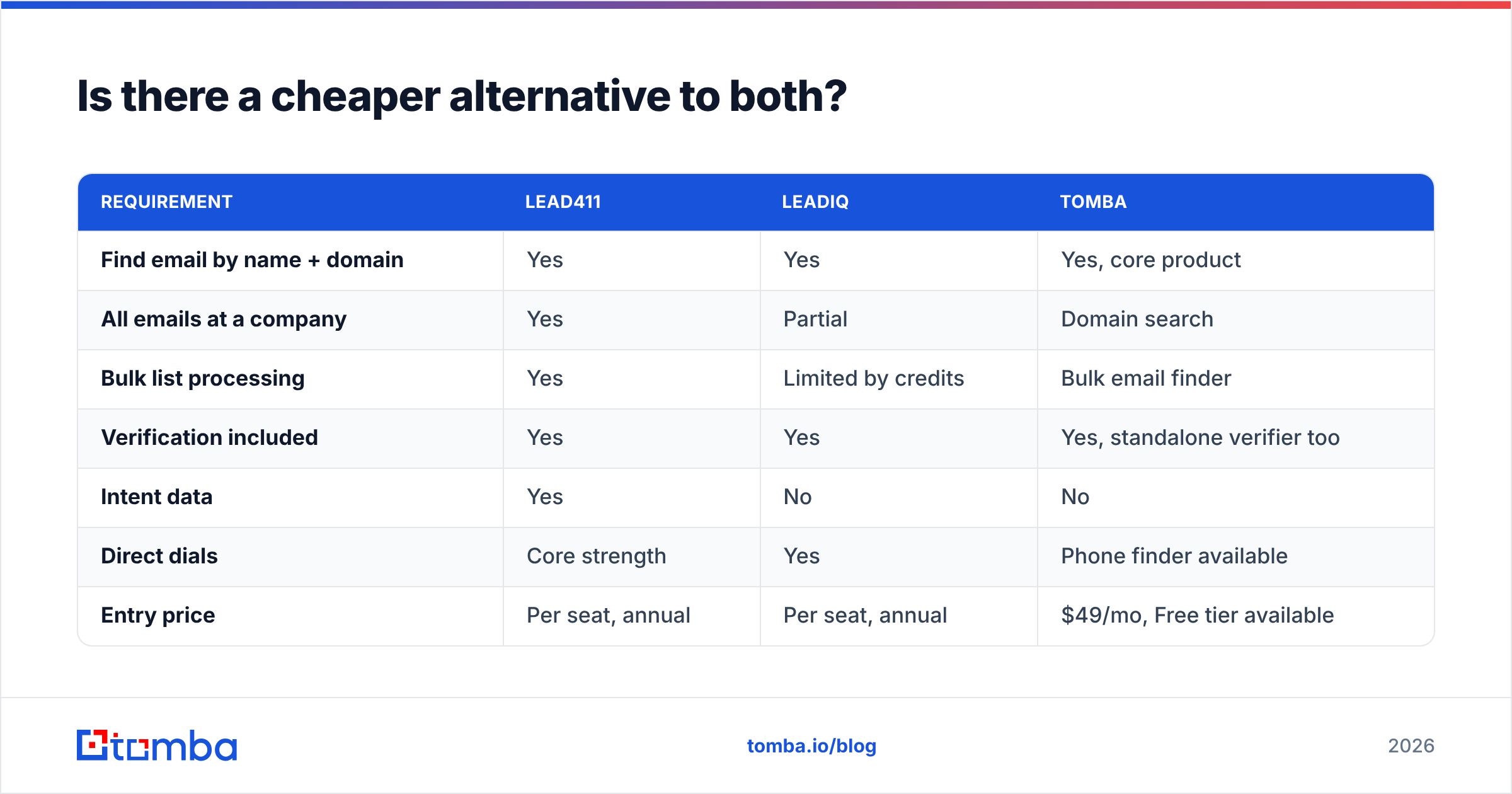
Is there a cheaper alternative to both?#
Yes — if your actual requirement is narrower than "sales intelligence platform."
Most teams evaluating Lead411 vs LeadIQ discover mid-trial that 80% of the value they'd get is "accurate work email for a person whose name and company I already know." That's a solved problem that does not require a per-seat database contract.
| Requirement | Lead411 | LeadIQ | Tomba |
|---|---|---|---|
| Find email by name + domain | Yes | Yes | Yes, core product |
| All emails at a company | Yes | Partial | Domain search |
| Bulk list processing | Yes | Limited by credits | Bulk email finder |
| Verification included | Yes | Yes | Yes, standalone verifier too |
| Intent data | Yes | No | No |
| Direct dials | Core strength | Yes | Phone finder available |
| Entry price | Per seat, annual | Per seat, annual | $49/mo, Free tier available |
| Developer API | Higher tiers | Higher tiers | Included |
Other credible options depending on your angle: BookYourData is a strong choice when you want to buy a targeted, pay-as-you-go list outright rather than rent database access — its pre-verified list model suits one-off campaigns well. Apollo bundles data with sequencing if you want consolidation. And if you're specifically shopping the LeadIQ side of this matchup, the LeadIQ alternative breakdown covers the swap in more detail.
The honest framing: Lead411 and LeadIQ are both defensible purchases for teams that need what they're actually selling — intent-driven list building and LinkedIn-native capture, respectively. They're bad purchases for teams that just need contact data and got upsold into a platform.
Frequently asked questions#
Is Lead411 or LeadIQ better for a 3-person startup sales team? LeadIQ, usually — lower entry commitment, faster to adopt, and small teams rarely need intent data before they've proven a repeatable motion. Revisit Lead411 once you're building territory lists, not working a handpicked 50.
Do either of them offer a genuinely free plan? LeadIQ offers a free plan with limited weekly credits, which is enough to evaluate the workflow. Lead411 runs a time-limited trial rather than a permanent free tier. For ongoing free-tier usage, Tomba's free plan includes 25 searches per month.
Will these tools keep my CRM clean? Not on their own. Both push records in; neither manages decay. B2B contact data goes stale at roughly 2-3% per month as people change jobs, so schedule a re-verification pass every quarter using an API rather than trusting the original import.
Can I use both together? Teams do — Lead411 for list building, LeadIQ for rep-level capture. It works, and it roughly doubles your data spend. Only do it if you've measured which half is generating pipeline.
The bottom line#
Pick Lead411 if intent signals and direct dials drive your prioritization. Pick LeadIQ if your reps prospect inside LinkedIn and your stack runs on Outreach or Salesloft. Pick neither if what you really need is verified email addresses without a per-seat contract.
If that last line describes you, start with the Tomba Email Finder. Find emails by name, domain, or company, verify them before they hit your sequencer, and run the whole thing through an API instead of buying a seat for every rep. The free tier gives you 25 searches a month to test the accuracy against whatever Lead411 or LeadIQ returned in your trial, and paid plans start at $49/mo — see the full Tomba pricing breakdown before you sign anything annual.
Related guides#
// get started
Find, verify and enrich your first contacts today
Start on the free plan with 25 searches a month, then scale when your team is ready.
Free plan · No credit card required · GDPR & CCPA
// about the author