Lead411 vs Soleadify: Which B2B Data Tool Wins in 2026?
Lead411 sells intent-scored enterprise contacts. Soleadify indexes millions of small and local businesses. They solve different problems — here is how to tell which database your pipeline actually needs.
Lead411 vs Soleadify comes down to one question: how big are your buyers? Lead411 tracks decision-makers at mid-market and enterprise companies. Soleadify maps the small and local businesses those platforms skip. Here is how to tell which one fits your pipeline.
TL;DR
- Lead411 is an intent-first sales intelligence platform. It covers US mid-market and enterprise decision-makers, direct dials, and Bombora buying signals. Long-tail local businesses are not its strength.
- Soleadify is a small-business database. It indexes company websites at scale. That is how it finds the dentist, the HVAC contractor, and the 6-person agency that Lead411 and ZoomInfo miss.
- They barely compete. Selling to a VP of Engineering at a 500-person SaaS company? Pick Lead411. Selling to a plumber in Ohio? Pick Soleadify.
- Both charge platform prices for a database. If you already know who you want to reach, a per-lookup email finder costs a fraction of either.
- Verification is on you either way. No vendor's "verified" flag survives 90 days of job changes. Run every export through a verifier first.
What are Lead411 and Soleadify, exactly?#
They are both B2B contact databases. But they were built from opposite ends of the market.
Lead411 is a sales intelligence platform for outbound teams selling to funded, growing, mid-market and enterprise companies. Its pitch has three parts: verified emails and direct dial mobile numbers, growth and hiring triggers, and intent data sourced through Bombora. Lead411 has been around since the mid-2000s and sells per seat. It competes head-on with ZoomInfo, Apollo, and Cognism. The product assumes you already know your ICP by company size and job title. What you want next is which of those accounts is in-market this quarter.
Soleadify attacks a problem the enterprise vendors mostly ignore: the long tail. It does not license contact data from resellers or shared address books. Instead it crawls and parses tens of millions of company websites. Then it structures what it finds — services offered, business category, locations, tech used, phone numbers, and emails. That is how it can hand you 4,000 independent vet clinics in Texas with phone numbers. Traditional B2B databases return a few hundred stale rows for that same search.
The practical difference is simple. Lead411 indexes people at companies with LinkedIn-shaped org charts. Soleadify indexes businesses that have a website. Those two universes overlap far less than you would guess.
Lead411 vs Soleadify: how do the features compare?#
Here is the honest side-by-side. A per-lookup tool is included as a third reference point, so you can see where a full database subscription actually earns its price.
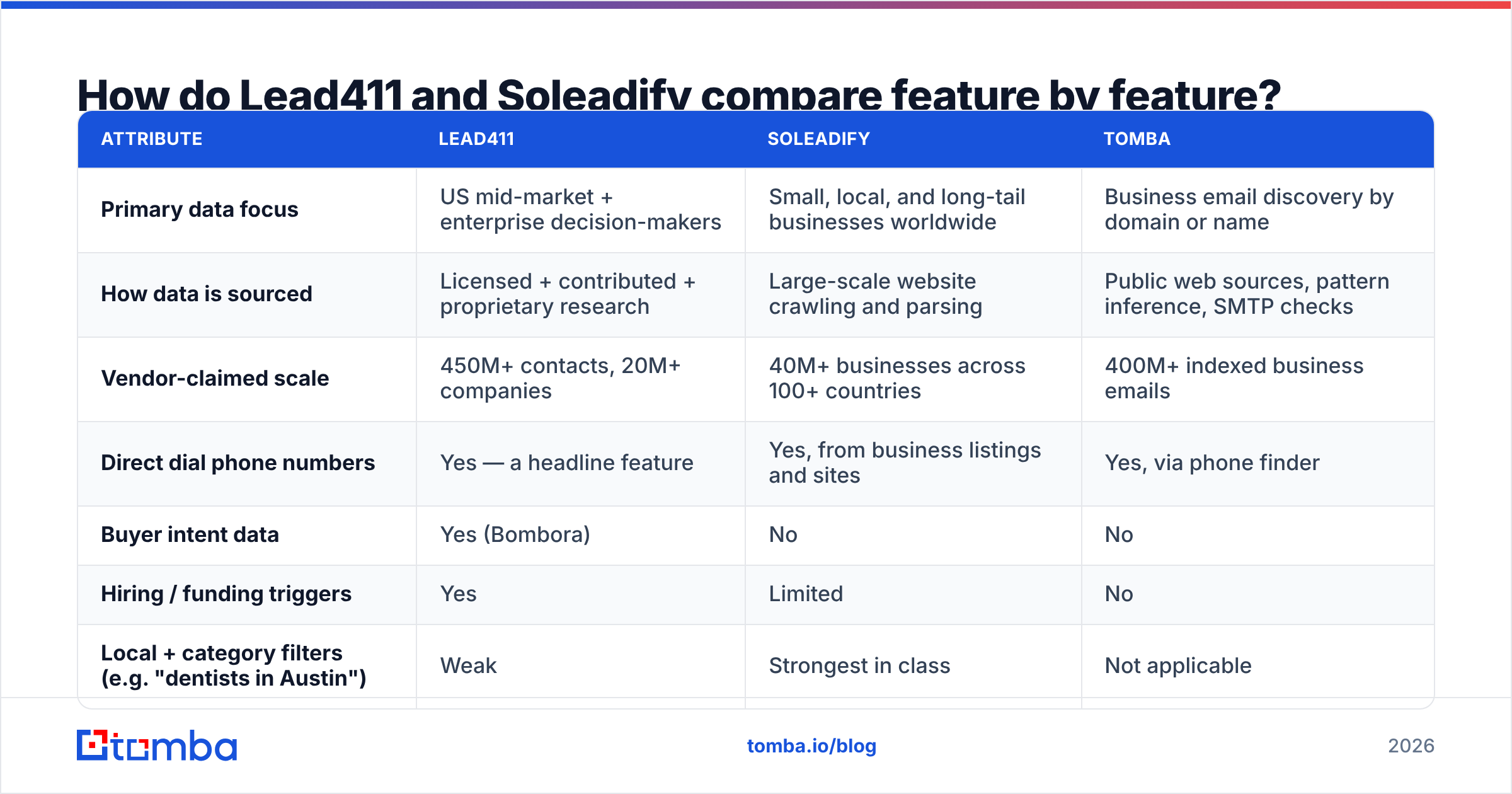
| Attribute | Lead411 | Soleadify | Tomba |
|---|---|---|---|
| Primary data focus | US mid-market + enterprise decision-makers | Small, local, and long-tail businesses worldwide | Business email discovery by domain or name |
| How data is sourced | Licensed + contributed + proprietary research | Large-scale website crawling and parsing | Public web sources, pattern inference, SMTP checks |
| Vendor-claimed scale | 450M+ contacts, 20M+ companies | 40M+ businesses across 100+ countries | 400M+ indexed business emails |
| Direct dial phone numbers | Yes — a headline feature | Yes, from business listings and sites | Yes, via phone finder |
| Buyer intent data | Yes (Bombora) | No | No |
| Hiring / funding triggers | Yes | Limited | No |
| Local + category filters (e.g. "dentists in Austin") | Weak | Strongest in class | Not applicable |
| Named-contact coverage at 1-20 employee firms | Thin | Good | Good for domains with any web presence |
| Email verification included | Yes, vendor-side | Yes, vendor-side | Yes — dedicated email verifier + catch-all handling |
| Entry price (public, subject to change) | ~$99/user/mo billed annually (Basic Plus Unlimited) | Quote-based / self-serve credit plans | $49/mo Starter, free tier at 25 searches |
| Free tier | Trial only | Trial only | Yes — 25 searches/mo, no card |
| API access | Enterprise tiers | Yes | Yes on all paid plans (Tomba API) |
| Best fit | Intent-driven enterprise outbound | Local + SMB list building at volume | Targeted lookups, enrichment, low-waste lists |
Pricing on both platforms moves, and it is often negotiated. Treat those figures as a starting point. Confirm on the vendors' own pages before you budget.
Whose data is actually more accurate?#
Accuracy is the wrong single question. The right one is accuracy for your segment. That flips the answer depending on who you sell to.

Run the test both vendors would rather you skipped. Pull 200 contacts that match your real ICP from each tool. Push them through an independent verifier and count what comes back valid. In practice you will see a pattern like this:
- On 200+ employee US tech companies, Lead411 wins comfortably. Those firms throw off public signal — job posts, press releases, LinkedIn updates — so stale records get caught fast.
- On sub-20-employee local businesses, Lead411 returns catch-alls (info@, contact@) or nothing at all. Soleadify returns a usable record, because it read the company's own contact page.
- On non-US and non-English markets, Soleadify's crawl model travels better. Lead411's depth sits in North America.
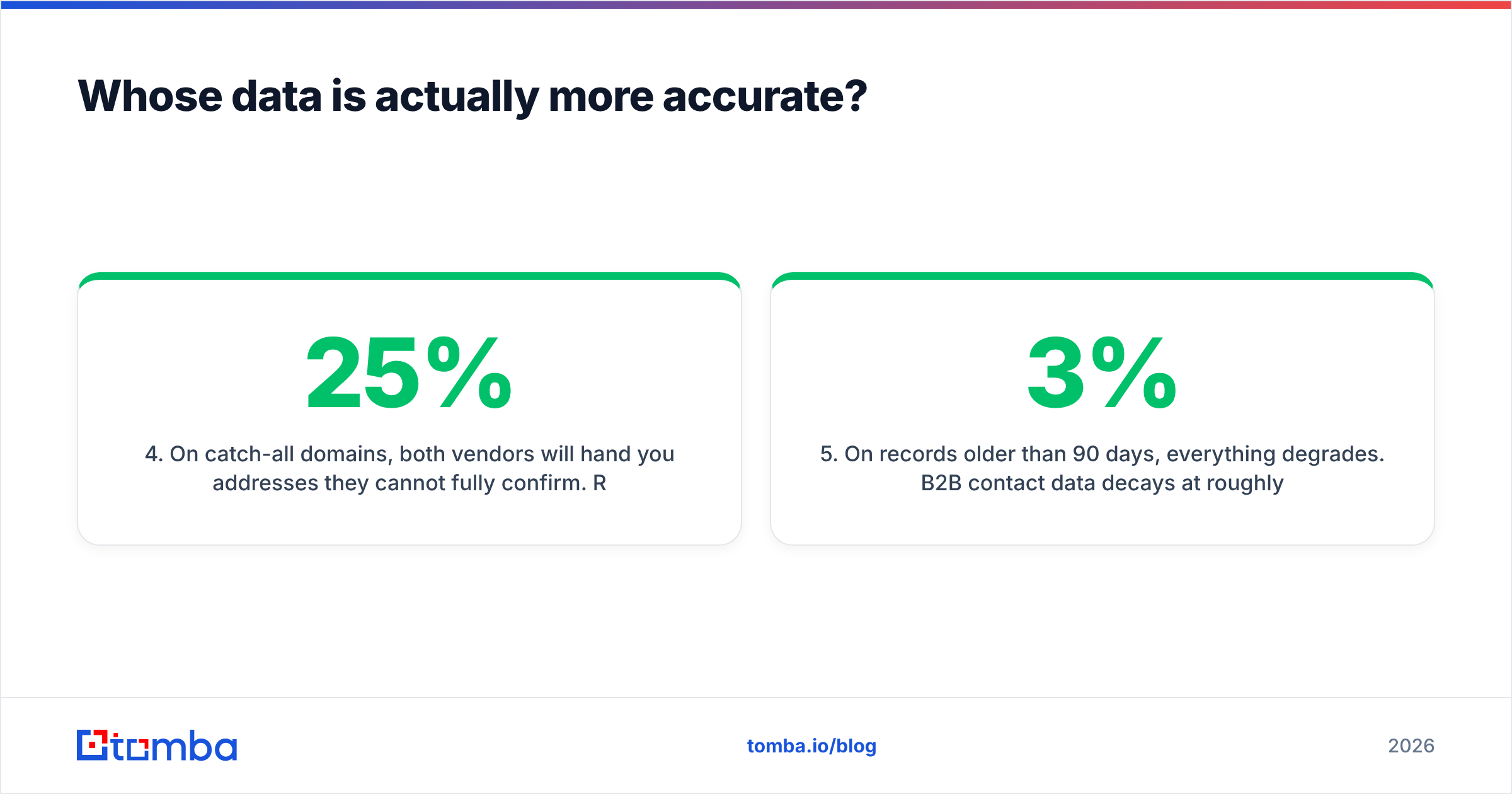
- On catch-all domains, neither vendor can fully confirm the address. Roughly 15-25% of B2B domains are catch-all. That is where "95% accuracy" claims go to die, and a catch-all verifier is the only real fix.
- On records older than 90 days, everything decays — about 2-3% a month, or 25-30% a year. Neither vendor is exempt.
The takeaway is uncomfortable. A "verified" label is a claim about a moment in the past. It is not a guarantee about the moment you hit send. Treat every export as raw material, and verify at send time.
Which one is better for SMB and local prospecting?#
Soleadify, and it isn't close.
Think of restaurants, clinics, law firms, contractors, and e-commerce shops under $5M in revenue. For any business whose whole digital footprint is a website and a Google Business Profile, the enterprise databases fail in a specific, expensive way. They return the right company with no usable contact. You pay platform prices for rows you cannot action.
Soleadify's filters are built for this world. You can slice by business category, by services mentioned on the site, by number of locations, and by geography down to city level. You can also filter on whether the business runs an online booking system or a given e-commerce platform. That last capability — category plus city — is the one feature that justifies a subscription for local-services sellers, franchise suppliers, and vertical SaaS teams.
Where it is weaker: named seniority targeting. If you need "Head of Marketing" rather than "the business," coverage is patchier than a LinkedIn-derived source. Many small-business records resolve to an owner or a general inbox. That is usually fine for the segment, but not always what a rigid sequence expects.
Here is a hybrid a lot of teams land on. Use Soleadify to build the company universe. Then run those domains through a domain search to pull named contacts and email patterns where they exist. You get local coverage plus person-level targeting without buying two full platforms.
Which one is better for mid-market and enterprise outbound?#
Lead411, for one reason above all others: intent.
Firmographic targeting tells you who could buy. Intent data tells you who is researching your category right now. Lead411 layers Bombora topic surges onto its contact records. Your SDRs can then work the 40 accounts showing activity instead of grinding alphabetically through 4,000. When it works, it shortens the gap between cold and warm. That is what justifies the seat price.
Direct dials are the other durable advantage. If your motion involves phones at all, mobile coverage on mid-market decision-makers is a real differentiator. Soleadify does not target it.
The caveats are the standard ones. "Unlimited" plans usually carry fair-use export caps. Contracts are annual and per seat, so scaling a 6-person SDR team becomes a five-figure conversation. And intent is directional, not deterministic. A topic surge at a 2,000-person company might be one intern reading a blog post. Teams that treat intent as a prioritization hint outperform teams that treat it as a buying signal.
Lead411 vs Soleadify pricing: how do the costs really compare?#
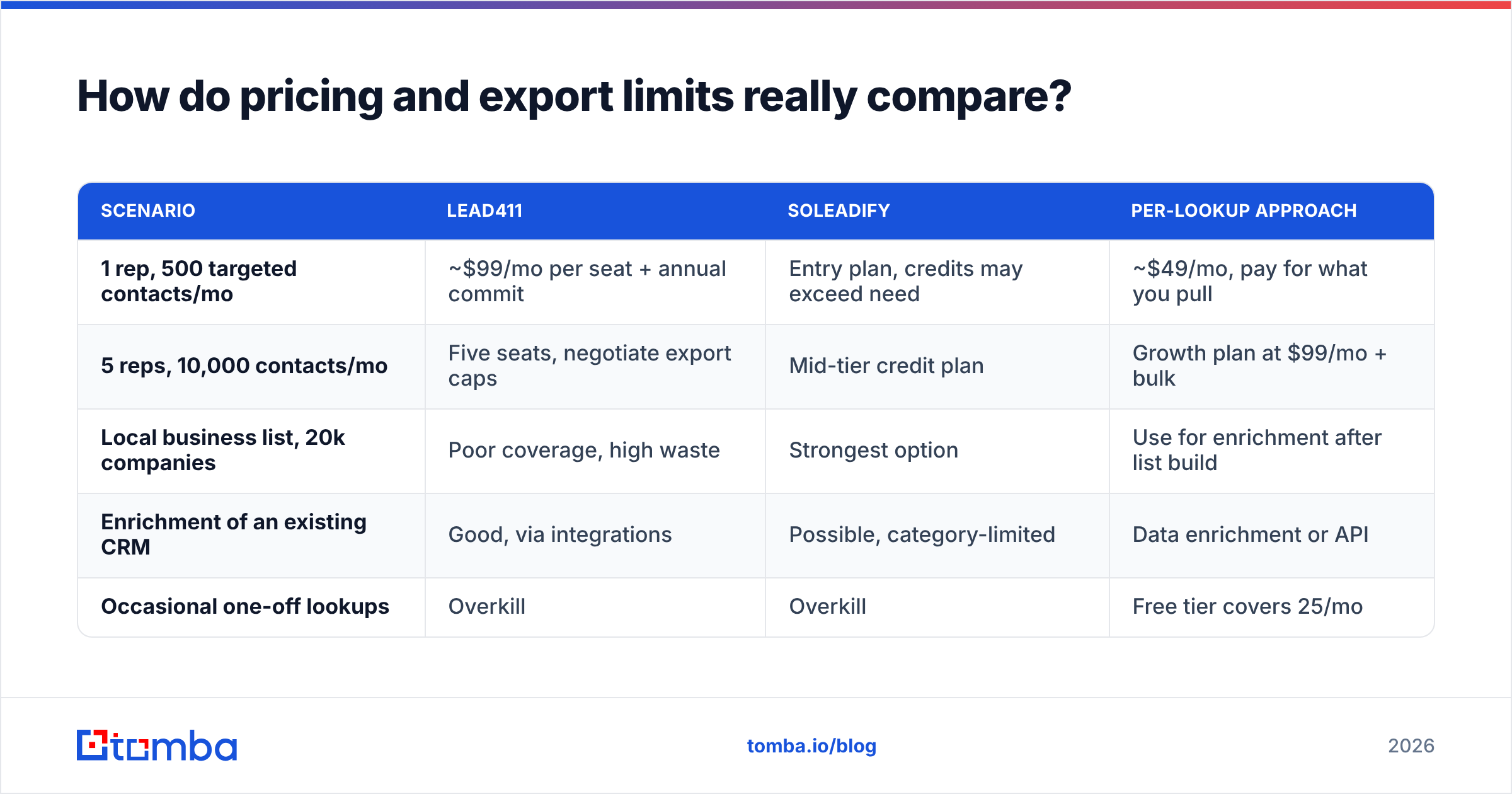
The sticker price is rarely the number that matters. What matters is cost per contact you actually email.
| Scenario | Lead411 | Soleadify | Per-lookup approach |
|---|---|---|---|
| 1 rep, 500 targeted contacts/mo | ~$99/mo per seat + annual commit | Entry plan, credits may exceed need | ~$49/mo, pay for what you pull |
| 5 reps, 10,000 contacts/mo | Five seats, negotiate export caps | Mid-tier credit plan | Growth plan at $99/mo + bulk |
| Local business list, 20k companies | Poor coverage, high waste | Strongest option | Use for enrichment after list build |
| Enrichment of an existing CRM | Good, via integrations | Possible, category-limited | Data enrichment or API |
| Occasional one-off lookups | Overkill | Overkill | Free tier covers 25/mo |
Three cost traps to check before you sign either contract:
- Seat math. Lead411 prices per user. A database that is cheap for one rep gets expensive across a team, and sharing data between seats is usually restricted.
- Credit expiry. Credit plans often reset monthly with no rollover. Buy for your average month, not your best one.
- Annual lock-in. Both vendors push annual commitments. If you are validating a new ICP, a month-to-month tool is the cheaper way to find out you were wrong. Compare Tomba pricing as a monthly baseline first.
What do real users say about each one?#
Skip the vendor case studies. Read the mid-range reviews on G2 — the 3-star ones hold the useful information.
The recurring Lead411 themes: reviewers rate the direct dials and the trigger alerts highly. They also flag that coverage outside North America and outside tech is thinner than the marketing suggests. Support and onboarding get decent marks next to larger competitors.
The recurring Soleadify themes: praise for finding businesses nobody else has. Repeated notes that records skew toward general inboxes rather than named people. And a learning curve on the filter depth. Teams that prospect local verticals are the most enthusiastic. Teams that expected a ZoomInfo clone are the most disappointed.
Cross-reference with Capterra for a second sample. In both cases, run a trial against your territory, not a demo dataset the vendor picked.
Are there better options than either?#
Depending on what you are actually buying, yes.
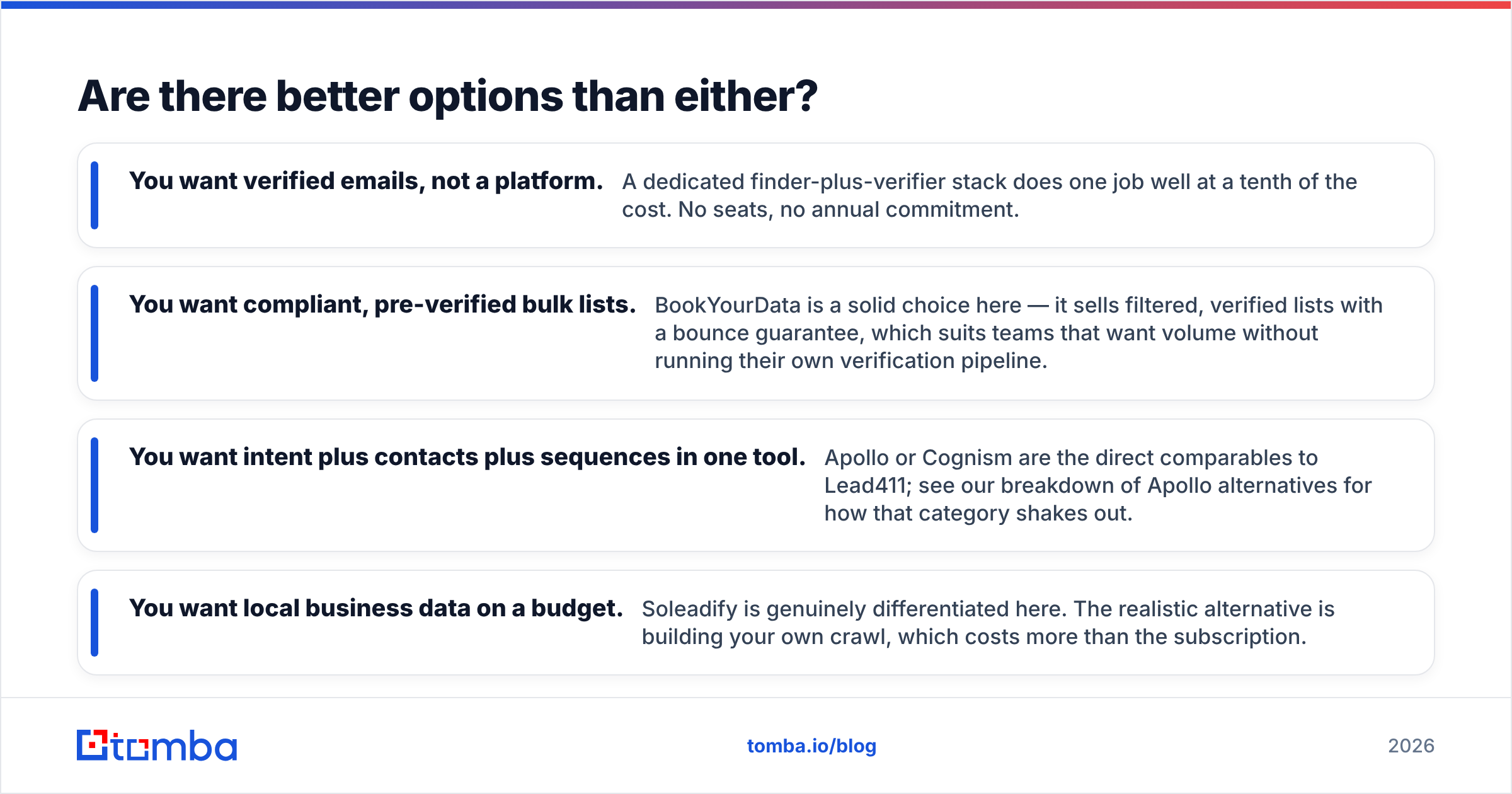
- You want verified emails, not a platform. A finder-plus-verifier stack does one job well at a tenth of the cost. No seats, no annual commitment.
- You want compliant, pre-verified bulk lists. BookYourData sells filtered, verified lists with a bounce guarantee. That suits teams who want volume without running their own verification pipeline.
- You want intent plus contacts plus sequences in one tool. Apollo and Cognism are the direct comparables to Lead411. See our breakdown of Apollo alternatives for how that category shakes out.
- You want local business data on a budget. Soleadify is genuinely differentiated here. The realistic alternative is building your own crawl, which costs more than the subscription.
Which one should you pick?#
Answer three questions and the Lead411 vs Soleadify decision makes itself.
- Are your buyers at companies with fewer than 50 employees? Yes → Soleadify. No → keep going.
- Do you need to know which accounts are in-market right now? Yes → Lead411. Its intent layer is the whole reason to pay seat prices.
- Do you already have your target account list? Yes → neither. You do not need a discovery database. You need email discovery and verification on domains you have already chosen, which is a per-lookup problem.
Most teams that regret their purchase made one of two mistakes. They bought a discovery platform when they had a verification problem. Or they bought an enterprise database when their ICP lived in the long tail. Get that diagnosis right and either tool can be the correct answer.
Already know the accounts you want to reach? Skip the annual contract. Drop a domain or a name into Tomba Email Finder and get a verified business email with a confidence score and cited sources. Scale it through bulk or the API when it works. The free tier gives you 25 searches a month with no card — enough to benchmark it against whatever quote lands in your inbox.
Related guides#
// get started
Find, verify and enrich your first contacts today
Start on the free plan with 25 searches a month, then scale when your team is ready.
Free plan · No credit card required · GDPR & CCPA
// about the author