Lead411 vs Webbula: Which B2B Data Tool Wins in 2026?
Lead411 sells you B2B contacts. Webbula cleans the contacts you already have. Here is an honest breakdown of pricing, accuracy, use cases, and which one actually belongs in your stack in 2026.
Lead411 vs Webbula is an odd matchup. One vendor sells you B2B contacts. The other cleans the contacts you already own. Here is the short answer first.
TL;DR
These two tools are not real rivals. Lead411 is a B2B contact database. It supplies leads. Webbula is an email hygiene vendor. It cleans the list you already hold.
Pick Lead411 if you do not have enough prospects. You get intent signals, direct dial numbers, and a Chrome extension your reps can live in.
Pick Webbula if your list is old and your email platform keeps throttling you. Trap detection on a big file is its core strength.
The price models differ a lot. Lead411 charges per seat, around $99 per user each month on annual terms. Webbula quotes you per record.
Do you want sourcing and checking in one bill? A solid email finder plus a verifier usually costs less than both vendors.
What do Lead411 and Webbula actually do?#
Most buyers who search Lead411 vs Webbula assume the two tools fix the same problem. They do not. They sit at opposite ends of the same data lifecycle.
Lead411 does sourcing. It is a B2B sales database of companies and people. You get work emails, direct dial numbers, and buyer intent data. Intent covers Bombora topics and growth triggers, such as new funding or a hiring spike. You go there to find people who are not in your CRM yet.
Webbula does hygiene. It is an email data quality vendor. Its main service is multi-method hygiene. It runs syntax and domain checks. It also flags spam traps, honeypots, bots, complainers, and known litigators. It can append demographic data too. You go there to fix a file you already own.
The overlap is small. Both touch email quality. Both sell to sales and marketing teams. The similarity stops there.
The gap is real. Lead411 checks its own records, but it will not clean your legacy database. Webbula improves records, but it will not build a new prospect list by job title.
So Lead411 vs Webbula comes down to one question. Is your problem list volume, or list rot?

Lead411 vs Webbula: how do they compare head-to-head?#
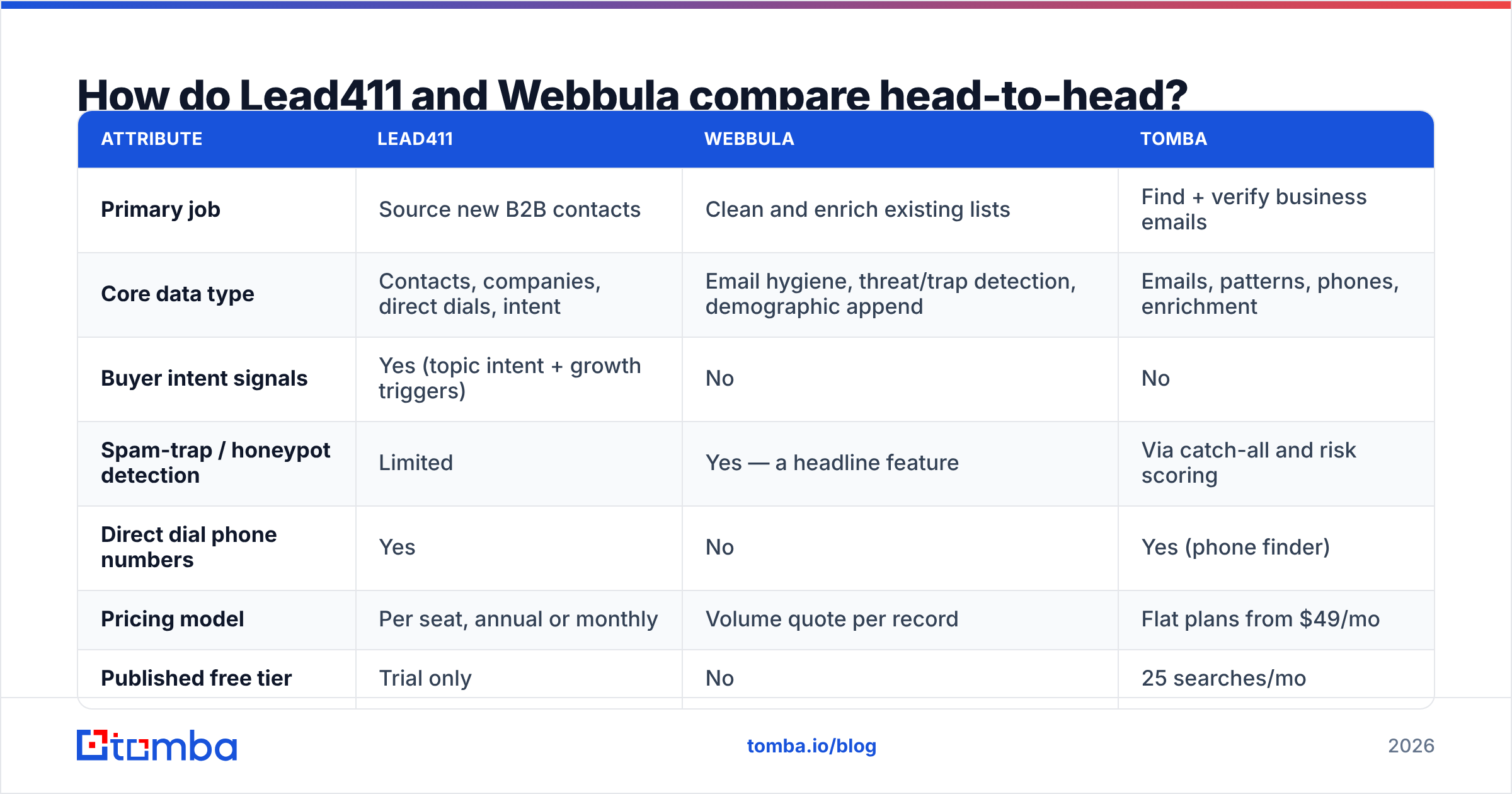
| What it does | Lead411 | Webbula | Tomba |
|---|---|---|---|
| Main job | Find new B2B contacts | Clean and enrich your list | Find and verify work emails |
| Core data | Contacts, firms, dials, intent | Hygiene, trap and threat flags, append | Emails, patterns, phones, enrichment |
| Buyer intent | Yes | No | No |
| Trap and honeypot flags | Limited | Yes, the headline feature | Via catch-all and risk scores |
| Direct dial numbers | Yes | No | Yes |
Now the commercial side. This is where most buyers get surprised.
| How you buy | Lead411 | Webbula | Tomba |
|---|---|---|---|
| Price model | Per seat, monthly or annual | Quote, priced per record | Flat plans from $49/mo |
| Free tier | Trial only | No | 25 searches a month |
| Self-serve API | On higher tiers | Yes, but sales-led | Yes, on every paid plan |
| Best fit | Reps building pipeline | Email teams with old databases | Teams that need good emails fast |
| Entry cost | About $99 per user/mo | Four figures for a large file | $49/mo |
Treat both price lines as a guide, not a quote. Lead411 publishes tiers but still negotiates larger deals. Webbula prices by record volume, file frequency, and the modules you turn on. Get the number in writing before you compare.
What is Lead411 good at?#
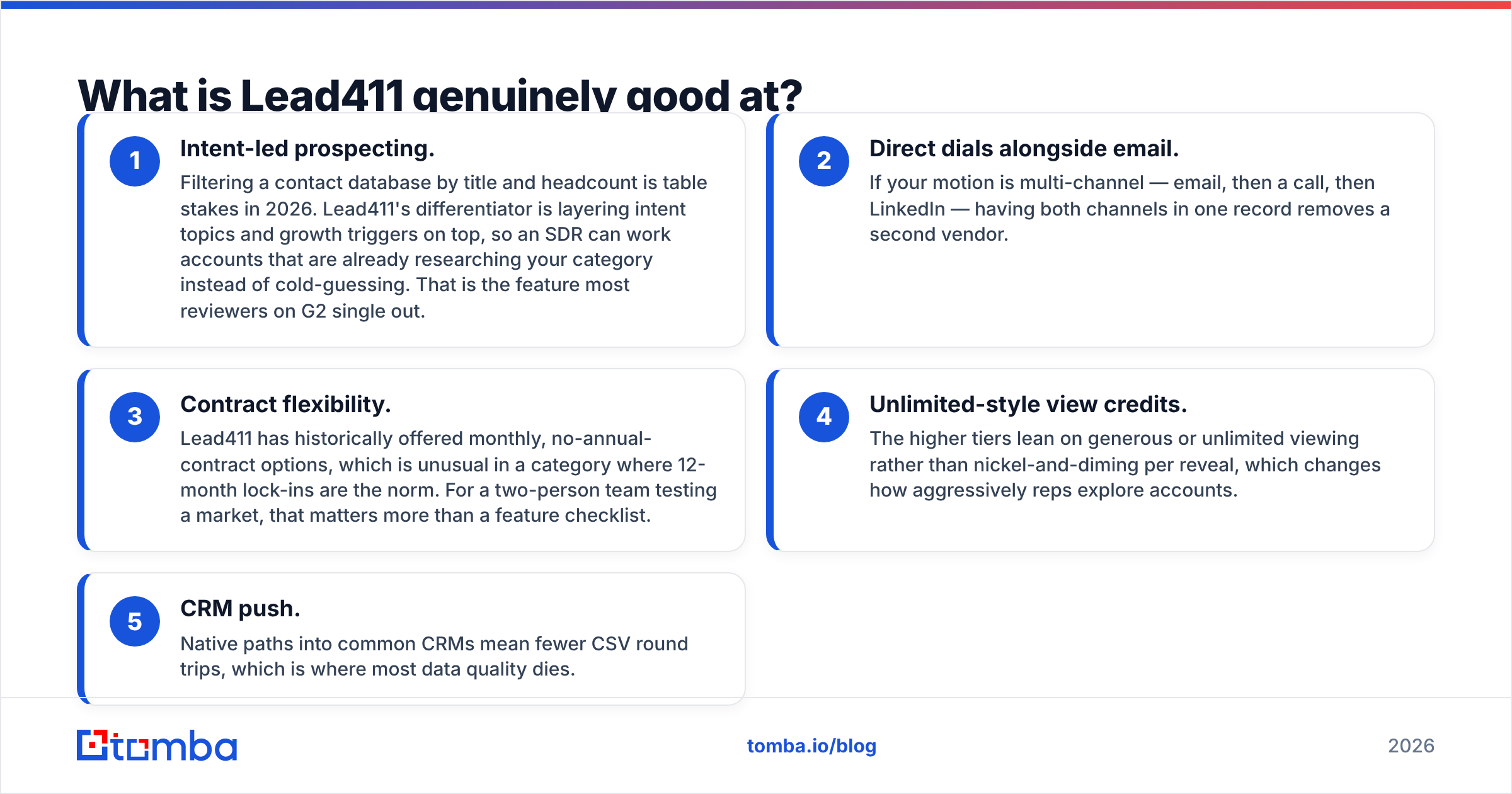
Intent-led prospecting. Filtering by job title and headcount is table stakes in 2026. Lead411 adds intent topics and growth triggers on top. A rep can work accounts that already shop your category. Reviewers on G2 call this out most often.
Dials next to email. Many teams send an email, then call, then try LinkedIn. Both channels sit in one record here, so you drop a second vendor.
Flexible contracts. Lead411 has long offered a monthly plan with no annual lock-in. That is rare in this category. For a two-person team testing a market, it matters more than a feature list.
Generous view credits. Higher tiers lean on large or unlimited views. Reps explore more accounts when each look is not metered.
CRM push. Native links into common CRMs cut out CSV round trips. Most data quality dies in those files.
The complaints are easy to list. Coverage thins out beyond North America. Seat pricing gets steep past a few reps. Records decay, as they do with every vendor. A contact checked nine months ago is a coin flip today. So run an email verifier pass before you send, whoever your source is.
What is Webbula good at?#
Webbula makes a narrower, more technical pitch. It treats email hygiene as a threat problem, not a spelling problem.
Trap and honeypot flags. Cheap validators only confirm that a mailbox exists. They will not tell you it is a recycled spam trap set by a blocklist operator. Hitting those wrecks your sender reputation. Trap detection is Webbula's headline skill.
Complainer and litigator flags. Some people complain about every email. A few sue. Flagging them before you send is real risk control.
Layered checks. Webbula uses several methods, not one SMTP ping. That helps on domains that block probing.
Data append. It can add demographic and firm detail to a file you inherited. Agencies use this to segment old lists.
Batch workflows. The product is built around files and repeat cleaning schedules. That suits agencies who clean client lists each quarter.
The drawbacks are clear. There is no self-serve signup and no public price, so every deal starts with a sales call. It also does nothing for prospecting. If you have 400 contacts and need 4,000, Webbula is the wrong purchase.
Lead411 vs Webbula: which one has better data?#
That is the wrong question. The two vendors measure different things.
Lead411 measures whether a record is still true. Is this person in this role, at this firm, on this email? Across the B2B data industry, roughly 25% to 30% of that decays each year. HubSpot and most CRM vendors have cited that range for years. No database escapes it.
Webbula measures risk. Will sending to this address hurt you? A record can be real and still be a bad idea to email.
So a contact can pass the Lead411 check and fail the Webbula check. The reverse happens too. At real volume you want both facts confirmed. That is why many teams pay two vendors. It is also why lean teams now fold sourcing and checking into one API.
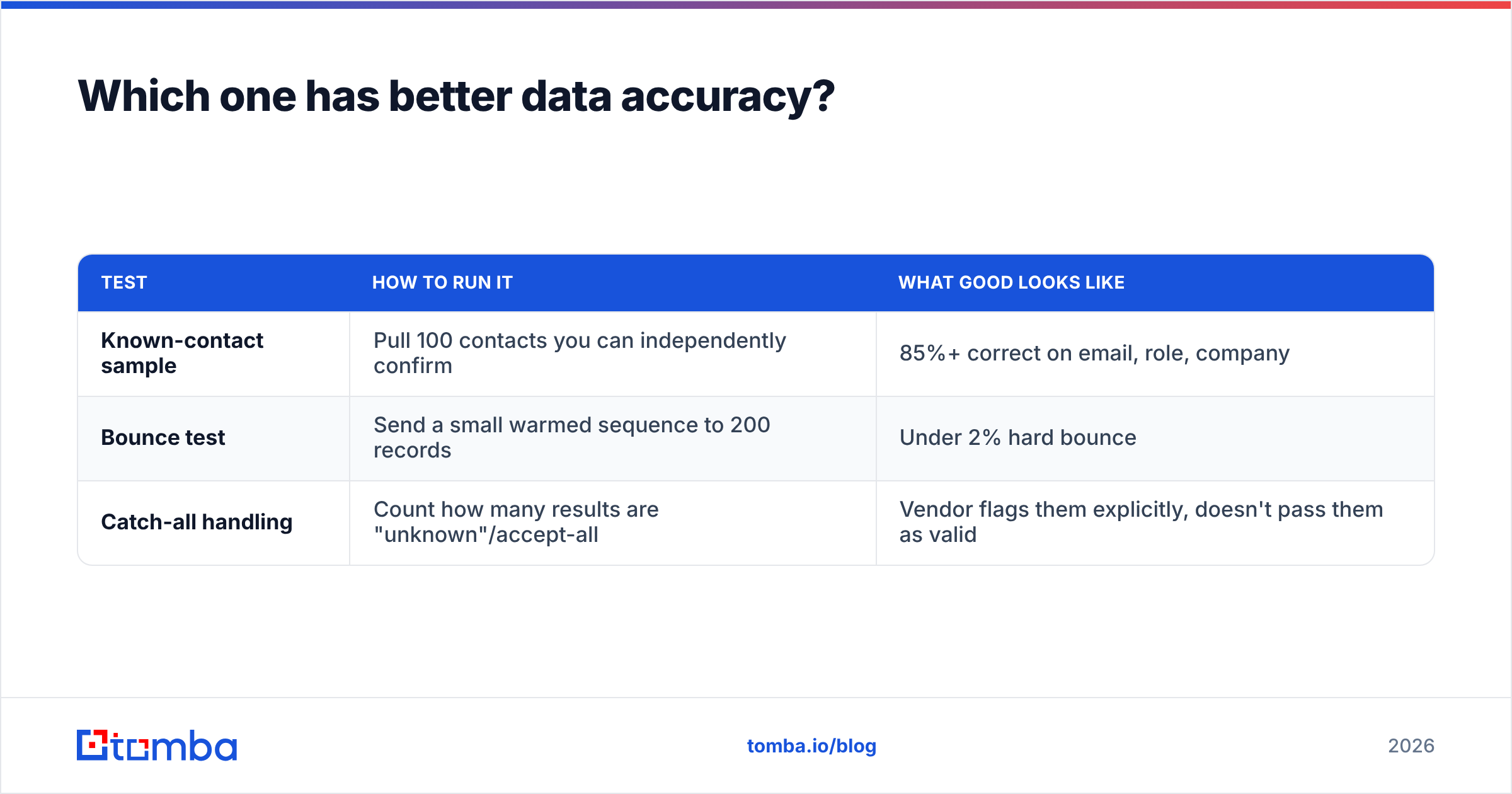
Run three tests on any vendor before you sign:
| Test | How to run it | What good looks like |
|---|---|---|
| Known-contact sample | Pull 100 contacts you can confirm yourself | 85% or better on email, role, firm |
| Bounce test | Send a small warm sequence to 200 records | Under 2% hard bounce |
| Catch-all handling | Count results marked unknown or accept-all | The vendor flags them, and never passes them as valid |
The third test catches more bad vendors than the other two. Any provider that quietly marks catch-all domains as valid is pushing risk onto your sending domain. Send those domains through a catch-all verifier instead.
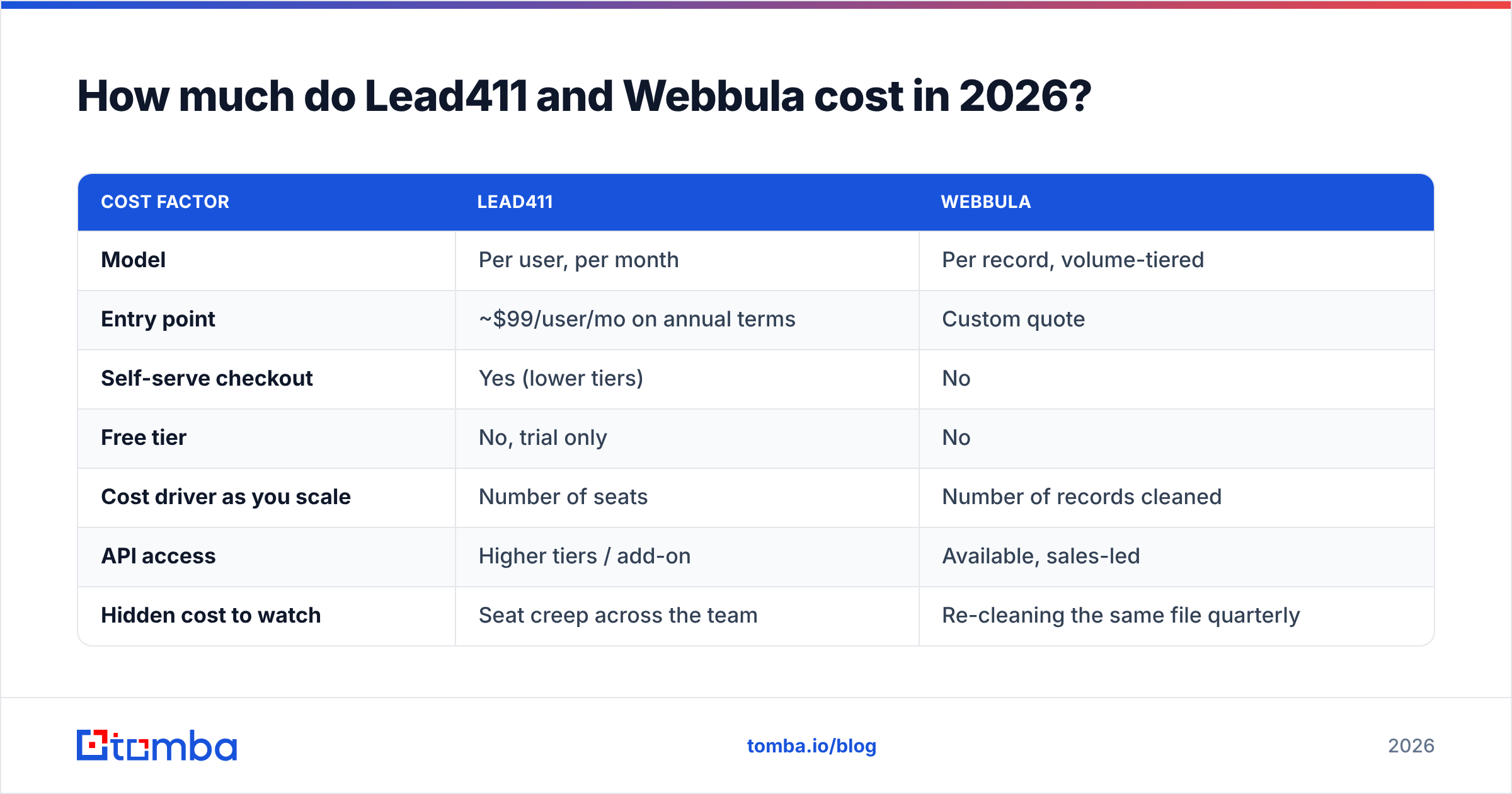
Lead411 vs Webbula pricing: what does each cost in 2026?#
| Cost factor | Lead411 | Webbula |
|---|---|---|
| Model | Per user, per month | Per record, by volume |
| Entry point | About $99 per user/mo on annual terms | Custom quote |
| Self-serve checkout | Yes, on lower tiers | No |
| Free tier | No, trial only | No |
| What drives cost | Number of seats | Records cleaned |
| API access | Higher tiers or add-on | Yes, sales-led |
| Hidden cost | Seat creep | Cleaning the same file again each quarter |
Model two things before you commit. First, seats add up. A five-rep plan is a five-figure year, even if only two reps prospect daily. Second, hygiene repeats. A growing database needs cleaning again and again, so budget it every quarter.
For contrast, Tomba pricing is flat and seat-free. Free covers 25 searches a month. Starter is $49/mo, Growth is $99/mo, and Pro is $249/mo. The point is not that one number is smaller. Flat plans charge for work done, not for people logged in. That suits teams that automate.

Do you need both, or neither?#
The Lead411 vs Webbula call gets easy once you name your bottleneck. Match your case to this list:
No list, and you need pipeline. Buy Lead411 or a rival source. Webbula does nothing for you yet.
A 500k-record file from three acquisitions, and your email platform is complaining. Buy Webbula. Lead411 does nothing for you yet.
Target accounts, but not the right people inside them. Neither, really. This is a domain search job. You know the firm. You need the people and the email format.
5k to 50k cold emails a month, and one bill. A find-and-verify platform beats stitching two vendors together. It wins on cost and on engineering time.
Real-time enrichment of inbound signups. You need an API with steady latency, not a batch file. That rules out Webbula's core motion. It puts the Lead411 API tier in play, next to contact enrichment endpoints.
Here is the honest version. Most teams under 20 reps who buy both use maybe 40% of each. The intent data sits idle because nobody built a workflow for it. The hygiene contract renews out of fear, not measured lift.
What are the strongest alternatives?#
Price the nearby options before you sign either contract.
Contact databases with intent. Apollo, ZoomInfo, Cognism, and Lead411 share a shelf. Compare them on your market's geography, not on feature lists.
List vendors. BookYourData and similar firms sell targeted, pre-checked lists outright. That can beat a seat plan if you buy one defined segment a year.
Verification specialists. ZeroBounce, Bouncer, and Webbula compete on risk detection. Webbula leans on trap and threat data. The others lean on speed and public pricing.
Find-and-verify platforms. These do both jobs in one API. Most lean outbound stacks have moved here.
Whichever way you go, insist on a paid pilot with your target market. A demo on US software firms tells you nothing about German factories or Brazilian logistics firms.
The verdict: Lead411 vs Webbula#
Lead411 wins if you build outbound pipeline from scratch. You get intent signals and dials in one seat-based plan. It is a sales team's tool.
Webbula wins if you already own a large, aging email file and deliverability is on fire. It is an email marketer's tool, and its trap detection is a real edge.
Neither wins if you just need current work emails for a set list of target firms, through an API, with no seat contract and no sales call. That job is narrower. Paying two enterprise vendors to cover it is how data budgets triple.
Start with the Tomba Email Finder. It finds verified work emails by name, domain, or company. Verification runs in the same call. You get 25 free searches a month, so you can test coverage on your own market first. If it covers your list, two line items leave next year's budget.
Related guides#
// get started
Find, verify and enrich your first contacts today
Start on the free plan with 25 searches a month, then scale when your team is ready.
Free plan · No credit card required · GDPR & CCPA
// about the author