Lead411 vs ZoomInfo: Which B2B Data Tool Wins in 2026?
ZoomInfo has the biggest B2B database. Lead411 has unlimited downloads and transparent pricing. We compare coverage, accuracy, contracts, and real cost per contact to find who should pick which.
Lead411 vs ZoomInfo comes down to one trade-off: scale or cost control. This guide compares both on price, data accuracy, contract terms, and export rights. It also covers a third option that fits a lot of teams better.
TL;DR
- ZoomInfo wins on raw database size, intent data, and enterprise workflow depth. It charges accordingly. Most real contracts land in the $15,000–$40,000/year range, with annual lock-in.
- Lead411 wins on pricing transparency and unlimited-download plans. Published pricing starts around $99/user/month. Its Bombora-powered intent add-on costs a fraction of ZoomInfo's.
- Neither is the right buy if you mostly need verified email addresses at scale — that's a $49–$249/month problem, not a five-figure one.
- Export rights matter more than record counts. ZoomInfo meters credits and seats. Lead411 sells unlimited exports on higher tiers. Both restrict how you use the data downstream.
- Pick ZoomInfo if you run an enterprise ABM motion with intent-triggered plays. Pick Lead411 if you're a 5–50 person sales team that wants predictable cost. Pick an email-finder API if enrichment — not a database subscription — is the actual job.
What are Lead411 and ZoomInfo, exactly?#
Both sell the same core promise: a searchable database of companies and the people inside them, with contact details attached. The difference is scale and business model.
ZoomInfo is the category's 800-pound gorilla. It's a public company (NASDAQ: GTM). The database holds hundreds of millions of professional profiles. On top of it sit a Copilot AI layer, native intent signals from its own web-traffic network, and deep two-way CRM sync. It sells top-down to RevOps and sales leaders on annual contracts. You buy through a rep, and the price is almost never on the website.
Lead411 is the scrappier challenger. Founded in 2001, it built its name on growth intent triggers: funding rounds, hiring surges, new executive appointments. It also has a pricing page you can actually read. Its headline feature is unlimited downloads on the Pro tier. That aims straight at ZoomInfo's credit meter.
Think of it like buying water. ZoomInfo sells you a city utility contract: huge supply, great infrastructure, and a meter on every tap. Lead411 sells you a well in your own yard: a smaller source, but you pump as much as you want for a flat fee.

Lead411 vs ZoomInfo: how do they compare head to head?#
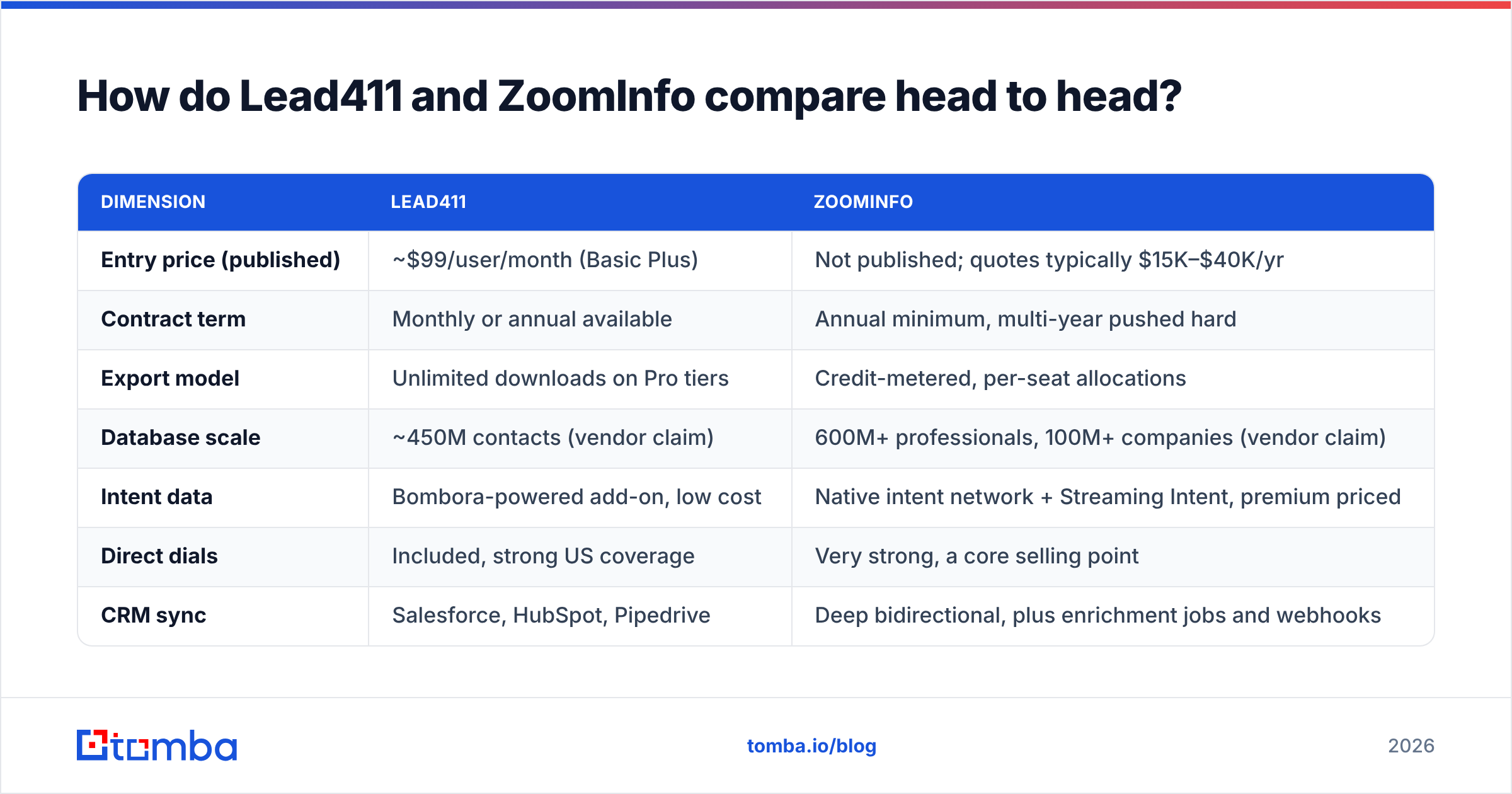
| Dimension | Lead411 | ZoomInfo |
|---|---|---|
| Entry price (published) | ~$99/user/month (Basic Plus) | Not published; quotes typically $15K–$40K/yr |
| Contract term | Monthly or annual available | Annual minimum, multi-year pushed hard |
| Export model | Unlimited downloads on Pro tiers | Credit-metered, per-seat allocations |
| Database scale | ~450M contacts (vendor claim) | 600M+ professionals, 100M+ companies (vendor claim) |
| Intent data | Bombora-powered add-on, low cost | Native intent network + Streaming Intent, premium priced |
| Direct dials | Included, strong US coverage | Very strong, a core selling point |
| CRM sync | Salesforce, HubSpot, Pipedrive | Deep bidirectional, plus enrichment jobs and webhooks |
| AI layer | Basic AI writer | Copilot: account prioritization, AI research, drafting |
| Free trial | Yes, limited-credit trial | Demo-gated; no self-serve trial |
| Best fit | SMB and mid-market sales teams | Enterprise ABM and large SDR orgs |
The table hides the thing that decides most deals: how the vendor meters you. With ZoomInfo credits, your usable output is capped apart from your seat count. Run a big list build in Q1, and you'll be negotiating a credit top-up by March. Lead411's unlimited tier removes that worry. That's why it wins bake-offs with teams that build lists in bulk.
Which one has better data accuracy?#
Honest answer: neither publishes an audited accuracy figure. Both claim numbers above 90%. Neither claim survives a real send.
Here is what buyer reviews on G2 and Capterra show again and again:
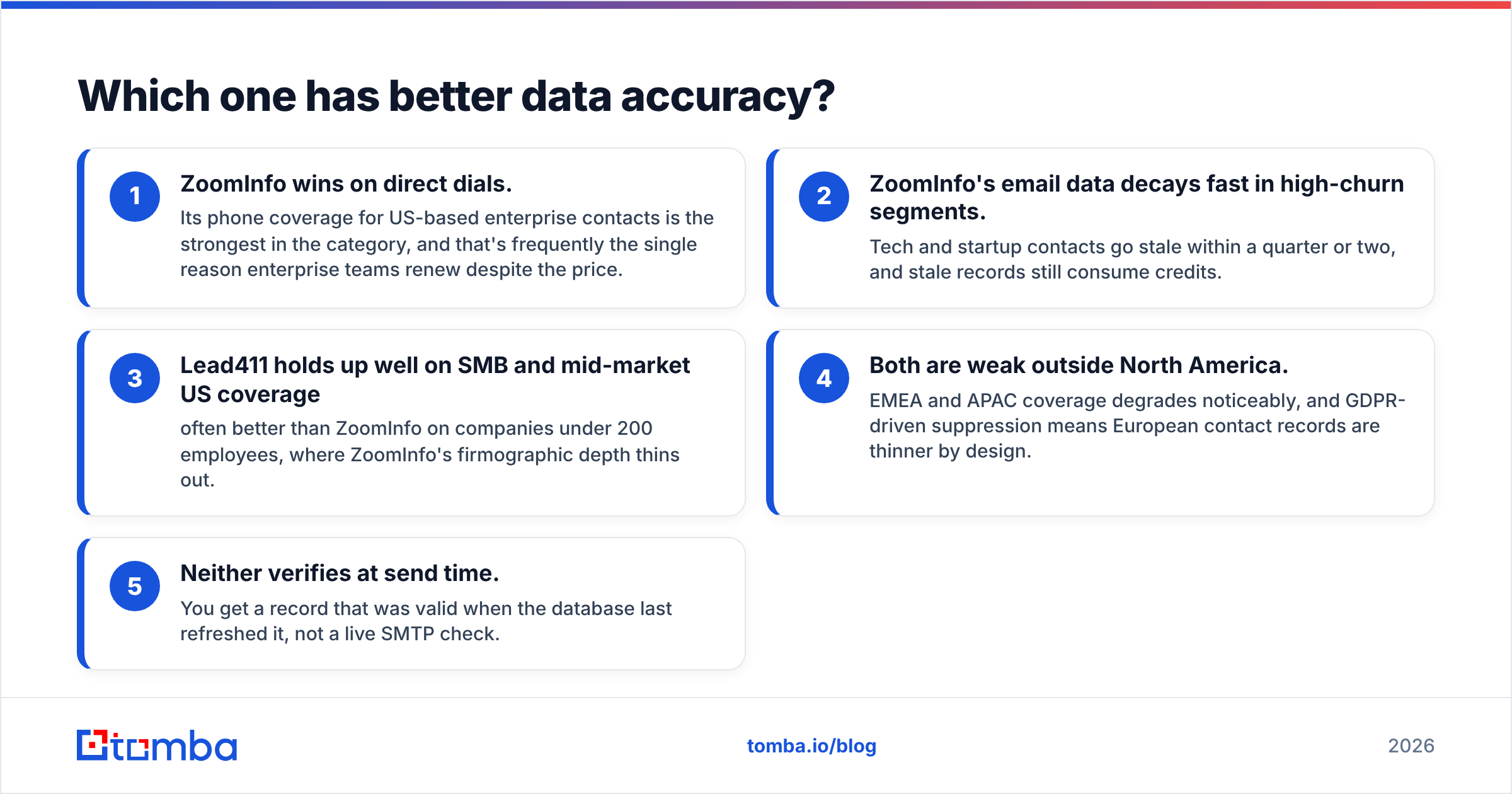
- ZoomInfo wins on direct dials. Its phone coverage for US enterprise contacts is the best in the category. For many enterprise teams, that alone justifies the renewal.
- ZoomInfo's email data decays fast in high-churn segments. Tech and startup contacts go stale within a quarter or two. Stale records still burn credits.
- Lead411 holds up well on SMB and mid-market US coverage. It often beats ZoomInfo on companies under 200 employees, where ZoomInfo's firmographic depth thins out.
- Both are weak outside North America. EMEA and APAC coverage drops off noticeably. GDPR-driven suppression also makes European records thinner by design.
- Neither verifies at send time. You get a record that was valid at the last database refresh, not a live SMTP check.
That last point costs teams real money. A database tells you an address existed. It can't tell you the address will accept mail today. At volume, you still need a separate email verifier in the pipeline before anything hits your sending domain. Otherwise your bounce rate does the damage, no matter who sourced the list.
What does Lead411 vs ZoomInfo actually cost in 2026?#
ZoomInfo's price is the harder number to pin down. It's built per deal, not listed. A typical quote stacks a platform fee, per-seat licenses, and a credit bundle. Then come the optional modules: intent, Engage for sequencing, and Operations for the enrichment API. Buyers say the sticker shock comes from the modules, not the base.
Lead411 publishes tiers. The structure roughly looks like this:
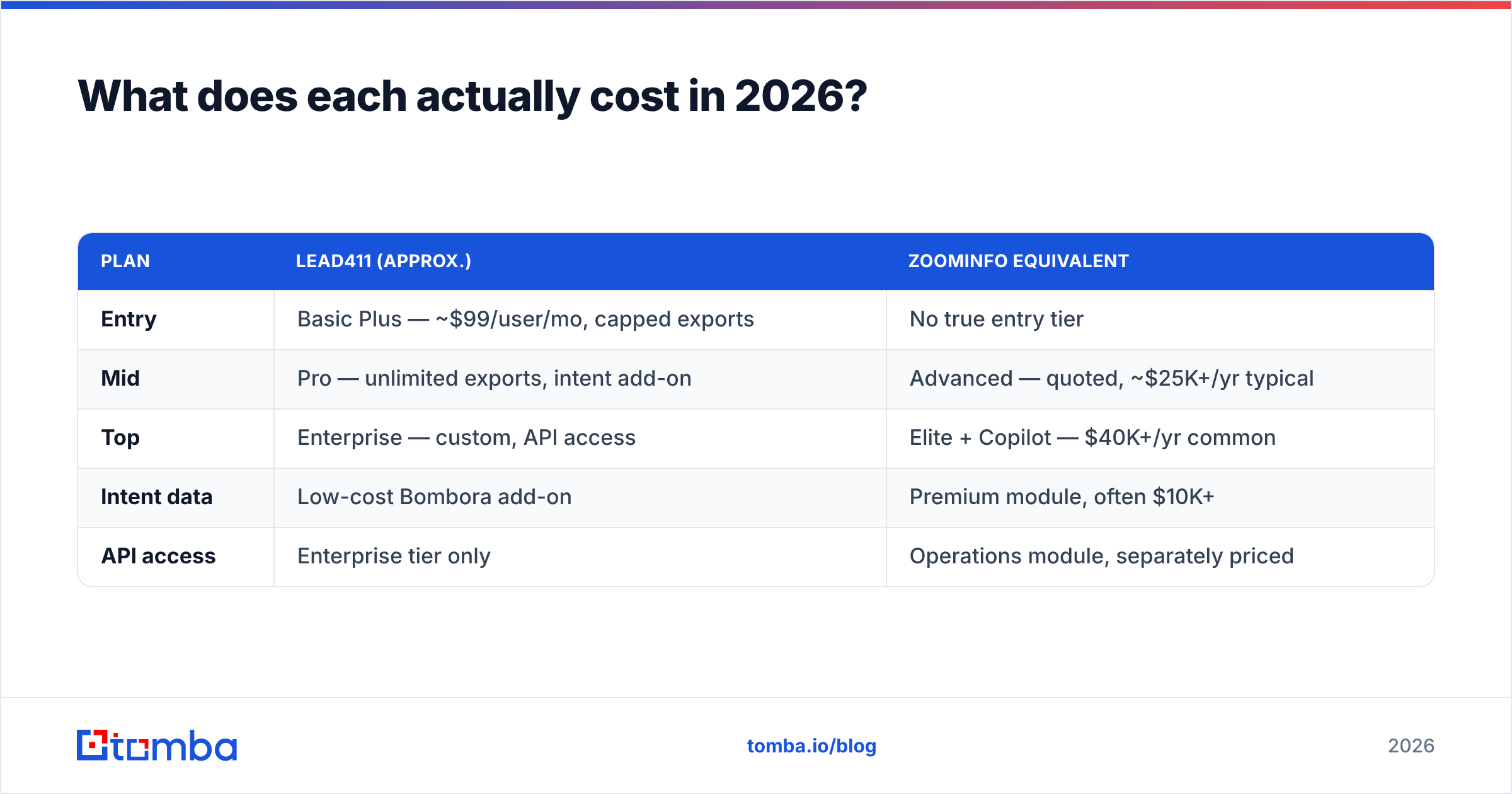
| Plan | Lead411 (approx.) | ZoomInfo equivalent |
|---|---|---|
| Entry | Basic Plus — ~$99/user/mo, capped exports | No true entry tier |
| Mid | Pro — unlimited exports, intent add-on | Advanced — quoted, ~$25K+/yr typical |
| Top | Enterprise — custom, API access | Elite + Copilot — $40K+/yr common |
| Intent data | Low-cost Bombora add-on | Premium module, often $10K+ |
| API access | Enterprise tier only | Operations module, separately priced |
Two warnings. First, ZoomInfo auto-renewal terms are aggressive. The notice window is short, and buyers routinely get rolled into another year. Read the termination clause before you sign, not in month eleven. Second, Lead411's "unlimited" has a fair-use ceiling. It works as a daily or monthly soft cap. It's generous, but it isn't infinite, and the exact limit isn't published.
Is a full database subscription even the right purchase?#
This is where most comparison posts stop. It's also where the real money decision lives.
Ask what job you're hiring the tool for:
- "I need to discover accounts I don't know about" → you need a database. ZoomInfo or Lead411 both qualify.
- "I need intent signals to time outreach" → ZoomInfo if budget allows, Lead411's Bombora add-on if it doesn't.
- "I already know the companies — I just need contacts at them" → you don't need a database. You need a domain search and an email finder.
- "I have a CRM full of half-empty records" → you need enrichment, not a seat license.
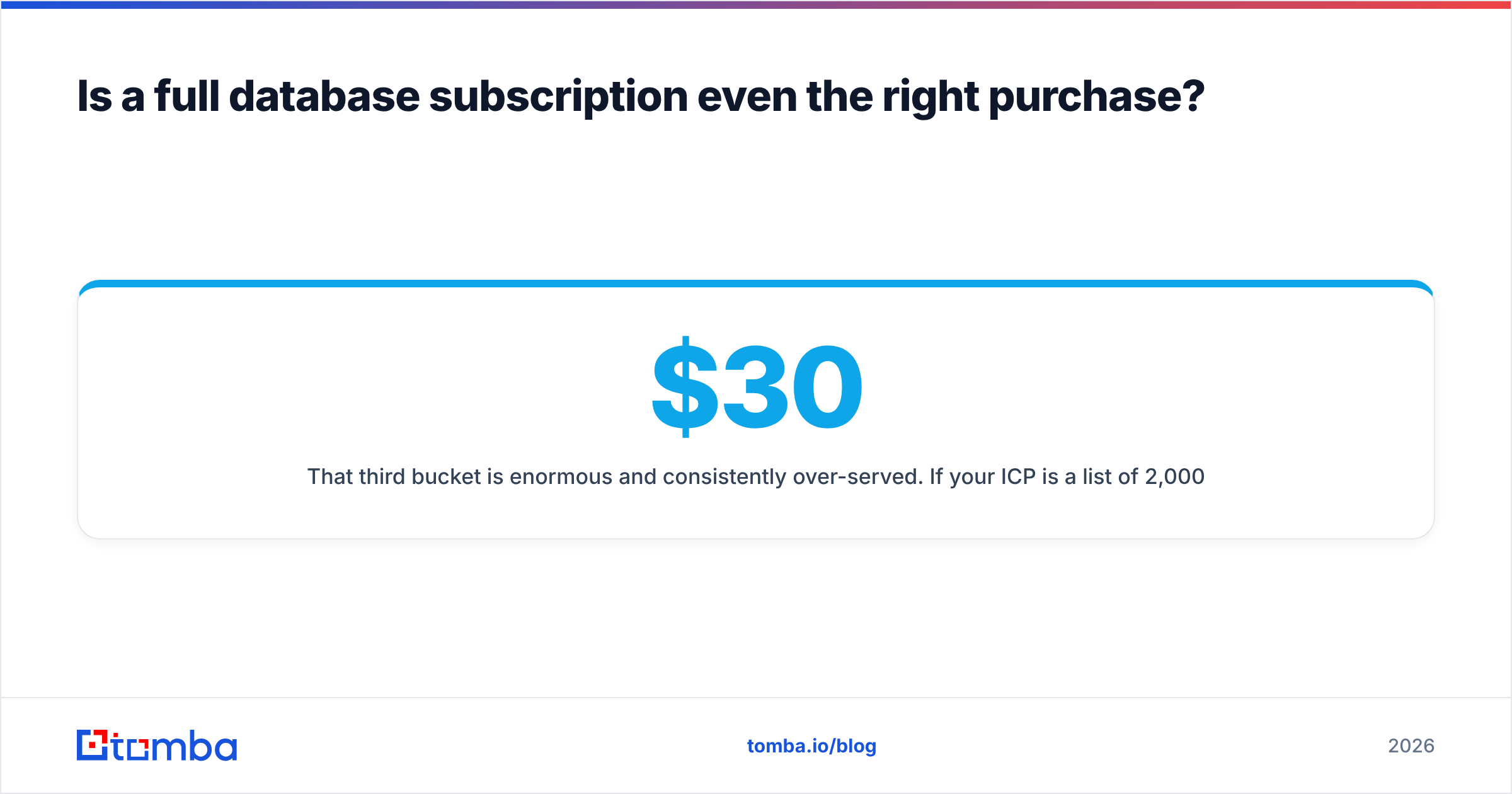
That third bucket is huge, and badly over-served. Say your ICP is a list of 2,000 named accounts. Paying $30,000 a year for access to 600 million profiles buys you 599.998 million records you will never query. Per-domain lookups at Tomba pricing start free at 25 searches a month, then run $49 for Starter and $99 for Growth. Same job, about 1% of the cost.
One more tool worth knowing here: BookYourData sells pay-as-you-go credits with no subscription at all. That suits teams running the odd campaign rather than prospecting year-round. It's a genuinely different model from both Lead411's seats and ZoomInfo's contracts.

How do they handle compliance and data sourcing?#
Both operate under CCPA and GDPR. Both have drawn privacy complaints. ZoomInfo draws more of them, given its scale and its history of surfacing personal contact details without direct consent. Both run a public opt-out portal.
Practical implications for your team:
- Never assume "the vendor is compliant" means "your use is compliant." In the EU, legitimate interest for B2B outreach rests on how you reach out, not on how they collected the data.
- Check your contract's data-retention clause. Most B2B data contracts make you delete or stop using exported records once the deal ends. That quietly undercuts the value of "unlimited downloads."
- Suppression lists are your responsibility. Neither platform scrubs contacts who opted out of your prior campaigns.
- Sourcing transparency varies. Understanding where a provider gets its data belongs in vendor due diligence, not in an afterthought.
Which should you choose?#
Choose ZoomInfo if: you have 25+ sellers, a defined ABM program, budget approval above $25K/year, and a RevOps function that will actually use intent signals. ZoomInfo's value sits in the workflow. Copilot surfaces the right account at the right moment, and enrichment jobs keep Salesforce clean on their own. If nobody owns that workflow internally, you're buying an expensive search box.
Choose Lead411 if: you're a 5–50 person sales org, you build lists in bursts, and predictable cost matters more than maximum coverage. The unlimited-download tier is a real differentiator. The growth triggers — funding, hiring, exec changes — are a solid prospecting signal at a fraction of ZoomInfo's intent price.
Choose neither if: your bottleneck is contact data on accounts you've already identified. A purpose-built finder plus verification beats a database subscription on cost by an order of magnitude. You also skip the annual contract entirely. Teams in this spot often pair a lightweight finder with their existing CRM through a HubSpot integration and never touch a seat-based platform.
What does a lean stack look like instead?#
If you're building outbound from scratch in 2026 without an enterprise budget, the replacement stack is roughly:
- Account discovery — LinkedIn Sales Navigator or a targeted list source, not a full database seat
- Contact discovery — an email finder API hitting your named-account domains on demand
- Verification — SMTP-level checking before every send, including catch-all handling
- Enrichment — fill CRM gaps with job title, company size, and social profiles at the record level
- Sequencing — a dedicated sending tool with warmup, kept separate from your data source
Keeping data and sending apart is deliberate. Bundled platforms like ZoomInfo Engage make switching costs brutal. When one contract covers your data vendor and your sending tool, you renew out of inertia rather than performance. A modular stack lets you swap any layer that underperforms without reopening the whole deal.
The bottom line#
The Lead411 vs ZoomInfo verdict is short. ZoomInfo is the better product. Lead411 is the better deal. Both are the wrong answer if what you actually need is verified email addresses for accounts you have already picked.
Before you sign a five-figure annual contract, run the math on your real usage. How many new contacts do you genuinely need per month? What would it cost to look those up on demand? For most teams the honest number is a few thousand lookups. The Tomba Email Finder handles that on a $49/month Starter plan, with verification built in and no annual commitment to escape from. Start on the free tier, benchmark it against your current provider's exports on the same 100 domains, and let the bounce rate decide.
Related guides#
Ready to find emails that actually work?
Join 150,000+ professionals who stopped guessing and started sending. Free credits on signup — no credit card required.
Get the Tomba newsletter
Practical outbound tactics and product updates — once every two weeks.
About the author