Leadberry Pricing, Reviews, Pros and Cons (2026 Review)
Leadberry turns anonymous website traffic into a list of companies. But what does it actually cost, where does the data stop, and what do you still have to buy? An honest 2026 breakdown.
TL;DR
- Leadberry pricing starts around $24/month on annual billing for the entry tier and climbs to roughly $149/month for the top published plan, with a 14-day free trial and no credit card required to start.
- What you buy is company-level identification of anonymous website traffic, built on top of Google Analytics data — not verified personal email addresses.
- Reviewers consistently praise the price-to-value ratio and the simple setup; the recurring complaints are match rate on small-business traffic, ISP noise in the lead list, and contact data that needs enrichment before it is usable.
- The real cost of Leadberry is the plan fee plus whatever you spend to turn "Acme Corp visited your pricing page" into a named decision-maker with a working inbox.
- Best fit: SMB and mid-market B2B teams with steady inbound traffic who already have a way to find contacts. Worst fit: teams expecting a full outbound database out of the box.
What is Leadberry and who is it actually for?#
Leadberry is a B2B website visitor identification tool. It reads the IP and firmographic signals behind your traffic, matches them against a company database, and tells you which organizations browsed your site, which pages they read, and how long they stayed.
The everyday analogy: it is a doorbell camera for your website. You already know someone rang the bell — analytics told you that. Leadberry tells you which company was standing on the porch. It does not tell you the person's name, and it certainly does not hand you their phone number.
Technically, Leadberry sits on top of your Google Analytics property rather than asking you to install yet another script, which is why setup is usually measured in minutes rather than sprints. If you run GA4, the connection is a permissions handshake and a property pick.
The product is aimed squarely at small and mid-market B2B companies: agencies, SaaS vendors, manufacturers, and consultancies that get a few thousand monthly sessions and know that most of those visitors leave without filling in a form. Enterprise ABM teams usually end up on heavier platforms with intent data and CRM-native workflows.
How much does Leadberry cost in 2026?#
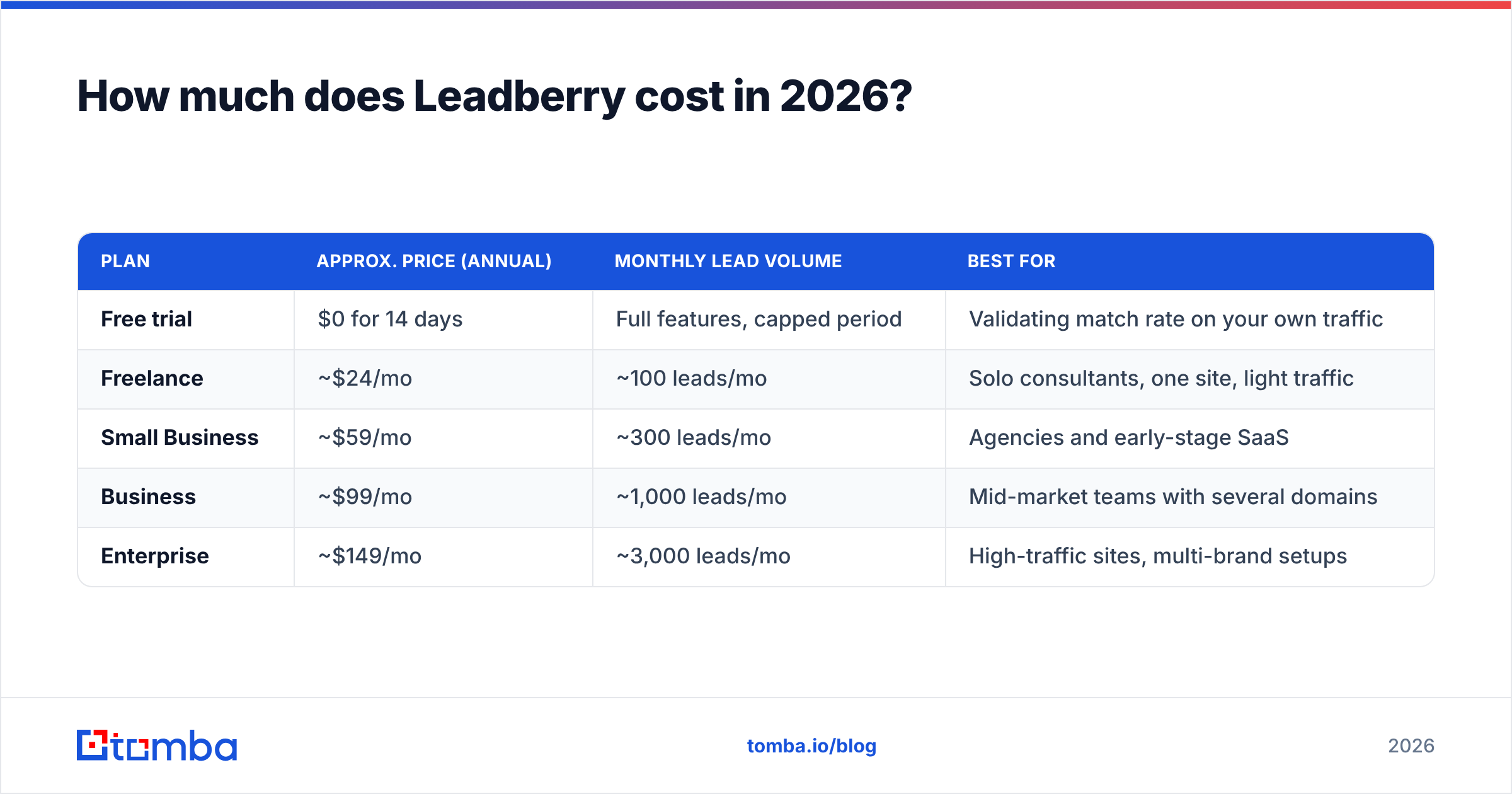
Leadberry publishes four tiers plus a free trial. Prices below reflect the published annual-billing rates at the time of writing; monthly billing runs roughly 20–25% higher, and Leadberry adjusts packaging periodically, so treat the official Leadberry site as the source of truth before you sign anything.
| Plan | Approx. price (annual) | Monthly lead volume | Best for |
|---|---|---|---|
| Free trial | $0 for 14 days | Full features, capped period | Validating match rate on your own traffic |
| Freelance | ~$24/mo | ~100 leads/mo | Solo consultants, one site, light traffic |
| Small Business | ~$59/mo | ~300 leads/mo | Agencies and early-stage SaaS |
| Business | ~$99/mo | ~1,000 leads/mo | Mid-market teams with several domains |
| Enterprise | ~$149/mo | ~3,000 leads/mo | High-traffic sites, multi-brand setups |
Three things about that table matter more than the headline numbers.
Volume is metered in identified leads, not sessions. A site with 20,000 monthly sessions might only resolve 400–900 identified companies. That is normal for IP-based identification, and it means the cheaper tiers stretch further than raw traffic numbers suggest.
Annual billing is the real price. The published low number almost always assumes a 12-month commitment. Budget for the monthly rate if you want to test for a quarter.
There are no per-contact credits. Unlike an email finder or enrichment API, Leadberry does not charge per lookup. You pay for the window of visibility, not per record. That is genuinely good value — as long as you understand what a "record" contains.

What do you actually get on each Leadberry plan?#
Feature gating is relatively light. Most of the product is available at the entry tier; what changes is volume, seats, and integration depth. Here is what the paid experience includes:
- Company identification with firmographics — name, industry, size band, location, and website for each resolved visitor.
- Behavioral detail per visit — pages viewed, session duration, entry source, and returning-visit history, which is where the buying signal actually lives.
- Lead filtering and smart rules — exclude ISPs, filter by country, page visited, or session depth, and auto-tag leads that hit high-intent URLs.
- LinkedIn and contact surfacing — Leadberry attaches public LinkedIn profiles and generic company contact details to matched accounts.
- CRM and workflow integrations — Pipedrive, HubSpot, Salesforce and Zapier connections plus daily email digests so nobody has to log in to the dashboard.
- Team seats and multi-domain tracking — the main upgrade lever on higher tiers, alongside lead volume.
Notice what is missing from that list: verified, person-level email addresses. Leadberry gives you the account and a shortlist of plausible people. Closing the loop from "Head of Ops at Acme" to a deliverable inbox is a separate job, which is why most teams pair a visitor-ID tool with a dedicated finder and email verifier.
What do Leadberry reviews say?#
Public reviews on G2 and Capterra skew positive, and the pattern across them is consistent enough to summarize honestly.
What reviewers like:
- Setup speed. The GA integration removes the usual "wait for the dev team to add a script" delay.
- Price relative to enterprise visitor-ID platforms, which commonly start several hundred dollars a month.
- The daily digest email. Several reviewers say it is the only reason the tool gets used — the data comes to the rep instead of the rep going to a dashboard.
- Filtering. Being able to suppress ISPs and irrelevant geographies makes the list workable rather than noisy.
What reviewers complain about:
- Match rate on small companies and remote-heavy workforces. Residential and mobile IPs resolve to consumer ISPs, not businesses, and no vendor can fully fix that.
- Contact data depth. The attached contacts are often generic (info@, a switchboard number) or a LinkedIn profile you still have to work.
- Duplicate or near-duplicate company entries on larger accounts with multiple offices.
- UI polish compared with newer, better-funded competitors.
None of these are dealbreakers at the price point. They are the predictable trade-offs of IP-based identification, and they show up in reviews of every tool in this category. The useful question is not "is Leadberry accurate?" but "is the resolved subset of my traffic worth $59 a month to see?" For most B2B sites with real inbound volume, the answer is yes.
What are the pros and cons of Leadberry?#
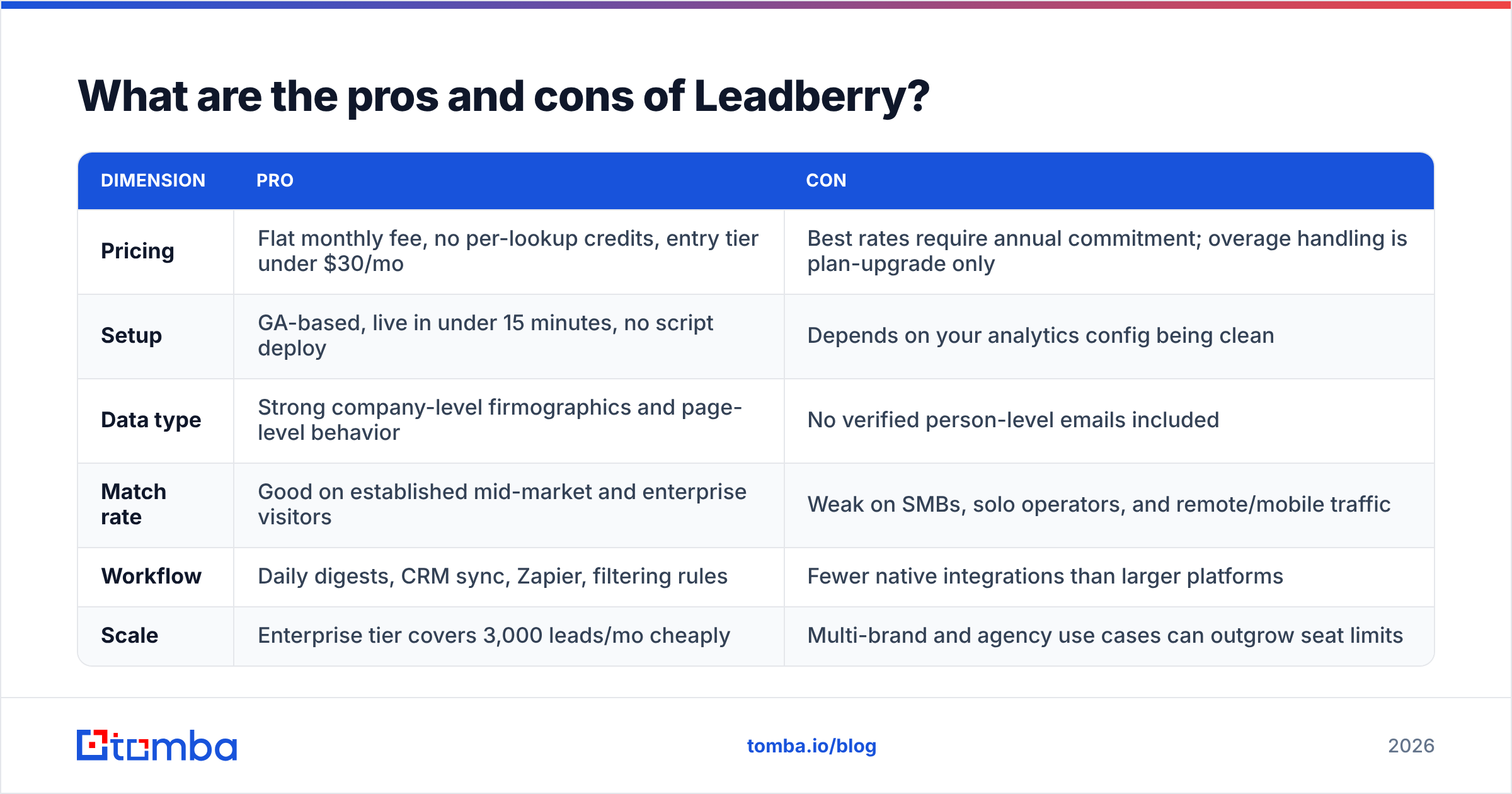
| Dimension | Pro | Con |
|---|---|---|
| Pricing | Flat monthly fee, no per-lookup credits, entry tier under $30/mo | Best rates require annual commitment; overage handling is plan-upgrade only |
| Setup | GA-based, live in under 15 minutes, no script deploy | Depends on your analytics config being clean |
| Data type | Strong company-level firmographics and page-level behavior | No verified person-level emails included |
| Match rate | Good on established mid-market and enterprise visitors | Weak on SMBs, solo operators, and remote/mobile traffic |
| Workflow | Daily digests, CRM sync, Zapier, filtering rules | Fewer native integrations than larger platforms |
| Scale | Enterprise tier covers 3,000 leads/mo cheaply | Multi-brand and agency use cases can outgrow seat limits |
How does Leadberry pricing compare with alternatives?#
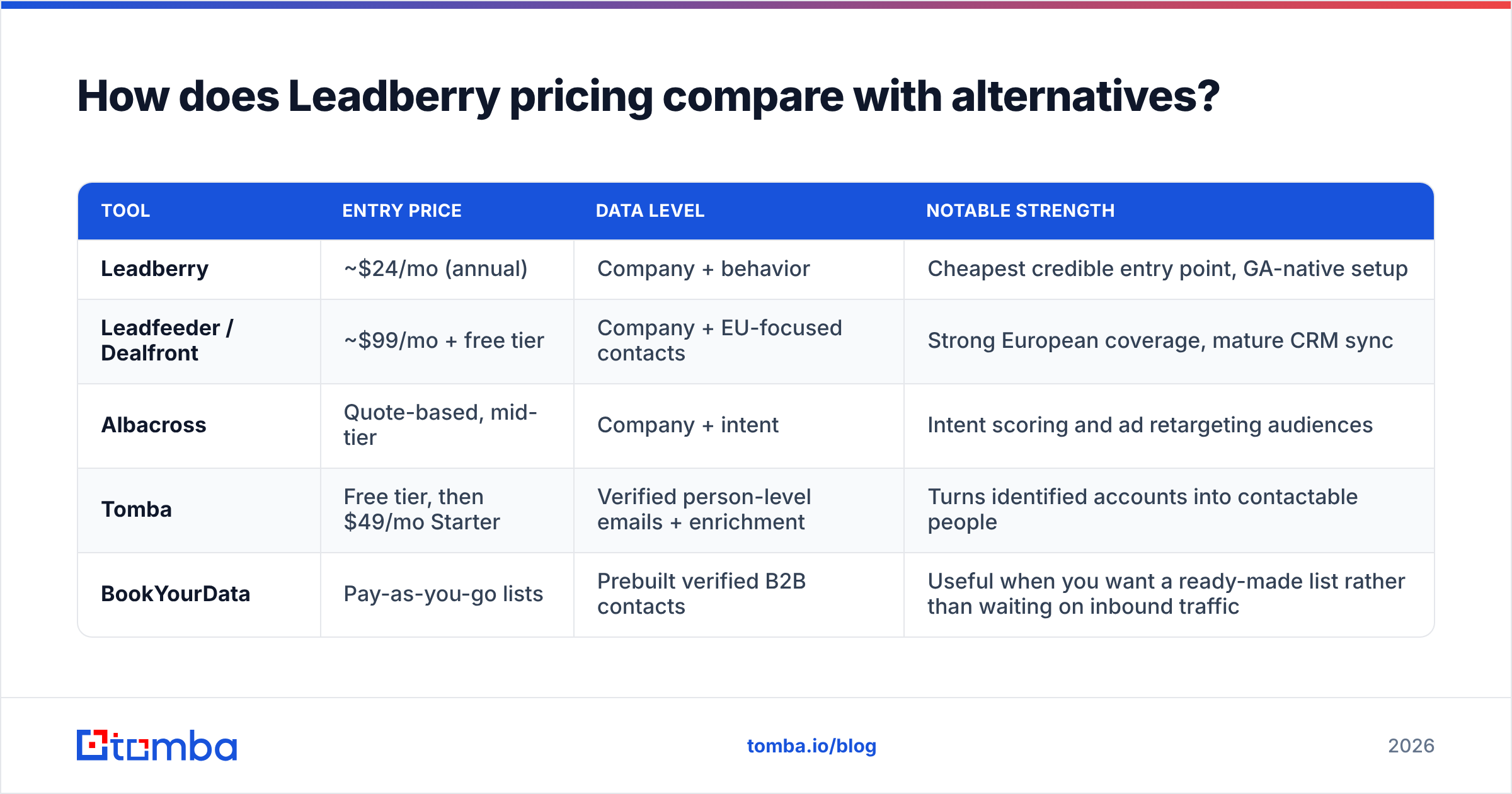
The visitor-identification market splits into three price bands: budget tools under $100/month, mid-tier platforms in the $150–$600 range, and enterprise ABM suites that quote annually and start in five figures.
| Tool | Entry price | Data level | Notable strength |
|---|---|---|---|
| Leadberry | ~$24/mo (annual) | Company + behavior | Cheapest credible entry point, GA-native setup |
| Leadfeeder / Dealfront | ~$99/mo + free tier | Company + EU-focused contacts | Strong European coverage, mature CRM sync |
| Albacross | Quote-based, mid-tier | Company + intent | Intent scoring and ad retargeting audiences |
| Tomba | Free tier, then $49/mo Starter | Verified person-level emails + enrichment | Turns identified accounts into contactable people |
| BookYourData | Pay-as-you-go lists | Prebuilt verified B2B contacts | Useful when you want a ready-made list rather than waiting on inbound traffic |
These products are not strictly substitutes. Leadberry and Albacross answer "who visited?" Tomba answers "how do I reach them?" BookYourData answers "what if I do not want to wait for traffic at all?" The stack most SMB teams settle on is one visitor-ID tool plus one contact-data tool, and the combined bill usually lands under $150/month.

Is Leadberry worth it in 2026?#
Short answer: yes, if you have inbound traffic and a rep who will act on the list within 48 hours. No, if either of those is missing.
Run the arithmetic before you subscribe. At $59/month, Leadberry needs to produce roughly one additional qualified conversation per quarter to pay for itself in almost any B2B model with a four-figure ACV. That is a low bar. The bar it frequently fails is organizational: the digest arrives, nobody owns follow-up, and the subscription renews for a year as a very expensive dashboard nobody opens.
Three checks before you buy:
1. Measure your resolvable traffic first. Use the 14-day trial and count how many distinct, non-ISP companies actually resolve. If your audience is solopreneurs and micro-businesses, the match rate will disappoint you regardless of vendor.
2. Decide who works the list. Visitor-ID data decays fast. A company that read your pricing page on Tuesday is a different prospect by Friday. Assign an owner and a same-week SLA or skip the category entirely.
3. Budget for the contact layer. This is the cost most buyers forget. Knowing that Acme Corp visited is only actionable once you know that Dana Reed runs revenue ops there and that dana@acme.com is deliverable.
How do you turn identified companies into real contacts?#
This is where the workflow gets practical. Once Leadberry hands you an account list, the sequence looks like this:
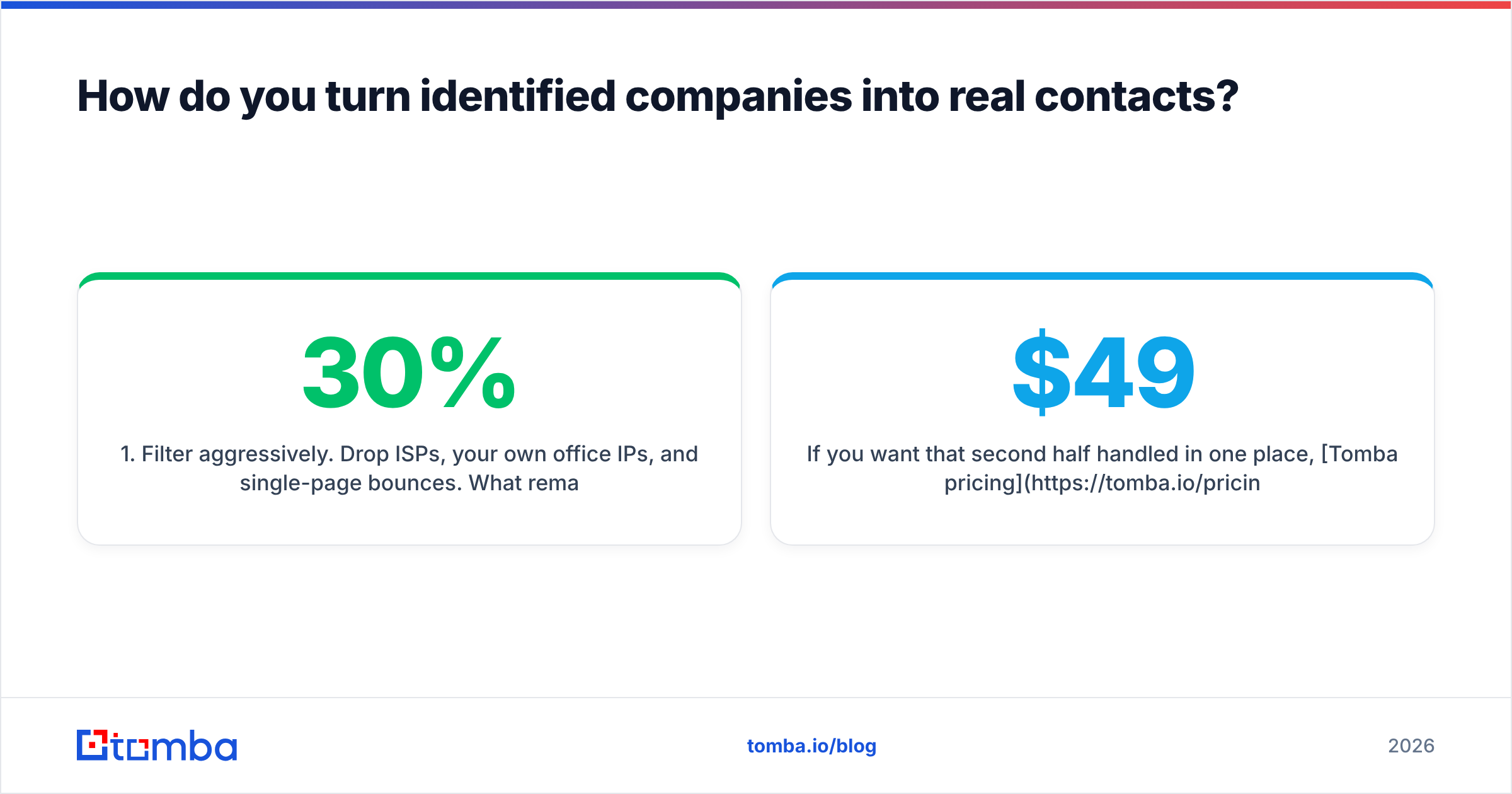
- Filter aggressively. Drop ISPs, your own office IPs, and single-page bounces. What remains is usually 20–30% of the raw list and 90% of the value.
- Score by page intent. Pricing page, integrations page, and comparison pages outrank blog reads by a wide margin.
- Resolve the company domain to people. Run each qualified domain through a domain search to pull the roles that matter — RevOps, demand gen, whoever owns the budget line your product touches.
- Verify before you send. Bounces on a fresh domain are the fastest way to damage sender reputation. Verify every address, and handle catch-all domains explicitly rather than guessing.
- Reference the visit without being creepy. "I saw you on our pricing page at 4:12pm" is a mistake. "Noticed a few folks at Acme have been comparing tools in this space" is fine.
- Push everything to the CRM. Both the account signal and the enriched contact should land on the same record, or your reporting will lie to you later.
If you want that second half handled in one place, Tomba pricing runs a free tier at 25 searches per month, Starter at $49/month, Growth at $99/month, and Pro at $249/month — and the same account covers verification, enrichment, and bulk lookups rather than charging separately for each. Teams that prefer to close the loop entirely inside one vendor can also look at website visitor reveal instead of running two subscriptions.
Frequently asked questions about Leadberry pricing#
Does Leadberry have a free plan? No permanent free plan — a 14-day full-feature trial, no card required. Use it to measure match rate, not features.
Is Leadberry GDPR compliant? Leadberry identifies companies rather than individuals, which is the legal basis most visitor-ID vendors rely on in the EU. Confirm the current DPA with their team if you operate in regulated markets.
Can I cancel monthly? Monthly plans are cancellable; annual plans carry the commitment that earns the discounted rate. Do not sign annual before the trial confirms your resolvable traffic.
Does Leadberry give me email addresses? Not verified personal ones. Expect company-level contact details and LinkedIn profiles, then pair it with a finder and verifier.
Where should you spend the next $100?#
Visitor identification tells you who showed up. It does not tell you who to email. If your pipeline problem is "we get traffic and cannot convert it," Leadberry at $59/month is a reasonable, honestly-priced answer to half the problem.
Solve the other half with the Tomba Email Finder: drop in the domains your visitor-ID tool surfaces, pull the decision-makers by role, verify deliverability before you send, and push the enriched contacts straight into your CRM. Start on the free tier, run it against one week of Leadberry accounts, and see how many of those anonymous sessions turn into actual replies.
Related guides#
// get started
Find, verify and enrich your first contacts today
Start on the free plan with 25 searches a month, then scale when your team is ready.
Free plan · No credit card required · GDPR & CCPA
// about the author