LeadDesk Pricing, Reviews, Pros and Cons: 2026 Buyer Guide
LeadDesk sells per-agent seats plus telephony minutes — and the second number is the one that surprises buyers. Here is what the platform actually costs, where reviewers praise it, and where it frustrates them.
TL;DR
- LeadDesk is a Nordic-built cloud contact center and outbound dialer, sold per agent seat per month, with telephony minutes billed separately on top. Expect roughly €89–€129 per agent/month on published list tiers, plus usage.
- The seat fee is not the whole bill. Call minutes, numbers, SMS, integrations, and onboarding all land outside the base license — budget 20–40% above list before you commit.
- Reviewers consistently praise the predictive dialer throughput, call quality, and uptime. The recurring complaints are reporting depth, admin learning curve, and contract/commitment terms.
- LeadDesk is a strong fit for teams of 10+ outbound agents doing high-volume dialing in Europe. For a 3-person SDR team making 40 calls a day, it is almost certainly over-bought.
- The dialer is only as good as the phone numbers you load into it. Bad list data burns paid minutes faster than any pricing tier decision — fix the data layer first with a phone finder and a phone validator.
What is LeadDesk, and who actually uses it?#
LeadDesk is a cloud contact center platform built for outbound-heavy teams. Think of it less as "a phone app for salespeople" and more as an air traffic control tower: it decides which number gets dialed, when, by which agent, on which line, and it logs every second of it.
The company is Finnish, publicly listed in the Nordics, and its customer base skews heavily toward European telesales, energy retail, insurance, debt collection, charity fundraising, and outsourced BPO operations. You can see the product positioning on LeadDesk's own site. That origin matters for a buying decision: LeadDesk was designed around high-volume, compliance-sensitive, multi-country calling — not around a five-person SaaS startup doing warm follow-ups.
Core capabilities:
- Predictive, progressive, preview, and power dialing modes
- Built-in telephony (LeadDesk is its own carrier in many markets, rather than reselling)
- Omnichannel inbox — voice, email, SMS, chat, WhatsApp
- Scripting, call recording, quality monitoring, and agent scorecards
- CRM sync and an open API for list injection and result write-back
If your operation is "20 agents, 300 dials each per day, four languages, recorded and auditable," LeadDesk is on the shortlist. If it is "four AEs and a shared Aircall number," it is not.
How does LeadDesk pricing work in 2026?#
Short answer: per agent, per month, plus minutes. LeadDesk does not sell a flat platform fee with unlimited usage, and it does not publish a self-serve credit card checkout the way a $29/month dialer does. Every real quote comes from sales, scoped to seats, countries, and expected call volume.
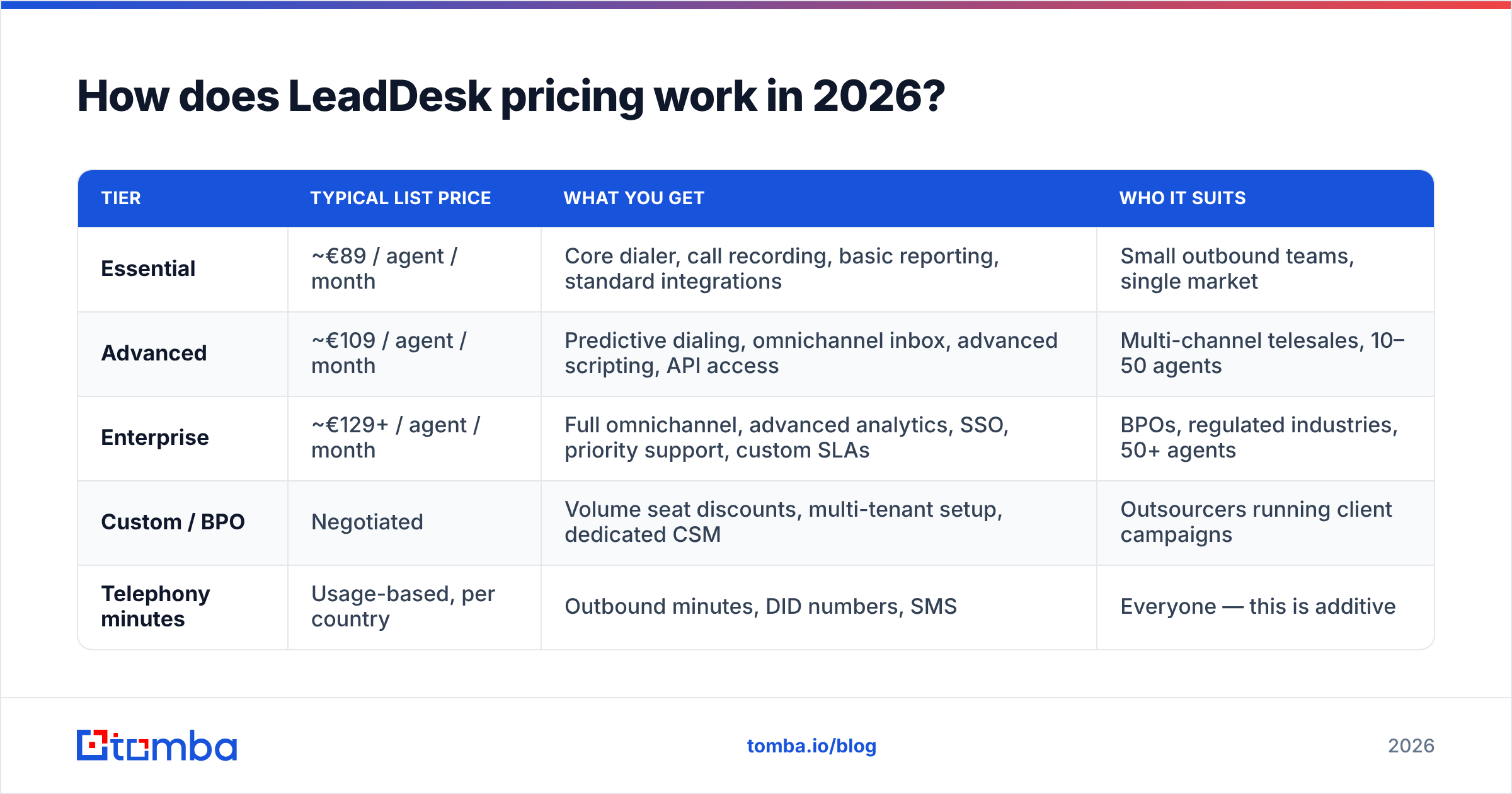
The published tier structure at the time of writing looks roughly like this — treat these as list anchors, not the number you will sign, and confirm current figures on LeadDesk's pricing page:
| Tier | Typical list price | What you get | Who it suits |
|---|---|---|---|
| Essential | ~€89 / agent / month | Core dialer, call recording, basic reporting, standard integrations | Small outbound teams, single market |
| Advanced | ~€109 / agent / month | Predictive dialing, omnichannel inbox, advanced scripting, API access | Multi-channel telesales, 10–50 agents |
| Enterprise | ~€129+ / agent / month | Full omnichannel, advanced analytics, SSO, priority support, custom SLAs | BPOs, regulated industries, 50+ agents |
| Custom / BPO | Negotiated | Volume seat discounts, multi-tenant setup, dedicated CSM | Outsourcers running client campaigns |
| Telephony minutes | Usage-based, per country | Outbound minutes, DID numbers, SMS | Everyone — this is additive |
Two structural things to understand before you model the cost.
First, the minutes are the variable that moves. A predictive dialer's whole job is to keep agents talking, which means it generates far more connected minutes per seat than manual dialing. That is the point — and it is also why a team that halves its idle time can double its telephony line item in the same month. Great outcome, surprising invoice.
Second, seat count is usually contracted, not elastic. Most LeadDesk agreements are annual with a committed number of named or concurrent seats. Seasonal teams that scale from 15 to 45 agents for Q4 need to negotiate that flex explicitly up front; discovering it later is expensive.

What are you actually paying for beyond the license?#
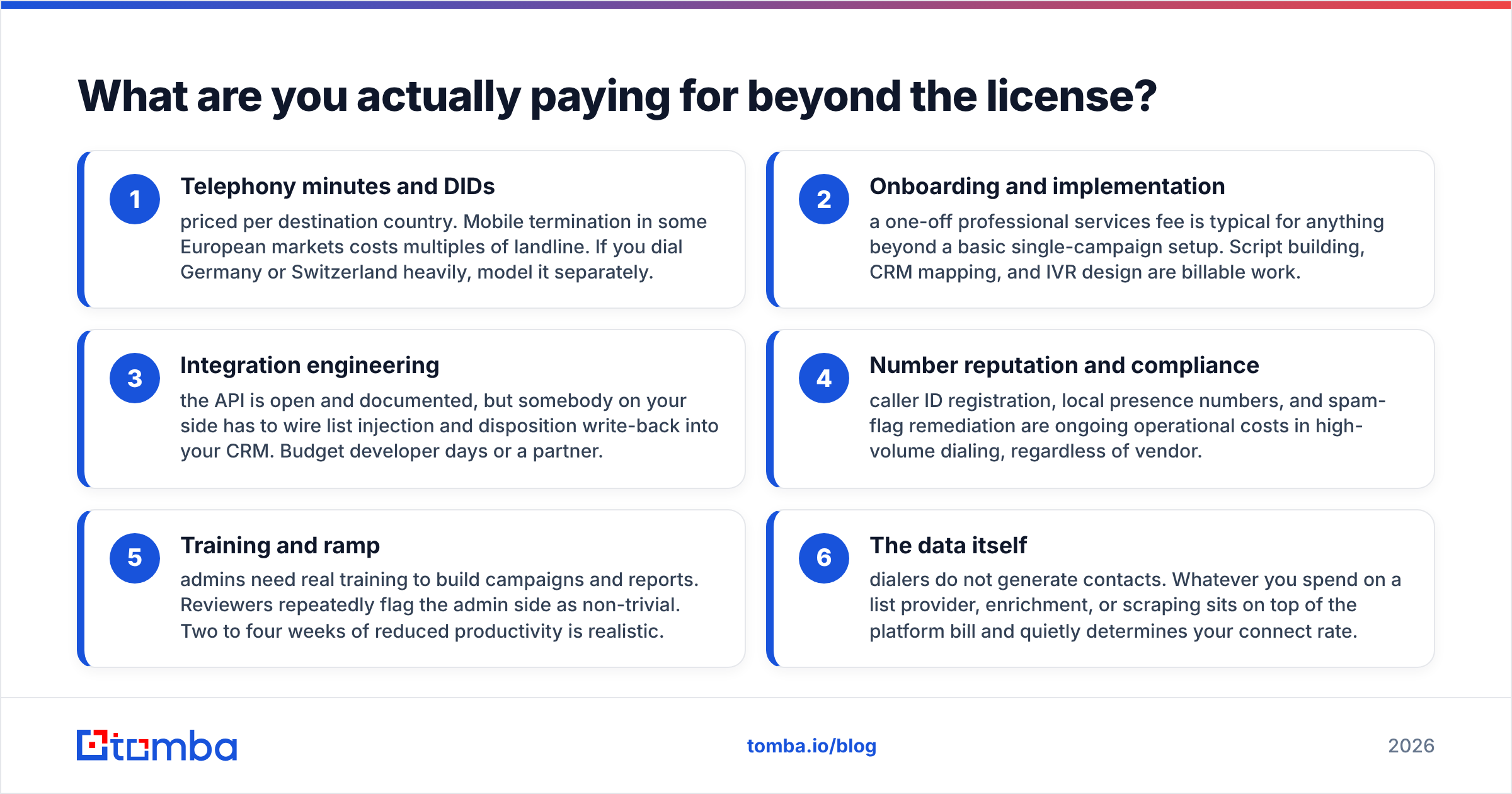
Here is the line-item list that turns a €89 headline into a real budget. Work through it before you sign:
- Telephony minutes and DIDs — priced per destination country. Mobile termination in some European markets costs multiples of landline. If you dial Germany or Switzerland heavily, model it separately.
- Onboarding and implementation — a one-off professional services fee is typical for anything beyond a basic single-campaign setup. Script building, CRM mapping, and IVR design are billable work.
- Integration engineering — the API is open and documented, but somebody on your side has to wire list injection and disposition write-back into your CRM. Budget developer days or a partner.
- Number reputation and compliance — caller ID registration, local presence numbers, and spam-flag remediation are ongoing operational costs in high-volume dialing, regardless of vendor.
- Training and ramp — admins need real training to build campaigns and reports. Reviewers repeatedly flag the admin side as non-trivial. Two to four weeks of reduced productivity is realistic.
- The data itself — dialers do not generate contacts. Whatever you spend on a list provider, enrichment, or scraping sits on top of the platform bill and quietly determines your connect rate.
That last one is the least-discussed and most consequential. A predictive dialer amplifies whatever you feed it. If 30% of your numbers are wrong, you are paying LeadDesk's per-minute rate to dial disconnected lines at industrial scale.
What do LeadDesk reviews actually say?#
Aggregated public reviews on G2's contact center category and Capterra's call center software directory land LeadDesk in respectable-but-not-dominant territory, typically in the low-to-mid 4-star range. The pattern in the written feedback is more useful than the average score.
What reviewers repeatedly praise:
- Dial throughput. The predictive engine genuinely lifts talk-time per agent-hour. Teams migrating from manual or click-to-dial report meaningful jumps in conversations per shift.
- Call quality and stability. Because LeadDesk operates much of its own telephony rather than reselling a third-party layer, audio quality and uptime complaints are comparatively rare.
- Agent UI simplicity. The agent-facing screen is deliberately minimal. New hires get productive on it quickly, which matters in high-churn telesales environments.
- Responsive support in the Nordics. European customers frequently mention same-day responses and named contacts.
What reviewers repeatedly criticise:
- Reporting depth. The most common complaint by a distance. Standard dashboards cover the basics; anything bespoke means exports, BI tooling, or API work.
- Admin complexity. Campaign, list, and routing configuration is powerful and correspondingly fiddly. Several reviewers describe needing a dedicated internal LeadDesk admin.
- Commercial rigidity. Annual contracts, seat minimums, and add-on pricing draw friction from smaller buyers who expected month-to-month flexibility.
- Integration coverage outside the Nordics. Native connectors are solid for common CRMs, thinner for regional or niche systems — API work fills the gap.
Read the negative reviews by company size. Nearly all the "too complex, too expensive" reviews come from sub-10-agent teams. Nearly all the "reporting is limited" reviews come from 50+ agent operations pushing the platform hard. Those are different products' worth of complaint.
How does LeadDesk compare to other outbound calling platforms?#
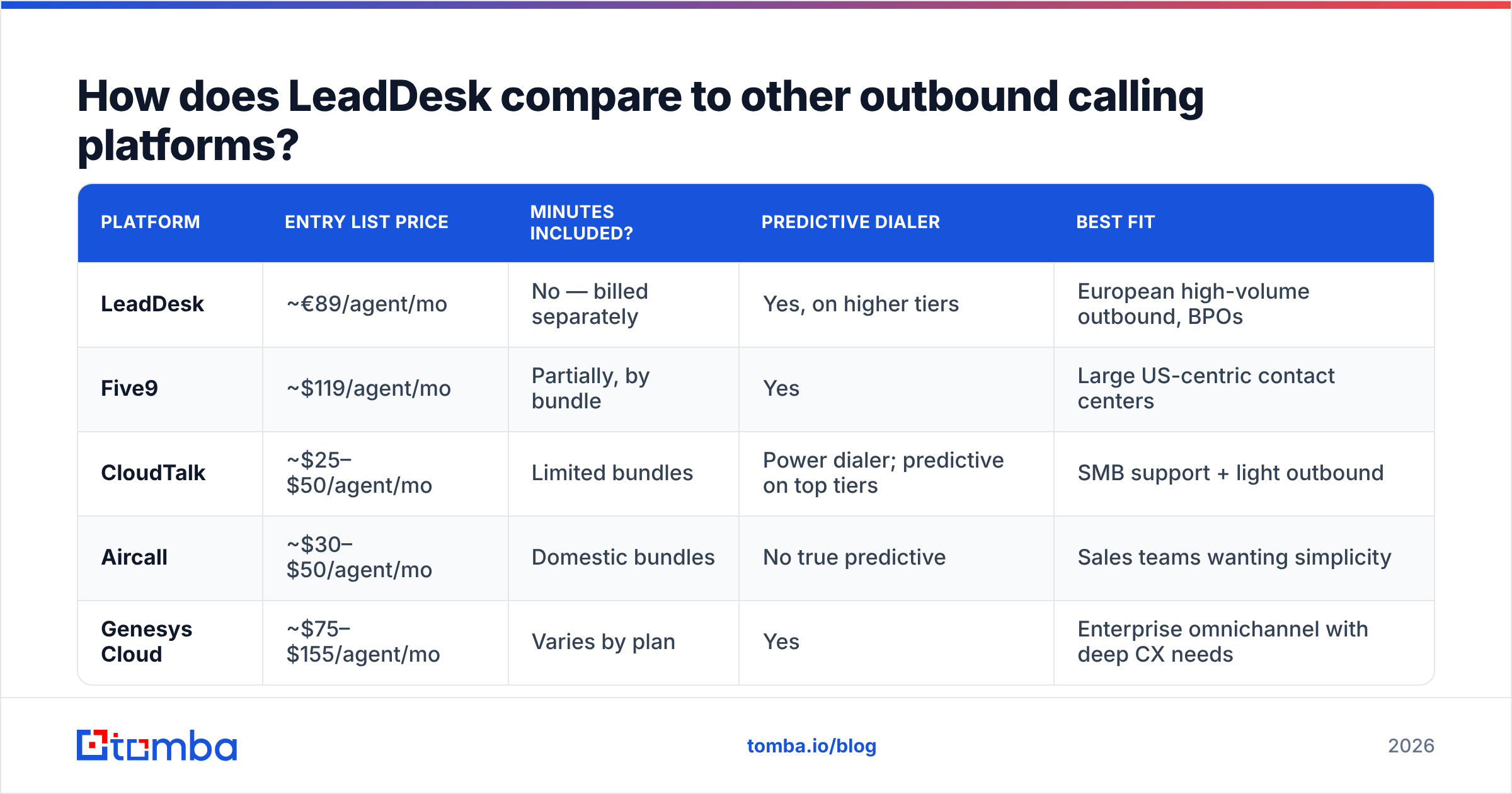
Pricing comparisons across contact center vendors are apples-to-oranges by default, because some bundle minutes and some do not. The table below normalises on published list entry pricing and flags the usage model explicitly.
| Platform | Entry list price | Minutes included? | Predictive dialer | Best fit |
|---|---|---|---|---|
| LeadDesk | ~€89/agent/mo | No — billed separately | Yes, on higher tiers | European high-volume outbound, BPOs |
| Five9 | ~$119/agent/mo | Partially, by bundle | Yes | Large US-centric contact centers |
| CloudTalk | ~$25–$50/agent/mo | Limited bundles | Power dialer; predictive on top tiers | SMB support + light outbound |
| Aircall | ~$30–$50/agent/mo | Domestic bundles | No true predictive | Sales teams wanting simplicity |
| Genesys Cloud | ~$75–$155/agent/mo | Varies by plan | Yes | Enterprise omnichannel with deep CX needs |
Read it this way: LeadDesk sits in the middle of the price band and the upper end of the outbound-specialisation band. You are not paying for the broadest omnichannel CX suite on the market; you are paying for a dialer that is unusually good at keeping agents in live conversations, with carrier-grade voice underneath.
If your use case is inbound-dominant support with occasional outbound, cheaper tools win. If you need Salesforce-native enterprise CX orchestration, Genesys and Five9 are the comparison set. If you need 30 agents hammering European mobile numbers all day with compliant recording, LeadDesk earns its seat fee.

Is LeadDesk worth it for your team?#
Yes, if you meet most of these: 10+ dedicated outbound agents; dialing volume above roughly 150 calls per agent per day; operations in one or more European markets; a compliance requirement for recording and auditability; and someone internally who can own campaign administration.
No, if any of these are true: fewer than 8 agents; your outbound motion is research-heavy and low-volume; you need month-to-month billing; your reporting requirements are sophisticated and you have no BI layer; or your primary market is the US, where LeadDesk's telephony and integration advantages are weaker.
The honest framing is that LeadDesk is a volume efficiency purchase. It costs more per seat than a lightweight dialer, and it pays that back only if the extra conversations per agent-hour are worth more than the delta. Run the arithmetic before the demo, not after:
(extra connects per agent per day × close rate × average deal value × working days) vs (seat delta + projected minute spend)
If that inequality is not comfortably positive at your current conversion rates, the platform is not the constraint — your list is.
What actually determines your cost per conversation?#
This is where most dialer buying decisions go wrong. Teams optimise the seat price and ignore the input quality, then wonder why cost per booked meeting barely moved.
Three inputs dominate cost per conversation, and only one of them is the vendor:
- Connect rate. Determined almost entirely by phone number accuracy and caller ID reputation. A list with 25% dead numbers inflates cost per conversation by roughly a third before anyone says hello.
- Right-party contact rate. Determined by whether the number belongs to the person you actually want. Switchboard numbers pulled from a website are cheap and nearly worthless for SDR work; direct dials and verified mobiles are the difference.
- Talk-time per agent-hour. This is the part LeadDesk genuinely improves. Predictive dialing is a real lever — but it multiplies the first two inputs rather than fixing them.
So the sequence matters. Clean the data, then buy the throughput. Teams that do it in reverse pay premium per-minute rates to reach voicemail.
Practically, that means running your list through verification before it ever hits a campaign. Validate line status and format with a phone validator, fill gaps in contact records with data enrichment, and source direct dials rather than scraping main switchboards. Pair the dialer with an email channel for the 60–70% of prospects who will never answer an unknown number — an email verifier keeps that half of the sequence out of spam folders.
What questions should you ask LeadDesk sales?#
Bring these to the demo. The answers change the total cost materially, and none of them appear on a pricing page:
- What is the per-minute rate for each country I dial, split by fixed and mobile? Ask for a written rate card, not a blended average.
- What is the seat minimum and the contract term, and can I flex seats down mid-term? Seasonal teams live or die on this clause.
- Which of my required features sit above the tier you just quoted? Predictive dialing, omnichannel, and advanced analytics are common upsell boundaries.
- What does onboarding cost, and what is included? Get the scope of script building and CRM mapping in writing.
- What happens to my call recordings and contact data at contract end? Export format and retention terms matter for compliance and for switching later.
- Can I trial with my own list for two weeks? A pilot on real data tells you more about connect rates than any reference call.
How should you budget the whole outbound stack?#
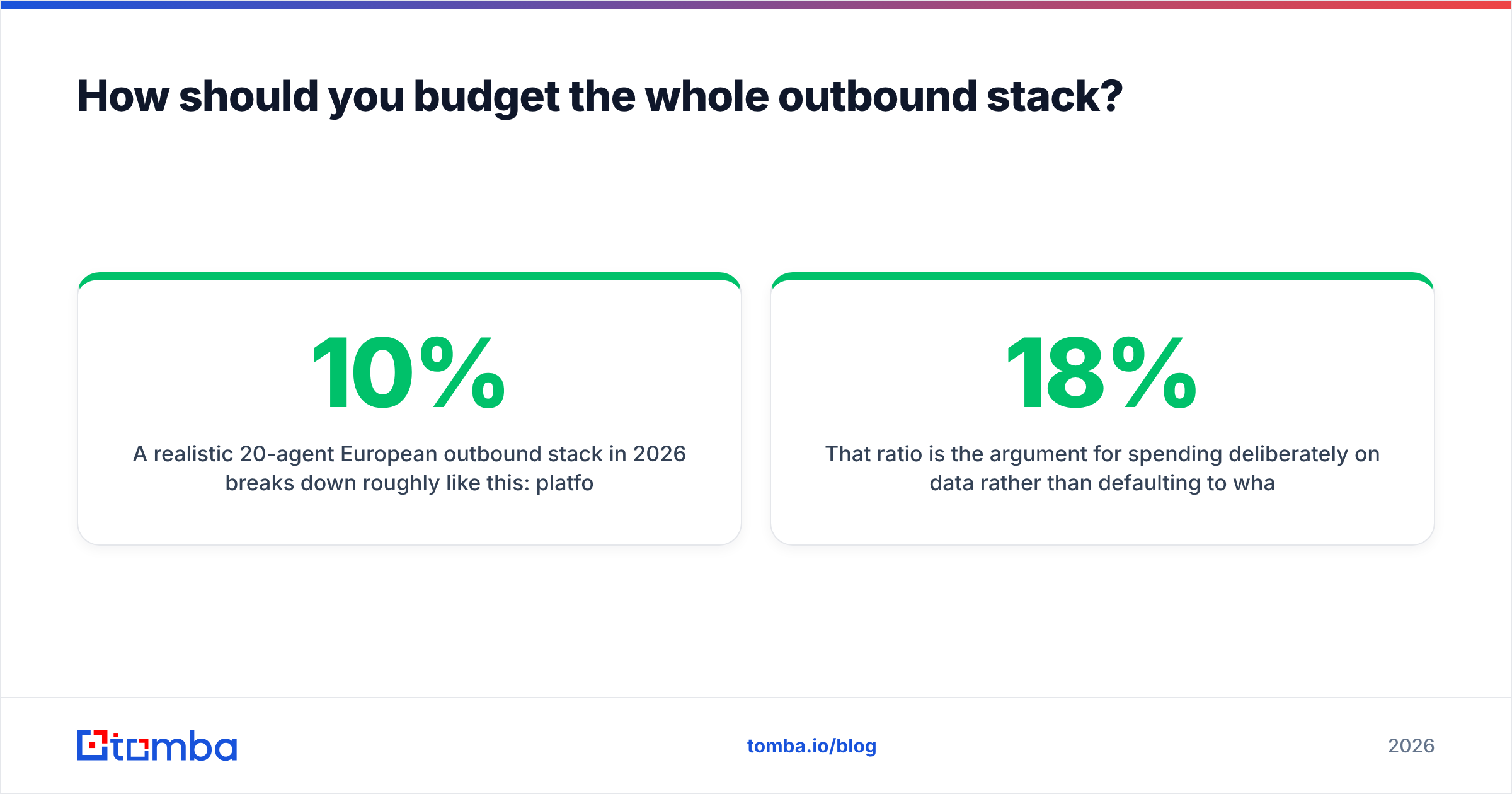
A realistic 20-agent European outbound stack in 2026 breaks down roughly like this: platform seats are the largest single line, telephony minutes come second and are the most volatile, and data sits third — usually under 10% of total spend while determining most of the output quality.
That ratio is the argument for spending deliberately on data rather than defaulting to whatever list your dialer vendor bundles. A contact database costing a few hundred dollars a month that lifts connect rate from 18% to 26% returns more than any seat discount you will negotiate. Tomba sits in that layer: the Tomba Email Finder and phone tooling run from a free tier at 25 searches per month up through Starter at $49/mo, Growth at $99/mo, and Pro at $249/mo — see Tomba pricing for the full breakdown. Compared with a five-figure annual dialer commitment, the data layer is the cheapest lever you have.
The bottom line#
LeadDesk is a credible, well-built outbound platform that is priced for teams large enough to exploit it. The list price is mid-market; the real cost depends on your minute profile and your country mix. Reviews are broadly positive on the things that are hard to build — dialer throughput, voice quality, uptime — and critical of the things that are easy to underestimate — reporting depth and admin overhead.
If you are evaluating it, do two things before the contract: get a written per-country rate card, and audit your existing call list for dead numbers. The first prevents invoice surprises. The second tells you whether the dialer is your bottleneck at all.
Fix the input before you scale the output. Load your dialer with verified direct dials and confirmed decision-maker contacts instead of scraped switchboards — start with the Tomba Email Finder and phone tooling on the free tier, test it against a sample of your current list, and measure the connect-rate delta before you sign a per-seat contract. A cleaner list makes every minute you buy from LeadDesk worth more.
Related guides#
// get started
Find, verify and enrich your first contacts today
Start on the free plan with 25 searches a month, then scale when your team is ready.
Free plan · No credit card required · GDPR & CCPA
Get the Tomba newsletter
Product and data updates
// about the author