LeadEngineAI vs Sparkle: Which AI Lead Tool Wins in 2026?
LeadEngineAI and Sparkle both promise AI-run prospecting, but they solve different halves of the problem. Here is an honest breakdown of data quality, pricing models, and the workflows each one actually wins.
TL;DR
- LeadEngineAI and Sparkle are not the same product category. One leans toward AI-driven lead discovery and scoring, the other toward AI-assisted outreach execution. Comparing them on "features" alone will mislead you.
- Neither publishes a stable, fully transparent price list. Both use credit or seat-based models that shift as they ship. Get a written quote with overage rates before you commit.
- Both tools rise or fall on contact-data accuracy — and neither owns a first-party email dataset the way a dedicated finder does. A separate verification layer is the difference between a 2% bounce rate and a burned domain.
- Buy LeadEngineAI if you need lead discovery and prioritisation. Buy Sparkle if your bottleneck is writing and sending. Buy neither if what you actually lack is clean, verified email addresses.
- The cheapest fix is often a data layer, not a platform swap. A verified email finder from $49/mo sits under whichever agent you pick.
What are LeadEngineAI and Sparkle?#
Both belong to the 2024–2026 wave of AI-native go-to-market tools: products that replace a chunk of the SDR workflow with an agent instead of a dashboard. That wave is young, and the two products are still moving fast, so treat every specific number below as something to re-confirm on the vendor's own site before you sign.
LeadEngineAI positions itself around the top of the funnel. The pitch is that you describe your ideal customer profile in plain language, the engine surfaces matching companies and contacts, scores them against intent and firmographic signals, and hands you a ranked list. The value claim is who to contact.
Sparkle sits closer to the message layer. The pitch is AI-assisted personalisation and sending: research a prospect, draft the sequence, adapt tone, manage replies. The value claim is what to say and when.
That split matters more than any feature checklist. If you evaluate them head to head on a spreadsheet of capabilities, both will claim the full stack, because every AI GTM vendor is expanding toward the other's territory. The honest question is which half each one was actually built for.

How do LeadEngineAI and Sparkle actually differ?#
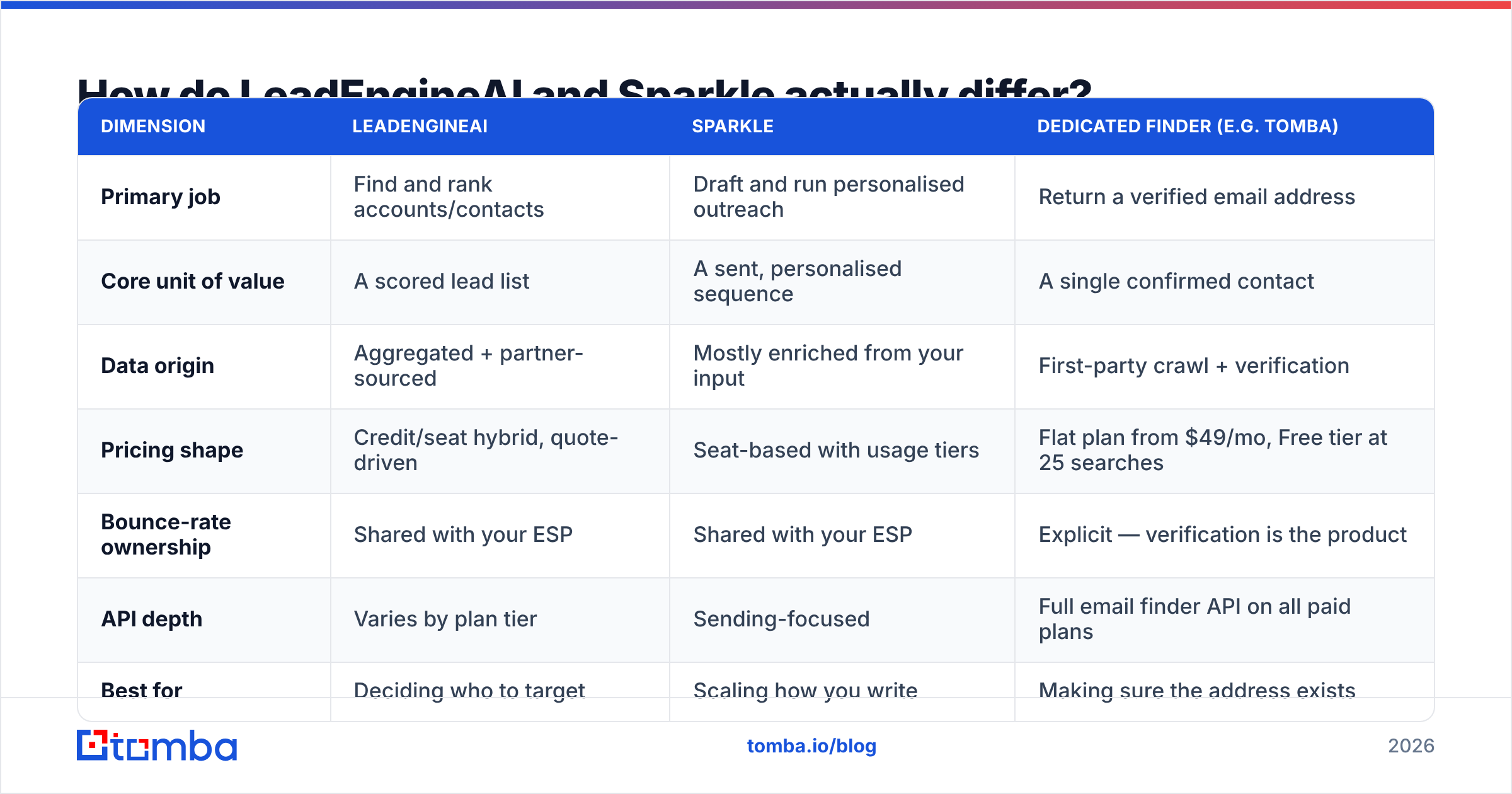
Here is the comparison that matters, with a dedicated data layer included as a third column, because most teams end up running one of these alongside whichever agent they choose.
| Dimension | LeadEngineAI | Sparkle | Dedicated finder (e.g. Tomba) |
|---|---|---|---|
| Primary job | Find and rank accounts/contacts | Draft and run personalised outreach | Return a verified email address |
| Core unit of value | A scored lead list | A sent, personalised sequence | A single confirmed contact |
| Data origin | Aggregated + partner-sourced | Mostly enriched from your input | First-party crawl + verification |
| Pricing shape | Credit/seat hybrid, quote-driven | Seat-based with usage tiers | Flat plan from $49/mo, Free tier at 25 searches |
| Bounce-rate ownership | Shared with your ESP | Shared with your ESP | Explicit — verification is the product |
| API depth | Varies by plan tier | Sending-focused | Full email finder API on all paid plans |
| Best for | Deciding who to target | Scaling how you write | Making sure the address exists |
| Weakest at | Message quality | Net-new discovery | Sequencing and replies |
Two things jump out of that table.
First, the overlap is smaller than the marketing suggests. A team that buys LeadEngineAI and expects it to write good first lines will be disappointed. A team that buys Sparkle and expects it to source a fresh TAM will be disappointed in the other direction.
Second, neither column owns the bounce rate. That is not a knock on either vendor. It is a structural fact of the category: discovery platforms and sending platforms both treat email addresses as an input, not as the thing they guarantee. Which brings us to the part most comparison posts skip.
Which one gives you better contact data?#
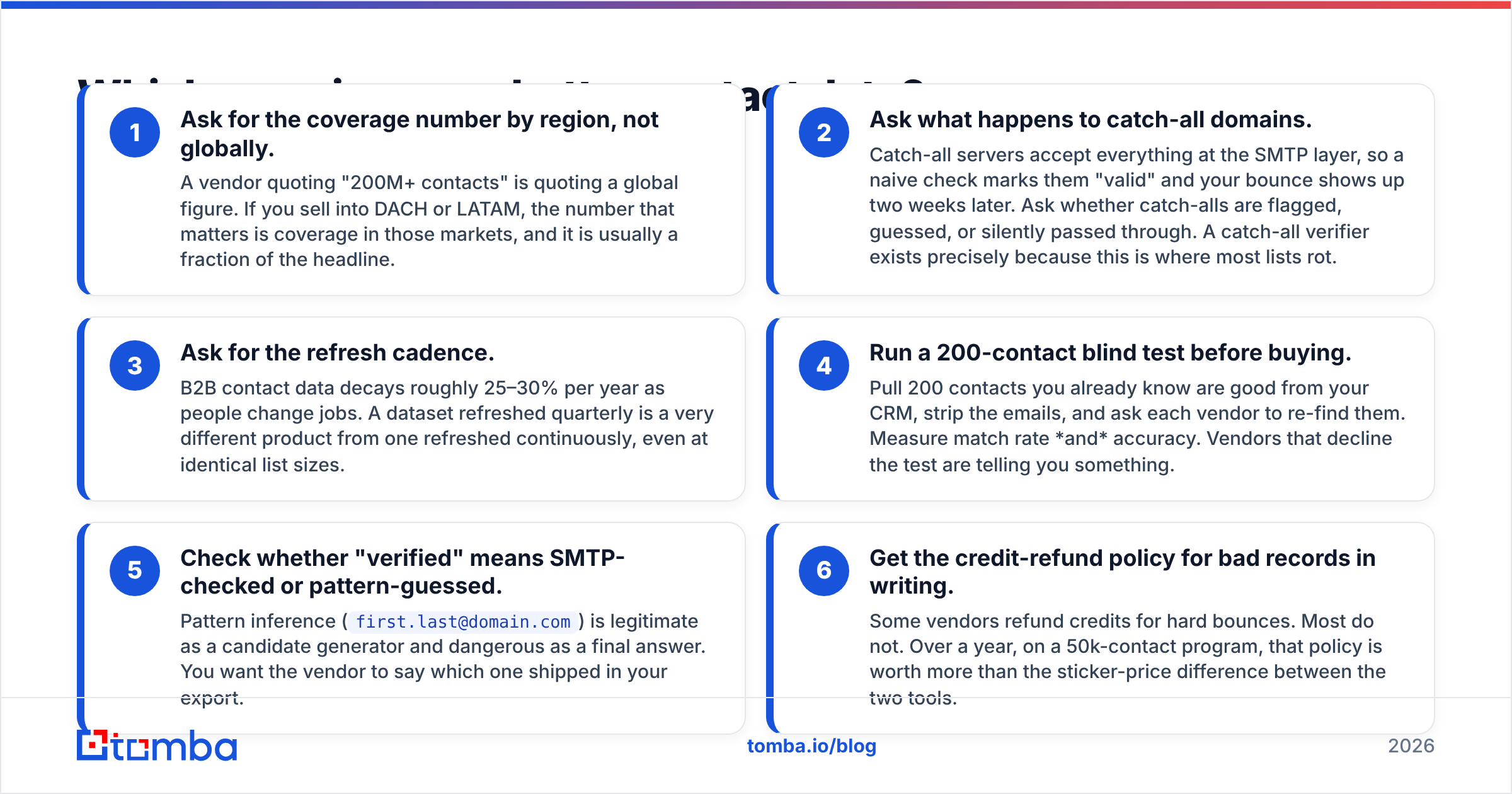
Neither, reliably — and that is the single most expensive thing to get wrong. Here is how to pressure-test either vendor before you sign:
- Ask for the coverage number by region, not globally. A vendor quoting "200M+ contacts" is quoting a global figure. If you sell into DACH or LATAM, the number that matters is coverage in those markets, and it is usually a fraction of the headline.
- Ask what happens to catch-all domains. Catch-all servers accept everything at the SMTP layer, so a naive check marks them "valid" and your bounce shows up two weeks later. Ask whether catch-alls are flagged, guessed, or silently passed through. A catch-all verifier exists precisely because this is where most lists rot.
- Ask for the refresh cadence. B2B contact data decays roughly 25–30% per year as people change jobs. A dataset refreshed quarterly is a very different product from one refreshed continuously, even at identical list sizes.
- Run a 200-contact blind test before buying. Pull 200 contacts you already know are good from your CRM, strip the emails, and ask each vendor to re-find them. Measure match rate and accuracy. Vendors that decline the test are telling you something.
- Check whether "verified" means SMTP-checked or pattern-guessed. Pattern inference (
first.last@domain.com) is legitimate as a candidate generator and dangerous as a final answer. You want the vendor to say which one shipped in your export. - Get the credit-refund policy for bad records in writing. Some vendors refund credits for hard bounces. Most do not. Over a year, on a 50k-contact program, that policy is worth more than the sticker-price difference between the two tools.
If both vendors fail steps 2 and 5 — and in this category, many do — the fix is not to keep shopping for a better agent. The fix is to put a verification layer underneath the one you like best. Running exports through an email verifier before they hit your sequencer costs a fraction of a seat and protects the asset that actually matters: your sending domain.
What does each one cost in practice?#
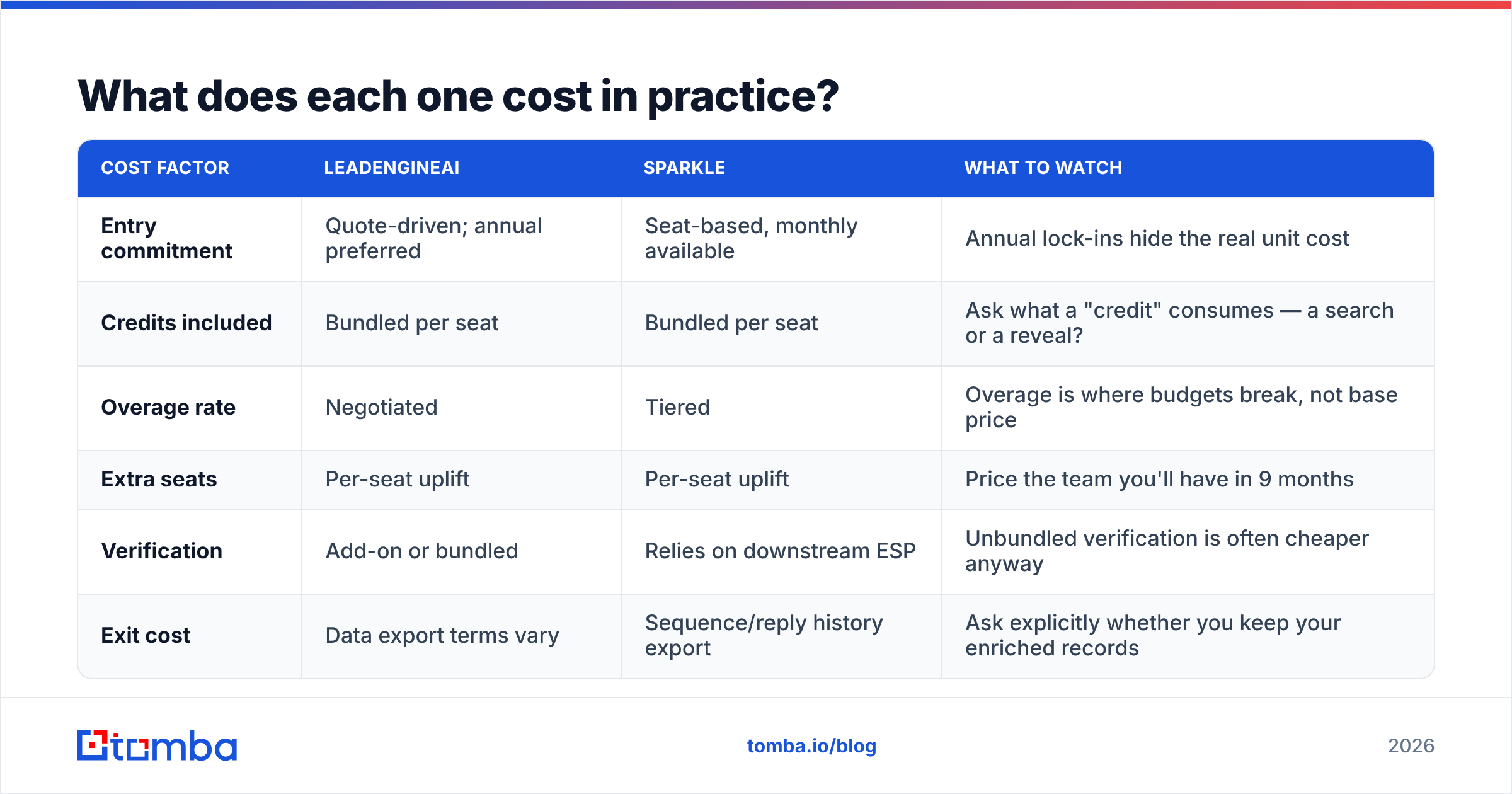
Published pricing in this category is unstable, and both vendors route larger accounts to sales. Rather than quote numbers that will be stale by the time you read this, here is the shape of each model and where the cost actually lands.
| Cost factor | LeadEngineAI | Sparkle | What to watch |
|---|---|---|---|
| Entry commitment | Quote-driven; annual preferred | Seat-based, monthly available | Annual lock-ins hide the real unit cost |
| Credits included | Bundled per seat | Bundled per seat | Ask what a "credit" consumes — a search or a reveal? |
| Overage rate | Negotiated | Tiered | Overage is where budgets break, not base price |
| Extra seats | Per-seat uplift | Per-seat uplift | Price the team you'll have in 9 months |
| Verification | Add-on or bundled | Relies on downstream ESP | Unbundled verification is often cheaper anyway |
| Exit cost | Data export terms vary | Sequence/reply history export | Ask explicitly whether you keep your enriched records |
For reference, a dedicated data layer is the predictable line item in this stack: Tomba pricing runs a Free tier at 25 searches/mo, Starter at $49/mo, Growth at $99/mo, and Pro at $249/mo, with Enterprise quoted. That predictability is the point. You can model it twelve months out; credit-based agent pricing you generally cannot.
The practical budgeting mistake teams make here is comparing base subscriptions. Compare cost per verified, contactable prospect delivered into your sequencer. On that metric, a cheap platform with a 60% match rate and a 9% bounce rate is more expensive than a pricier one at 85% and 2%.
Is an AI agent better than a data source plus a sequencer?#
Sometimes. It depends on whether your team's constraint is throughput or judgment.
The agent pitch — held by both LeadEngineAI and Sparkle in different forms — is compression: fewer tools, fewer handoffs, fewer people. That is real. A two-person startup running outbound has no business maintaining a five-tool stack, and an agent that does 70% of the job at 100% of the speed is a rational trade.
The counter-argument shows up at scale. Once you are sending meaningful volume, you want to control each layer independently: swap the data provider without rebuilding sequences, change sequencers without losing enrichment, run verification on a schedule your deliverability team sets. Bundled agents make each of those swaps a migration. Analysts at Gartner and reviewers on G2 have both tracked the same pattern across sales-tech consolidation cycles: teams bundle for speed, then unbundle for control.

There is a third position worth naming, because it is the one most mature teams land on: keep the agent, unbundle the data. Let LeadEngineAI or Sparkle do the work it is genuinely good at, and feed it from a source you control. That means a bulk email finder run against your target account list, verification before import, and a clean CSV or API push into whichever platform you chose. You get the speed of the agent and the accuracy of a specialist, and your sender reputation stops depending on a vendor roadmap.
Who should choose LeadEngineAI?#
Pick LeadEngineAI if these describe you:
- Your ICP is fuzzy and you need help defining it. Scoring and signal-ranking are genuinely useful when you do not yet know which segment converts.
- You have message-market fit but not enough accounts. Your reply rate is fine; your list is thin. Discovery is the bottleneck.
- You want prioritisation, not just volume. A ranked list beats a bigger list when your team can only work 40 accounts a week.
- You already have a sequencer you like. Layering discovery on top of an existing sending stack is a clean fit.
Where it disappoints: teams expecting the copy to be good out of the box, and teams selling into markets where aggregated data coverage is thin.
Who should choose Sparkle?#
Pick Sparkle if these describe you:
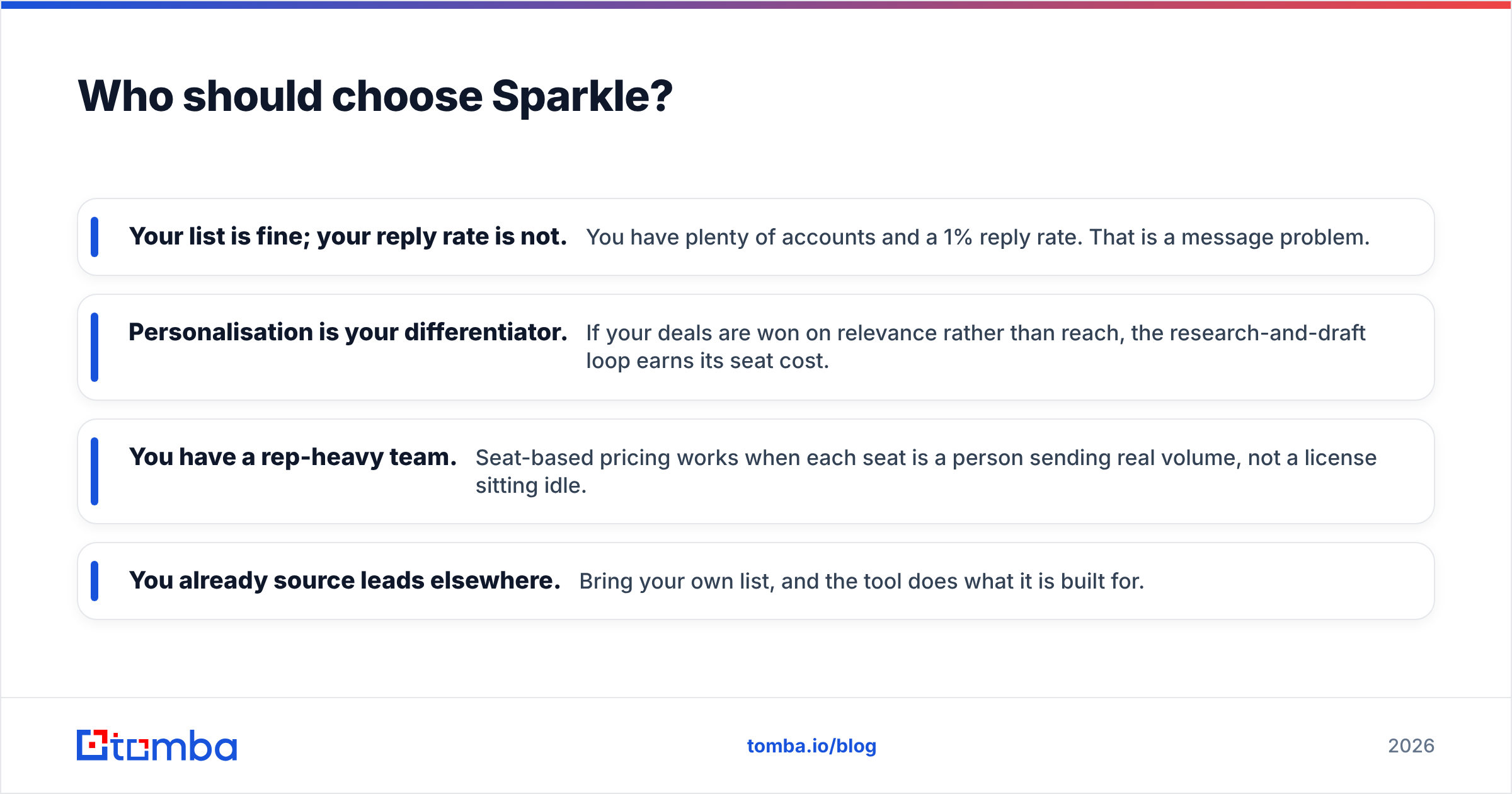
- Your list is fine; your reply rate is not. You have plenty of accounts and a 1% reply rate. That is a message problem.
- Personalisation is your differentiator. If your deals are won on relevance rather than reach, the research-and-draft loop earns its seat cost.
- You have a rep-heavy team. Seat-based pricing works when each seat is a person sending real volume, not a license sitting idle.
- You already source leads elsewhere. Bring your own list, and the tool does what it is built for.
Where it disappoints: solo founders who need discovery too, and teams that expect it to guarantee inbox placement. No sending tool fixes a bad list; the email deliverability math is unforgiving regardless of how good the copy is.
What does the decision actually come down to?#
Three questions, in order:
- What is your real bottleneck — who, what, or whether the address works? Discovery, messaging, and data quality are three different problems with three different fixes. Buying the wrong one is how teams end up with four subscriptions and the same pipeline.
- Can you model the cost twelve months out? If the answer involves "it depends on credits," negotiate the overage rate now, not after your first spike.
- Who owns your bounce rate? If the answer is "the vendor, probably," you do not have an answer. Own it yourself with a verification step you control.
For most teams comparing LeadEngineAI vs Sparkle, the honest verdict is: pick based on your bottleneck, then add a data layer underneath either one. The platform choice moves your efficiency by some percentage. The data choice moves your deliverability, which is binary — either your emails land or your domain does.
For background on how the broader category is structured, Capterra's lead generation software directory and the lead generation entry on Wikipedia are both reasonable neutral starting points before you take a vendor demo.
Where to start#
If you are still deciding between the two agents, do the 200-contact blind test first. It takes an afternoon and settles the argument better than any feature matrix, including this one.
And whichever platform you land on, fix the layer underneath it before you send a single sequence. Tomba Email Finder finds and verifies professional email addresses by domain, name, or company, with a Free tier at 25 searches per month to test against your own target list, paid plans from $49/mo, and an API on every paid tier so it slots under LeadEngineAI, Sparkle, or whatever replaces them in eighteen months. Run your next 200 target contacts through it, compare the match and bounce rates against your current source, and let the numbers pick the stack. Start at tomba.io/email-finder.
Related guides#
// get started
Find, verify and enrich your first contacts today
Start on the free plan with 25 searches a month, then scale when your team is ready.
Free plan · No credit card required · GDPR & CCPA
// about the author