LeadEngineAI vs Techsalerator: B2B Data Tools Compared
LeadEngineAI sells AI-generated lead lists. Techsalerator sells bulk data files. They solve different problems — and neither is a verification layer. Here's how to pick, and where each one breaks.
TL;DR
- LeadEngineAI is an AI-assisted lead-generation layer: you describe an ICP, it returns a built list with contact details. You pay for output, not for a database seat.
- Techsalerator is a data licensor: you buy bulk B2B/consumer datasets by country, industry, or segment, usually delivered as files or via API. You pay for volume, not for workflow.
- They are not really competitors. One hands you a campaign-ready list; the other hands you raw fuel you still have to refine.
- Both share the same failure mode: neither is a verification layer. Bulk B2B files decay roughly 2–3% per month, and AI-generated "found" emails are guesses until an SMTP check proves otherwise.
- Practical stack for most teams: pick whichever source matches your volume model, then run every record through a dedicated email verifier before it touches your sending domain.
What are LeadEngineAI and Techsalerator, actually?#
Different categories wearing similar marketing language.
LeadEngineAI sits in the "AI SDR / AI lead engine" bucket that exploded after 2023. The pitch: instead of building filters in a database UI, you write a natural-language ICP ("Series B fintech companies in DACH with 50–200 employees, VP Marketing or above"), and the system assembles the list — company matching, contact identification, and email discovery bundled into one output. Pricing in this category is typically per-lead or per-month with a lead cap, and the contract is usually monthly or annual SaaS.
Techsalerator is a data provider, not a workflow tool. It licenses datasets — B2B contact data, company firmographics, consumer data, and various niche verticals — with strong coverage in markets that most US-centric tools ignore (Africa, Southeast Asia, the Gulf, Eastern Europe). You typically scope a purchase by geography and record count, receive a CSV/Parquet delivery or API access, and own the data under the licence terms. See the official Techsalerator site for their current catalogue structure.
The distinction matters more than any feature table. One is a pipeline, the other is inventory.
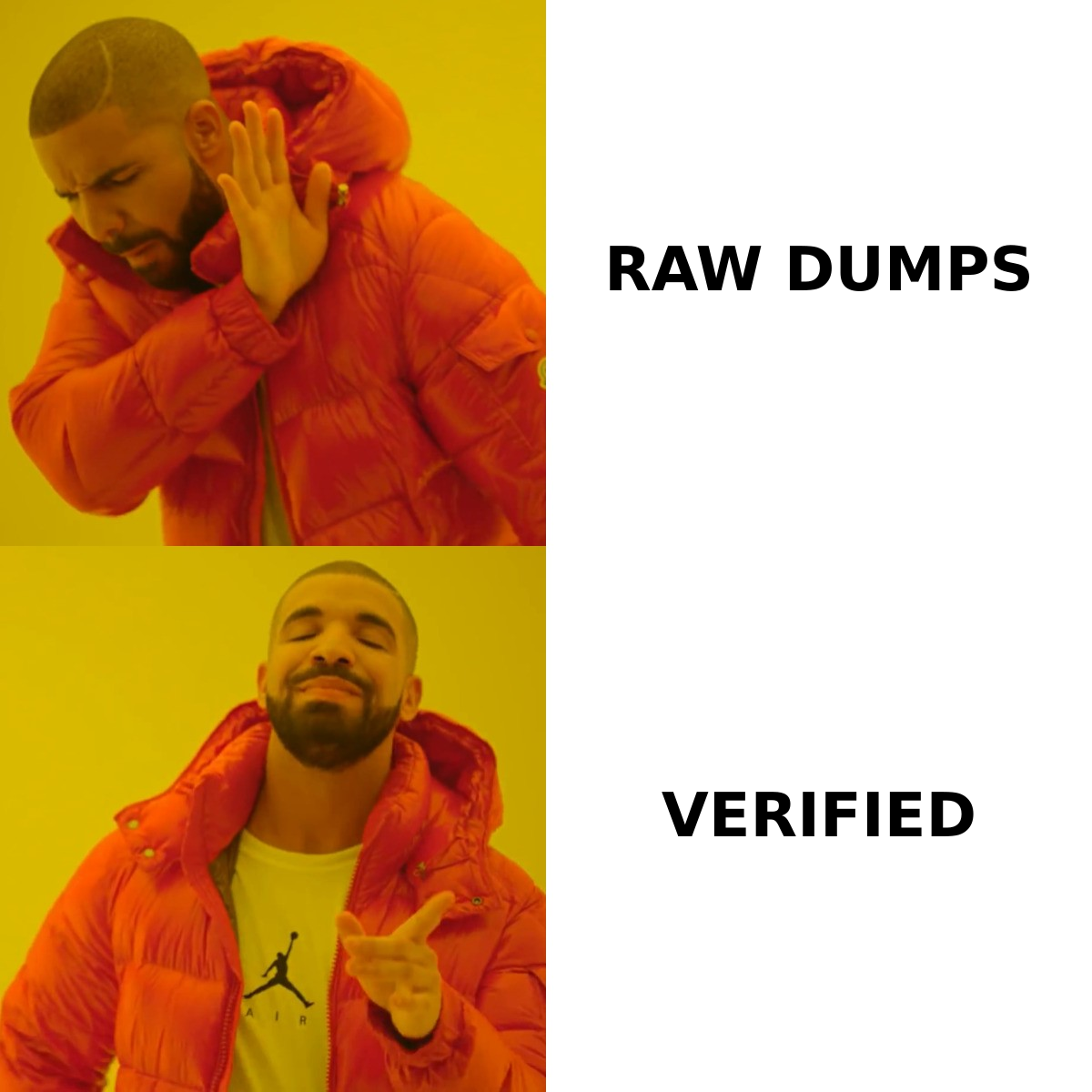
How do LeadEngineAI and Techsalerator compare head-to-head?#
| Dimension | LeadEngineAI | Techsalerator | Tomba |
|---|---|---|---|
| Primary model | AI-built lead lists from an ICP prompt | Licensed bulk datasets by geo/industry | Search + verification API and UI |
| What you buy | Output volume (leads delivered) | Record volume (rows licensed) | Credits for finds + verifications |
| Typical delivery | In-app list, CSV export, CRM push | CSV / Parquet file, or API feed | API, web app, CSV, Sheets add-on |
| Entry pricing | Custom / quote-based, per-lead tiers | Quote-based, scales with record count | Free 25 searches/mo, then $49/mo |
| Geographic strength | Mostly NA + Western Europe | Broad global, strong emerging markets | Global, domain-driven |
| Email verification | Bundled, opaque methodology | Usually not included | Core product, SMTP-level |
| Data freshness control | Refreshed per run | Snapshot at delivery date | Live lookup at query time |
| Best for | Teams that want lists, not tooling | Data teams building their own stack | Teams enriching or cleaning at scale |
| Weak spot | Black-box sourcing, hard to audit | Decay after delivery, no workflow | Not a sequencer or CRM |
Two honest caveats on that table. First, both vendors quote rather than publish, so any pricing comparison you read — including this one — is directional. Ask both for a per-1,000-usable-contacts number, not a per-record number. Second, "verification included" is not the same as "verification you can inspect." If a vendor cannot tell you whether a record passed an SMTP handshake, a catch-all check, or merely a syntax regex, treat the claim as marketing.
Which one should you choose for your use case?#
Pick by the shape of your problem, not by the feature list.
You run outbound and need 500–2,000 contacts a month. LeadEngineAI-style tools fit. The per-lead economics work at that volume and you skip the data-engineering overhead entirely. Buying a 2-million-row licence to use 8,000 rows is waste.
You are building an internal data product, a TAM model, or a scoring system. Techsalerator fits. You need coverage, schema control, and the right to store and re-process the data. A per-lead SaaS tool will not license you bulk rows at a sane price.
You sell into emerging markets. Techsalerator is the stronger bet. Most AI lead engines are thin outside North America and the UK — the underlying sources (LinkedIn-adjacent scrapes, US filings, tech-stack crawlers) simply have less to work with in Lagos, Jakarta, or Riyadh.
You already have a CRM full of records and need them corrected. Neither. This is an enrichment and verification job — run your existing rows through data enrichment and a bulk verify pass instead of buying a new list to sit beside the stale one.
You need contacts at named target accounts. Neither, primarily. Account-based motion means you already know the companies; you need people at them. Domain search against your target list is faster and cheaper than any list build, and you can hit named accounts the bulk file missed.
You are doing compliance-sensitive outreach in the EU or UK. Read the licence terms line by line before either purchase. Ask for the lawful basis, the source of each field, and the opt-out handling. This is not a place to trust a sales deck.
Is AI-generated lead data more accurate than licensed bulk data?#
No — and the question is framed wrong.
"AI-generated" contact data mostly means pattern-based email construction plus a probabilistic confidence score. The system observes that a company uses first.last@domain.com, finds a person named Maria Kowalski via a public profile, and outputs maria.kowalski@company.com. That is a reasonable guess. It is not a fact until a mail server confirms the mailbox exists.
Licensed bulk data is the opposite failure mode. The record was probably real when it was collected. The problem is when. B2B contact data decays continuously — job changes, domain migrations, restructures — and most practitioner estimates land around 2–3% per month, which compounds to roughly a quarter to a third of a file going stale within a year. A dataset delivered in January and used in September is a different asset than the one you bought.
So you get two distinct risks:
- AI-built lists: high plausibility, unverified existence. Bounce risk concentrated in catch-all domains and fabricated-but-well-formed addresses.
- Bulk licensed files: verified-at-collection, decayed-at-use. Bounce risk concentrated in departed employees and dead domains.
Both risks are solved by the same thing, and neither vendor is the one who solves it for you.
What does an unverified list actually cost you?#
More than the list.
Google and Yahoo's bulk-sender requirements, in force since 2024, cap spam complaints at 0.3% and expect authenticated, low-bounce sending. Google's own sender guidelines are explicit about it. A single campaign to a 41%-bad list does not just waste 41% of your sends — it drags your sender reputation down for every subsequent campaign, including the ones to your good contacts.
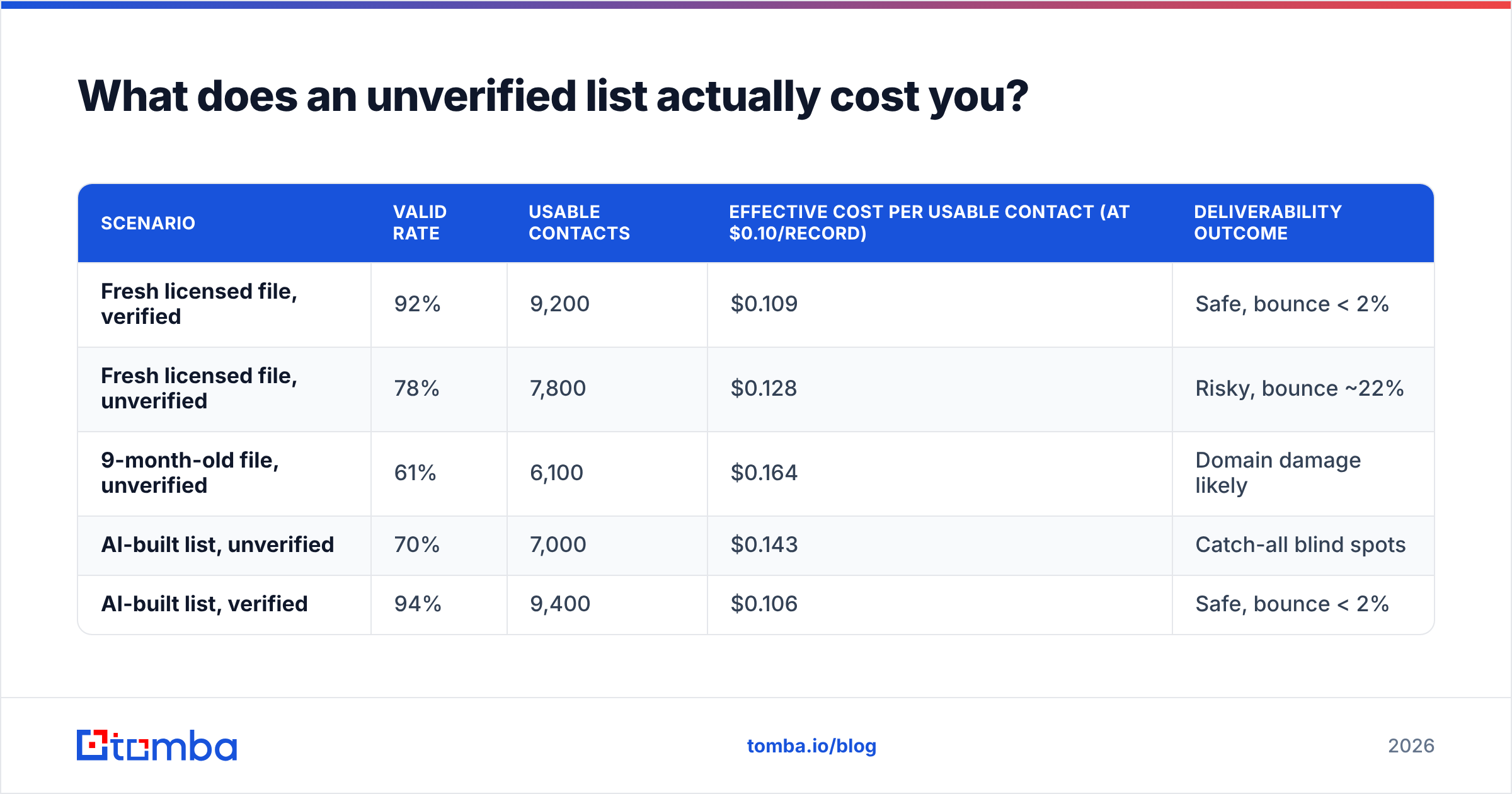
Run the arithmetic on a 10,000-contact purchase:
| Scenario | Valid rate | Usable contacts | Effective cost per usable contact (at $0.10/record) | Deliverability outcome |
|---|---|---|---|---|
| Fresh licensed file, verified | 92% | 9,200 | $0.109 | Safe, bounce < 2% |
| Fresh licensed file, unverified | 78% | 7,800 | $0.128 | Risky, bounce ~22% |
| 9-month-old file, unverified | 61% | 6,100 | $0.164 | Domain damage likely |
| AI-built list, unverified | 70% | 7,000 | $0.143 | Catch-all blind spots |
| AI-built list, verified | 94% | 9,400 | $0.106 | Safe, bounce < 2% |
The verification pass is the cheapest line item in the whole exercise and the only one that changes the outcome. Note that the two verified rows are also the two cheapest per usable contact — cleaning is not an added cost, it is a discount.
Catch-all domains deserve their own mention. A large share of enterprise domains accept every address at the SMTP layer, so a naive verifier marks them "unknown" and you either send blind or discard real contacts. A dedicated catch-all verifier resolves a meaningful slice of those rather than throwing them away — which matters most on exactly the enterprise accounts you care about.
How do these two stack up against the broader market?#
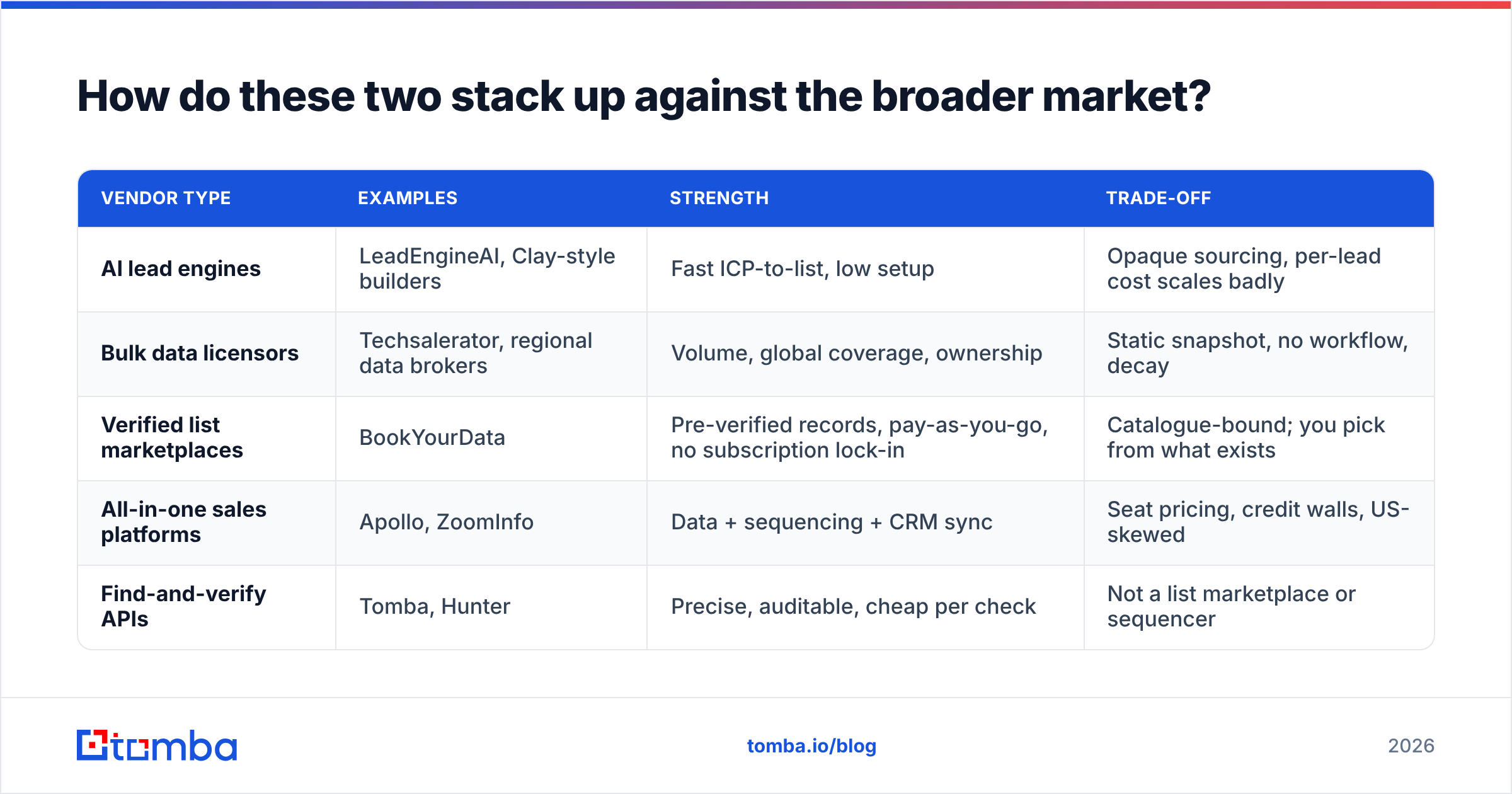
Neither LeadEngineAI nor Techsalerator exists in a vacuum. The realistic shortlist for a 2026 buyer usually includes a few shapes:
| Vendor type | Examples | Strength | Trade-off |
|---|---|---|---|
| AI lead engines | LeadEngineAI, Clay-style builders | Fast ICP-to-list, low setup | Opaque sourcing, per-lead cost scales badly |
| Bulk data licensors | Techsalerator, regional data brokers | Volume, global coverage, ownership | Static snapshot, no workflow, decay |
| Verified list marketplaces | BookYourData | Pre-verified records, pay-as-you-go, no subscription lock-in | Catalogue-bound; you pick from what exists |
| All-in-one sales platforms | Apollo, ZoomInfo | Data + sequencing + CRM sync | Seat pricing, credit walls, US-skewed |
| Find-and-verify APIs | Tomba, Hunter | Precise, auditable, cheap per check | Not a list marketplace or sequencer |
BookYourData is worth a specific look if your objection to bulk licensing is decay — their model is pre-verified, pay-per-record with no subscription, which sidesteps both the "buy 2M rows" problem and the "rent a seat forever" problem. It is a genuinely different answer to the same question, and for teams buying in the 1k–50k range it often beats both options in this comparison on total cost.
Independent review data is worth consulting before you commit spend: check current category listings on G2 rather than relying on any vendor's own case studies, including the ones in this post's comparison set.
What should your actual stack look like?#
Source, verify, send — three layers, ideally from three vendors who each do one thing well.
Layer 1 — Source. Pick by volume shape. Under 5,000 contacts/month with no engineering resource: an AI lead engine. Over 100,000 records with a data team: a bulk licence. In between, or targeting named accounts: domain-driven search against your own account list.
Layer 2 — Verify. Non-negotiable, regardless of layer 1. Every record gets an SMTP-level check before it enters a sequence, plus a catch-all resolution pass for enterprise domains. Re-verify anything older than 90 days. This is where a purpose-built tool earns its keep — verification is a commodity you should buy at commodity prices, not bundle at SaaS prices.
Layer 3 — Send. Your sequencer or CRM. Authenticated domain, warmed inbox, complaint rate monitored weekly. If you skipped layer 2, nothing here saves you.
The reason to keep these separate is leverage. When a bundled tool does all three, you cannot swap the weak component without replacing everything — and in practice the weak component is almost always the data quality, which is the one you most need to be able to replace.
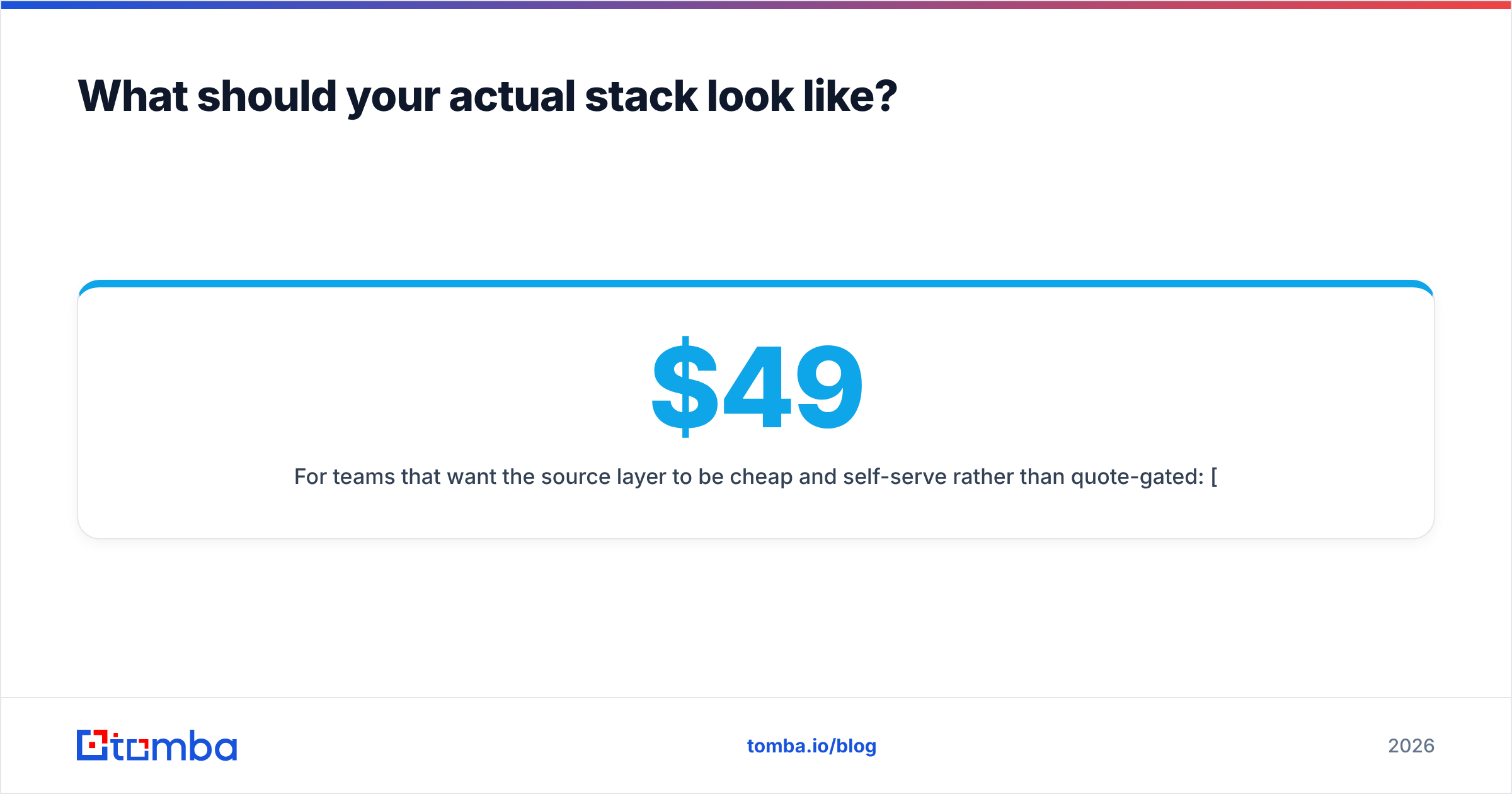
For teams that want the source layer to be cheap and self-serve rather than quote-gated: Tomba pricing starts with a free tier at 25 searches/month, Starter at $49/mo, Growth at $99/mo, and Pro at $249/mo, with the same credits usable across find, verify, and enrich. That is a different economic model than both vendors in this comparison — you are buying operations, not seats or rows.
Frequently asked questions#
Does LeadEngineAI or Techsalerator give you phone numbers? Techsalerator's datasets often include phone fields depending on the segment and geography you license. AI lead engines vary widely and typically charge separately for mobile numbers. If phones are the priority, evaluate a dedicated phone finder alongside either, and validate the numbers before your dialer burns connect rates on disconnected lines.
Can you negotiate on either? Yes, on both — neither publishes rates, which means both expect negotiation. Anchor on cost-per-usable-contact after verification, and ask for a paid sample (1,000–5,000 records) you can independently verify before signing anything annual. A vendor who refuses a paid sample is telling you something.
Is it legal to buy B2B contact data? Jurisdiction-dependent. In the US, B2B email under CAN-SPAM is permissive with clear opt-out and accurate headers. In the EU and UK, GDPR and PECR require a documented lawful basis, and legitimate interest for B2B outreach is defensible but must be assessed and recorded. Get the licence terms reviewed by counsel before a large purchase, not after.
What happens to bulk data after the licence period? Read the contract. Some licences are perpetual-use on the delivered snapshot; others require deletion at term. This single clause changes the effective price by a lot, and it is frequently glossed over in the sales conversation.
The bottom line#
LeadEngineAI and Techsalerator are answers to different questions. If your bottleneck is "I don't have time to build lists," an AI lead engine is the right shape. If your bottleneck is "I need 2 million rows in Southeast Asia to build a model," a data licensor is the right shape. Buying the wrong shape is expensive in a way that is hard to unwind, because both are quote-based and both like annual terms.
What neither one is, is a quality guarantee. The record you paid for is a hypothesis until a mail server confirms it, and a fact with a 90-day shelf life after that.
Start with the layer that makes every other layer work: run your target domains through the Tomba Email Finder to build or fill lists from companies you actually want, verify every address at SMTP level before it enters a sequence, and re-check anything older than a quarter. The free tier covers 25 searches a month if you want to test accuracy against a sample from either vendor before you sign — which is exactly the test you should run.
Related guides#
// get started
Find, verify and enrich your first contacts today
Start on the free plan with 25 searches a month, then scale when your team is ready.
Free plan · No credit card required · GDPR & CCPA
// about the author