LeadEngineAI vs Voila Norbert: Email Finder Showdown 2026
One tool sells AI-scored lead lists, the other sells a simple name-plus-domain lookup that has worked since 2014. Here is how LeadEngineAI and Voila Norbert actually differ on hit rate, bounce risk, and cost per usable contact.
TL;DR
- Voila Norbert is the older, simpler product: give it a full name and a company domain, get one email back, optionally verified. It is predictable, easy to teach a junior SDR, and priced per lead found.
- LeadEngineAI sits in the newer "AI lead engine" category: it bundles list building, scoring, and enrichment rather than doing a single clean lookup. You buy a workflow, not a field.
- Neither tool wins on every axis. Norbert is stronger for surgical, one-contact-at-a-time research. AI lead engines are stronger when you want a prospect list assembled for you and do not mind reviewing the output.
- The number that matters is cost per usable email, not price per credit. A $0.02 email that bounces costs more than a $0.05 email that lands, because bounces damage your sending domain.
- If you want the lookup layer separated from the list-building layer — with verification, catch-all handling, and an API on the same plan — Tomba starts free at 25 searches/month and $49/mo on Starter.
What are LeadEngineAI and Voila Norbert?#
Think of it like buying tools for a kitchen. Voila Norbert is a good chef's knife: one job, done cleanly, no learning curve. An AI lead engine is a food processor: it does several jobs at once, faster, but you have to trust what comes out of the chute without watching every cut.
Voila Norbert launched in 2014 and has barely changed its core promise since: type a person's name and their company domain, and it returns the most likely work email, with a confidence indicator. It added bulk CSV uploads, an email verification add-on, a Chrome extension, and an API, but the product is still organised around the single lookup. That consistency is why it still shows up in G2 email-finder categories a decade later.
LeadEngineAI belongs to the 2023-2026 wave of AI-branded prospecting platforms. Products in this class typically combine a contact database, natural-language or filter-based list building, AI scoring or intent signals, and enrichment of your existing CRM records. The email address is one output among several rather than the whole product.
That difference in shape drives every practical trade-off below. One tool answers "what is this person's email?" The other answers "who should I email, and what do I know about them?"
Because LeadEngineAI's plan structure and credit definitions change more often than Norbert's, treat any pricing you read anywhere — including here — as a starting point and confirm on the vendor's own page before you commit budget.

Which tool finds more valid emails?#
Accuracy is where these two products diverge most, and where marketing claims are least useful.
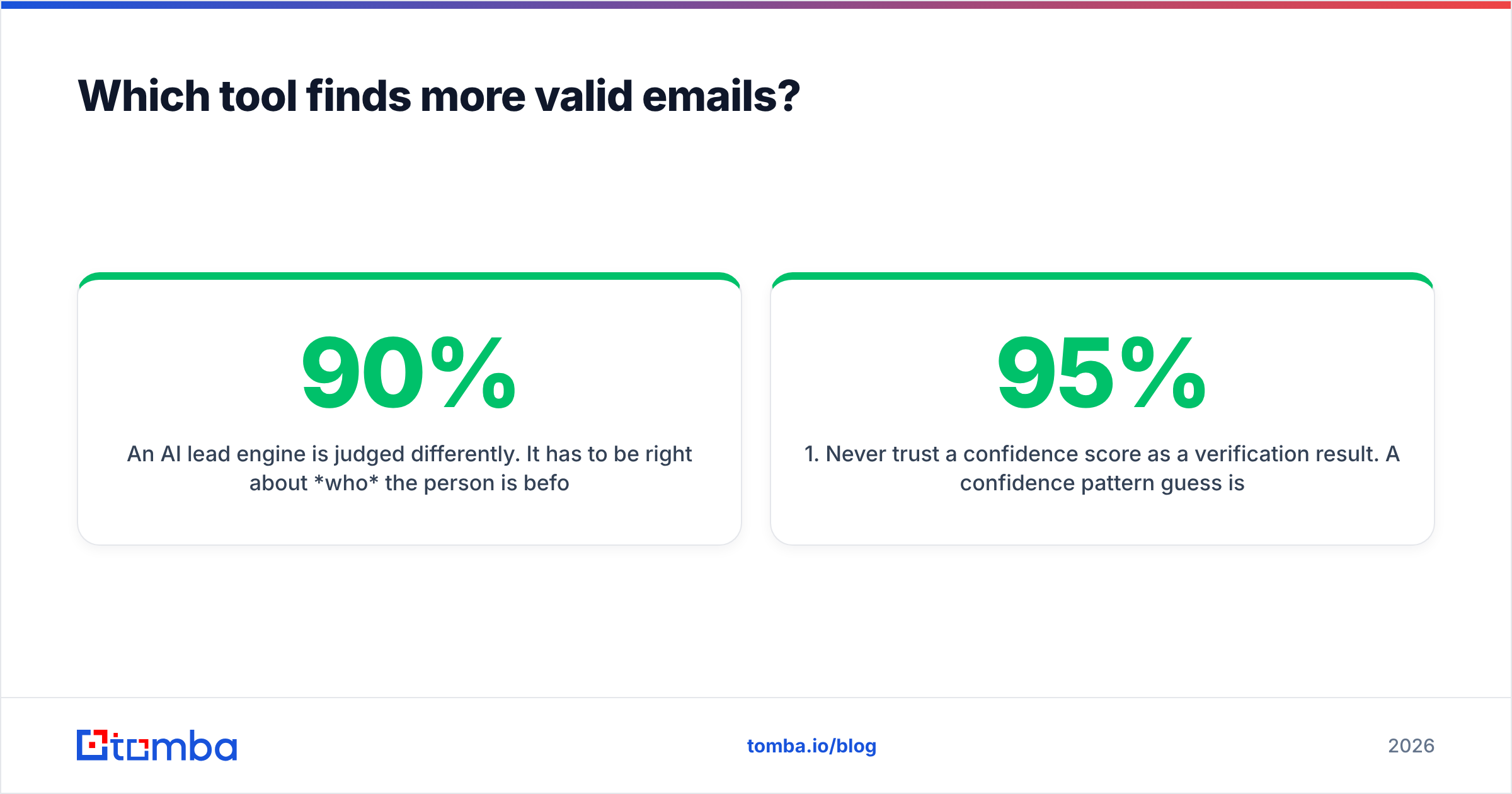
A single-lookup tool like Norbert is judged on two numbers: hit rate (how often it returns anything at all for a name plus domain) and bounce rate (how often what it returns is dead). Because the input is tightly constrained — you already know the person and the company — hit rates on mainstream SaaS and tech domains are usually good, and degrade on small businesses, regional companies, and firms using privacy-forward mail providers.
An AI lead engine is judged differently. It has to be right about who the person is before it can be right about their email. A list of 500 "VP of Marketing at Series B SaaS companies" can be 90% accurate on email format and still waste your quarter if a third of those people changed jobs eight months ago. Job-change decay is the silent killer in list-built prospecting: B2B contact data goes stale at roughly 25-30% per year, and title changes are the fastest-moving field.

Three practical accuracy rules apply regardless of which tool you choose:
- Never trust a confidence score as a verification result. A 95% confidence pattern guess is still a guess. Run the address through a real SMTP-level email verifier before it enters a sequence.
- Handle catch-all domains explicitly. Catch-all servers accept every address, so naive verification marks garbage as valid. Either exclude them or use a dedicated catch-all verifier that probes deeper.
- Re-verify anything older than 90 days. A list you bought in January is not the same list in April, even if the CSV looks identical.
- Measure bounce rate per source, not per campaign. If you blend two providers into one sequence, you cannot tell which one is burning your domain.
Follow those four and the gap between any two decent providers narrows dramatically. Skip them and even the best data source will look broken.
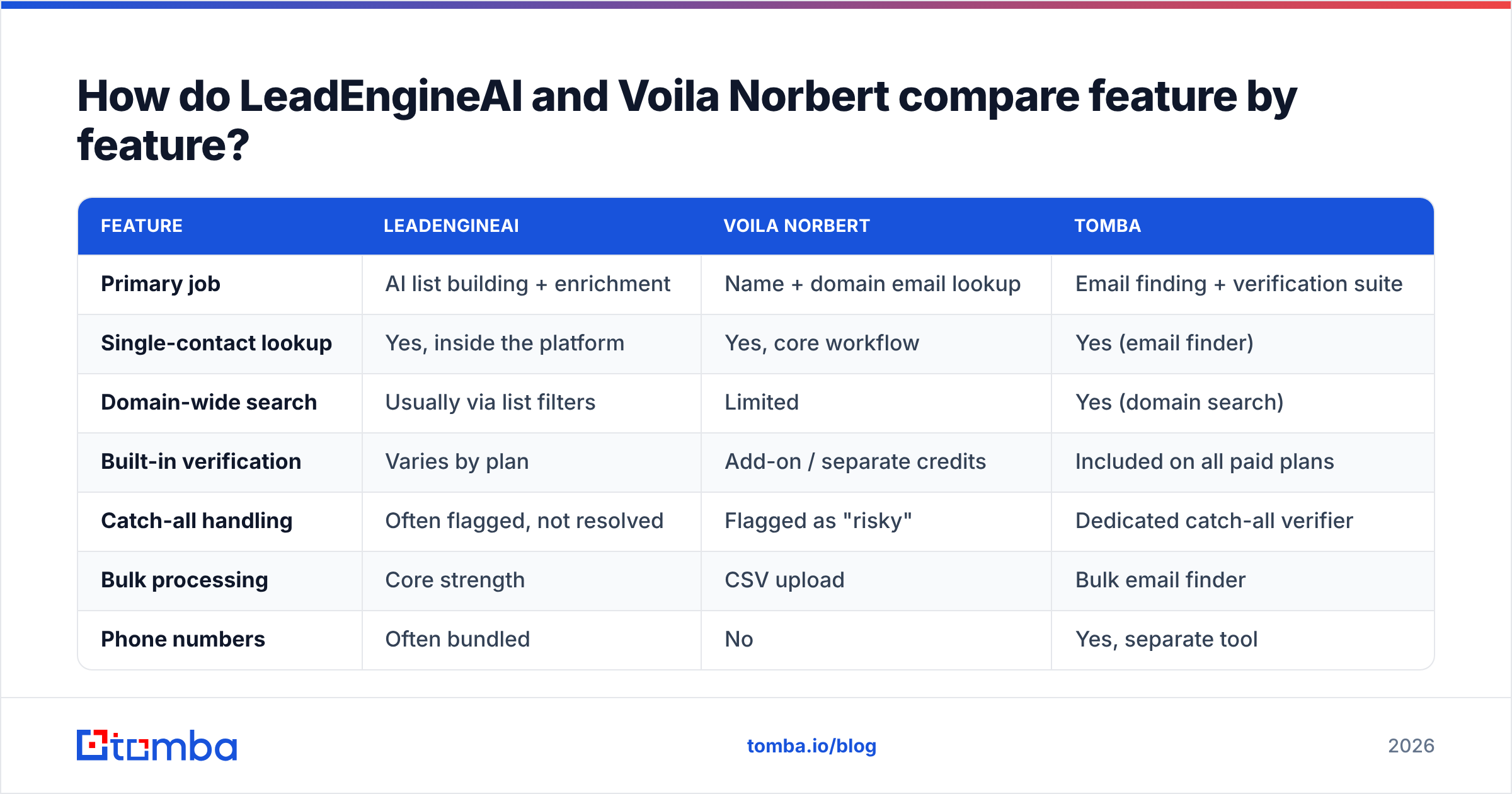
How do LeadEngineAI and Voila Norbert compare feature by feature?#
Here is the honest side-by-side. Where a vendor's terms shift frequently, the cell reflects the general product shape rather than a guaranteed SKU.
| Feature | LeadEngineAI | Voila Norbert | Tomba |
|---|---|---|---|
| Primary job | AI list building + enrichment | Name + domain email lookup | Email finding + verification suite |
| Single-contact lookup | Yes, inside the platform | Yes, core workflow | Yes (email finder) |
| Domain-wide search | Usually via list filters | Limited | Yes (domain search) |
| Built-in verification | Varies by plan | Add-on / separate credits | Included on all paid plans |
| Catch-all handling | Often flagged, not resolved | Flagged as "risky" | Dedicated catch-all verifier |
| Bulk processing | Core strength | CSV upload | Bulk email finder |
| Phone numbers | Often bundled | No | Yes, separate tool |
| API | Yes | Yes | Yes, documented REST API |
| Free tier | Trial credits, varies | Limited free leads | 25 searches/month, no card |
| Entry paid price | Varies by credit bundle | Per-lead tiers | $49/mo Starter |
| Best for | Teams who want the list built for them | Researchers who already know the target | Teams who want lookup + verify in one place |

The table makes the strategic split obvious. LeadEngineAI competes with the Apollo/ZoomInfo end of the market — a database plus workflow. Norbert competes with Hunter and the classic finder tools — a utility you call when you already have a target. Comparing them head-to-head only makes sense if you have not yet decided which of those two jobs you are actually buying.
What does each one really cost per usable email?#
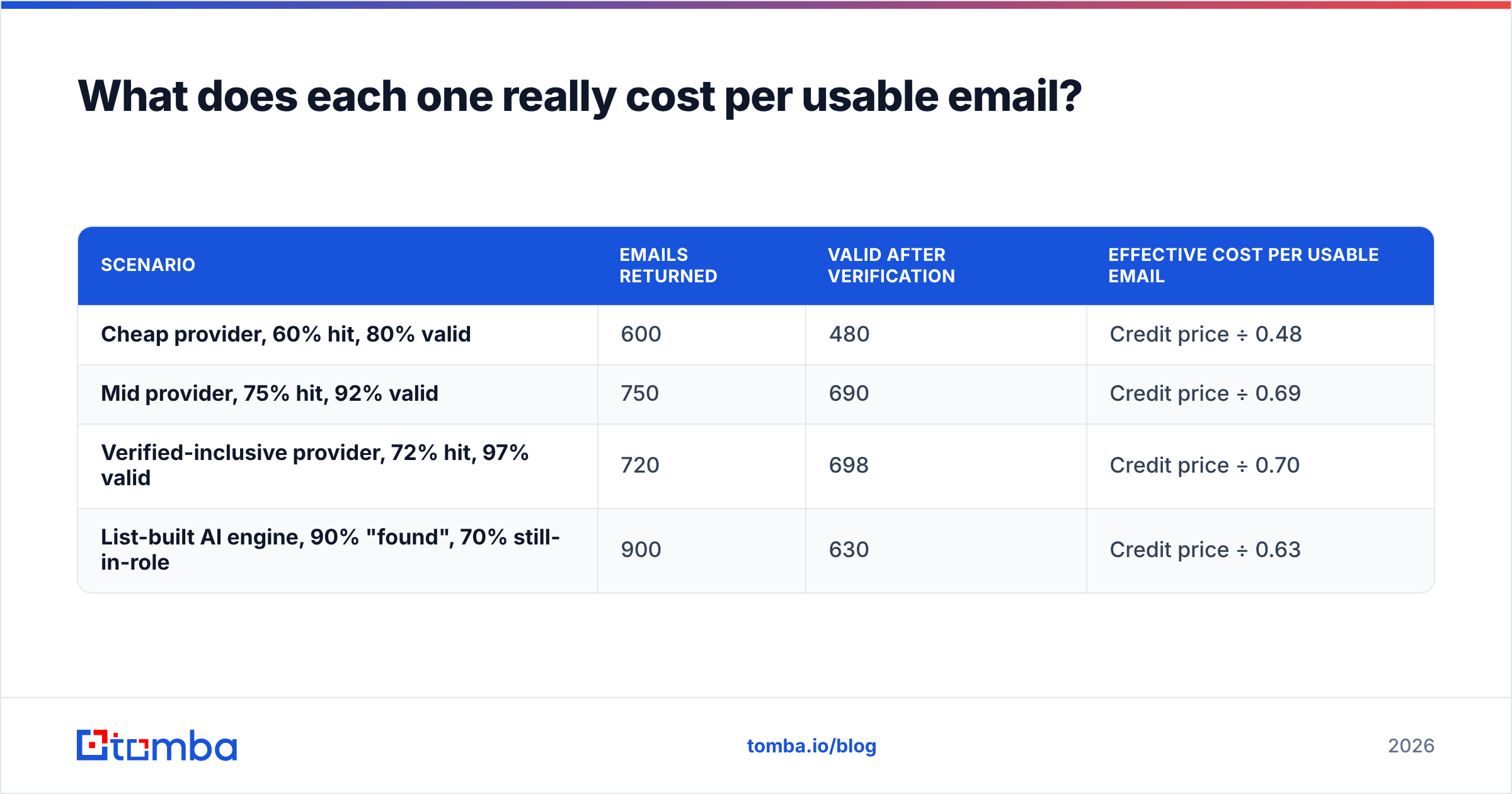
Price per credit is the wrong metric. Work the maths on cost per contact that actually receives your message.
Take a 1,000-contact target list and run three scenarios:
| Scenario | Emails returned | Valid after verification | Effective cost per usable email |
|---|---|---|---|
| Cheap provider, 60% hit, 80% valid | 600 | 480 | Credit price ÷ 0.48 |
| Mid provider, 75% hit, 92% valid | 750 | 690 | Credit price ÷ 0.69 |
| Verified-inclusive provider, 72% hit, 97% valid | 720 | 698 | Credit price ÷ 0.70 |
| List-built AI engine, 90% "found", 70% still-in-role | 900 | 630 | Credit price ÷ 0.63 |
Two things fall out of this. First, a provider that charges more per credit but includes verification frequently wins on effective cost. Second, the AI-engine row looks strongest on raw volume and lands mid-pack once role accuracy is factored in — which is exactly the failure mode buyers miss during a trial, because trials are too short for job-change decay to show up.
Also budget for the invisible cost: deliverability damage. A sequence that bounces above 3-5% starts eroding sender reputation, and recovering an inbox placement rate is far more expensive than paying an extra cent per verified address. HubSpot and other major senders have published the same guidance for years on their marketing resources — list hygiene is cheaper than list rehab.

Who should pick Voila Norbert?#
Choose Norbert when your prospecting is targeted rather than volume-driven. Concrete profiles where it fits:
- Agency and partnership outreach. You have a hand-built list of 80 companies and a named contact at each. You need one email per row, not a database.
- Recruiting and executive search. The target is a specific individual; you need the address, not a segment.
- Link building and PR. You are chasing named writers and editors at known publications. (A dedicated author finder does this even more directly.)
- Teams who want zero training overhead. The interface is a single form. A new hire is productive in five minutes.
- Buyers who dislike seat-based contracts. Per-lead pricing scales down as well as up, which platform pricing rarely does.
Where Norbert struggles: it will not build a prospect list for you, its enrichment is thin next to platform competitors, and verification is a separate line item rather than a native part of every result. If your workflow starts with "I don't know who to contact yet," it is the wrong tool.
Who should pick LeadEngineAI?#
Choose an AI lead engine when the bottleneck is list creation, not lookup:
- New market entry. You do not have a target account list yet and want filters plus scoring to propose one.
- Small teams without a data analyst. The platform handles segmentation you would otherwise build in spreadsheets.
- CRM enrichment at scale. You have 20,000 stale records and want fields backfilled in bulk rather than one at a time.
- Signal-driven outbound. If the platform surfaces hiring, funding, or tech-stack signals you would not gather manually, that is genuine leverage.
Where AI engines struggle: credit accounting gets opaque fast (does an enrichment call cost the same as a search?), data freshness varies by segment, and you often pay for a database you only partially use. Run a hard trial — 200 contacts, verified independently, bounce-tested on a real send — before you sign an annual deal.
Where does Tomba fit between them?#
Tomba deliberately sits on the lookup-and-verify side rather than the "we'll pick your prospects" side, but it closes the gaps that make Norbert feel thin.
The practical difference is that finding and verifying live on the same plan. You are not buying lookup credits from one line item and verification credits from another, then discovering the verification pool ran out mid-campaign. Domain search returns every published address at a company with role and confidence data. The catch-all tooling resolves the category that most finders simply flag and walk away from. And the Tomba API exposes all of it, so an engineering team can wire finding and verification into a CRM sync without buying a second vendor.
Pricing is flat and public: free at 25 searches/month, Starter at $49/mo, Growth at $99/mo, Pro at $249/mo, Enterprise custom. No per-seat multiplier, no separate verification SKU.
The honest limitation: if you genuinely want a platform to decide who your prospects should be, Tomba is not that product, and an AI lead engine will serve you better. Many teams end up running both — an engine or a database for list building, and a dedicated finder/verifier as the accuracy layer before anything hits a sequence. That pairing is usually cheaper than paying platform prices for verification you do not trust anyway.
How should you run the trial before you buy?#
Do not evaluate on the vendor's demo list. Run this instead:
- Build a 200-row control set from companies you already have verified contacts for. You need ground truth to measure against.
- Run the same 200 rows through both tools on the same day. Record hit rate, and record how many results are catch-all or "risky."
- Verify every returned address with a third, independent verifier. Self-reported validity is not evidence.
- Send a real low-volume campaign — 50 addresses, from a warmed domain — and log actual bounces. This is the only number that matters.
- Divide total spend by confirmed-delivered contacts. That is your true cost per usable email. Compare that figure, not the pricing page.
- Re-run steps 2 and 3 sixty days later on a fresh sample to see how fast each source decays.
Most buyers skip steps 4 through 6 and then wonder why a tool that tested beautifully in week one produced a 9% bounce rate in month three.
The verdict#
If you already know who you are contacting, Voila Norbert is the simpler, more predictable purchase, and a decade of stability counts for something. If your problem is that you do not yet have a list, an AI lead engine like LeadEngineAI addresses a job Norbert was never built for — just verify its output independently and re-check role accuracy before you scale spend.
If what you actually want is the accuracy layer — find the address, verify it properly, handle catch-alls, and push it into your CRM through an API — start with the Tomba Email Finder. The free tier gives you 25 searches a month with no card, which is enough to run the control-set test above against whichever platform you are considering. Test it against your own ground truth, then decide with numbers instead of pricing pages.
Related guides#
// get started
Find, verify and enrich your first contacts today
Start on the free plan with 25 searches a month, then scale when your team is ready.
Free plan · No credit card required · GDPR & CCPA
// about the author