LeadEngineAI vs WarpLeads: Which Lead Tool Wins in 2026?
LeadEngineAI sells AI-assisted lead discovery. WarpLeads sells volume. We break down data accuracy, export limits, real cost per usable contact, and which one actually belongs in your outbound stack.
TL;DR
- LeadEngineAI is an AI-assisted lead discovery layer: you describe an ICP, it builds and scores a list. Best when you don't yet know exactly who you're targeting.
- WarpLeads is a volume play: large exportable B2B lead databases with generous (often "unlimited") export tiers. Best when you already know your ICP and want raw records fast.
- Neither tool wins on verification depth. Both hand you lists you still need to clean before your sending domain touches them.
- The real cost is never the sticker price — it's cost per usable contact after bounces, duplicates, and role-based addresses are stripped out.
- If your bottleneck is accuracy rather than volume, a dedicated finder + verifier stack (Tomba, plus a peer like BookYourData for pre-built lists) usually beats either platform on deliverable-contact economics.
What are LeadEngineAI and WarpLeads?#
They solve the same problem from opposite ends.
LeadEngineAI positions itself as an AI layer on top of B2B contact data. You feed it a description of your ideal customer — industry, headcount, tech stack, trigger events — and it assembles a target list, scores it, and in most configurations drafts outreach angles alongside each record. The pitch is less time defining filters, more time sending.
WarpLeads takes the opposite stance. It's a lead export platform built around throughput: big databases, bulk filtering, and export tiers designed so you stop rationing credits. The pitch is stop paying per row.
That difference in philosophy explains almost every practical trade-off between them. One sells judgment. The other sells volume. And as anyone who has run lead generation at scale knows, those two things fail in completely different ways.

How do LeadEngineAI and WarpLeads compare head to head?#
Here's the honest side-by-side. Pricing on both platforms moves, so treat the pricing row as a model description rather than a quote — check each vendor's current page before you buy.
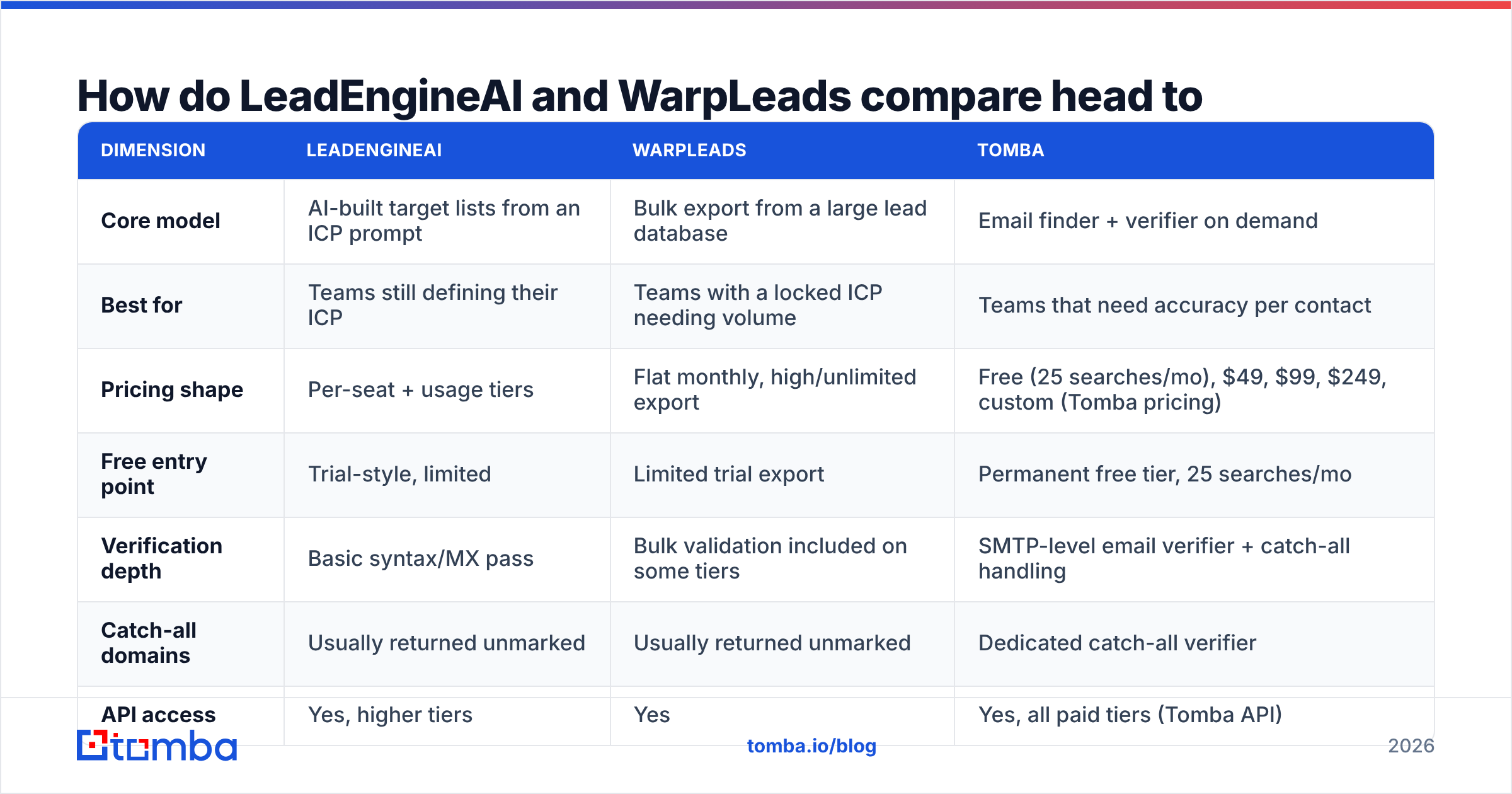
| Dimension | LeadEngineAI | WarpLeads | Tomba |
|---|---|---|---|
| Core model | AI-built target lists from an ICP prompt | Bulk export from a large lead database | Email finder + verifier on demand |
| Best for | Teams still defining their ICP | Teams with a locked ICP needing volume | Teams that need accuracy per contact |
| Pricing shape | Per-seat + usage tiers | Flat monthly, high/unlimited export | Free (25 searches/mo), $49, $99, $249, custom (Tomba pricing) |
| Free entry point | Trial-style, limited | Limited trial export | Permanent free tier, 25 searches/mo |
| Verification depth | Basic syntax/MX pass | Bulk validation included on some tiers | SMTP-level email verifier + catch-all handling |
| Catch-all domains | Usually returned unmarked | Usually returned unmarked | Dedicated catch-all verifier |
| API access | Yes, higher tiers | Yes | Yes, all paid tiers (Tomba API) |
| Phone data | Limited | Available on some plans | Phone finder + validator |
| Typical use | Discovery | Volume | Precision |
The pattern is consistent across every review site I checked, including the G2 category pages for lead intelligence: users praise LeadEngineAI for saving research time and criticise its list depth, while WarpLeads users praise export economics and criticise data freshness on long-tail records.
How accurate is the data on each platform?#
Accuracy is where the "unlimited" framing gets expensive.

Three things quietly determine whether a list is usable:
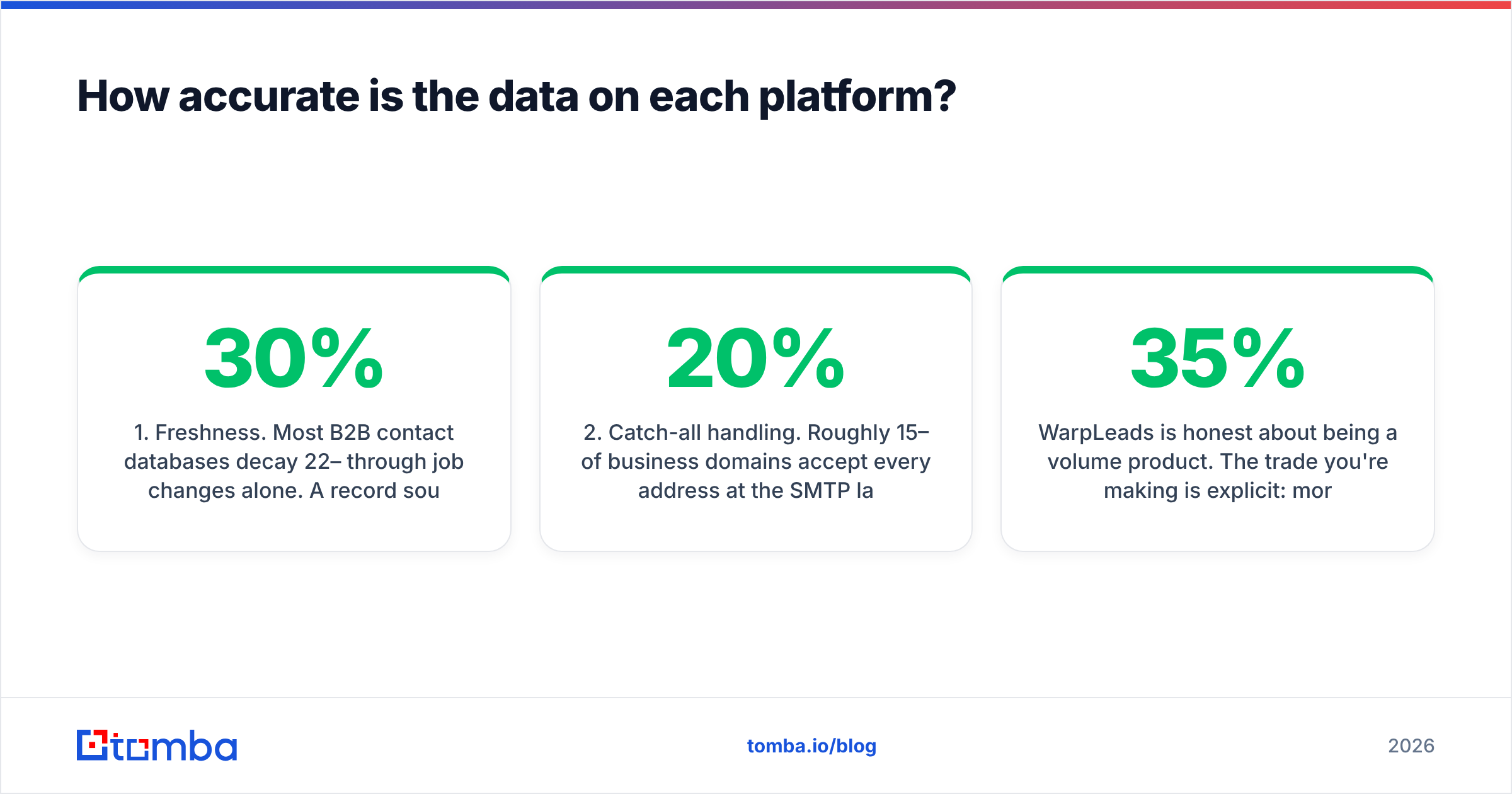
- Freshness. Most B2B contact databases decay 22–30% per year through job changes alone. A record sourced 14 months ago is a coin flip.
- Catch-all handling. Roughly 15–20% of business domains accept every address at the SMTP layer. Tools that don't flag these report them as "valid" — and your bounce rate finds out the truth later.
- Source transparency. Resold, co-mingled database inventory shows up across multiple vendors. If three tools return the same wrong email, they share an upstream.
LeadEngineAI's AI layer is genuinely useful for the targeting half of the problem: it narrows a universe of 40,000 companies into 600 that look like your customers. But the AI doesn't improve the underlying record — it selects from the same contact inventory everyone licenses. A well-chosen wrong email is still a bounce.
WarpLeads is honest about being a volume product. The trade you're making is explicit: more rows, more cleaning. Teams that succeed with it treat every export as raw material, run it through a bulk verify pass, and expect to discard 20–35% before it ever enters a sequence.

Which one is actually cheaper at real volume?#
Sticker price is the wrong metric. Here's the calculation that matters.
Take a $200/month plan that exports 10,000 contacts. Sounds like $0.02 per lead. Now apply reality:
- Remove 12% duplicates against your CRM → 8,800
- Remove 9% role-based addresses (info@, sales@, support@) → 8,008
- Remove 18% that fail verification → 6,567
- Remove 15% catch-all domains you won't risk → 5,582
Your real cost is $0.036 per usable contact — 80% higher than advertised. And that's before you count the hour of ops time spent on the cleaning.
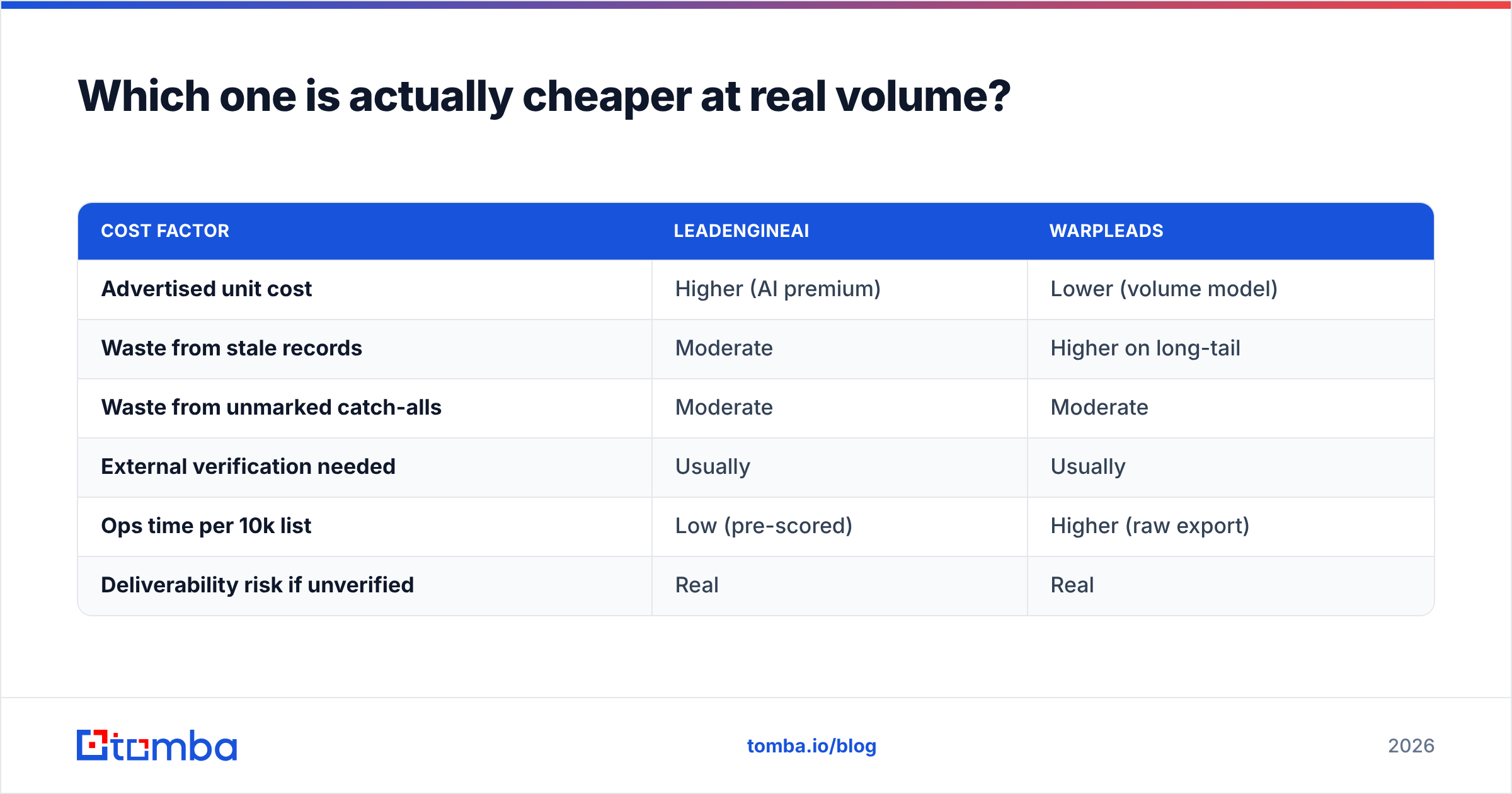
| Cost factor | LeadEngineAI | WarpLeads |
|---|---|---|
| Advertised unit cost | Higher (AI premium) | Lower (volume model) |
| Waste from stale records | Moderate | Higher on long-tail |
| Waste from unmarked catch-alls | Moderate | Moderate |
| External verification needed | Usually | Usually |
| Ops time per 10k list | Low (pre-scored) | Higher (raw export) |
| Deliverability risk if unverified | Real | Real |
This is why "unlimited exports" and "cheapest per lead" rarely produce the cheapest pipeline. A 6% bounce rate doesn't just waste a row — it damages sender reputation, which suppresses inbox placement for the contacts that were valid.
Who should pick LeadEngineAI?#
Choose LeadEngineAI if three or more of these are true:
- Your ICP is still a hypothesis. You've closed 15 deals, you can't yet articulate the pattern, and you want software to find it for you.
- You have more budget than SDR hours. The AI scoring genuinely replaces a research analyst for early-stage teams.
- You run low-volume, high-ACV outbound. 200 well-chosen accounts per month, not 20,000.
- You want outreach angles bundled in. The drafted messaging is a real time saver if your team writes from scratch today.
- You're comfortable being on a seat-based plan. Costs scale with headcount, not usage.
Where it disappoints: enrichment depth on non-US markets, and the fact that you're paying an AI premium on top of data that originated somewhere cheaper.
Who should pick WarpLeads?#
Choose WarpLeads if:
- Your ICP is locked. You know the exact titles, industries, and company sizes. You don't need software to think for you.
- You run high-volume outbound across multiple sending domains and need fresh raw material every week.
- You already own a verification step. Either an in-house pipeline or a dedicated tool. Without one, volume becomes a liability.
- Flat pricing matters more than per-record quality. Predictable monthly cost beats credit anxiety for some teams.
- You're comfortable doing your own scoring in the CRM or a spreadsheet.
Where it disappoints: long-tail records (sub-50-employee companies, non-English markets) skew stale, and you'll be the one discovering that after the send.
What are the hidden costs nobody mentions?#
Four line items that don't appear on either pricing page:
- Domain warmup and replacement. Burn a sending domain on a bad list and you're 3–4 weeks and ~$15/domain away from full capacity again. Run the numbers with a warmup calculator before you scale sends.
- CRM pollution. Unverified records imported into HubSpot or Salesforce inflate your contact count — which is a billable metric on most CRM plans — and corrupt every reporting cohort downstream.
- Rep trust. SDRs who get burned by a bad list stop trusting the list. That behavioural cost is invisible in a spreadsheet and enormous in practice.
- Compliance exposure. Bulk exports from consolidated databases carry more GDPR provenance risk than targeted, verified lookups. Ask both vendors where each record originated and how consent is documented.
Is there a better third option?#
For most teams, the honest answer is that this is a false binary — you're comparing a discovery tool against a volume tool, and the actual bottleneck is usually verification.
A more durable stack looks like this:
- Targeting — keep your ICP definition in the CRM, or use LeadEngineAI if you genuinely need help forming it.
- Sourcing — pull contacts on demand with a domain search or resolve specific people with a LinkedIn finder, rather than exporting 10,000 rows you'll never touch. For pre-built vertical lists, a peer vendor like BookYourData is a solid complement and covers a different sourcing mode well.
- Verification — run everything through SMTP-level verification with explicit catch-all flagging before it reaches your sequencer.
- Enrichment — fill in firmographics and phone data only for contacts that survived verification. Enriching dead records is pure waste.
Tomba fits the sourcing and verification layers specifically. Pricing runs from a free tier at 25 searches/month through Starter at $49/mo, Growth at $99/mo, and Pro at $249/mo, with API access on every paid plan — which matters if you're wiring this into an automated pipeline rather than clicking through a UI.

What's the verdict on LeadEngineAI vs WarpLeads?#
If you must pick one:
- Early-stage, high-ACV, ICP unclear → LeadEngineAI. The scoring earns its premium when you're still learning who buys.
- Established motion, ICP locked, volume-hungry → WarpLeads. The export economics are hard to beat, provided you budget for cleaning.
- Accuracy is the binding constraint → neither, alone. Pair whichever you choose with real verification, or your email deliverability will quietly cap your pipeline regardless of how many rows you exported.
The teams that win at outbound in 2026 aren't the ones with the biggest lists. They're the ones whose 2,000-contact list actually reaches 1,900 inboxes.
FAQ#
Can I use LeadEngineAI and WarpLeads together? Yes, and some teams do — LeadEngineAI to define and score the account list, WarpLeads to bulk-pull contacts at those accounts. It's redundant on cost, though, unless your volume genuinely justifies two subscriptions.
Do either of them replace a dedicated email verifier? No. Both include a validation pass, but neither treats catch-all domains as a first-class problem. That gap is where most bounce rates come from.
Which has better API coverage? Both gate API access behind higher tiers. If programmatic access on an entry plan matters, that's a point against both.
How often should I re-verify an existing list? Every 60–90 days for active sequences. B2B contact data decays fast enough that a quarter-old list is measurably worse than a fresh one.
Start with the layer that's actually costing you pipeline. Before you commit to a seat-based AI platform or an unlimited-export subscription, test what your current data is worth: run a sample through the Tomba Email Finder and compare the verified-contact yield against whatever you're paying per row today. The free tier gives you 25 searches a month — enough to know whether your bottleneck is targeting, volume, or accuracy before you sign anything.
Related guides#
// get started
Find, verify and enrich your first contacts today
Start on the free plan with 25 searches a month, then scale when your team is ready.
Free plan · No credit card required · GDPR & CCPA
// about the author