LeadEngineAI vs Xverum: Which B2B Data Platform Wins in 2026?
LeadEngineAI sells finished leads. Xverum sells raw web data at scale. They solve different problems, and picking the wrong one wastes a quarter. Here is the honest breakdown, with pricing models, freshness, and the setup each one actually demands.
LeadEngineAI vs Xverum is the wrong fight to pick. One sells finished leads. The other sells raw web data by the million. The real question is which problem you actually have, and what your team can build. Here is the short answer first.
TL;DR
- LeadEngineAI vs Xverum is not a fair fight. They sell different things. LeadEngineAI packages AI-assisted lead discovery and outreach-ready contacts. Xverum sells bulk web data — company, people, and job records — to teams that process it themselves.
- Pick Xverum if you have a data engineer and want millions of records on a recurring feed. You will build the scoring, matching, and enrichment yourself.
- Pick LeadEngineAI if you want a list you can email this week, with no ETL code to write.
- Neither one verifies email. Both sell contact data that decays. Verify before you send, or your bounce rate decides for you.
- Cheapest honest path for most SMB teams: a targeted finder plus verifier stack. Tomba starts at $49/mo with a free tier, and you skip the five-figure annual contract you use at 5% capacity.
What is LeadEngineAI?#
LeadEngineAI positions itself as an AI-driven lead generation layer. You describe an ideal customer profile in plain language. The platform returns matching companies and contacts, usually with scoring, intent signals, and export-to-CRM plumbing attached. The bet is simple: most sales teams do not want data. They want a queue of people to contact.
That framing matters when you evaluate it. You are not buying a database; you are buying an opinion about who to call, wrapped around a database. The value is in how good the opinion is.
Practical implications:
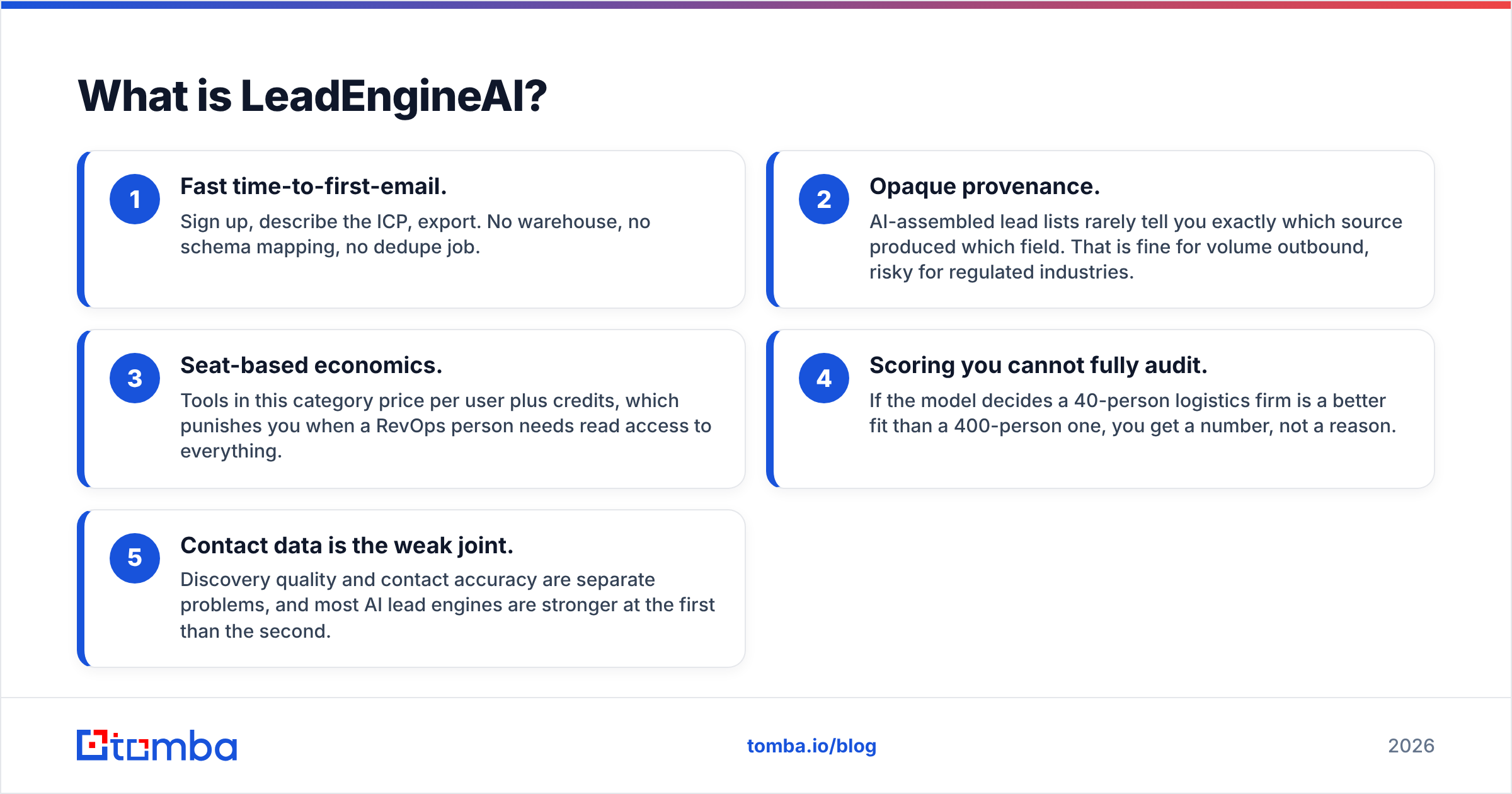
- Fast time-to-first-email. Sign up, describe the ICP, export. No warehouse, no schema mapping, no dedupe job.
- Opaque provenance. AI-assembled lead lists rarely tell you exactly which source produced which field. That is fine for volume outbound, risky for regulated industries.
- Seat-based economics. Tools in this category price per user plus credits, which punishes you when a RevOps person needs read access to everything.
- Scoring you cannot fully audit. If the model decides a 40-person logistics firm is a better fit than a 400-person one, you get a number, not a reason.
- Contact data is the weak joint. Discovery quality and contact accuracy are separate problems, and most AI lead engines are stronger at the first than the second.
If you want to sanity-check any vendor in this category, the review corpus on G2 is more useful than the vendor site, because bounce-rate complaints show up there first.
What is Xverum?#
Xverum is a web data provider. Its business is crawling public web sources at scale and delivering structured datasets — company profiles, professional profiles, job postings, local business listings — as bulk files or scheduled feeds. You can read the current product scope on xverum.com.
The mental model: Xverum is a lumber mill, not a furniture store. You get enormous volumes of clean, consistently shaped material, and you build the thing you actually wanted. If your team has a data warehouse, a matching pipeline, and someone comfortable with 50-million-row Parquet files, this is leverage. If it does not, the dataset sits in cloud storage as an expensive reminder of ambition.
What you typically get:
- Scale first. Hundreds of millions of records across entity types, refreshed on a schedule rather than queried one lookup at a time.
- Delivery, not UI. S3, GCS, Snowflake, or API delivery. There is no "click here to email this person" button, by design.
- Schema stability. The main reason data teams like bulk providers: the columns do not move under you every quarter.
- Annual contracts. Bulk web data is almost always a negotiated yearly deal, not a credit card signup.
- Compliance posture matters. Public-web collection is legal in most places. Still, the rules around web scraping and downstream personal-data use deserve a real legal review, especially for EU contacts.
LeadEngineAI vs Xverum: how do they compare head to head?#
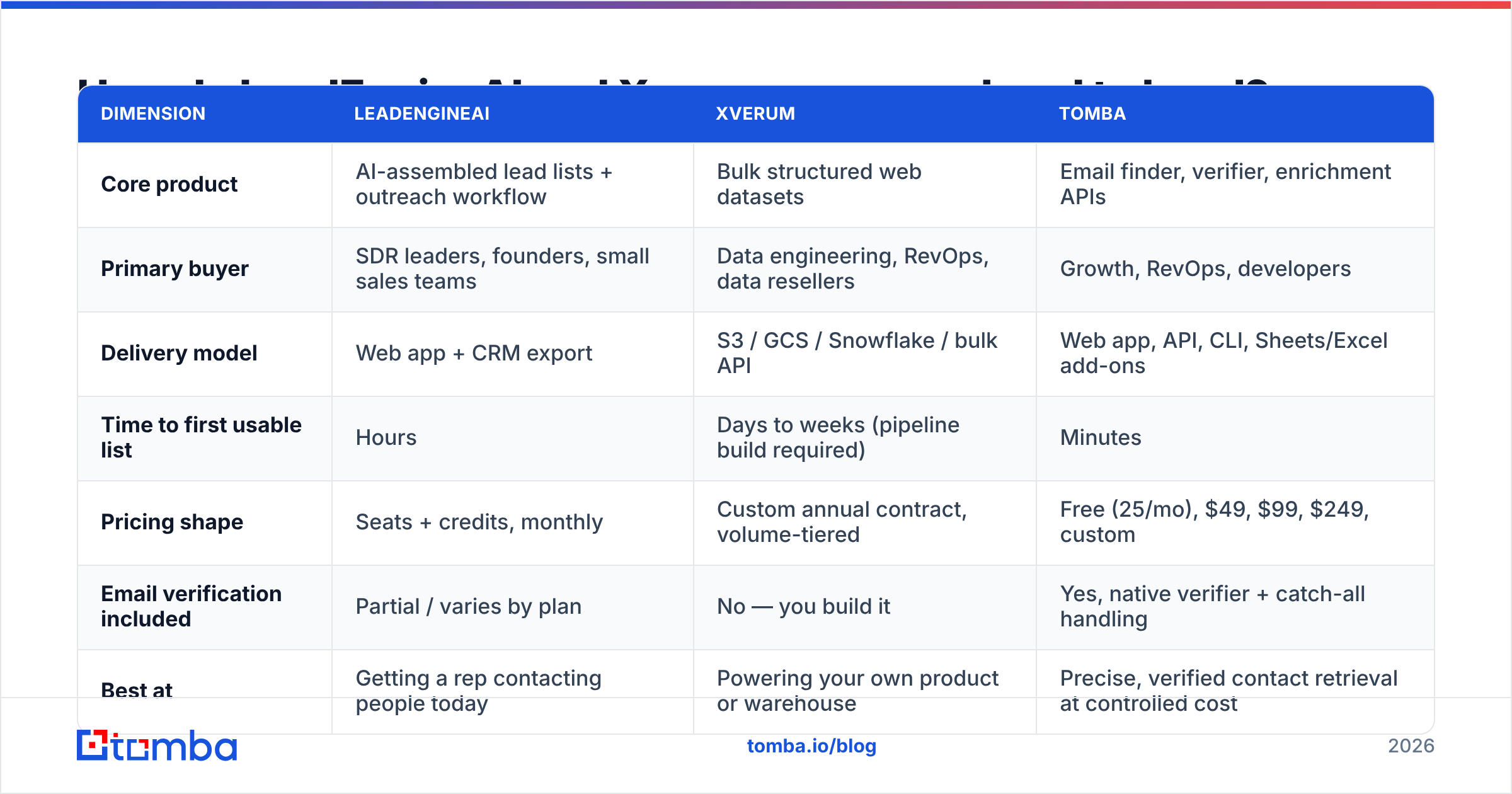
| Dimension | LeadEngineAI | Xverum | Tomba |
|---|---|---|---|
| Core product | AI-assembled lead lists + outreach workflow | Bulk structured web datasets | Email finder, verifier, enrichment APIs |
| Primary buyer | SDR leaders, founders, small sales teams | Data engineering, RevOps, data resellers | Growth, RevOps, developers |
| Delivery model | Web app + CRM export | S3 / GCS / Snowflake / bulk API | Web app, API, CLI, Sheets/Excel add-ons |
| Time to first usable list | Hours | Days to weeks (pipeline build required) | Minutes |
| Pricing shape | Seats + credits, monthly | Custom annual contract, volume-tiered | Free (25/mo), $49, $99, $249, custom |
| Email verification included | Partial / varies by plan | No — you build it | Yes, native verifier + catch-all handling |
| Best at | Getting a rep contacting people today | Powering your own product or warehouse | Precise, verified contact retrieval at controlled cost |
| Worst at | Auditability of sources and scores | Anything without engineering support | Being a full outbound sequencer |
Three things this table hides, so read them before you decide.
Volume is not coverage. A provider with 400 million profiles may still be thin in your exact niche — German mid-market manufacturers, US healthcare procurement, Japanese SaaS. Always run a sample test against 100 accounts you already know. Count how many are present, then count how many are correct. Those two numbers are rarely close.
Freshness beats size. B2B contact data decays at roughly 2–3% per month as people change jobs. Over a year, a quarter of your list goes stale. A dataset refreshed quarterly is a different product from one refreshed weekly, even when the row counts match. Ask each vendor for refresh cadence per entity type, not one marketing number.
Neither vendor guarantees deliverability. Data providers sell records. Your mail server sells your reputation. Those are separate contracts. Anything you buy from either platform should pass through an email verifier before it touches a sending domain, with catch-all domains routed through a dedicated catch-all verifier rather than guessed at.
Which one is better for outbound sales teams?#
LeadEngineAI, in almost every case where the team is under 20 reps.
The reason is not product quality. It is the cost of the missing middle. A bulk dataset gives you rows; an outbound motion needs a filtered, deduplicated, verified, CRM-mapped, owner-assigned list. Building that middle layer costs one engineer roughly four to eight weeks for a first version, plus permanent maintenance. That is a real six-figure decision disguised as a data purchase.
If your company already has that middle layer — a data warehouse, dbt models, an identity-resolution step — the calculus flips. Xverum then costs less per usable contact than any per-credit tool. You pay for raw material, and your own pipeline does the refining.
A rough decision rule:
- Fewer than 5,000 new contacts per month, no data engineer: use a finder-and-verifier stack. Bulk data is overkill.
- 5,000–50,000 per month, RevOps but no data team: an AI lead platform plus a verification layer, with API-based enrichment filling gaps.
- 50,000+ per month, or you are building a product on top of the data: bulk web data, with your own enrichment and validation.

What does each one actually cost?#
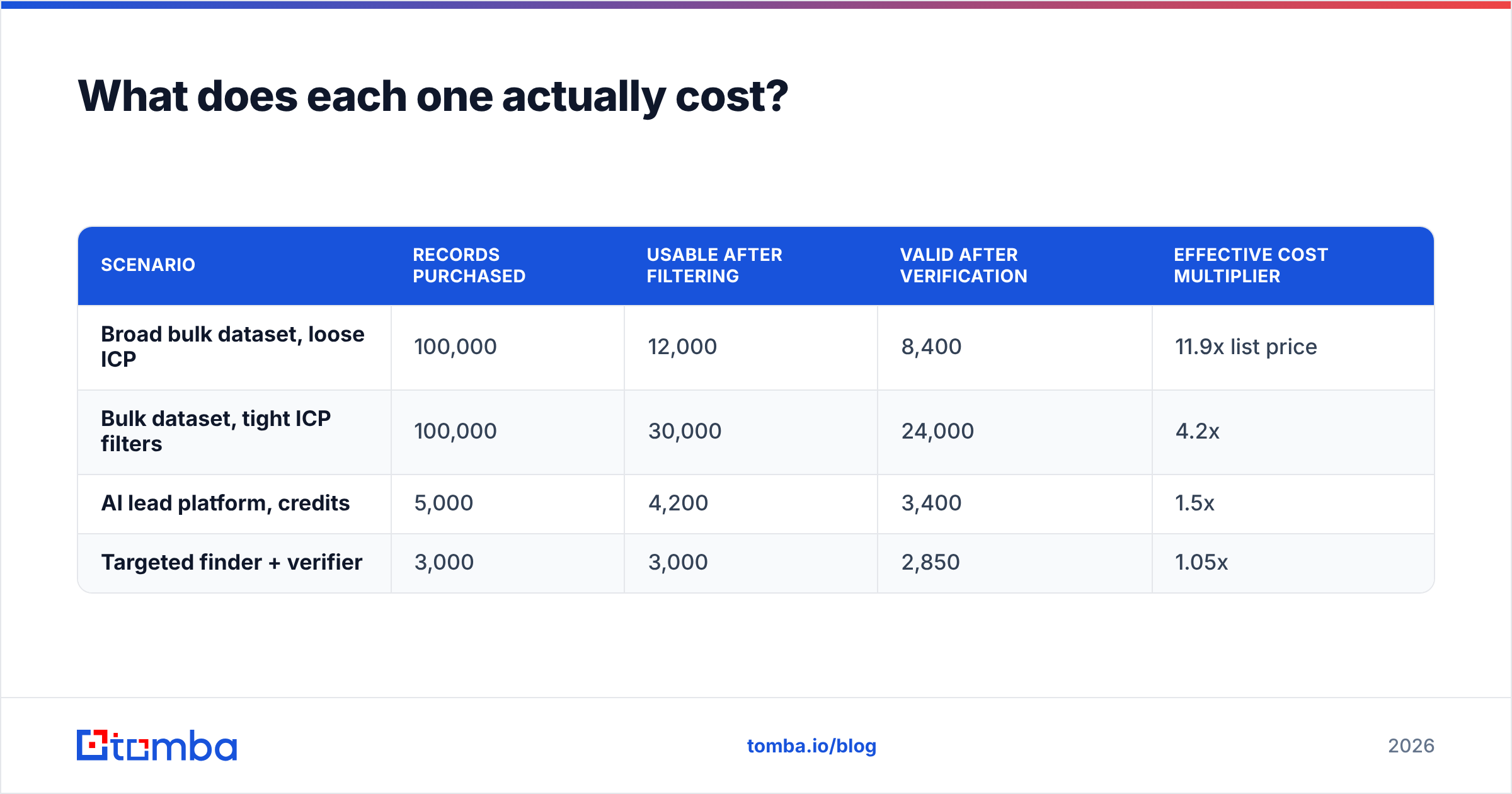
Honest answer: nobody can quote both accurately. LeadEngineAI publishes tiered SaaS pricing that changes often. Xverum quotes custom annual contracts that depend on entity types, volume, and refresh frequency. Get both quotes in writing, then compare on cost-per-verified-contact rather than cost-per-record.
That metric matters more than it sounds. Run the math:
| Scenario | Records purchased | Usable after filtering | Valid after verification | Effective cost multiplier |
|---|---|---|---|---|
| Broad bulk dataset, loose ICP | 100,000 | 12,000 | 8,400 | 11.9x list price |
| Bulk dataset, tight ICP filters | 100,000 | 30,000 | 24,000 | 4.2x |
| AI lead platform, credits | 5,000 | 4,200 | 3,400 | 1.5x |
| Targeted finder + verifier | 3,000 | 3,000 | 2,850 | 1.05x |
The pattern is consistent across every procurement exercise I have seen: the cheaper the per-record price, the worse the effective multiplier, because cheap records come in bulk and bulk requires discarding. A $0.002 record you throw away 90% of costs more than a $0.02 record you use.
For reference on the third and fourth rows, Tomba pricing runs Free (25 searches/mo), Starter $49/mo, Growth $99/mo, Pro $249/mo, and Enterprise custom — and verification is part of the same stack rather than a second vendor invoice. BookYourData is also worth a quote if you specifically want pre-built, pay-as-you-go lists with a bounce guarantee; it competes on a different axis than either platform here and does that axis well.
How do you evaluate either vendor without wasting a quarter?#
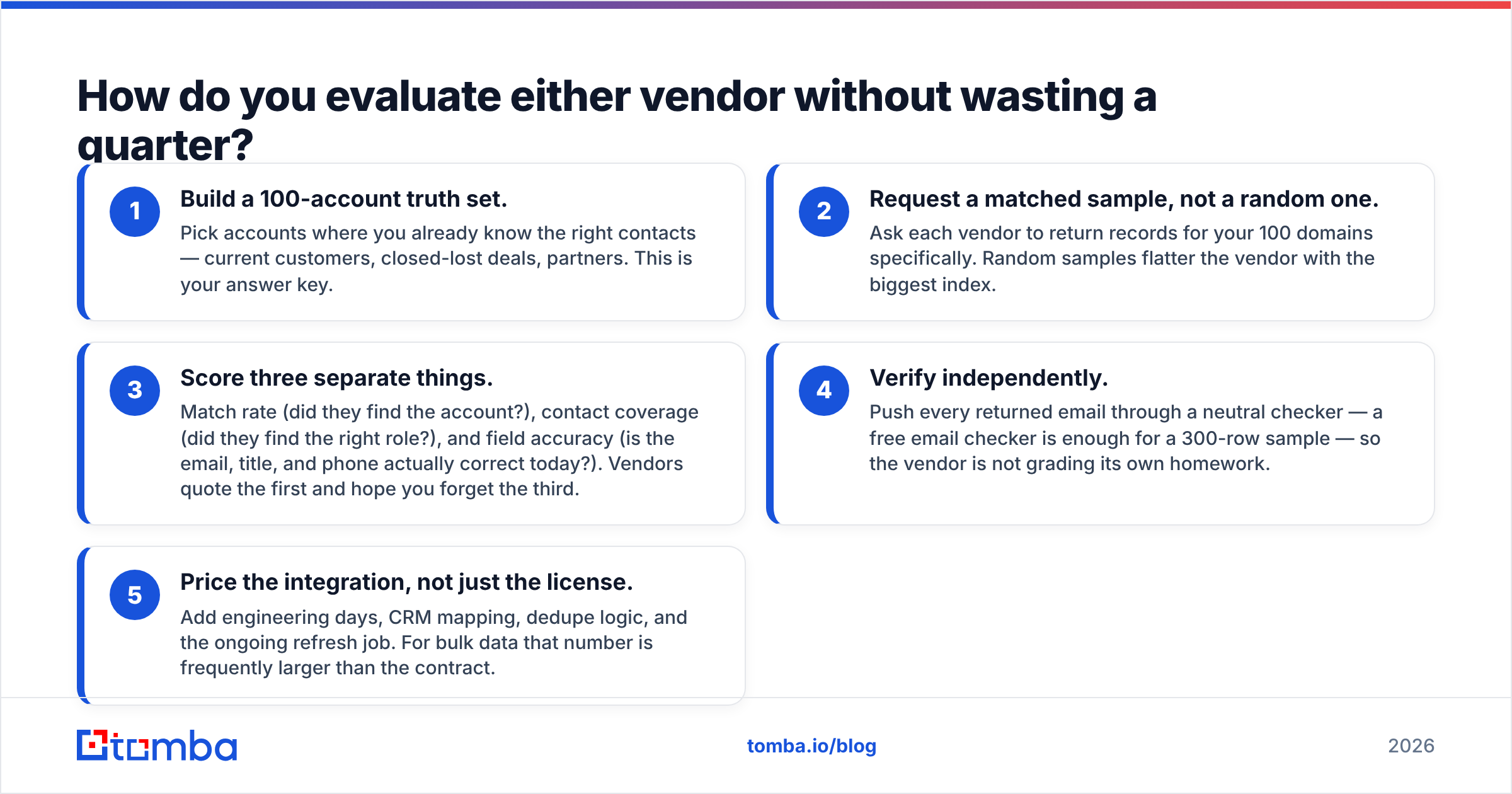
Run the same five-step test on both. It takes about a week and it settles arguments that otherwise take months.
- Build a 100-account truth set. Pick accounts where you already know the right contacts: current customers, closed-lost deals, partners. That is your answer key.
- Request a matched sample, not a random one. Ask each vendor for records on your 100 domains. Random samples flatter the vendor with the biggest index.
- Score three things separately. Match rate: did they find the account? Contact coverage: did they find the right role? Field accuracy: is the email correct today? Vendors quote the first and hope you forget the third.
- Verify independently. Push every returned email through a neutral checker, such as a free email checker. The vendor should not grade its own homework.
- Price the integration, not just the license. Add engineering days, CRM mapping, dedupe logic, and the refresh job. For bulk data, that number often beats the contract.
Step 4 is where most evaluations flip. I have watched a dataset with a 92% claimed accuracy figure return 61% deliverable emails on a matched sample. "Accurate" meant "matched the source we scraped," not "reaches a human." Ask precisely what the accuracy number is measured against.
When is neither the right answer?#
Three common situations:
You need 200 specific people, not 200,000 plausible ones. Account-based motions, partnership outreach, recruiting, and founder-led sales are precision problems. A domain search that returns every published address at a target company, with confidence scores and sources, beats a probabilistic list every time — and costs a rounding error by comparison.
You already have the accounts and need the contacts. If your CRM has 8,000 companies and no decision-maker emails, you do not have a lead generation problem. You have an enrichment problem. Run the domains through a bulk email finder or a data enrichment job and skip the new data contract entirely.
Your deliverability is the bottleneck. If you are already bouncing above 3%, more contacts makes it worse, not better. Fix sender reputation, authentication, and list hygiene before you buy volume. Adding rows to a broken sending setup is how domains get burned.
The verdict#
The honest LeadEngineAI vs Xverum verdict: Xverum wins on raw scale and schema discipline. LeadEngineAI wins on speed to first conversation. Neither wins on cost-per-verified-contact for a team under 20 reps. Both make you pay for volume you will not use, and for verification you still have to run.
If your bottleneck is "I need correct, deliverable email addresses for people I can already name," start with the Tomba Email Finder. The free tier gives you 25 searches a month to test against your own truth set. No contract, no sample-data theater, no pipeline to build first. Run your 100-account test on all three and let the match rate decide instead of the pitch deck.
Related guides#
Ready to find emails that actually work?
Join 150,000+ professionals who stopped guessing and started sending. Free credits on signup — no credit card required.
Get the Tomba newsletter
Practical outbound tactics and product updates — once every two weeks.
About the author