LeadEngineAI vs ZoomInfo: Which B2B Data Tool Wins in 2026?
One is an AI-native lead engine sold month to month. The other is the enterprise data incumbent with an annual contract and a seat minimum. Here is how LeadEngineAI and ZoomInfo actually compare on coverage, accuracy, workflow, and real cost.
TL;DR — LeadEngineAI vs ZoomInfo, in short:
- ZoomInfo is the incumbent. Deepest B2B coverage, plus intent data, visitor ID, and call analysis. Annual deals only, and most land near $15,000 a year with seats and credits.
- LeadEngineAI is the challenger. Prompt-built lists, self-serve signup, monthly billing, far lower entry price. Coverage thins outside North America and tech.
- The split is commitment, not features. ZoomInfo wants a year of budget. LeadEngineAI wants this month.
- Both cost too much for plain email data. A finder-and-verifier stack like Tomba does that job for $49/mo.
- Run a 250-contact bake-off first. Same accounts, same filters, same checks. Vendor claims are marketing. Your list is evidence.
What is LeadEngineAI and what is ZoomInfo?#
They solve the same problem from opposite ends.
ZoomInfo is the old guard of sales intelligence. It began as a contact database. It grew, partly by buying other tools, into a full go-to-market platform. You get contact and company records, tech stack data, intent signals, website visitor ID, sequencing, CRM enrichment, and call analysis.
Its edge is the size and depth of the graph behind it. ZoomInfo keeps that graph fresh with web crawling, data shared by users, partner feeds, and a research team. You can see the full product line on zoominfo.com and the company history on Wikipedia.
LeadEngineAI sits in the new AI-native group. Here the main interface is a prompt, not a filter panel. You describe the account and the person you want. For example: "Series B fintechs in the UK with an in-house data team, RevOps or Sales Ops leader."
The engine reads that, builds the list, enriches the contacts, and hands you a CSV or a CRM push. Signup is self-serve and billing is monthly. The product also moves fast, which cuts both ways. Check current limits and prices on the vendor's own site first, because tiers in this bracket change often.
Here is the honest frame for LeadEngineAI vs ZoomInfo. ZoomInfo sells you a database and a platform around it. LeadEngineAI sells you a workflow that produces lists. If you already know who to reach, the second is faster. If you need to find and map a market, the first is deeper.

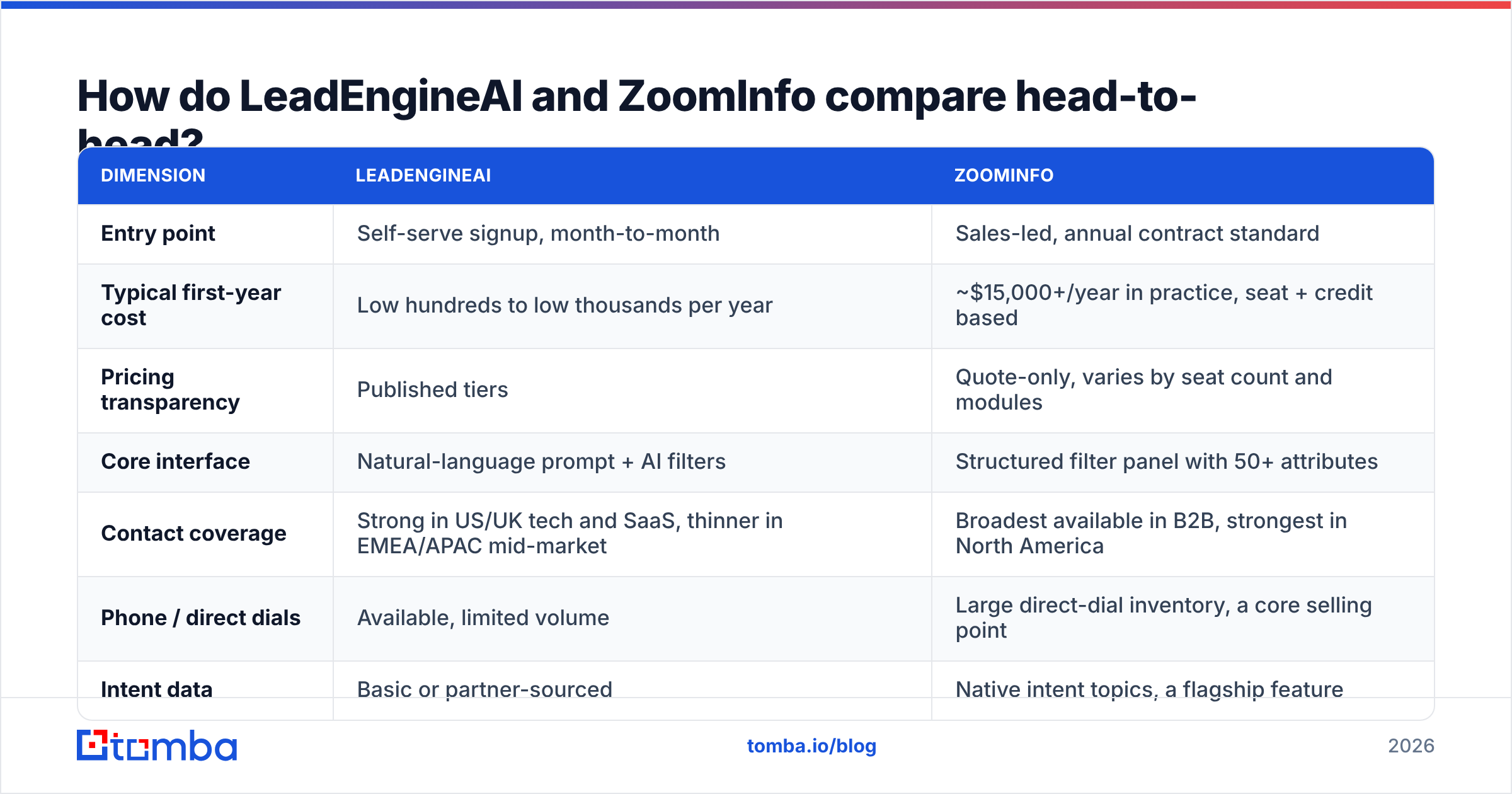
LeadEngineAI vs ZoomInfo: how do they compare head-to-head?#
| Dimension | LeadEngineAI | ZoomInfo |
|---|---|---|
| Entry point | Self-serve signup, month-to-month | Sales-led, annual contract standard |
| Typical first-year cost | Low hundreds to low thousands per year | ~$15,000+/year in practice, seat + credit based |
| Pricing transparency | Published tiers | Quote-only, varies by seat count and modules |
| Core interface | Natural-language prompt + AI filters | Structured filter panel with 50+ attributes |
| Contact coverage | Strong in US/UK tech and SaaS, thinner in EMEA/APAC mid-market | Broadest available in B2B, strongest in North America |
| Phone / direct dials | Available, limited volume | Large direct-dial inventory, a core selling point |
| Intent data | Basic or partner-sourced | Native intent topics, a flagship feature |
| Visitor identification | Usually not included | WebSights included in higher tiers |
| Sequencing / engagement | Export to your sequencer | Native Engage module |
| CRM enrichment | Push and basic sync | Deep enrichment + data hygiene (RingLead lineage) |
| Contract exit | Cancel any month | Renewal negotiation, auto-renew clauses common |
| Best fit | Founders, agencies, lean outbound teams | Enterprise SDR orgs and RevOps with budget |

Read that table as a spectrum, not a scoreboard. Every row ZoomInfo wins costs money. Every row LeadEngineAI wins costs coverage. A six-person startup that buys the full ZoomInfo stack pays for intent data and visitor ID it will never use. A 40-rep team running territory outbound on an AI list builder runs dry by month four.
LeadEngineAI vs ZoomInfo: which one has better data accuracy?#
No headline number should decide this. Everyone who sells data measures "accuracy" their own way.
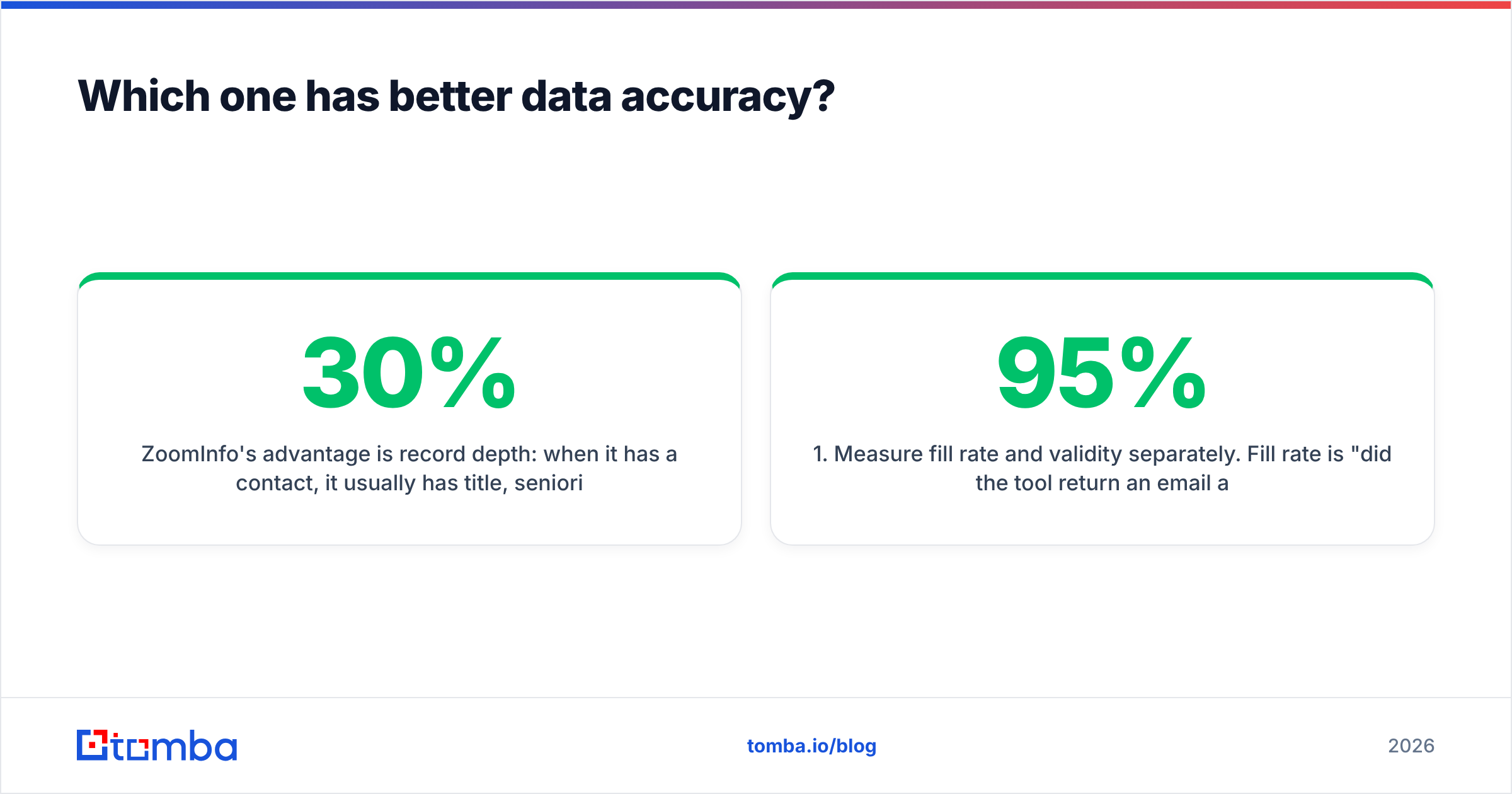
ZoomInfo's strength is record depth. When it has a contact, it usually has the title, seniority, department, location, revenue band, tech stack, and often a direct dial. Its weakness is the one every big database has: scale brings staleness. Roughly 25–30% of B2B people change jobs each year. So a base of hundreds of millions of rows is always rotting somewhere. Reviews in G2's sales intelligence category praise the coverage and flag old titles and dead dials in the same breath.
LeadEngineAI's strength is freshness at query time. AI-native tools tend to look a contact up when you ask, instead of serving a row built months ago. That keeps the records they do find fresher. The trade-off is variance. Coverage is strong for the personas the engine was tuned on, and it drops fast outside them. Ask for VPs of Engineering at US SaaS firms and the list is clean. Ask for plant managers at German mid-market factories and the fill rate falls apart.

Three rules for judging accuracy in any LeadEngineAI vs ZoomInfo test:
- Split fill rate from validity. Fill rate asks: did the tool return an email at all? Validity asks: does that email accept mail? A tool can post 95% fill and 60% validity by guessing patterns. Run every export through an outside email verifier instead of trusting the source's own flag.
- Put catch-all domains in their own bucket. About a fifth of B2B domains accept anything at the SMTP layer. Neither vendor can prove delivery there. Treat them as a separate risk tier, and run a catch-all verifier before you load them into a sequence.
- Test your ICP, not the demo list. A demo built on Fortune 500 tech accounts tells you nothing about your 200-person factory niche.
LeadEngineAI vs ZoomInfo: what does each cost in year one?#
Sticker price is not the number that matters. Total first-year cost is.
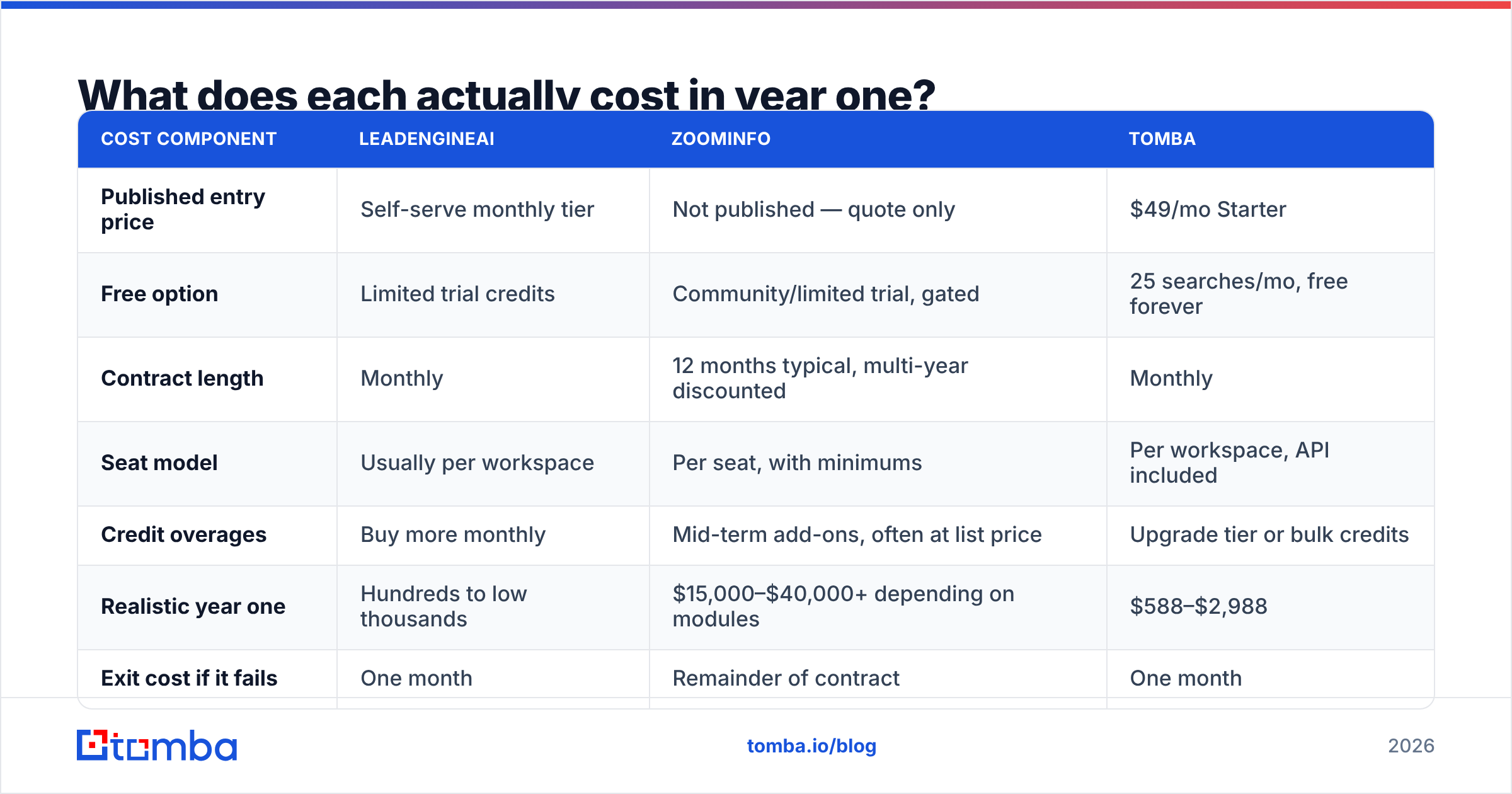
| Cost component | LeadEngineAI | ZoomInfo | Tomba |
|---|---|---|---|
| Published entry price | Self-serve monthly tier | Not published — quote only | $49/mo Starter |
| Free option | Limited trial credits | Community/limited trial, gated | 25 searches/mo, free forever |
| Contract length | Monthly | 12 months typical, multi-year discounted | Monthly |
| Seat model | Usually per workspace | Per seat, with minimums | Per workspace, API included |
| Credit overages | Buy more monthly | Mid-term add-ons, often at list price | Upgrade tier or bulk credits |
| Realistic year one | Hundreds to low thousands | $15,000–$40,000+ depending on modules | $588–$2,988 |
| Exit cost if it fails | One month | Remainder of contract | One month |
Year one is where LeadEngineAI vs ZoomInfo stops being a feature debate. The last row is the one that catches teams out. ZoomInfo's model assumes you know your outbound works before you buy. If your ICP shifts in month three, and it often does at firms under Series C, you still pay for the old scope. Teams tell us the same story: they bought eight seats, used four, and carried the rest all year.
LeadEngineAI carries the opposite risk. You commit little, but the tool and the price you signed up for may look different next quarter. That is the tax on buying from a young, fast-moving vendor. At the low end of the market it is usually worth paying.
Now set both against published Tomba pricing: Free, $49 Starter, $99 Growth, $249 Pro. The gap is not subtle. The real question is what you give up when you drop the platform layer. That is the next section.
Who should choose ZoomInfo?#
ZoomInfo wins the LeadEngineAI vs ZoomInfo call when all three of these are true:
- You run outbound at scale. Several SDRs, set territories, and a quota model that needs list volume. The cost only pays off when a team works it daily.
- You need signals, not just contacts. Intent topics, visitor ID, and tech-stack filters are hard to copy with point tools. If your plan is to reach accounts already shopping in your category, this is the strongest single source.
- You have RevOps time to own it. ZoomInfo pays off when it is wired into the CRM with enrichment rules, dedupe, and routing. With no owner, it turns into a pricey list exporter.
Skip it if you are pre-product-market-fit, if your ICP sits outside North America, or if the only field you ever export is the email address.

Who should choose LeadEngineAI?#
Choose LeadEngineAI if speed and budget matter more than depth:
- Founder-led or lean outbound. One or two people build lists each week and tune the ICP as they learn.
- Agency and consultancy work. New client, new ICP, new list, every month. A prompt beats rebuilding a 15-filter query each time.
- Campaign-driven teams. You run bursts, not steady territory coverage, so yearly credit deals waste money.
- You already own a sequencer. If Instantly, Smartlead, or Lemlist sends your mail, you do not need ZoomInfo's Engage module, and you should not pay for it.
One caveat: check coverage on your own segment during the trial. AI list builders are strong in the middle of the market they learned on, and thin at the edges.
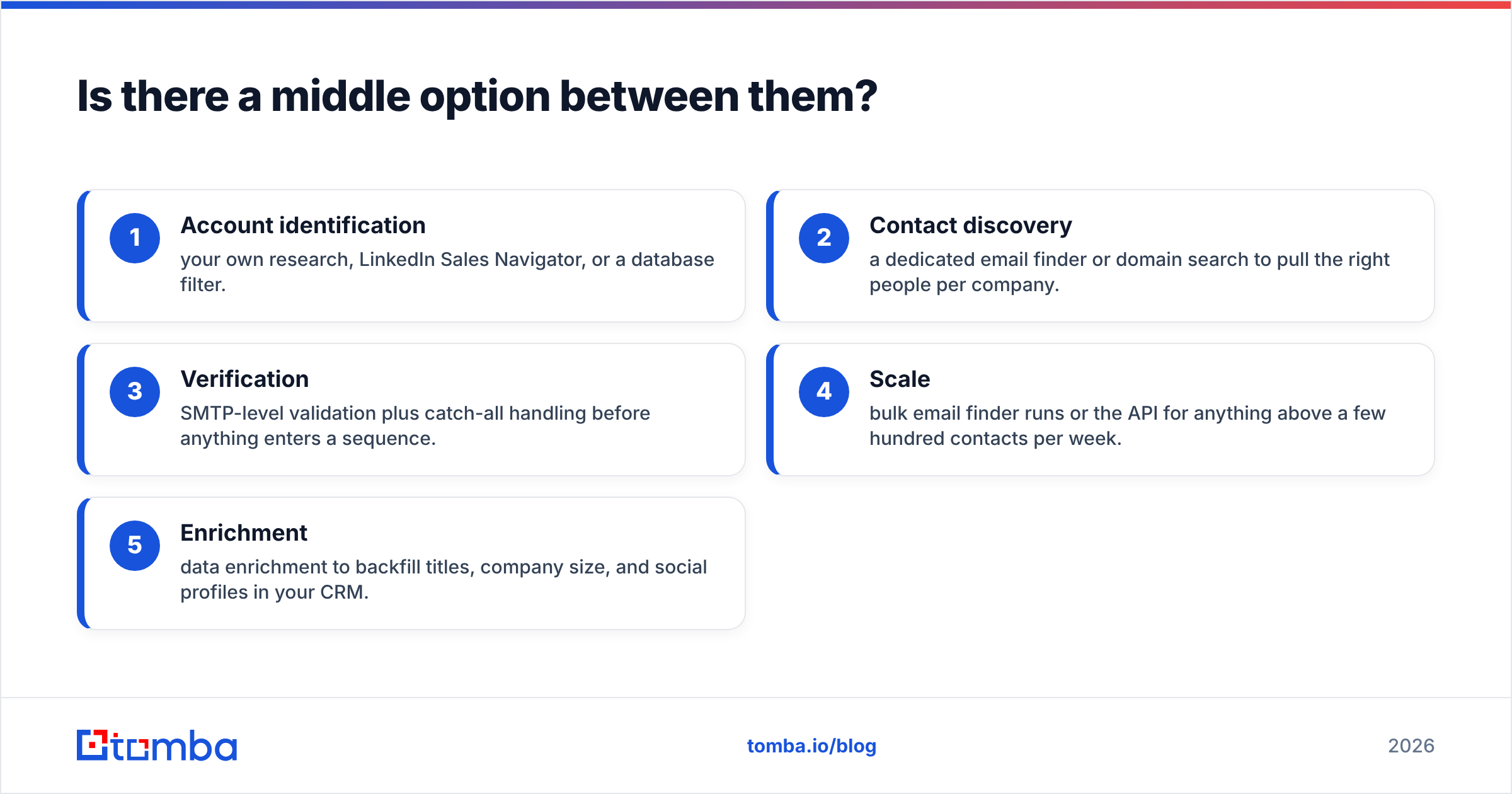
Is there a middle option between them?#
Yes. For a lot of teams it is the right answer.
Most buyers weighing leadengineai vs zoominfo are not really shopping for a go-to-market platform. They want verified contact data, and the platform came bolted on. If your flow is "find accounts, find the right person, get a valid email, send it from a tool I already pay for," then you are paying a platform premium for a data job.
The unbundled stack looks like this:
- Account identification — your own research, LinkedIn Sales Navigator, or a database filter.
- Contact discovery — an email finder or domain search to pull the right people per company.
- Verification — SMTP checks plus catch-all handling before anything enters a sequence.
- Scale — bulk email finder runs, or the API for more than a few hundred contacts a week.
- Enrichment — data enrichment to fill in titles, company size, and social profiles in your CRM.
Two other names are worth a look. BookYourData sells pay-as-you-go verified B2B lists with an accuracy guarantee and no subscription. That fits well when you need one list rather than an ongoing tool. Apollo gives you a database plus a sequencer at mid-market prices. Neither replaces ZoomInfo's intent and visitor data, and neither claims to.
How do you run a fair 30-day bake-off?#
Do not decide on demos. Settle LeadEngineAI vs ZoomInfo with a test, and hold every variable steady except the vendor.
- Pick 50 accounts you already know. Ideally you hold a verified contact for each in the CRM, so you have ground truth.
- Define one persona exactly. Same title band, same department, same seniority in both tools. Loose rules here produce useless results.
- Pull five contacts per account from each vendor. That is 250 records a side — enough to trust, quick to finish.
- Verify with a neutral third party. Never grade a vendor with its own flag. Sort results into valid, invalid, catch-all, and not found.
- Score four numbers. Fill rate, verified-valid rate, cost per verified contact, and build time. Cost per verified contact is the only price metric that counts.
- Send a real 100-contact campaign from each side. Bounce rate and reply rate close the loop that checks alone cannot.
Most teams who run this find the accuracy gap is smaller than the price gap. Often a few points of validity separate two tools with a 10x price difference. That is the finding that should drive your call.
The bottom line#
ZoomInfo wins on depth, signals, and enterprise workflow, and charges for it. LeadEngineAI wins on speed, price, and the freedom to leave. It asks you to accept thinner coverage from a young vendor. Neither is a mistake for the buyer it was built for. Both are costly mistakes for the buyer it was not. That is the whole LeadEngineAI vs ZoomInfo story in two lines.
If what you need is accurate contact data, and not intent scores or visitor ID, start narrow and keep your budget. Tomba's email finder returns verified work emails by name, domain, or company. Verification, catch-all detection, and the full API come in the same plan.
The free tier covers 25 searches a month, so you can test it beside both tools before you spend a dollar. Starter is $49/mo if it wins. Run the 250-contact test, compare cost per verified contact, and let the numbers pick the vendor.
Related guides#
Ready to find emails that actually work?
Join 150,000+ professionals who stopped guessing and started sending. Free credits on signup — no credit card required.
Get the Tomba newsletter
Practical outbound tactics and product updates — once every two weeks.
About the author