LeadFuze vs LeadzenAI: Which B2B Lead Tool Wins in 2026?
LeadFuze and LeadzenAI both promise verified B2B contacts on autopilot, but they solve different problems. Here is the honest breakdown on data coverage, pricing, and which one your team should actually buy.
LeadFuze vs LeadzenAI is a choice between two different machines. One builds lists in bulk. The other looks up people one at a time. Here is the short version.
TL;DR
- LeadFuze is a list-building engine. It runs on saved searches plus "Fuzebot" automation. Best for agencies and SDR teams that want recurring lists matching a fixed ICP.
- LeadzenAI is an AI-assisted contact finder with a browser extension. Its data leans India and APAC. Best for solo founders and regional sales teams who prospect one person at a time.
- Neither is a verification engine. Both hand you addresses. Neither gives you a bounce guarantee, so you still need a separate verify step before you send.
- Pricing shape differs more than price. LeadFuze meters lead credits on annual-leaning plans. LeadzenAI meters searches and credits on cheaper monthly tiers.
- Got 4,000 companies and need accurate work emails? A finder-plus-verifier API like Tomba costs less per usable contact than either tool.
What are LeadFuze and LeadzenAI, actually?#
Start with the honest framing. These two tools compete only in the sense that both sell B2B contact records. Their design and their buyers differ.
LeadFuze has been around since the mid-2010s. It runs on "market-based search" plus "account-based search." You define an ICP — industry, headcount, tech stack, role, location — and LeadFuze returns matching people with emails and phone numbers. Its signature feature is Fuzebot. Fuzebot is a saved search that keeps running and drips new leads into your list as they appear. It also dedupes against records you already own or imported from your CRM.
LeadzenAI is newer. It bills itself as an AI-powered prospecting assistant. The core loop is search by criteria or by profile. A Chrome extension pulls contact details while you browse LinkedIn or a company site. Its dataset is much stronger on Indian and APAC companies than most US-first vendors. That is the single most useful thing to know about it. If you sell into Bengaluru, Pune, or Mumbai mid-market, that gap is not a rounding error.
Here is the analogy that makes it stick. LeadFuze is a conveyor belt: you set the machine once and it keeps producing lists. LeadzenAI is a handheld scanner: you point it at a target and it reads the label. Belts win when your ICP is stable and wide. Scanners win when every target is deliberate.

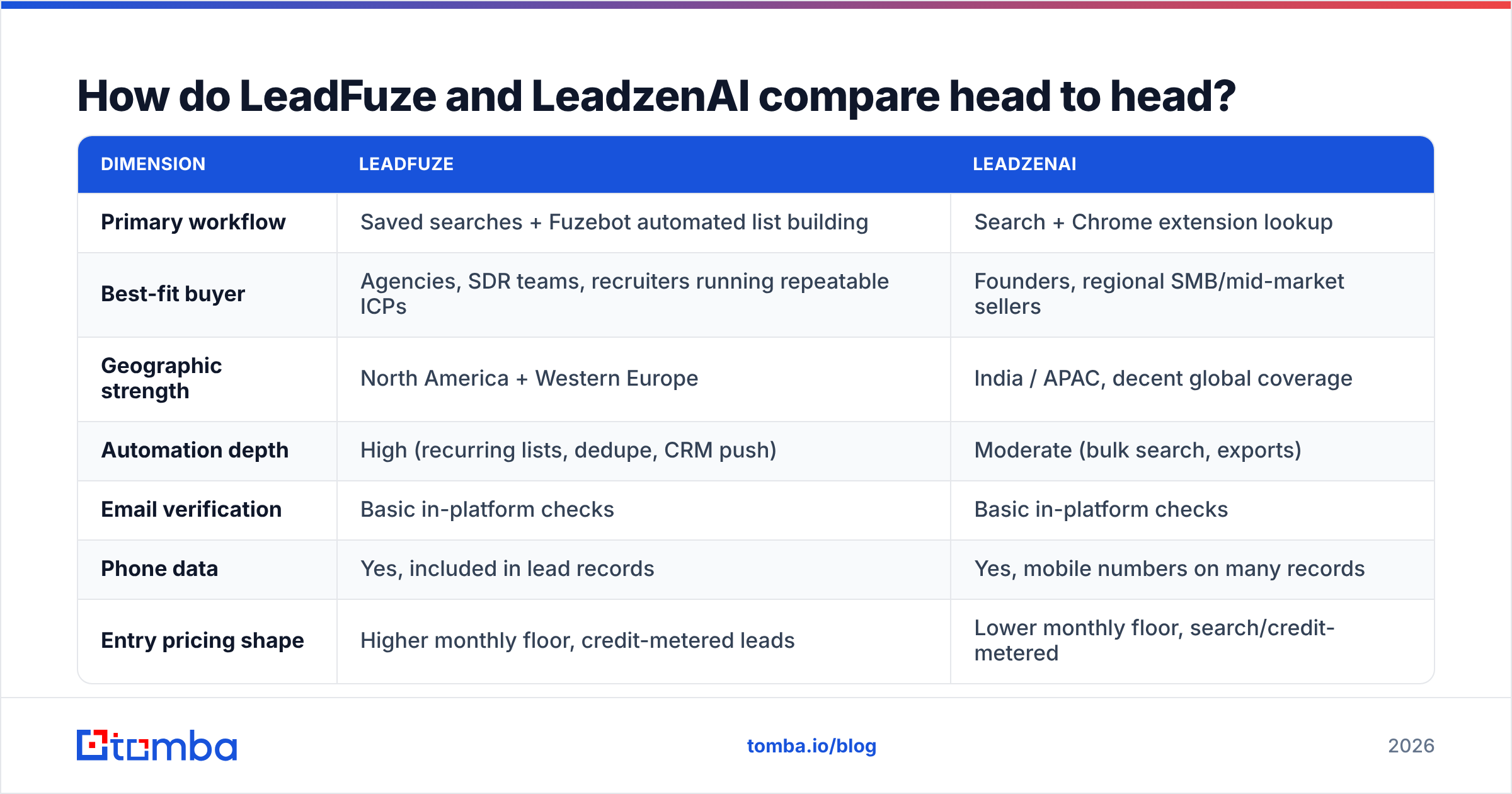
LeadFuze vs LeadzenAI: how do they compare head to head?#
| Dimension | LeadFuze | LeadzenAI |
|---|---|---|
| Primary workflow | Saved searches + Fuzebot automated list building | Search + Chrome extension lookup |
| Best-fit buyer | Agencies, SDR teams, recruiters running repeatable ICPs | Founders, regional SMB/mid-market sellers |
| Geographic strength | North America + Western Europe | India / APAC, decent global coverage |
| Automation depth | High (recurring lists, dedupe, CRM push) | Moderate (bulk search, exports) |
| Email verification | Basic in-platform checks | Basic in-platform checks |
| Phone data | Yes, included in lead records | Yes, mobile numbers on many records |
| Entry pricing shape | Higher monthly floor, credit-metered leads | Lower monthly floor, search/credit-metered |
| Free trial | Limited trial leads | Limited free credits |
| API access | Available on higher tiers | Available, less documented |
| Learning curve | Moderate — filters are deep | Low — extension-first |
Two caveats on that table. First, published pricing moves on both sides. Check the current pages before you budget. Second, "email verification" here means a syntax and MX sanity check plus whatever score the data pipeline already had. That is not an SMTP-level verdict with catch-all handling. The difference matters a lot once your list passes a few thousand rows.
Which one has better data coverage and accuracy?#
Neither wins outright. They win in different territories, and that is the real decision criterion.
LeadFuze covers US and Western European tech, SaaS, professional services, and recruiting best. Its filters are the deep part: hiring signals, technologies used, ad spend, funding, headcount bands. Want "Series B SaaS companies in the US using HubSpot with 50-200 employees that are hiring SDRs"? LeadFuze will build that list. Whether every email in it still resolves is another question.
LeadzenAI leans toward companies with a strong Indian digital footprint. Ask it for mid-market manufacturing in Gujarat or IT services in Hyderabad. You will get records where US-first vendors return blanks. Its Western coverage exists, but it is thinner and noisier than LeadFuze's.
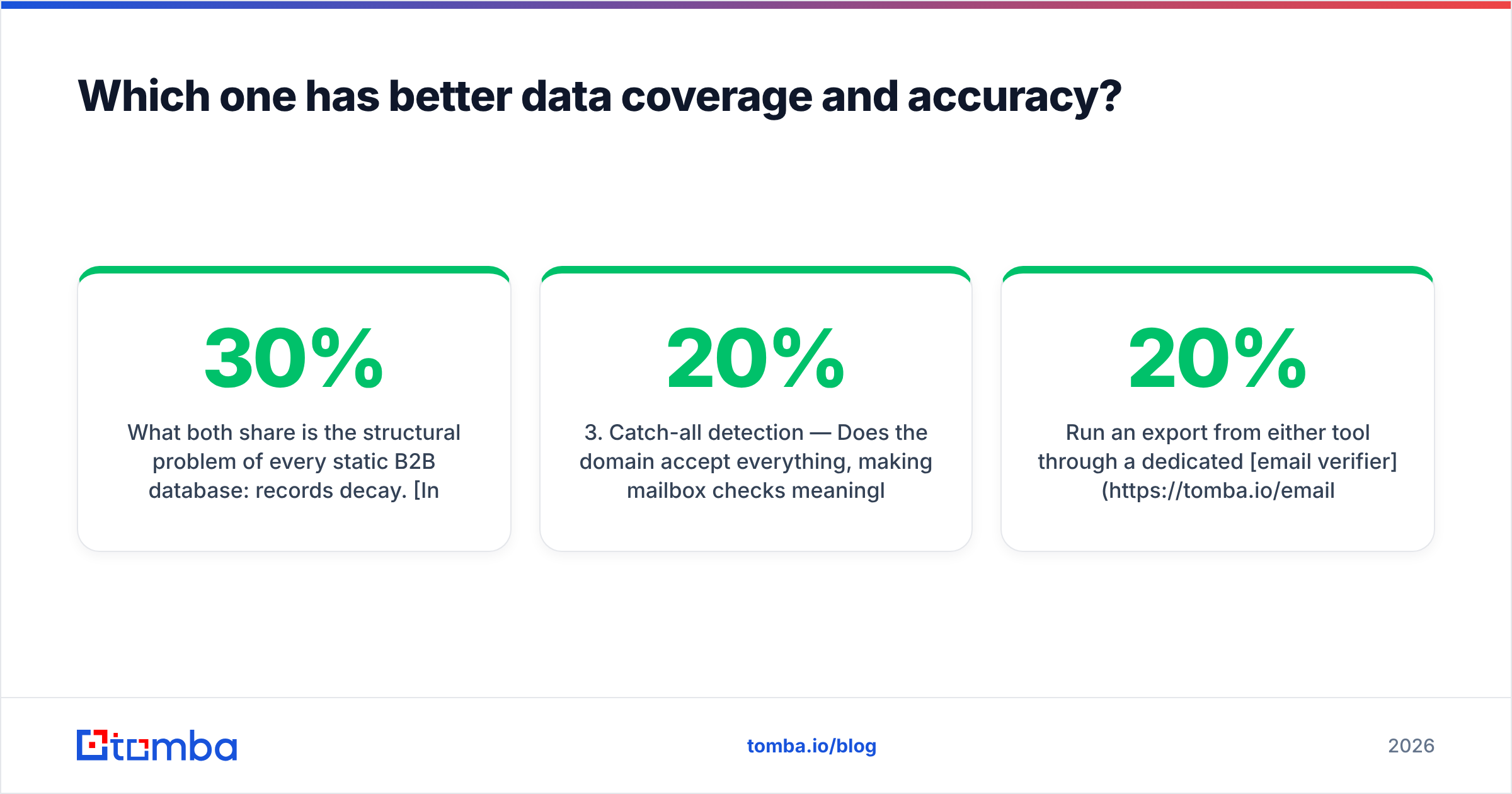
Both share the structural problem of every static B2B database: records decay. Industry research consistently puts B2B data decay around 25-30% per year. People change jobs, companies rebrand, domains merge. A database that was 92% accurate at scrape time is about 70% accurate a year later if nothing re-verifies it.
So the practical question is not "whose database is better." It is "what happens between the export and the send." Four checks separate a usable list from a domain-burning one:
- Syntax and MX — Does the domain exist and accept mail at all? Cheapest check. It catches the obvious garbage.
- Mailbox existence (SMTP) — Does this specific mailbox resolve? Most in-platform "verification" stops before this step.
- Catch-all detection — Does the domain accept every address, making mailbox checks meaningless? Roughly 15-20% of B2B domains are catch-all. Mailing them blind is how bounce rates spike. A catch-all verifier handles this tier on its own.
- Role and risk flags — Is this
info@,sales@, a spam trap, or a throwaway address? Role accounts drag engagement down even when they deliver.
Run an export from either tool through a dedicated email verifier and you will drop 8-20% of rows. That is not a knock on either vendor. It is what happens to any database between refresh cycles.
What does each tool actually cost?#
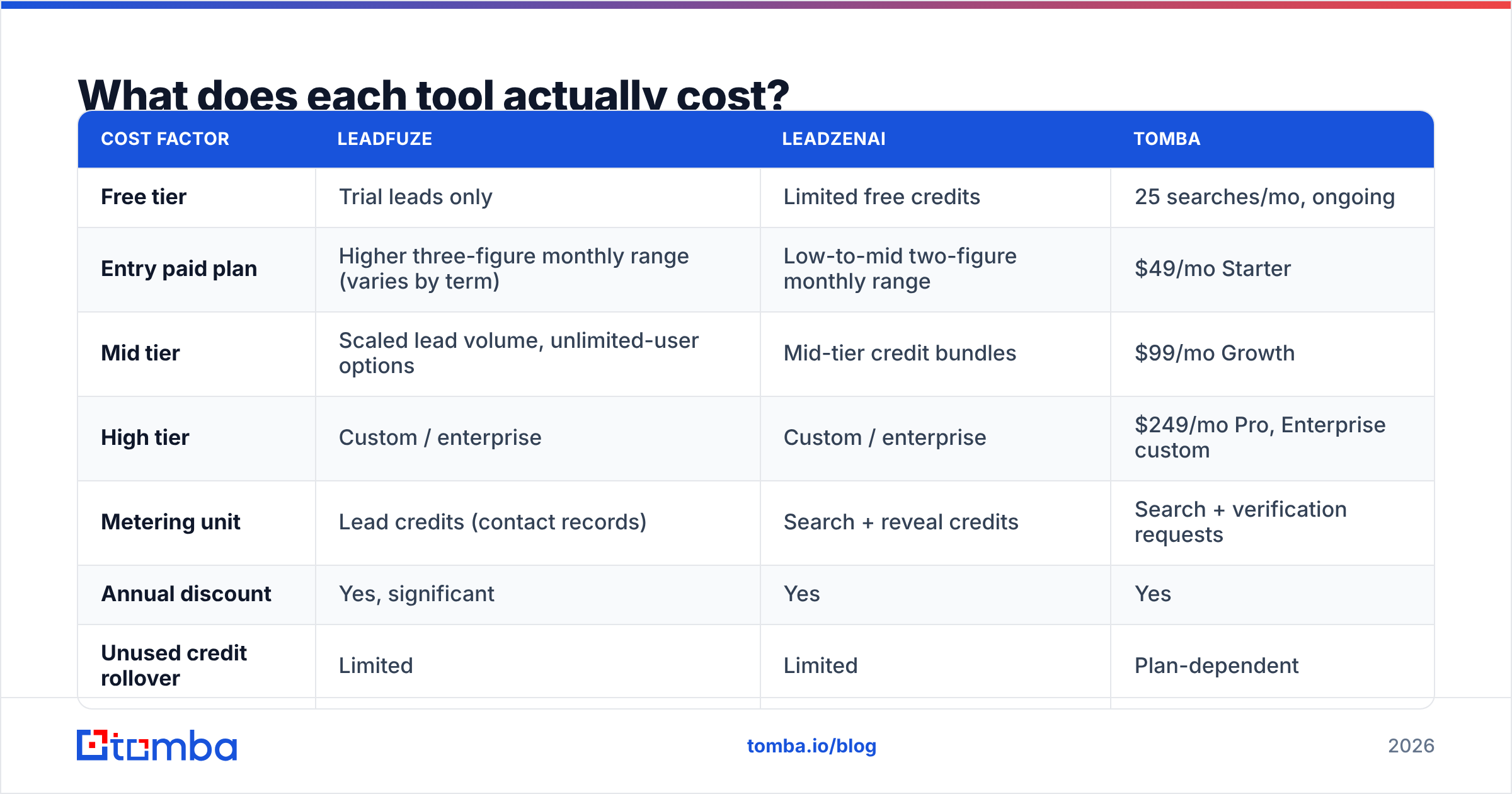
Pricing is where LeadFuze vs LeadzenAI gets uncomfortable, because the two vendors meter different units.
| Cost factor | LeadFuze | LeadzenAI | Tomba |
|---|---|---|---|
| Free tier | Trial leads only | Limited free credits | 25 searches/mo, ongoing |
| Entry paid plan | Higher three-figure monthly range (varies by term) | Low-to-mid two-figure monthly range | $49/mo Starter |
| Mid tier | Scaled lead volume, unlimited-user options | Mid-tier credit bundles | $99/mo Growth |
| High tier | Custom / enterprise | Custom / enterprise | $249/mo Pro, Enterprise custom |
| Metering unit | Lead credits (contact records) | Search + reveal credits | Search + verification requests |
| Annual discount | Yes, significant | Yes | Yes |
| Unused credit rollover | Limited | Limited | Plan-dependent |
| API included | Higher tiers | Yes | All paid tiers |
List price is not the number that matters. Cost per usable contact is. Take the plan price, divide by the credits, then divide again by your post-verification keep rate. A $150 plan with 1,000 leads at a 78% keep rate costs $0.19 per usable contact. A $49 plan with 1,000 verified finds at a 95% keep rate costs $0.05. Run that math on your own numbers first. It reorders vendor rankings more often than you would expect.
Budget for the hidden line item too. A bad list costs more than its price tag. Bounces above 2-3% start to damage sender reputation. That damage taxes every campaign you run later, not just the one with the bad list.
Is there a better approach than either tool?#
For many teams, yes. It depends on what you actually need.
Is your bottleneck discovery ("I don't know who to target")? Then a database tool earns its keep. LeadFuze's filters or LeadzenAI's regional depth give you names you would not have found. Pay for that.
Is your bottleneck contact data ("I have the company list, I need reachable people")? Then a database subscription is an expensive fix for a narrow problem. You buy a filtering engine you will not use. You pay database prices for what is really an enrichment call.
That second case is where a finder-plus-verifier stack wins on unit economics. You feed in domains and names, and you get back verified addresses. The input can be a conference attendee list, a G2 category scrape, a CRM export, or an investor portfolio page. A domain search returns every discoverable address at a company plus the detected email pattern. A bulk email finder runs thousands of rows at once. The Tomba API wires the same thing into your own pipeline, so enrichment happens at record creation instead of in a monthly CSV ritual.

There is a third pattern worth naming honestly. Many teams combine sources. Use a database for the top-of-funnel account list. Use a finder API to fill and verify the contact layer. Use your CRM as the dedupe authority. That stack costs less than two overlapping database subscriptions, and it produces cleaner data than either one alone.
A curated-list vendor is a fair option too. BookYourData sells pay-as-you-go verified lists with a bounce guarantee. That suits teams that want a one-time list without a recurring seat commitment. Different model, and genuinely useful for a certain buyer.
Which should you choose for your specific situation?#
Here is the decision framework, stated plainly.
- Choose LeadFuze if you run repeatable outbound against a stable ICP in North America or Western Europe. You need enough volume to justify the higher floor price. In return, your lists refresh themselves and nobody rebuilds a search every Monday. Agencies running outbound for several clients get the most leverage here.
- Choose LeadzenAI if your market is India or APAC, if you prospect deliberately rather than in bulk, or if you want a smaller monthly commitment while you test whether outbound works for you at all. The extension workflow suits founder-led sales well.
Neither one the right shape? Three other routes are open.
- Choose a finder + verifier stack if you already know your target companies and want accurate work emails at the lowest cost per contact. Same answer if you need enrichment inside your own product via API rather than in a dashboard.
- Choose a curated list vendor if you need a one-time, pre-verified list for a single campaign and want no subscription at all.
- Choose two of the above if your funnel has both a discovery problem and a data-quality problem. Most scaling teams do.
One test cuts through all the demos. Run the same 100 target companies through each tool's trial. Export the results. Run every export through the same third-party verifier. Then compare three numbers: match rate, pass rate, and cost per passing row. Whichever tool wins that test for your ICP is the right answer — no matter what any comparison post says, including this one.
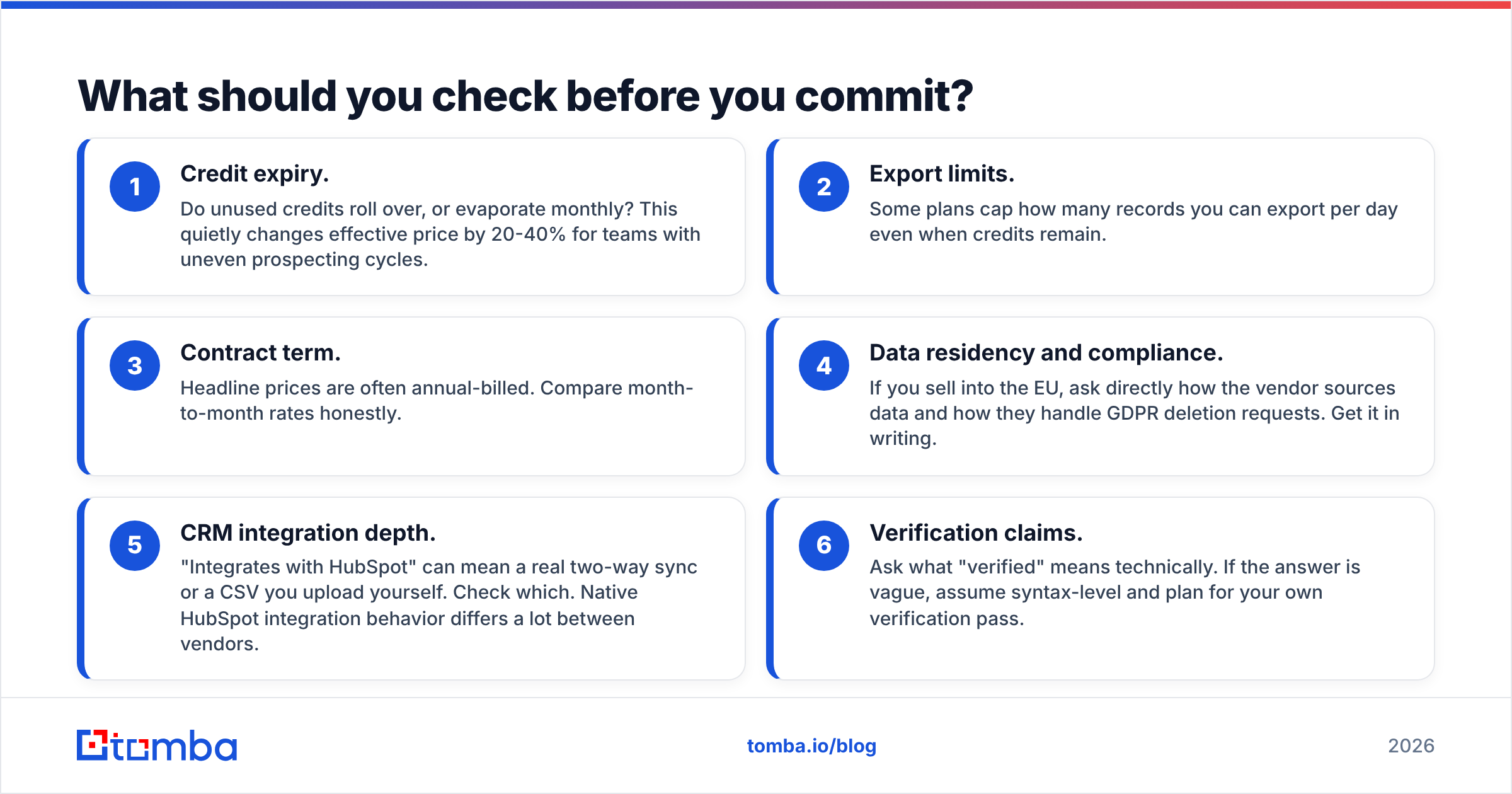
What should you check before you commit?#
Six things that catch people out after signing:
- Credit expiry. Do unused credits roll over, or do they vanish monthly? This quietly shifts effective price by 20-40% for teams with uneven prospecting cycles.
- Export limits. Some plans cap how many records you can export per day, even when credits remain.
- Contract term. Headline prices are often annual-billed. Compare month-to-month rates honestly.
- Data residency and compliance. Selling into the EU? Ask how the vendor sources data and how it handles GDPR deletion requests. Get it in writing.
- CRM integration depth. "Integrates with HubSpot" can mean a real two-way sync, or a CSV you upload yourself. Check which. Native HubSpot integration depth varies a lot between vendors.
- Verification claims. Ask what "verified" means in technical terms. If the answer is vague, assume syntax-level and plan your own verification pass.
Sanity-check any vendor's claims against real user reviews on G2 before you commit. Filter by company size closest to yours. Enterprise reviews rarely describe the SMB experience well.
The bottom line#
LeadFuze vs LeadzenAI is not a fight one tool wins. Both are legitimate, and they serve different buyers. LeadFuze is the better automation engine for Western markets with stable ICPs. LeadzenAI is the better fit for APAC-focused, deliberate prospecting on a smaller budget. Neither one verifies email properly. Treating either export as send-ready is the most common way teams turn a good tool into a deliverability problem.
Is your real job turning a list of companies and names into verified, reachable work emails? Then start with the Tomba Email Finder and skip database-tier prices for filters you will not use. The free tier gives you 25 searches a month to test match rates on your own target list. Starter is $49/mo. Every paid plan includes API access, so you can wire finding and verification straight into your pipeline. Run your 100-company test, compare the cost per passing row, and let the numbers pick your stack. Full Tomba pricing is public, so the math takes about ten minutes.
Related guides#
Ready to find emails that actually work?
Join 150,000+ professionals who stopped guessing and started sending. Free credits on signup — no credit card required.
Get the Tomba newsletter
Practical outbound tactics and product updates — once every two weeks.
About the author