LeadFuze vs Warpleads: Which B2B Lead Tool Wins in 2026?
LeadFuze sells curated lead lists with automation. Warpleads sells volume. We break down pricing, data quality, export limits, and who each one actually fits in 2026.
LeadFuze vs Warpleads comes down to one choice: curated lead lists or raw volume. Here is how the two tools compare on price, data quality, and team fit.
TL;DR
- LeadFuze builds curated lead lists, with automation (Fuzebot) on top. You describe an ICP. It keeps adding matching leads on a schedule. Good for small teams that want lists built for them.
- Warpleads is a volume play. It sells big B2B contact exports at prices that survive tens of thousands of rows. Good for agencies and high-volume outbound.
- Pricing is not comparable head-to-head. LeadFuze meters leads per month. Warpleads sells bulk export packages. Ask for cost per usable contact, not cost per row.
- Neither is a verification layer. Re-verify both before you send. Watch catch-all domains, where "verified" lists quietly fall apart.
- Our take: LeadFuze for a narrow niche. Warpleads if volume is the strategy. Pair either with an email verifier.
What are LeadFuze and Warpleads?#
They solve the same problem — "get me a list of people to email" — from opposite ends.
LeadFuze has been around since the mid-2010s. It calls itself lead generation software rather than a raw database. Its two search modes are the giveaway. Market Based Search builds an audience by role, industry, headcount, tech stack, ad spend, and similar filters. Account Based Search takes a list of companies and returns the people inside them. Fuzebot, its automation layer, then drips new matching leads into your list. It also de-duplicates against contacts you have already exported or already hold in your CRM.
Warpleads is newer and starts from a different assumption. It treats modern outbound as a volume game, and per-credit pricing as a tax on the teams running it. The pitch is large-scale export of B2B contacts. Filter, export, load into your sequencer, repeat. LeadFuze wants to be your list-building assistant. Warpleads wants to be your bulk data faucet.
That gap in philosophy shows up everywhere else: pricing, filter depth, how much manual QA you do, and which kind of team each tool fits.
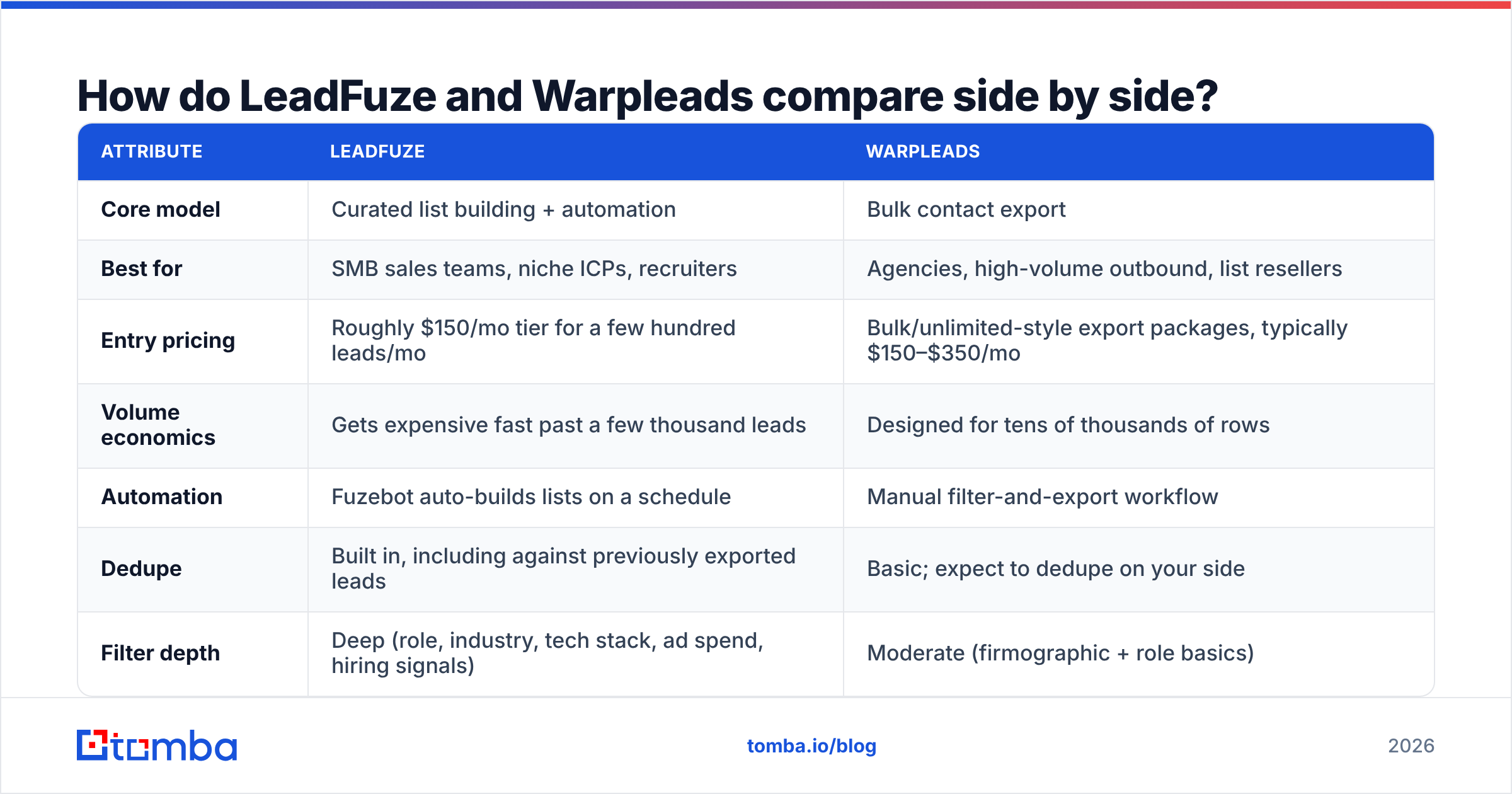
LeadFuze vs Warpleads: how do they compare side by side?#
Here's the practical comparison. Treat pricing as published list price at the time of writing. Both vendors change tiers, and annual deals shift the numbers. Always confirm on the vendor's own page before you buy.
| Attribute | LeadFuze | Warpleads |
|---|---|---|
| Core model | Curated list building + automation | Bulk contact export |
| Best for | SMB sales teams, niche ICPs, recruiters | Agencies, high-volume outbound, list resellers |
| Entry pricing | Roughly $150/mo tier for a few hundred leads/mo | Bulk/unlimited-style export packages, typically $150–$350/mo |
| Volume economics | Gets expensive fast past a few thousand leads | Designed for tens of thousands of rows |
| Automation | Fuzebot auto-builds lists on a schedule | Manual filter-and-export workflow |
| Dedupe | Built in, including against previously exported leads | Basic; expect to dedupe on your side |
| Filter depth | Deep (role, industry, tech stack, ad spend, hiring signals) | Moderate (firmographic + role basics) |
| Email verification | Included at export, quality varies by segment | Claims verified exports, quality varies by segment |
| Phone data | Available on higher tiers | Limited |
| API | Available | Limited / export-first |
| Free trial | Limited-lead trial | Sample/trial credits |
The honest summary: LeadFuze charges you for curation, Warpleads charges you for throughput. Pay LeadFuze prices and then export 50,000 rows a month, and you are overpaying. Pay Warpleads prices and then need deep intent-style filtering on a 400-person ICP, and you will do that filtering yourself in a spreadsheet.
Which one has better data accuracy?#
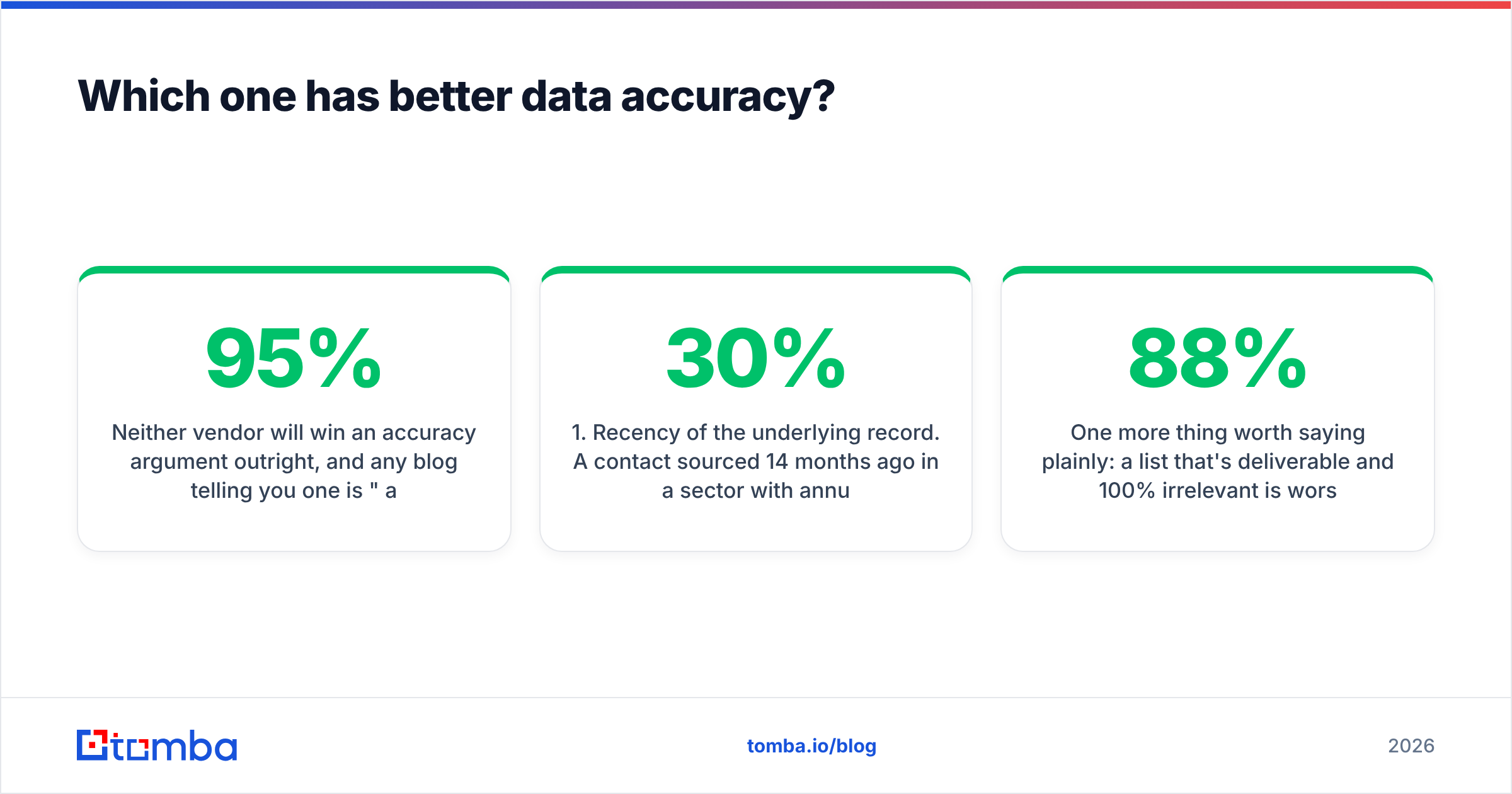
Neither vendor wins an accuracy argument outright. Any blog that calls one "95% accurate" across the board is quoting a marketing page, not a test.
What actually determines accuracy in a B2B dataset:
- Recency of the underlying record. A contact sourced 14 months ago is a coin flip in a sector with 30% annual churn. That holds no matter who sells it to you.
- Whether the email was pattern-guessed or observed. Guessed addresses on a
firstname.lastname@domain are usually fine. Guessed addresses on a domain with three competing formats are not. - How catch-all domains are handled. This is the single biggest source of inflated "verified" numbers. A catch-all server accepts everything, so naive verification marks every address valid. A serious provider flags these separately.
- Segment coverage. Both tools are stronger in US tech and SaaS than in, say, mid-market European manufacturing. Run your own sample on your ICP, not a generic one.
- Whether verification runs at export time or at list-build time. A record checked six months ago is not a verified record today.

The test that settles it takes 30 minutes. Pull 200 contacts from each tool inside your exact ICP. Run both lists through an independent verifier. Then compare valid counts, not total rows. In the side-by-side tests we have seen run this way, the gap between the two vendors on a narrow ICP is small. The gap between a vendor's marketing claim and its real output is much bigger.
One more point, said plainly. A list that is 88% deliverable and 100% irrelevant is worse than a smaller list that is 80% deliverable and precisely targeted. Bounce rate is a deliverability problem. Relevance is a revenue problem. Don't fix the first at the cost of the second.
How do the pricing models actually work?#
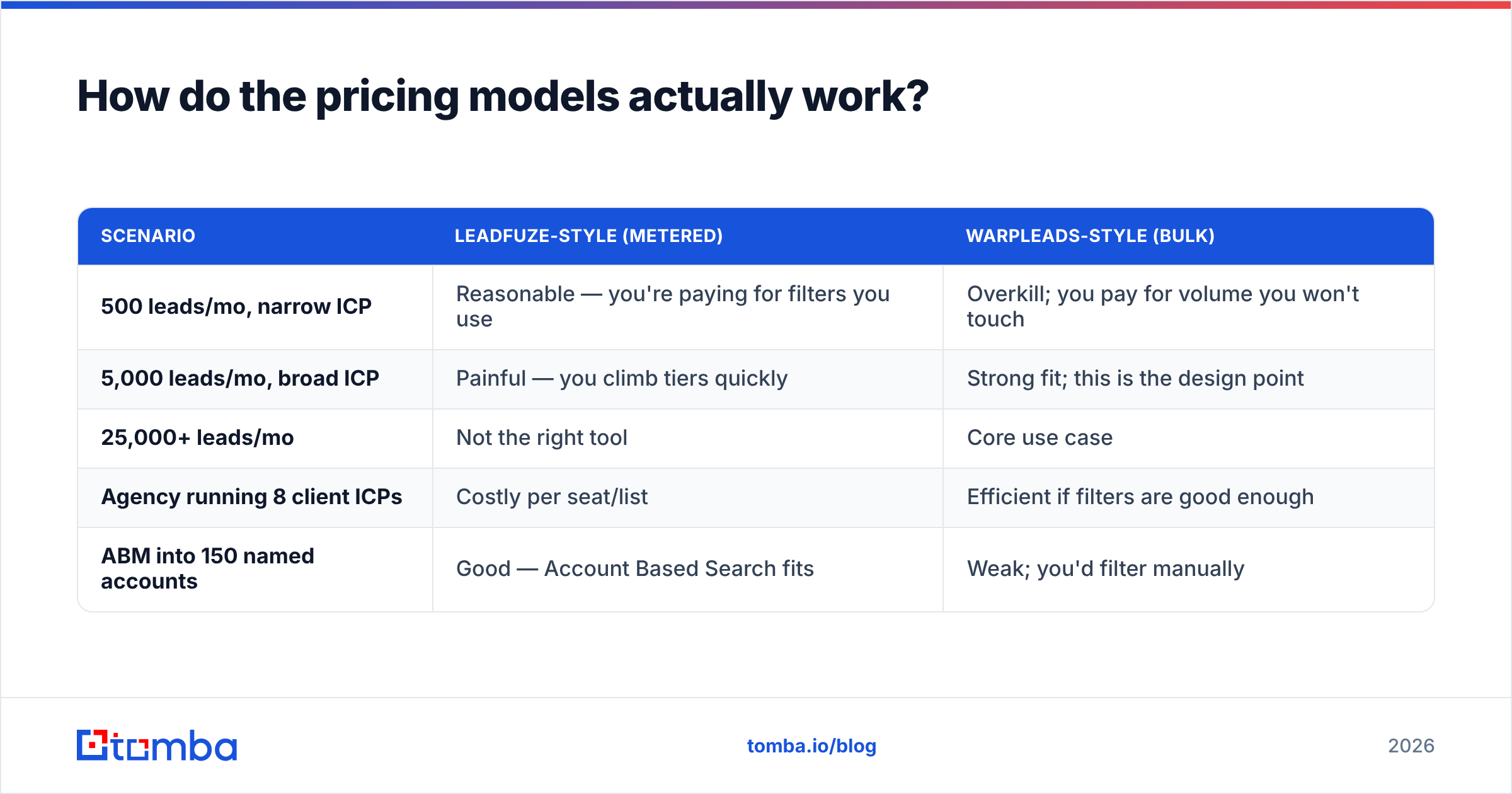
Most LeadFuze vs Warpleads comparisons hand-wave here. The two tools are not priced on the same unit, so a flat "$X vs $Y" misleads you. Model cost per usable contact instead.
| Scenario | LeadFuze-style (metered) | Warpleads-style (bulk) |
|---|---|---|
| 500 leads/mo, narrow ICP | Reasonable — you're paying for filters you use | Overkill; you pay for volume you won't touch |
| 5,000 leads/mo, broad ICP | Painful — you climb tiers quickly | Strong fit; this is the design point |
| 25,000+ leads/mo | Not the right tool | Core use case |
| Agency running 8 client ICPs | Costly per seat/list | Efficient if filters are good enough |
| ABM into 150 named accounts | Good — Account Based Search fits | Weak; you'd filter manually |
Then add the line item nobody quotes you: re-verification. Export 20,000 rows, find 18% of them dead or catch-all, and you either eat the bounces or pay to clean them. At typical verification prices that is small money. Skipping it costs you domain reputation, which is not small money. Budget for it explicitly. A bulk verify pass on every export belongs in your outbound cost model, not in the afterthought pile.

Who should choose LeadFuze?#
Pick LeadFuze if most of these are true:
- Your ICP is narrow and describable. "VP of Ops at 50–200 person logistics companies in the US using NetSuite" is exactly the query LeadFuze's filters were built for.
- List building is eating your reps' time. Fuzebot's scheduled list-building removes real recurring work. That is the feature you pay the premium for.
- You need dedupe you can trust. LeadFuze dedupes against past exports and CRM records. Most export-first tools do not. It prevents the "we emailed them three times" problem.
- You run ABM. Account Based Search — upload accounts, get the people — is a clean fit.
- Volume is modest. Under a few thousand contacts a month, metered pricing is defensible.
Skip it if you run high-volume outbound. The tier math turns against you fast. You end up rationing exports, which is the opposite of what you bought.
Who should choose Warpleads?#
Pick Warpleads if:
- Volume is the strategy. You send at scale across many domains and inboxes, and per-lead pricing is the bottleneck.
- You're an agency. Several client ICPs, each needing fresh lists monthly, is where bulk export economics beat curated pricing outright.
- You already own your filtering layer. If you enrich, score, and segment in your own stack or CRM anyway, you don't need to pay for someone else's filter depth.
- Your ICP is broad. "Marketing managers at SMBs in North America" doesn't need ten filters. It needs rows.
Skip it if you sell a high-ACV product into 300 named accounts. Buying 30,000 contacts to find 300 is not efficient. It is expensive noise plus a data hygiene problem.
What do both tools leave you to solve?#
Three gaps, and they are the same three either way.
Verification is your job, not theirs. Every database vendor verifies at some point in the pipeline. Almost none re-verify at the moment you export. The fix is boring and cheap. Run every list through an independent email verification pass right before import into your sequencer. Do it even when the vendor says the list is verified — especially then.
Catch-all domains need separate handling. Roughly a fifth of B2B domains in a typical list are catch-all. They are the reason "verified" lists still bounce. Don't discard them, and don't blindly send to them. Route them through a catch-all verifier that tests them properly, then send to the ones that clear. Treating catch-alls as binary valid/invalid is how good lists get blamed for bad domains.
Enrichment gaps show up at personalization time. Both tools give you name, title, company, email. Neither reliably gives you the hook that makes a cold email land. If your sequences lean on job-change signals, tech stack shifts, or recent hiring, plan a second data enrichment step. Otherwise your personalization ceiling is "I saw you're the VP of Sales at Acme."
Are there better alternatives in 2026?#
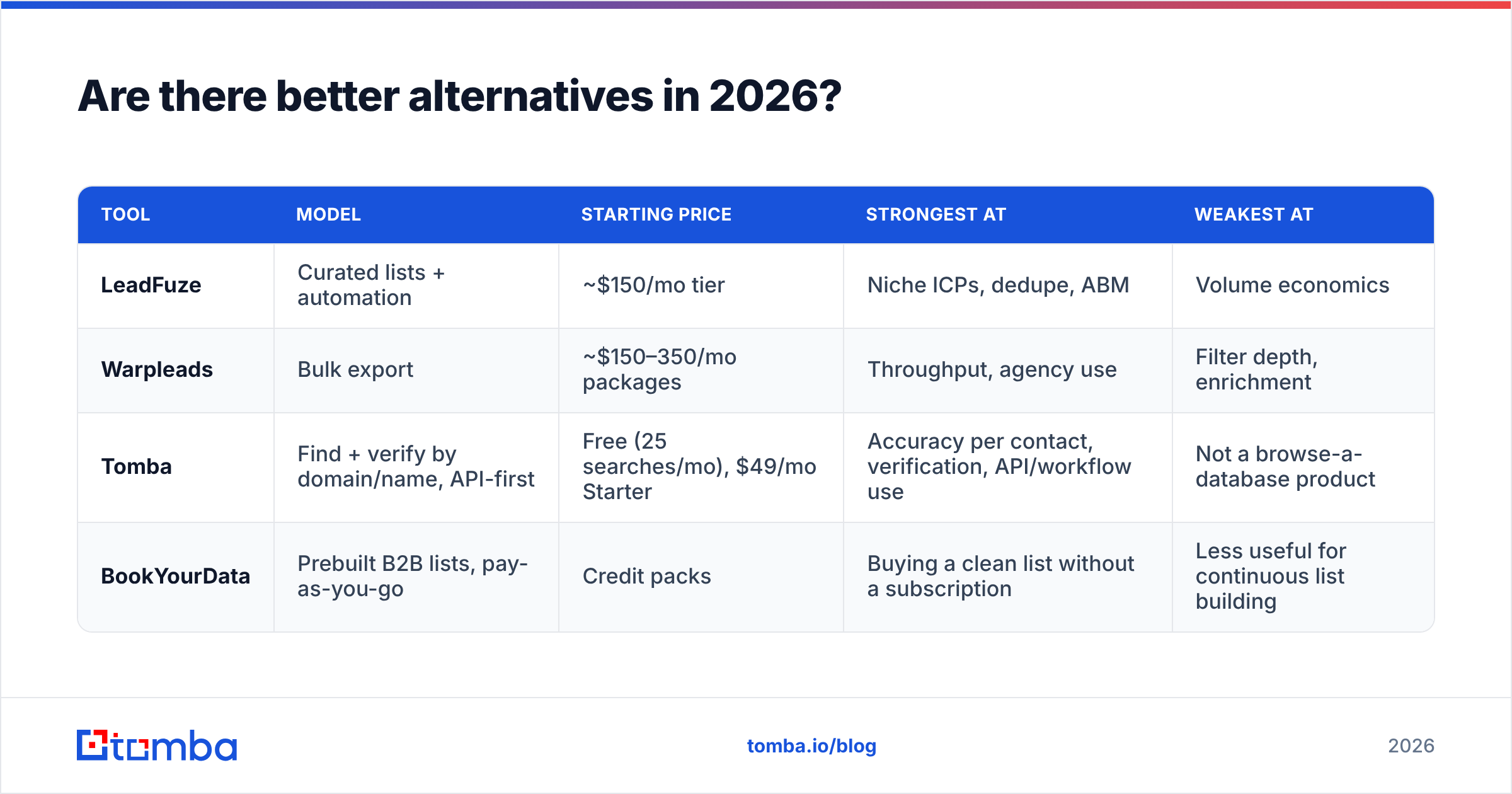
Depends what you're optimizing for. Here's how the wider field sits:
| Tool | Model | Starting price | Strongest at | Weakest at |
|---|---|---|---|---|
| LeadFuze | Curated lists + automation | ~$150/mo tier | Niche ICPs, dedupe, ABM | Volume economics |
| Warpleads | Bulk export | ~$150–350/mo packages | Throughput, agency use | Filter depth, enrichment |
| Tomba | Find + verify by domain/name, API-first | Free (25 searches/mo), $49/mo Starter | Accuracy per contact, verification, API/workflow use | Not a browse-a-database product |
| BookYourData | Prebuilt B2B lists, pay-as-you-go | Credit packs | Buying a clean list without a subscription | Less useful for continuous list building |

Tomba plays a different position than either LeadFuze or Warpleads. It is worth being clear about that rather than pretending it is a drop-in replacement. Tomba is strongest when you already know who or where. You have a company domain, a name, a LinkedIn profile, or a list of accounts, and you need the correct verified address plus the confidence score behind it.
Domain search returns everyone findable at a company, along with the detected email pattern. The Tomba API does the same job inside your own pipeline at whatever scale you need. Pricing runs free (25 searches/mo), then $49/mo Starter, $99/mo Growth, $249/mo Pro, with Enterprise custom. See Tomba pricing for current limits.
BookYourData is a good option if you want to buy one clean, targeted list without signing up for another monthly seat. Pay-as-you-go credits, no subscription pressure. For teams that buy lists quarterly rather than continuously, that model is often the honest answer.
For independent signal on any of these, G2 category reviews beat vendor pages. Reviewers complain about the things vendors omit: refresh cadence, support responsiveness, and how the data holds up outside the US.
So which one wins?#
Neither wins universally. The LeadFuze vs Warpleads tiebreaker is your volume.
Under ~2,000 contacts a month with a tightly defined ICP, LeadFuze earns its price. You get filter depth, automation, and dedupe. You are buying back hours, and hours are expensive.
Above ~10,000 contacts a month, Warpleads' economics win, and it isn't close. Paying metered per-lead rates at that scale is a self-inflicted wound.
Between those numbers, run the 200-row test on both. Verify independently, and let the usable contact count decide. That is a half-day of work. It saves you a twelve-month contract on the wrong tool.
And whichever you pick: put a verification step between the export and the send. The tools that sell you data are not the tools that protect your domain. Those are separate jobs. Treating them as one is the most common and most expensive mistake in outbound.
Ready to fix the accuracy half of the problem? Start with the Tomba Email Finder. It finds and verifies professional email addresses by domain, name, or company, with a confidence score on every result. The free tier includes 25 searches a month. That is more than enough to run the side-by-side test above before you commit budget to either LeadFuze or Warpleads.
Related guides#
Ready to find emails that actually work?
Join 150,000+ professionals who stopped guessing and started sending. Free credits on signup — no credit card required.
Get the Tomba newsletter
Practical outbound tactics and product updates — once every two weeks.
About the author