LeadGenius vs OutboundView: Which B2B Lead Engine Wins?
One sells custom-researched data, the other sells booked meetings. Here's an honest breakdown of LeadGenius vs OutboundView — pricing models, contract risk, and who each one actually fits.
TL;DR
- They are not the same category. LeadGenius sells custom-researched B2B data. OutboundView sells outsourced SDR execution — humans who send the emails and book the meetings. Comparing them is comparing a fuel supplier to a driver.
- LeadGenius fits enterprise teams who need data points no database has (headcount by location, SKU-level signals, non-US coverage) and can absorb a five-figure annual contract.
- OutboundView fits SMB and lower mid-market teams who have a working offer but no SDR headcount, and want meetings on the calendar in 60–90 days.
- Neither publishes pricing. Both are quote-only, and both typically want 6–12 month commitments. Budget expectations below are ranges reported by buyers, not official rate cards.
- Most teams under $10M ARR should not buy either one yet. A $49–$99/mo data stack plus one in-house rep usually beats both on cost per meeting — and you keep the list.
What are LeadGenius and OutboundView, exactly?#
Start here, because the naming confuses people.
LeadGenius is a managed data company founded out of UC Berkeley research in 2011. Its model is human-in-the-loop: a distributed research workforce, supported by machine learning, builds custom datasets to your spec. You don't browse a database and export contacts. You describe the account and contact attributes you need — "every Shopify Plus merchant in DACH with a Head of Logistics and 50+ retail locations" — and LeadGenius goes and builds that list, then refreshes it on a cadence. Output lands in your CRM, warehouse, or a Chrome extension called Flow.
OutboundView is an outbound agency based in Indianapolis. It's a services business: appointment setting, outsourced SDR teams, email-only outbound programs, and inside-sales consulting. You hand them an ICP and an offer; they build sequences, run the sending infrastructure, handle replies, and put qualified meetings on your AEs' calendars. They also do "we'll audit your existing outbound and tell you why it's broken" engagements.
So the real question behind LeadGenius vs OutboundView is usually: do I have a data problem or an execution problem? Teams that can't find the right accounts have a data problem. Teams that have a good list sitting untouched in a CSV have an execution problem. Buying the wrong one wastes a year.

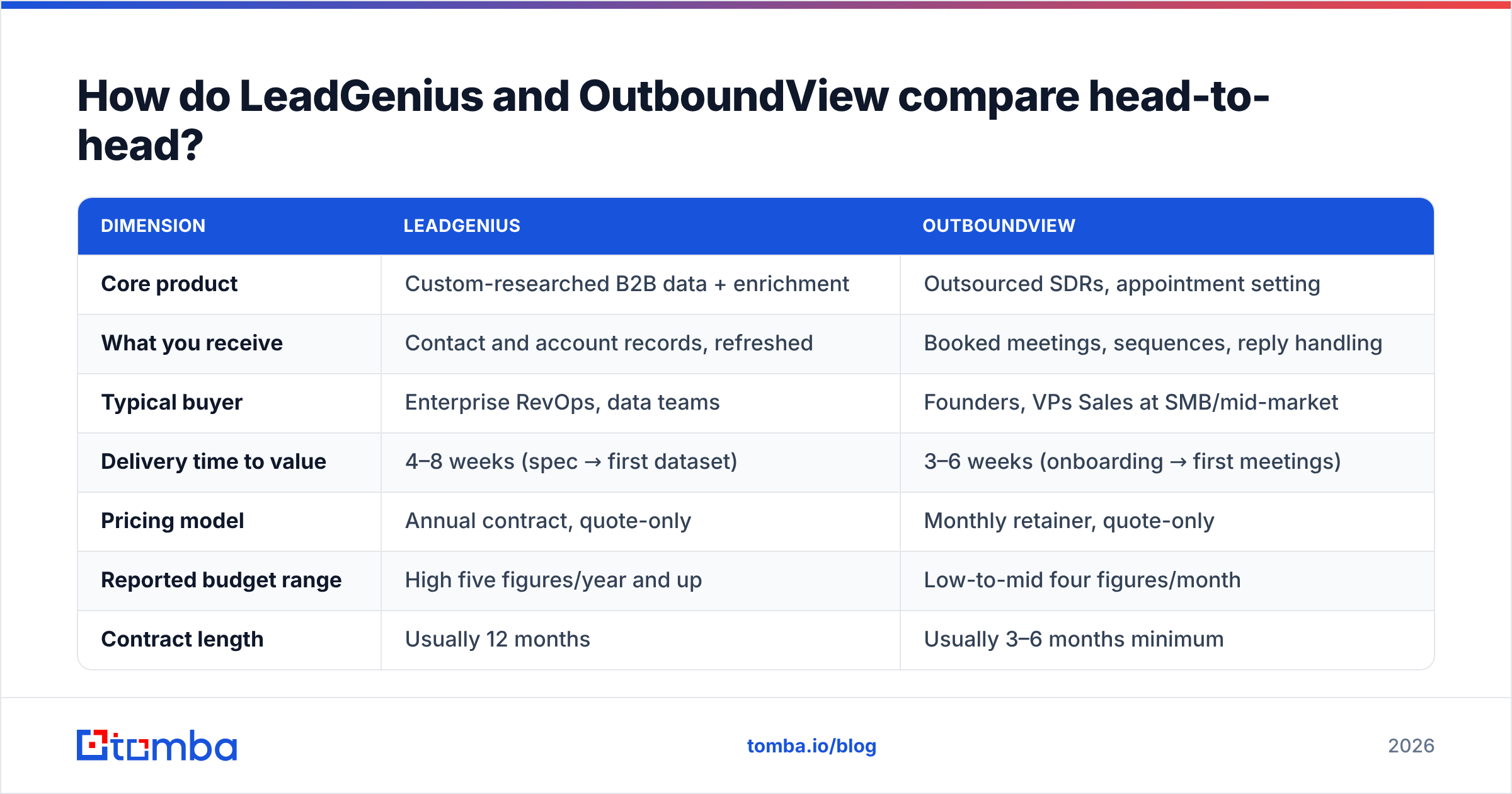
How do LeadGenius and OutboundView compare head-to-head?#
| Dimension | LeadGenius | OutboundView |
|---|---|---|
| Core product | Custom-researched B2B data + enrichment | Outsourced SDRs, appointment setting |
| What you receive | Contact and account records, refreshed | Booked meetings, sequences, reply handling |
| Typical buyer | Enterprise RevOps, data teams | Founders, VPs Sales at SMB/mid-market |
| Delivery time to value | 4–8 weeks (spec → first dataset) | 3–6 weeks (onboarding → first meetings) |
| Pricing model | Annual contract, quote-only | Monthly retainer, quote-only |
| Reported budget range | High five figures/year and up | Low-to-mid four figures/month |
| Contract length | Usually 12 months | Usually 3–6 months minimum |
| Self-serve option | No | No |
| Free trial | No | No |
| Who owns the data afterwards | You (delivered to your systems) | You, but tied to their sending stack |
| Geographic strength | Global, strong non-English research | Primarily North America |
| Best failure mode to avoid | Paying for research you could buy off-the-shelf | Paying for volume against a weak offer |
The table makes the split obvious. LeadGenius is an input. OutboundView is an output. A large organization might genuinely buy both — LeadGenius builds the account universe, an agency or in-house SDR pod works it. Most companies asking this question are trying to pick one because they only have budget for one.
What does LeadGenius actually do well?#
1. Data that doesn't exist in any database. This is the whole pitch, and it's legitimate. If your ICP is defined by something structured databases don't track — number of loading docks, presence of a specific compliance certification, whether a retailer stocks a competitor's product — no amount of filtering in a standard tool gets you there. Human researchers can.
2. Non-US and non-English coverage. Most B2B databases degrade badly outside North America and Western Europe. Managed research doesn't have that ceiling in the same way, because a person can read the local company registry.
3. Signal monitoring at account level. Recurring refreshes mean you can watch a defined account set for changes — new locations, leadership changes, tech adoption — rather than re-buying a stale snapshot every quarter.
4. Delivery into your systems. Records flow into Salesforce, HubSpot, or a warehouse rather than living in a vendor UI you have to log into. For a RevOps team, that matters more than feature checklists.
The honest limitation: you pay per research hour, in effect. If 90% of the contacts you need are already sitting in commodity databases, you are paying a premium for the 10%. Several buyer reviews on G2 make exactly this point — great for hard lists, over-engineered for easy ones.
What does OutboundView actually do well?#
1. They run the machine, not just advise on it. Plenty of "outbound consultants" deliver a deck. OutboundView's core offerings put someone in the seat doing the sending and the follow-up. For a founder-led sales team with no bandwidth, that's the difference between a program that exists and one that doesn't.
2. Domain and infrastructure setup is handled. Secondary domains, warmup, sending limits, inbox rotation — the unglamorous plumbing that sinks most first-time outbound programs. An agency that does this weekly will get it right faster than your first hire will.
3. Shorter commitment than a headcount. A full-time SDR in the US costs roughly $70–95K base plus tooling, ramp, and management time. A 3–6 month agency engagement is a cheaper way to test whether outbound works for your offer at all.
4. Consulting on the existing motion. If you already have two SDRs producing nothing, an audit engagement is a reasonable, bounded spend.
The honest limitation: agencies amplify your offer, they don't fix it. If your message doesn't land, a professional sender just burns through your addressable market faster and more politely. Ask any agency for the reply-rate floor they'll commit to and the process when month two underperforms — the answer tells you a lot.
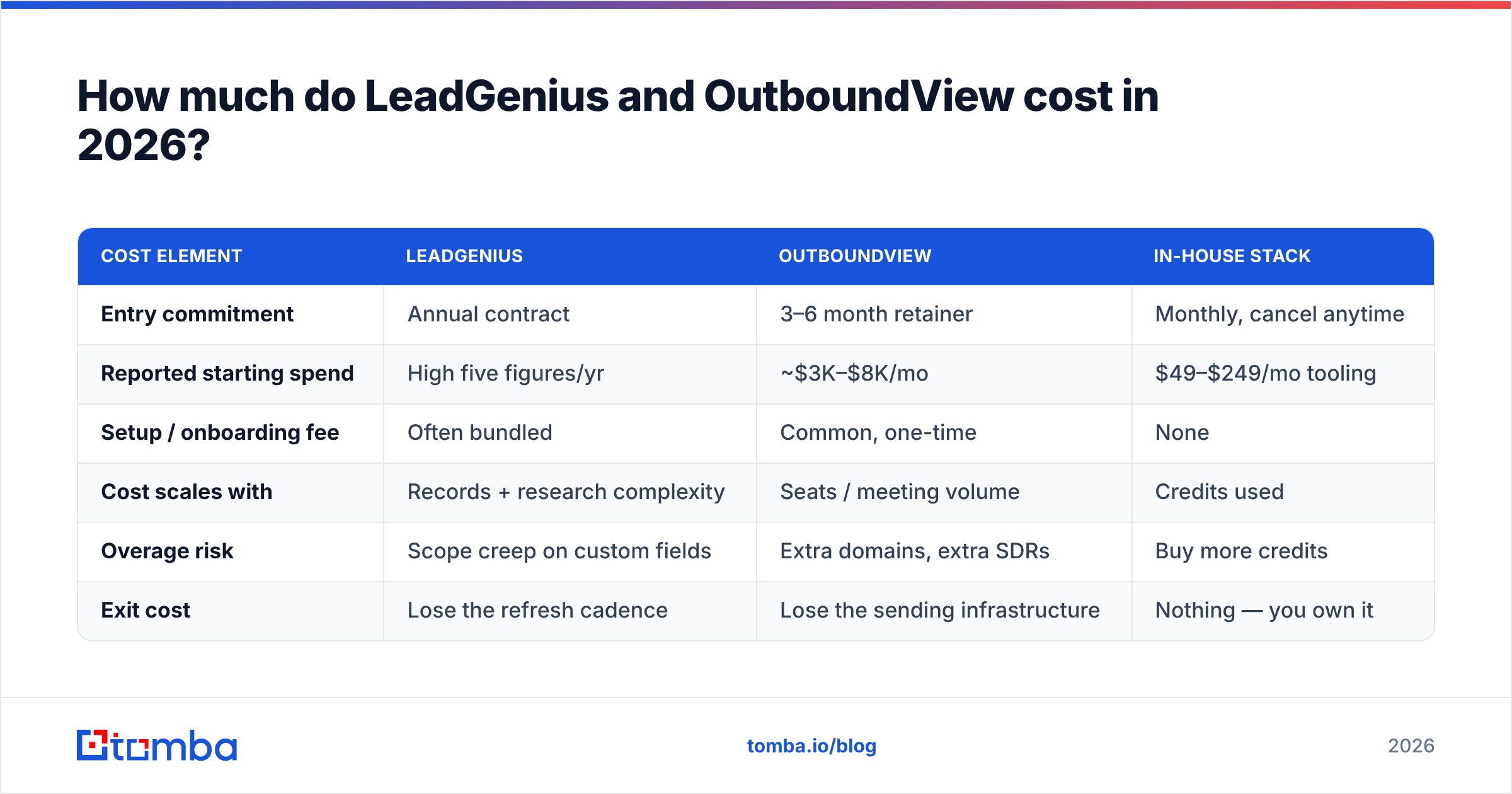
How much do LeadGenius and OutboundView cost in 2026?#
Neither vendor publishes rates, so treat everything below as directional. Both will quote based on scope, and both will quote higher if you sound like an enterprise.
| Cost element | LeadGenius | OutboundView | In-house stack |
|---|---|---|---|
| Entry commitment | Annual contract | 3–6 month retainer | Monthly, cancel anytime |
| Reported starting spend | High five figures/yr | ~$3K–$8K/mo | $49–$249/mo tooling |
| Setup / onboarding fee | Often bundled | Common, one-time | None |
| Cost scales with | Records + research complexity | Seats / meeting volume | Credits used |
| Overage risk | Scope creep on custom fields | Extra domains, extra SDRs | Buy more credits |
| Exit cost | Lose the refresh cadence | Lose the sending infrastructure | Nothing — you own it |
The line that matters most is the last one. When an agency engagement ends, the sequences, the warmed domains, and often the institutional knowledge leave with them. When a managed-data contract ends, your enrichment goes stale. When you run the stack yourself, everything stays.
Which one should you choose?#
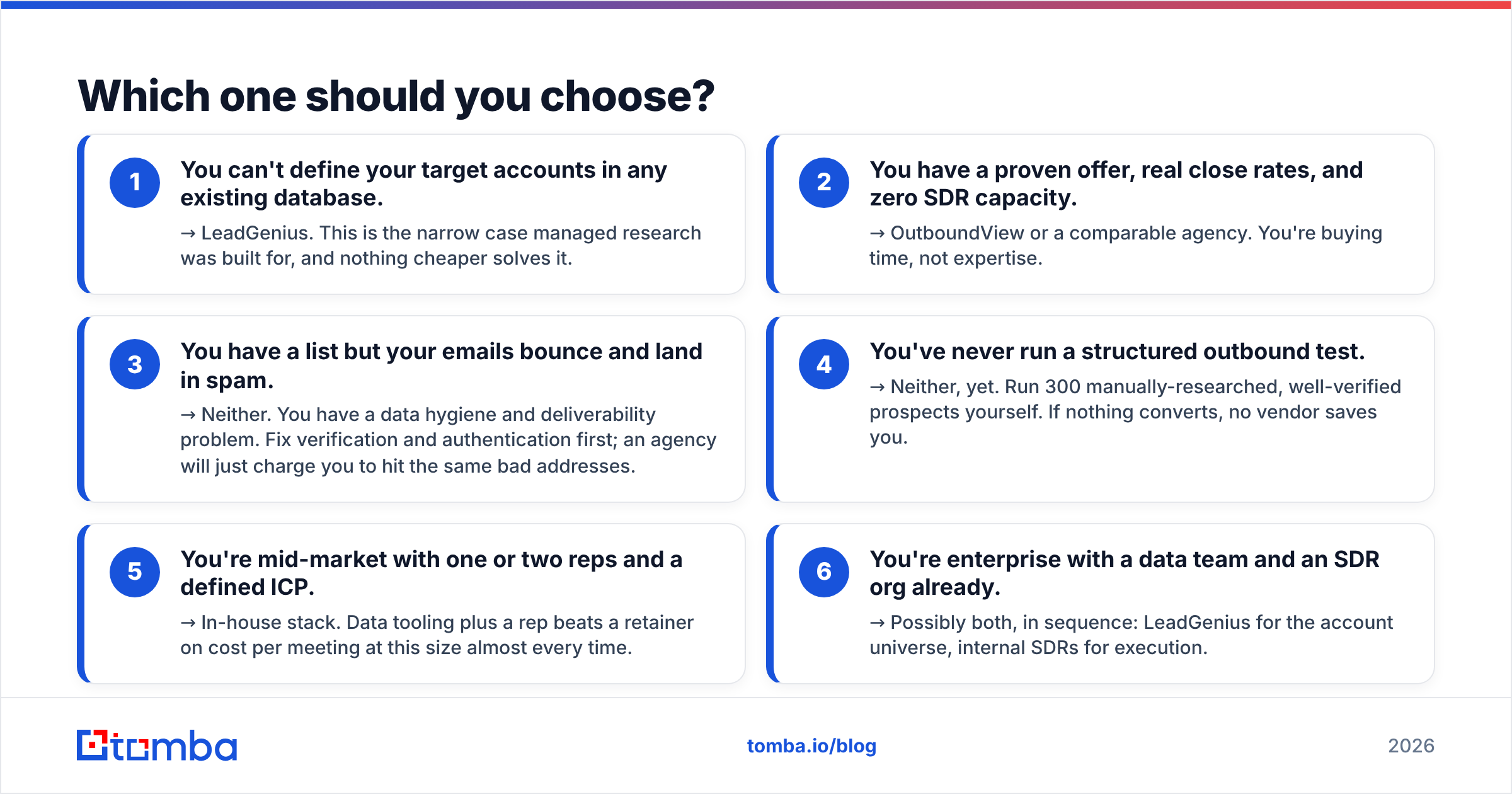
Work through these in order. Stop at the first one that describes you.
- You can't define your target accounts in any existing database. → LeadGenius. This is the narrow case managed research was built for, and nothing cheaper solves it.
- You have a proven offer, real close rates, and zero SDR capacity. → OutboundView or a comparable agency. You're buying time, not expertise.
- You have a list but your emails bounce and land in spam. → Neither. You have a data hygiene and deliverability problem. Fix verification and authentication first; an agency will just charge you to hit the same bad addresses.
- You've never run a structured outbound test. → Neither, yet. Run 300 manually-researched, well-verified prospects yourself. If nothing converts, no vendor saves you.
- You're mid-market with one or two reps and a defined ICP. → In-house stack. Data tooling plus a rep beats a retainer on cost per meeting at this size almost every time.
- You're enterprise with a data team and an SDR org already. → Possibly both, in sequence: LeadGenius for the account universe, internal SDRs for execution.
Can you build the same outcome in-house for less?#
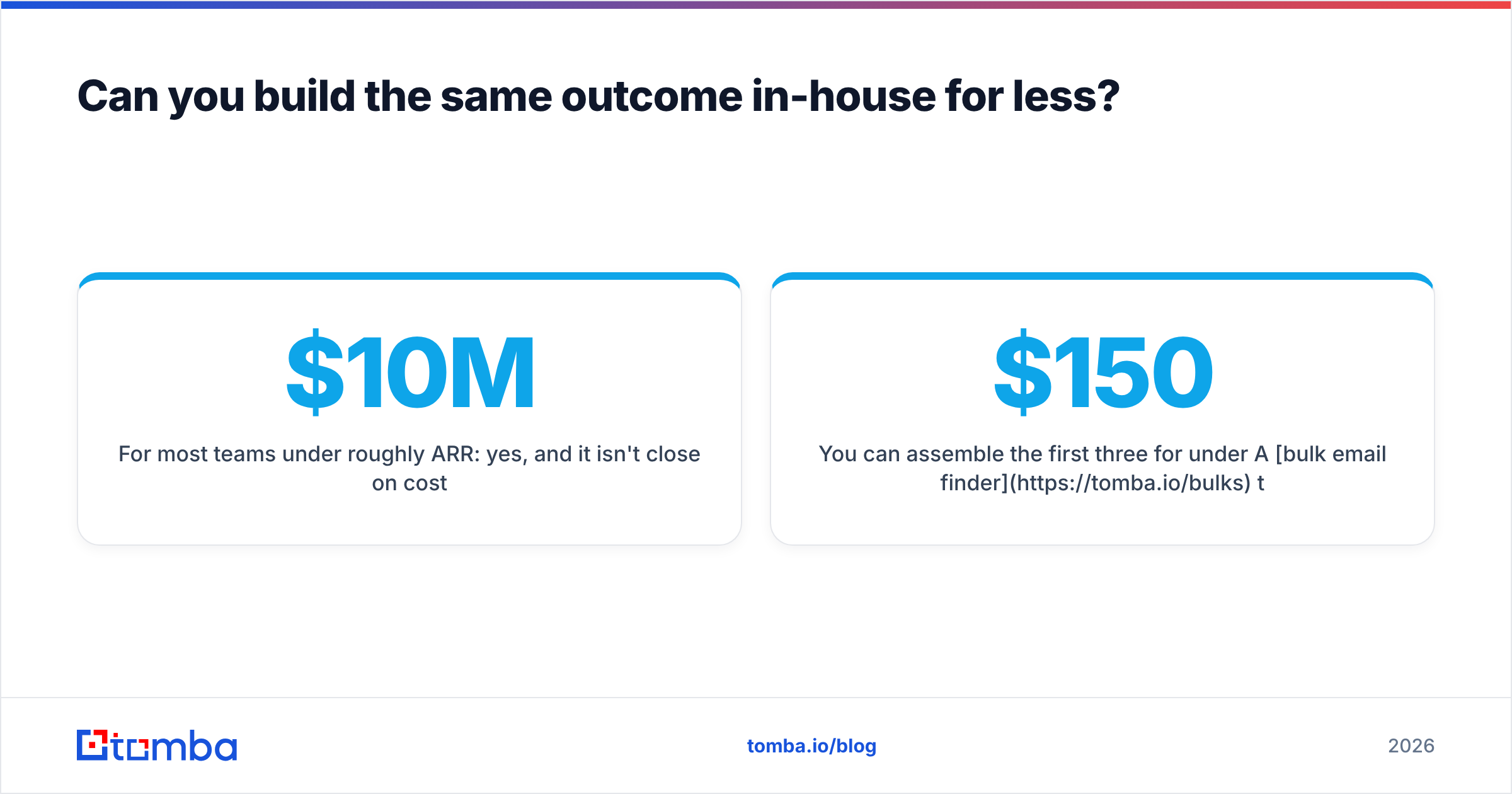
For most teams under roughly $10M ARR: yes, and it isn't close on cost.
An outbound program needs four things. Managed vendors bundle all four and charge for the bundle.
- Account list — firmographic filters, funding signals, tech stack. Commodity for standard ICPs.
- Contact data — names, titles, verified work emails, sometimes direct dials. Also commodity, if you verify properly.
- Sending infrastructure — domains, warmup, authentication, throttling. One-time setup, then maintenance.
- Human execution — writing, sending, following up, qualifying. The part you can't fully outsource without losing the feedback loop.
You can assemble the first three for under $150/month. A bulk email finder turns a company list into verified contacts at scale. An email verifier keeps bounce rates under 2% so your domain reputation survives the first month. Data enrichment fills in the firmographics your CRM is missing. Tomba pricing starts at a free tier with 25 searches a month, then $49/mo for Starter, $99/mo Growth, and $249/mo Pro — which is roughly what an agency bills in a single afternoon.
The fourth item — human execution — is the one you should own. Your first 200 outbound conversations contain the positioning insight that determines the next two years of your GTM. Outsourcing that before you've learned it is the expensive mistake, and it's the reason so many agency engagements look fine in month two and get cancelled in month five.
What should you ask before signing with either vendor?#
Bring these to the call. The answers separate serious providers from polished ones.
- What's the refresh cadence and the accuracy SLA? For LeadGenius, ask what percentage of delivered emails they guarantee deliverable, and what happens when a batch misses it.
- Who writes the copy, and do I approve it? For OutboundView, ask to see the actual sequences before launch, and confirm who owns reply handling.
- Which domains send? Never let an agency send from your primary domain. Confirm secondary domains, and confirm you keep them at the end of the contract.
- What's the ramp assumption? Ask for the month-by-month meeting forecast in writing. Vague forecasts are a choice.
- What's the exit? Notice period, data export format, and whether sequences and warmed domains transfer to you.
- Can I see three references in my segment? Not their best logo — their most similar customer by size and market.
Any vendor that answers all six cleanly is worth a pilot. Any vendor that deflects on two of them is selling you optimism.
The bottom line on LeadGenius vs OutboundView#
LeadGenius wins when your problem is genuinely unsolvable with off-the-shelf data — obscure attributes, hard geographies, account-level monitoring at enterprise scale. OutboundView wins when your offer is proven and your bottleneck is purely human capacity to send and follow up.
Both lose to a lean in-house setup when the real issue is that nobody on your team has run a disciplined outbound test yet. That's the most common situation, and no retainer fixes it.
If you're in that third group, start by building one clean, verified list of 300 accounts that match your best existing customers. The Tomba Email Finder gets you verified work emails by name and domain, with a free tier to test before you spend anything — so you can find out whether outbound works for you before you commit to a twelve-month contract to find out for you.
Related guides#
// get started
Find, verify and enrich your first contacts today
Start on the free plan with 25 searches a month, then scale when your team is ready.
Free plan · No credit card required · GDPR & CCPA
// about the author