LeadGenius vs Salesbot: Which B2B Lead Engine Wins in 2026?
One sells you researched humans-in-the-loop data. The other sells you an always-on AI conversation layer. They solve different halves of the same pipeline problem — and only one of them is worth your first $1,000.
TL;DR#
- LeadGenius and Salesbot are not competitors in the strict sense. LeadGenius is a managed, human-in-the-loop B2B data provider. "Salesbot" refers to the AI sales-bot category — conversational agents that qualify, route and reply — with Kommo's Salesbot as the best-known named implementation. One fills your list; the other works it.
- LeadGenius wins when your ICP is weird. Niche firmographics, hard-to-scrape signals, non-US markets, custom research fields no database ships out of the box.
- Salesbot-style tools win when you already have traffic or a list and your bottleneck is response time, qualification and routing — not sourcing.
- Both carry the same tax: opacity. Neither publishes transparent self-serve pricing at the level most teams need, and both require you to trust a black box you can't audit line by line.
- The cheapest honest answer for most teams under 20 reps is a self-serve data layer (verified emails on demand, API access, flat pricing) plus whatever sequencer you already pay for — often a fraction of either contract.
What is LeadGenius, exactly?#
LeadGenius is a managed B2B data company. You describe your ideal customer profile in painful detail — industry, headcount band, tech stack, whether they run a second warehouse in EMEA, whether the VP of Ops posted about a reorg last quarter — and LeadGenius combines automated collection with a distributed human research team to build and maintain that dataset for you. You can see how they position it on their own site.
The pitch is custom data at scale. Not "here are 200 million contacts, go filter." More like "here are the 4,000 accounts that match your seventeen-criteria definition, with the four custom fields you asked for, refreshed quarterly."
That's genuinely valuable when your motion depends on a signal no off-the-shelf database tracks. It's genuinely overkill when you need firstname.lastname@company.com for 500 marketing directors at Series B SaaS companies.
Key characteristics:
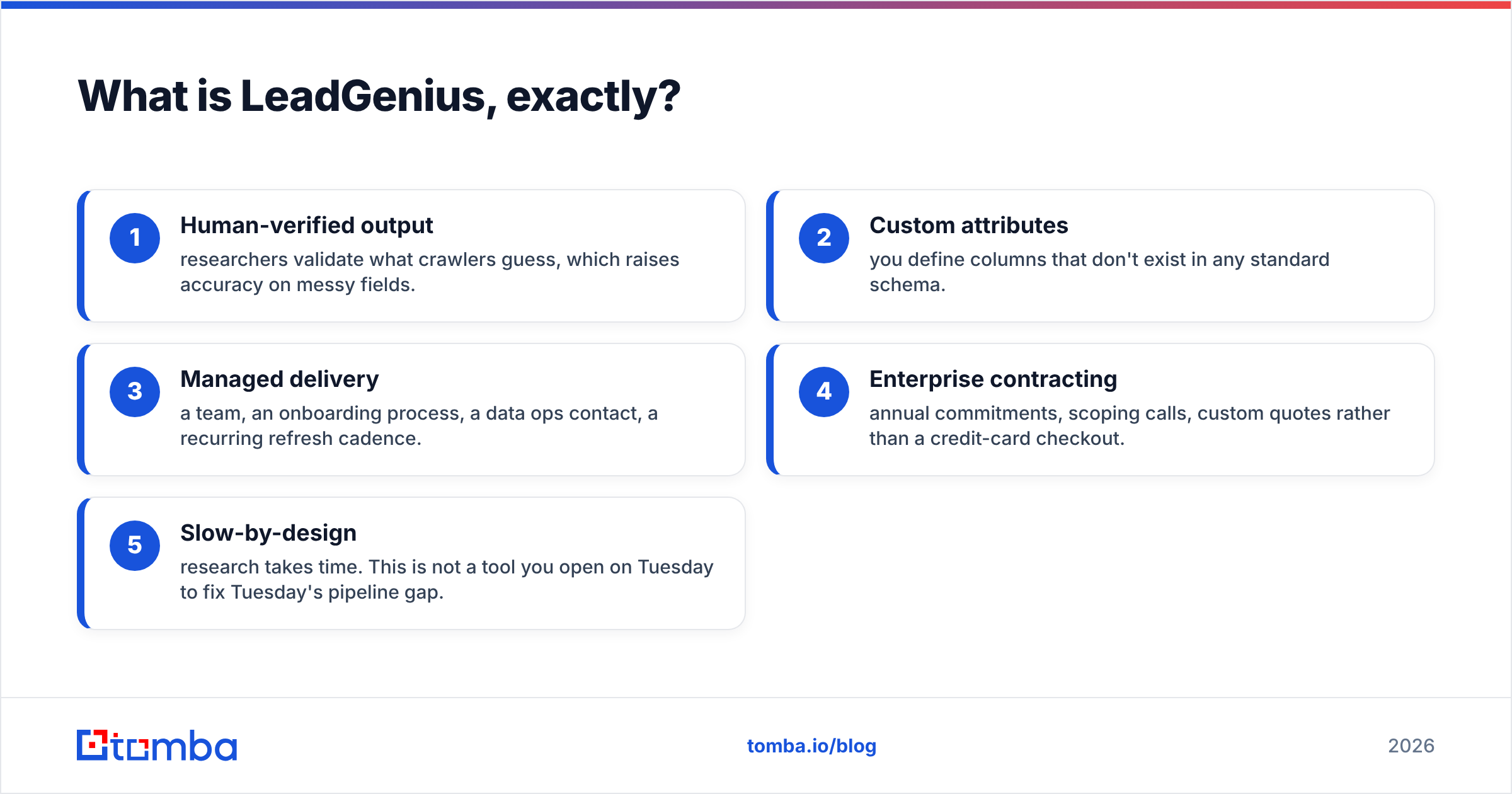
- Human-verified output — researchers validate what crawlers guess, which raises accuracy on messy fields.
- Custom attributes — you define columns that don't exist in any standard schema.
- Managed delivery — a team, an onboarding process, a data ops contact, a recurring refresh cadence.
- Enterprise contracting — annual commitments, scoping calls, custom quotes rather than a credit-card checkout.
- Slow-by-design — research takes time. This is not a tool you open on Tuesday to fix Tuesday's pipeline gap.
What is Salesbot, exactly?#
"Salesbot" is where the comparison gets slippery, so let's be precise. There is no single dominant vendor that owns the name. The most widely used product carrying it is the Salesbot inside Kommo (the CRM formerly known as amoCRM), a visual bot builder that handles inbound chat, qualification questions, lead routing and follow-up triggers across messaging channels. Several smaller vendors and a long tail of "AI SDR" products use the same label generically.
For this comparison, treat Salesbot as the category: an AI conversation layer that sits on top of inbound and existing contacts and automates the first-touch, qualification and routing work a junior SDR would do.
Characteristics:
- Always-on response — sub-minute replies to inbound, which matters more than most teams admit.
- Channel-native — built for WhatsApp, web chat, Instagram DMs, email, depending on the implementation.
- Rules plus LLM — modern versions blend deterministic branching with generative replies.
- Cheap to start — typically bundled into a CRM seat or sold as a low monthly add-on.
- Zero sourcing capability — a bot cannot conjure contacts. It needs a list or a traffic source.
That last point is the whole comparison in one line. LeadGenius creates supply. Salesbot processes demand.
How do LeadGenius and Salesbot compare head-to-head?#
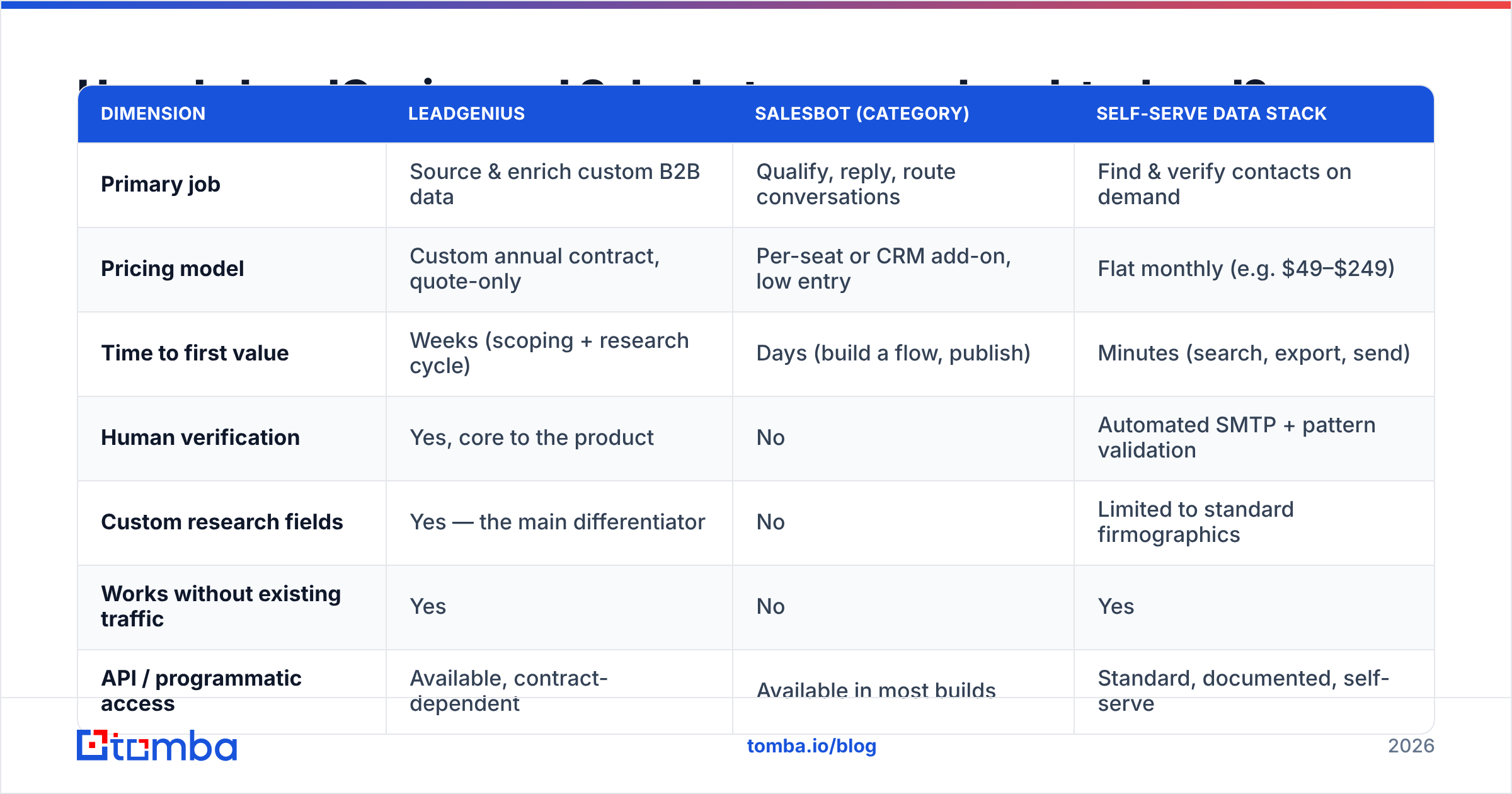
| Dimension | LeadGenius | Salesbot (category) | Self-serve data stack |
|---|---|---|---|
| Primary job | Source & enrich custom B2B data | Qualify, reply, route conversations | Find & verify contacts on demand |
| Pricing model | Custom annual contract, quote-only | Per-seat or CRM add-on, low entry | Flat monthly (e.g. $49–$249) |
| Time to first value | Weeks (scoping + research cycle) | Days (build a flow, publish) | Minutes (search, export, send) |
| Human verification | Yes, core to the product | No | Automated SMTP + pattern validation |
| Custom research fields | Yes — the main differentiator | No | Limited to standard firmographics |
| Works without existing traffic | Yes | No | Yes |
| API / programmatic access | Available, contract-dependent | Available in most builds | Standard, documented, self-serve |
| Best team size | 50+ reps, defined ICP, budget | Any size with inbound volume | 1–50 reps, outbound-led |
| Biggest risk | Long contract, slow iteration | Bot handles a hot lead badly | You still own list-building |
The table makes the trap obvious: teams often evaluate these two against each other, pick one, and discover six weeks later they needed the other half. You bought researched accounts and have no one to work them fast enough. Or you bought a conversation engine and have nothing flowing into it.
Which one gives you better data accuracy?#
Different question than it looks, because they're measuring different things.
LeadGenius measures research accuracy. Did a human confirm this company runs SAP? Did someone verify the plant manager's name and title? On custom, non-public attributes, human-in-the-loop beats automated inference — that's not marketing, it's just what happens when you put a person on a field a crawler can only guess at. The cost is throughput and price per record.
Salesbot-style tools measure conversation accuracy. Did the bot correctly classify intent? Did it route the enterprise lead to the enterprise rep instead of the self-serve queue? Did it avoid hallucinating a discount? Vendor-reported qualification accuracy in this category is generally strong on narrow, scripted flows and degrades fast on open-ended ones.
Neither measures deliverability, and that's the gap that bites. A researched contact record with a stale mailbox still bounces. A bot that books a meeting into a typo'd address still loses the deal. Whatever you buy, you need an independent email verifier in the loop before send — bounce rate is a sender-reputation problem, not a data-vendor problem, and no provider's internal QA substitutes for a fresh SMTP check at send time.
Practical accuracy checklist, in order of impact:
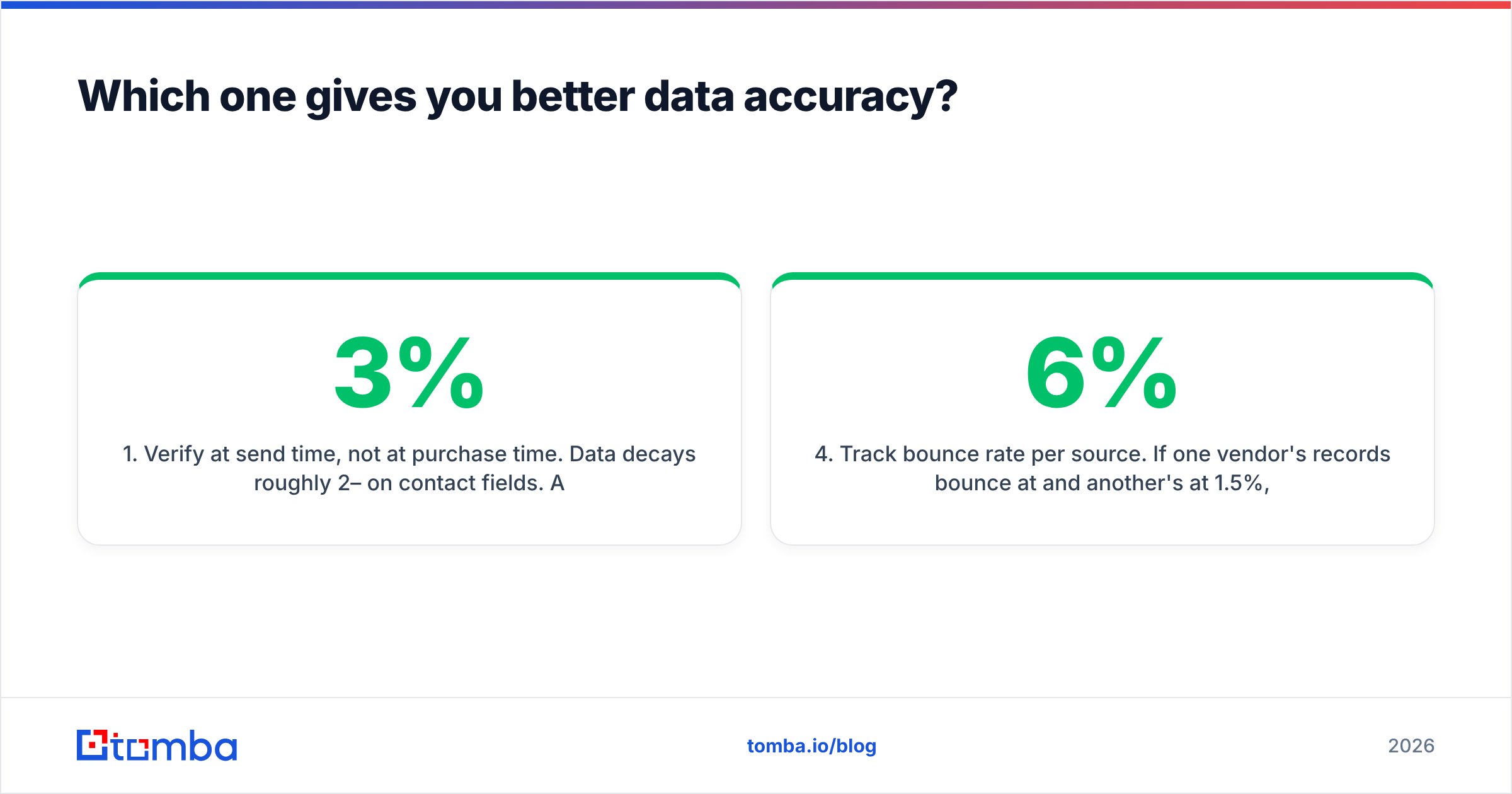
- Verify at send time, not at purchase time. Data decays roughly 2–3% per month on contact fields. A list validated in March is a different list in September.
- Check the catch-all share of your list. Catch-all domains accept everything and tell you nothing. Run a dedicated catch-all verifier rather than assuming "accepted" means "delivered."
- Sample before you scale. Take 200 records from any vendor, verify independently, measure the real hit rate. Do this before signing, not after.
- Track bounce rate per source. If one vendor's records bounce at 6% and another's at 1.5%, that's your renewal decision made for you.
- Separate "found" from "reachable." A record can be accurate and unreachable. Those are two different KPIs and conflating them hides the problem.
What does each one actually cost in 2026?#
Honest answer: LeadGenius does not publish public pricing, and neither do most enterprise data vendors. Expect a scoping call, a custom quote, and an annual commitment. Buyer reviews on G2 consistently describe it as a premium, enterprise-tier spend rather than a departmental tool. If a vendor won't show you a price page, budget for a procurement cycle.
Salesbot-class products sit at the other end. When bundled into a CRM, the incremental cost is often a modest per-seat uplift or a flat add-on. Standalone AI SDR products vary wildly — some charge per conversation, some per seat, some per booked meeting.
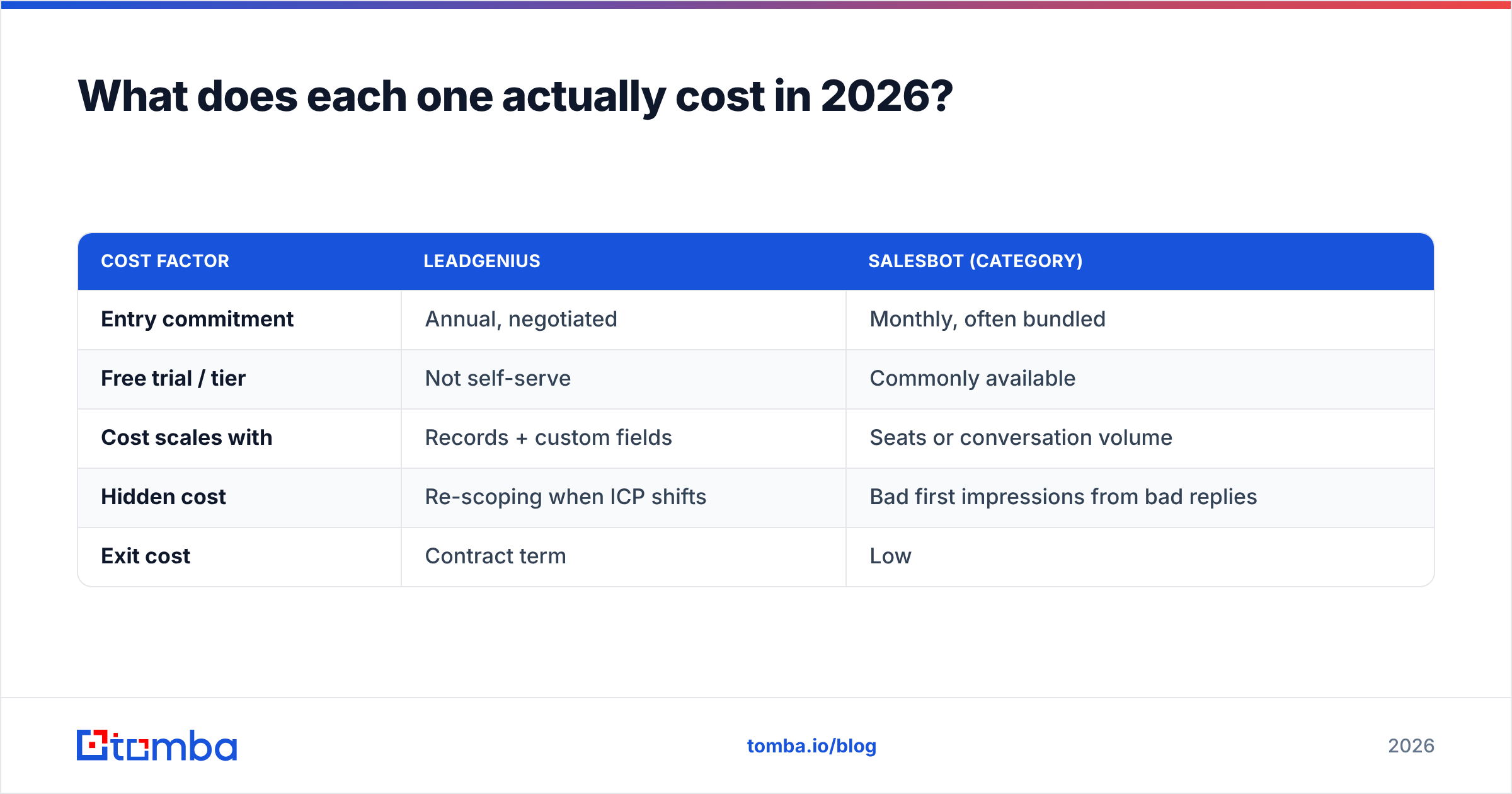
The pricing asymmetry matters more than the feature comparison for most buyers:
| Cost factor | LeadGenius | Salesbot (category) |
|---|---|---|
| Entry commitment | Annual, negotiated | Monthly, often bundled |
| Free trial / tier | Not self-serve | Commonly available |
| Cost scales with | Records + custom fields | Seats or conversation volume |
| Hidden cost | Re-scoping when ICP shifts | Bad first impressions from bad replies |
| Exit cost | Contract term | Low |
Compare either to transparent Tomba pricing — a free tier at 25 searches per month, Starter at $49/mo, Growth at $99/mo, Pro at $249/mo — and the structural difference is clear. One model asks you to commit before you know the ROI. The other lets you prove the ROI first.
That's not an argument that LeadGenius is overpriced. For a 200-rep org chasing a genuinely custom ICP, a six-figure data contract can pay for itself in one closed enterprise deal. It is an argument that most teams evaluating "LeadGenius vs Salesbot" are too small for either to be the right first purchase.
Is Salesbot better than LeadGenius for small teams?#
For teams under roughly 15 reps: usually yes, but with a caveat that swallows the answer.
Salesbot-style automation is better if you have inbound volume. If 300 people a month hit your site, start a chat, or fill a form, a bot that replies in 40 seconds instead of 4 hours will measurably lift your response rate and meeting count. The Harvard Business Review lead-response research that established the five-minute rule hasn't been meaningfully contradicted in fifteen years — speed compounds.
If you don't have inbound volume, a bot is a very sophisticated answering machine in an empty room. You don't have a qualification problem. You have a supply problem, and supply is exactly what LeadGenius sells and exactly what most small teams can't afford from LeadGenius.
Which leaves the third door most comparison posts skip.
Do you actually need either one?#
Map your bottleneck before you map vendors.
- "I don't know who to contact." → Data problem. LeadGenius solves it expensively and custom; a self-serve email finder solves it cheaply for standard ICPs.
- "I know who to contact but can't reach them." → Deliverability and verification problem. Neither vendor fixes this. Verification and warmup do.
- "People reply and we're slow." → Salesbot territory. Buy the bot.
- "We reach the right people and they don't care." → Messaging problem. No tool on this page fixes it.
- "Our ICP needs three fields nobody sells." → This is the one clear LeadGenius case. Pay for the research.
For the first case — the most common one — the workflow that beats both vendors on cost per meeting is unglamorous: identify target companies, run a domain search to pull the roles you need, verify before send, push into your existing sequencer via API. No annual contract, no scoping call, no bot to train.
Where that workflow loses is scale with complexity. Ten thousand accounts across six languages with custom operational signals is a research project, not an API call. That's when the LeadGenius model earns its price.
Where does each one break down?#
LeadGenius breaks down on iteration speed. Outbound in 2026 is an experimental discipline — you test five ICP hypotheses a quarter and kill four. A research-cycle vendor is structurally mismatched to that cadence. By the time the custom dataset lands, the hypothesis that justified it may already be dead. Teams that succeed with managed data have a stable, validated ICP first.
Salesbot breaks down on nuance and trust. A bot mishandling a curious prospect costs more than the time it saved. The failure mode is silent: you never see the enterprise buyer who got a canned reply and closed the tab. Guard against it with tight scope — qualification and routing, yes; negotiation and technical Q&A, no — and a fast human handoff trigger.
Both break down on ownership. Managed data means your ICP knowledge lives in a vendor's process. Bot-mediated conversation means your first-touch voice lives in a flow builder. Neither is fatal, but both make switching costs real, which is precisely why the contracts are structured the way they are.
Which should you choose in 2026?#
| Your situation | Pick |
|---|---|
| 50+ reps, stable ICP, custom fields nobody sells | LeadGenius |
| Meaningful inbound volume, slow response times | Salesbot-class automation |
| Outbound-led, standard ICP, under 20 reps | Self-serve data stack |
| Both problems, limited budget | Fix supply first, automate second |
| Still validating ICP | Neither — stay flexible and cheap |
The order matters. Automation applied to a bad list amplifies the bad list. Custom research applied to an unvalidated ICP funds an expensive guess. Supply, then verification, then automation — in that sequence — is how the spend actually converts.
Start with the layer that unblocks everything else#
Before you sit through a data-vendor scoping call or build a bot flow, prove your ICP converts. Pull the contacts, verify them, send 200 emails, count the replies. If the motion works, you'll know exactly which of these two vendors you actually need — and you'll negotiate from evidence instead of hope.
The Tomba Email Finder is built for that step: search by domain, name or company, verify before you send, and pull it all through a documented API or your existing spreadsheet workflow. Free tier covers 25 searches a month, which is enough to run the test. Starter is $49/mo when the test works.
Buy the enterprise contract when the data says you need it. Not before.
Related guides#
// get started
Find, verify and enrich your first contacts today
Start on the free plan with 25 searches a month, then scale when your team is ready.
Free plan · No credit card required · GDPR & CCPA
Get the Tomba newsletter
Product and data updates
// about the author