LeadGenius vs SeamlessAI: Which B2B Data Tool Wins in 2026?
LeadGenius vs SeamlessAI: one sells human-verified custom datasets, the other a self-serve AI contact engine. They solve different problems at wildly different prices — here is which one actually fits your team.
LeadGenius vs SeamlessAI comes down to one question. Do you need data built for you, or data found for you? LeadGenius builds custom lists by hand. Seamless.AI finds contacts with AI, in minutes. The prices differ by a factor of ten. Here is how to pick.
TL;DR
- LeadGenius is a managed data service with humans in the loop. You brief a team. They build custom datasets with fields no database has. Deals usually start in the five-figure range per year.
- Seamless.AI is a self-serve, AI-driven contact engine. It markets unlimited credits and a huge auto-built contact index. Pricing is not public, and annual contracts are the norm.
- In a LeadGenius vs SeamlessAI matchup, the two are not really rivals. LeadGenius competes with research firms. Seamless.AI competes with Apollo, ZoomInfo, and Lusha.
- Accuracy decides it. LeadGenius wins on custom, checked fields. Seamless.AI wins on breadth and speed, but you must verify before you send.
- Many teams only need work emails at a set price. A focused email finder like Tomba does that job at $49/mo, for a fraction of either.
What is LeadGenius?#
LeadGenius is a B2B data company built on managed research, not a database subscription. You tell them the accounts, personas, and fields you need. That can include fields no off-the-shelf provider has. Say, companies running a specific POS system across more than 40 stores. A mix of machine learning and human researchers then builds that dataset for you.
The model is closer to hiring a research firm than buying software. You get a dedicated account team, a set delivery schedule, and data piped into your CRM or warehouse. The official LeadGenius site calls this "custom data" for enterprise GTM teams. That is an accurate read.
Where it pays off: when your ICP is defined by something odd. Maybe you sell by shipping volume, fleet size, store count, or a compliance badge. No standard database carries those fields. LeadGenius will go build them.
Where it hurts: cost and speed. A managed data program is a buying cycle, not a credit card signup. Expect a scoping call, a pilot, and a yearly agreement.
What is Seamless.AI?#
Seamless.AI is a self-serve sales intelligence platform. It pitches a real-time search engine for B2B contacts. Instead of licensing a static database, its engine crawls and infers contact data as you search. Each result gets a confidence score.
In practice: you search a company or a persona. The platform returns contacts with emails and phone numbers. You export them, or push them to your CRM. There is a Chrome extension, a LinkedIn workflow, and a "Buyer Intent" add-on.
Two themes come up again and again in Seamless.AI reviews on G2. First, the "unlimited credits" pitch, which in practice has fair-use caps. Second, uneven data quality. Contacts are AI-generated rather than always human-checked. So some records are clean, and some are guesses that never existed. That is a fixable problem, but only if you verify before you send.

LeadGenius vs SeamlessAI: how do the two compare?#
The honest framing: these tools sit at opposite ends of the B2B data market. One is high-touch, custom, and costly. The other is low-touch, broad, and built for volume.
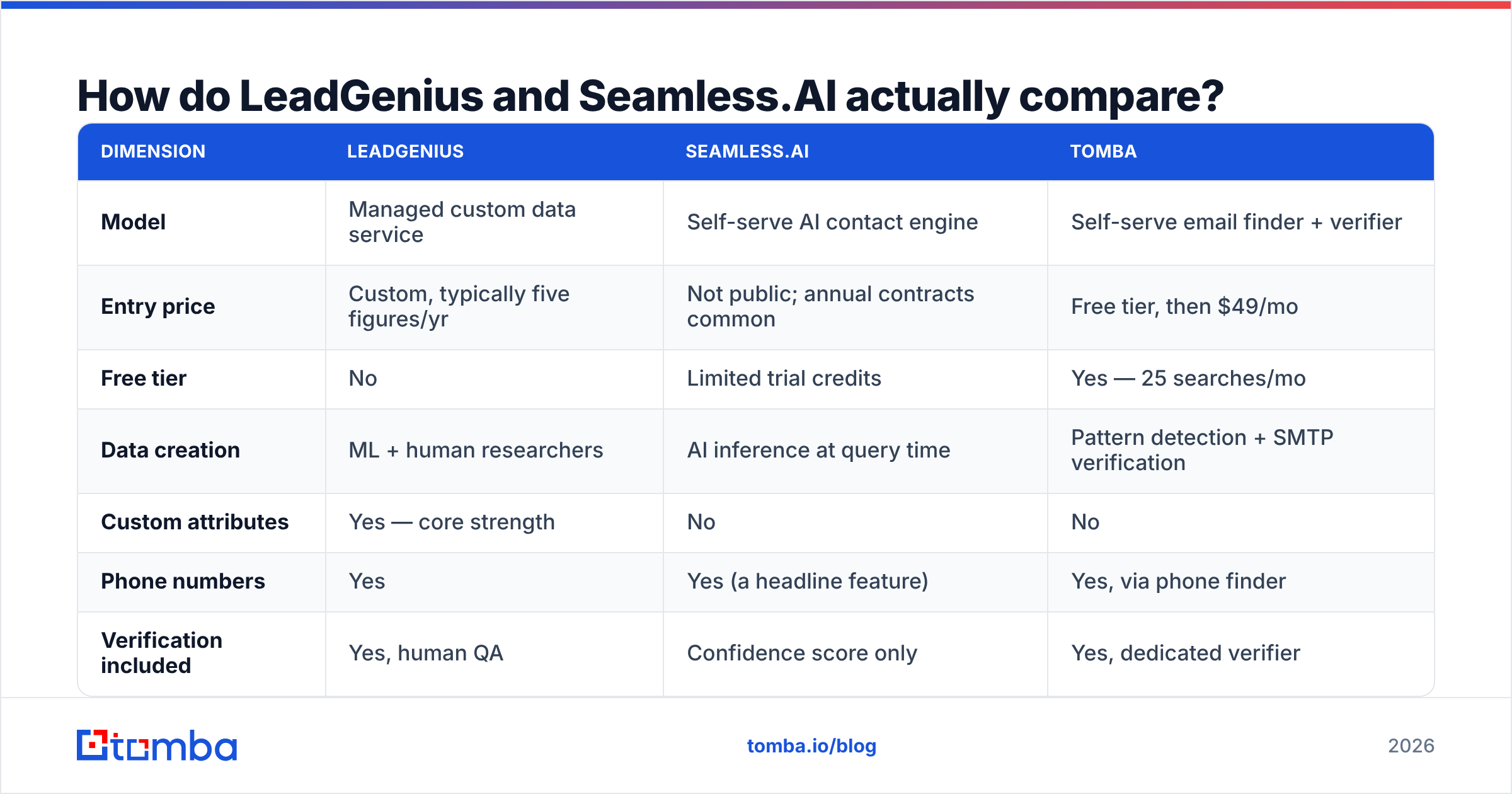
| Dimension | LeadGenius | Seamless.AI | Tomba |
|---|---|---|---|
| Model | Managed custom data service | Self-serve AI contact engine | Self-serve email finder + verifier |
| Entry price | Custom, typically five figures/yr | Not public; annual contracts common | Free tier, then $49/mo |
| Free tier | No | Limited trial credits | Yes — 25 searches/mo |
| Data creation | ML + human researchers | AI inference at query time | Pattern detection + SMTP verification |
| Custom attributes | Yes — core strength | No | No |
| Phone numbers | Yes | Yes (a headline feature) | Yes, via phone finder |
| Verification included | Yes, human QA | Confidence score only | Yes, dedicated verifier |
| API access | Yes, enterprise | Yes, higher tiers | Yes, all paid plans |
| Time to first data | Weeks (scoping + build) | Minutes | Minutes |
| Best for | Enterprise ABM with non-standard ICP | High-volume SDR prospecting | Precise email discovery and list hygiene |
Read that table as three jobs, not three ranks. If you need a dataset that does not exist yet, Seamless.AI cannot help you at any price. If you need 500 contacts by Thursday, LeadGenius cannot help you at any price.
Which one has better data accuracy?#
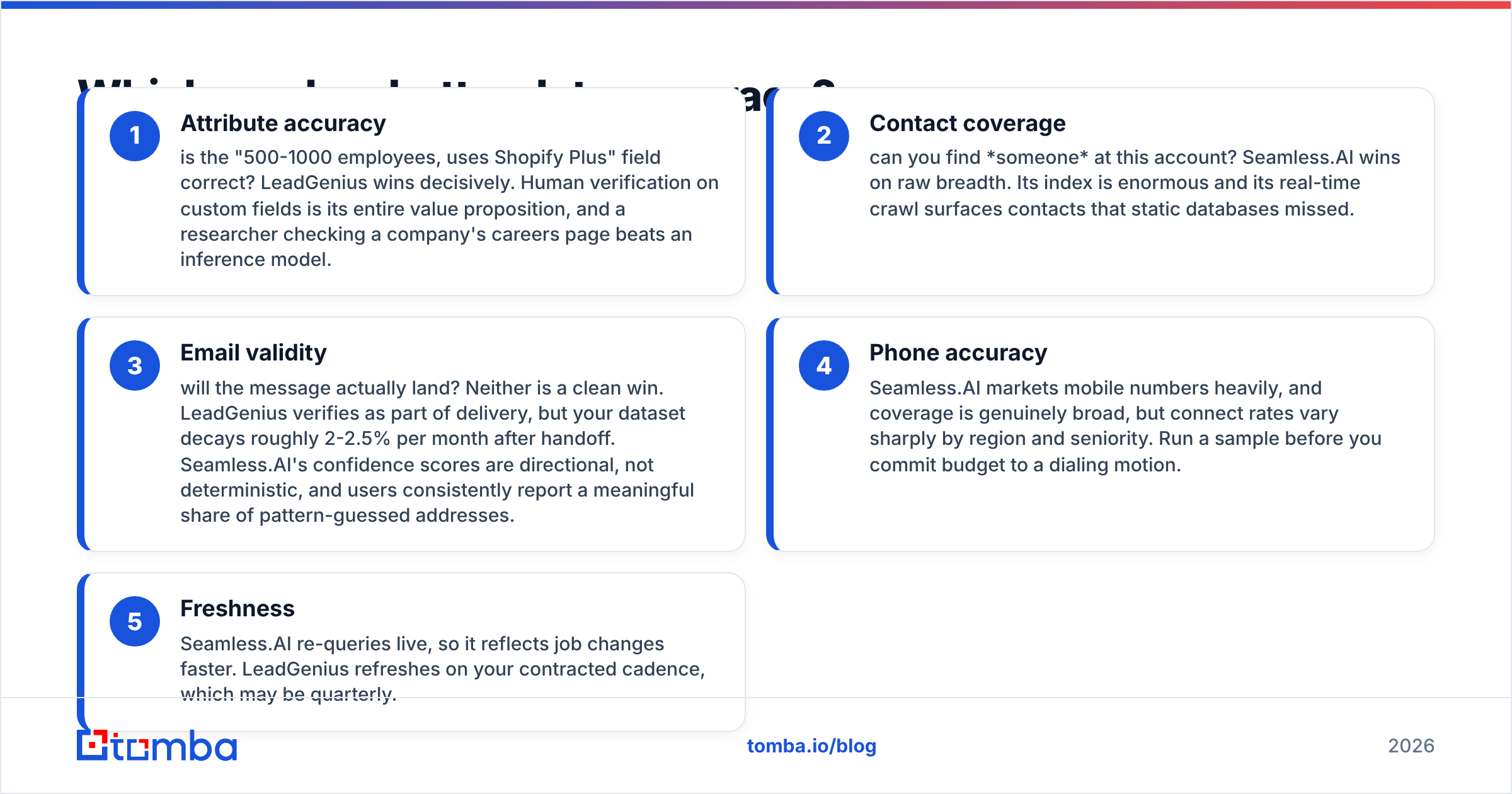
Accuracy means several different things here. Mixing them up is how teams waste budget.
- Field accuracy — is the "500-1000 employees, uses Shopify Plus" field correct? LeadGenius wins here. Human checks on custom fields are its whole value. A researcher reading a careers page beats a guessing model.
- Contact coverage — can you find someone at this account? Seamless.AI wins on raw breadth. Its index is huge, and its live crawl surfaces contacts that static databases miss.
- Email validity — will the message land? Neither one wins cleanly. LeadGenius verifies at delivery, but your data decays about 2-2.5% a month after handoff. Seamless.AI confidence scores point the right way, yet they are not proof. Users report a real share of guessed addresses.
Two more axes matter if you dial phones or refresh lists often.
- Phone accuracy — Seamless.AI markets mobile numbers hard, and coverage is broad. Connect rates still swing by region and seniority. Run a sample before you fund a dialing motion.
- Freshness — Seamless.AI queries live, so it catches job changes faster. LeadGenius refreshes on your contract schedule, which may be quarterly.
The fix for points 3 and 4 is the same, whichever vendor you pick. Put a verification step between the export and the send. Run exports through an email verifier before they reach your sequencer. That catches the bad records before they turn into bounces, and bounces are what damage sender reputation.
If many of your target accounts run accept-all mail servers, go one step further. A plain SMTP ping returns "valid" for every address on a catch-all domain. A catch-all verifier adds pattern confidence and other signals. So you are not flying blind on the accounts that matter most.
What does each one cost in 2026?#
Neither vendor publishes a price list. That alone is a signal about who they sell to.
LeadGenius prices per program. Cost scales with record volume, field complexity, and refresh rate. Buyer reports put typical yearly deals in the $20,000-$60,000 range. Pilots sometimes start in the low five figures. There is no monthly option and no self-serve signup.
Seamless.AI offers a free tier with limited credits. After that come Basic, Pro, and Enterprise tiers, each quoted by a rep. The common complaint is not the headline number but the structure. Buyers cite yearly commitments, auto-renewal clauses, and "unlimited" plans with hidden daily caps. Get the cap in writing before you sign.
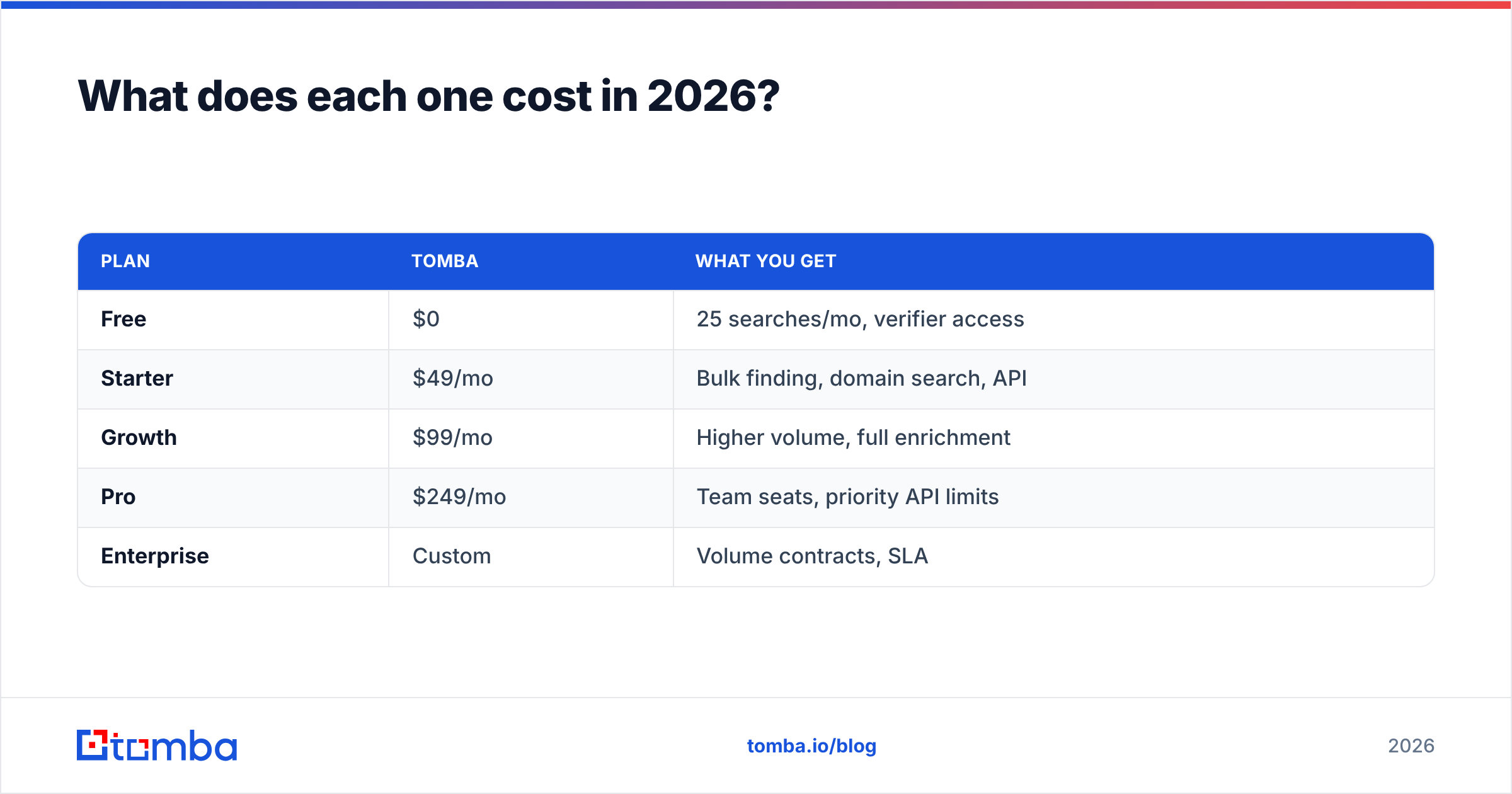
For comparison, clear per-seat pricing looks like this:
| Plan | Tomba | What you get |
|---|---|---|
| Free | $0 | 25 searches/mo, verifier access |
| Starter | $49/mo | Bulk finding, domain search, API |
| Growth | $99/mo | Higher volume, full enrichment |
| Pro | $249/mo | Team seats, priority API limits |
| Enterprise | Custom | Volume contracts, SLA |
Full Tomba pricing is public. That matters more than it sounds. When you know the cost up front, you can model cost per meeting before you commit, not after.

Who should choose LeadGenius?#
Pick LeadGenius when all three of these are true:
- Your ICP runs on an odd field. Fleet size, store count, a license, installed hardware, or franchise structure. If you cannot filter for it in ZoomInfo or Apollo, this is the kind of vendor you need.
- You have budget authority and time to buy. This is planned yearly spend, not a trial.
- Your deal size justifies it. At $25,000 a year for data, you need deals in the tens of thousands for the math to work. Teams selling $500/mo SaaS should not be here.
LeadGenius also fits market-mapping work. Think TAM sizing, territory carve-ups, or install-base research. The output is a strategic asset, not a weekly prospecting list.
Who should choose Seamless.AI?#
Pick Seamless.AI when:
- You run a high-volume outbound motion with SDRs who need hundreds of contacts a week and can live with some noise.
- Phone is central to your process. Mobile coverage is a real strength here, and a dialing team gets more from it than an email-only team does.
- You want a self-serve workflow with a Chrome extension and a quick path from LinkedIn profile to contact record.
Go in with two safeguards. First, pin down the contract terms. Ask about auto-renewal, cancellation windows, and the real daily export cap. Second, budget for a verification layer. Assume 15-25% of exported emails need filtering before they reach a sequencer. Build that step into your workflow, instead of finding out through a bounce spike.
Is there a simpler alternative to both?#
Often, yes. Many teams buy an enterprise data platform to solve a much smaller problem. The real need is usually this: "I have a company and a name, and I need the work email."
That is a narrow job, and narrow tools do it better and cheaper. A dedicated email finder turns a name plus a domain into a verified address. Domain search returns every known contact at a company, plus its email pattern. Bulk processing handles a CSV of 5,000 rows with no buying cycle.
Here is the realistic stack for most mid-market teams in 2026:
- Account list from a database or intent tool, or from LeadGenius if your fields are exotic
- Contact resolution from a focused finder at a fixed monthly cost
- Verification before every send, including catch-all handling
- Enrichment to fill firmographic gaps via data enrichment
- Sequencing in whatever sending tool you already own
That stack costs a couple hundred dollars a month. It also gives you control over each layer. Swapping one piece does not mean renegotiating a bundled yearly contract, which is the quiet cost of putting everything on one enterprise platform.
Worth noting: providers like BookYourData sit in a useful middle ground. They sell pay-as-you-go verified lists with no yearly commitment. If you want a one-time list rather than a subscription, that model deserves a look too.
How do you test either tool before committing?#
Run the same test on both. Do not accept a vendor demo on vendor-chosen accounts. The LeadGenius vs SeamlessAI call should rest on your own data.
- Build a 100-account golden list from your real pipeline. Use accounts you know well, including a few you have closed.
- Request the same 100 records from each vendor, with identical field requirements.
- Verify on your own. Run every returned email through a third-party verifier. Record the valid, invalid, and catch-all split. Do not use the vendor's confidence score as the grade.
- Spot-check 20 records by hand. Confirm the job title on LinkedIn and the company field on the company's own site.
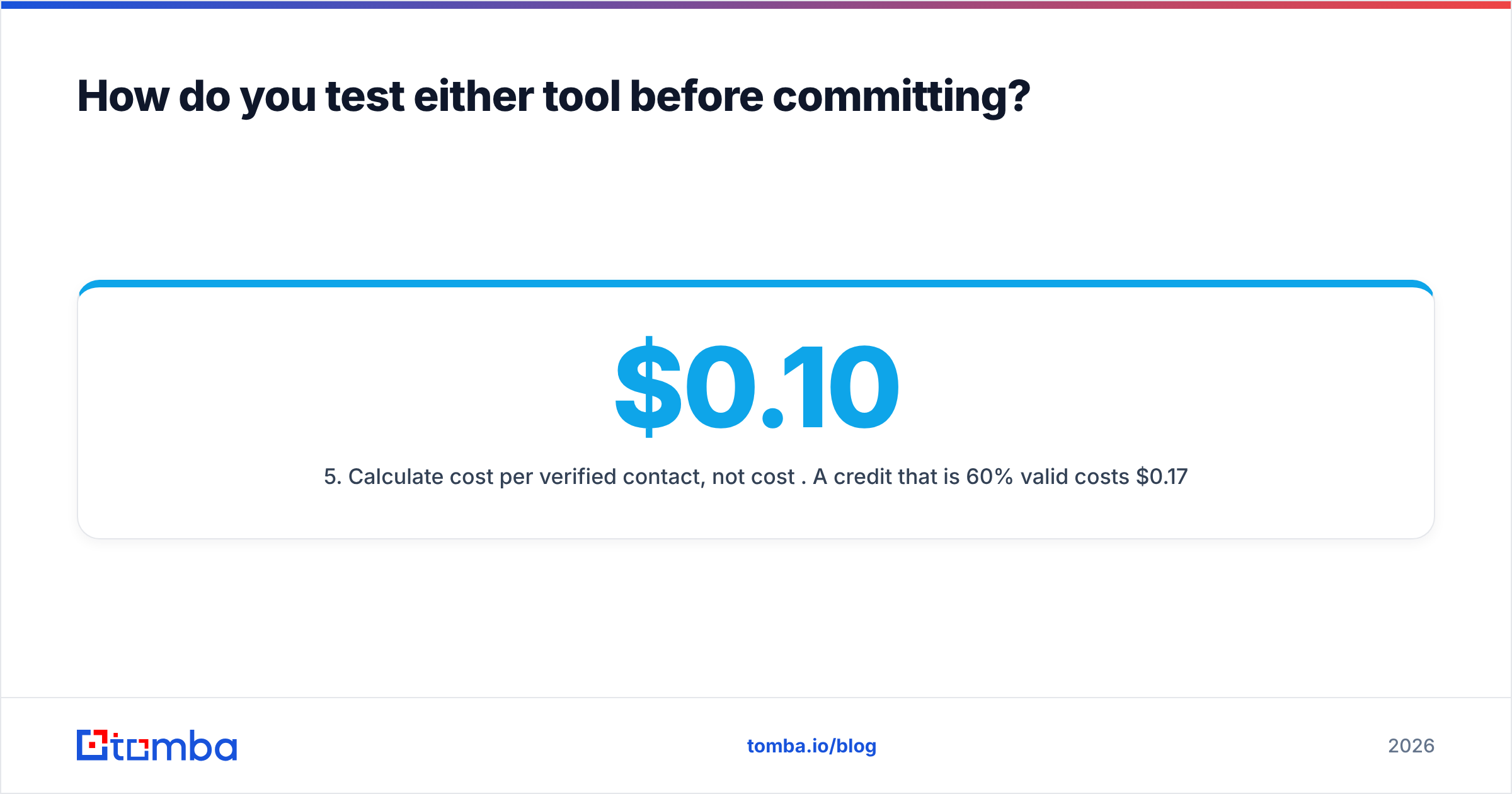
- Calculate cost per verified contact, not cost per credit. A $0.10 credit that is 60% valid costs $0.17 per usable record.
- Test the job-change rate. Pull the same 100 records 30 days later and count the changes. That is your real decay rate, and it drives your refresh budget.
This takes about a day, and it often changes the decision. A vendor who refuses a structured pilot is telling you something.
What is the verdict on LeadGenius vs SeamlessAI?#
LeadGenius wins if your ICP needs data that no database holds and you can pay to have it built. Nothing in the self-serve tier matches human-researched custom fields.
Seamless.AI wins if you need volume, speed, and phone numbers. It suits a self-serve motion with a verification step already in place. Read the contract terms closely.
Neither wins if your real bottleneck is accurate work emails for known contacts at a set price. That is a smaller, clearer problem. Paying enterprise data prices to solve it is the most common budget leak in B2B GTM.
Before you sign a yearly contract with either vendor, test the cheap path first. Start with the Tomba Email Finder. The free tier gives you 25 searches a month, which is enough to run a real accuracy test against accounts you already know. Paid plans start at $49/mo with verification, domain search, and API access included. If it closes the gap, you just saved five figures. If it does not, you will walk into the vendor call knowing exactly which data problem you are paying to solve.
Related guides#
// get started
Find, verify and enrich your first contacts today
Start on the free plan with 25 searches a month, then scale when your team is ready.
Free plan · No credit card required · GDPR & CCPA
// about the author