LeadGibbon vs ZoomInfo (2026): Which B2B Data Tool Wins?
One is a lightweight list builder you can buy with a credit card. The other is an enterprise data platform with a procurement cycle. Here is how LeadGibbon and ZoomInfo actually compare on data, exports, and true cost.
LeadGibbon vs ZoomInfo is not a feature fight. One tool builds lists. The other runs your whole data layer. Here is the short answer first.
TL;DR
- LeadGibbon is a self-serve list builder and email finder. It works off LinkedIn, ships a Chrome extension, and exports to Google Sheets in one click. You can start today with a credit card.
- ZoomInfo is a full go-to-market data platform. You get a huge contact and company database, buying signals, org charts, phone numbers, and deep CRM sync. It is sold on a yearly contract, through a rep.
- The honest verdict on LeadGibbon vs ZoomInfo: if the job is build a list, export it, send a sequence, then LeadGibbon wins on speed and cost. If you need wide coverage, intent data, and one shared source of truth for 20-plus seats, only ZoomInfo fits.
Cost is the real tie-breaker.
- LeadGibbon sits in plain self-serve SaaS pricing. ZoomInfo deals often land in the five figures per year once you add seats and credits.
- Most teams under 15 reps end up in the middle. They pair a finder and a verifier (Tomba starts at $49/mo, with a free tier) with a little enrichment on the accounts that matter.
LeadGibbon vs ZoomInfo: what each tool really is#
They are not the same kind of product. Pretending they are is how teams overbuy.
LeadGibbon is a prospecting tool. You find people, usually on LinkedIn or through a company filter. LeadGibbon then finds their work email and drops the row into a sheet. The core job is list building. The pitch is simple: get a clean CSV of the right 500 people in an afternoon.
ZoomInfo is a data platform. Its core job is coverage and control. You rent access to a database of tens of millions of firms and contacts. On top of that sit company size, funding, tech stack, buying signals, org charts, and direct dials. You wire it into Salesforce or HubSpot. Records then update themselves, and your RevOps team sets the ICP filters once for everyone.
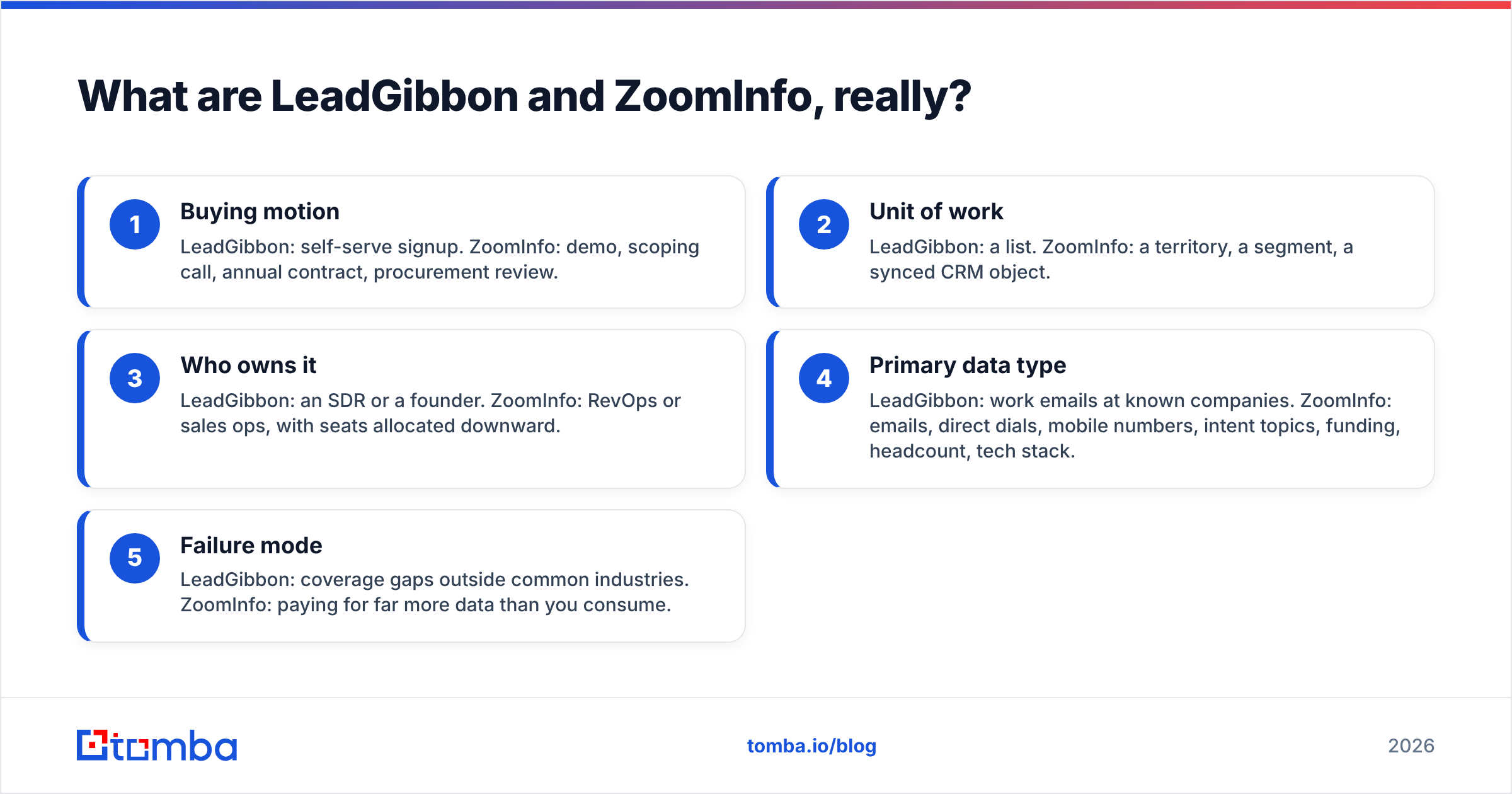
Here is the real difference in five lines:
- How you buy — LeadGibbon: sign up online. ZoomInfo: demo, scoping call, yearly contract, sign-off.
- Unit of work — LeadGibbon: a list. ZoomInfo: a whole market, a segment, a synced CRM record.
- Who owns it — LeadGibbon: an SDR or a founder. ZoomInfo: RevOps, with seats handed down.
- Main data type — LeadGibbon: work emails at known firms. ZoomInfo: emails, direct dials, mobiles, intent topics, funding, headcount, tech stack.
- How it fails — LeadGibbon: gaps outside common trades. ZoomInfo: you pay for far more data than you use.

LeadGibbon vs ZoomInfo: the head-to-head table#
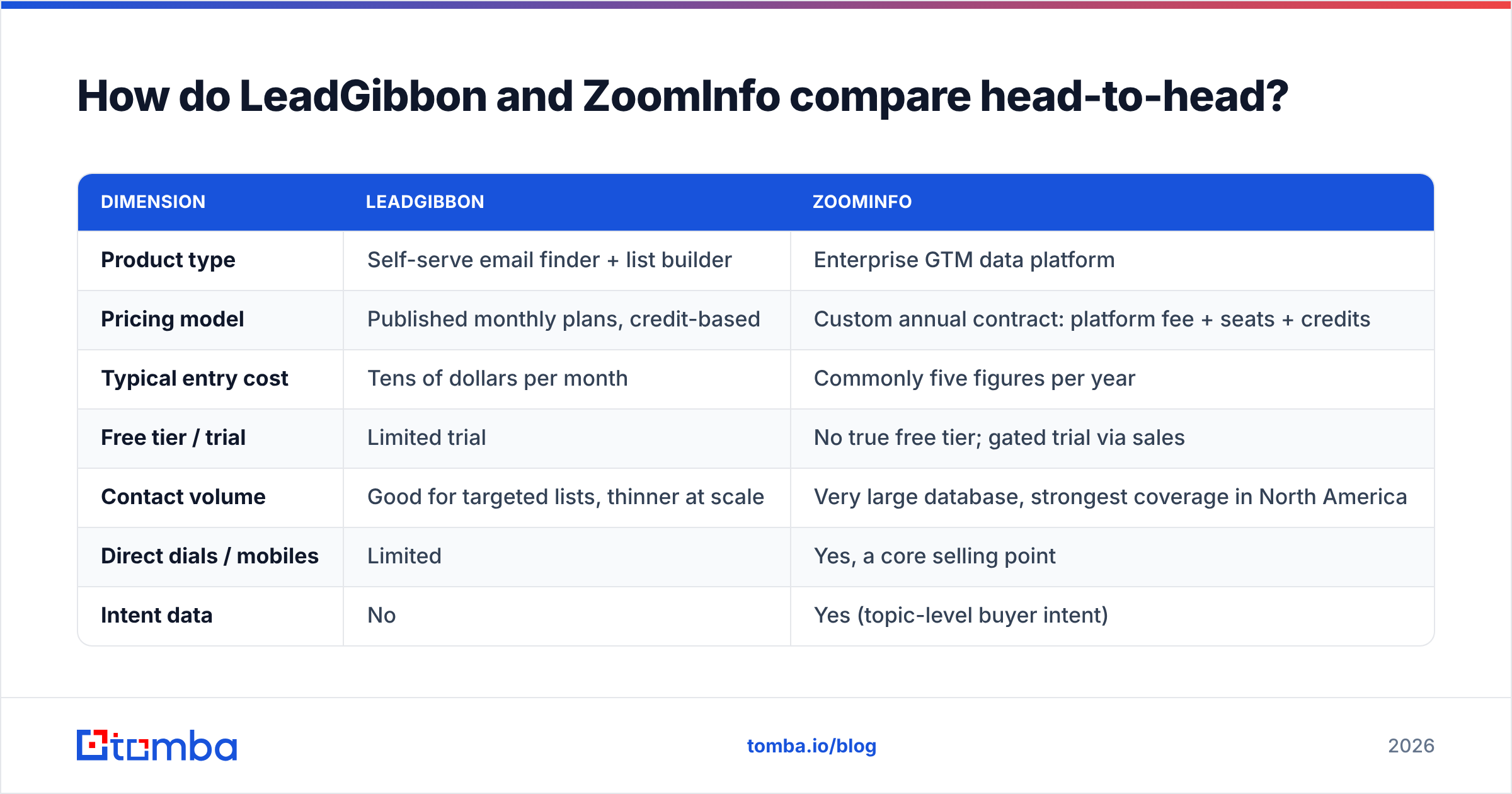
The table below is the short version. Prices and limits change on both sides. ZoomInfo does not publish a rate card, so read its column as the range buyers report. Check zoominfo.com and leadgibbon.com before you sign.
| Dimension | LeadGibbon | ZoomInfo |
|---|---|---|
| Product type | Self-serve email finder + list builder | Full GTM data platform |
| Pricing model | Public monthly plans, credit-based | Custom yearly deal: platform fee + seats + credits |
| Typical entry cost | Tens of dollars per month | Often five figures per year |
| Free tier / trial | Limited trial | No real free tier; trial gated by sales |
| Contact volume | Good for tight lists, thinner at scale | Very large database, best in North America |
| Direct dials / mobiles | Limited | Yes, a core selling point |
| Intent data | No | Yes (topic-level buyer intent) |
| Org charts / hierarchy | No | Yes |
| CRM sync | Export-first (Sheets, CSV) | Native two-way Salesforce/HubSpot/Dynamics sync |
| Email verification depth | Basic checks | Built in, plus data clean-up services |
| Best for | Founders, solo SDRs, agencies, 1-10 seats | 20-plus seat sales teams with RevOps |
| Contract flexibility | Cancel monthly | Yearly, auto-renew clauses common |

Read the table as a fork, not a scoreboard. Almost every row where ZoomInfo wins is a row you only care about with a RevOps team in place. Intent data with nobody to act on it is a line item, not an edge.
LeadGibbon vs ZoomInfo: how accurate is the data?#
Vendor accuracy claims are marketing. What counts is your bounce rate, on your list.
ZoomInfo wins on breadth and refresh rate. It runs a large data-sharing network, takes contact updates from users, and pays a team to re-check records. It is strongest on mid-size and large North American firms. It is also strong on common roles like IT, finance, and marketing. There, hit rates are high. Direct-dial coverage is hard to match with a self-serve tool.
It gets weaker where you would expect. Small firms, markets outside the US, new hires, and roles that never show up in public profiles all suffer. Reviewers on G2 flag stale records and wrong titles often enough that it should shape your test.
LeadGibbon has a narrower profile, and it is upfront about that. It works from a live target: one person, at one domain. It does well when the firm has a clear email pattern and a real web presence. It does worse on catch-all domains, on firms with no public pattern, and on personal-brand shops.

So the accuracy gap is a segment question, not a winner question. Do these four things either way:
- Test on your own list, not the demo list. Pull 200 contacts from your real ICP. Count valid, risky, and invalid. Vendor demos run on easy data.
- Re-check before every send. Even a perfect database rots 2-3% a month as people switch jobs. Run exports through a real email verifier instead of trusting the source flag.
- Treat catch-alls with care. Catch-all domains accept any address at the SMTP layer, so a naive check calls them valid. A catch-all verifier splits the safe ones from the coin flips.
- Track bounce rate by source. If you blend two vendors, tag the source field. In a month you will know which one to drop.
LeadGibbon vs ZoomInfo: what each one costs in 2026#
LeadGibbon posts its plans. You read the page, pick a credit tier, and enter a card. The sticker price is close to your real cost. If it flops, you cancel at month end.
ZoomInfo hides its pricing, and the sticker price is not the whole cost. Deals tend to stack:
- A platform fee for database access, whether you use it or not
- Per-seat fees, so each rep who logs in adds cost
- Credit packs for exports and enrichment, often use-it-or-lose-it
- Add-on modules — intent, API, engagement, chat — each priced on its own
- A yearly lock-in that auto-renews, so a change of heart mid-year is costly
Public figures and buyer chatter put mid-market ZoomInfo deals in the low-to-mid five figures a year. Large rollouts run well past that. Research shops like Forrester keep finding the same thing. The biggest waste in data spend is unused seats and dead credits, not the price per record.
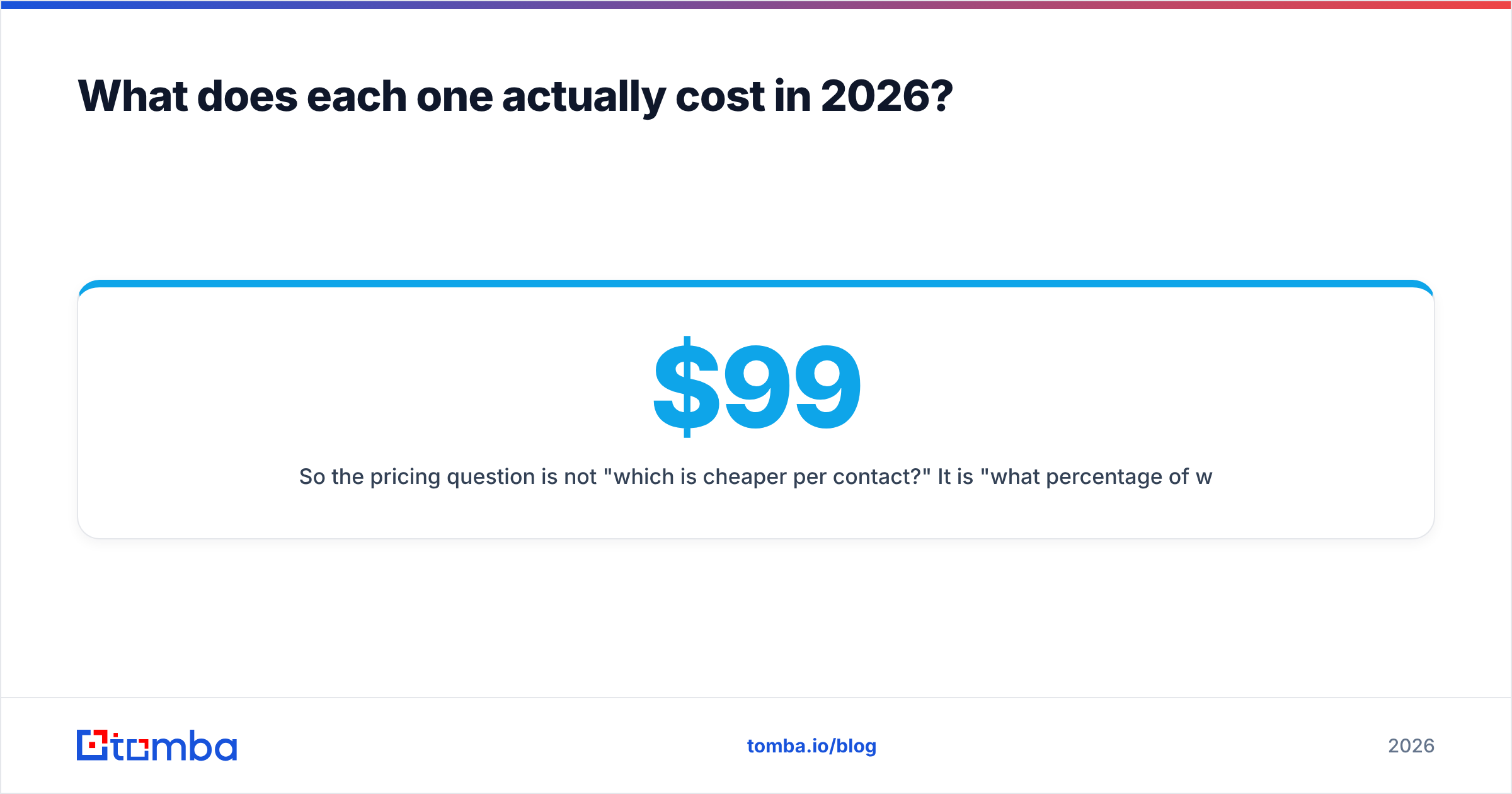
So the real LeadGibbon vs ZoomInfo cost question is not "which is cheaper per contact?" It is "how much of what I buy will I use?" A $99/mo tool used hard beats a $30k/yr platform used at 20%. The second case is far more common than vendors admit.
/blog/generated/memes/2026-09-23/leadgibbon-vs-zoominfo-meme-2.png
Who should pick LeadGibbon?#
Pick LeadGibbon if most of this sounds like you:
- You are a founder, solo SDR, or small agency running outbound yourself.
- Your motion is list → sequence → reply, not account-based plays.
- You live in spreadsheets and are fine with CSV or Sheets as the handoff.
- You need monthly freedom, because volume moves with campaigns.
- Your targets have normal domains and normal email patterns.
LeadGibbon keeps winning these tests because it is scoped to the job. No seat math. No sign-off. No unused intent module. You build the list, you export it, you send.
Who should pick ZoomInfo?#
Pick ZoomInfo if most of this sounds like you:
- You have 15 to 20-plus reps who need the same data, with rules around it.
- You run account-based plays built on org charts and buying groups.
- Direct dials matter, because you call as well as email.
- You want CRM records to update themselves, which then feeds lead scoring and routing.
- You have RevOps time to set filters, watch credit burn, and hold the ICP line.
- You can defend a five-figure yearly line item against pipeline.
The honest case for ZoomInfo is not better emails. It is that a big team needs one trusted dataset wired into its tools. Paying for that beats ten reps buying ten tools and pasting rival records into Salesforce.
Where does each one break down?#
No fair LeadGibbon vs ZoomInfo review skips the weak spots.
LeadGibbon's limits:
- Coverage thins outside common trades, regions, and job types.
- No intent or engagement signals, so you cannot sort by buying stage.
- It is built around exports, so CRM hygiene stays manual.
- Phone coverage is weak. If you dial, add a phone finder.
ZoomInfo's limits:
- Price, and a rigid contract. A yearly lock-in punishes teams whose needs shift.
- Credit anxiety is real. Reps ration exports, which defeats the point of paying for breadth.
- Freshness varies. SMB and non-US records are weaker than the marketing implies.
- It needs an owner. Without a RevOps admin, most of the platform sits unused.
- Compliance work is heavier. Selling into the EU means more paperwork with a broad shared database than with on-demand lookups.
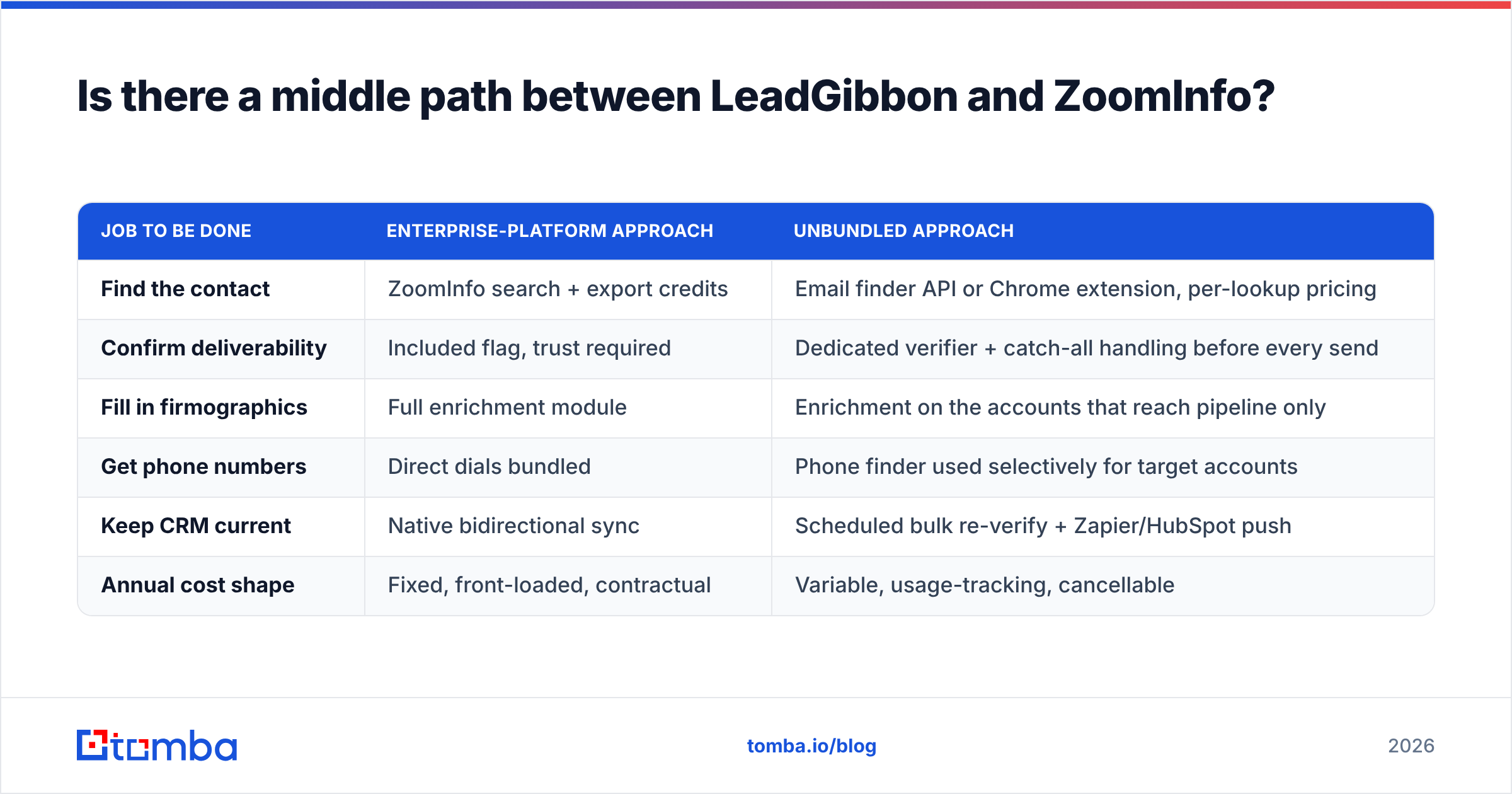
Is there a middle path between LeadGibbon and ZoomInfo?#
Yes. For most teams of 5 to 25 reps, LeadGibbon vs ZoomInfo is a false choice. Unbundle the stack instead.
B2B data is really three jobs: find, verify, and enrich. One vendor does not have to do all three at full scale.
| Job to be done | Big-platform approach | Unbundled approach |
|---|---|---|
| Find the contact | ZoomInfo search + export credits | Email finder API or Chrome extension, priced per lookup |
| Confirm it is safe to send | Built-in flag, trust required | Real verifier + catch-all handling before every send |
| Fill in company data | Full enrichment module | Enrichment only on accounts that reach pipeline |
| Get phone numbers | Direct dials bundled | Phone finder used only on target accounts |
| Keep CRM current | Native two-way sync | Scheduled bulk re-check + Zapier/HubSpot push |
| Yearly cost shape | Fixed, paid up front, locked | Variable, usage-based, cancel any time |
In practice, a finder plus a verifier does the volume work. You query a broader database only for the accounts that survive the first cut.
Tomba fits that slot. The email finder resolves contacts by domain, name, or company. Data enrichment fills the rest. Tomba pricing runs a free tier at 25 searches/mo, then $49/mo, $99/mo, and $249/mo. No yearly lock-in. No seat haggling. If you would rather buy prebuilt, filtered lists than build your own, BookYourData is a good add-on in the same price range.
The trade-off is real. You give up intent signals and the single pane of glass ZoomInfo gives you. If your pipeline needs those, buy them. If it does not, you pay a platform tax for features no rep ever touches.
FAQ#
Is LeadGibbon vs ZoomInfo a fair fight? Not really. LeadGibbon competes with other self-serve email finders and list builders. ZoomInfo competes with Apollo at the low end, and with Demandbase, Clearbit-class enrichment, and 6sense at the top. So it is a budget-tier question more than a feature question.
Which one has better email accuracy? It depends on the segment. ZoomInfo usually wins on mid-size and large North American contacts. On-demand finders often match or beat it on small firms and fresh role changes, because they check the live domain instead of a stored record. Test both on 200 of your own contacts.
Can I haggle on ZoomInfo pricing? Yes. Pricing is custom, so the levers are seat count, credit volume, contract length, and which modules you take. Bring a written use forecast, and be ready to drop add-ons you cannot tie to a play.
What is the cheapest way to start outbound in 2026? A free or cheap finder, a verifier, and a sending tool. Skip enrichment and intent until your message works. You can test a channel for under $100/mo.
Do I still need a verifier if my data vendor verifies? Yes. A vendor flag reflects the day the record was captured, not the day you send. A re-check right before the send is the cheapest way to protect your sender score.
Bottom line#
LeadGibbon vs ZoomInfo comes down to the question you are asking. LeadGibbon answers "how do I get this list built today?" ZoomInfo answers "how does a 30-person sales team work from one dataset?" Buy the one that matches your question. And be honest about whether you have the RevOps team to make the costly answer pay off.
Are you in the big middle? Too big for spreadsheets, too small for a five-figure yearly deal? Then fix the find-and-verify layer first, before you buy a platform. Try the Tomba Email Finder free at 25 searches/mo. Run your real ICP list through it. Compare bounce rates with what you pay now. If the numbers hold, $49/mo replaces a sign-off cycle. If they do not, you will walk into the ZoomInfo call knowing what you need — and what you do not.
Related guides#
Ready to find emails that actually work?
Join 150,000+ professionals who stopped guessing and started sending. Free credits on signup — no credit card required.
Get the Tomba newsletter
Practical outbound tactics and product updates — once every two weeks.
About the author