Leadmine vs ZoomInfo: Honest 2026 Comparison for B2B Prospecting
One costs less than a team lunch each month, the other can run to five figures a year. Here's how Leadmine and ZoomInfo actually compare on data, accuracy, workflow and total cost, and which one fits your team.
TL;DR
- Leadmine is a lightweight, credit-based email finder and verifier. It's cheap to start, quick to learn, and a good fit for solo founders, agencies and small outbound teams.
- ZoomInfo is an enterprise go-to-market data platform. It covers direct dials, org charts, intent signals, technographics and a CRM-grade database, and it's priced to match.
- If your main job is to find and verify business emails, ZoomInfo is usually too much tool. If you need account intelligence across a 20+ rep team, Leadmine won't be enough.
- Before you sign an annual ZoomInfo contract, run a 100-contact accuracy test on both tools against your own ICP.
- If you want something in between (pay-as-you-grow pricing with finder, verifier and enrichment in one place), Tomba is worth a look too.
What is Leadmine?#
Leadmine is a self-serve prospecting tool built around one job: getting a verified business email for a person or domain. You give it a name and company domain, or just a domain, and it returns likely addresses with a verification status. Most users work through the web app, bulk CSV uploads and a browser extension.
Its appeal is simplicity. You don't book a demo, sign an annual contract or sit through onboarding. You sign up, use the free credits and upgrade monthly if the results hold up. Third-party listings report a small free allowance and paid tiers that start in the tens of dollars per month. Leadmine's plans have changed over time, so check its pricing page for current credit counts before you budget.
What Leadmine doesn't try to be is a full data platform. You won't get buying-intent signals, detailed org charts or a deep direct-dial database. Think of it as a sharp, focused tool rather than a Swiss Army knife.
What is ZoomInfo?#
ZoomInfo is one of the largest B2B data vendors in the market. Its core product (sold under the SalesOS and wider GTM platform branding) combines contact and company records with:
- Direct dials and mobile numbers
- Org charts and reporting lines
- Buyer intent data from topic-level research signals
- Technographics and firmographics
- Website visitor identification
- Native CRM sync, workflows and AI-assisted prospecting
ZoomInfo doesn't publish list prices. You buy through sales, usually on an annual contract, and the price depends on seats, credits and add-ons. Buyer reports on sites like G2 and procurement forums often put entry contracts in the five-figure-per-year range, with larger deployments well above that. Treat any number you see as a starting point for negotiation, not a quote.
How are Leadmine and ZoomInfo fundamentally different?#
A good analogy: Leadmine is a locksmith and ZoomInfo is a property-management company. The locksmith does one thing well and charges per job. The property manager runs the whole building, which is great if you own a building and expensive if you only need one door opened.
Here are the five differences that matter most when you choose between them:
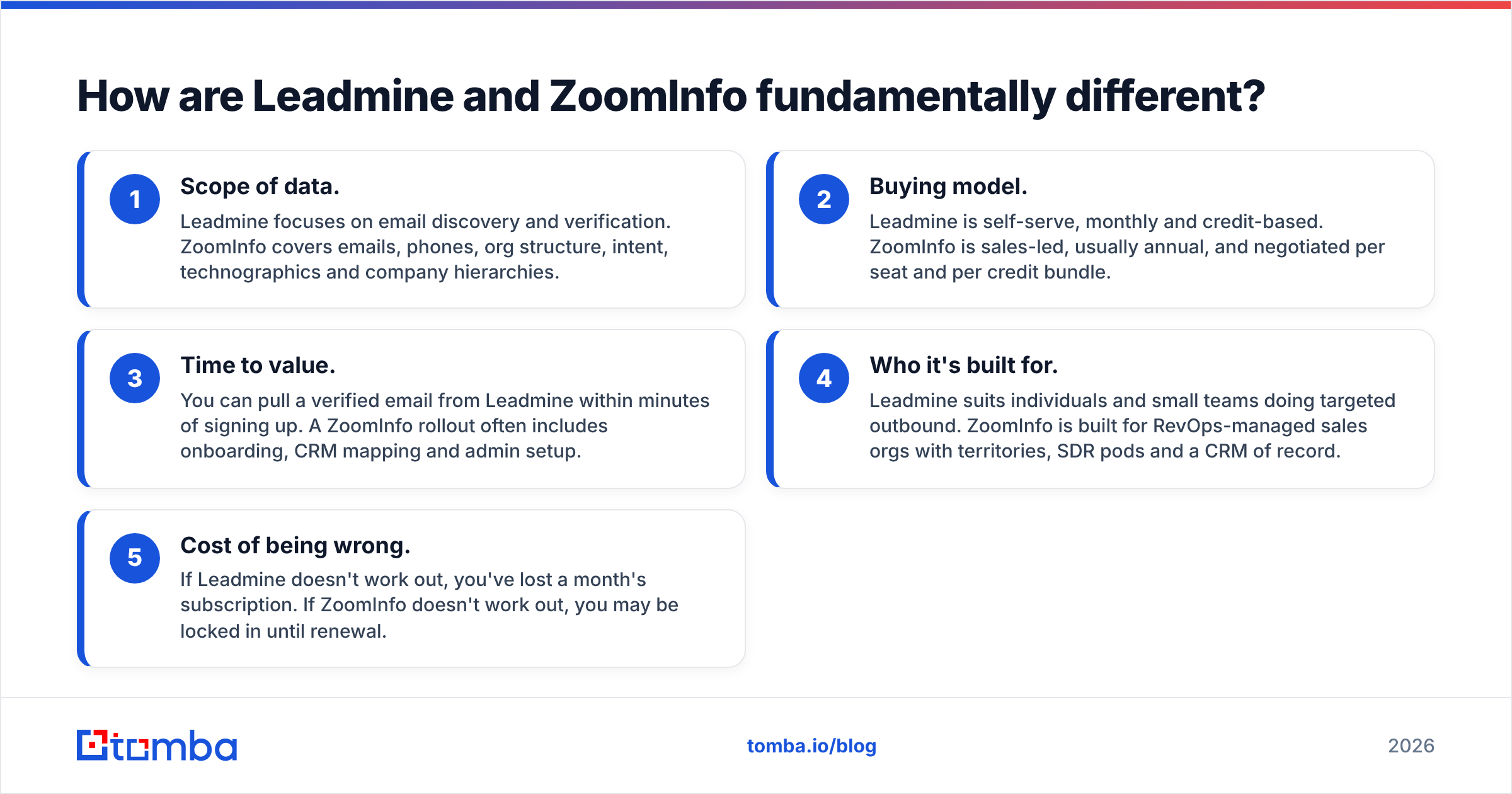
- Scope of data. Leadmine focuses on email discovery and verification. ZoomInfo covers emails, phones, org structure, intent, technographics and company hierarchies.
- Buying model. Leadmine is self-serve, monthly and credit-based. ZoomInfo is sales-led, usually annual, and negotiated per seat and per credit bundle.
- Time to value. You can pull a verified email from Leadmine within minutes of signing up. A ZoomInfo rollout often includes onboarding, CRM mapping and admin setup.
- Who it's built for. Leadmine suits individuals and small teams doing targeted outbound. ZoomInfo is built for RevOps-managed sales orgs with territories, SDR pods and a CRM of record.
- Cost of being wrong. If Leadmine doesn't work out, you've lost a month's subscription. If ZoomInfo doesn't work out, you may be locked in until renewal.
How do Leadmine and ZoomInfo compare feature by feature?#

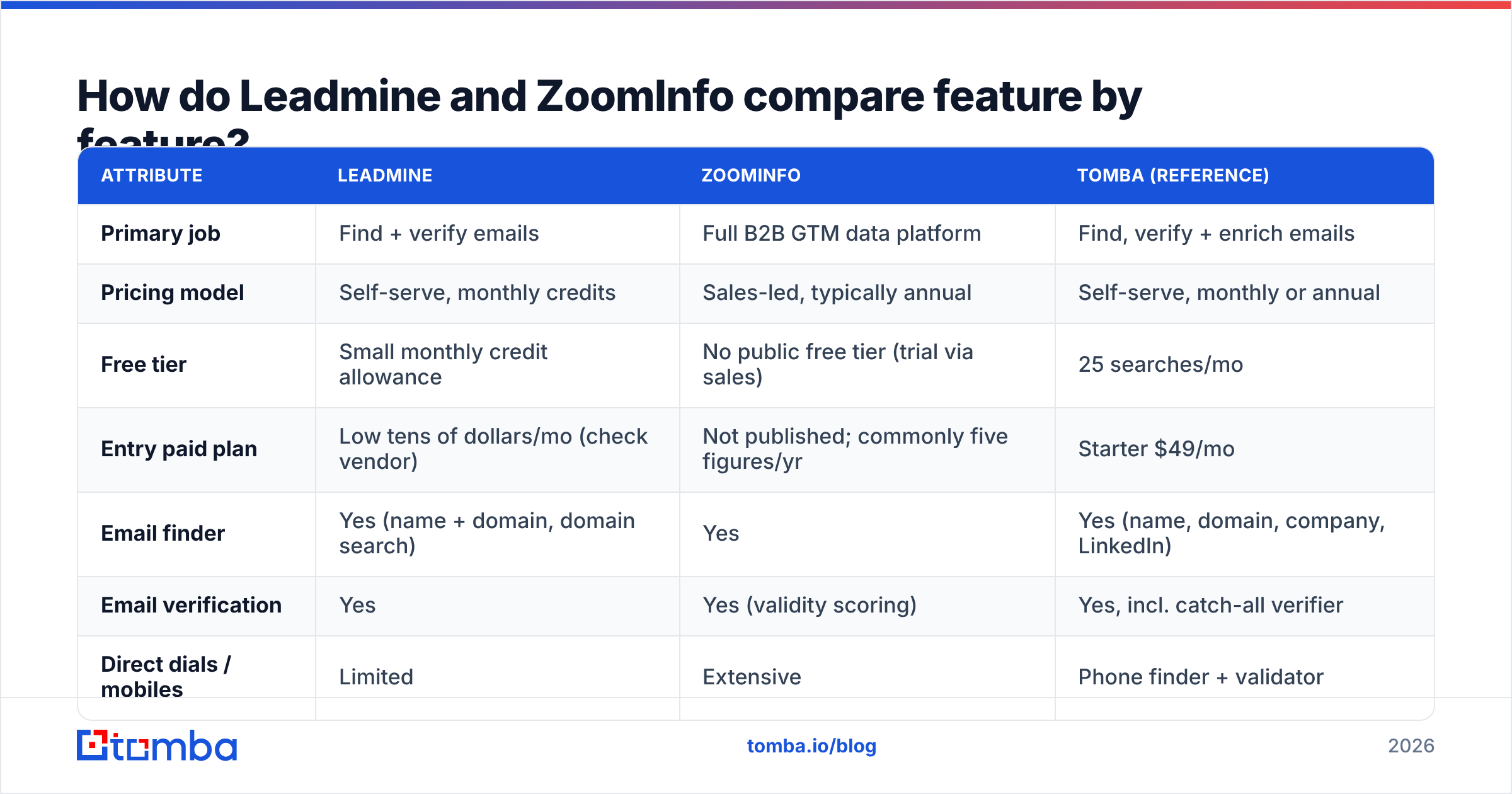
| Attribute | Leadmine | ZoomInfo | Tomba (reference) |
|---|---|---|---|
| Primary job | Find + verify emails | Full B2B GTM data platform | Find, verify + enrich emails |
| Pricing model | Self-serve, monthly credits | Sales-led, typically annual | Self-serve, monthly or annual |
| Free tier | Small monthly credit allowance | No public free tier (trial via sales) | 25 searches/mo |
| Entry paid plan | Low tens of dollars/mo (check vendor) | Not published; commonly five figures/yr | Starter $49/mo |
| Email finder | Yes (name + domain, domain search) | Yes | Yes (name, domain, company, LinkedIn) |
| Email verification | Yes | Yes (validity scoring) | Yes, incl. catch-all verifier |
| Direct dials / mobiles | Limited | Extensive | Phone finder + validator |
| Intent data | No | Yes | No |
| Org charts | No | Yes | No |
| CRM integrations | CSV + basic integrations | Deep Salesforce, HubSpot, Dynamics | HubSpot, Salesforce, Pipedrive, Zapier, API |
| Contract lock-in | Low | High (annual, auto-renew common) | Low |
| Best for | Solo reps, agencies, small teams | Mid-market and enterprise sales orgs | SMB to mid-market outbound + data teams |
A few takeaways stand out.
ZoomInfo wins on breadth. If your playbook depends on calling decision-makers, mapping buying committees or prioritising accounts by intent, Leadmine doesn't really compete. Those are different product categories.
Leadmine wins on accessibility. No procurement cycle, no seat minimum, no renewal negotiation. For a founder doing their own outbound, that matters more than intent topics they'll never use.
The middle is where most teams actually sit. Plenty of 3-15 person sales teams need more than a basic finder (bulk enrichment, catch-all handling, CRM sync, an API) but can't justify an enterprise contract. That gap is why mid-tier tools exist.
Which is more accurate: Leadmine or ZoomInfo?#

It depends on your market, and anyone who gives you a single universal accuracy percentage is simplifying.
ZoomInfo's strength is its large, continuously refreshed database with a lot of human and machine verification on top. For North American mid-market and enterprise contacts, coverage is generally strong. Where users complain on review sites, it's usually about stale records in fast-moving roles, weaker coverage outside the US, and bounce rates on contacts that haven't been re-verified recently.
Leadmine's strength is real-time lookup. It works out likely email patterns for a domain and verifies them when you search, instead of relying only on a stored record. That can mean fresher results for small companies, startups and niche verticals that big databases under-index. The weak spots are the usual ones for pattern-and-verify tools: catch-all domains, where the mail server accepts every address, so a "valid" result proves little.
Here's a fair way to test both yourself:
- Pull 100 target contacts from your actual ICP, not a vendor-supplied sample.
- Run them through both tools and record found / not found / risky.
- Push every "found" email through an independent email verifier so you judge both tools by the same standard.
- Send a small, warmed-up test campaign and measure hard bounces.
- Compare cost per deliverable email, not cost per credit.
The fifth step is the one most teams skip, and it's the one that decides the question. A cheap tool with a 60% find rate can beat an expensive tool with 85% once you divide by price. The reverse is also true when your deal sizes are large.
How much do Leadmine and ZoomInfo really cost?#
The sticker price is only part of it.
Leadmine's cost profile is simple. You pay monthly for a set number of credits, and you upgrade or downgrade as volume changes. The hidden cost is time. Without intent data or org charts, your reps do more manual research to decide who to contact before they look up how to reach them.
ZoomInfo's cost profile has more parts:
- Per-seat licences, often with minimum seat counts
- Credit allotments that can run out before renewal
- Add-ons (intent, website visitor identification, conversation intelligence, data-as-a-service) priced separately
- Annual terms, and many buyers report auto-renewal clauses that need notice well before the end date
None of this is unusual for enterprise software, and ZoomInfo does deliver a lot for the money when the whole team uses it. The trouble starts when a five-person team buys an enterprise platform and uses 15% of it.
A quick sanity check: work out how many net-new contacts your team actually needs per month. If it's a few hundred to a few thousand, and you mostly need emails, a monthly-credit tool will almost always win on total cost of ownership. If you need tens of thousands of enriched records plus phones and intent across a large team, ZoomInfo's per-record economics start to make sense.
Who should choose Leadmine?#
Leadmine fits you if:
- You're a founder, freelancer or small agency running targeted outbound campaigns.
- Your main problem is "I know who, I need their email." That's exactly what it's built for.
- You want to try before you commit. The free allowance and monthly billing make it low-risk.
- Your targets are SMBs or niche companies that big databases tend to cover less well.
Watch out for:
- Catch-all domains. Check "valid" results on these with a dedicated catch-all check before you send.
- Workflows that need phones, intent or account hierarchies. You'll end up adding a second tool.
Who should choose ZoomInfo?#
ZoomInfo fits you if:
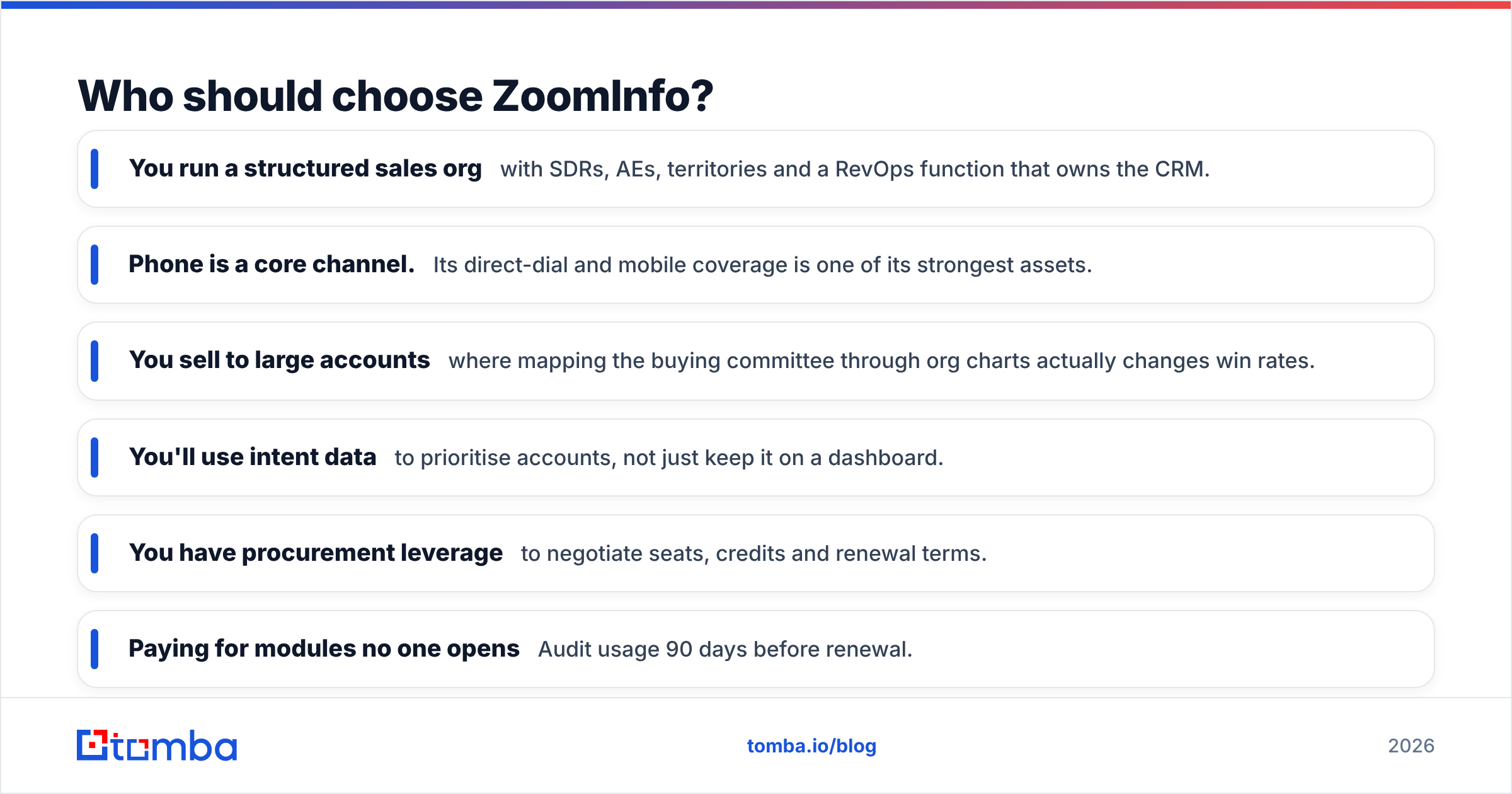
- You run a structured sales org with SDRs, AEs, territories and a RevOps function that owns the CRM.
- Phone is a core channel. Its direct-dial and mobile coverage is one of its strongest assets.
- You sell to large accounts where mapping the buying committee through org charts actually changes win rates.
- You'll use intent data to prioritise accounts, not just keep it on a dashboard.
- You have procurement leverage to negotiate seats, credits and renewal terms.
Watch out for:
- Paying for modules no one opens. Audit usage 90 days before renewal.
- Coverage gaps outside North America if you sell into EMEA or APAC.
- Contract terms. Read the renewal and notice clauses before signing, not after.
Is there a middle-ground option between Leadmine and ZoomInfo?#
Yes, and for many teams comparing these two it's the more realistic choice. The Leadmine-vs-ZoomInfo framing hides a common situation: you've outgrown a single-purpose finder, but you're nowhere near needing an enterprise intelligence suite.
What that middle tier typically needs to do:
- Find emails several ways: by name and domain, by company, from LinkedIn profiles, or through a full domain search that lists every public address at a company.
- Verify properly, including catch-all detection, so bounce rates stay low and your sender reputation holds up.
- Enrich records with job title, company data and phone numbers where available.
- Plug into your stack through native CRM integrations, Google Sheets, Zapier or a clean API.
- Price transparently, with monthly plans you can scale up or down.
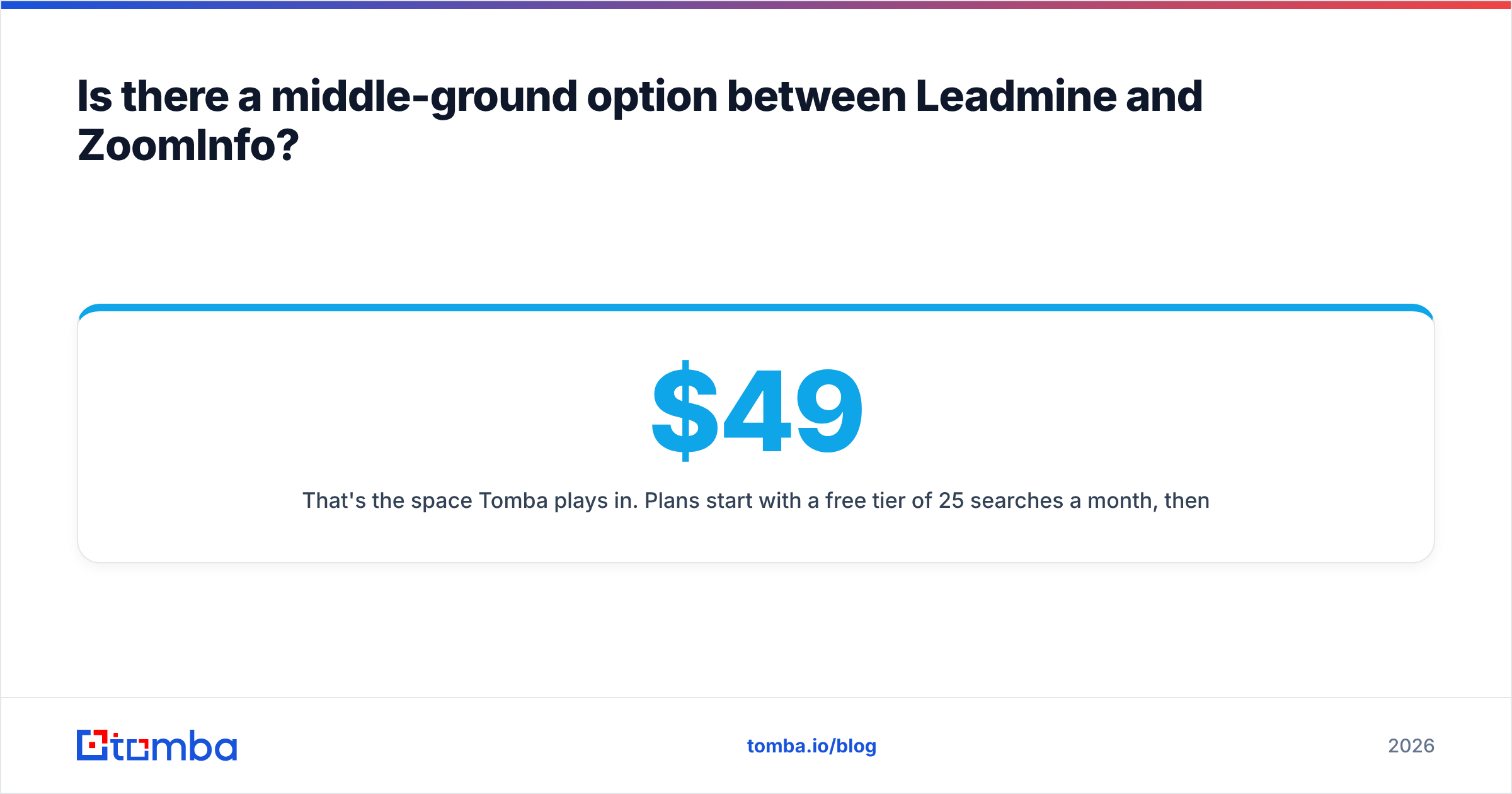
That's the space Tomba plays in. Plans start with a free tier of 25 searches a month, then Starter at $49/mo, Growth at $99/mo and Pro at $249/mo, with custom Enterprise options (full breakdown on the Tomba pricing page). Tomba won't replace ZoomInfo's intent data or org charts, and it doesn't claim to. What it does is cover the email-first workflow more fully than a basic finder, without annual lock-in.
Leadmine vs ZoomInfo: which should you pick?#
The short version:
| Your situation | Best fit |
|---|---|
| Solo or tiny team, email-only outbound, tight budget | Leadmine |
| 20+ reps, phone-heavy, enterprise accounts, RevOps in place | ZoomInfo |
| 3-20 person team needing finder + verifier + enrichment + integrations | A mid-tier tool such as Tomba |
| Unsure of volume or channel mix | Start monthly and self-serve, reassess in 90 days |
The biggest mistake teams make in this comparison is buying for the sales org they hope to have in two years instead of the one they have today. Start with the tool that matches your current motion, measure cost per deliverable contact, and move up when the data says you've outgrown it. Enterprise platforms will still be there, and with real usage numbers you'll negotiate a much better contract.
Ready to find verified emails without an enterprise contract?#
If your outbound is email-first and you want more than a basic finder without signing a five-figure annual deal, try the Tomba Email Finder. Search by name, domain, company or LinkedIn profile, verify every result (catch-all domains included), and push clean contacts straight into your CRM. Start on the free tier, run the same 100-contact test described above, and compare the numbers yourself before you commit.
Related guides#
// get started
Find, verify and enrich your first contacts today
Start on the free plan with 25 searches a month, then scale when your team is ready.
Free plan · No credit card required · GDPR & CCPA
// about the author