Leadpipe Pricing Reviews Pros and Cons: 2026 Buyer's Verdict
Leadpipe starts at $147/mo for 500 identified visitors, with unlimited seats and no contracts. Here's what reviewers praise, where it falls short, and how to work out whether the cost per lead holds up for your traffic.
This guide covers Leadpipe pricing reviews pros and cons in one place. You'll see what the plans cost, what users say, and where the tool falls short.
TL;DR
Leadpipe's Pro plan starts at $147/month for 500 identified visitors (1 credit = 1 unique person). That's about $0.29 per ID at the entry tier. Seats are unlimited, there's no contract, and the pixel pauses instead of charging overages when you hit your cap.
Reviews are positive but there aren't many of them. On G2, users praise setup speed and how rich the contact data is. The most common complaint is that features in the menu still say "coming soon."
The big caveat: person-level identification only covers US traffic. Visitors from elsewhere are resolved to the company level only.
Leadpipe fits US-focused B2B teams with steady, high-intent traffic. It's a weak fit if most of your pipeline comes from EMEA or APAC. It's also a weak fit if your site gets fewer than a few thousand visits a month.
Whatever visitor-ID tool you pick, verify the emails before you send. Identity-resolution data goes stale faster than most teams expect.
What is Leadpipe and what does it actually do?#
Leadpipe is a website visitor identification tool. You add a JavaScript pixel to your site, and Leadpipe matches anonymous sessions against an identity graph. In the US, it returns a person: name, job title, company, LinkedIn URL, and contact details. Outside the US, it falls back to company-level matching, which is the older reverse-IP approach tools like Leadfeeder made popular.
That split is what makes Leadpipe different. Most visitor-ID tools sold to B2B teams before 2023 stopped at the company level. They could tell you "someone from Acme Corp viewed your pricing page," and then your SDR had to guess who. Leadpipe belongs to a newer group, alongside RB2B, Warmly, and Vector, that tries to name the actual person.
Here's an analogy. Company-level ID is like knowing which apartment building a letter came from. Person-level ID gives you the apartment number. Technically, person-level matching usually relies on cookie and device graphs, hashed-email partnerships, and consent-based data co-ops. That's why coverage is strong in the US and thin almost everywhere else.
If you want company-level identification for global traffic, you can use website visitor reveal tools to find out which accounts are browsing. Then you work out the right contacts through a separate prospecting step.
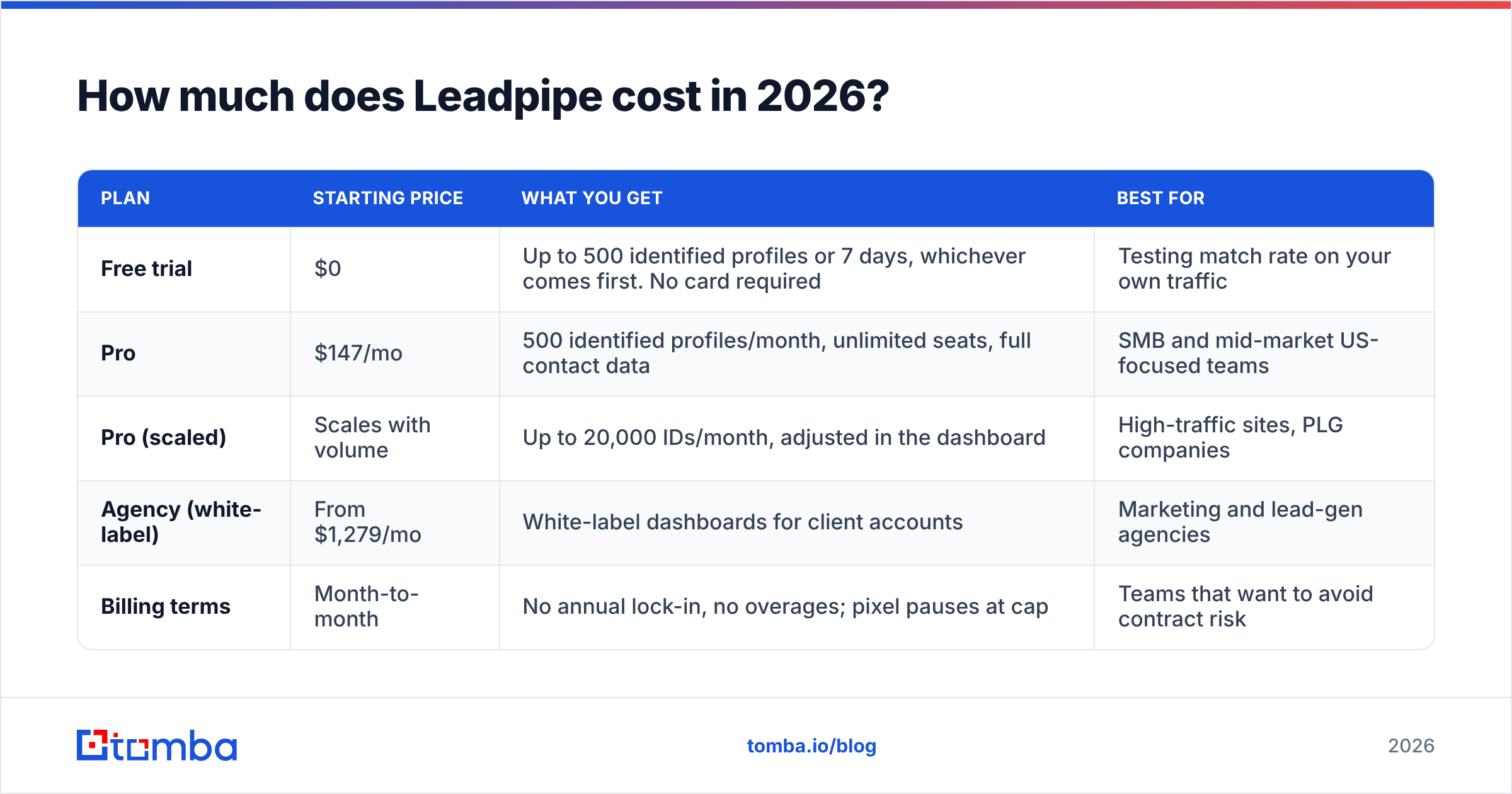
How much does Leadpipe cost in 2026?#
Leadpipe's pricing is simpler than most tools in this category. According to the official Leadpipe pricing page, the model at the time of writing is:
| Plan | Starting price | What you get | Best for |
|---|---|---|---|
| Free trial | $0 | Up to 500 identified profiles or 7 days, whichever comes first. No card required | Testing match rate on your own traffic |
| Pro | $147/mo | 500 identified profiles/month, unlimited seats, full contact data | SMB and mid-market US-focused teams |
| Pro (scaled) | Scales with volume | Up to 20,000 IDs/month, adjusted in the dashboard | High-traffic sites, PLG companies |
| Agency (white-label) | From $1,279/mo | White-label dashboards for client accounts | Marketing and lead-gen agencies |
| Billing terms | Month-to-month | No annual lock-in, no overages; pixel pauses at cap | Teams that want to avoid contract risk |
A few pricing details matter more than the headline number:
1 credit = 1 unique person. A return visitor shouldn't burn a second credit within the same billing window. Compare this with tools that charge per session or per "enrichment."
No per-seat fees. Your whole SDR team, RevOps, and marketing can all log in. Seat-based tools like ZoomInfo or Apollo can cost several times more once you're past five users.
The pixel pauses at your cap. You won't get a surprise bill. The trade-off is that you stop identifying visitors mid-month. That could happen during your highest-intent week (a launch, a webinar, a big campaign).

What is the real cost per usable lead?#
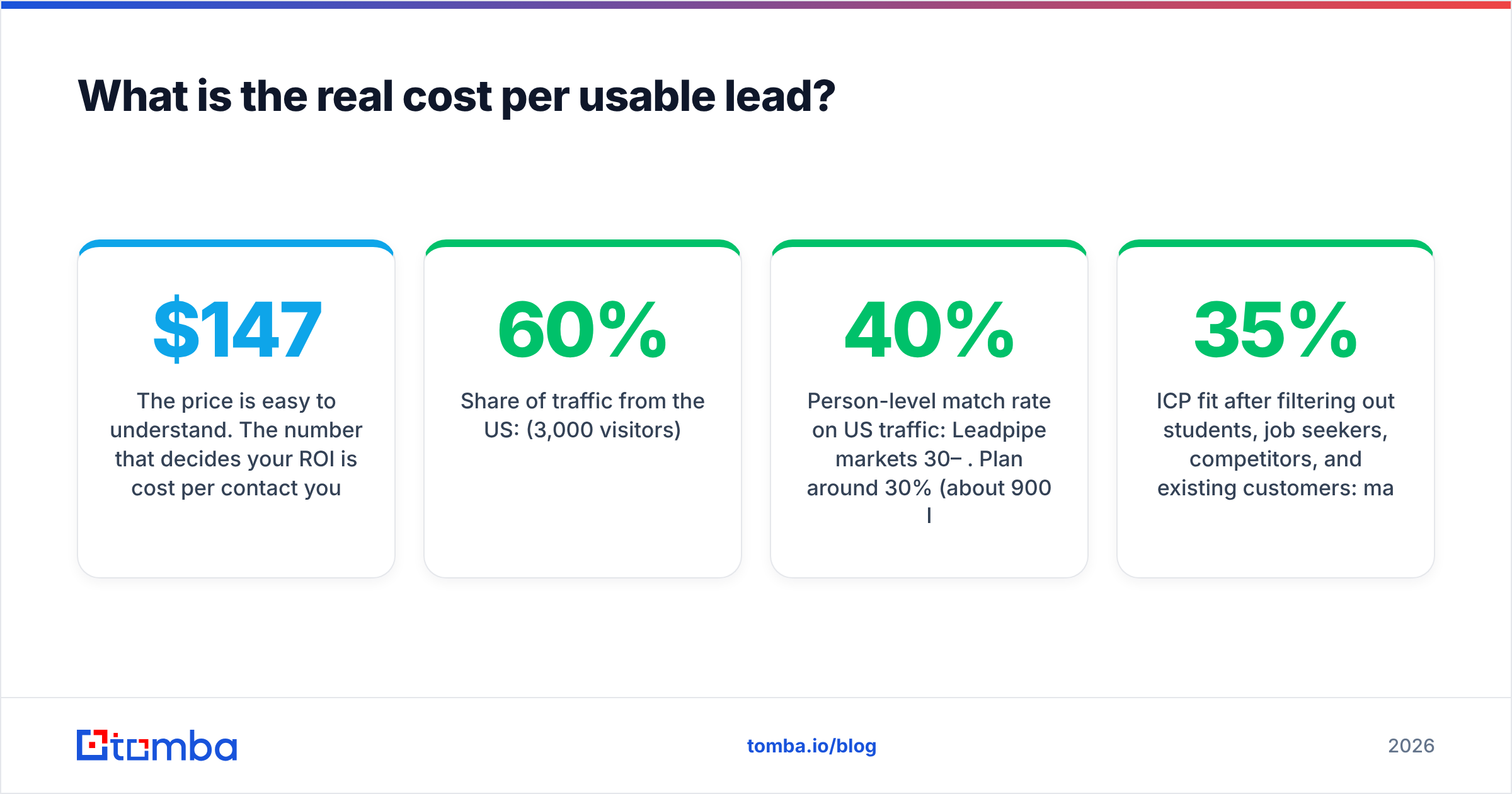
The $147 price is easy to understand. The number that decides your ROI is cost per contact you can actually work, and that's always higher than cost per ID.
Here's a worked example with conservative assumptions:
- Monthly unique visitors: 5,000
- Share of traffic from the US: 60% (3,000 visitors)
- Person-level match rate on US traffic: Leadpipe markets 30–40%. Plan around 30% (about 900 IDs)
- Your plan cap: 500 IDs, so the pixel pauses partway through the month
- ICP fit after filtering out students, job seekers, competitors, and existing customers: maybe 35% (about 175 people)
- Emails that pass verification: say 85% (about 150 contacts)
That puts your real cost at roughly $147 ÷ 150 ≈ $1 per verified, in-ICP contact. That's still cheap next to buying intent data or running paid social. But it's about three times the headline $0.29. The math shifts fast when your traffic is small or mostly outside the US.
The other hidden cost is time. Someone has to triage the feed and push good leads into your CRM. They also have to write outreach that doesn't sound like "I saw you on our website." Budget for that labor.
What do Leadpipe reviews say?#
At the time of writing, Leadpipe holds a 4.6/5 rating on G2, based on a small number of reviews (single digits). It also has a listing on Capterra. With a sample that small, read the rating as a direction, not a verdict. A few happy early customers can move the score a lot.
The same themes show up across reviews:
- Setup is fast. Reviewers say they add the pixel and see identified visitors the same day. Leadpipe claims about five minutes, and user comments back that up.
- The dashboard is easy to read. You get an at-a-glance summary, and you can drill into each visitor's name, title, company, and contact details.
- Data depth impresses first-time users. People coming from company-level tools see named contacts on day one and find it a big step up.
- The product is still early. The most common criticism is that some menu items are marked "coming soon." Expect the roadmap to keep changing.
What reviews don't cover well yet: how match accuracy holds up over months, how often contact data bounces, and how well support handles CRM sync edge cases. Run your own test before you trust any single number.
What are the pros and cons of Leadpipe?#
Here's the short version, based on the pricing model, user reviews, and how person-level ID tends to perform:
Pro: transparent, low entry price. At $147/month with a free trial, you don't need to talk to sales to find out whether it works on your traffic. That's rare in visitor ID.
Pro: unlimited seats. It's a real advantage for agencies and multi-team orgs. No one has to share a login or ration access.
Pro: no contracts, no overages. You can cancel month to month, and billing is capped. Your finance team will like this.
Con: person-level ID is US-only. If 50% or more of your ICP is in the UK, DACH, or APAC, you're paying a person-level price for mostly company-level results.
Con: small review base and an early roadmap. A 4.6 from a handful of reviews tells you less than a 4.3 from hundreds. Some features are still on the way.
Con: privacy and compliance exposure. Person-level identification raises questions under state privacy laws such as CCPA/CPRA. Have legal review the consent flow before you roll it out, especially in regulated industries.
How does Leadpipe compare to other visitor identification tools?#
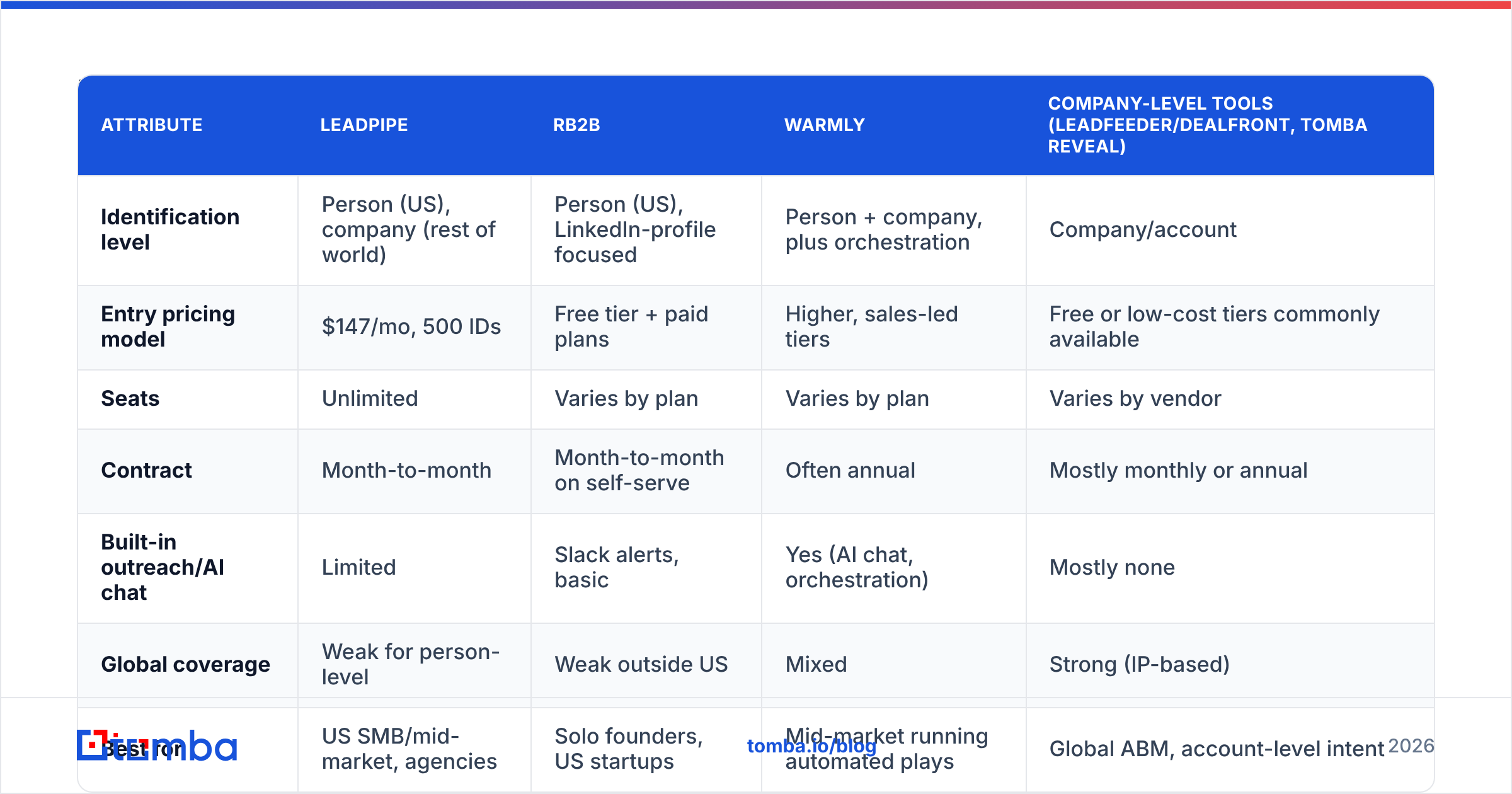
Pricing in this category changes often, so check each vendor's page before you buy. The structural differences below matter more than any one month's price:
| Attribute | Leadpipe | RB2B | Warmly | Company-level tools (Leadfeeder/Dealfront, Tomba Reveal) |
|---|---|---|---|---|
| Identification level | Person (US), company (rest of world) | Person (US), LinkedIn-profile focused | Person + company, plus orchestration | Company/account |
| Entry pricing model | $147/mo, 500 IDs | Free tier + paid plans | Higher, sales-led tiers | Free or low-cost tiers commonly available |
| Seats | Unlimited | Varies by plan | Varies by plan | Varies by vendor |
| Contract | Month-to-month | Month-to-month on self-serve | Often annual | Mostly monthly or annual |
| Built-in outreach/AI chat | Limited | Slack alerts, basic | Yes (AI chat, orchestration) | Mostly none |
| Global coverage | Weak for person-level | Weak outside US | Mixed | Strong (IP-based) |
| Best for | US SMB/mid-market, agencies | Solo founders, US startups | Mid-market running automated plays | Global ABM, account-level intent |
The pattern: Leadpipe competes on price transparency and seat economics, not on features. If you want AI chat, automated playbooks, and intent scoring in one place, Warmly-style platforms offer more, at a higher price. If you only need to know which accounts are warming up, a company-level tool plus a good contact-finding workflow is often cheaper. It also works worldwide.
Is Leadpipe worth it for your team?#
Use this checklist. If you can say yes to at least four, Leadpipe is probably worth a paid month:
- Most of your pipeline is US-based. Person-level ID is the whole value, and it only applies to US visitors.
- You get at least 3,000 unique visitors a month, with real traffic on pricing, demo, or comparison pages.
- Someone owns the feed. An SDR or founder reviews new IDs every day and follows up within 24–48 hours.
- Your CRM is set up to receive them. Leadpipe pushes leads into a system where they get routed and scored, so they don't just sit in a dashboard.
- Legal has signed off on your consent banner and privacy policy for person-level tracking.
If you can't, you're paying $147 a month to watch a list of names you won't act on.

What should you do after Leadpipe identifies a visitor?#
Identification is the start of the work. Three steps separate teams that get pipeline from visitor ID from teams that just collect names:
Verify before you send. Identity-graph emails are often personal addresses or old work addresses. Run every contact through an email verifier before it goes into a sequence. Sending to unverified visitor-ID data is a quick way to damage your email deliverability.
Fill gaps at the account level. Sometimes Leadpipe (or a company-level tool) finds an account but not a buyer. Or it names a junior visitor when you need the VP. In that case, use a domain search or email finder to reach the real decision-maker at that company.
Enrich, then personalize on intent. Add firmographic context with data enrichment. Then point the first touch at the problem the visited page addresses. Don't lead with the fact that they visited. "Saw you on our pricing page" gets deleted. "Teams moving off per-seat tools usually hit X" gets replies.
This workflow also covers Leadpipe's biggest gap. For your non-US visitors, company-level identification plus a strong contact-finding step gets you most of the value that person-level matching can't provide outside the US.
Are there cheaper alternatives to Leadpipe?#
Yes, depending on what "cheaper" means for you:
- Lowest cash cost for US startups: a tool with a free person-level tier (RB2B is the best-known example) can be enough to test the idea before you pay.
- Lowest cost for global B2B: company-level visitor reveal plus on-demand contact finding. You only pay for contacts you choose to pursue, not for every student or job seeker who hits your blog.
- Lowest cost per actioned lead: often a hybrid. Use person-level ID on your highest-intent US pages, and use account-level ID plus targeted email finding everywhere else.
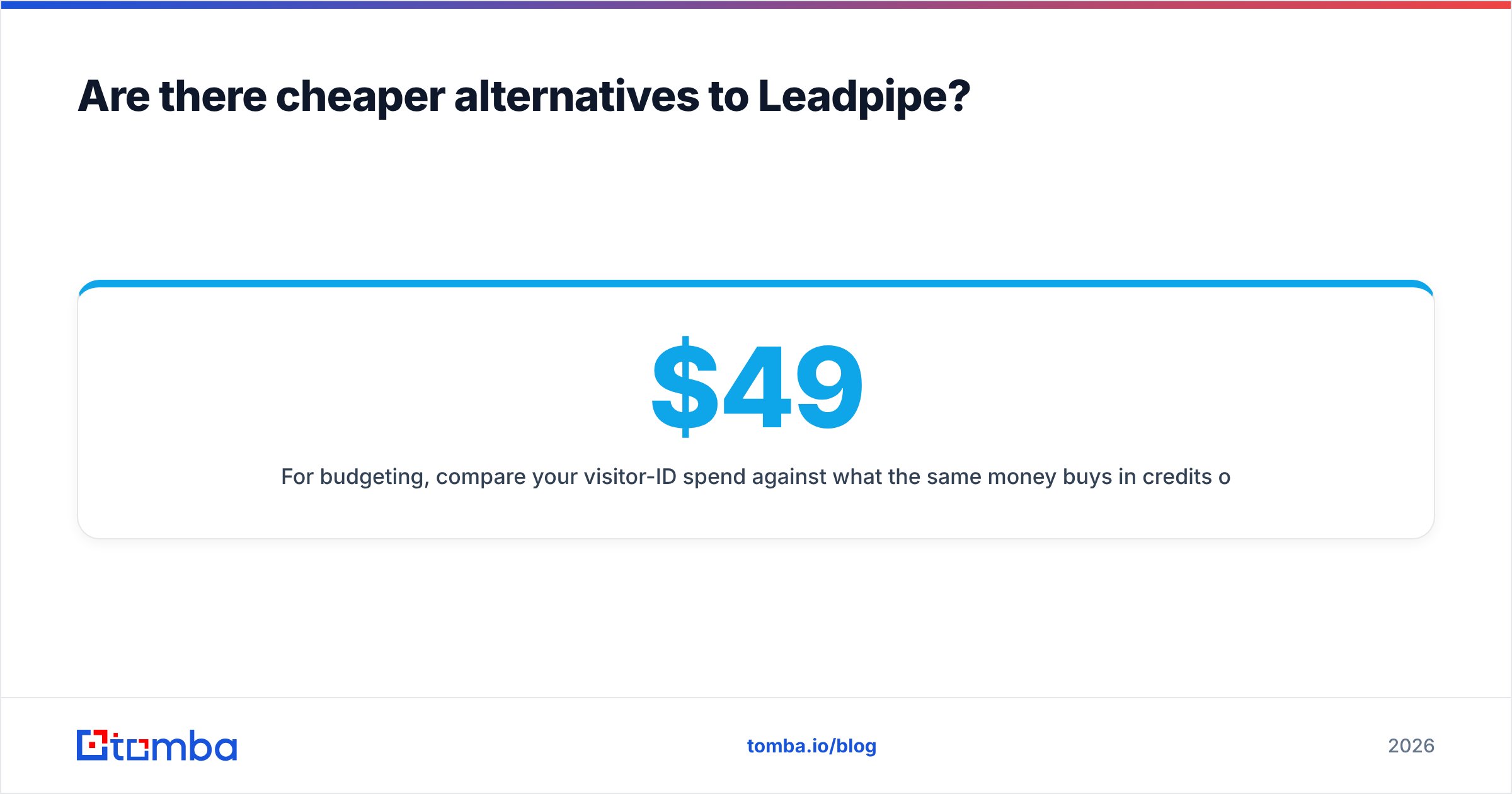
For budgeting, compare your visitor-ID spend against what the same money buys in credits on a contact-data platform. As a reference point, Tomba plans start with a free tier of 25 searches/month, and paid tiers begin at $49/month (Starter), then $99 (Growth) and $249 (Pro). For many teams, pairing an account-level signal with pay-as-you-go contact lookups costs less than a person-level pixel on all their traffic.
Verdict: Leadpipe pricing reviews pros and cons#
Leadpipe is one of the most honestly priced person-level visitor ID tools on the market. The $147 entry point is published, seats are unlimited, there's no contract, and there are no overage surprises. The early G2 reviews are positive about setup and data quality, with the expected rough edges of a young product.
The limits are structural, not something a pricing change would fix. Person-level matching stops at the US border. The review base is still thin. And your real cost per usable lead will likely come in at three to five times the headline $0.29. Weigh the Leadpipe pricing reviews pros and cons above against your own data. Use the free trial on your own traffic, measure cost per verified, in-ICP contact, and decide from that number.
Turn identified accounts into people you can reach. Leadpipe tells you who's browsing, but only for part of your traffic. Tomba Email Finder covers the rest. Enter a company domain or a name and get verified work emails for the decision-makers at accounts already showing intent, in any country. Start with the free tier, test it on your last 30 days of identified accounts, and compare the reply rates yourself.
Related guides#
// get started
Find, verify and enrich your first contacts today
Start on the free plan with 25 searches a month, then scale when your team is ready.
Free plan · No credit card required · GDPR & CCPA
// about the author