Leadrocks vs Market Location: Which B2B Data Source Fits You?
One is a self-serve contact finder for global outbound, the other is a UK business-data specialist that researches records by phone. Here's how Leadrocks and Market Location compare on coverage, pricing, compliance and fit.
TL;DR
- Leadrocks is a self-serve B2B contact database and email finder. It's built for SDRs and founders who pull contacts across many countries and want to export them the same day.
- Market Location is a long-established UK business-data provider. Its strength is researched company and decision-maker records for UK campaigns in direct mail, telemarketing and email.
- If your total addressable market is mostly UK SMEs and mid-market firms, Market Location usually has the more complete company-level picture. If you prospect globally, Leadrocks fits better.
- Pricing works very differently. Leadrocks sells self-serve plans, while Market Location is typically quote-based and priced by list size, selection criteria and licence terms.
- Whichever you pick, verify every email before sending. Neither database replaces a verification step.
What are Leadrocks and Market Location, in one paragraph each?#
Leadrocks (leadrocks.io) is a B2B lead-generation platform. It combines a searchable contact database with an email finder and a browser extension that works alongside LinkedIn profiles. You filter by job title, seniority, industry, company size and geography, reveal contacts with credits, and export to CSV or your outreach tool. The buyer is usually an individual rep, a small sales team or an agency that runs outbound cold email.
Market Location (marketlocation.com) is a UK-based business-data company. It has spent decades building and maintaining a database of British businesses. It is known for researching records through its own team rather than relying only on scraped web sources, and it sells data for marketing campaigns, territory planning and CRM cleansing. The buyer is usually a marketing team, a data or RevOps lead, or a UK-focused sales organisation that needs broad, compliant coverage of companies, including small ones with a thin web footprint.
Put simply, Leadrocks is a prospecting tool with data inside it, and Market Location is a data supplier whose data you use in your other tools.
How do Leadrocks and Market Location compare side by side?#
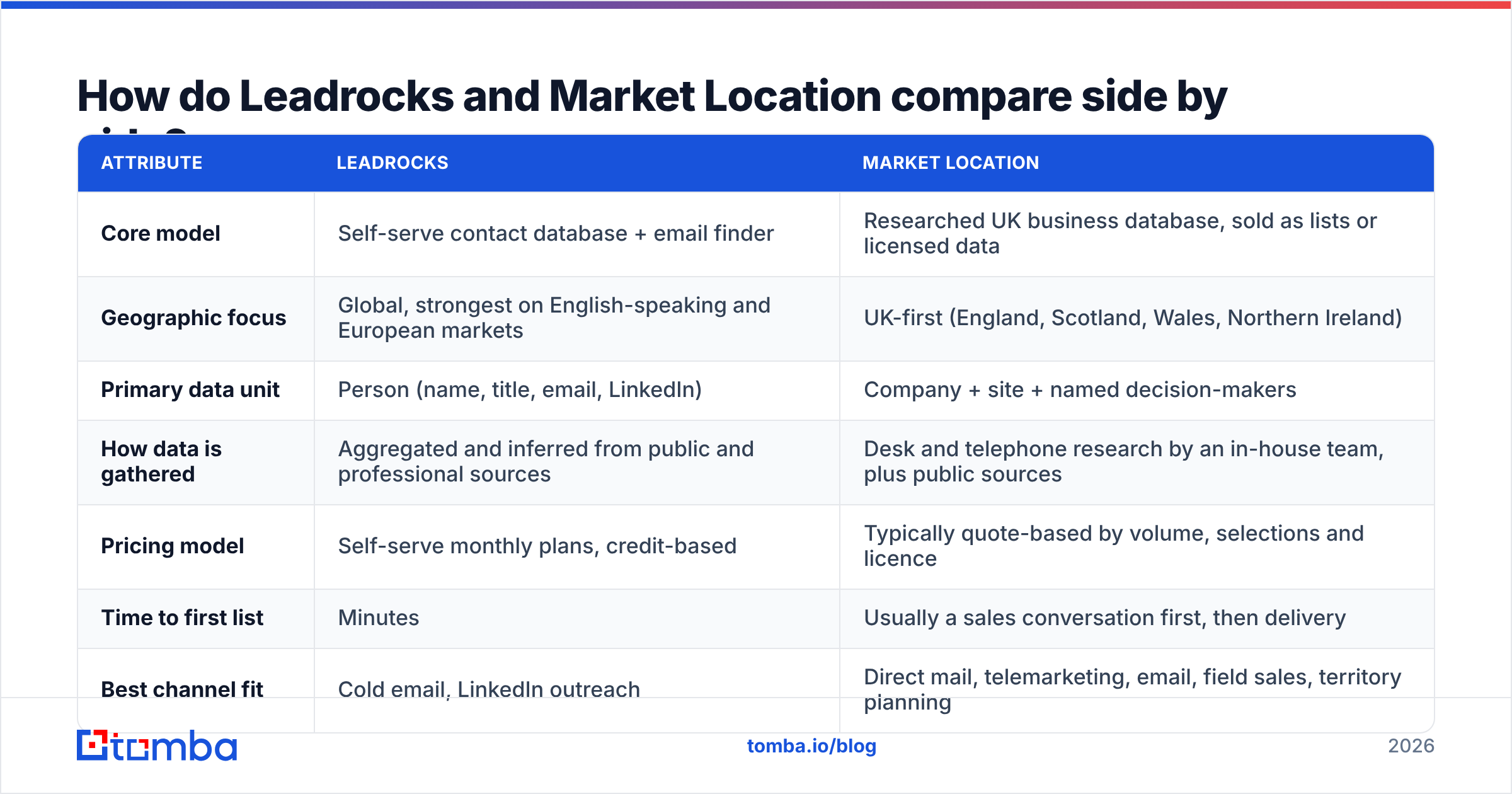
The table below covers what most buyers look at first. Pricing and feature details change often, so check both vendors' current pages before you commit budget.
| Attribute | Leadrocks | Market Location |
|---|---|---|
| Core model | Self-serve contact database + email finder | Researched UK business database, sold as lists or licensed data |
| Geographic focus | Global, strongest on English-speaking and European markets | UK-first (England, Scotland, Wales, Northern Ireland) |
| Primary data unit | Person (name, title, email, LinkedIn) | Company + site + named decision-makers |
| How data is gathered | Aggregated and inferred from public and professional sources | Desk and telephone research by an in-house team, plus public sources |
| Pricing model | Self-serve monthly plans, credit-based | Typically quote-based by volume, selections and licence |
| Time to first list | Minutes | Usually a sales conversation first, then delivery |
| Best channel fit | Cold email, LinkedIn outreach | Direct mail, telemarketing, email, field sales, territory planning |
| Compliance posture | GDPR positioning, B2B legitimate-interest use | Built around UK GDPR and PECR, suppression screening (e.g. TPS/CTPS) commonly offered |
| Ideal buyer | SDR, founder, lead-gen agency | UK marketing team, RevOps, data manager |
What decides it is where your buyers are and which channel you're using, not which vendor is "better". Both are legitimate. They solve different problems.

Which tool has better data coverage?#
This depends on the market, and it's the most important question in this comparison.
For UK companies, Market Location has the edge on breadth. A lot of UK businesses are small: independent manufacturers, regional distributors, family-run professional-services firms. Many of them have little LinkedIn presence and a basic website. Person-centric databases built from professional-network signals miss these firms or hold only one or two contacts for them. A researched database that starts from the company and works outward to the decision-makers covers that long tail better. If you sell to UK facilities managers, practice owners or operations directors at 20–200-person firms, this matters.
For global and tech-heavy markets, Leadrocks is more practical. If your ideal customer profile is "VP Sales at B2B SaaS companies with 50–500 employees in the US, UK and DACH", a person-first database with LinkedIn-adjacent enrichment is faster to search and export. Market Location is not designed for multi-country outbound.
Company data compared with contact data. Market Location records usually carry richer firmographics, such as site-level addresses, SIC codes, employee bands and turnover bands. That's useful for segmentation and territory design. Leadrocks records are richer at the person level, especially job title and LinkedIn URL, which is useful for personalised outreach.
To check coverage fairly, take 50 accounts from your real target list and request samples or trial reveals from both vendors. Count three things: how many accounts come back, how many have at least one decision-maker, and how many emails pass verification. That small test will tell you more than any vendor's headline database size.
How is data accuracy handled on each platform?#
Think of data accuracy like milk: it's only as good as its date. B2B data decays because people change jobs, companies rebrand and domains move. Industry estimates commonly put contact-data decay at 20–30% a year.
Leadrocks handles freshness mainly through aggregation and email verification at the point of reveal. That gives good results for active, web-visible professionals. Accuracy can drop on catch-all domains and at smaller firms where the email pattern has to be inferred.
Market Location puts its research process first. Records are checked by researchers, often over the phone, which is slower and costlier to run but tends to produce reliable company-level data and correct named contacts for smaller UK businesses. The trade-off is that a phone-verified contact name doesn't always come with a verified direct email. Some records carry a generic or switchboard-style address instead.
Neither approach removes the need to check emails before you send. Bounce rates above roughly 2–3% put your sender reputation at risk no matter who supplied the list. Run exports through an email verifier before they reach your sequencer, and treat "accept-all" results as a separate, lower-volume segment.
How much do Leadrocks and Market Location cost?#
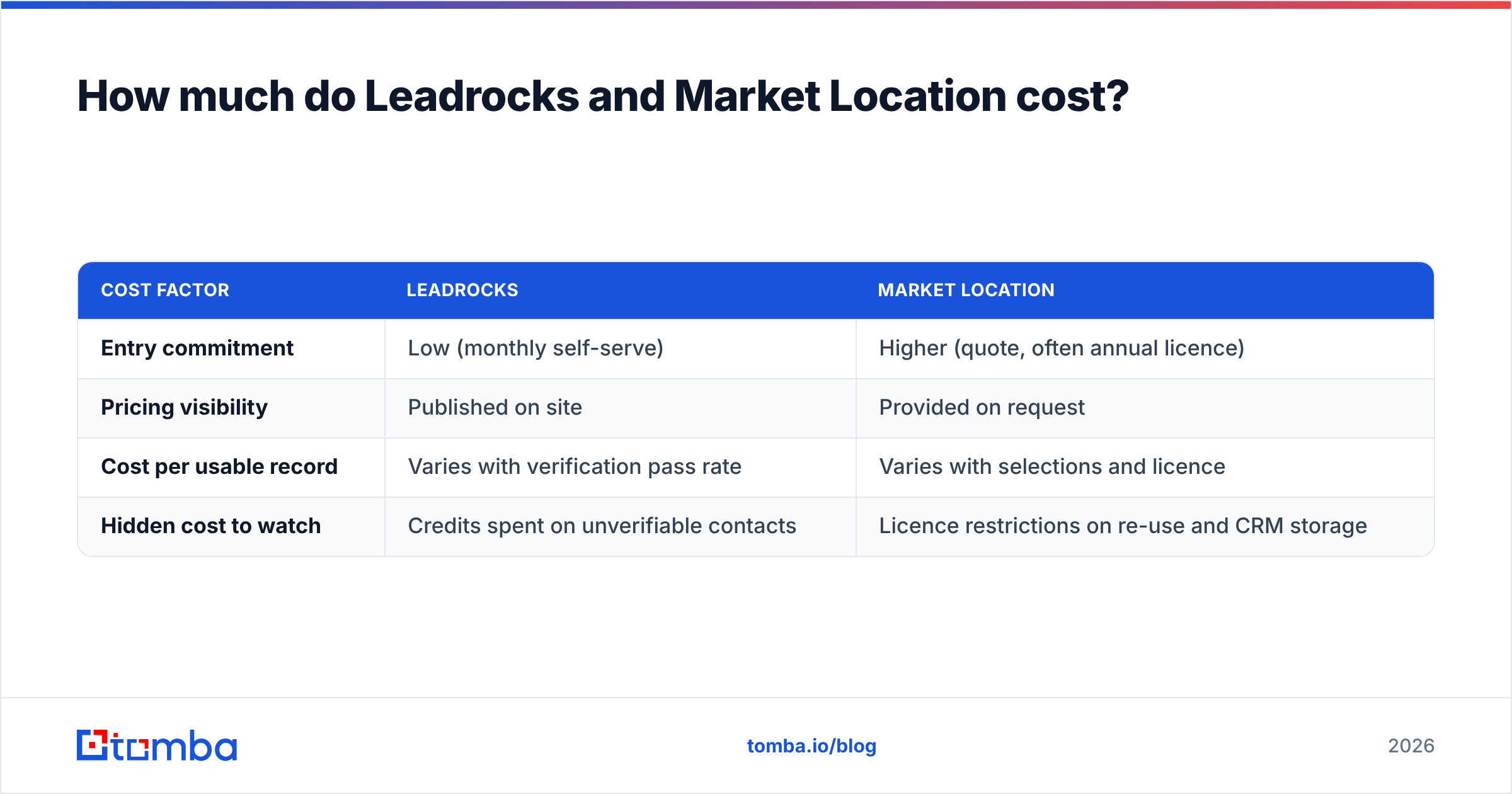
The pricing philosophies differ, and that affects your total cost more than any single price.
Leadrocks uses self-serve SaaS pricing. You choose a monthly plan that includes a set number of contact reveals or exports, and higher plans unlock more credits and team features. Check leadrocks.io for current tiers, because credit allowances change. The model suits you if you want predictable monthly spend and the ability to cancel.
Market Location generally prices by quote. Cost depends on:
- Volume: how many company and contact records you license.
- Selection criteria: filtering by SIC code, region, employee band, turnover and job function can change the price.
- Data fields: email, telephone, postal address and firmographics may be priced differently.
- Licence type: single-use campaign lists vs. 12-month multi-use licences vs. ongoing data feeds.
- Services: CRM cleansing, suppression screening and data appending are often add-ons.
In practice, Leadrocks is cheaper to start with and easier to test. Market Location can be very cost-effective per record for a large, well-defined UK campaign, especially one that uses postal or telephone channels, but you'll need to talk to sales before you see a number.
| Cost factor | Leadrocks | Market Location |
|---|---|---|
| Entry commitment | Low (monthly self-serve) | Higher (quote, often annual licence) |
| Pricing visibility | Published on site | Provided on request |
| Cost per usable record | Varies with verification pass rate | Varies with selections and licence |
| Hidden cost to watch | Credits spent on unverifiable contacts | Licence restrictions on re-use and CRM storage |
Which one is more compliant for UK and EU outreach?#
Both vendors position themselves as GDPR-aware. But compliance comes down to how you use the data, not only where you bought it.
In the UK, B2B email marketing falls under UK GDPR and PECR. Corporate subscribers (limited companies, LLPs) can generally receive B2B marketing emails under legitimate interest, provided you identify yourself and include an opt-out. Sole traders and some partnerships are treated as individuals and need consent. The ICO publishes guidance on this distinction, and it matters a lot for UK SME lists.
This is where Market Location's UK focus pays off. A UK-specialist provider is more likely to flag company type, offer TPS/CTPS screening for telephone campaigns, and document data provenance in a way your DPO will accept. Leadrocks can be used compliantly too, but the job of segmenting by entity type and handling opt-outs falls more on you.
Whichever you choose, keep a record of your legitimate-interest assessment and your data source. Honour opt-outs across every tool you use.
When should you choose Leadrocks?#
Choose Leadrocks when these match your situation:
- You prospect outside the UK, or across several countries at once.
- Your buyers are active on LinkedIn, e.g. tech, SaaS, agencies and professional services.
- Cold email and LinkedIn outreach are your main channels, so you need person-level emails more than postal addresses.
- You want to self-serve: sign up, search, export and send the same afternoon.
- Your budget is small or experimental, and you'd rather pay monthly than sign a licence.
Leadrocks is a practical choice for founders doing their own outbound and for lead-gen agencies running several client campaigns.
When should you choose Market Location?#
Choose Market Location when these match your situation:
- Your addressable market is mostly UK businesses, especially SMEs with a light digital footprint.
- You run multichannel campaigns that include direct mail, telemarketing or field sales, not only email.
- You need firmographic depth (site addresses, SIC codes, turnover and headcount bands) for segmentation or territory planning.
- Compliance review is strict and you need documented provenance and suppression screening.
- You want a data partner that can also cleanse and append your existing CRM records.
Market Location suits UK marketing departments, franchise networks, wholesalers and B2B service firms whose customers are spread across British towns rather than concentrated in tech hubs.

Can you use Leadrocks and Market Location together?#
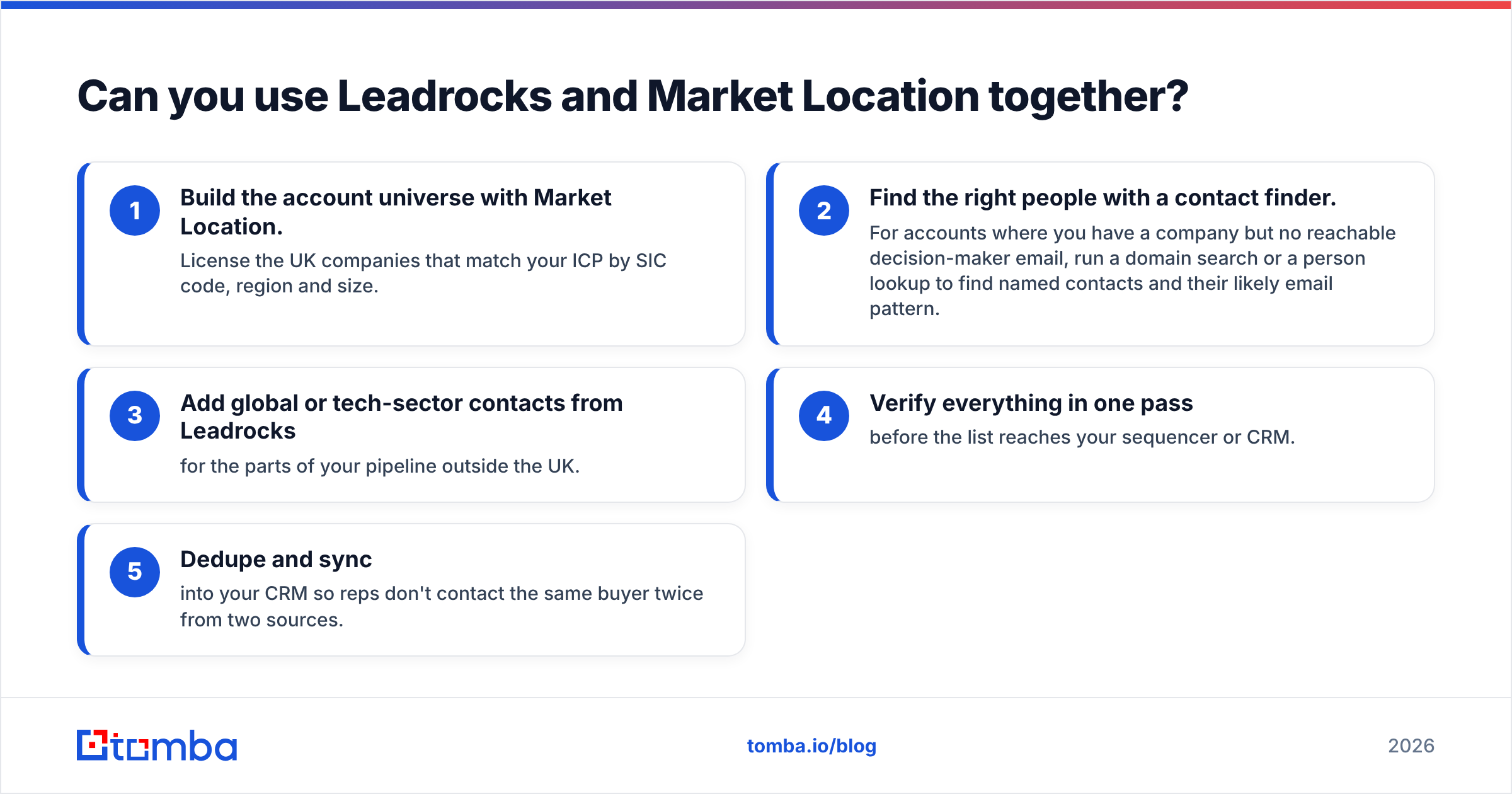
Yes, and many UK teams do. A common setup looks like this:
- Build the account universe with Market Location. License the UK companies that match your ICP by SIC code, region and size.
- Find the right people with a contact finder. For accounts where you have a company but no reachable decision-maker email, run a domain search or a person lookup to find named contacts and their likely email pattern.
- Add global or tech-sector contacts from Leadrocks for the parts of your pipeline outside the UK.
- Verify everything in one pass before the list reaches your sequencer or CRM.
- Dedupe and sync into your CRM so reps don't contact the same buyer twice from two sources.
This combined approach costs more to run, but it closes the biggest gap in each tool. Market Location is thin on direct emails for some records, and Leadrocks is thin on small UK companies.
What about alternatives to both?#
If neither fits well, look at your actual job to be done. If you mainly need verified professional emails for companies you already know, you may not need a full database licence at all. A domain-based email finder with built-in verification can be cheaper and more accurate for that use case. Review sites like G2 are useful for shortlisting, but always run your own 50-account test before you trust any vendor's figures.
Tomba is one option in that category. It's an email finder first, with domain search, email verification, a catch-all verifier, phone finder and enrichment alongside it. Tomba pricing starts with a free tier (25 searches a month), then Starter at $49/mo, Growth at $99/mo and Pro at $249/mo, with custom Enterprise plans. It doesn't replace Market Location's researched UK firmographics, and it isn't a list-licensing service. It works best as the "find and verify the person" layer next to whichever database you choose.
So, Leadrocks vs Market Location: which should you pick?#
- Pick Leadrocks if you're an outbound-first team prospecting globally or in tech-heavy markets, and you want self-serve access to person-level contacts at a predictable monthly cost.
- Pick Market Location if you're UK-focused, sell to a broad range of SMEs and mid-market firms, use more than one channel, and need researched company data with a clear compliance trail.
- Use both if you need Market Location's UK account coverage and a contact finder to fill in reachable decision-makers.
Before you sign anything, run the same 50 real target accounts through each option. Measure match rate, decision-maker coverage and verified-email pass rate, then divide cost by usable records. That number is the fair comparison.
Whichever database you choose, you'll still hit accounts with no reachable decision-maker email. That's where Tomba Email Finder helps. Enter a name and company domain and it returns a professional email address with verification built in, so your Leadrocks or Market Location lists become contacts you can actually send to. You can start free with 25 searches a month and move to Starter at $49/mo when you're ready to scale.
Related guides#
// get started
Find, verify and enrich your first contacts today
Start on the free plan with 25 searches a month, then scale when your team is ready.
Free plan · No credit card required · GDPR & CCPA
// about the author