LeadRocks vs OutboundView: Self-Serve Data or Done-for-You Outbound?
LeadRocks sells you a B2B contact database. OutboundView sells you booked meetings with HR buyers. Here is how to tell which one fits your team, budget, and market in 2026.
TL;DR
- LeadRocks is a self-serve B2B contact database and LinkedIn extension. You pay for credits and your own team does the prospecting, writing, and sending.
- OutboundView is a US sales development agency. Its SDRs book meetings for you, and most of its clients sell to HR and learning & development (L&D) buyers.
- The two products don't do the same job. LeadRocks is a data tool with low monthly costs. OutboundView is an outsourced service priced by quote, and it usually costs far more because you're paying for people.
- Pick LeadRocks if you already have reps and a sequencer and just need contacts. Pick OutboundView if you sell into HR, need pipeline quickly, and have nobody to run outbound.
- With either one, verify every email before a campaign goes out. Contact data goes stale fast, and bounces hurt your domain no matter where the list came from.
Searches for "LeadRocks vs OutboundView" often come from people who expect two competing apps. That isn't what you're comparing. One is software you run yourself. The other is a team you hire. So the real decision is about how you want to build pipeline, and the features matter less.
This guide covers what each company actually sells, what each costs in practice, where each one fits, and the workflow mistakes that hurt teams using either one.
What is LeadRocks?#
LeadRocks is a B2B contact database with prospecting tools built around it. The vendor says it holds more than 100 million business records with work emails, phone numbers, and LinkedIn profile links. You can use it in two main ways:
- Web app search. Filter by job title, industry, company size, and location, then export contacts.
- Chrome extension. Open a LinkedIn search or profile and pull contact details for the people on the page.
It also has an email verifier for checking lists you got elsewhere, plus an API for teams that want to pipe data into their own systems.
On pricing, LeadRocks is at the budget end. Third-party listings describe a free plan with about 50 monthly credits, and paid tiers from roughly $29/mo up to several hundred dollars a month for high volume. It has also sold lifetime deals through AppSumo, which explains why so many small agencies and solo founders use it. Check the current price on the vendor's site before you buy, because credit bundles change.
The trade-off is data quality. The vendor advertises high accuracy, but independent reviewers have reported widely varying valid-email rates in their tests. That's common with big, cheap databases. A large index also has more stale records, so your cost per usable contact can be well above the sticker price per credit.
What is OutboundView?#
OutboundView is a B2B sales development agency based in Franklin, Tennessee. Blake Johnston founded it in 2017. It doesn't sell a database subscription in the usual sense. It sells outcomes: qualified meetings, cold-calling capacity, and consulting on outbound playbooks.
Its public offerings fall into three areas:
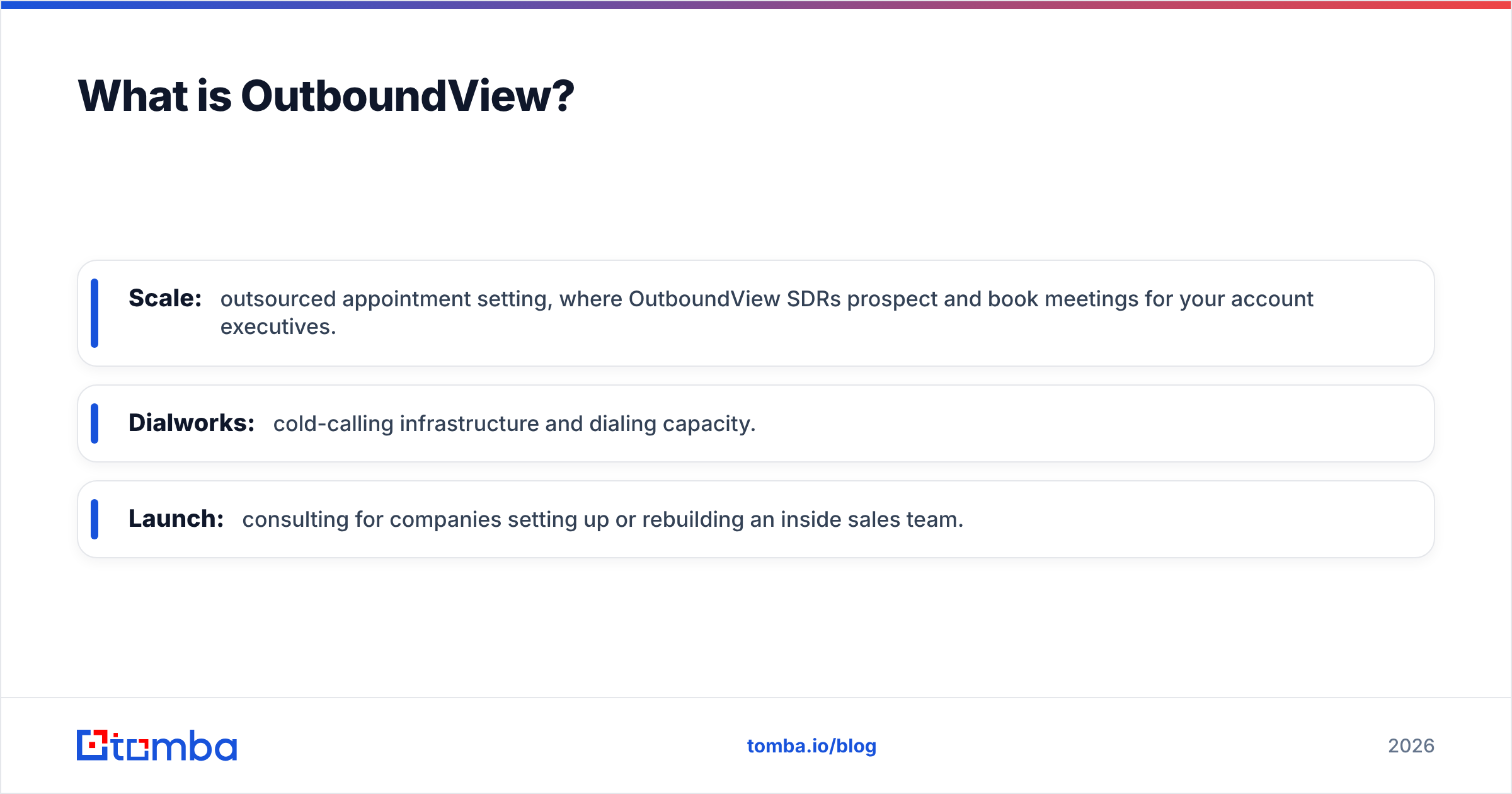
- Scale: outsourced appointment setting, where OutboundView SDRs prospect and book meetings for your account executives.
- Dialworks: cold-calling infrastructure and dialing capacity.
- Launch: consulting for companies setting up or rebuilding an inside sales team.
It also runs TalentView, a proprietary, human-verified database of HR buyers in North America. Public descriptions put it at more than half a million contacts, with validated emails and buyer-intent signals.
The niche is what sets OutboundView apart. Most of its clients sell HR tech, corporate training, benefits, PEO services, or other products bought by HR and L&D leaders. It does work in other verticals too, but the vertical focus is the main thing you're buying. Its SDRs already know how a CHRO or an L&D director buys, which objections they raise, and which titles hold budget.
There's no public price list. Pricing is by custom quote. Across the US, outsourced SDR programs are usually priced as a monthly retainer, sometimes combined with per-meeting fees, and they commonly cost thousands of dollars per month. Treat that as a market range and ask OutboundView for its actual number.
How do LeadRocks and OutboundView compare side by side?#
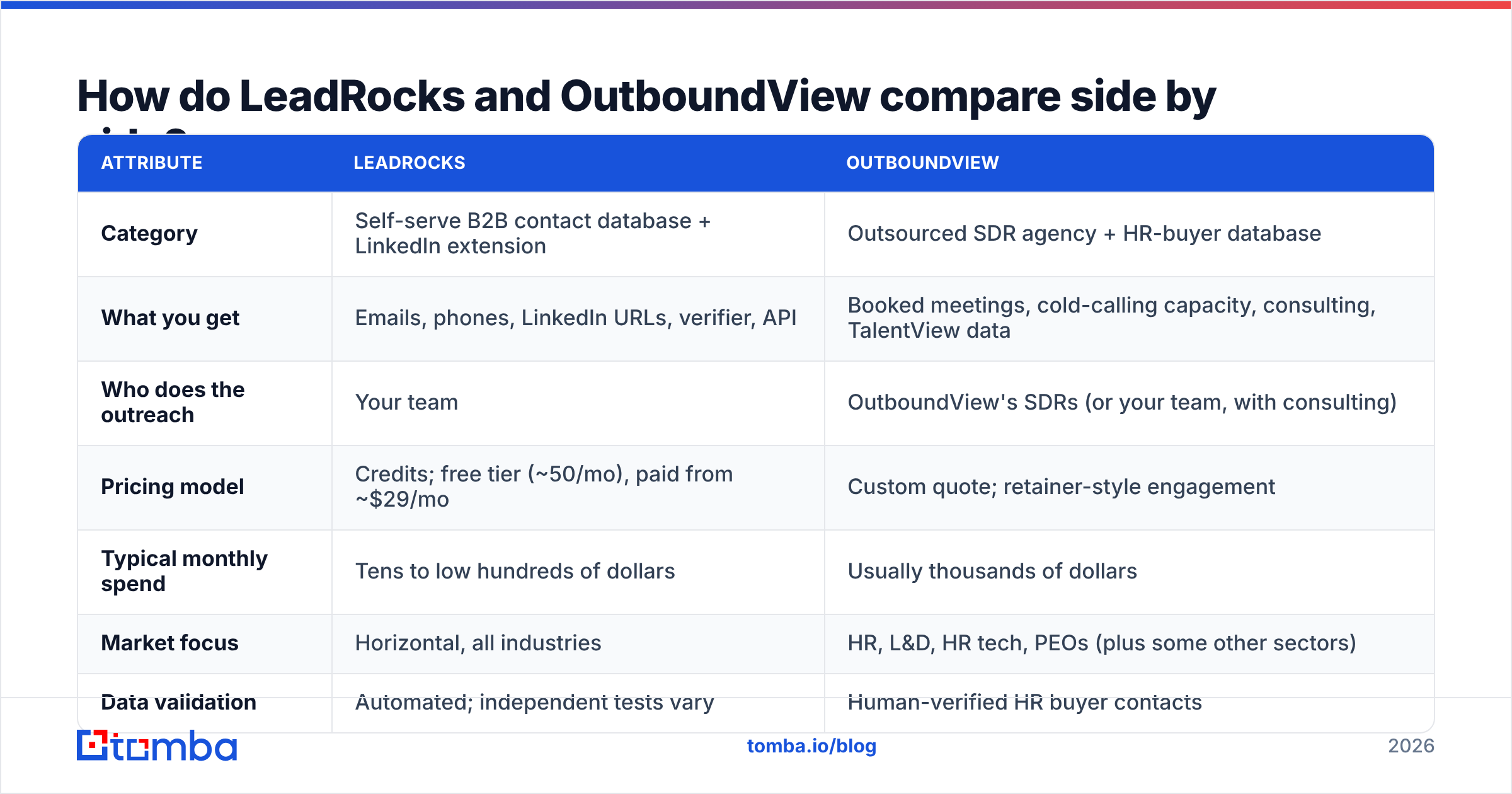
The table below compares them on the points that matter most when you're choosing between a data tool and an agency.
| Attribute | LeadRocks | OutboundView |
|---|---|---|
| Category | Self-serve B2B contact database + LinkedIn extension | Outsourced SDR agency + HR-buyer database |
| What you get | Emails, phones, LinkedIn URLs, verifier, API | Booked meetings, cold-calling capacity, consulting, TalentView data |
| Who does the outreach | Your team | OutboundView's SDRs (or your team, with consulting) |
| Pricing model | Credits; free tier (~50/mo), paid from ~$29/mo | Custom quote; retainer-style engagement |
| Typical monthly spend | Tens to low hundreds of dollars | Usually thousands of dollars |
| Market focus | Horizontal, all industries | HR, L&D, HR tech, PEOs (plus some other sectors) |
| Data validation | Automated; independent tests vary | Human-verified HR buyer contacts |
| Time to first meeting | Depends on your team's speed | Agency ramp period, then steady meeting flow |
| Best for | Founders, SDR teams, agencies with their own sending setup | Companies selling to HR without an in-house SDR function |
| Main risk | Bounce rates if you skip verification | High fixed cost; less control over messaging |
Put simply, LeadRocks gives you inputs and OutboundView gives you outputs. With LeadRocks you still have to write copy, set up sending domains, run sequences, and follow up. OutboundView does most of that for you and charges accordingly.
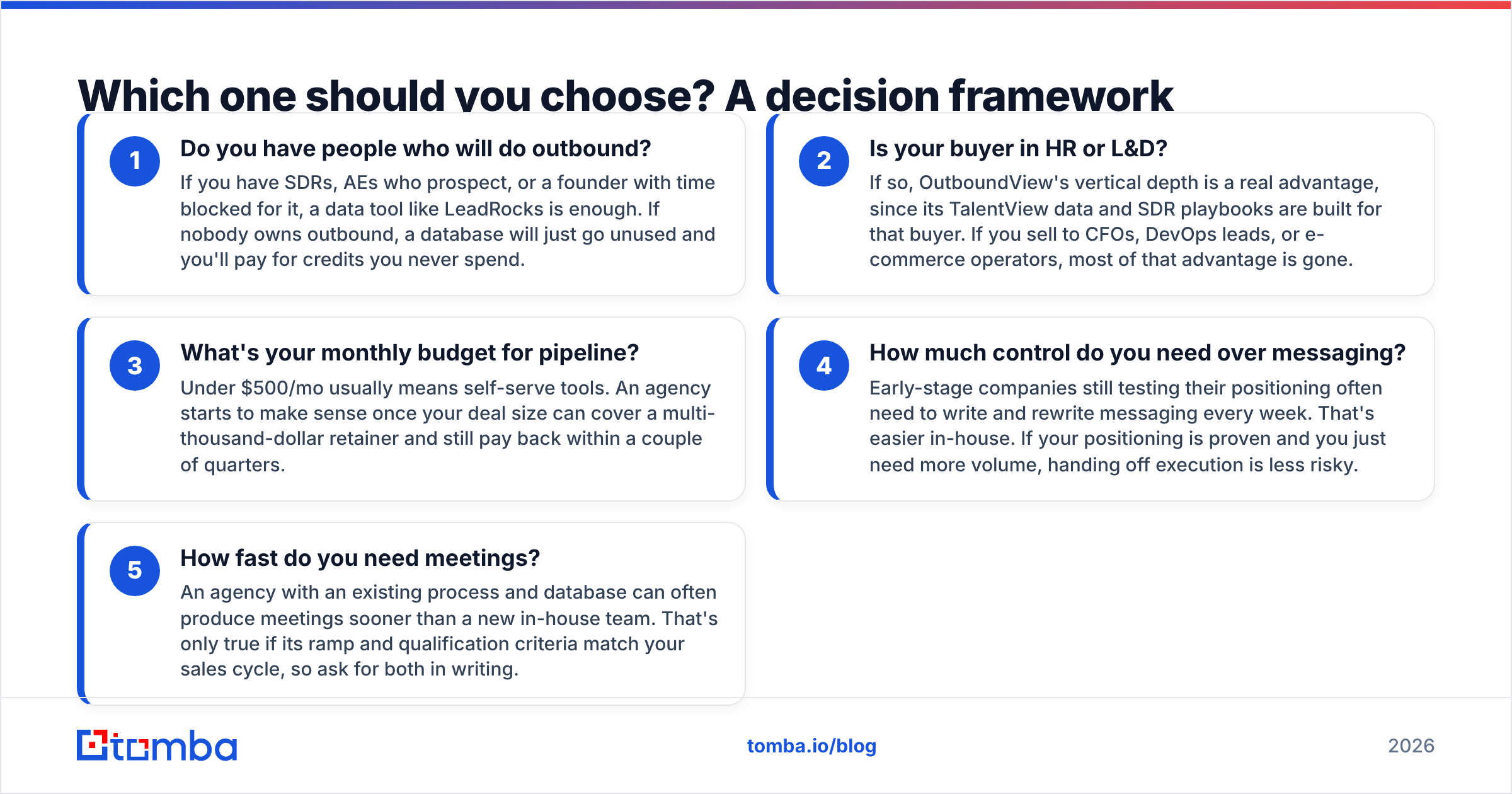
Which one should you choose? A decision framework#
You don't need a feature-by-feature scorecard. Answer these five questions in order:
- Do you have people who will do outbound? If you have SDRs, AEs who prospect, or a founder with time blocked for it, a data tool like LeadRocks is enough. If nobody owns outbound, a database will just go unused and you'll pay for credits you never spend.
- Is your buyer in HR or L&D? If so, OutboundView's vertical depth is a real advantage, since its TalentView data and SDR playbooks are built for that buyer. If you sell to CFOs, DevOps leads, or e-commerce operators, most of that advantage is gone.
- What's your monthly budget for pipeline? Under $500/mo usually means self-serve tools. An agency starts to make sense once your deal size can cover a multi-thousand-dollar retainer and still pay back within a couple of quarters.
- How much control do you need over messaging? Early-stage companies still testing their positioning often need to write and rewrite messaging every week. That's easier in-house. If your positioning is proven and you just need more volume, handing off execution is less risky.
- How fast do you need meetings? An agency with an existing process and database can often produce meetings sooner than a new in-house team. That's only true if its ramp and qualification criteria match your sales cycle, so ask for both in writing.
If your answers were mostly "we have people, we're not HR-focused, the budget is tight," choose LeadRocks or another self-serve data tool. If they were "no outbound team, HR buyers, healthy deal size," OutboundView is a better fit.
What are the pros and cons of LeadRocks?#
Pros
- Low entry cost, including a free tier, so you can test before committing.
- LinkedIn extension fits the way most SDRs already prospect.
- Broad horizontal coverage across industries and regions.
- Built-in verifier and API let technical teams automate enrichment.
- Unlimited users on some plans helps small agencies share one account.
Cons
- Valid-email rates in third-party tests vary widely, so you need a separate verification step.
- Credits are used on every lookup, including ones that return stale data.
- No intent data or human validation comparable to specialist databases.
- It's only data. You still need a sequencer, copy, and a deliverability setup.
What are the pros and cons of OutboundView?#
Pros
- Done-for-you appointment setting removes the hiring, training, and management of SDRs.
- Deep HR and L&D specialization, with a human-verified buyer database.
- Cold calling is included via Dialworks, which many email-only tools and agencies skip.
- Consulting helps you build an in-house team later instead of renting one forever.
Cons
- Pricing isn't published and is much higher than a data subscription.
- The advantage shrinks if you sell outside HR-adjacent markets.
- Your messaging is only partly in your control. Brand voice and qualification standards need close alignment.
- Like any agency, results depend on the account team assigned to you. Ask for references in your segment.
For neutral user sentiment on both, look at review aggregators such as G2, which lists B2B data tools and sales development agencies. Weight reviews from companies your size in your vertical, not the overall star rating.
Where does verification fit into either workflow?#
Whether your contacts come from a cheap database, a premium database, or an agency's internal list, email data decays. People change jobs, companies rebrand, and domains switch mail providers. B2B contact data is commonly estimated to decay by roughly a quarter or more every year.
That matters more to you than to your vendor. When a list with a 10% bounce rate goes out, the vendor's domain isn't affected. Yours is. High bounce rates lead mailbox providers to throttle or spam-folder your future sends, and that damage takes weeks to repair.
So the rule is the same for both options:
- With LeadRocks: run every export through an email verifier before it goes into your sequencer. Take out invalid addresses, handle catch-all domains separately, and send only to "deliverable" results.
- With OutboundView: if the agency sends from domains you own, ask what verification it runs and what bounce-rate threshold it uses. Put that in the contract.

Are there alternatives worth considering?#
You may not need either one. There are other options between "cheap database" and "full-service agency":
- A precise email finder plus your own sequencer. If you already know who you want to reach (a named-account list, conference attendees, a LinkedIn saved search), you don't need a 100-million-record database. You need an accurate way to find email addresses for specific people at specific domains. This usually costs less per usable contact because you only pay for people you actually target.
- LinkedIn-first workflows. If your reps already live in Sales Navigator, a LinkedIn finder that returns verified emails from profiles gets you most of the LeadRocks extension experience without a separate database subscription.
- An all-in-one platform. Tools that bundle data, sequencing, and dialing suit teams that want fewer vendors. They are usually horizontal, like LeadRocks, not HR-specialized like OutboundView.
- Freelance or fractional SDRs. They sit between an agency and a hire, with lower commitment than a retainer. The quality varies more.
Whichever route you take, compare cost per verified contact or cost per qualified meeting, not cost per credit or cost per month. A $29 plan that returns half-valid data can cost more per real conversation than a pricier source that returns mostly deliverable emails.
How should you calculate the real cost?#
Here's a quick way to compare a data tool and an agency directly.
Data tool (LeadRocks-style) cost per meeting:
- Monthly subscription + verification cost + sequencer cost + the loaded cost of the rep's time
- Divided by meetings booked that month
Agency (OutboundView-style) cost per meeting:
- Monthly retainer + any per-meeting fees
- Divided by qualified meetings delivered (use the agency's qualification definition, and check that it matches yours)
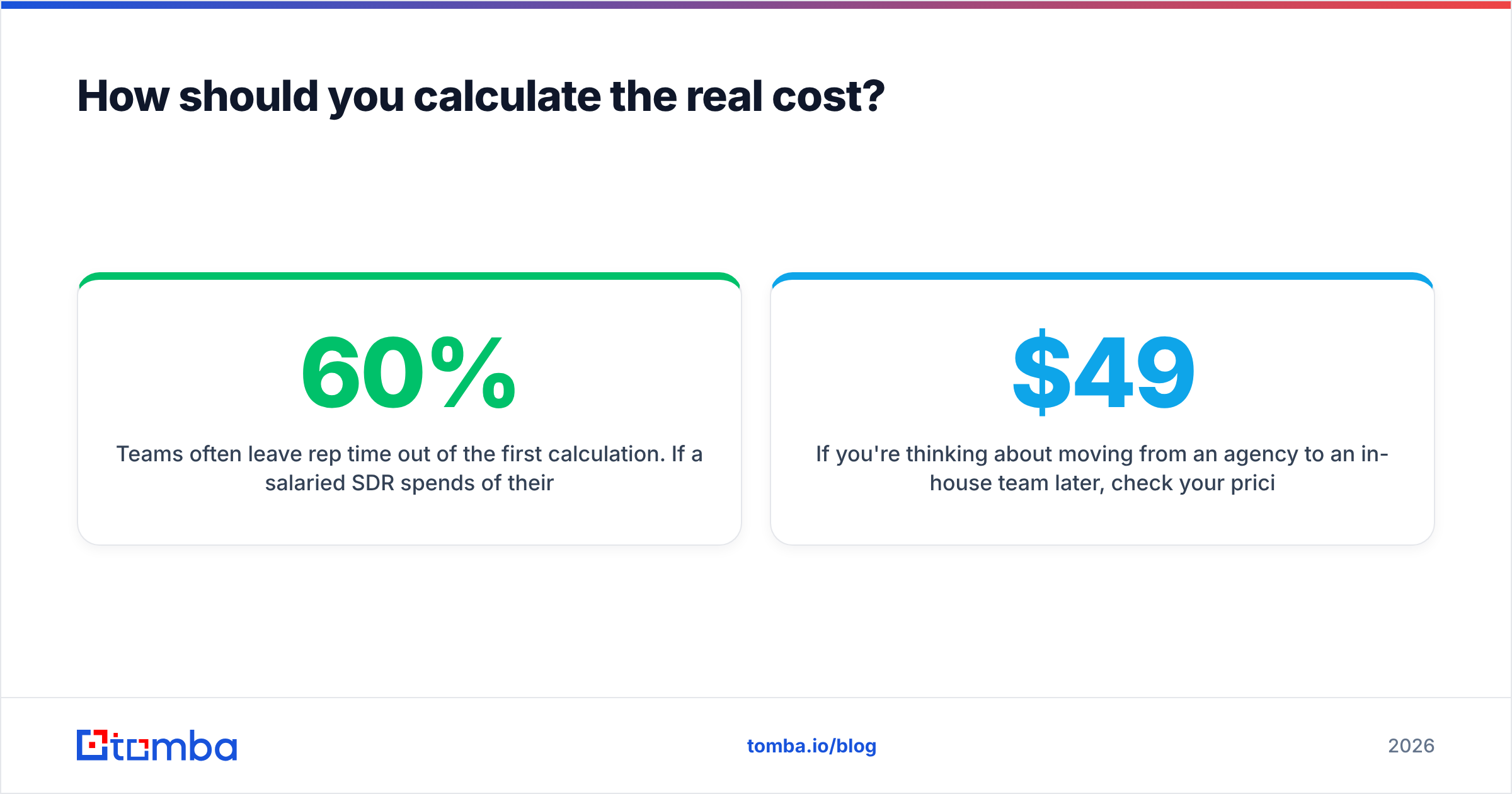
Teams often leave rep time out of the first calculation. If a salaried SDR spends 60% of their week building lists and sending sequences, that salary is part of your data cost. After you include it, the gap between a $49 tool and a multi-thousand-dollar agency usually gets smaller, although it rarely disappears for small teams.
If you're thinking about moving from an agency to an in-house team later, check your pricing assumptions against the plan you'd actually use. For example, Tomba pricing runs from a free tier with 25 searches a month to Starter at $49/mo, Growth at $99/mo, and Pro at $249/mo. That gives you a realistic data-cost line for an in-house model.
So, LeadRocks vs OutboundView: which wins?#
Neither one is better overall, because they solve different problems.
- LeadRocks wins for teams that already do outbound and want cheap, broad contact data they control. Plan to budget time and tools for verification.
- OutboundView wins for companies selling to HR and L&D buyers that want meetings without building an SDR function, and whose deal sizes justify agency pricing.
If you're still unsure, look at your org chart. If someone on it owns outbound, buy data. If nobody does, and your buyer is in HR, OutboundView is worth talking to.
Ready to build your own outbound pipeline?#
If you've decided to keep prospecting in-house, the most important part of your stack is accurate contact data for the specific people you want to reach. Tomba Email Finder finds professional email addresses from a name and company or domain, and you can check each result with Tomba's built-in verifier before it goes into a sequence. Start on the free tier with 25 searches a month, test it against your own target accounts, and upgrade once the valid-email rate proves itself.
Related guides#
// get started
Find, verify and enrich your first contacts today
Start on the free plan with 25 searches a month, then scale when your team is ready.
Free plan · No credit card required · GDPR & CCPA
Get the Tomba newsletter
Product and data updates
// about the author