Leadrocks vs Sparklane (2026): Contact Data or Sales Signals?
Leadrocks sells you contacts. Sparklane tells you which accounts to call and when. Here is how the two compare on data, signals, pricing and GDPR fit, and which one suits your team in 2026.
TL;DR
- Leadrocks is a self-serve B2B contact database with a LinkedIn Chrome extension. You pay for credits and get names, titles and emails fast. It suits SDRs and small teams who already know who they want to reach.
- Sparklane is a predictive sales-intelligence platform with deep roots in France and Europe. It watches business signals like funding, hiring and relocations, then scores accounts so you know when to reach out. You buy it on a quote-based, usually annual contract.
- They don't really compete. Leadrocks answers "what's this person's email?" Sparklane answers "which companies should we call this week?"
- If you're a small outbound team on a budget, start with Leadrocks. If you're a mid-market or enterprise team selling mainly into France and the EU, and your CRM is already in good shape, Sparklane is the stronger choice.
- Whichever you pick, verify emails before you send. Neither database removes the need for a separate verification step.
What are Leadrocks and Sparklane, in one sentence each?#
Most people searching "leadrocks vs sparklane" assume the two products do the same job. They don't. Here is a short way to put it:
- Leadrocks is like a phone book you search from inside LinkedIn. You find a person and reveal their contact details.
- Sparklane is like a news desk that watches thousands of companies and tells you which ones just became worth a call.
Leadrocks (leadrocks.io) sells access to a large database of B2B contacts. You search it through a web app and a Chrome extension that sits on top of LinkedIn and Sales Navigator. You spend credits to reveal emails, then export to CSV or push the contacts to your outreach tool.
Sparklane (sparklane.com) started in Nantes, France, as a predictive prospecting platform. Its main value is account-level intelligence: company data, trigger events and AI-driven scoring, delivered into the CRM your team already uses. Contact data is included, but it isn't the headline feature.
That difference affects every other comparison in this post: price, onboarding, who uses it and what "accuracy" means for each tool.
How do Leadrocks and Sparklane compare feature by feature?#
Here is the side-by-side view. Pricing and plan details change often, so treat the figures below as directional and check each vendor's current pricing page before you buy.
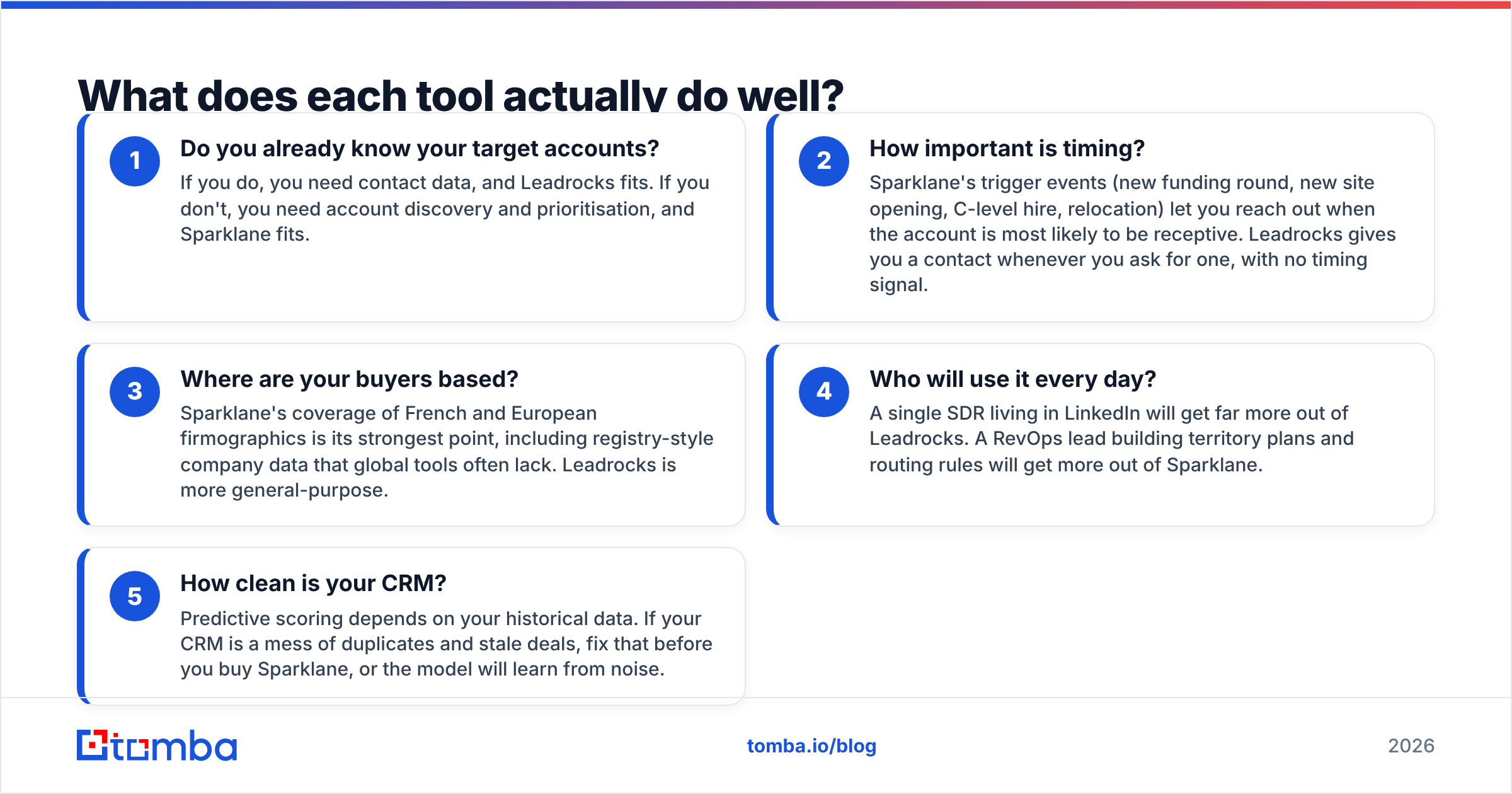
| Attribute | Leadrocks | Sparklane |
|---|---|---|
| Core job | Find and export contact emails | Identify and prioritise target accounts |
| Primary unit | Person (contact) | Company (account) + signals |
| Geographic strength | Global, English-speaking markets strongest | France and Western Europe strongest |
| Buying motion | Self-serve, credit-based, monthly | Sales-led demo, quote-based, typically annual |
| Entry price | Low monthly tiers plus a free trial | Custom quote; higher annual commitment |
| LinkedIn extension | Yes, a core workflow | Not the main workflow |
| Buying signals / intent | Minimal | Core feature (funding, hiring, moves, news) |
| Predictive account scoring | No | Yes |
| CRM integrations | CSV export plus common outreach/CRM connectors | Native Salesforce, HubSpot, Microsoft Dynamics focus |
| Time to first value | Minutes | Weeks (setup, ICP modelling, CRM sync) |
| Best for | SDRs, founders, agencies | Mid-market/enterprise sales and RevOps teams |
Which tool is easier to start with?#
Leadrocks, by a long way. You sign up, install the extension, open a LinkedIn search and start revealing contacts. There's no ideal-customer-profile workshop and no CRM mapping.
Sparklane expects some onboarding. The scoring model works best after you've defined your ICP, connected your CRM and let the platform learn from past wins. That extra effort is where its value comes from, but it means you won't see results the same afternoon.
What does each tool actually do well?#
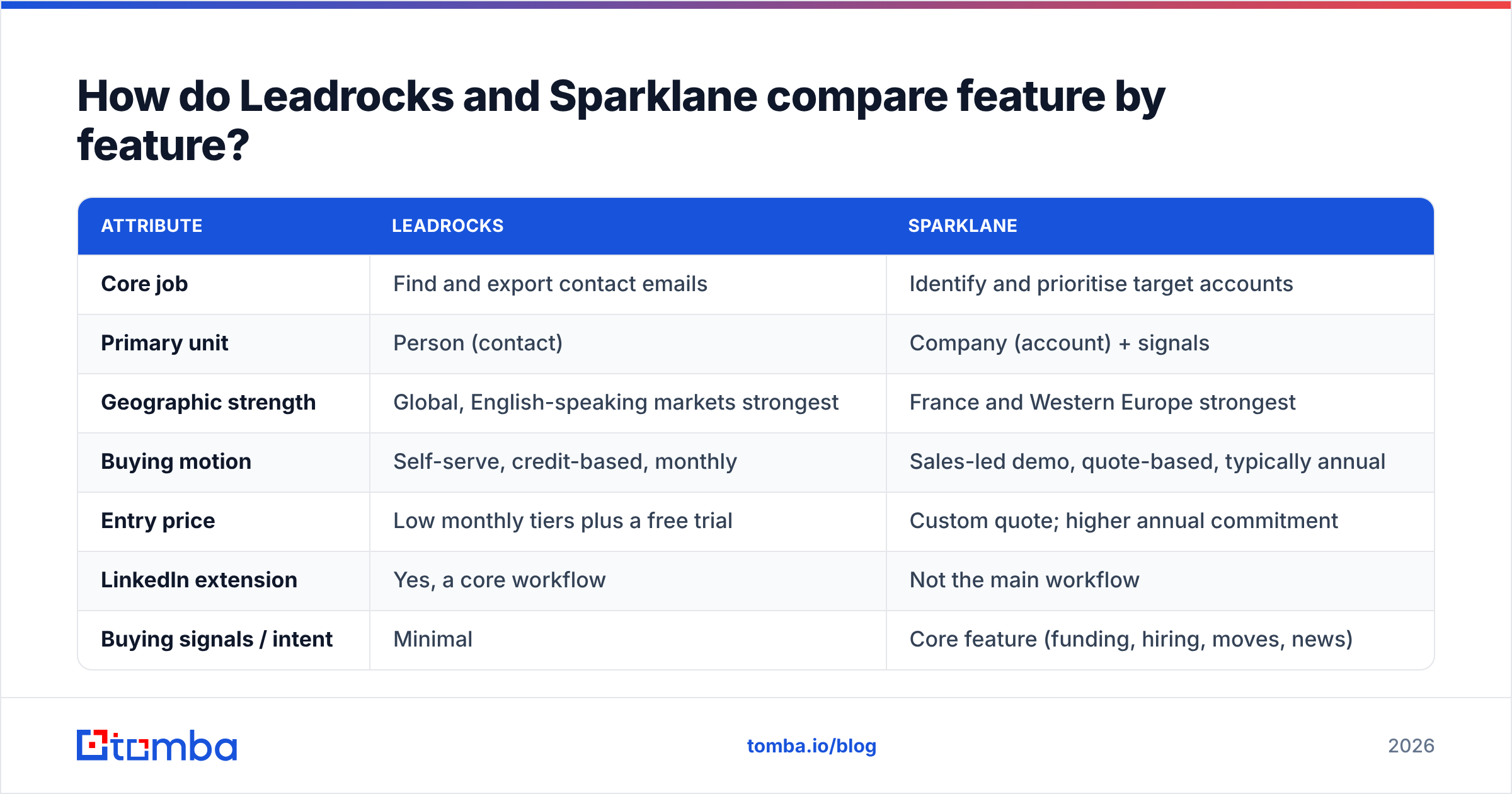
Before you compare prices, check that the tool fits how your team works. These five questions make the choice clear:
- Do you already know your target accounts? If you do, you need contact data, and Leadrocks fits. If you don't, you need account discovery and prioritisation, and Sparklane fits.
- How important is timing? Sparklane's trigger events (new funding round, new site opening, C-level hire, relocation) let you reach out when the account is most likely to be receptive. Leadrocks gives you a contact whenever you ask for one, with no timing signal.
- Where are your buyers based? Sparklane's coverage of French and European firmographics is its strongest point, including registry-style company data that global tools often lack. Leadrocks is more general-purpose.
- Who will use it every day? A single SDR living in LinkedIn will get far more out of Leadrocks. A RevOps lead building territory plans and routing rules will get more out of Sparklane.
- How clean is your CRM? Predictive scoring depends on your historical data. If your CRM is a mess of duplicates and stale deals, fix that before you buy Sparklane, or the model will learn from noise.

Where Leadrocks shines#
- Speed. You go from prospect to email in one click on LinkedIn.
- Low commitment. Monthly credits make it easy to test for one campaign and cancel if it doesn't work.
- Simple exports. Download a CSV and drop it into Instantly, Lemlist, Apollo sequences or whatever sender you use.
Where Sparklane shines#
- Prioritisation. Your reps work a ranked list rather than a random one.
- Signals. The "why now" hook for your first line comes built into the account record.
- European depth. French company data, including structures, subsidiaries and headcount changes, is far richer than what most US-centric databases hold.
- CRM-native workflow. Insights show up where your reps already work, not in yet another tab.
Is Leadrocks data accurate enough for cold email?#
It's accurate enough to start with, but you shouldn't send to it without checking. That applies to every static contact database, not just Leadrocks. B2B data decays quickly. People change jobs, companies rebrand domains and catch-all servers accept every address without confirming the mailbox exists.
In practice, reviewers on platforms like G2 report a familiar pattern for credit-based databases: good hit rates on mid-sized tech companies, weaker results on very small businesses and on regions outside the vendor's main market. Your bounce rate depends more on your segment than on the vendor's headline accuracy claim.
The fix is procedural, not a matter of switching vendors:
- Run every exported list through a dedicated email verifier before it reaches your sending tool.
- Put catch-all addresses in a separate, lower-volume sequence rather than mixing them into your main campaign.
- Re-verify any list older than about 60–90 days.
Keeping hard bounces under roughly 2% protects your domain reputation far more than any small accuracy edge between vendors.
Is Sparklane worth the higher price?#
Only if you'll actually use the signals. Sparklane's cost goes toward the intelligence layer: the scoring, the monitoring and the European data. If your team exports a list, ignores the scores and blasts every account the same way, you're paying enterprise prices for what is effectively a contact database.
Sparklane tends to pay for itself in these situations:
- You sell a high-ACV product where one extra closed deal per quarter covers the licence.
- Your total addressable market is finite, say a few thousand French or EU accounts, so when you reach out matters more than how many you reach.
- You have RevOps capacity to maintain the ICP model and CRM hygiene.
- Your reps currently spend hours deciding who to call before they start calling.
It's hard to justify when:
- You run high-volume, low-ACV outbound where coverage beats precision.
- Most of your market is in North America or APAC.
- You don't have anyone to own the setup.
Analyst firms like Gartner have pointed out for years that sales-intelligence ROI depends on adoption, not features. Tools that reps don't open deliver nothing, however good the scoring model is.
What about GDPR and data compliance?#
For EU prospecting, compliance isn't optional. Under the GDPR, cold B2B email usually relies on legitimate interest. That means you need a relevant offer, a clear opt-out and a documented data source.
- Sparklane is built in Europe with European buyers in mind. In procurement conversations, its data-processing documentation and hosting are usually easier to get through legal review at EU companies.
- Leadrocks operates globally. You should ask directly about data sourcing, retention and how opt-out requests are handled, especially if you'll email contacts in France or Germany.
Whichever you choose, record where each contact came from and honour unsubscribes across every tool in your stack. Most practical compliance failures come from the sender's own process, not the data vendor.
Leadrocks vs Sparklane: which should you choose?#
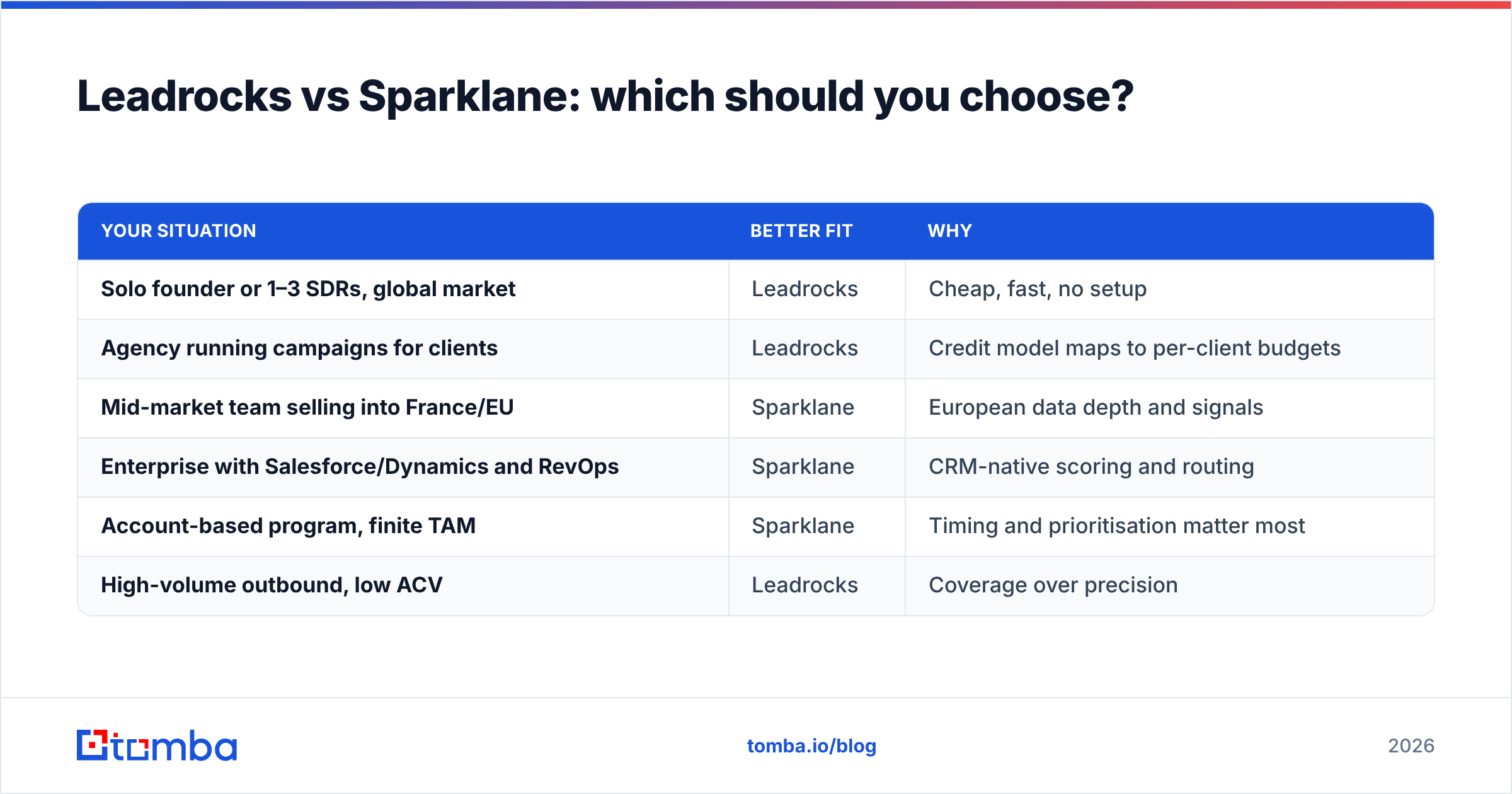
Pick by team profile, not by feature count.
| Your situation | Better fit | Why |
|---|---|---|
| Solo founder or 1–3 SDRs, global market | Leadrocks | Cheap, fast, no setup |
| Agency running campaigns for clients | Leadrocks | Credit model maps to per-client budgets |
| Mid-market team selling into France/EU | Sparklane | European data depth and signals |
| Enterprise with Salesforce/Dynamics and RevOps | Sparklane | CRM-native scoring and routing |
| Account-based program, finite TAM | Sparklane | Timing and prioritisation matter most |
| High-volume outbound, low ACV | Leadrocks | Coverage over precision |

Can you use both?#
Yes, and plenty of mature teams do something like it. The common pattern is:
- Use a signal platform like Sparklane to decide which accounts are worth working this week.
- Use a contact-level tool to find the right people at those accounts and their verified emails.
- Push everything into your CRM and sequencer, and verify before sending.
This split works because account intelligence and contact finding really are separate jobs. Where teams go wrong is paying for two overlapping contact databases and no verification.
Where does Tomba fit alongside either tool?#
Tomba sits in the contact layer, doing the same job as Leadrocks rather than Sparklane. It's also a natural companion to a signal platform. Once Sparklane flags an account, you can run a domain search on the company's website to see every publicly associated professional email and the company's email pattern. Then you can enrich leads with titles, LinkedIn URLs and phone numbers before they reach your sequence.
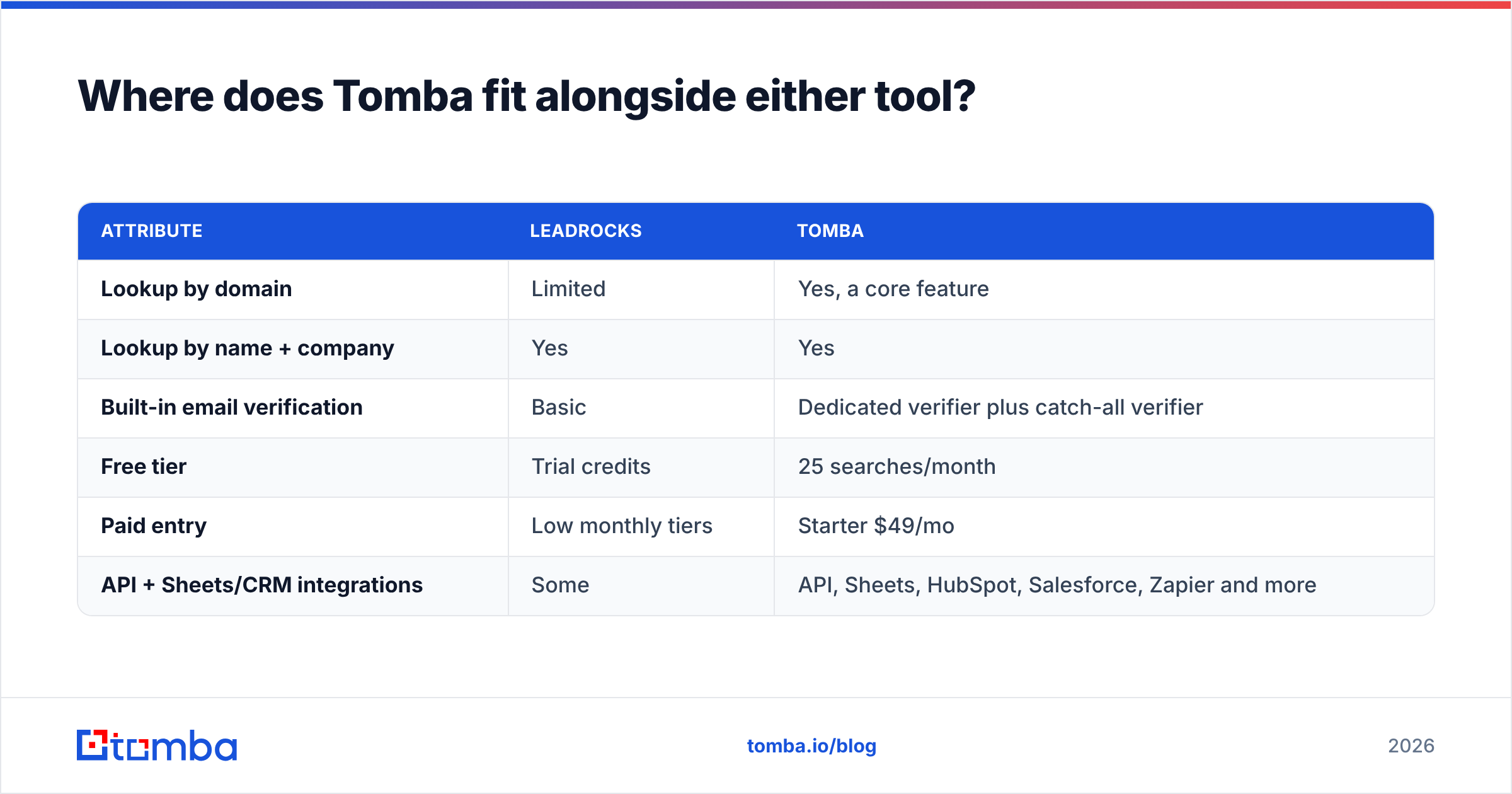
How it compares to Leadrocks on the basics:
| Attribute | Leadrocks | Tomba |
|---|---|---|
| Lookup by domain | Limited | Yes, a core feature |
| Lookup by name + company | Yes | Yes |
| Built-in email verification | Basic | Dedicated verifier plus catch-all verifier |
| Free tier | Trial credits | 25 searches/month |
| Paid entry | Low monthly tiers | Starter $49/mo |
| API + Sheets/CRM integrations | Some | API, Sheets, HubSpot, Salesforce, Zapier and more |
Paid Tomba plans run from Starter at $49/mo to Growth at $99/mo and Pro at $249/mo, with custom Enterprise pricing. Full breakdown on the Tomba pricing page.
What's the bottom line?#
Leadrocks and Sparklane answer different questions. Leadrocks helps you reach people you've already chosen. Sparklane helps you choose them and pick the right moment. For a lean outbound team, Leadrocks is the sensible, low-risk start. For a European mid-market or enterprise team with good CRM discipline, Sparklane's signals and scoring can change how reps spend their day.
If you want the contact layer without being locked into a single database, try the Tomba Email Finder. You can look up professional emails by domain, name or company, verify them in the same workflow and send the results to your CRM or sequencer. The free tier gives you 25 searches a month, enough to test it on your next target account list before you commit to anything.
Related guides#
// get started
Find, verify and enrich your first contacts today
Start on the free plan with 25 searches a month, then scale when your team is ready.
Free plan · No credit card required · GDPR & CCPA
// about the author