LeadRocks vs VCBacked (2026): Which B2B Data Tool Fits You?
LeadRocks is a broad B2B contact database with outreach built in. VCBacked is a narrow list of venture-funded startups and their founders. Here's how to pick the one that matches your ICP instead of the one with the better landing page.
TL;DR
- LeadRocks is a general B2B contact database. You can filter by title, industry, location, and company size, and it comes with an email verifier and basic sequences. The free plan gives 50 credits a month and paid plans start at $29/mo.
- VCBacked is a curated database of about 41,000 venture-backed startups, with funding rounds, lead investors, and founder contacts. Plans start around $79/mo with unlimited exports.
- They answer different questions. LeadRocks helps you find a named persona at almost any kind of company. VCBacked tells you which startups just raised money and who founded them.
- If your ICP is "recently funded startups," VCBacked is the sharper tool. For anything wider, LeadRocks covers more ground for less money.
- Whichever you pick, verify the emails before you send. List data goes stale fast, and startup data goes stale fastest.
What are LeadRocks and VCBacked, in one sentence each?#
LeadRocks is a B2B lead database and enrichment tool. You search by job title, company, industry, location, and headcount, reveal contacts with credits, and can push them straight into its built-in email sequences.
VCBacked is a database of venture-funded companies. Each record carries the funding round, the lead investors, and founder contact details, so you can build lists of startups that just raised capital.
Putting them side by side is a bit unusual, because they aren't really competing for the same job. People still search "leadrocks vs vcbacked" for a sensible reason: if you sell to startups (dev tools, SaaS infrastructure, recruiting, fractional finance, agencies), both tools claim to hand you the right founders' inboxes. What differs is how each one decides who the "right" founder is.
LeadRocks starts from the person and works back to the company. VCBacked starts from the funding event and works forward to the people. That one difference explains almost every trade-off below.
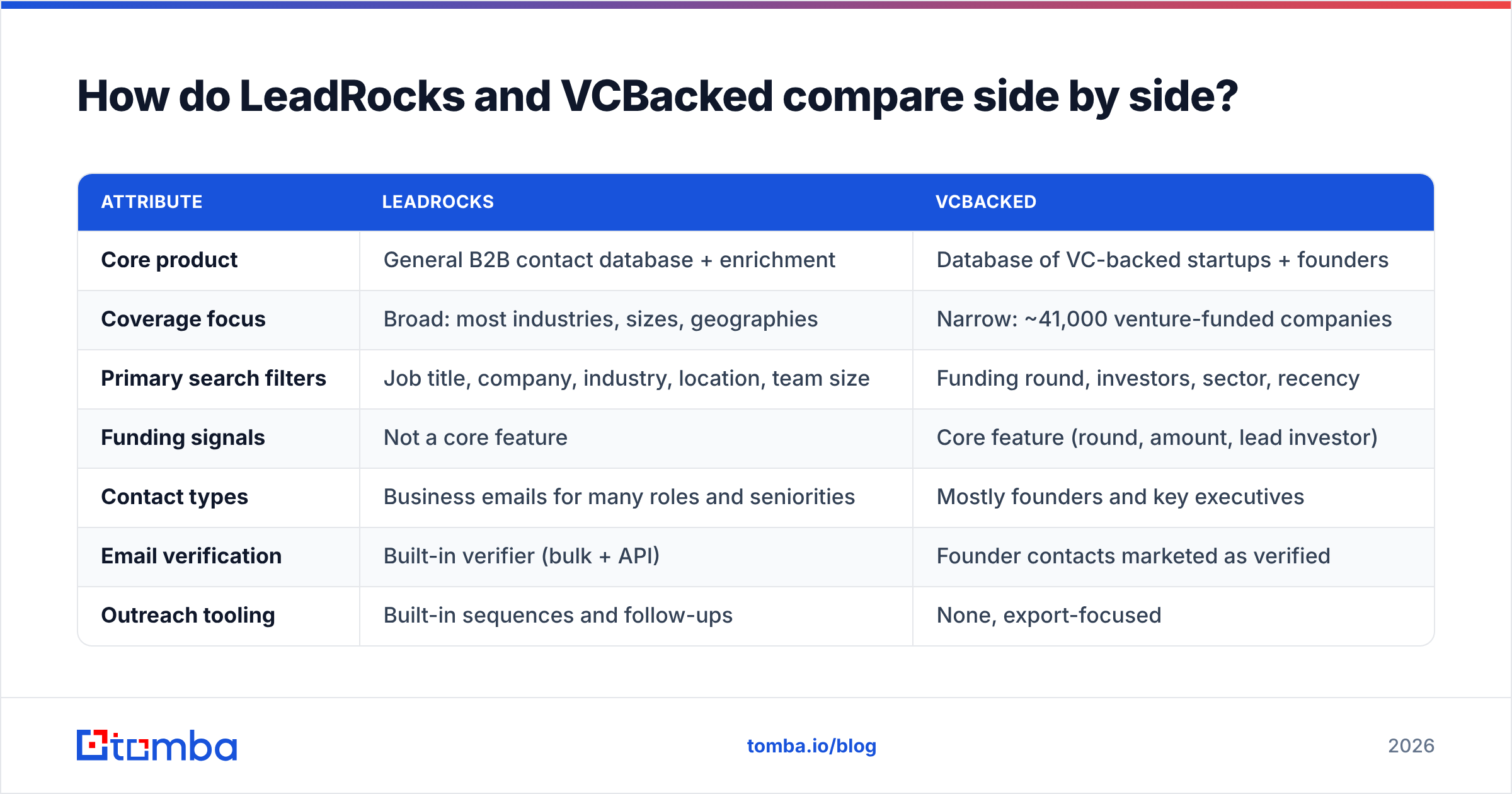
How do LeadRocks and VCBacked compare side by side?#
Here's the short version. Pricing and database sizes are what the vendors publish at the time of writing, so check their pages before you buy.
| Attribute | LeadRocks | VCBacked |
|---|---|---|
| Core product | General B2B contact database + enrichment | Database of VC-backed startups + founders |
| Coverage focus | Broad: most industries, sizes, geographies | Narrow: ~41,000 venture-funded companies |
| Primary search filters | Job title, company, industry, location, team size | Funding round, investors, sector, recency |
| Funding signals | Not a core feature | Core feature (round, amount, lead investor) |
| Contact types | Business emails for many roles and seniorities | Mostly founders and key executives |
| Email verification | Built-in verifier (bulk + API) | Founder contacts marketed as verified |
| Outreach tooling | Built-in sequences and follow-ups | None, export-focused |
| Free tier | Yes, 50 credits/mo | No permanent free tier advertised |
| Entry paid price | $29/mo (1,000 credits) | ~$79/mo |
| Export model | Credit-based | Unlimited exports on paid plans |
| Lifetime deal history | Yes (AppSumo) | Not widely promoted |
| Best fit | Agencies, SDR teams, broad outbound | Selling specifically into funded startups |
The table makes the split obvious. LeadRocks is a wide net with a starter outreach kit attached. VCBacked is a targeting layer built on one strong buying signal: fresh capital.
What does each tool actually give you day to day?#
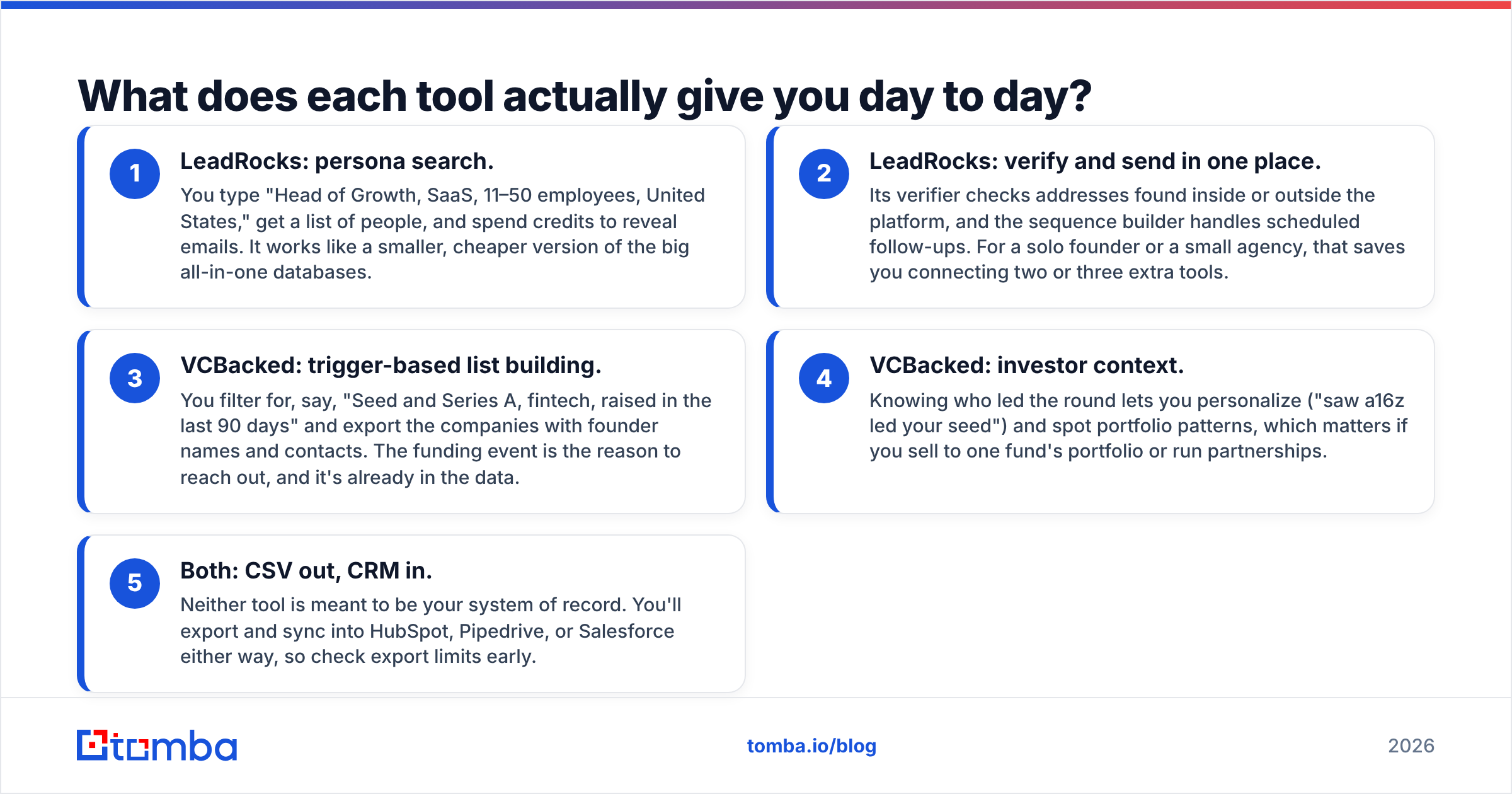
Feature lists blur together, so it helps to think about what you actually do with each tool on a Tuesday morning.
- LeadRocks: persona search. You type "Head of Growth, SaaS, 11–50 employees, United States," get a list of people, and spend credits to reveal emails. It works like a smaller, cheaper version of the big all-in-one databases.
- LeadRocks: verify and send in one place. Its verifier checks addresses found inside or outside the platform, and the sequence builder handles scheduled follow-ups. For a solo founder or a small agency, that saves you connecting two or three extra tools.
- VCBacked: trigger-based list building. You filter for, say, "Seed and Series A, fintech, raised in the last 90 days" and export the companies with founder names and contacts. The funding event is the reason to reach out, and it's already in the data.
- VCBacked: investor context. Knowing who led the round lets you personalize ("saw a16z led your seed") and spot portfolio patterns, which matters if you sell to one fund's portfolio or run partnerships.
- Both: CSV out, CRM in. Neither tool is meant to be your system of record. You'll export and sync into HubSpot, Pipedrive, or Salesforce either way, so check export limits early.

Which tool has better data for your ICP?#
It depends on who you sell to, and both vendors would probably say the same.
When LeadRocks' data wins: your buyers work at mid-market companies, traditional businesses, agencies, e-commerce brands, or any company that never raised venture money. That's most companies in the world. Wikipedia's overview of venture capital is a useful reminder that VC-backed firms are a tiny share of all businesses. A VC-only database can't reach a family-owned logistics firm or a bootstrapped SaaS with 40 employees. LeadRocks can.
LeadRocks also wins when you need several contacts per account: the VP of Sales, the RevOps lead, and the CFO. VCBacked centers on founders. That's great for five-person startups, but thin once a company has 150 employees and a real buying committee.
When VCBacked's data wins: your pitch only makes sense after a funding round. Think "you just raised, now you need to hire eight engineers," or "you just raised, your board wants SOC 2." In those cases, the funding filter does qualification work that a title-based search can't. On LeadRocks you can find founders at SaaS companies. On VCBacked you can find founders at SaaS companies that have money to spend this quarter.
Timing matters too. Startups change quickly after a round: new executives, new domains, rebrands, and founders who hand the inbox to a head of ops. Recency filters help, but no database updates as fast as a startup's org chart. So verification isn't optional for either tool (more on that below).
A quick way to decide: pull 25 accounts from your last quarter's closed-won deals. Count how many were venture-backed at the time. If it's more than two-thirds, VCBacked's targeting is worth paying for. If it's under a third, LeadRocks (or another broad database) is the more honest fit.
How does LeadRocks vs VCBacked pricing compare in 2026?#
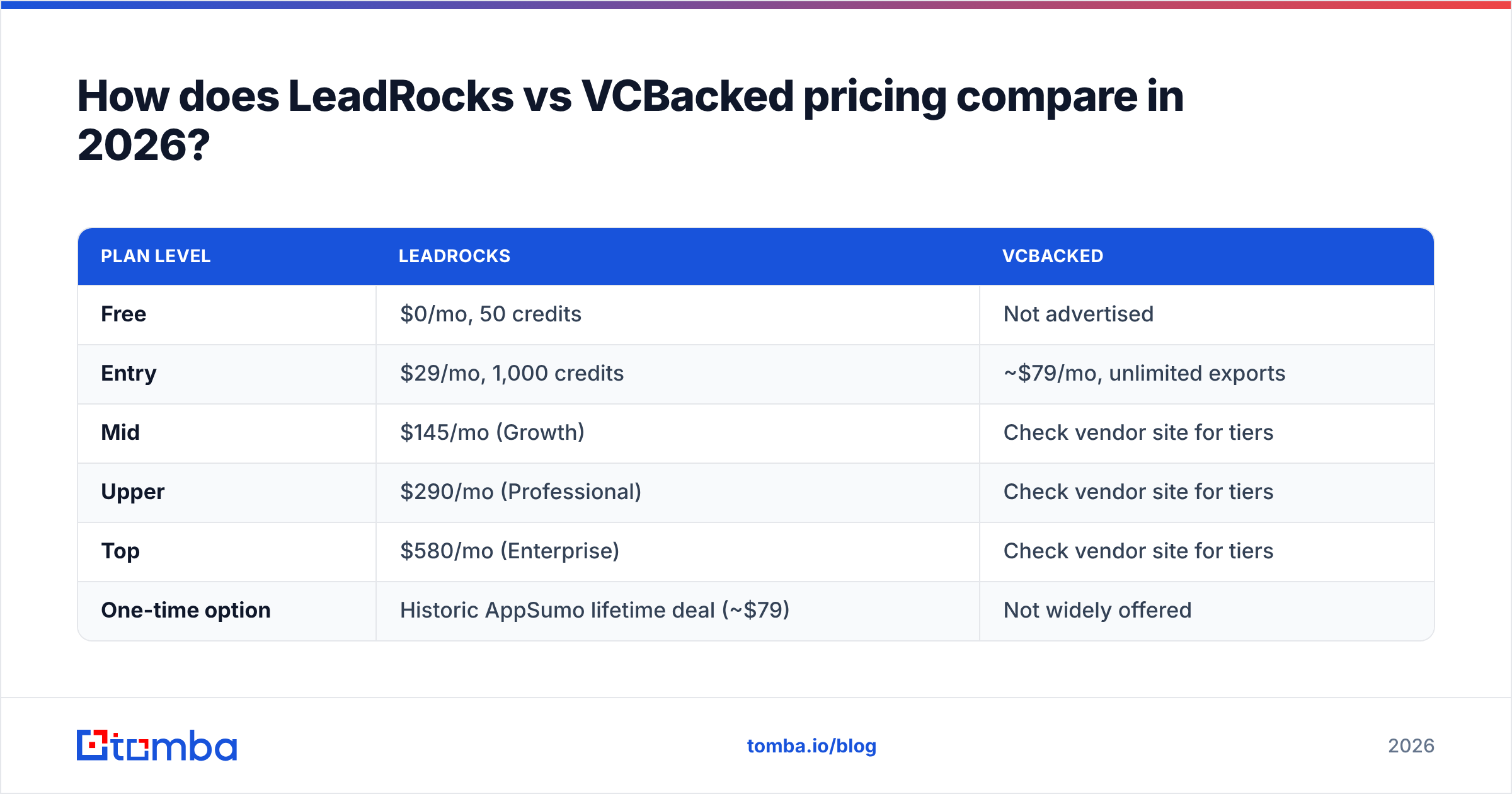
The two pricing models encourage different habits. LeadRocks charges per revealed contact through credits. VCBacked charges a flat subscription and lets you export as much as you want.
| Plan level | LeadRocks | VCBacked |
|---|---|---|
| Free | $0/mo, 50 credits | Not advertised |
| Entry | $29/mo, 1,000 credits | ~$79/mo, unlimited exports |
| Mid | $145/mo (Growth) | Check vendor site for tiers |
| Upper | $290/mo (Professional) | Check vendor site for tiers |
| Top | $580/mo (Enterprise) | Check vendor site for tiers |
| One-time option | Historic AppSumo lifetime deal (~$79) | Not widely offered |
How to read this:
- If you need fewer than ~1,000 contacts a month across a broad ICP, LeadRocks' $29 tier is hard to beat on raw cost per contact.
- If your total market is a few thousand funded startups and you want to export all of them, re-segment, and re-export as new rounds close, VCBacked's flat fee means you're not rationing credits.
- Compare either one with enterprise funding databases like PitchBook or CB Insights, which usually sell annual contracts in the thousands to tens of thousands of dollars. Next to those, VCBacked is a budget-friendly way to get a funded-company list, though it doesn't try to match their research depth.
A common mistake is judging price per record instead of price per reply. A $0.03 contact that bounces costs more than a $0.10 contact that books a meeting, because bounces hurt your domain reputation for every campaign that follows.
Where does each tool fall short?#
Neither tool is perfect. These are the limitations to plan around.
LeadRocks limitations
- Signal-poor. You get who and where, but not much about why now. You'll need to add your own triggers such as hiring, funding, or tech changes.
- Credit math adds up. Credit-based reveals get expensive when you need several contacts per account or re-enrich regularly.
- Outreach module is basic. The built-in sequences suit small teams. Once you need inbox rotation, warmup, or multichannel steps, you'll probably move sending to a dedicated platform.
- Lifetime-deal user base. Tools that grew through AppSumo sometimes put a lot of roadmap effort into LTD users. Check recent reviews and changelogs before you commit.
VCBacked limitations
- Narrow by design. About 41,000 companies is a well-defined universe, and you'll work through your slice of it faster than you expect.
- Founder-centric. Great for selling to CEOs of 10-person startups, less useful when the buyer is a VP of Engineering at a Series C company.
- No outreach layer. You'll need a separate sending tool and, ideally, a separate verification step.
- Funding ≠ fit. A fresh round is a strong signal, but not proof they need your product. Qualify on stage, sector, and headcount growth as well as the fact that they raised.
Which should you pick for your situation?#
Match the tool to what you do most often:
- You're an agency or SDR team prospecting across many industries. Pick LeadRocks. You need breadth and multiple personas per account, and the built-in verifier and sequences keep your stack small.
- You sell dev tools, cloud infrastructure, or HR/recruiting software to startups. Pick VCBacked. Filtering by funding round removes most of the qualification guesswork.
- You run investor relations, a venture studio, or portfolio services. VCBacked. Investor and round data is exactly what you need.
- You're a solo founder testing outbound on a tight budget. Start with LeadRocks' free tier to test messaging, then add VCBacked for one focused campaign if funded startups respond well.
- You sell to startups and to established SMBs. Use both. VCBacked gives you the "who just raised" list, LeadRocks fills in extra personas and non-VC accounts, and a separate lookup and verification layer keeps everything deliverable.
Do you still need an email finder and verifier on top?#
Most likely yes. That's not because either tool is bad. Every static database drifts. B2B contact data decays steadily as people change jobs, companies rebrand, and startups switch domains after a round or an acquisition. A founder list exported in January is partly wrong by June.
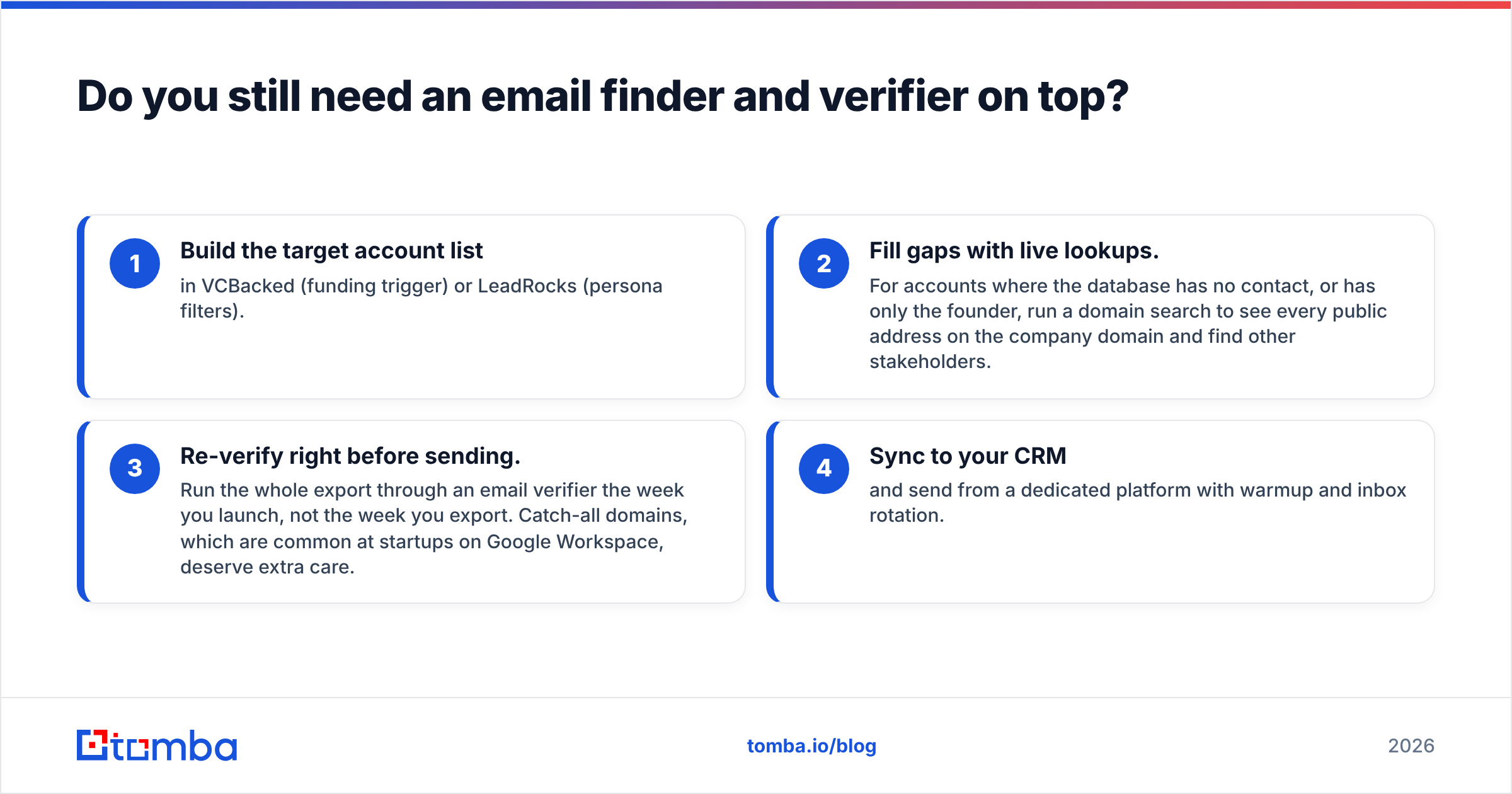
A practical workflow for either tool:
- Build the target account list in VCBacked (funding trigger) or LeadRocks (persona filters).
- Fill gaps with live lookups. For accounts where the database has no contact, or has only the founder, run a domain search to see every public address on the company domain and find other stakeholders.
- Re-verify right before sending. Run the whole export through an email verifier the week you launch, not the week you export. Catch-all domains, which are common at startups on Google Workspace, deserve extra care.
- Sync to your CRM and send from a dedicated platform with warmup and inbox rotation.
For CRM hygiene, HubSpot's guide to data decay and CRM cleanup is a good reference for how quickly unmaintained lists lose value.
This layered approach also makes the LeadRocks vs VCBacked choice less risky. The database decides who you target, and a live finder plus verifier decides whether the email actually reaches them.
Frequently asked questions#
Is LeadRocks or VCBacked cheaper? LeadRocks has the lower entry price: a free 50-credit plan and a $29/mo starter tier. VCBacked starts around $79/mo but includes unlimited exports, so it can work out cheaper per record if you export a lot within its niche.
Does VCBacked include non-founder contacts? It's built mainly around founders and key executives of venture-backed companies. If you need several department heads per account, pair it with a broader database or a domain-level email search.
Can LeadRocks filter by funding round? Funding isn't a core LeadRocks filter. You can search by industry, size, and title, but for funding-triggered prospecting VCBacked, or a funding database like Crunchbase, is the better starting point.
Are the emails from these tools safe to send to immediately? Treat any exported list as unverified until you've checked it yourself. LeadRocks includes a verifier and VCBacked markets verified founder contacts, but addresses decay between export and send. Verify within a few days of launching a campaign.
Which tool is better for selling to startups? If "startup" means venture-funded, VCBacked targets that market more precisely. If you also sell to bootstrapped or small traditional companies, LeadRocks covers more of your market.
The bottom line#
In the LeadRocks vs VCBacked matchup, the right answer depends on your ICP. LeadRocks is an affordable, broad B2B database with verification and simple sequences built in, which suits teams prospecting across many kinds of companies. VCBacked is a focused, flat-priced list of funded startups and their founders, and it's the better choice when a new round is the reason your pitch works. Many startup-focused teams end up using both.
Neither tool fixes the underlying problem of static data: it goes stale. Whichever database you start with, add a live lookup layer so every contact is current when you hit send. Tomba Email Finder finds professional email addresses by name, domain, or company in real time, and it works alongside the verifier and domain search to fill the gaps your list vendor leaves. The free tier includes 25 searches a month, and paid plans start at $49/mo. See Tomba pricing to find the plan that fits your outbound volume.
Related guides#
// get started
Find, verify and enrich your first contacts today
Start on the free plan with 25 searches a month, then scale when your team is ready.
Free plan · No credit card required · GDPR & CCPA
Get the Tomba newsletter
Product and data updates
// about the author