Leadrocks vs Vulcan7 (2026): Which Prospecting Tool Fits Your Market?
Leadrocks and Vulcan7 both sell contact data, but to different buyers: B2B sales teams and real estate agents. Here is how data, dialing, compliance and cost compare, and which one fits your pipeline.
TL;DR
- Leadrocks is a B2B contact database with a LinkedIn-focused Chrome extension. It suits SDRs, recruiters and agencies who need business emails and phone numbers for decision-makers.
- Vulcan7 is a prospecting platform for real estate agents. It combines expired, FSBO and pre-foreclosure leads with owner phone numbers and a built-in multi-line dialer.
- The two tools barely compete. Your choice depends on whether you sell to businesses or to homeowners.
- If you sell B2B, Leadrocks is the closer fit, but check verification quality on your target segment before you commit to a larger plan.
- If you're an agent who spends hours on the phone every day, Vulcan7's dialer and DNC scrubbing are the main reasons to pay for it.
What are Leadrocks and Vulcan7, in one sentence each?#
People search "leadrocks vs vulcan7" because both products say "leads" and "contact data" on their homepages. After that, they have little in common.
Leadrocks is a B2B lead database. You search by job title, company, industry, location and seniority. You reveal work emails and, for some records, direct phone numbers. Most of the workflow runs through its Chrome extension, which pulls contact details while you browse LinkedIn profiles and search results.
Vulcan7 is built only for residential real estate. It gives agents lists of homeowners whose listings expired, For Sale By Owner (FSBO) sellers and other seller-intent segments, then matches phone numbers to those owners. You call them through a power dialer inside the platform. It's a cold-calling system for listing agents, not a general data tool.
In short, Leadrocks helps you reach a VP of Marketing at a 200-person SaaS company, and Vulcan7 helps you reach a homeowner whose listing expired yesterday.
How do Leadrocks and Vulcan7 differ at the core?#
The core-concept differences explain almost everything else in this comparison, so here they are side by side:
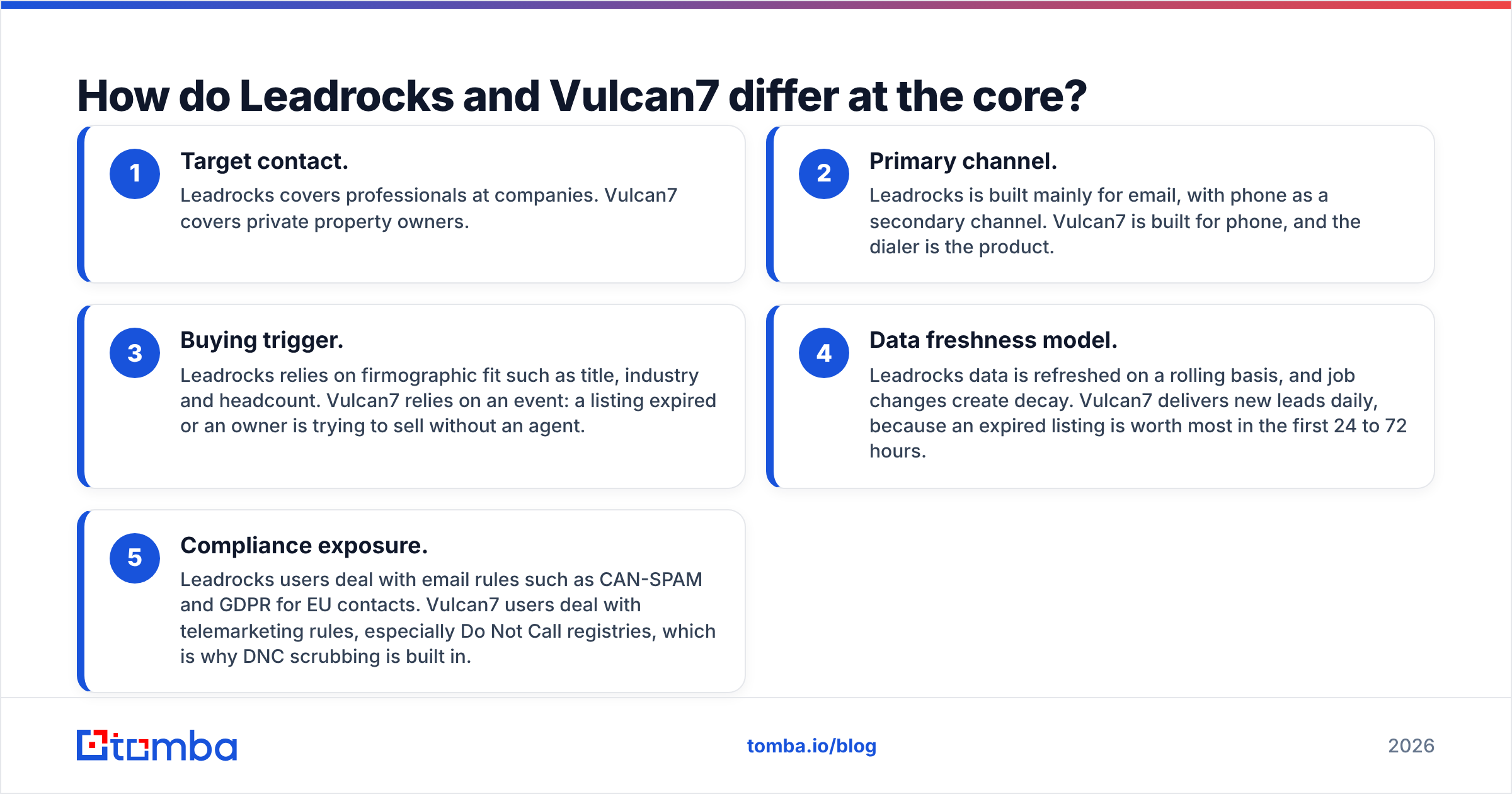
- Target contact. Leadrocks covers professionals at companies. Vulcan7 covers private property owners.
- Primary channel. Leadrocks is built mainly for email, with phone as a secondary channel. Vulcan7 is built for phone, and the dialer is the product.
- Buying trigger. Leadrocks relies on firmographic fit such as title, industry and headcount. Vulcan7 relies on an event: a listing expired or an owner is trying to sell without an agent.
- Data freshness model. Leadrocks data is refreshed on a rolling basis, and job changes create decay. Vulcan7 delivers new leads daily, because an expired listing is worth most in the first 24 to 72 hours.
- Compliance exposure. Leadrocks users deal with email rules such as CAN-SPAM and GDPR for EU contacts. Vulcan7 users deal with telemarketing rules, especially Do Not Call registries, which is why DNC scrubbing is built in.
If you remember one item, make it #2. Leadrocks helps you fill a sequencer. Vulcan7 helps you fill a calling session.
How do features, pricing and fit compare?#
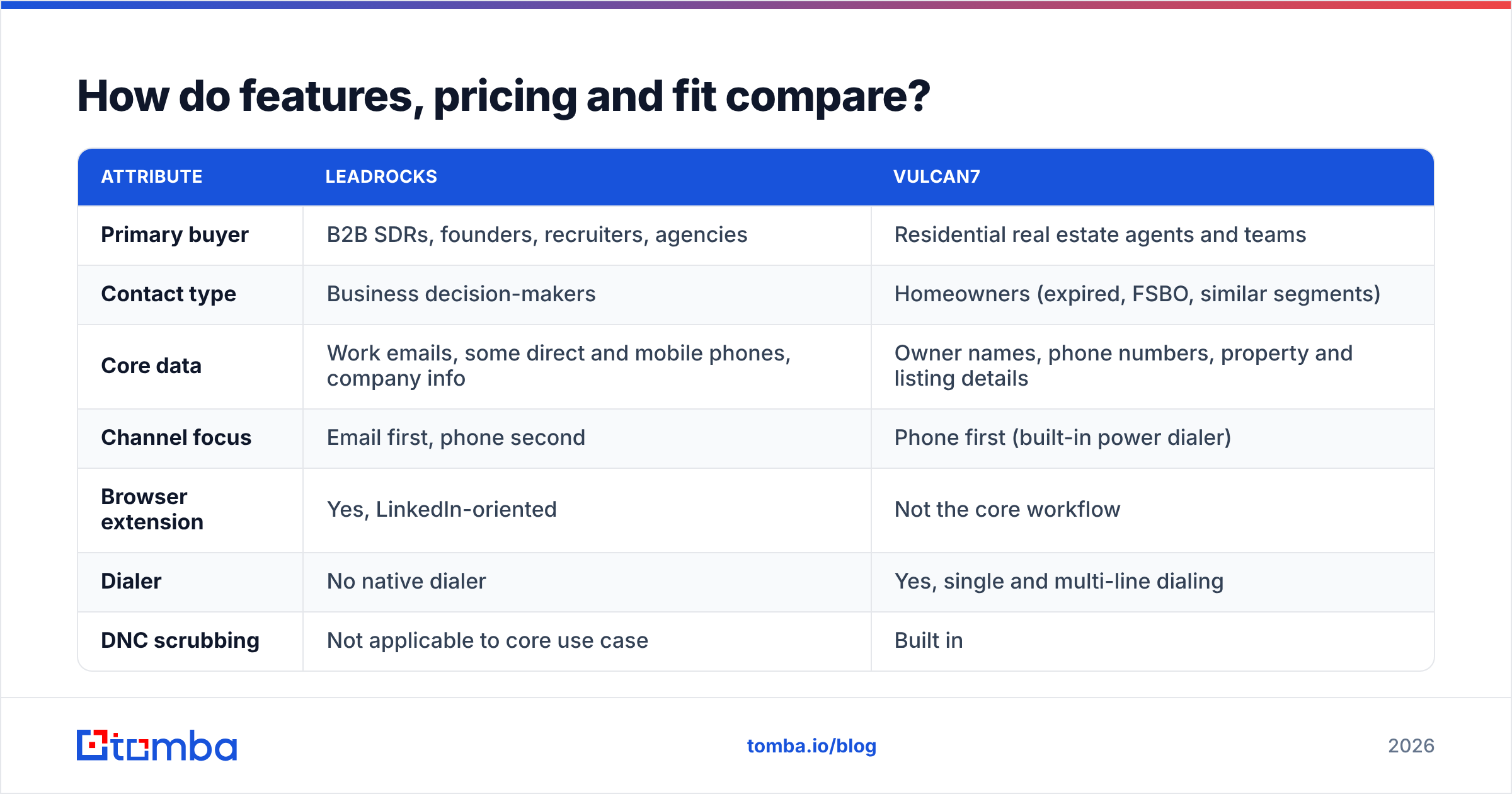
Here's how the two tools line up on the attributes buyers usually ask about. Pricing for both vendors changes often and Vulcan7 quotes by market and lead type, so treat the pricing rows as directional and confirm on each vendor's site.
| Attribute | Leadrocks | Vulcan7 |
|---|---|---|
| Primary buyer | B2B SDRs, founders, recruiters, agencies | Residential real estate agents and teams |
| Contact type | Business decision-makers | Homeowners (expired, FSBO, similar segments) |
| Core data | Work emails, some direct and mobile phones, company info | Owner names, phone numbers, property and listing details |
| Channel focus | Email first, phone second | Phone first (built-in power dialer) |
| Browser extension | Yes, LinkedIn-oriented | Not the core workflow |
| Dialer | No native dialer | Yes, single and multi-line dialing |
| DNC scrubbing | Not applicable to core use case | Built in |
| Lead delivery | On-demand search and reveal | Daily lead feeds by market |
| Pricing model | Credit-based monthly plans, free trial credits | Monthly subscription, priced by lead type and market, usually several hundred dollars per month |
| Best for | Building targeted B2B prospect lists | High-volume listing-prospecting call sessions |
| Main limitation | Coverage and accuracy vary by region and seniority | Useless outside residential real estate |
Two points stand out.
First, Vulcan7 is expensive if you look only at data, but cheaper than it seems when you count the dialer, DNC compliance tooling and the daily feed. A real estate agent who assembles those three pieces separately often ends up paying about the same and gets a clumsier workflow.
Second, Leadrocks is cheaper per contact, but you pay for the dialer, the sequencer and verification separately. B2B teams usually already have that stack, so the incremental cost stays low.

Is Leadrocks better than Vulcan7 for B2B sales?#
Yes, because Vulcan7 isn't a B2B tool. If your buyer is a business, Vulcan7 has nothing you can use.
The fairer question is whether Leadrocks is good enough among B2B data tools. Here's how it performs in practice:
Where Leadrocks is strong
- LinkedIn-centric workflow. If your prospecting already starts on LinkedIn or Sales Navigator, the extension lets you reveal contacts without switching tabs.
- Low entry cost. Credit-based pricing lets a solo founder or small agency test it without an annual contract.
- Simple filters. Title, seniority, industry and geography cover about 80% of what most outbound teams filter on.
Where Leadrocks needs checking
- Verification depth. Every B2B database has decay. People change jobs, companies change domains and catch-all servers accept any address. Run a sample of your target segment through a separate email verifier before you load a sequencer, especially for mid-market and enterprise contacts.
- Phone coverage. Direct dials are harder to source than emails in every B2B database. Expect lower fill rates on mobile numbers than on emails, and test on your own ICP.
- Regional variance. Coverage in North America is usually denser than in parts of APAC, LATAM or smaller European markets.
User reviews on G2 are useful for spotting patterns like these, but a 200-contact pilot on your own ICP tells you more than any review.
Is Vulcan7 better than Leadrocks for real estate agents?#
Yes, clearly. Leadrocks has no concept of an expired listing, a FSBO or a homeowner. You would be searching a B2B database for people who aren't in it.
Vulcan7's value for agents comes from three things working together:
- Timing. Expired listings are one of the highest-intent seller segments. The owner wanted to sell, it didn't happen, and they're often open to a new agent. The first agents to call win most of these, so a daily feed is worth paying for.
- Contact matching. Public listing data rarely includes a working phone number. Matching owners to current numbers is the hard part, and it's where Vulcan7 earns its fee.
- Dialer plus compliance. Calling through a multi-line dialer with DNC scrubbing built in lets you make many more dials per hour and lowers your telemarketing risk. Agents working expireds by hand from a spreadsheet can't keep up.
Common complaints among agents are cost, especially for solo agents in smaller markets, and phone-number accuracy on older records. Both are normal for this category. Before you sign up, ask for a trial in your specific market and look at connect rate, meaning how many dials reach a live owner, not just lead count.
Can one team need both tools?#
Rarely, but it happens. Some examples:
- Brokerages that also recruit agents. They use Vulcan7 for listing prospecting and a B2B tool to recruit agents and find partners such as mortgage brokers, title companies and relocation firms.
- Proptech and real estate SaaS vendors. They sell to brokerages (B2B) while their customers prospect homeowners. They might use a B2B database for their own pipeline and resell or integrate homeowner data for customers.
- Commercial real estate. CRE buyers and tenants are businesses, so B2B contact data such as Leadrocks or another email finder fits better than Vulcan7's residential feed.
If none of these describes you, pick one. Paying for both "just in case" is a common way to waste prospecting budget.
What should you check before buying either tool?#
Whichever tool you pick, test it with the same pilot checklist:
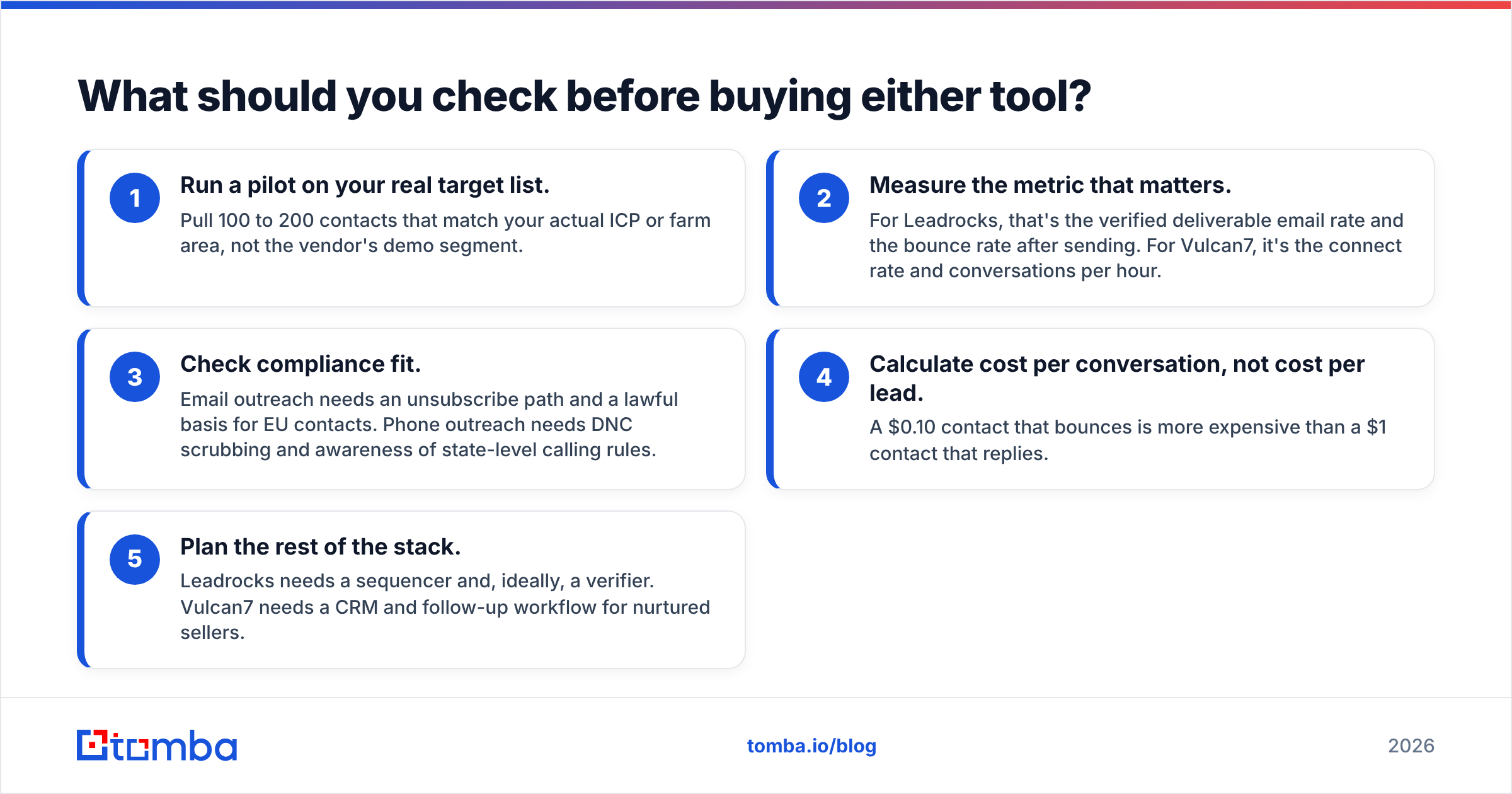
- Run a pilot on your real target list. Pull 100 to 200 contacts that match your actual ICP or farm area, not the vendor's demo segment.
- Measure the metric that matters. For Leadrocks, that's the verified deliverable email rate and the bounce rate after sending. For Vulcan7, it's the connect rate and conversations per hour.
- Check compliance fit. Email outreach needs an unsubscribe path and a lawful basis for EU contacts. Phone outreach needs DNC scrubbing and awareness of state-level calling rules.
- Calculate cost per conversation, not cost per lead. A $0.10 contact that bounces is more expensive than a $1 contact that replies.
- Plan the rest of the stack. Leadrocks needs a sequencer and, ideally, a verifier. Vulcan7 needs a CRM and follow-up workflow for nurtured sellers.

Where does Tomba fit into a Leadrocks vs Vulcan7 decision?#
If you're a real estate agent prospecting homeowners, Tomba isn't the right tool for your core workflow. Vulcan7 or a similar real estate platform is.
If you're on the B2B side and considering Leadrocks, Tomba is worth testing next to it, for a few practical reasons:
- Domain-first search. Tomba starts from a company domain and returns the people and email patterns tied to it. This works well for account-based prospecting, where you know the company before you know the person.
- Verification in the same place. Finding and verifying in one tool cuts out a step where bad data often slips through.
- Phone data. If you call as well as email, the phone finder covers direct numbers for business contacts.
- Clear pricing. Tomba has a free tier with 25 searches a month. Paid plans are Starter at $49/mo, Growth at $99/mo and Pro at $249/mo, with custom Enterprise pricing. See Tomba pricing for credit allowances.
Leadrocks and Tomba aren't mutually exclusive either. Many teams use a LinkedIn-first tool for discovery and a separate finder or verifier to fill gaps and confirm deliverability before sending.
Which should you choose in 2026?#
The verdict is simple once you know your market:
| Your situation | Pick |
|---|---|
| You sell software or services to businesses | Leadrocks (or another B2B email finder) |
| You're a residential listing agent working expireds and FSBOs | Vulcan7 |
| You're in commercial real estate | A B2B data tool, not Vulcan7 |
| You recruit agents or partners for a brokerage | A B2B data tool for recruiting, Vulcan7 for listings |
| You prospect on LinkedIn every day | Leadrocks or a LinkedIn-friendly finder |
| You need to make hundreds of compliant dials a day to homeowners | Vulcan7 |
Most "leadrocks vs vulcan7" searches come from people who haven't yet decided which market they're prospecting. Once you know that, the choice is easy.
Ready to build a cleaner B2B prospect list?#
If you sell to businesses, Tomba Email Finder finds professional email addresses by name, company or domain, and verifies them in the same workflow. Start on the free tier with 25 searches a month, run your pilot list through it next to whatever database you're evaluating, and compare bounce rates before you commit to a plan.
Related guides#
// get started
Find, verify and enrich your first contacts today
Start on the free plan with 25 searches a month, then scale when your team is ready.
Free plan · No credit card required · GDPR & CCPA
// about the author