LeadRocks vs ZoomInfo (2026): Pricing, Data Quality and Verdict
LeadRocks costs about as much as a lunch meeting. ZoomInfo usually means a five-figure annual contract. We compare data depth, accuracy, workflow fit and total cost so you can pick the right one for your team size.
TL;DR
- LeadRocks is a low-cost B2B contact database with a LinkedIn-focused Chrome extension. It suits solo reps, agencies and small teams that want emails in bulk without signing a contract.
- ZoomInfo is an enterprise go-to-market platform. It bundles contact data with intent signals, org charts, technographics, conversation intelligence and CRM enrichment. Pricing is custom, annual and usually five figures.
- ZoomInfo has more coverage in North America, especially for direct dials and mid-market and enterprise org charts. LeadRocks gives you a lot of volume for the money but has less depth per record.
- Pick ZoomInfo if you have a full SDR team, a RevOps owner and a budget to match. Pick LeadRocks if you mostly need emails at scale on a small budget.
- If you mostly need verified professional emails, a dedicated email finder with built-in verification, like Tomba, often covers the job at a fraction of either cost.
What is LeadRocks?#
LeadRocks is a B2B contact data provider. It is best known for a searchable database of professional profiles and a Chrome extension that pulls contact details while you browse LinkedIn and Sales Navigator. You filter by job title, industry, location and company size, then export the contacts with work emails attached.
The pitch is straightforward: lots of contacts, low price, no sales call. You sign up, get a trial allowance, and start exporting. For freelancers, lead-gen agencies and early-stage founders, that low-friction setup is the main appeal.
What it doesn't try to be is a revenue platform. You won't find buyer intent scoring, website visitor identification, conversation recording or deep hierarchy mapping. LeadRocks does one job, putting contacts in a spreadsheet, and charges accordingly.
Where LeadRocks is strong:
- Cheap per contact compared with enterprise vendors
- Self-serve signup with no annual commitment
- A LinkedIn workflow that fits how most outbound reps already prospect
- Bulk export to CSV for any sequencer
Where it's weaker:
- Fewer mobile numbers and direct dials than enterprise providers
- Record freshness varies. Run exports through verification before you send
- Few native CRM integrations or automated enrichment
What is ZoomInfo?#
ZoomInfo is one of the largest B2B data companies in the world. Its core product, SalesOS, combines company and contact records with a stack of add-ons: intent data, technographics, org charts, scoops (news-based buying triggers), website visitor tracking, a conversation intelligence product, and data enrichment and hygiene tools for Salesforce and HubSpot.
ZoomInfo is built for companies where data is infrastructure. A RevOps team pipes enriched records into the CRM automatically, SDRs work from intent-scored account lists, and marketing runs ABM off the same dataset. Its AI features, marketed under Copilot, sit on top of that and surface accounts and suggested messaging.
Where ZoomInfo is strong:
- Deep North American coverage, especially direct dials and org charts
- Intent and technographic signals for prioritizing accounts
- Mature CRM integrations and automated enrichment
- One vendor for sales, marketing and RevOps data
Where it's weaker:
- No public pricing. Contracts are annual and often start in the low-to-mid five figures
- Credit limits, seat pricing and add-on packaging make the true cost hard to predict
- Weaker coverage outside the US and Canada than inside them
- More platform than a small team will use

How do LeadRocks and ZoomInfo compare side by side?#
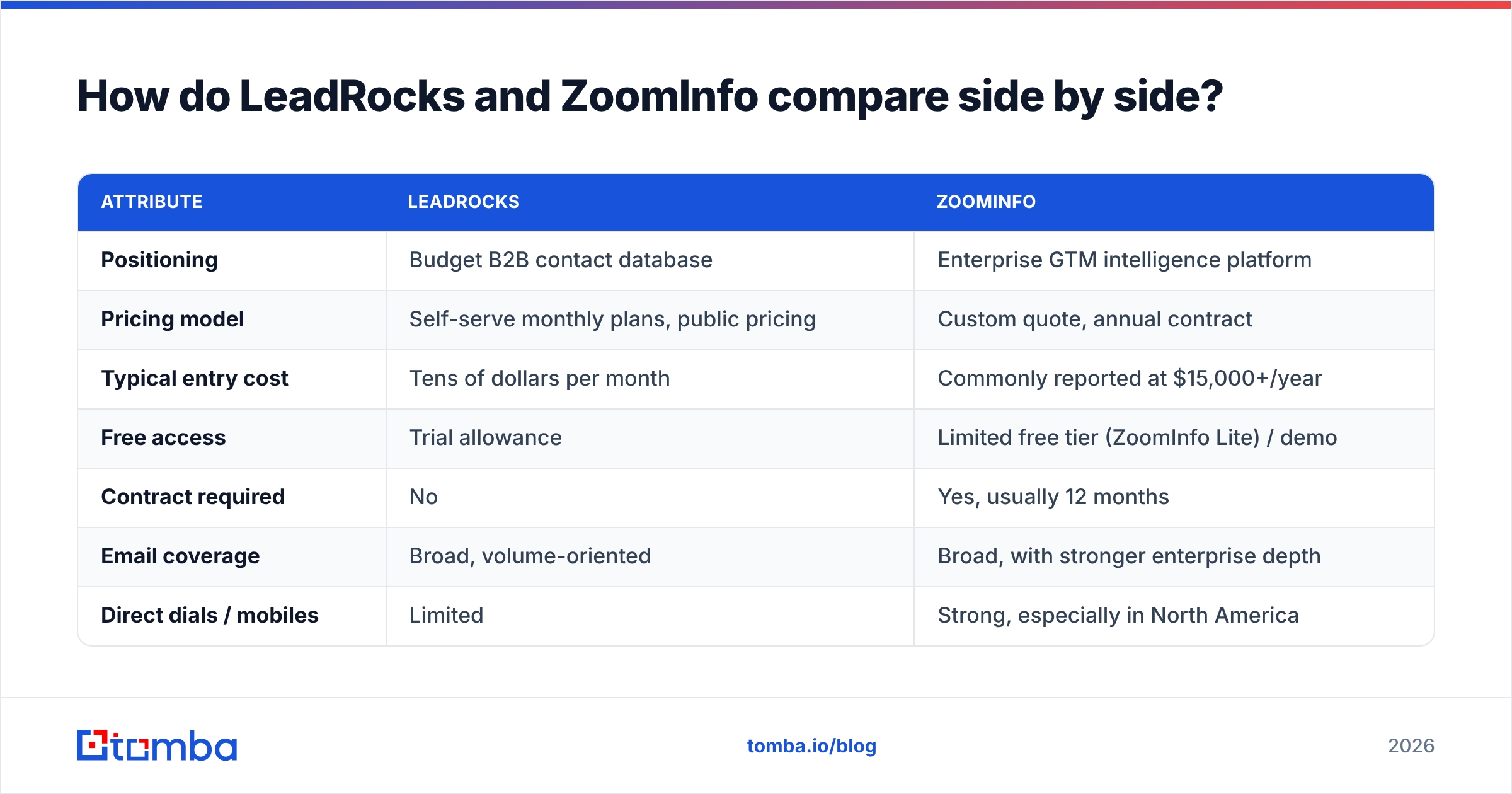
The table below covers the attributes that usually decide a purchase. Treat pricing as directional. LeadRocks changes its public plans from time to time, and ZoomInfo quotes each deal separately, so confirm current numbers with both vendors before you buy.
| Attribute | LeadRocks | ZoomInfo |
|---|---|---|
| Positioning | Budget B2B contact database | Enterprise GTM intelligence platform |
| Pricing model | Self-serve monthly plans, public pricing | Custom quote, annual contract |
| Typical entry cost | Tens of dollars per month | Commonly reported at $15,000+/year |
| Free access | Trial allowance | Limited free tier (ZoomInfo Lite) / demo |
| Contract required | No | Yes, usually 12 months |
| Email coverage | Broad, volume-oriented | Broad, with stronger enterprise depth |
| Direct dials / mobiles | Limited | Strong, especially in North America |
| Intent data | No | Yes (add-on) |
| Org charts | No | Yes |
| Technographics | No | Yes |
| CRM integrations | Mostly CSV export | Native Salesforce, HubSpot, Dynamics and more |
| Chrome extension | Yes, LinkedIn-focused | Yes (ReachOut) |
| Best for | Solo reps, agencies, startups | Mid-market and enterprise sales orgs |
In short, you aren't choosing between two versions of the same product. You're choosing between a data export tool and a data platform.
Is ZoomInfo's data more accurate than LeadRocks'?#
For North American mid-market and enterprise contacts, ZoomInfo usually wins on depth: more fields per record, more phone numbers, better role hierarchy. It invests heavily in research teams, contributor networks and automated refresh cycles, and it shows in how complete the records are.
Accuracy is a different question from completeness, though. Both vendors store contacts that go stale. People change jobs, domains get rebranded, companies merge. B2B contact data decays by roughly 20–30% a year, and no database is immune to that. The real question is how many bounces you'll eat before you catch the bad records.
Here's what that means in practice:
- Never send straight from an export. Whichever vendor you use, run the list through an email verifier first. A 5% bounce rate on a new sending domain can hurt your sender reputation for weeks.
- Catch-all domains are the gray zone. Many enterprise domains accept all mail at the SMTP level, so a basic check can't tell a real inbox from a dead one. Neither vendor fully solves this. A dedicated catch-all check helps.
- Spot-check before you commit. Pull 100 contacts from your real ICP out of each tool, verify them independently, and compare deliverable rates. It takes an afternoon and beats trusting any vendor's marketing claims.
User reviews on G2 back this up. ZoomInfo gets consistent praise for coverage and complaints about outdated records and renewal pricing. LeadRocks reviews tend to praise value for money and note that verification is still needed.
How much do LeadRocks and ZoomInfo actually cost?#
The price gap is the single biggest difference between these two tools.
LeadRocks publishes its plans. You pick a monthly tier based on how many contacts you'll export, pay by card, and cancel when you like. For a solo SDR or a small agency, the total cost of ownership is roughly the sticker price plus whatever you pay for verification and a sequencer.
ZoomInfo doesn't publish pricing. Buyers commonly report entry packages starting in the mid-five figures per year. The price goes up with seats, credits and add-ons like intent, enrichment and conversation intelligence. The common points of friction are:
- Annual commitment. You pay for 12 months whether or not you use the credits.
- Credit caps. Exports and views are metered, and overages or top-ups cost extra.
- Renewal increases. Many buyers report price increases at renewal, so negotiate multi-year terms and caps up front.
- Add-on creep. The demo shows the full platform, but the base package usually doesn't include all of it.
Here's a rough cost-per-use comparison for a three-rep team sending about 1,500 new contacts a month:
| Scenario | LeadRocks | ZoomInfo | Dedicated email finder (e.g. Tomba) |
|---|---|---|---|
| Annual platform cost | Low hundreds to low thousands | Commonly $15K–$40K+ | $588–$2,988 (Starter to Pro, billed monthly) |
| Contract | Monthly | Annual | Monthly |
| Verification included | Separate step recommended | Partial | Built in |
| Phone numbers | Limited | Strong | Phone finder available |
| Intent / org charts | No | Yes | No |
If intent data and org charts drive your pipeline, ZoomInfo's premium can pay for itself. If you mainly need a verified email for each prospect, you're paying for a lot of platform you won't use.
Which workflows does each tool fit best?#
Here's how each tool fits into a normal week of outbound work.
A LeadRocks workflow looks like this: build a Sales Navigator search, open the extension, bulk-save the matching profiles, export a CSV, verify it, then import it into Instantly, Lemlist or Smartlead. The workflow is manual, fast and cheap. It works well for agencies running campaigns for many clients, because every export is just a file.
A ZoomInfo workflow looks like this: RevOps sets up enrichment rules so every new CRM lead is completed automatically. SDRs open a daily intent-scored account list, check the org chart to find the economic buyer and the champion, and push contacts into Outreach or Salesloft sequences with one click. Marketing uses the same data for ABM audiences. The workflow is integrated and automated, and it's expensive.
The deciding question is usually who owns the data in your company. If one person owns the whole funnel, LeadRocks and a spreadsheet are enough. If a RevOps team owns the CRM and multiple teams read from it, ZoomInfo's integrations start to justify the cost.
For teams in between, a common setup is a lighter data source plus automated data enrichment into the CRM. You get most of the practical benefit without the enterprise contract.
Is LeadRocks a good ZoomInfo alternative?#
It can be, if you're clear about what you're giving up.
LeadRocks is a good ZoomInfo alternative when:
- Your motion is email-first, not phone-first
- You prospect mostly from LinkedIn and Sales Navigator
- You're a founder, a solo SDR or an agency without a RevOps function
- You'd rather have month-to-month flexibility than a feature-rich annual contract
LeadRocks is not a good replacement when:
- Your team relies on cold calling and needs verified mobile numbers at scale
- You prioritize accounts using intent or technographic signals
- You need automated, always-on CRM enrichment and deduplication
- You sell into complex enterprise buying committees where org charts matter
It's also worth knowing that "ZoomInfo alternative" covers a wide market. Apollo, Lusha, Cognism, RocketReach, BookYourData, Tomba and others each cover a different part of what ZoomInfo does. BookYourData, for example, is a solid option for teams that want pre-built, verified B2B lists without a platform commitment. The right alternative depends on which part of ZoomInfo you actually use.

What should you check before buying either one?#
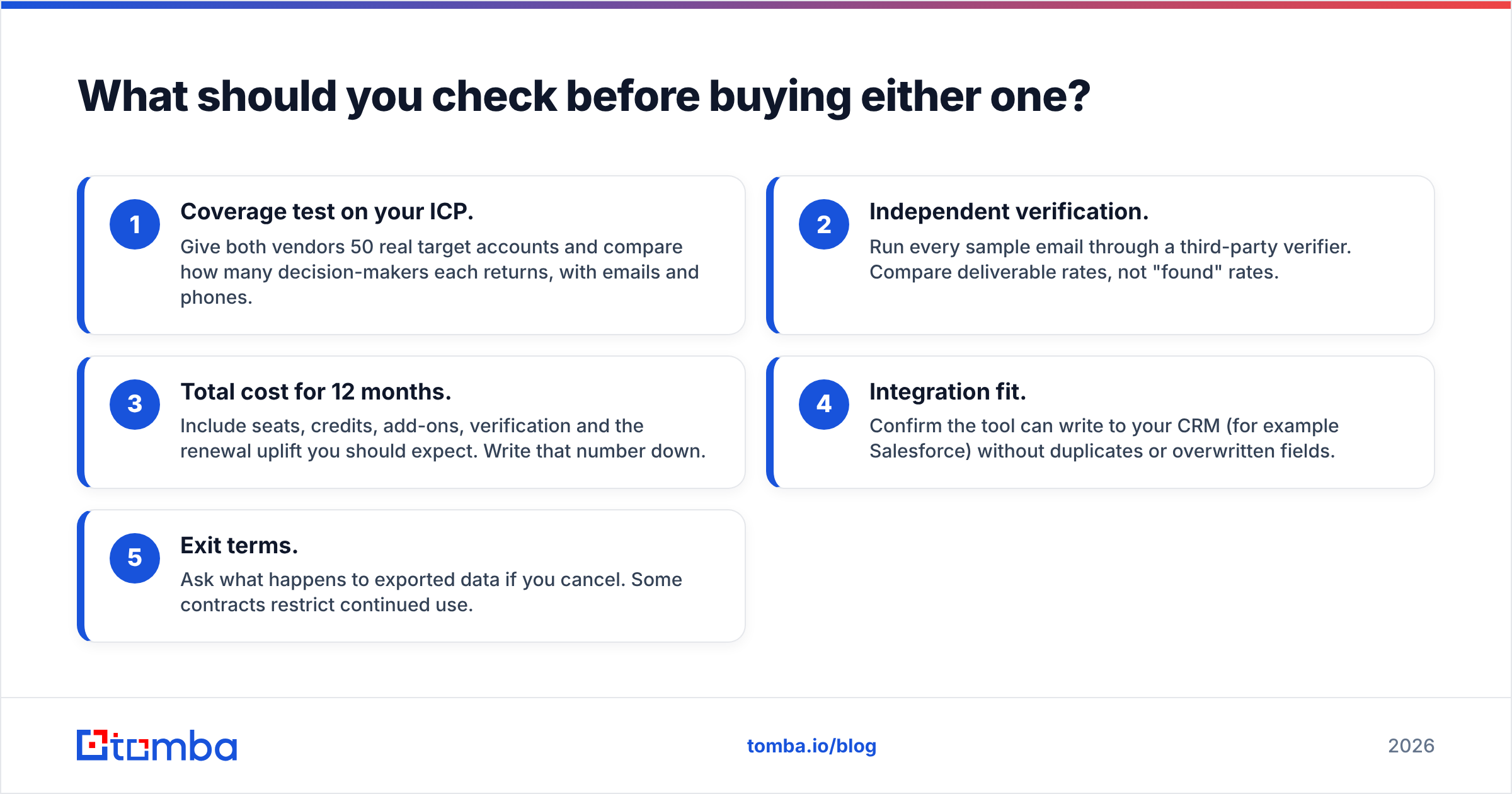
Run this five-point check before anyone sends you an order form:
- Coverage test on your ICP. Give both vendors 50 real target accounts and compare how many decision-makers each returns, with emails and phones.
- Independent verification. Run every sample email through a third-party verifier. Compare deliverable rates, not "found" rates.
- Total cost for 12 months. Include seats, credits, add-ons, verification and the renewal uplift you should expect. Write that number down.
- Integration fit. Confirm the tool can write to your CRM (for example Salesforce) without duplicates or overwritten fields.
- Exit terms. Ask what happens to exported data if you cancel. Some contracts restrict continued use.
This takes a day, and it keeps you from signing a five-figure deal you'll regret or buying a cheap tool that doesn't cover your market.
So, LeadRocks vs ZoomInfo: which should you choose?#
Choose ZoomInfo if you have a sales team of 10 or more, a RevOps owner, a phone-heavy motion into North American mid-market or enterprise accounts, and the budget for an annual contract. It's the more complete platform, and the intent data and org charts can meaningfully improve targeting.
Choose LeadRocks if you're lean, email-first and prospect from LinkedIn. It gets you contacts at a price that won't eat your budget, as long as you verify every export before sending.
Consider a third option if what you actually need is simpler: find the right person's work email, confirm it's deliverable and send. Many teams buy ZoomInfo for that one job and pay for a platform they barely use. Others buy a cheap database and then pay for a separate verification tool on top.
Where does Tomba fit?#
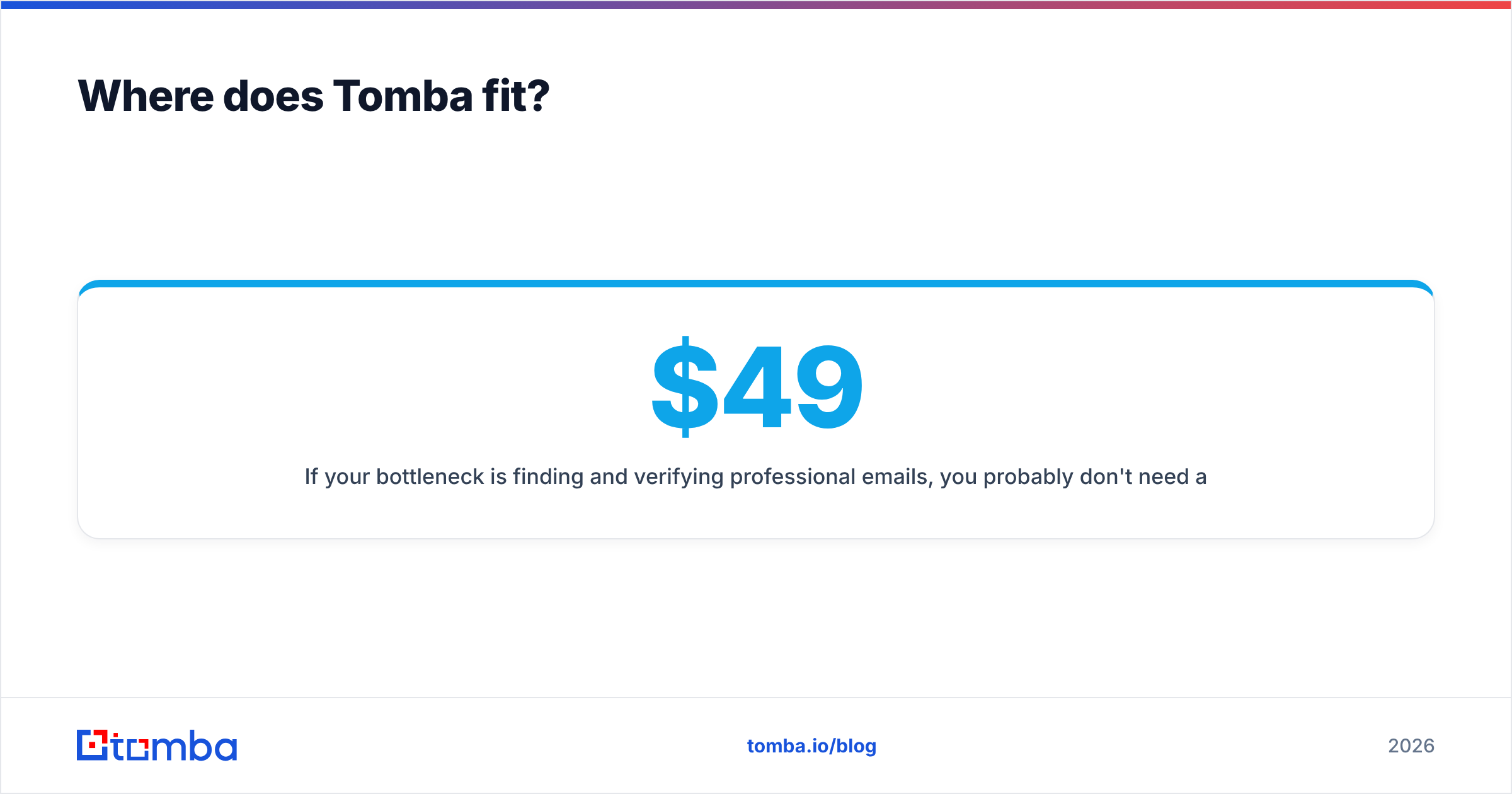
If your bottleneck is finding and verifying professional emails, you probably don't need a full intelligence suite. Tomba Email Finder finds work emails by name, company or domain, verifies them in the same step, and works from a Chrome extension, Google Sheets, a bulk upload or the API. Plans start with a free tier of 25 searches a month, and paid plans run from $49/mo (Starter) through $99/mo (Growth) and $249/mo (Pro), with no annual contract required. See the full Tomba pricing to compare tiers. You can try it on the same 50-account test list you'd use to evaluate LeadRocks and ZoomInfo, and compare deliverable rates before you commit to either.
Related guides#
// get started
Find, verify and enrich your first contacts today
Start on the free plan with 25 searches a month, then scale when your team is ready.
Free plan · No credit card required · GDPR & CCPA
Get the Tomba newsletter
Product and data updates
// about the author