Leads2b Pros and Cons: An Honest 2026 Review for B2B Sales Teams
Leads2b is one of the best-known prospecting platforms for Brazilian B2B data. Here is where its CNPJ-based database helps, where it falls short, and when a global email finder fits better.
TL;DR
- Leads2b is a Brazil-focused B2B prospecting platform. It is built on company registry (CNPJ) data and adds filters, list building, and a lightweight sales pipeline on top.
- Biggest pros: deep coverage of Brazilian companies, filters based on local data (CNAE activity codes, state, company size, registration status), and a Portuguese-language product and support team.
- Biggest cons: little value outside Brazil, uneven decision-maker email coverage compared with company-level data, sales-led pricing in BRL, and a feature set that overlaps with CRMs you may already pay for.
- Leads2b is a good fit for teams whose total addressable market is Brazilian SMBs and mid-market companies. If you sell into the US, Europe, or several regions at once, pair it with a global email finder or pick one instead.
- Always check contact data before you send. Registry data is accurate about companies, but that tells you nothing about whether a specific inbox exists today.
What is Leads2b?#
Leads2b is a Brazilian B2B prospecting and lead-generation platform. Its core is a searchable database of companies registered in Brazil, indexed by CNPJ (Cadastro Nacional da Pessoa Jurídica, the national business registration number). On top of that registry layer it adds:
- Segmentation filters, such as CNAE activity code, city and state, company size, founding date, capital, and registration status
- List building and export, so sales teams can turn a filtered search into a prospect list
- Contact data, including company phones, emails, and, where available, partner or decision-maker information
- Pipeline and prospecting workflows, so small teams can work leads without a separate CRM
Think of Leads2b as a very good map of which Brazilian companies exist and what they do. It is less of a tool for finding the right person's verified inbox inside each one. That distinction explains most of the pros and cons below.
You can see the current product lineup on the official Leads2b website. Features and plan names change, so treat any specific module name in a review (including this one) as something to confirm on a demo call.
Who is Leads2b built for?#
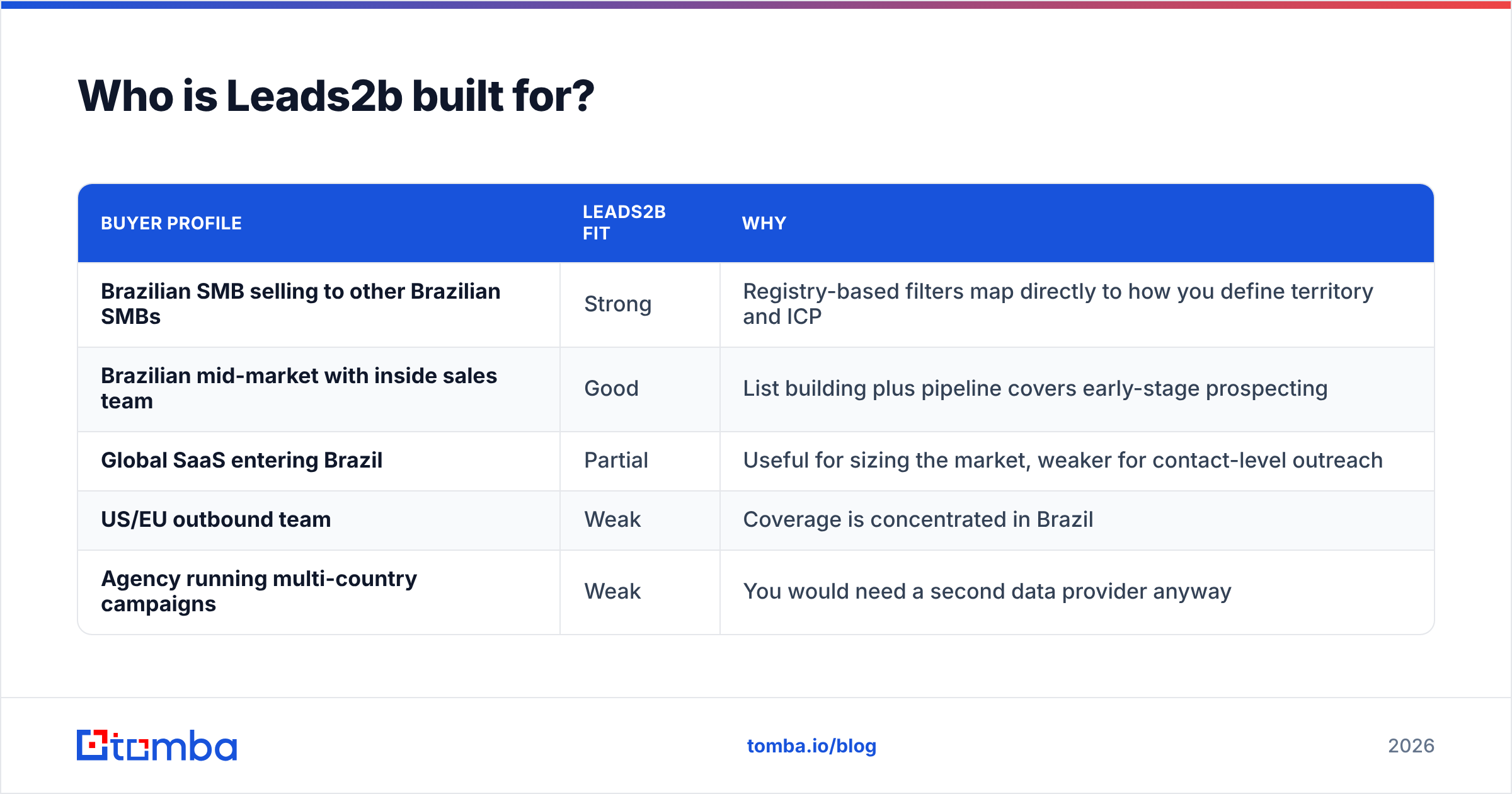
The best-fit buyer profile is narrow and clear:
| Buyer profile | Leads2b fit | Why |
|---|---|---|
| Brazilian SMB selling to other Brazilian SMBs | Strong | Registry-based filters map directly to how you define territory and ICP |
| Brazilian mid-market with inside sales team | Good | List building plus pipeline covers early-stage prospecting |
| Global SaaS entering Brazil | Partial | Useful for sizing the market, weaker for contact-level outreach |
| US/EU outbound team | Weak | Coverage is concentrated in Brazil |
| Agency running multi-country campaigns | Weak | You would need a second data provider anyway |
If your ideal customer profile can be written as "Brazilian companies with CNAE X, in states Y and Z, with more than N employees," Leads2b speaks your language, both literally and structurally.
What are the main pros of Leads2b?#
1. Deep Brazilian company coverage#
Leads2b's most defensible advantage is its registry foundation. Brazil requires companies to register with the Receita Federal, and that data includes activity codes, addresses, legal status, and partner information. A platform built on that data can show you every registered company that matches your filters, not just the ones that happen to have a LinkedIn page.
That matters in Brazil because a large share of the SMB market has almost no presence on LinkedIn. Global tools that lean on professional-network scraping tend to under-index these companies.
2. Filters that match how Brazilian sellers segment#
Filtering by CNAE code is the native way to define a vertical in Brazil. Leads2b also lets you filter by registration status (active vs. inactive), tax regime indicators, and geography down to the city. You can quickly build lists like "active logistics companies in Santa Catarina founded after 2018." Global databases usually cannot do that, because their industry taxonomies (SIC, NAICS, or proprietary tags) do not map cleanly to CNAE.
3. Portuguese-first product and local support#
The interface, onboarding, and support are built for Brazilian teams. That is easy to underrate. SDR ramp time goes down, and so does the friction of getting non-technical managers to adopt the tool. You also get a vendor that understands local compliance under LGPD, Brazil's General Personal Data Protection Law.
4. Prospecting and pipeline in one place#
For a five-person sales team with no RevOps function, having list building and a simple pipeline in one tool is a real simplification. You search, save, assign, and follow up without wiring three tools together.
5. Good for market sizing and territory planning#
Even teams that do outreach with another tool often use registry-based platforms to answer "how many companies actually match our ICP in this region?" That TAM view is harder to get from contact-first tools.
What are the main cons of Leads2b?#
1. Limited value outside Brazil#
This is the most important limitation. If your pipeline includes Mexico, Portugal, the US, or Europe, Leads2b will not carry that load. You will need a second provider, which means two contracts, two data models, and duplicate-handling logic in your CRM.
2. Company data is stronger than person data#
Registry data tells you the company exists, where it is, and who the legal partners are. It does not reliably tell you the email address of the Head of Procurement who joined six months ago. Generic company inboxes (contato@, comercial@, financeiro@) are common in registry-derived data. They reach someone, but reply rates on generic inboxes are usually far lower than on named decision-makers.
If your outbound motion depends on reaching a specific role, expect to add a person-level email finder, or accept that a lot of your first-touch emails will go to shared inboxes.
3. Email validity is your responsibility#
Company records can stay accurate for years, but mailboxes go stale much faster. People leave, domains migrate, and small businesses swap providers. Before you load any exported list into a sequencer, run it through an email verifier. This is not a Leads2b-specific problem; it applies to every database. The risk is higher, though, when a lot of the data comes from registry filings that may be years old.
4. Sales-led, BRL-denominated pricing#
Leads2b pricing is typically quoted through a sales conversation and billed in Brazilian reais, with plans scaled by users and export or credit volume. For a Brazilian company this is normal. For an international buyer it makes like-for-like budgeting harder, and it takes longer to get a number than on self-serve tools. Ask for the price per exported contact, not just the monthly fee.
5. Overlap with your existing CRM#
If you already run HubSpot, Pipedrive, or RD Station CRM, Leads2b's pipeline features partly duplicate what you have. You then pay for a second place where deals can live. You also risk the classic problem of reps updating one system and forgetting the other. Check the native integrations on your demo and confirm that syncing works in both directions.
6. Data freshness varies by field#
Registry fields like CNAE and legal status update on the government's schedule. Phone numbers and emails depend on the vendor's enrichment cadence. Ask how often each field is refreshed. "Updated monthly" can mean very different things for company status and for contact emails.
Leads2b pros and cons at a glance#
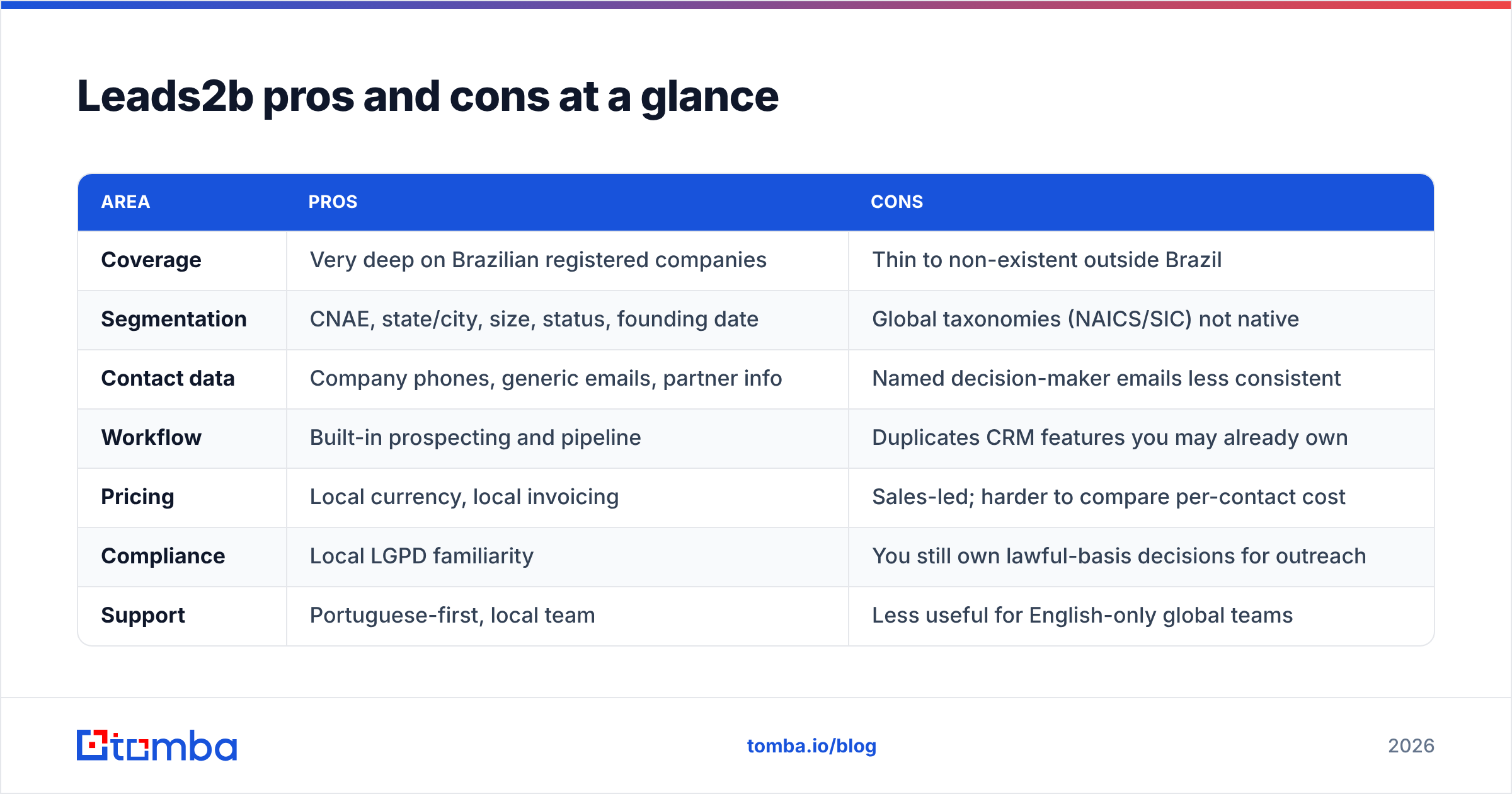
| Area | Pros | Cons |
|---|---|---|
| Coverage | Very deep on Brazilian registered companies | Thin to non-existent outside Brazil |
| Segmentation | CNAE, state/city, size, status, founding date | Global taxonomies (NAICS/SIC) not native |
| Contact data | Company phones, generic emails, partner info | Named decision-maker emails less consistent |
| Workflow | Built-in prospecting and pipeline | Duplicates CRM features you may already own |
| Pricing | Local currency, local invoicing | Sales-led; harder to compare per-contact cost |
| Compliance | Local LGPD familiarity | You still own lawful-basis decisions for outreach |
| Support | Portuguese-first, local team | Less useful for English-only global teams |
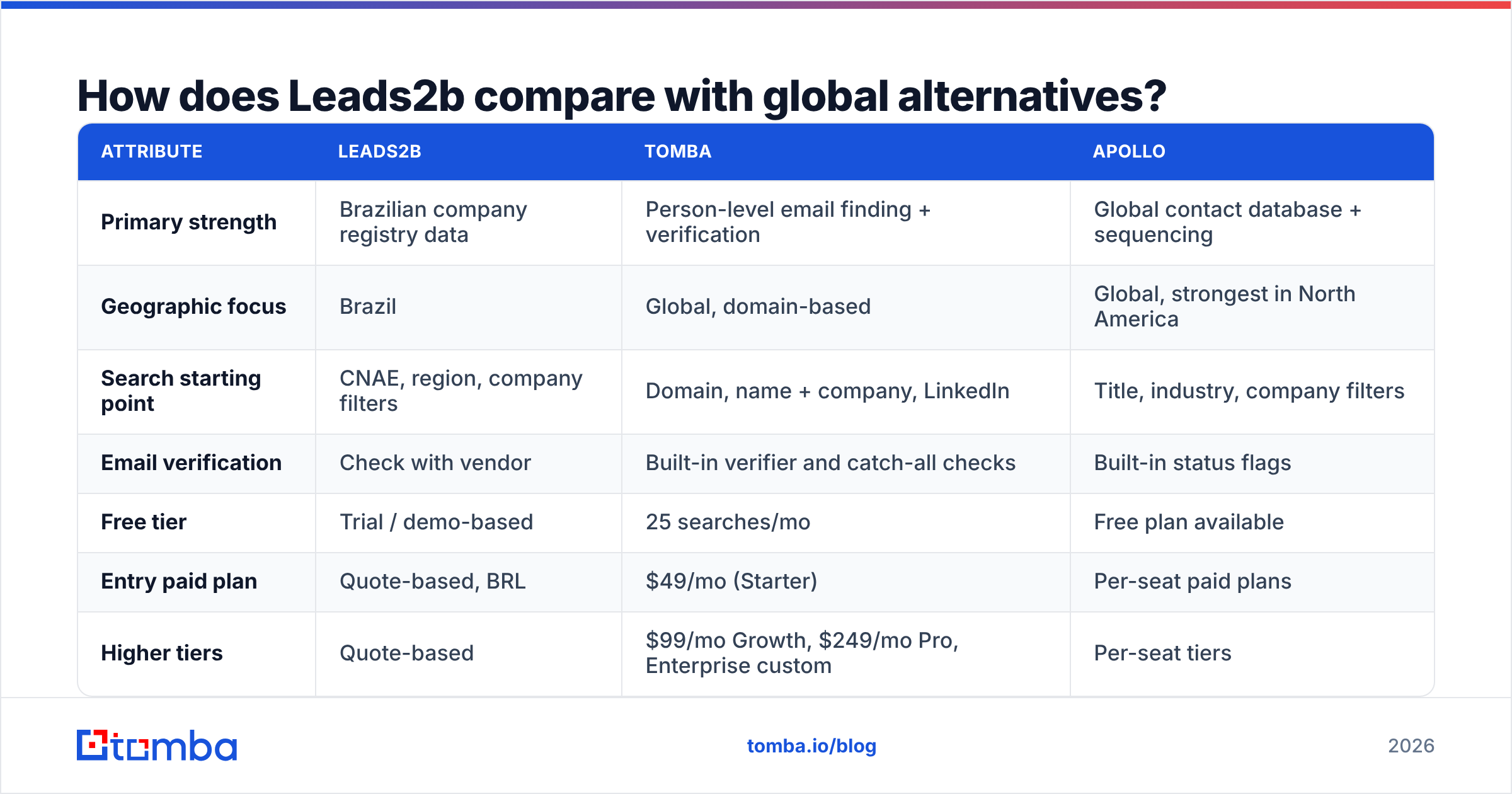
How does Leads2b compare with global alternatives?#
The fair comparison is not "which tool is better." It is "which tool matches the shape of your market." Here is how Leads2b stacks up against a person-level email finder and an all-in-one global platform.
| Attribute | Leads2b | Tomba | Apollo |
|---|---|---|---|
| Primary strength | Brazilian company registry data | Person-level email finding + verification | Global contact database + sequencing |
| Geographic focus | Brazil | Global, domain-based | Global, strongest in North America |
| Search starting point | CNAE, region, company filters | Domain, name + company, LinkedIn | Title, industry, company filters |
| Email verification | Check with vendor | Built-in verifier and catch-all checks | Built-in status flags |
| Free tier | Trial / demo-based | 25 searches/mo | Free plan available |
| Entry paid plan | Quote-based, BRL | $49/mo (Starter) | Per-seat paid plans |
| Higher tiers | Quote-based | $99/mo Growth, $249/mo Pro, Enterprise custom | Per-seat tiers |
| API access | Check plan | Yes (REST API) | Yes on paid tiers |
| Best for | Brazil-only SMB/mid-market prospecting | Adding verified named contacts to any account list | US-heavy outbound with built-in sequences |
A few honest notes on reading this table:
- Tomba is not a Brazilian registry. It won't list every active CNPJ in a given CNAE code. It finds and verifies email addresses for people at a domain you already have.
- Apollo combines database and sequencing, but its coverage of small Brazilian companies without much online presence is usually thinner than a registry-based tool's. If you are evaluating it too, see our breakdown of Apollo alternatives.
- Review sites such as G2 are useful for checking real-user sentiment on support and data quality, but filter reviews by company location. A US reviewer's opinion of Brazilian coverage tells you little.
Can you combine Leads2b with an email finder?#
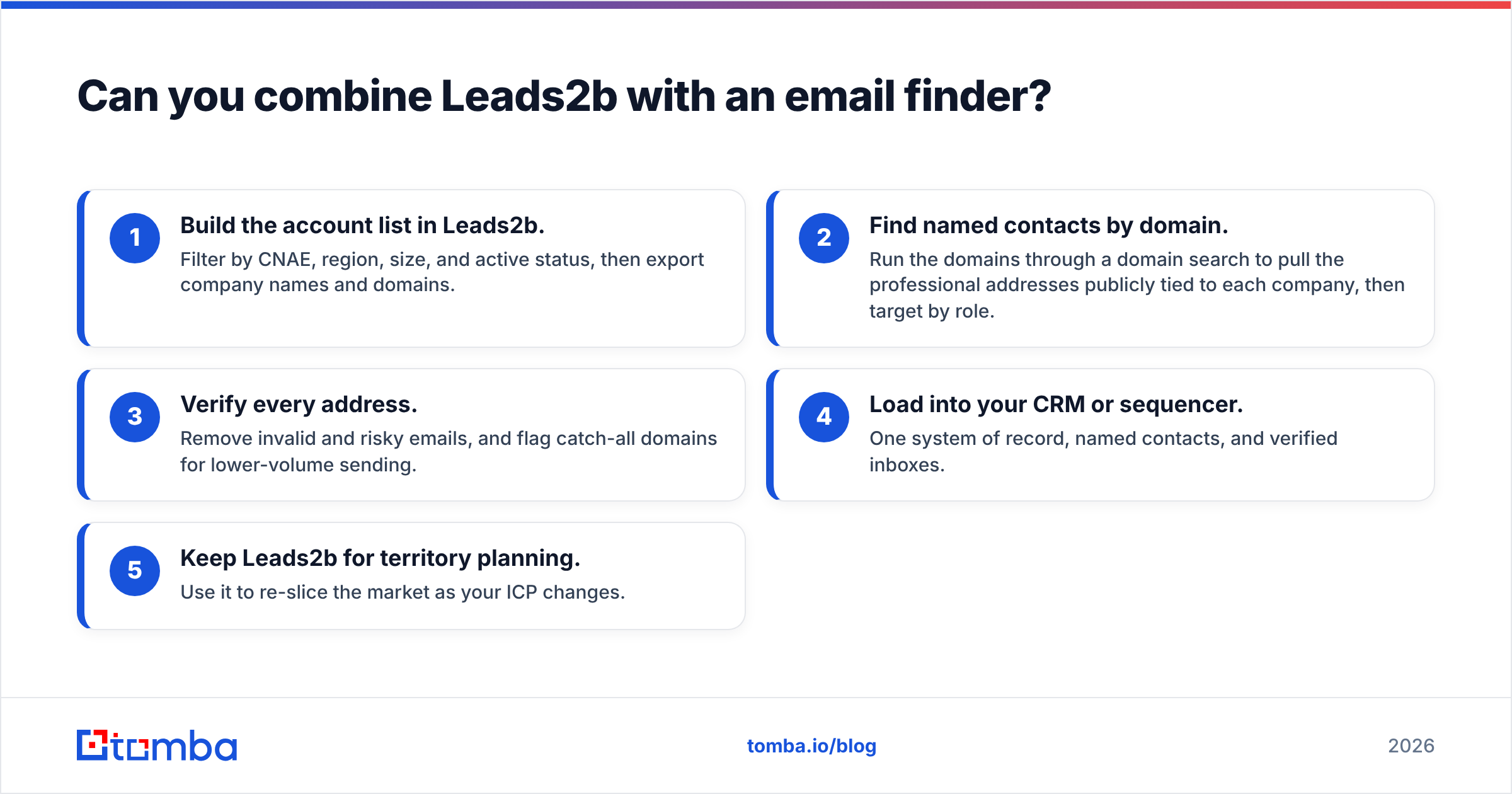
Yes, and for many Brazilian teams with named-account motions, this is the best setup. The workflow looks like this:
- Build the account list in Leads2b. Filter by CNAE, region, size, and active status, then export company names and domains.
- Find named contacts by domain. Run the domains through a domain search to pull the professional addresses publicly tied to each company, then target by role.
- Verify every address. Remove invalid and risky emails, and flag catch-all domains for lower-volume sending.
- Load into your CRM or sequencer. One system of record, named contacts, and verified inboxes.
- Keep Leads2b for territory planning. Use it to re-slice the market as your ICP changes.
This splits the job cleanly: Leads2b answers which companies, and a person-level finder answers which inbox. You avoid the most common registry-data failure mode, which is sending a thoughtful, personalized cold email to financeiro@ and wondering why nobody replies.

What should you ask on a Leads2b demo?#
Go into the call with specific questions, not "show me the product":
- What share of records in my target CNAE codes include a named decision-maker email, not just a generic inbox? Ask them to show you on a live search.
- How often is each field refreshed? Ask separately for registry fields, phones, and emails.
- What does one "credit" or export actually buy? Get the effective cost per usable contact.
- Which CRMs sync in both directions? Check your exact stack (HubSpot, Pipedrive, RD Station, Salesforce).
- Is there an API, and on which plan? This matters if you want to enrich inbound leads automatically.
- How do you document the lawful basis for B2B contact data under LGPD? You need this answer for your own compliance file.
Then run a pilot: export 200 contacts in your core segment, verify them, send a small campaign, and measure bounce rate and reply rate against your current source. The numbers will tell you more than any review.
Is Leads2b worth it in 2026?#
Leads2b is worth it if your market is Brazil and you segment by registry attributes. Few global tools match its depth on Brazilian companies, and the Portuguese-first experience lowers adoption friction for local teams.
It is not worth it as your only data source if:
- more than a small share of your pipeline sits outside Brazil,
- your outbound motion depends on reaching specific named roles, or
- you already have a CRM and only need contact data, not another pipeline.
In those cases, either pair Leads2b with a person-level finder or start with a global, self-serve tool where you can see cost per verified contact up front. You can compare Tomba pricing against a Leads2b quote on a per-contact basis before you commit.
Final verdict#
Leads2b does one thing very well: it maps the Brazilian B2B market using official registry data, with filters that match how local sellers think. Its weaknesses mostly come from that same focus. Coverage outside Brazil is thin, named-contact email coverage is less consistent than company data, and pricing takes a sales call to understand. Judge it by your market's shape, pilot it on your real ICP, and verify every address before it reaches your sequencer.
If you already know which companies you want to reach, in Brazil or anywhere else, and you need the verified inbox of the right person inside each one, try the Tomba Email Finder. Search by domain, by name and company, or straight from LinkedIn, and every address is checked before you export. The free tier includes 25 searches a month, so you can test it on your own account list first.
Related guides#
// get started
Find, verify and enrich your first contacts today
Start on the free plan with 25 searches a month, then scale when your team is ready.
Free plan · No credit card required · GDPR & CCPA
// about the author