Leadsforge vs Market Location: Global AI Search or UK Verified Data?
Leadsforge lets you search 500M+ global contacts by typing a prompt. Market Location sells human-verified, TPS-screened UK business data. Here is which one fits your pipeline, and when you'll want both.
Leadsforge vs Market Location is a choice between global AI search and verified UK data. This guide compares both so you can pick the right one for your pipeline.
TL;DR
- Leadsforge is a self-serve AI lead search engine. You describe your ideal customer in plain English and search 500M+ global contacts. Plans start at $49/mo for 2,000 credits. Credits don't expire.
- Market Location is a long-running UK B2B data provider. It sells human-verified, TPS/CTPS-screened business data. It also offers cleansing, segmentation and consultancy. Pricing is quote-based.
- Run outbound outside the UK, or want lists in minutes? Pick Leadsforge. Sell to UK SMBs, cold call a lot, or need data that passes a GDPR/PECR audit? Pick Market Location.
- Neither tool removes the need to verify an email right before you send it. Put an email verifier between your list source and your sequencer.
Leadsforge vs Market Location: what is the real difference?#
These two tools solve different problems. Yet both end up as "a list of B2B contacts" in your CRM.
Leadsforge is software. It belongs to the Forge stack (Salesforge, Mailforge, Infraforge). It's built for outbound teams who want to go from idea to list in one sitting. You type something like "Heads of Finance at Series B SaaS companies in Germany with 50–200 employees". It then returns matching contacts. You can also filter by buying signals or pull a competitor's followers.
Market Location is a data business with its own tools. Its core asset is a "Verified Business Universe". This is a live record of UK firms that are still trading. It pulls from phone, credit, Companies House and web sources. People check the data along the way. You aren't prompting an AI. You're buying curated UK data, often with a person helping you define the segment.
Think of it as a search engine versus a specialist library. The search engine covers more ground faster. The library has fewer books, but someone has checked each one.
How do Leadsforge and Market Location compare feature by feature?#
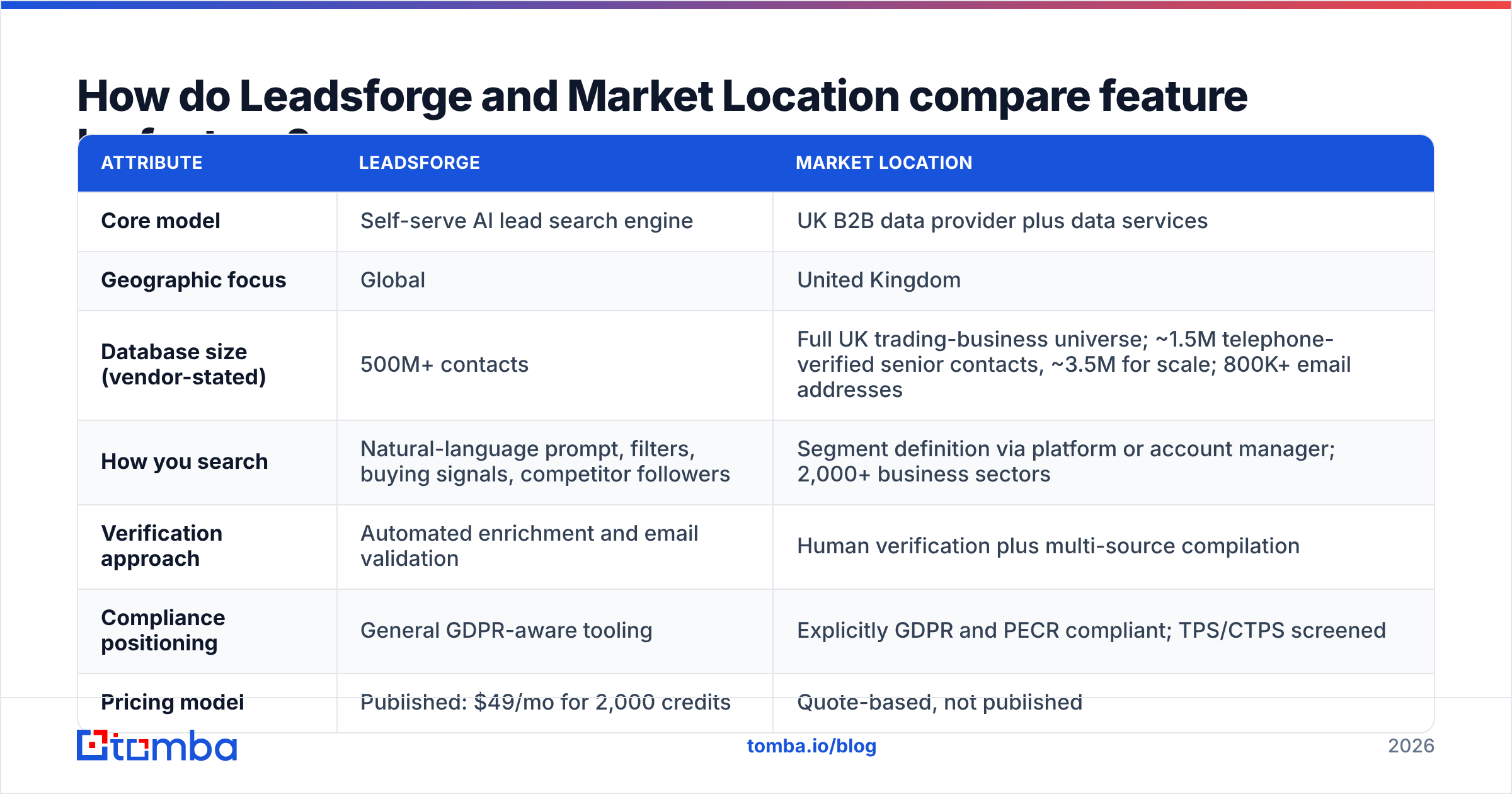
Here's the side-by-side view, based on public information as of 2026.
| Attribute | Leadsforge | Market Location |
|---|---|---|
| Core model | Self-serve AI lead search engine | UK B2B data provider plus data services |
| Geographic focus | Global | United Kingdom |
| Database size (vendor-stated) | 500M+ contacts | Full UK trading-business universe; ~1.5M telephone-verified senior contacts, ~3.5M for scale; 800K+ email addresses |
| How you search | Natural-language prompt, filters, buying signals, competitor followers | Segment definition via platform or account manager; 2,000+ business sectors |
| Verification approach | Automated enrichment and email validation | Human verification plus multi-source compilation |
| Compliance positioning | General GDPR-aware tooling | Explicitly GDPR and PECR compliant; TPS/CTPS screened |
| Pricing model | Published: $49/mo for 2,000 credits | Quote-based, not published |
| Free trial | 100 free credits | Contact sales |
| Credit expiry | Credits roll over and don't expire | Depends on contract/licence terms |
| Phone data | Available (10 credits per phone lookup) | Core strength: telephone-verified contacts |
| Extra services | Native handoff to Salesforge sequencing | Data cleansing, segmentation, insights, telemarketing, consultancy |
| Best for | Global outbound, agencies, fast list building | UK-focused sales, telemarketing, regulated outreach |
The table shows the main split. Leadsforge gives you breadth and speed. Market Location gives you UK depth and compliance.
How does each platform actually work day to day?#
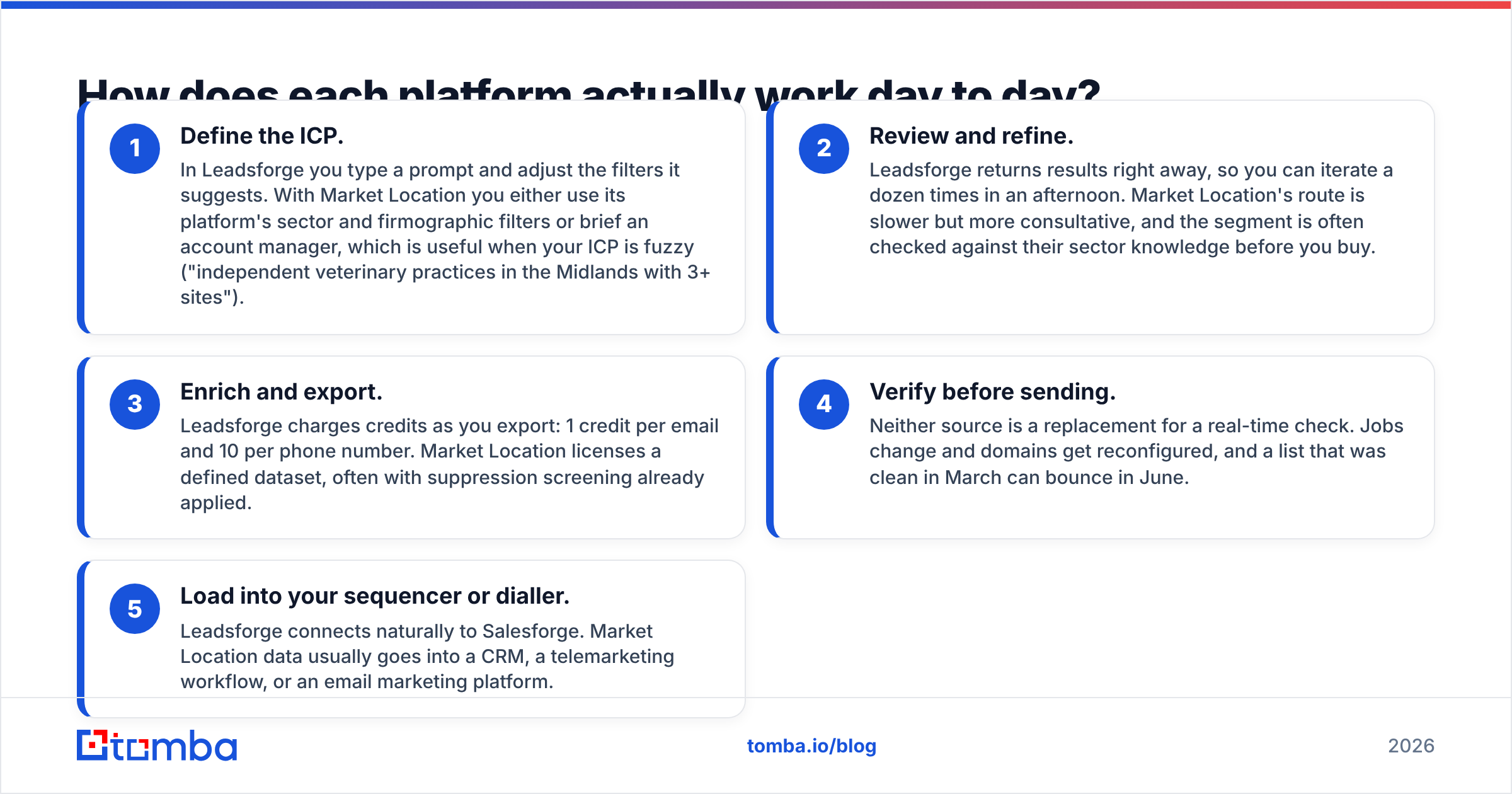
The workflow matters more than the feature list. It decides how many lists your team really builds each week.
- Define the ICP. In Leadsforge you type a prompt and tweak the filters it suggests. With Market Location you use its sector filters or brief an account manager. That helps when your ICP is fuzzy ("independent vet practices in the Midlands with 3+ sites").
- Review and refine. Leadsforge returns results right away, so you can iterate a dozen times in an afternoon. Market Location is slower but more hands-on. Staff often check the segment before you buy.
- Enrich and export. Leadsforge charges credits as you export: 1 per email and 10 per phone number. Market Location licenses a set dataset, often already screened.
The last two steps are the same whichever tool you pick.
- Verify before sending. Neither source replaces a real-time check. People change jobs and domains change. A list that was clean in March can bounce in June.
- Load into your sequencer or dialler. Leadsforge links easily to Salesforge. Market Location data usually goes into a CRM, a call workflow, or an email platform.
Which one has better data quality?#
It depends which kind of "quality" you mean.
Market Location wins on UK depth. Human checks, phone checks and TPS/CTPS screening cost a lot to run. That's why UK call teams keep buying from local firms. Say you call Scottish manufacturers or Welsh accountancy firms. A provider that has phoned those firms has a real edge over a global scrape.
Leadsforge wins on coverage and fresh discovery. With 500M+ contacts across markets, it finds people Market Location doesn't cover at all. Think US startups, DACH mid-market firms and APAC regional offices. Buying-signal filters also help you reach accounts at the right moment. Static lists can't do that.
The trade-off shows up at the edges. Large global databases always hold some stale records. Curated national datasets are always smaller. Plan for both:
- Expect bounce risk on any list. B2B contact data decays as people change roles. Run everything through email verification before your first send.
- Watch catch-all domains. Many UK firms accept all mail at the server. A basic check marks them "valid" when they aren't. A catch-all verifier separates real inboxes from black holes.
- Spot-check samples. Before you commit budget, pull 100 records from either source. Verify them and compare deliverable rates against your ICP.
Leadsforge vs Market Location pricing: how much do they cost?#
Leadsforge publishes its pricing, so it's easy to budget. Its pricing page lists an entry plan at $49/mo for 2,000 credits. The yearly plan is $588 with 28,000 credits upfront. There is no per-seat charge. Credits don't expire, so a slow month doesn't waste budget. Email lookups cost 1 credit and phone lookups cost 10. A phone-heavy workflow burns credits about ten times faster.
Rough maths: 500 contacts a month with emails and phones needs 500 + 5,000 = 5,500 credits. That's well above the entry tier. Email-only prospecting goes much further.
Market Location doesn't publish prices. You contact sales via marketlocation.com and get a quote. The price depends on list size, data fields, term and extras. This is normal for UK list providers. Each record usually costs more than with a self-serve tool. But you're paying for checks and compliance work you'd otherwise do yourself.
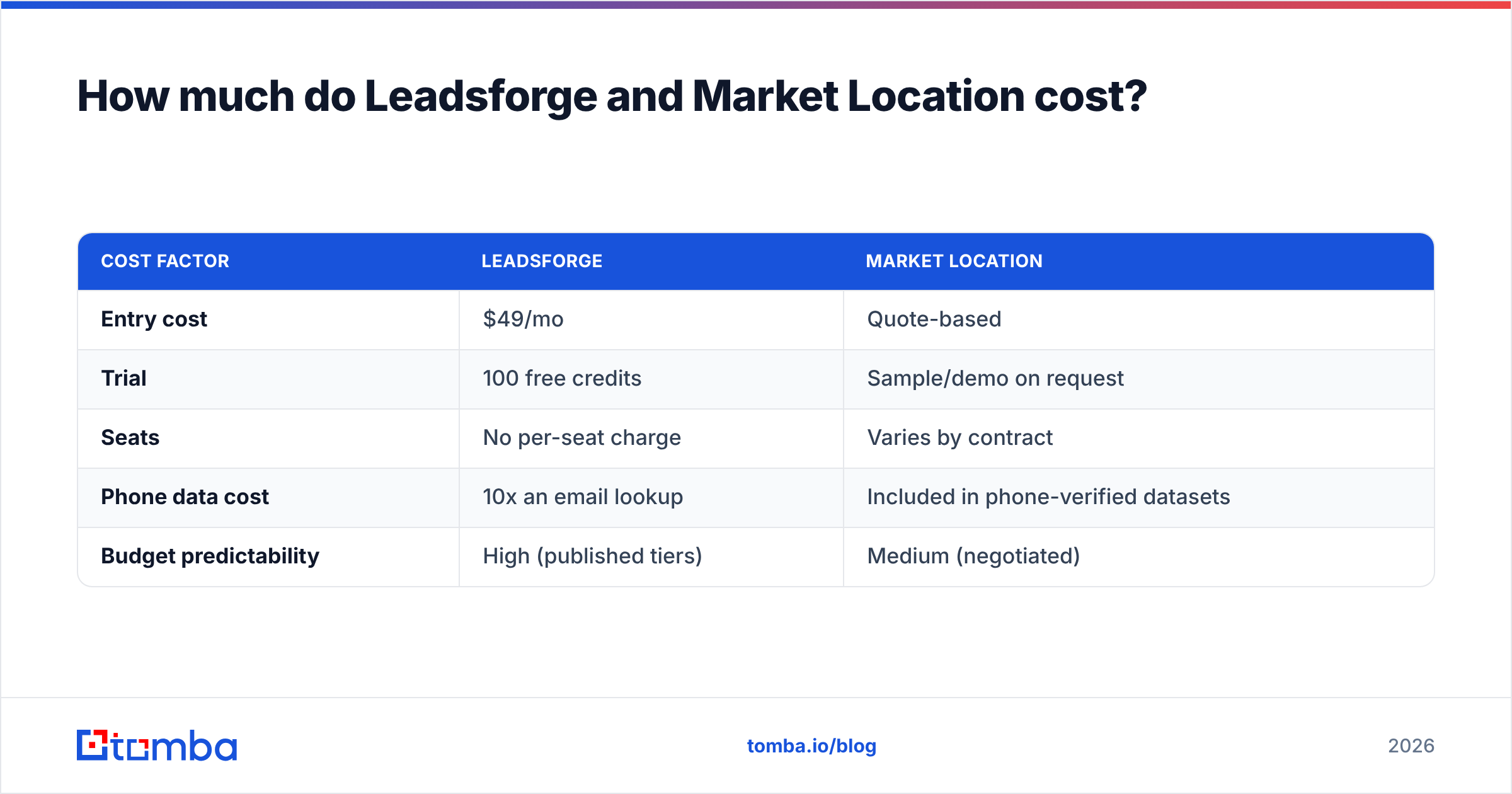
| Cost factor | Leadsforge | Market Location |
|---|---|---|
| Entry cost | $49/mo | Quote-based |
| Trial | 100 free credits | Sample/demo on request |
| Seats | No per-seat charge | Varies by contract |
| Phone data cost | 10x an email lookup | Included in phone-verified datasets |
| Budget predictability | High (published tiers) | Medium (negotiated) |
Which is more compliant for UK and EU outreach?#
In Leadsforge vs Market Location, this is where the gap is widest.
Market Location says its data is GDPR and PECR compliant. It also screens phone contacts against TPS and CTPS. If you're a UK business calling other UK businesses, CTPS screening isn't optional. The ICO's guidance on direct marketing is clear. You can't make unsolicited sales calls to numbers on these lists. A provider that screens for you removes a real legal risk.
Leadsforge is a global tool built for cold email. You can use it for B2B outreach under GDPR's legitimate-interest basis. But more of the work falls on you. You must log your reasons, honour opt-outs, and screen phone numbers yourself before you call UK contacts.
If your legal team signs off on data sources, Market Location's paperwork will be easier to approve.
Leadsforge vs Market Location: which should your team choose?#
Match the tool to how you sell, not to the brand. Here's how the choice usually plays out:
- Global outbound agency: Leadsforge. You need many ICPs across many countries, fast turnaround and steady per-client costs.
- US or EU SaaS startup: Leadsforge. Prompt-based search and buying signals suit a small sales team that tests new messages each week.
- UK telemarketing or inside sales team: Market Location. Phone-verified senior contacts and CTPS screening matter most when you sell by phone.
- UK SMB-focused B2B service (accountants, IT support, facilities): Market Location. It covers 2,000+ sectors and reaches local firms that global databases tend to miss.
- Mixed UK plus international pipeline: Both. Use Market Location for the UK core and Leadsforge for other markets. Then dedupe and verify in one place.
- Regulated industry (finance, healthcare suppliers): Market Location, or at least a UK-verified source for anything you'll call.

What are the pros and cons of each?#
Leadsforge pros
- Plain-English search makes list building fast, even without training
- 500M+ global contacts cover markets UK providers don't
- Clear, low entry pricing; credits never expire
- Buying-signal and competitor-follower filters help you time outreach
- Clean handoff to Salesforge for sequencing
Leadsforge cons
- Phone lookups get expensive at 10 credits each
- Compliance screening (TPS/CTPS, opt-outs) is your job
- Global breadth means less depth on small UK local firms
- Tied most closely to the Forge tools
Market Location pros
- Human-verified UK business data built over decades
- Clear GDPR/PECR compliance and TPS/CTPS screening
- Strong phone-verified senior contact data
- Hands-on services: cleansing, segmentation, telemarketing
Market Location cons
- UK-only, so no help for going abroad
- No published pricing and a slower buying process
- Email coverage (800K+ addresses) is smaller than phone coverage
- Less suited to fast, self-serve list building
Is Leadsforge better than Market Location?#
Not overall. But for a typical cold-email team outside the UK, yes. Leadsforge is quicker to start, cheaper to test and far broader in reach. If you email people in several countries, it's the more practical tool.
For UK-first teams, Market Location is the stronger choice. This is truer still if you pick up the phone. Verified UK data, screening and a real account team are worth the higher price. A bad call list carries legal and brand risk.
In the Leadsforge vs Market Location debate, many mature teams end up using both. You don't have to stick to one data source. But be strict about what happens after the list arrives.
What should you add to either stack?#
Whichever you buy, three gaps remain:
- Real-time email verification. Lists age. Verify at send time, not purchase time.
- Filling gaps for named accounts. When a target account lacks a decision-maker, find email addresses by name and domain. Don't just hope the next export has them.
- Domain-level discovery. For account-based campaigns, a domain search shows every public email tied to a company. It helps you map the buyers that list providers only partly cover.
Tomba covers all three. You can use it with Leadsforge for global lists or with Market Location for UK lists. You don't need to change your main data source. Plans start with a free tier of 25 searches a month. Then Starter is $49/mo, Growth is $99/mo and Pro is $249/mo. See Tomba pricing for the full breakdown.
The bottom line#
Pick Leadsforge for speed, global reach and self-serve pricing. Pick Market Location for verified UK data, phone-first outreach and compliance confidence. Pick both if your pipeline crosses the Channel. That's the short answer to Leadsforge vs Market Location.
Then close the loop. Before any list reaches your sequencer, fill the missing contacts and confirm every address works. Tomba Email Finder finds work email addresses by name, domain or company. It verifies them in the same step, so your Leadsforge exports and Market Location files both go out clean. Start with the free tier and test it on your next list.
Related guides#
Ready to find emails that actually work?
Join 150,000+ professionals who stopped guessing and started sending. Free credits on signup — no credit card required.
Get the Tomba newsletter
Practical outbound tactics and product updates — once every two weeks.
About the author