Leadsforge vs OutboundView: AI Lead Lists or an Outbound Agency?
Leadsforge and OutboundView are different kinds of product. One is a $49/mo AI lead-list tool you run yourself. The other is an agency that books meetings with HR buyers for you. Here is how to tell which one fits your pipeline.
- They are different kinds of product. Leadsforge is self-serve AI software that builds B2B lead lists. OutboundView is a US sales development agency that runs outbound campaigns and books meetings for you.
- Leadsforge costs $49/month for 2,000 credits. New accounts get 100 free credits, and unused credits carry over. OutboundView doesn't publish prices, so you get a quote after a sales call.
- OutboundView only works in one niche: companies that sell to HR and L&D buyers. It uses its own human-verified database of HR decision-makers, called TalentView.
- Pick Leadsforge if you have someone to write and send the emails and you mainly need lists. Pick OutboundView if you sell HR tech or services and would rather pay someone to fill your calendar.
- Neither one replaces email verification. Always check deliverability before you send.
What is the real difference between Leadsforge and OutboundView?#
Most "X vs Y" posts compare two tools that do roughly the same job. This one doesn't. Comparing Leadsforge with OutboundView is a bit like choosing between a well-stocked kitchen and a caterer. The kitchen gives you the ingredients cheaply, and you do the cooking. The caterer costs more and hands you a finished meal. It also only serves one kind of event.
Leadsforge is an AI lead-generation search engine. You describe your ideal customer in plain language, for example "Series A fintech companies in Germany with a VP of Finance". It returns a list of contacts with enriched data that you can export into your sequencer. It belongs to the Forge product family, which also includes Salesforge for sequencing and related tools for warmup and sending infrastructure.
OutboundView is a B2B sales development agency based in Franklin, Tennessee. Blake Johnston founded it in 2017. It designs and runs outbound programs such as cold calling, email and appointment setting, and it focuses entirely on companies that sell to HR and learning & development teams. You don't log into OutboundView to pull leads. You hire it to produce meetings.
So the first question isn't which one is better. It's whether you want to buy data or buy outcomes.
How do Leadsforge and OutboundView compare side by side?#
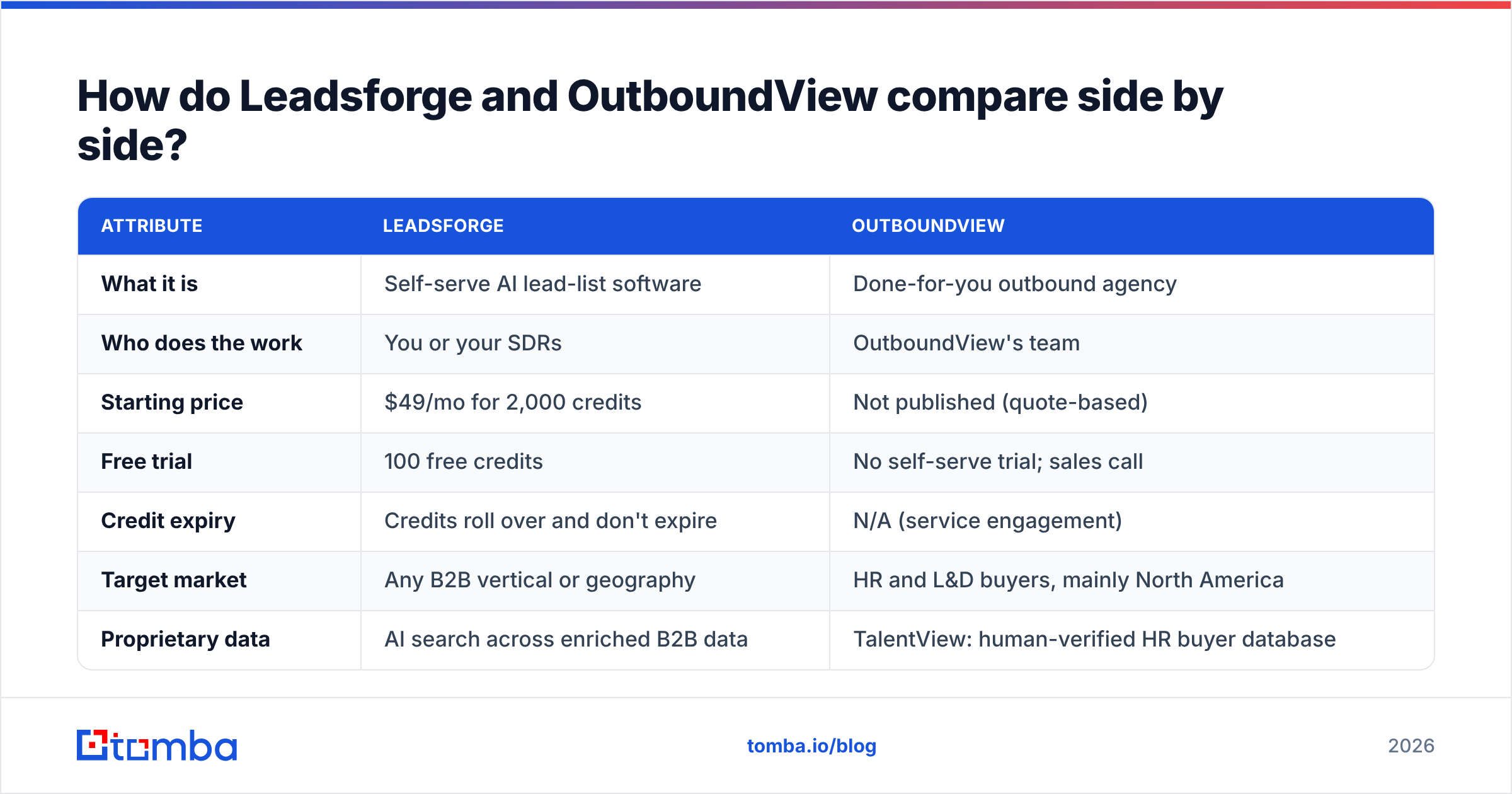
Here is the comparison at the level a buyer actually cares about:
| Attribute | Leadsforge | OutboundView |
|---|---|---|
| What it is | Self-serve AI lead-list software | Done-for-you outbound agency |
| Who does the work | You or your SDRs | OutboundView's team |
| Starting price | $49/mo for 2,000 credits | Not published (quote-based) |
| Free trial | 100 free credits | No self-serve trial; sales call |
| Credit expiry | Credits roll over and don't expire | N/A (service engagement) |
| Target market | Any B2B vertical or geography | HR and L&D buyers, mainly North America |
| Proprietary data | AI search across enriched B2B data | TalentView: human-verified HR buyer database |
| Channels covered | Lists only; pair with your own sequencer | Email, cold calling, appointment setting |
| Main deliverable | Exportable contact lists | Booked meetings and outbound strategy |
| Time to first result | Minutes | Weeks (onboarding, messaging, ramp) |
| Best for | Lean teams that already run outbound | HR-tech vendors that want outsourced SDRs |
The table shows the trade-off. Leadsforge is cheap and fast, but you still do the outreach. OutboundView costs much more and takes longer to start, but it covers strategy, messaging, calling and follow-up for one specific kind of buyer.
How does each option actually work?#
Here is what each one looks like in practice, from first contact to a booked meeting:
- Leadsforge: describe your ICP. You type a natural-language prompt describing the ideal customer profile. The AI turns it into filters for industry, headcount, title, location and technology.
- Leadsforge: review and export. The app shows you the list and the credit cost before you export. That cost depends on the number of leads and the level of enrichment you choose. You then push the list to a sequencer or CSV.
- OutboundView: discovery and strategy. You meet the team, and they map your HR buyer personas, offer and messaging. For newer sales teams, the Launch consulting track also covers hiring and process.
- OutboundView: execution. Through the Scale program, their reps prospect from TalentView, run email and phone outreach (Dialworks is their cold-calling setup), and book meetings on your calendar.
- Both: measure what converts. With Leadsforge, you own the reply-rate and meeting-rate data in your own tools. With OutboundView, you get reports from the agency and judge them by meetings held and pipeline created.
Steps 1–2 take an afternoon. Steps 3–4 take a sales cycle. That difference in speed is part of what you pay for, not a flaw in either option.
How much do Leadsforge and OutboundView cost?#
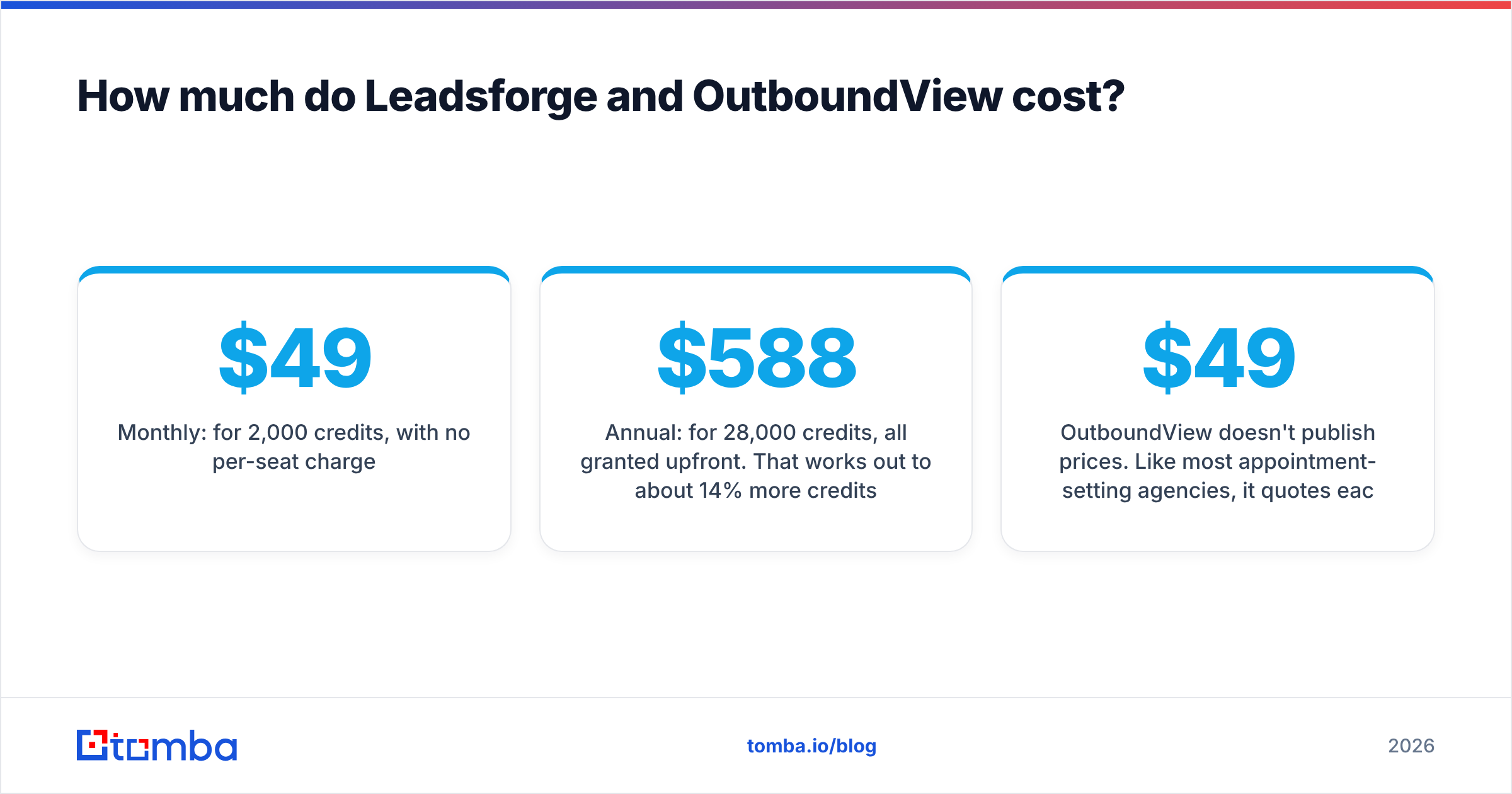
Leadsforge publishes its prices on its pricing page. At the time of writing:
- Monthly: $49/month for 2,000 credits, with no per-seat charge.
- Annual: $588/year for 28,000 credits, all granted upfront. That works out to about 14% more credits than paying monthly.
- Free: 100 credits when you sign up.
- Rollover: unused credits stay in your account and don't expire.
- Top-ups: you can buy extra credits in the app.
Because credits are spent per export, and the cost depends on enrichment depth, your real cost per lead depends on how much data you pull for each contact. A basic list costs less per row than a fully enriched one. Check the credit estimate before you confirm an export.
OutboundView doesn't publish prices. Like most appointment-setting agencies, it quotes each engagement based on scope: how many reps, which channels, how long the program runs, and whether consulting is included. For budgeting, compare the quote against what it would cost you to hire, ramp and manage an SDR yourself, not against a $49 software subscription. One in-house SDR usually costs far more per year than any data tool once you add salary, benefits, tooling and management time.
Put simply, Leadsforge's cost is predictable and low but doesn't include any labor. OutboundView's cost is higher and needs a quote, but it includes the labor.
Which one has better data quality?#
This is where the niche matters.
Leadsforge covers a broad range of industries and countries. That makes it a good fit if your ICP spans several verticals or regions. The trade-off is that broad B2B databases always have some decay: people change jobs, domains get retired, and catch-all servers accept everything. You should verify any list before sending, whichever source it came from.
OutboundView's TalentView takes the opposite approach. It covers one buyer group in depth. It's a human-verified database of more than half a million HR decision-makers in North America, at manager level and above. If your buyer is a CHRO, a Head of People or an L&D director, a dataset curated around exactly those roles will usually be more complete for your use case than a general-purpose index. If your buyer is a CFO or a DevOps lead, TalentView doesn't help you, and OutboundView isn't built for you.
Whichever option you choose, keep a verification step between sourcing and sending. Running exports through an email verifier before they reach your sequencer keeps bounce rates low and protects your sending domains. That applies to any list, from any vendor. Independent review sites such as G2 can also show you how real users rate data freshness over time.
Who should choose Leadsforge?#
Leadsforge is the better fit when:
- You already run outbound yourself. You have a sequencer, warmed-up mailboxes and someone who can write copy. What you're missing is a steady supply of relevant contacts.
- Your ICP is outside HR, or covers several verticals and countries.
- You want predictable, low spend. $49/month with rollover credits is easy to justify, even for a solo founder.
- You iterate quickly. You can test a new segment in an afternoon, send a small campaign and cut it if it doesn't work, without renegotiating a contract.
- You like the Forge ecosystem. If you already use Salesforge or its sister tools, the list-to-send workflow will feel familiar.
Where it falls short: Leadsforge doesn't write your emails, make your calls or handle objections. If nobody on your team owns outbound, a list just sits in a CSV.
Who should choose OutboundView?#
OutboundView is the better fit when:
- You sell to HR or L&D. Examples include HR tech, benefits, PEOs, payroll, recruiting software and corporate training. This is the only market they serve, and they know it well.
- You don't have SDR capacity. You would rather pay an experienced team than hire, train and manage reps yourself.
- You need phone as well as email. HR buyers often respond better to multichannel outreach, and OutboundView brings its own calling setup.
- You want strategy, not just execution. The consulting track helps if you're building an inside sales function for the first time.
- Your deal sizes justify it. Agency fees make sense when a single closed deal pays for months of the engagement.
Where it falls short: you give up control and speed, and you can't use it outside the HR niche. You also can't try it for free or pay month to month the way you can with a SaaS tool.
Can you use Leadsforge and OutboundView together?#
You can, but it rarely makes sense. OutboundView brings its own HR database, so buying Leadsforge credits to feed the agency would mostly duplicate its sourcing. Some companies run both on separate tracks, though. The agency covers the core HR buyer segment, and the in-house team uses Leadsforge to test adjacent segments such as finance leaders at the same accounts, or a new country.
If you do run parallel tracks, keep a clear owner for each account in your CRM. Otherwise the agency's SDR and your in-house rep may email the same VP of People in the same week, which makes both of you look disorganized.
Where does Tomba fit into this decision?#
Neither Leadsforge nor OutboundView is an email finder in the narrow sense. So the gap many teams run into is this: "I already know which companies and people I want. I just need their verified work email."
That's a different job from AI list-building or outsourced SDR work. A few examples:
- You have a target account list from your CRM, and you need contacts at those specific domains. A domain search returns the publicly indexed emails for a company along with their sources.
- You have a name and a company from a LinkedIn search or a conference attendee list, and you need the one correct address. An email finder does exactly that.
- You have a list from any vendor, Leadsforge included, and you want to clean it before sending. A verifier and a catch-all check handle that.
Tomba's plans start with a free tier of 25 searches a month, then Starter at $49/mo, Growth at $99/mo and Pro at $249/mo (full Tomba pricing). That puts it at the same budget level as Leadsforge, not an agency. The difference is in the job. Leadsforge helps you discover who to target. Tomba is built to find and verify the exact address for people you've already chosen.
So which should you pick: Leadsforge or OutboundView?#
Here is our verdict.
- Choose Leadsforge if you run outbound in-house, sell outside HR (or across several verticals), and want fast, cheap and flexible list-building. At $49/month with rollover credits, it costs little to test. Just add a verification step before sending.
- Choose OutboundView if you sell to HR or L&D buyers in North America, don't have SDR capacity, and your deal sizes can support an agency engagement. Its HR specialization and human-verified TalentView data are real advantages, but only inside that niche.
- Choose neither if your real problem is "I know who I want, I just can't reach them." In that case you need a precise email finder and verifier, not an AI list builder or an agency.
A simple rule: if you'd be happy doing the outreach yourself, buy software. If you wouldn't, and you sell to HR, hire OutboundView.
Frequently asked questions#
Is OutboundView a software tool like Leadsforge?#
No. OutboundView is a sales development agency. It runs outbound campaigns and books appointments for clients selling to HR and L&D buyers. Its TalentView database supports its own programs. It isn't sold as a self-serve SaaS product the way Leadsforge is.
How much does Leadsforge cost in 2026?#
Leadsforge lists $49/month for 2,000 credits, or $588/year for 28,000 credits granted upfront. New accounts get 100 free credits, and unused credits don't expire. Check the Leadsforge pricing page before you buy, because vendors change prices often.
Does OutboundView publish its pricing?#
No. Engagements are quoted after a discovery call and depend on channels, rep count and program length.
Do I still need email verification with Leadsforge?#
Yes. Any B2B database decays as people change jobs and domains change. Verify every export before it goes into a live sequence to protect your sender reputation.
Which is better for a startup?#
Most early-stage startups outside the HR market should start with self-serve tools like Leadsforge, because the cost is low and they can change course quickly. HR-tech startups with funding but no SDR team are the main exception, and OutboundView is worth talking to in that case.
If what's slowing your pipeline isn't who to target but how to reach them, try the Tomba Email Finder. Give it a name and a company domain and it returns a verified professional email along with its public sources. You can start on the free plan with 25 searches a month and upgrade to Starter at $49/mo when volume grows. It fits alongside Leadsforge, an agency, or your own CRM target list.
Related guides#
// get started
Find, verify and enrich your first contacts today
Start on the free plan with 25 searches a month, then scale when your team is ready.
Free plan · No credit card required · GDPR & CCPA
// about the author