Leadsforge vs Revli (2026): Which Lead Source Fits Your Outbound?
Leadsforge builds lead lists from a plain-English ICP prompt. Revli sells access to recently funded companies and their decision-makers. Here's how to choose, and how to keep either list from bouncing.
TL;DR
- Leadsforge is an AI list builder. You describe your ideal customer in plain English and it returns matching companies and contacts. It belongs to the Forge suite (Salesforge, Warmforge, Infraforge), so it suits teams that want to go from prompt to live sequence quickly.
- Revli is a narrower database built around one trigger: startups that recently raised venture funding. You get round data plus contacts for decision-makers.
- Choose Leadsforge if your ICP is broad or hard to express as filters, or if you already send through Salesforge.
- Choose Revli if you sell to startups that just raised, such as recruiting, dev shops, SaaS infrastructure or fractional services, and timing matters more than volume.
- Neither tool removes the need to verify addresses before you send. Put an independent verification step between export and sequence whichever one you pick.
What are Leadsforge and Revli?#
Both tools produce lead lists, but they start from different questions.
Leadsforge asks "who is your ideal customer?" You type something like "Series A fintech companies in the UK with 50–200 employees, heads of compliance" into a chat-style prompt. The tool turns that into a search and returns companies and people. It also offers lookalike search: give it a customer's domain and it finds similar companies. Because it sits in the same product family as Salesforge, lists can go straight into sequencing without a CSV round-trip.
Revli asks "who just got money?" It tracks companies that recently closed a funding round and records the round type, amount and date alongside contacts for founders and executives. The logic is simple: a startup that closed a round last month has fresh budget, a hiring plan and pressure to spend both. If your product fits that moment, Revli gives you a list already filtered for timing.
So one is a general-purpose AI search layer and the other is a trigger-event database. That difference shapes almost every comparison below.
How do Leadsforge and Revli compare side by side?#
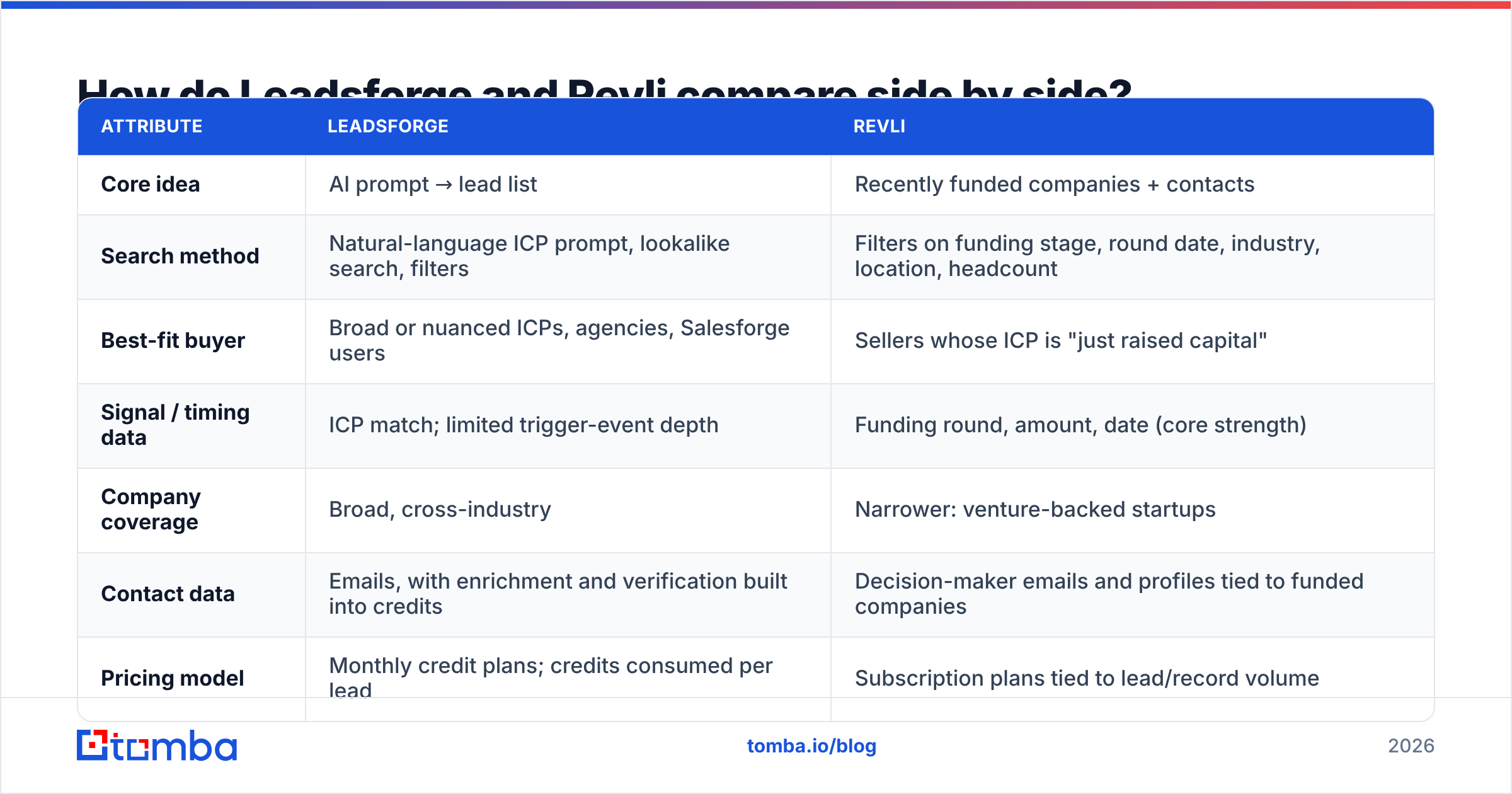
Vendor plans change often, so treat pricing rows as structural (how you pay) and confirm current numbers on each vendor's pricing page before you buy.
| Attribute | Leadsforge | Revli |
|---|---|---|
| Core idea | AI prompt → lead list | Recently funded companies + contacts |
| Search method | Natural-language ICP prompt, lookalike search, filters | Filters on funding stage, round date, industry, location, headcount |
| Best-fit buyer | Broad or nuanced ICPs, agencies, Salesforge users | Sellers whose ICP is "just raised capital" |
| Signal / timing data | ICP match; limited trigger-event depth | Funding round, amount, date (core strength) |
| Company coverage | Broad, cross-industry | Narrower: venture-backed startups |
| Contact data | Emails, with enrichment and verification built into credits | Decision-maker emails and profiles tied to funded companies |
| Pricing model | Monthly credit plans; credits consumed per lead | Subscription plans tied to lead/record volume |
| Native outbound | Direct push to Salesforge sequences | CSV export / CRM-style workflows; sequencing tool required |
| Learning curve | Very low (type a sentence) | Low (standard filter UI) |
| Main risk | Prompt ambiguity returns loose matches | Small addressable pool; everyone uses the same funding news |
User reviews on sites like G2 are worth a skim for both, mainly for complaints about bounce rates and list freshness. Those two issues matter most once you start sending.
What does a real prospecting workflow look like in each tool?#
Here is the practical path from "I need leads" to "emails are sending" in each tool, including the steps the demos tend to skip.
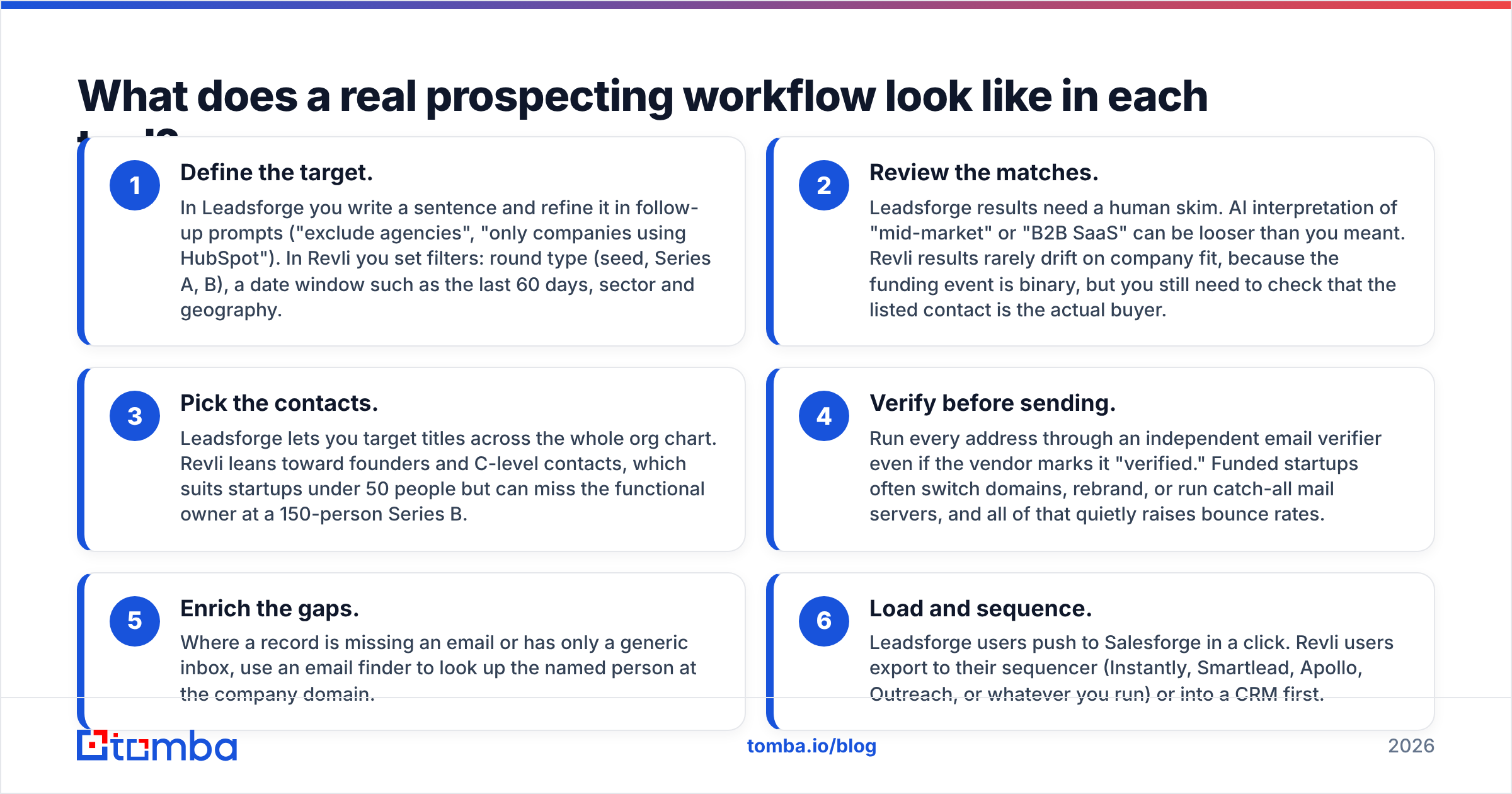
- Define the target. In Leadsforge you write a sentence and refine it in follow-up prompts ("exclude agencies", "only companies using HubSpot"). In Revli you set filters: round type (seed, Series A, B), a date window such as the last 60 days, sector and geography.
- Review the matches. Leadsforge results need a human skim. AI interpretation of "mid-market" or "B2B SaaS" can be looser than you meant. Revli results rarely drift on company fit, because the funding event is binary, but you still need to check that the listed contact is the actual buyer.
- Pick the contacts. Leadsforge lets you target titles across the whole org chart. Revli leans toward founders and C-level contacts, which suits startups under 50 people but can miss the functional owner at a 150-person Series B.
- Verify before sending. Run every address through an independent email verifier even if the vendor marks it "verified." Funded startups often switch domains, rebrand, or run catch-all mail servers, and all of that quietly raises bounce rates.
- Enrich the gaps. Where a record is missing an email or has only a generic inbox, use an email finder to look up the named person at the company domain.
- Load and sequence. Leadsforge users push to Salesforge in a click. Revli users export to their sequencer (Instantly, Smartlead, Apollo, Outreach, or whatever you run) or into a CRM first.
Which tool has better data quality and coverage?#
The two tools are good at different things, so there's no single winner here.
Coverage. Leadsforge covers more ground. You can target a logistics firm in Ohio, a dental group in Texas or a German Mittelstand manufacturer. Revli will never return most of those companies, because they didn't raise venture money. If your total addressable market includes bootstrapped, PE-backed or traditional businesses, Revli can only cover a slice of it.
Relevance. Revli wins on timing relevance. A contact at a company that closed a Series A three weeks ago has more reason to reply than a contact who simply matches a firmographic profile. Funding is one of the most reliable buying signals in B2B, and Revli has built its whole product around it.
Freshness. Both tools face the same startup problem: people move fast. Early-stage companies have high turnover, titles change after every round, and founders use personal-ish addresses. Plan for some decay in any list you export, and don't let a list sit for weeks before you send.
Email accuracy. Neither vendor publishes an independent, audited accuracy benchmark that you can compare directly. Your own bounce rate on a test batch is the only number you should trust. Pull 200 records from each tool for the same segment, verify them with the same third-party verifier, and compare the valid, risky and invalid percentages. It takes an afternoon and tells you more than any marketing page.
How do the pricing models compare?#
Both tools charge by volume, but they structure it differently, and that changes your effective cost per usable lead.
Leadsforge uses monthly credit plans. Credits are spent when you reveal or export leads, and verification and enrichment are bundled into that spend. The model suits variable workloads: prompt, test, discard, prompt again. Watch how many credits a loose prompt burns before you narrow it down.
Revli uses subscription plans sized by how many records you can access or export. Its data is pre-filtered to one segment, so a higher share of what you pay for is on-target. The trade-off is that you're paying a premium for the funding signal. If you don't need that signal, you're overpaying.
The useful calculation is not price per credit. It's this:
Cost per sequence-ready lead = plan cost ÷ (records exported × % on-ICP × % deliverable)
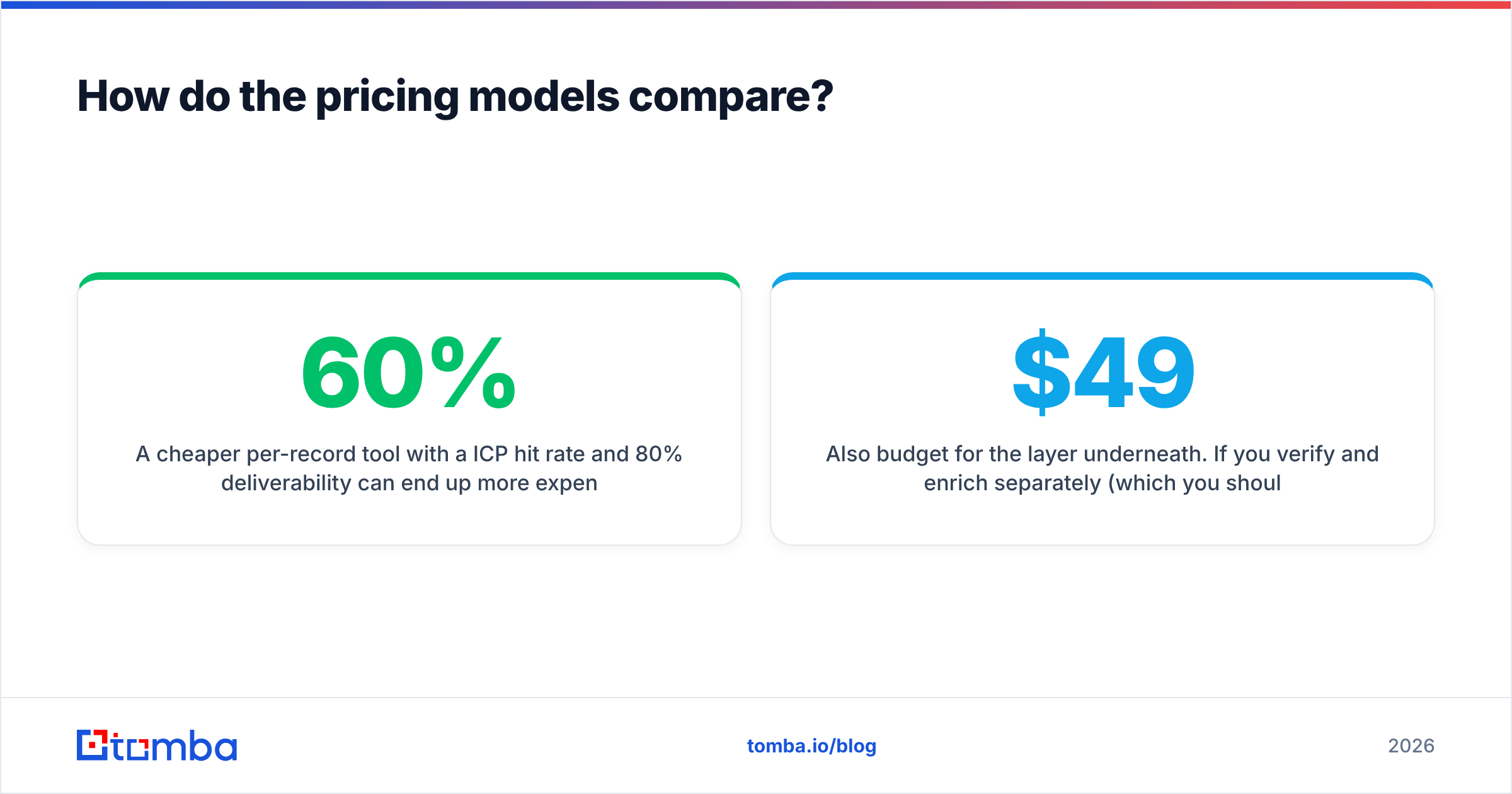
A cheaper per-record tool with a 60% ICP hit rate and 80% deliverability can end up more expensive than a pricier one with 90% on both. Run the formula on your test batch before you commit to an annual plan.
Also budget for the layer underneath. If you verify and enrich separately (which you should), add that to the calculation. Check Tomba pricing as a reference: the free tier covers 25 searches a month for spot checks, and paid plans run $49/mo (Starter), $99/mo (Growth) and $249/mo (Pro) for teams verifying at volume.
Is Leadsforge better than Revli for outbound?#
For most general outbound teams, yes. Leadsforge is the more flexible tool. Three reasons:
- Breadth. Most B2B sellers have ICPs that include companies without recent funding. Leadsforge can reach them and Revli can't.
- Speed to first send. If you're already on Salesforge, the prompt-to-sequence path is very short. Infraforge handles mailbox infrastructure and Warmforge handles warmup, so the whole stack comes from one vendor.
- Iteration. Refining a prompt in conversation is faster than rebuilding a filter set, especially for agencies juggling several client ICPs a week.
Leadsforge has weaknesses too. AI interpretation adds a layer of uncertainty. "Fast-growing" and "tech-forward" mean whatever the model decides they mean. You need to check the first 20–30 results of every new prompt by hand, and write prompts with hard constraints (headcount ranges, named industries, named geographies) instead of adjectives.
When is Revli the better pick?#
Revli is the better tool when funding is your buying trigger. That covers more businesses than people expect:
- Recruiting and staffing firms. A new round usually comes with a hiring plan.
- Dev shops and agencies. Funded startups need to ship faster than their team can.
- SaaS infrastructure and tooling. Security, compliance, payroll, HRIS, cloud cost tools and anything else a company "grows into" after a raise.
- Fractional executives and consultants. Fractional CFOs, heads of growth, RevOps specialists.
- Office, benefits and perks vendors. Headcount growth means spending here.
For these sellers, Revli's smaller pool is an advantage. You aren't paying to sift through thousands of irrelevant companies, and your opener writes itself: "Congrats on the Series A. Most teams at your stage run into X within six months."
The main risk is competition. Every recruiter and agency sees the same funding announcements. The founder of a newly funded startup may get dozens of cold emails in the week after the news, so speed and relevance matter more than volume. Reach them quickly, reach someone other than the founder, and say something specific.
What should you check before buying either tool?#
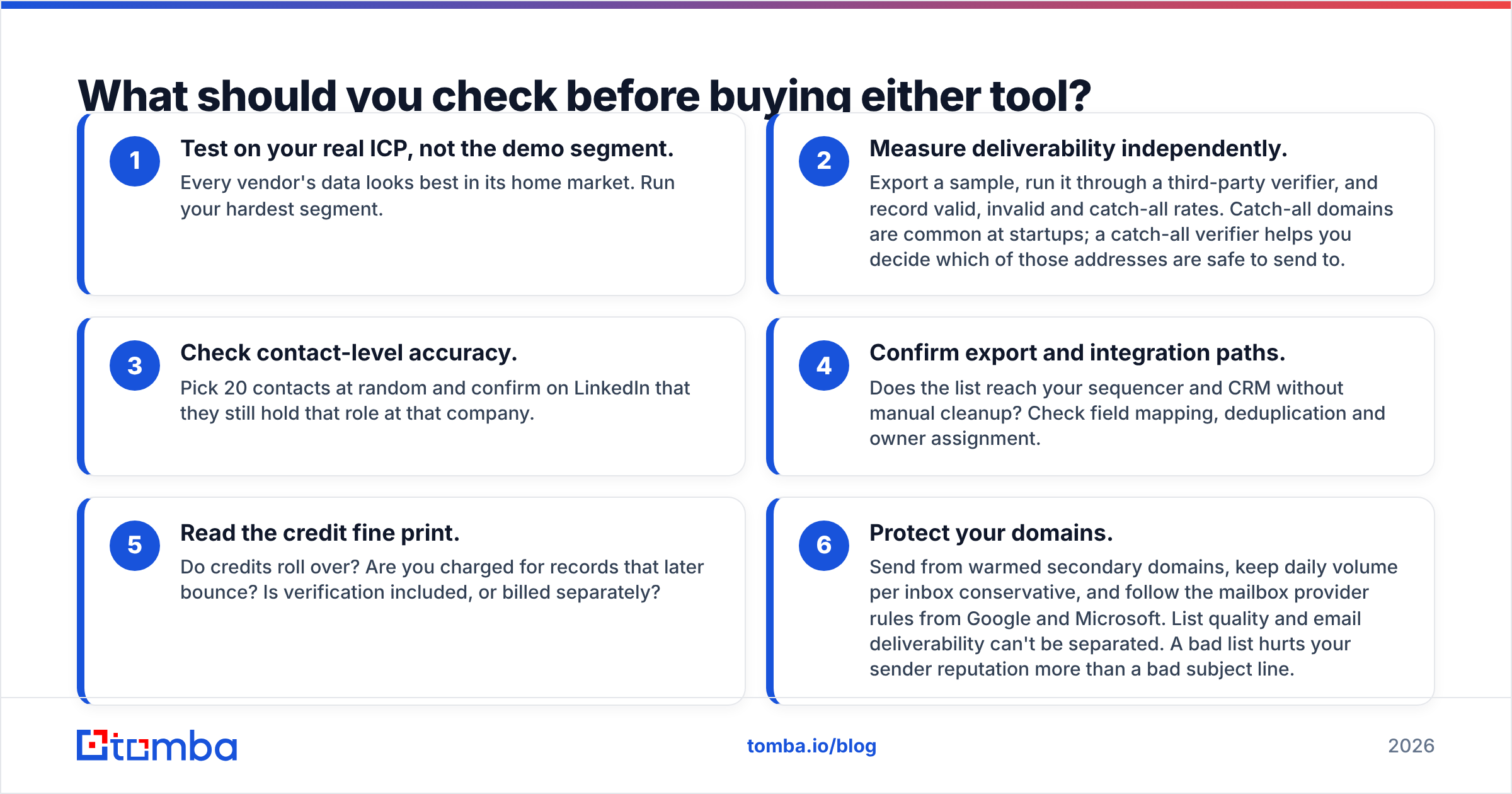
Use this checklist during a trial. It separates tools that look good in a demo from ones that hold up in production.
- Test on your real ICP, not the demo segment. Every vendor's data looks best in its home market. Run your hardest segment.
- Measure deliverability independently. Export a sample, run it through a third-party verifier, and record valid, invalid and catch-all rates. Catch-all domains are common at startups; a catch-all verifier helps you decide which of those addresses are safe to send to.
- Check contact-level accuracy. Pick 20 contacts at random and confirm on LinkedIn that they still hold that role at that company.
- Confirm export and integration paths. Does the list reach your sequencer and CRM without manual cleanup? Check field mapping, deduplication and owner assignment.
- Read the credit fine print. Do credits roll over? Are you charged for records that later bounce? Is verification included, or billed separately?
- Protect your domains. Send from warmed secondary domains, keep daily volume per inbox conservative, and follow the mailbox provider rules from Google and Microsoft. List quality and email deliverability can't be separated. A bad list hurts your sender reputation more than a bad subject line.
Can you use Leadsforge and Revli together?#
Yes, and some teams do. A common setup:
- Revli for timing-led campaigns. A weekly pull of newly funded companies in your sectors feeds a short, high-personalization sequence.
- Leadsforge for always-on volume. Broader ICP prompts feed your evergreen campaigns and fill the gaps between funding waves.
- An independent data layer underneath both. One verifier and one enrichment tool normalize both sources, so bounce rates are measured the same way and records missing an email get filled in consistently.
That third layer is where a tool like Tomba fits. Tomba doesn't replace either list source, because it isn't a funding database or an AI prompt builder. It makes their output safer to send. Use a domain search to find additional stakeholders at a funded startup beyond the founder, verify every address before import, and use data enrichment to fill in missing titles or LinkedIn URLs.
What else do buyers ask about Leadsforge vs Revli?#
Is Leadsforge only useful if I use Salesforge?#
No. You can export leads and use any sequencer. The native Salesforge connection is a convenience, not a requirement. If you already run another sending platform, compare the export workflow in your trial.
Does Revli include companies that aren't venture-funded?#
Revli's core dataset is built around funding events, so bootstrapped and traditional businesses are largely out of scope. If a large share of your market never raises venture capital, pair Revli with a broader source or choose a general database.
Which tool is better for agencies?#
Agencies with many clients and varied ICPs usually get more from Leadsforge's prompt-based flexibility. Agencies with a single vertical focused on startups (recruiting, dev, growth services) often get better reply rates from Revli's funding-triggered lists.
Do I still need an email verifier if the vendor says contacts are verified?#
Yes. Vendor verification happens at a point in time, and startup data decays quickly. Re-verify right before you send, especially if the list has been sitting for more than a couple of weeks.
Which should you choose?#
If you sell to startups at the moment they raise, Revli gives you a sharper, better-timed list and a strong opening line. If your ICP is broader, your campaigns change often, or you're already in the Forge ecosystem, Leadsforge is the more flexible choice. The deciding factor is how important the funding signal is to your motion, not which tool has the longer feature list.
Either way, the list is only as good as the addresses in it. Before you load either export into a sequence, run it through the Tomba Email Finder to find the right people behind every funded or AI-matched company. Find additional decision-makers by domain, fill in contacts that are missing emails, and verify everything, so your first campaign builds sender reputation instead of damaging it. Start on the free tier with 25 searches a month and upgrade to Starter at $49/mo when you're ready to scale.
Related guides#
// get started
Find, verify and enrich your first contacts today
Start on the free plan with 25 searches a month, then scale when your team is ready.
Free plan · No credit card required · GDPR & CCPA
// about the author