Leadsforge vs SalesRipe 2026: Which Lead Tool Should You Use?
Leadsforge vs SalesRipe looks like a normal head-to-head until you check the status pages. SalesRipe posted a shutdown notice in 2020. Here's what that means for your lead list and what to use instead.
TL;DR
- SalesRipe is no longer an active option. Its own website says it shut down operations beginning June 5, 2020. Any "SalesRipe" comparison that treats it as a live product is out of date.
- Leadsforge is active and built for AI-era prospecting. You describe your ideal customer in plain English and get back lists with verified emails. The Essential plan costs $49/mo for 2,000 credits, and credits don't expire.
- On paper, both cost about $49/mo to start. They differ in data model (AI search on demand vs. a static SMB/consumer database) and, most importantly, in whether you can still log in.
- If you came here from an old SalesRipe export, treat that data as stale. Re-verify it before you send a single email.
- Our pick: Leadsforge if you want AI-built lists inside the Forge outbound stack. A dedicated email finder like Tomba if you already know which accounts you want and just need accurate addresses.
Why are people still comparing Leadsforge vs SalesRipe?#
Search for "leadsforge vs salesripe" and you'll find directory pages, alternative lists, and auto-generated comparisons treating the two as current rivals. That makes sense on the surface. Both sold themselves as fast, self-serve ways to get B2B contact data. Both started at roughly $49 a month. Both went after small teams and solo founders instead of enterprise buyers.
The problem is timing. SalesRipe's own company page carries a notice that it began shutting down operations on June 5, 2020. Several pages on the site still describe features and pricing, which is why aggregators keep indexing it as if nothing happened.
So this post answers two questions at once:
- How did SalesRipe work, and how does it compare to Leadsforge on paper? This matters if you inherited SalesRipe data or are auditing an old stack.
- What should you actually buy in 2026 if you liked SalesRipe's price and simplicity?
What is Leadsforge?#
Leadsforge calls itself a search engine for leads. It belongs to the Forge family of outbound tools, next to Salesforge (sequencing), Mailforge and Infraforge (sending infrastructure), and Warmforge (warmup). Instead of stacking filter dropdowns, you type a description of your ideal customer profile, something like "Series A SaaS companies in Germany with 50-200 employees, heads of RevOps", and Leadsforge builds the list.
Here's what matters for buyers, based on Leadsforge's published pricing:
- Credit-based pricing, no seat fees. The Essential plan is $49/mo for 2,000 credits, or $588/year with 28,000 credits granted upfront.
- Credits roll over. Unused credits stay in your account, which helps teams with lumpy outbound calendars.
- Different costs per data type. An email lookup costs 1 credit and a phone number costs 10.
- Free trial. New accounts get 100 free credits to test list quality before paying.
- Native handoff to the Forge stack. If you already sequence in Salesforge, lists move over with little friction.
The weak spots are typical for AI-generated lists. How you phrase the prompt changes the output, niche ICPs can return thin results, and phone coverage uses credits fast at 10 credits per number.
What was SalesRipe?#
SalesRipe was a self-serve contact database aimed at SMB sales teams. Before the shutdown notice, it advertised roughly 20 million business leads and about 200 million consumer records. You could filter by industry, location, job title, company size and, on the consumer side, income and age. Pricing started at $49/mo, and the pitch was unlimited access to contact details inside those filters.
Its feature set included:
- Targeted prospect list building
- Account-based marketing lists
- Technology tracking (which tools a company runs)
- A built-in lead manager for simple follow-up tracking
- A claimed average data accuracy of around 90%
Independent reviewers who covered it praised the price and ease of use, and pointed to stale records and duplicate rows as the recurring complaints. That fits a static database model: records are collected, stored and sold, and they decay between refreshes.
Some directories now list SalesRipe as a legacy brand tied to another data vendor. We couldn't confirm that from primary sources, so don't assume a SalesRipe login, or SalesRipe-era data, carried over anywhere.
How do Leadsforge and SalesRipe compare side by side?#
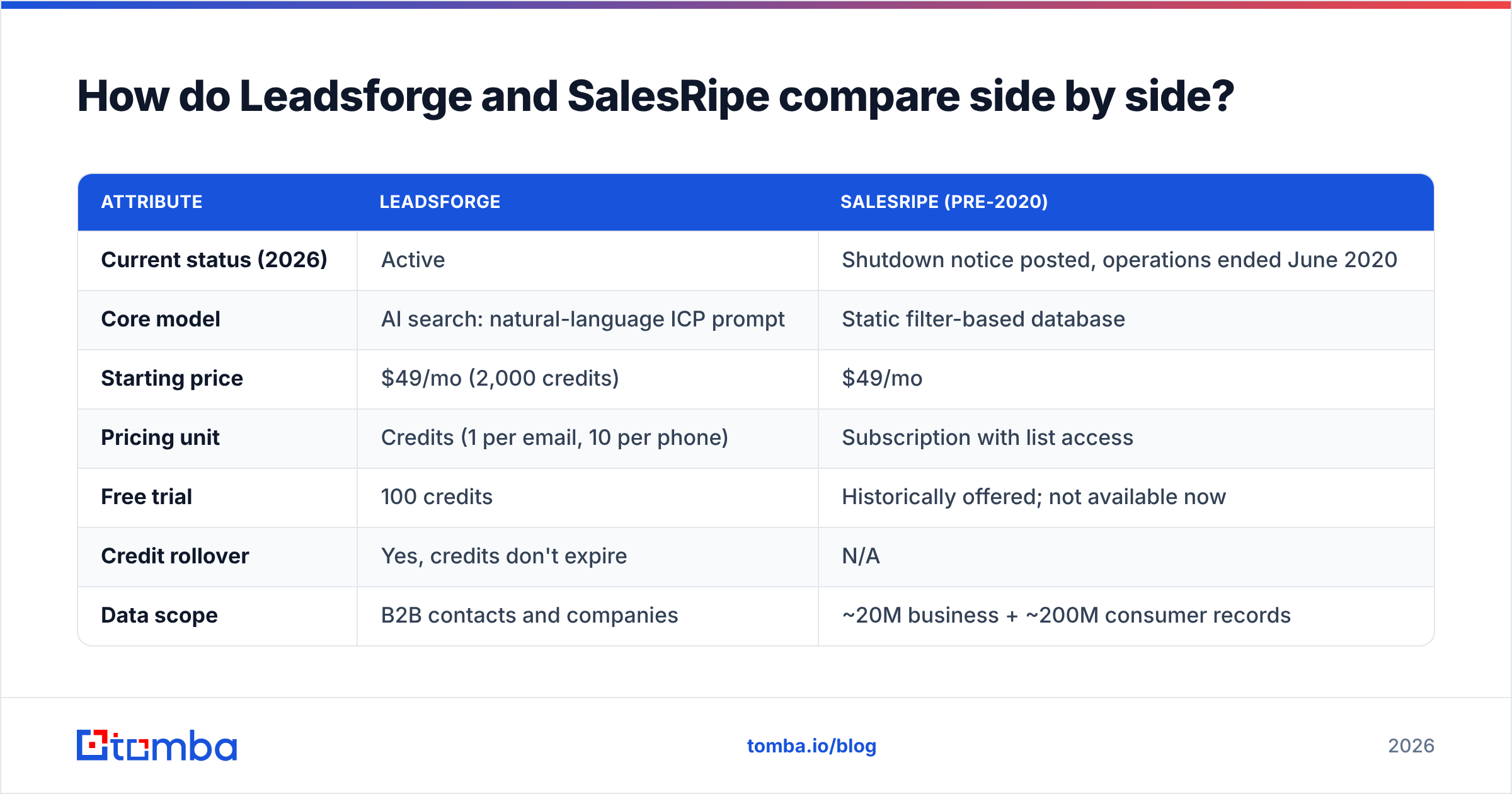
The table below compares both tools as documented. For SalesRipe, that means pre-shutdown.
| Attribute | Leadsforge | SalesRipe (pre-2020) |
|---|---|---|
| Current status (2026) | Active | Shutdown notice posted, operations ended June 2020 |
| Core model | AI search: natural-language ICP prompt | Static filter-based database |
| Starting price | $49/mo (2,000 credits) | $49/mo |
| Pricing unit | Credits (1 per email, 10 per phone) | Subscription with list access |
| Free trial | 100 credits | Historically offered; not available now |
| Credit rollover | Yes, credits don't expire | N/A |
| Data scope | B2B contacts and companies | ~20M business + ~200M consumer records |
| Email verification | Verified emails in results | Claimed ~90% average accuracy |
| Outreach integration | Native with Salesforge / Forge stack | Built-in lead manager, CSV export |
| Best fit | Small outbound teams wanting AI-built lists | SMB teams wanting cheap bulk lists (historically) |
| Main risk | Output quality depends on prompt; phone credits add up | No longer operating; legacy data is stale |

Which one has better data quality?#
Leadsforge wins, and not only because SalesRipe is gone.
The two tools represent two different eras of B2B data. SalesRipe's model was collect once, sell many times. Its 90% accuracy claim described the database at a point in time, and B2B contact data decays quickly as people change jobs, companies rebrand domains, and mailboxes get shut off. HubSpot's research on database decay has long pointed to roughly a fifth to a third of a contact database going stale every year.
Take a SalesRipe export from early 2020. After six years of decay, a large share of those rows now point to people who have left, domains that redirect, or inboxes that bounce. Sending to that list damages your sender reputation far more than it helps your pipeline.
Leadsforge works on demand: you describe the ICP, it assembles the list, and emails come back verified. That doesn't make every record perfect. No provider is, and you should still verify before large sends. But you start from current data, not a six-year-old snapshot.
Is Leadsforge cheaper than SalesRipe?#
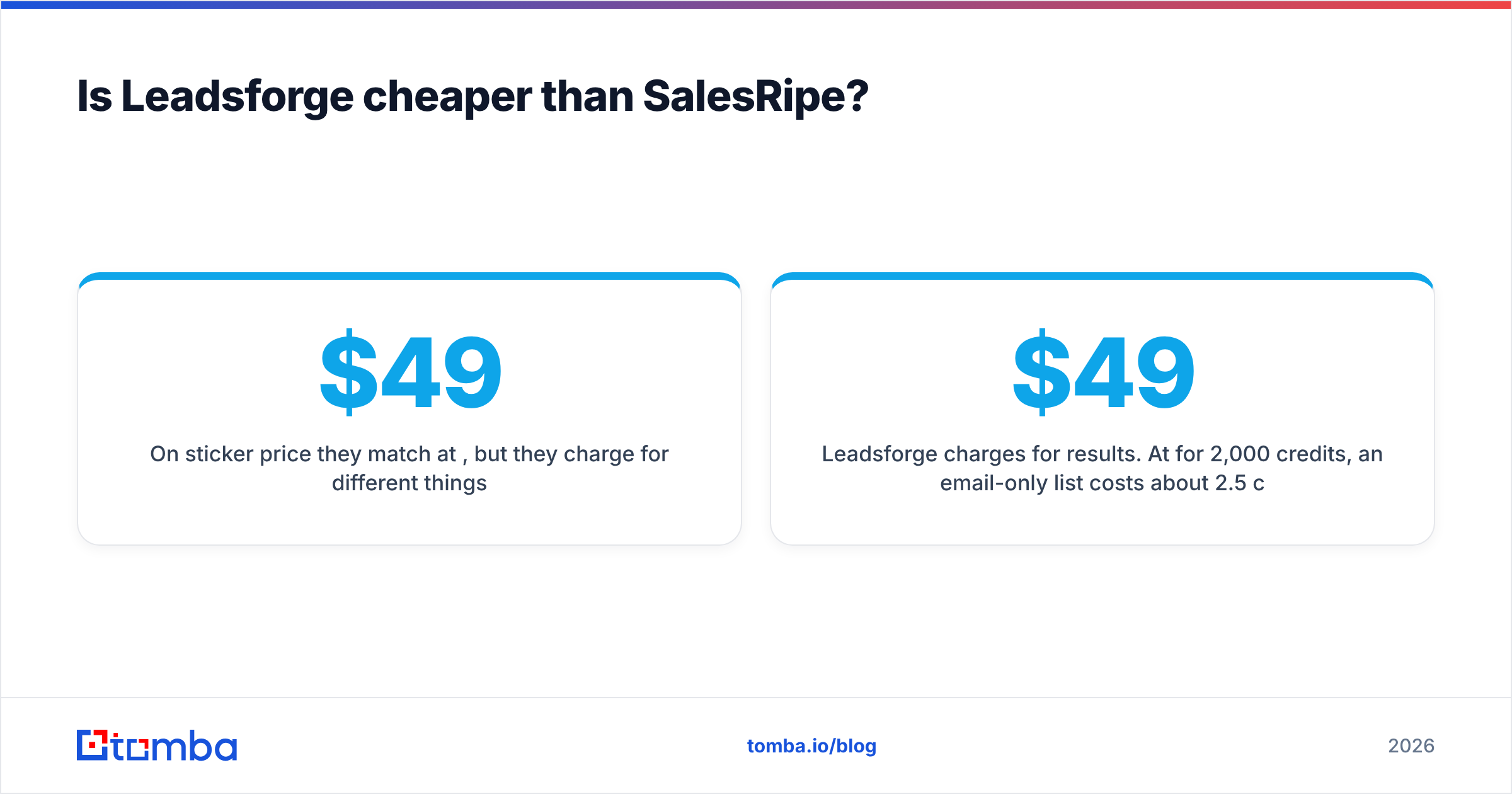
On sticker price they match at $49/mo, but they charge for different things.
- SalesRipe charged for access. You paid a subscription and pulled lists within its limits. That's cheap per row, but every stale row still costs you in bounces and domain reputation.
- Leadsforge charges for results. At $49 for 2,000 credits, an email-only list costs about 2.5 cents per contact. Add phone numbers and it rises fast: a contact with both email and phone costs 11 credits, so the same $49 buys about 180 fully enriched contacts.
The practical lesson: if you only need emails, Leadsforge's Essential plan goes a long way. If you depend on phone data, plan your credit budget carefully or pair Leadsforge with a dedicated phone source.
What should you do with old SalesRipe data?#
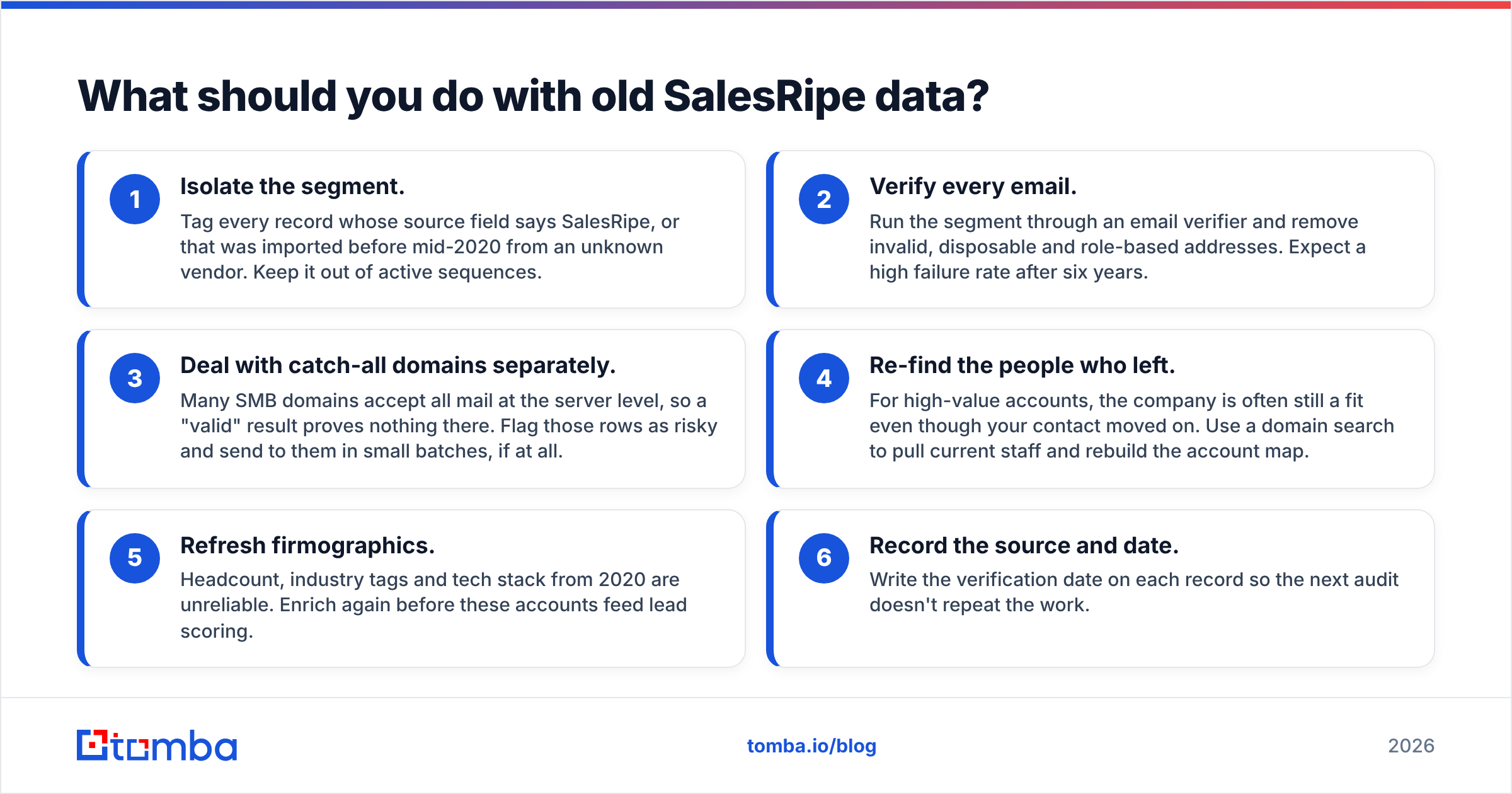
If your CRM still holds contacts imported from SalesRipe, don't delete them blindly and don't email them blindly. Work through them in this order:
- Isolate the segment. Tag every record whose source field says SalesRipe, or that was imported before mid-2020 from an unknown vendor. Keep it out of active sequences.
- Verify every email. Run the segment through an email verifier and remove invalid, disposable and role-based addresses. Expect a high failure rate after six years.
- Deal with catch-all domains separately. Many SMB domains accept all mail at the server level, so a "valid" result proves nothing there. Flag those rows as risky and send to them in small batches, if at all.
- Re-find the people who left. For high-value accounts, the company is often still a fit even though your contact moved on. Use a domain search to pull current staff and rebuild the account map.
- Refresh firmographics. Headcount, industry tags and tech stack from 2020 are unreliable. Enrich again before these accounts feed lead scoring.
- Record the source and date. Write the verification date on each record so the next audit doesn't repeat the work.
This is the same hygiene you'd apply to any aging list. SalesRipe data just needs all of it at once.

Who should choose Leadsforge?#
Leadsforge makes sense if most of these describe you:
- You're building net-new lists from scratch and would rather describe an ICP than click through 30 filters.
- You already use Salesforge or another Forge product, so native list handoff saves real time.
- Your outbound is mostly email. At 1 credit per email, the unit cost stays low.
- Your prospecting volume is uneven. Rollover credits mean a quiet month doesn't waste money.
- You're a small team that wants self-serve pricing with no seat licenses or annual sales calls.
It's a weaker fit if you rely on phone numbers, if your ICP is so niche that AI search returns thin results, or if you already have a named account list and only need to find the right person at each company. That last case is where a dedicated email finder is usually the better tool.
What are the best SalesRipe alternatives in 2026?#
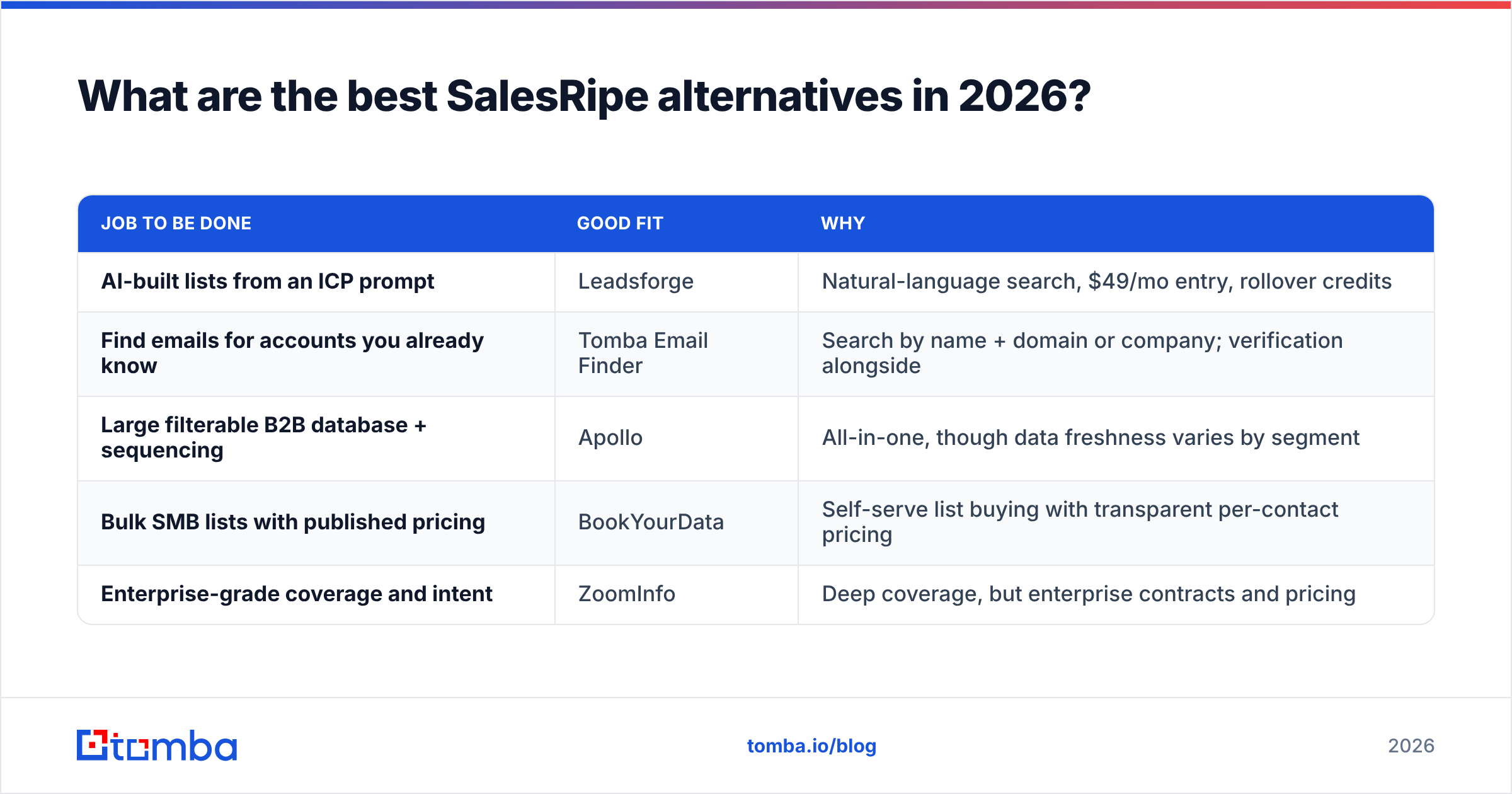
If SalesRipe appealed to you because it was cheap, self-serve and fast to a first list, these are the realistic options. They're grouped by job, not by brand hype:
| Job to be done | Good fit | Why |
|---|---|---|
| AI-built lists from an ICP prompt | Leadsforge | Natural-language search, $49/mo entry, rollover credits |
| Find emails for accounts you already know | Tomba Email Finder | Search by name + domain or company; verification alongside |
| Large filterable B2B database + sequencing | Apollo | All-in-one, though data freshness varies by segment |
| Bulk SMB lists with published pricing | BookYourData | Self-serve list buying with transparent per-contact pricing |
| Enterprise-grade coverage and intent | ZoomInfo | Deep coverage, but enterprise contracts and pricing |
Check current reviews on G2 before you commit, and filter for reviews from the last 12 months. Data vendors change quickly, and a glowing review from 2022 says little about today's bounce rates.
A pattern we see often: teams use an AI list builder like Leadsforge for discovery, then run the resulting accounts through a dedicated email finder and verifier before sending. Discovery tools are good at which companies and roles to target. Specialist finders are usually better at the exact correct address for that person.
So, Leadsforge vs SalesRipe: which wins?#
Leadsforge wins, and it isn't close, because SalesRipe posted a shutdown notice in 2020 and there's nothing to buy. Even judged purely on design, Leadsforge's on-demand, verified-email model suits 2026 outbound better than a static database that decays between refreshes.
The more useful takeaway is about the category, not the brands:
- Freshness beats volume. A 200-million-row database means little if a third of it bounces.
- Match pricing to your channel. Credit-per-result pricing favors email-first teams; phone-heavy teams should budget differently.
- Split discovery from verification. Use one tool to decide who to contact and another to confirm how to reach them.
- Audit legacy imports. If a vendor in your CRM's source field no longer exists, that segment needs re-verification before it goes back into sequences.
How does Tomba fit into this stack?#
If you're replacing SalesRipe because you already know your target accounts and just need accurate contact details, a dedicated finder is the leaner choice. Tomba Email Finder finds professional email addresses by name and domain or by company. Verification, domain search and catch-all checks sit alongside it, so you can clean an old SalesRipe segment and rebuild it in one place. There's a free tier with 25 searches a month to test your own accounts, and paid plans start at $49/mo. See the Tomba pricing page for Growth, Pro and Enterprise tiers. Run a handful of your hardest-to-find contacts through Tomba Email Finder this week and compare the hit rate against whatever your old list gave you.
Related guides#
Ready to find emails that actually work?
Join 150,000+ professionals who stopped guessing and started sending. Free credits on signup — no credit card required.
Get the Tomba newsletter
Practical outbound tactics and product updates — once every two weeks.
About the author