Leadsforge vs Span Global Services: Self-Serve AI or Managed Data?
Leadsforge builds lead lists from a chat prompt in minutes. Span Global Services builds custom B2B databases to your spec. Here's which model fits your pipeline, budget, and data-quality bar.
TL;DR
- Leadsforge is a self-serve, AI-driven lead-list builder. You describe your ideal customer in plain language and get contacts with verified emails in minutes, paid for with monthly credits.
- Span Global Services is a managed B2B data provider. You send a spec, and it delivers custom contact lists, data append, cleansing, and technographic install-base lists, usually priced by quote.
- For startups and SDR teams sending outbound every week, Leadsforge usually wins on speed and on cost per contact.
- For enterprise marketing teams that need niche segments (healthcare, specific tech installs, regional lists) or CRM cleanup, Span Global Services is the better fit.
- Neither one removes the need to verify before you send. Keep a separate email finder and verifier in your stack for single lookups and re-checks.
What is the real difference between Leadsforge and Span Global Services?#
These two products look like competitors because both hand you a spreadsheet of B2B contacts. They don't work the same way, though, and that affects nearly every decision you'll make.
A restaurant comparison helps. Leadsforge is a self-service buffet: you walk up, take what you need, and pay as you go. Span Global Services is a caterer: you describe the event, they plan the menu, and the food arrives ready to serve. Each one feeds people. They suit different occasions.
In practice:
- Leadsforge (leadsforge.ai) belongs to the Forge product family built around Salesforge. It's a SaaS app. You type a prompt like "Series A fintech companies in the UK with a VP of Sales hired in the last 6 months," and it returns matching companies and contacts with emails, job titles, and LinkedIn URLs. You can export them or push them straight into a sequencer.
- Span Global Services (spanglobalservices.com) is a B2B data and marketing services company. Its catalog covers custom contact lists by industry, job function, and geography, plus technology install-base lists, healthcare and professional lists, data append (adding missing emails and phones to your records), and data cleansing for existing CRM databases. Someone on their team handles the work for you.
So the question isn't which database is bigger. It's whether you want a tool you run yourself or a vendor who does the work for you.
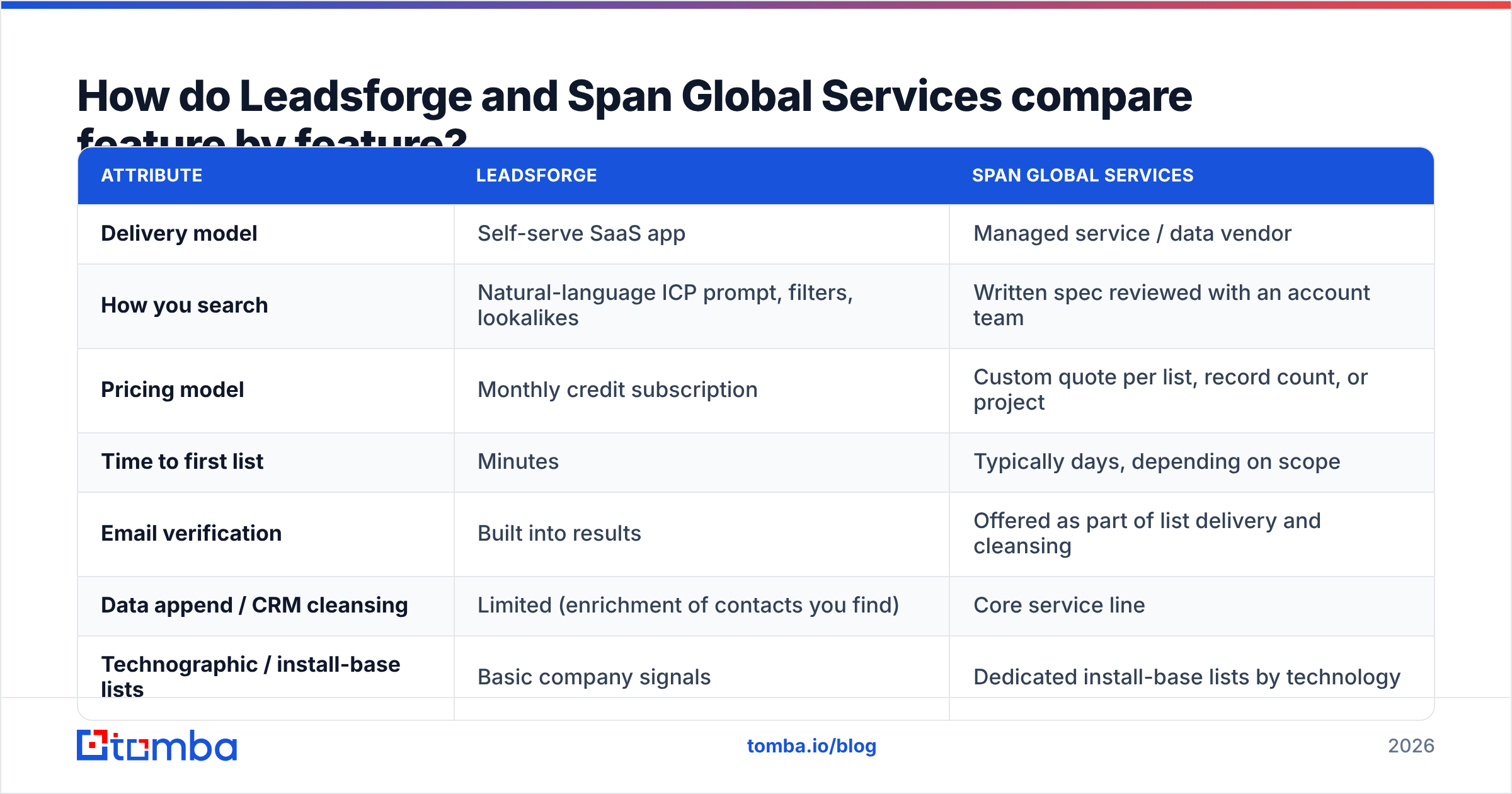
How do Leadsforge and Span Global Services compare feature by feature?#
Here's the side-by-side view. Treat pricing as a model rather than a quote. Both vendors change tiers, and Span Global prices custom work case by case.
| Attribute | Leadsforge | Span Global Services |
|---|---|---|
| Delivery model | Self-serve SaaS app | Managed service / data vendor |
| How you search | Natural-language ICP prompt, filters, lookalikes | Written spec reviewed with an account team |
| Pricing model | Monthly credit subscription | Custom quote per list, record count, or project |
| Time to first list | Minutes | Typically days, depending on scope |
| Email verification | Built into results | Offered as part of list delivery and cleansing |
| Data append / CRM cleansing | Limited (enrichment of contacts you find) | Core service line |
| Technographic / install-base lists | Basic company signals | Dedicated install-base lists by technology |
| Niche verticals (e.g., healthcare) | Depends on coverage | Dedicated vertical lists |
| Outreach integration | Native handoff to Salesforge; CSV export | File delivery; you import into your CRM or MAP |
| Best for | SDR teams, founders, agencies running weekly outbound | Enterprise marketing, ABM programs, CRM hygiene projects |
Two points stand out. Leadsforge optimizes for iteration speed: you can test five ICP variations before lunch. Span Global optimizes for specification depth: you can ask for "hospital IT directors at facilities running a specific EHR in three states," and a human team builds that list.
How does each tool actually build a list?#
The workflow is where you'll feel the difference day to day. A typical run looks like this on each side.
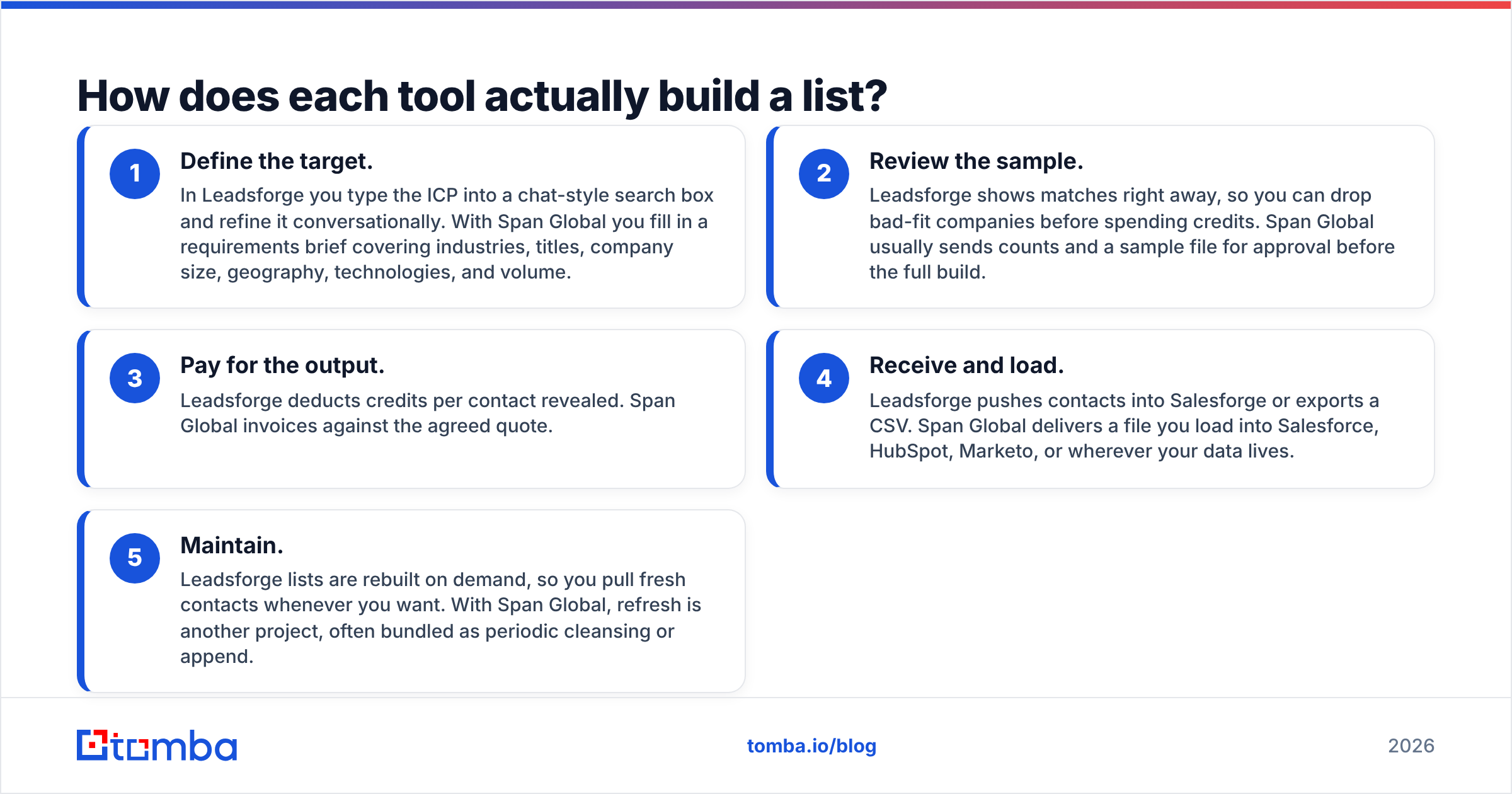
- Define the target. In Leadsforge you type the ICP into a chat-style search box and refine it conversationally. With Span Global you fill in a requirements brief covering industries, titles, company size, geography, technologies, and volume.
- Review the sample. Leadsforge shows matches right away, so you can drop bad-fit companies before spending credits. Span Global usually sends counts and a sample file for approval before the full build.
- Pay for the output. Leadsforge deducts credits per contact revealed. Span Global invoices against the agreed quote.
- Receive and load. Leadsforge pushes contacts into Salesforge or exports a CSV. Span Global delivers a file you load into Salesforce, HubSpot, Marketo, or wherever your data lives.
- Maintain. Leadsforge lists are rebuilt on demand, so you pull fresh contacts whenever you want. With Span Global, refresh is another project, often bundled as periodic cleansing or append.
If your team's rhythm is "launch a new campaign every Monday," step 5 matters more than anything else in the table. A managed vendor can't match a self-serve tool on turnaround. If your rhythm is "one big ABM push per quarter," the extra days don't matter much, and a curated file saves your ops team real work.
Which one has better data accuracy?#
Neither vendor publishes an independent, apples-to-apples accuracy audit, so be skeptical of any blog that claims a precise bounce-rate winner. What you can judge is how each one handles accuracy.
Leadsforge verifies emails as part of the search result. Because lists are built at the moment you request them, the data is as fresh as the underlying sources that day. The risk is coverage gaps: in niche industries or small regional markets, AI search can return thin results or loosely matched titles, so check the first page carefully before bulk-revealing.
Span Global Services relies on a mix of compiled data and human research and verification, which is the standard approach for managed data vendors. The strength is precision on hard segments where automated search struggles. The risk is time: B2B contact data decays quickly as people change jobs, and a list delivered today starts losing accuracy as soon as it arrives. Ask any managed provider how records were verified and what bounce guarantee or replacement policy applies.
No matter which one you pick, run your own check before a campaign. Use an email verifier on the full file, and flag catch-all domains separately. Those addresses accept every message at the server level and can hide real bounces until you've already damaged your sender reputation.
How much do Leadsforge and Span Global Services cost?#
This is where the buffet-versus-caterer analogy gets expensive.
Leadsforge uses monthly credit plans. Pricing is published on its site, and you can predict your cost per contact before you commit. Credits usually reset each billing cycle, so bursty usage can waste some of them. Check leadsforge.ai for current tiers, because Forge-family products have changed their packaging more than once.
Span Global Services is quote-based. Cost depends on record volume, how niche the segment is, which fields you want (email only vs. email plus direct dial plus technographics), and whether you're also buying append or cleansing. For large or unusual segments this can be good value, since you pay for a finished asset instead of spending your own SDR hours. For small, frequent pulls it's usually the more expensive path per contact once you add procurement time.
Rules of thumb:
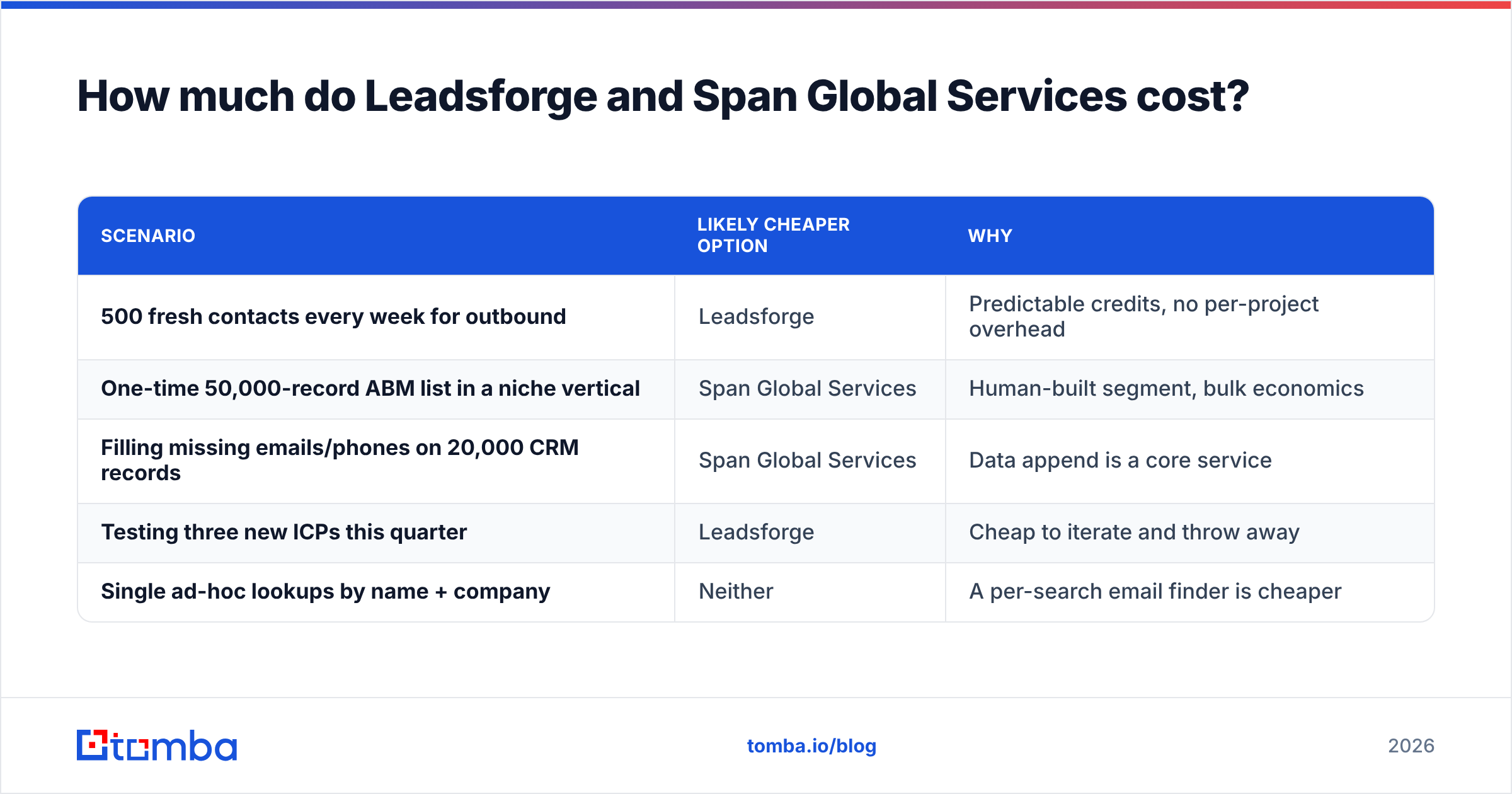
| Scenario | Likely cheaper option | Why |
|---|---|---|
| 500 fresh contacts every week for outbound | Leadsforge | Predictable credits, no per-project overhead |
| One-time 50,000-record ABM list in a niche vertical | Span Global Services | Human-built segment, bulk economics |
| Filling missing emails/phones on 20,000 CRM records | Span Global Services | Data append is a core service |
| Testing three new ICPs this quarter | Leadsforge | Cheap to iterate and throw away |
| Single ad-hoc lookups by name + company | Neither | A per-search email finder is cheaper |
The last row matters. Many teams buy a list platform and then burn credits on one-off "find me this one person" requests. That job belongs to a lightweight email finder or domain search tool, which can run on a free tier or a $49/mo plan instead of expensive list credits.
What do users say on review sites?#
Treat review sites as directional. Sample sizes for both vendors are modest compared with category giants like ZoomInfo or Apollo. On G2 and similar platforms, feedback tends to split along the lines you'd expect from each business model:
- Leadsforge reviewers praise the speed of the natural-language search, the easy handoff into Salesforge sequences, and how quickly they can test an ICP. Common complaints concern match quality on narrow searches and credit usage adding up at higher volumes.
- Span Global Services reviewers and case studies emphasize account-team responsiveness, custom segmentation, and data-cleansing projects. The usual caveats are turnaround time and the overhead of a quote-based buying process compared with swiping a card.
Neither pattern is a red flag. Each reflects what the product is designed to do.

Is Leadsforge better than Span Global Services for outbound sales?#
For most outbound sales teams, yes. Outbound depends on three things: fresh contacts, fast iteration, and a short path from "list" to "sequence." Leadsforge is built for all three. An SDR manager can spot a new trigger (a funding round, a hiring spree, a competitor's pricing change), build a matching list, and have a sequence live the same afternoon. A managed-vendor workflow can't match that loop.
The exception is outbound into verticals where self-serve data is thin: regulated healthcare, public sector, industrial manufacturing, or markets outside North America and Western Europe. There, a human-researched list from a managed vendor often gets better reply rates, because the contacts are the right people rather than the closest title match.
Is Span Global Services better for marketing and ABM?#
Often, yes. Marketing ops and ABM teams usually care about coverage of a named account list, consistent field formatting for their automation platform, and clean CRM records more than daily freshness. Span Global's mix of custom lists, technology install-base data, append, and cleansing fits that set of needs well. Instead of stitching together three tools and an intern, you hand over one brief.
It's also a sensible choice when procurement prefers a services contract with a named account manager over another SaaS seat. That comes up often in larger organizations, and it's a legitimate reason to pick a managed provider.
What should you check before choosing either one?#
Before you sign anything, run this short evaluation. It takes about a day and protects you from months of bad data.
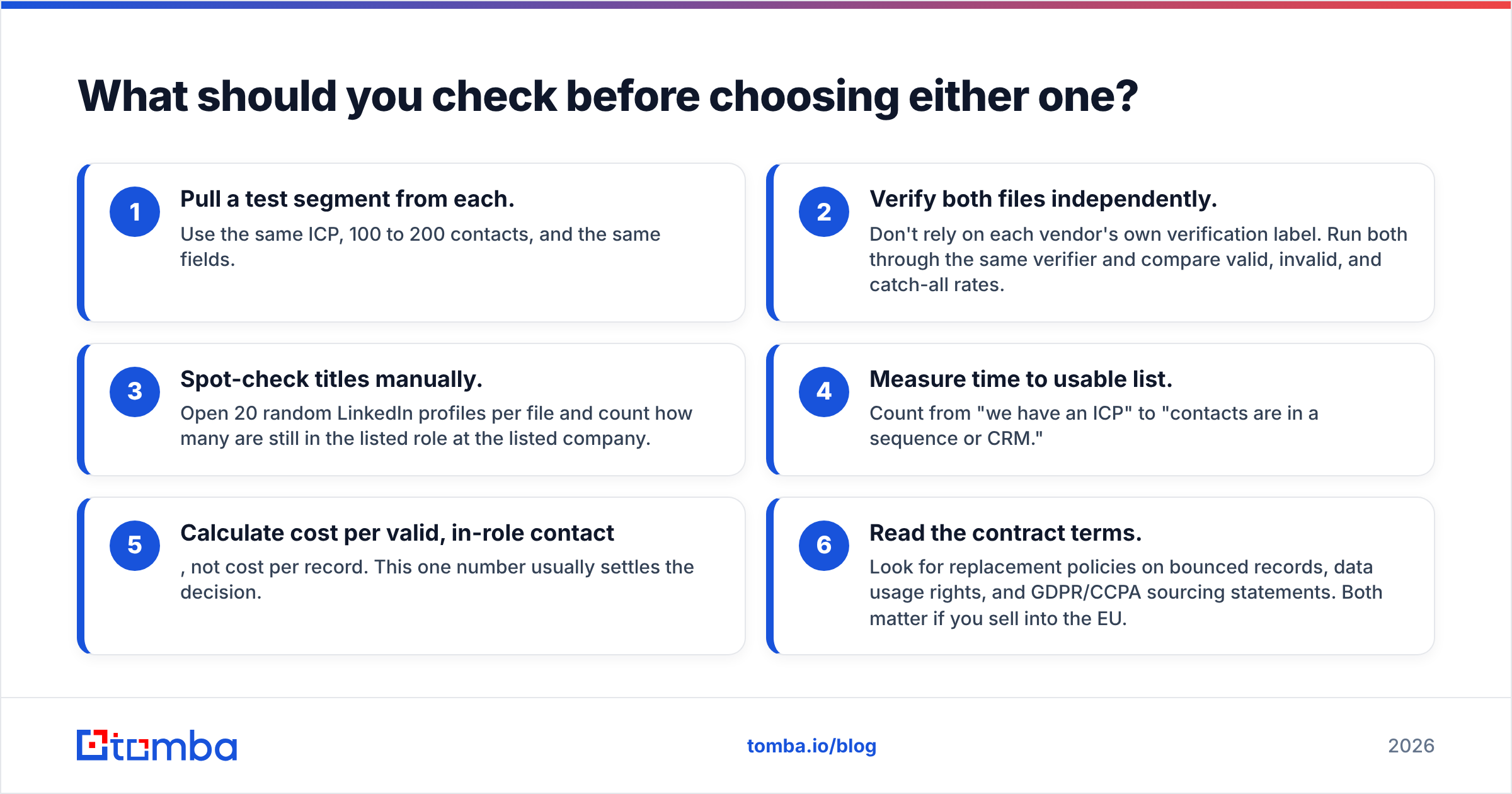
- Pull a test segment from each. Use the same ICP, 100 to 200 contacts, and the same fields.
- Verify both files independently. Don't rely on each vendor's own verification label. Run both through the same verifier and compare valid, invalid, and catch-all rates.
- Spot-check titles manually. Open 20 random LinkedIn profiles per file and count how many are still in the listed role at the listed company.
- Measure time to usable list. Count from "we have an ICP" to "contacts are in a sequence or CRM."
- Calculate cost per valid, in-role contact, not cost per record. This one number usually settles the decision.
- Read the contract terms. Look for replacement policies on bounced records, data usage rights, and GDPR/CCPA sourcing statements. Both matter if you sell into the EU.
If you want a neutral third baseline, run the same test names through a standalone email finder and compare. The gap between a vendor's claimed coverage and what an independent lookup confirms can tell you a lot.
Can you use Leadsforge and Span Global Services together?#
Yes, and plenty of mid-market teams do something similar. A common split looks like this:
- Span Global Services handles the quarterly ABM target list and a twice-yearly CRM cleansing and append project.
- Leadsforge handles weekly SDR outbound and experimental ICPs.
- A standalone finder and verifier handles everything in between: single lookups from inbound signals, checks on contacts reps find on their own, and re-verifying old records before a re-engagement campaign.
That last layer is what keeps the other two honest. Contact data starts decaying the day it's delivered, and your sender reputation depends on your worst list, not your average one.
Which should you pick: Leadsforge or Span Global Services?#
Pick Leadsforge if you run outbound yourself, want lists in minutes, need to test ICPs quickly, and already use (or are open to) Salesforge for sequencing.
Pick Span Global Services if you need niche or technographic segments, large one-time builds, data append on an existing CRM, or a managed service with a named account team.
Pick both if marketing and sales have different rhythms. Many companies do, and that's fine. Let each team use the model that fits how it works.
Both are credible options serving different buyers. The worst outcome is buying one and forcing it into the other's job.
Where does Tomba fit in this stack?#
Whichever list source you choose, you'll still need to find individual emails on demand and confirm addresses before they reach your sending domain. That's the gap Tomba Email Finder fills. Look up any professional email by name and company or domain, verify it in the same workflow, and pay per search instead of per list. The free tier gives you 25 searches a month, and paid plans start at $49/mo. See Tomba pricing for Growth and Pro volumes. Use it next to Leadsforge or Span Global Services to fill gaps, re-check aging records, and keep your bounce rate low.
Related guides#
// get started
Find, verify and enrich your first contacts today
Start on the free plan with 25 searches a month, then scale when your team is ready.
Free plan · No credit card required · GDPR & CCPA
// about the author