LeadSift Alternatives: 8 Intent & Lead Data Tools Compared (2026)
LeadSift shows you who is showing buying intent. Most teams also need verified contacts, transparent pricing and CRM workflows. Here are 8 LeadSift alternatives, each with its best-fit use case.
TL;DR
- LeadSift is an intent-data platform. It watches public web and social signals to show which companies and people look ready to buy. It's good at the who. It's weaker at transparent pricing and self-serve contact lookup.
- If you need enterprise intent plus a huge contact database, look at ZoomInfo or 6sense. If you need pure account-level intent to feed an ABM stack, look at Bombora.
- If you need verified emails for the accounts you already know are in-market, a dedicated email finder like Tomba ($49/mo Starter, 25 free searches/mo) is usually the cheapest layer to add.
- Apollo, Lusha, Cognism and BookYourData sit in between. Each one gives you contacts plus some filtering, and each has a different pricing model and regional strength.
- The best setup for most teams pairs two tools: one for intent signals and one for contact accuracy. Paying enterprise prices for one platform to do both is rarely worth it.
What is LeadSift, and why do teams look for alternatives?#
LeadSift is a B2B intent-data and lead-generation platform. It started by mining public social conversations and web activity for buying signals: hiring posts, technology mentions, competitor engagement and topic interest. It then maps those signals to companies and decision-makers. The pitch is simple. Instead of cold-prospecting a static list, you reach out to accounts that are already showing interest in your category.
That model works, but it leaves gaps that push teams to evaluate LeadSift alternatives:
- Pricing is quote-based. A small sales team can't sign up, test with a credit card and scale gradually.
- Intent isn't the same as contact coverage. Knowing an account is researching "sales engagement software" doesn't give you a deliverable email for its VP of Sales.
- Workflow fit. Some teams want intent inside the CRM, others want it in a sequencer, and others just want a Chrome extension they can use while browsing LinkedIn.
- Signal type. Social and public-web signals are one flavor of intent. Co-op intent (Bombora), first-party website intent (visitor identification) and predictive models (6sense) are others. Your market may respond better to a different one.
Before comparing tools, pin down which of those gaps you're actually trying to close.
What types of LeadSift alternatives exist?#
Not every "alternative" replaces LeadSift one for one. They fall into five groups. Knowing which group you're shopping in saves you a lot of demo calls.
- All-in-one data platforms. Contact database, intent signals and enrichment in one contract (ZoomInfo, Apollo). Best when you want one vendor and have the budget.
- Pure intent providers. Account-level surge data with no contact details (Bombora). Best for ABM teams whose contact data already comes from elsewhere.
- Predictive ABM platforms. Intent plus AI scoring, orchestration and ad targeting (6sense). Best for mid-market and enterprise marketing-led motions.
- Contact data specialists. Emails and direct dials for people you've already picked (Tomba, Lusha, Cognism). Best as the "last mile" after intent tells you where to look.
- List providers. Pre-built, filterable contact lists bought by the record (BookYourData). Best when you want a ready-to-load list without a platform subscription.
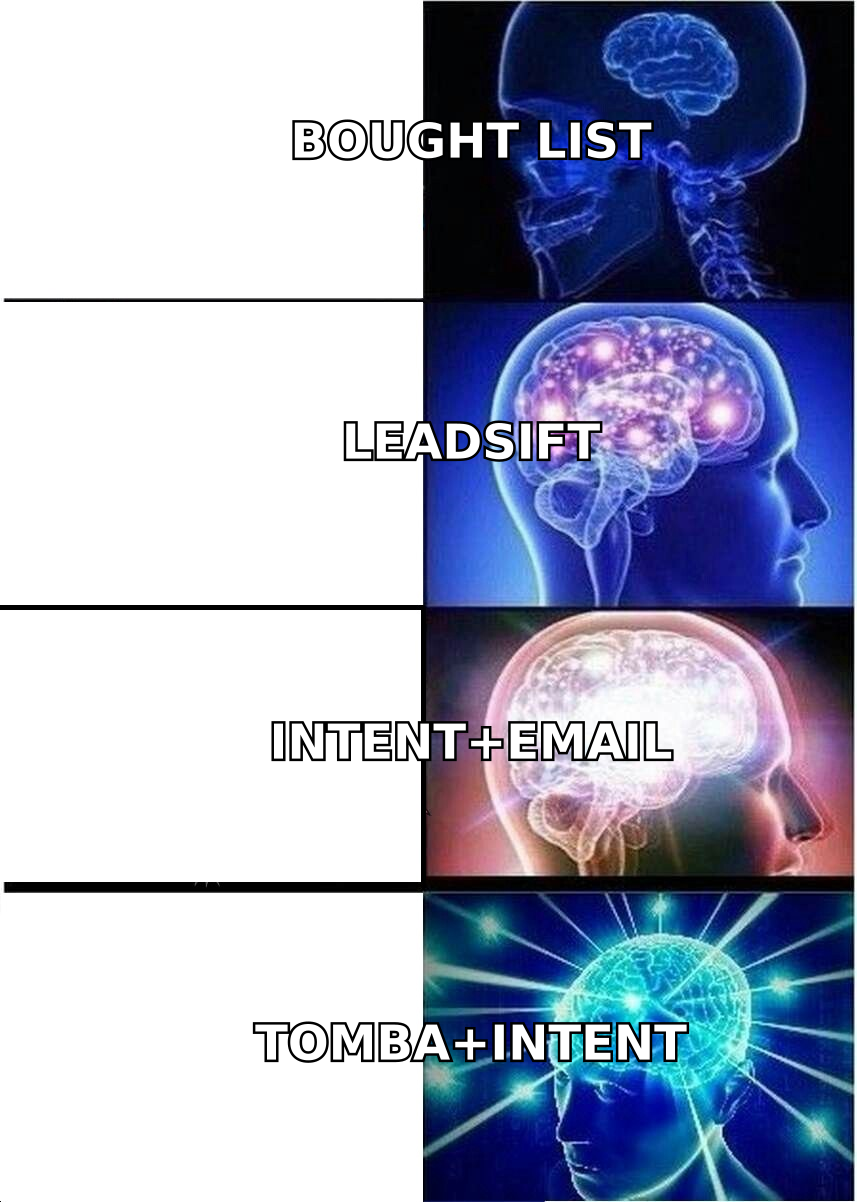
Most teams that leave LeadSift end up combining group 2 or 3 with group 4, or they collapse everything into group 1.
How do the top LeadSift alternatives compare?#
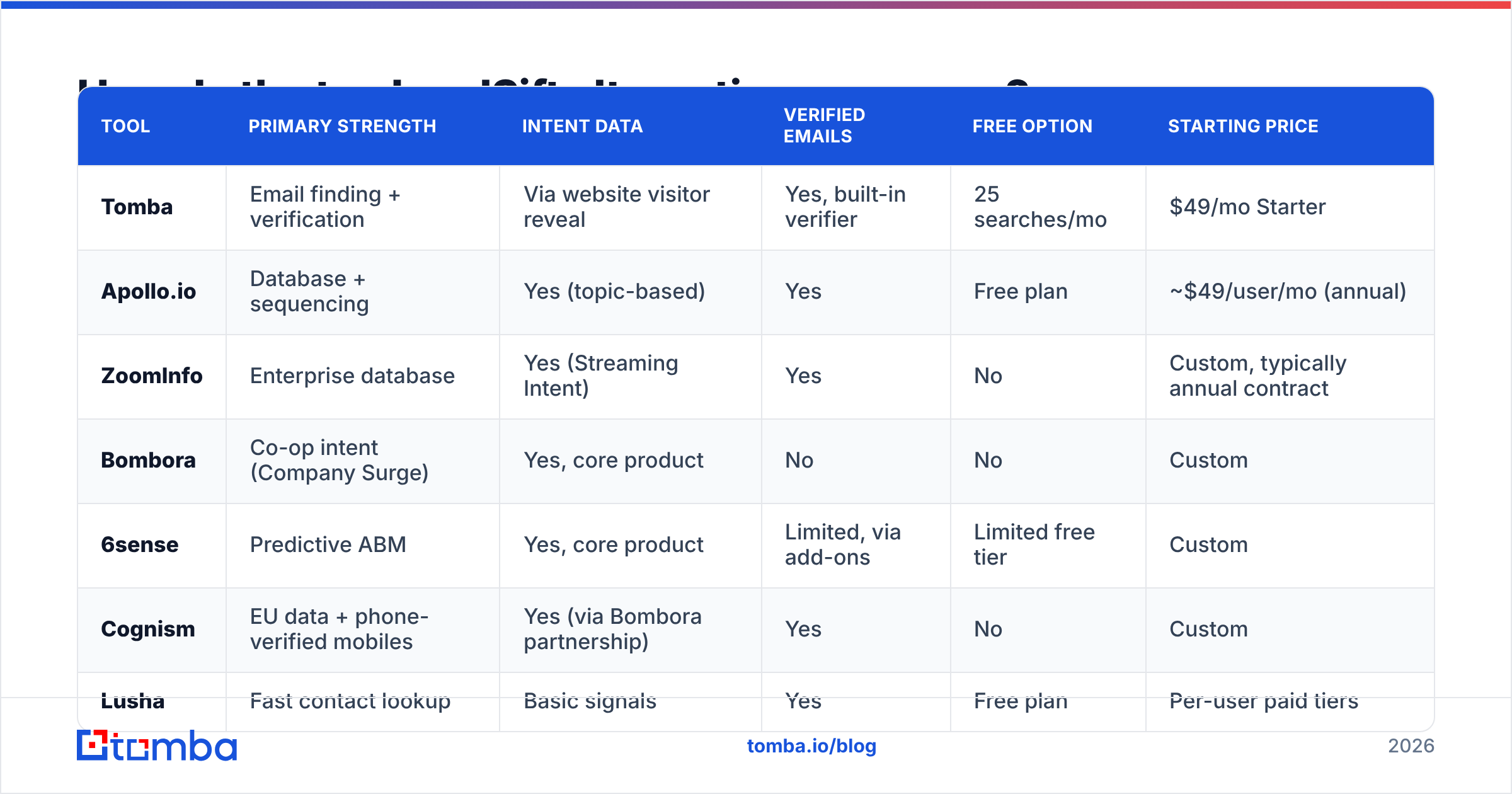
| Tool | Primary strength | Intent data | Verified emails | Free option | Starting price |
|---|---|---|---|---|---|
| Tomba | Email finding + verification | Via website visitor reveal | Yes, built-in verifier | 25 searches/mo | $49/mo Starter |
| Apollo.io | Database + sequencing | Yes (topic-based) | Yes | Free plan | ~$49/user/mo (annual) |
| ZoomInfo | Enterprise database | Yes (Streaming Intent) | Yes | No | Custom, typically annual contract |
| Bombora | Co-op intent (Company Surge) | Yes, core product | No | No | Custom |
| 6sense | Predictive ABM | Yes, core product | Limited, via add-ons | Limited free tier | Custom |
| Cognism | EU data + phone-verified mobiles | Yes (via Bombora partnership) | Yes | No | Custom |
| Lusha | Fast contact lookup | Basic signals | Yes | Free plan | Per-user paid tiers |
| BookYourData | Pre-built verified lists | Filter-based targeting | Yes, accuracy-focused | Free sample credits | Pay-as-you-go credits |
| LeadSift (baseline) | Social/web intent signals | Yes, core product | Partial | No | Custom |
Pricing changes often. Confirm current tiers on each vendor's site or on G2 before you commit.
Which LeadSift alternatives are worth your shortlist?#
1. Tomba: best for turning intent into deliverable emails#
Tomba isn't an intent platform, and pretending otherwise would be misleading. It solves the problem LeadSift users hit right after the signal fires: who exactly do I email, and will it bounce?
You get a Tomba Email Finder that works by name + domain, a domain search that returns every public email tied to a company, and a built-in email verifier that includes catch-all handling. Phone finder, enrichment and an API sit alongside. If you do want first-party intent, Tomba's website visitor reveal identifies companies browsing your site, which is often a stronger signal than third-party social chatter.
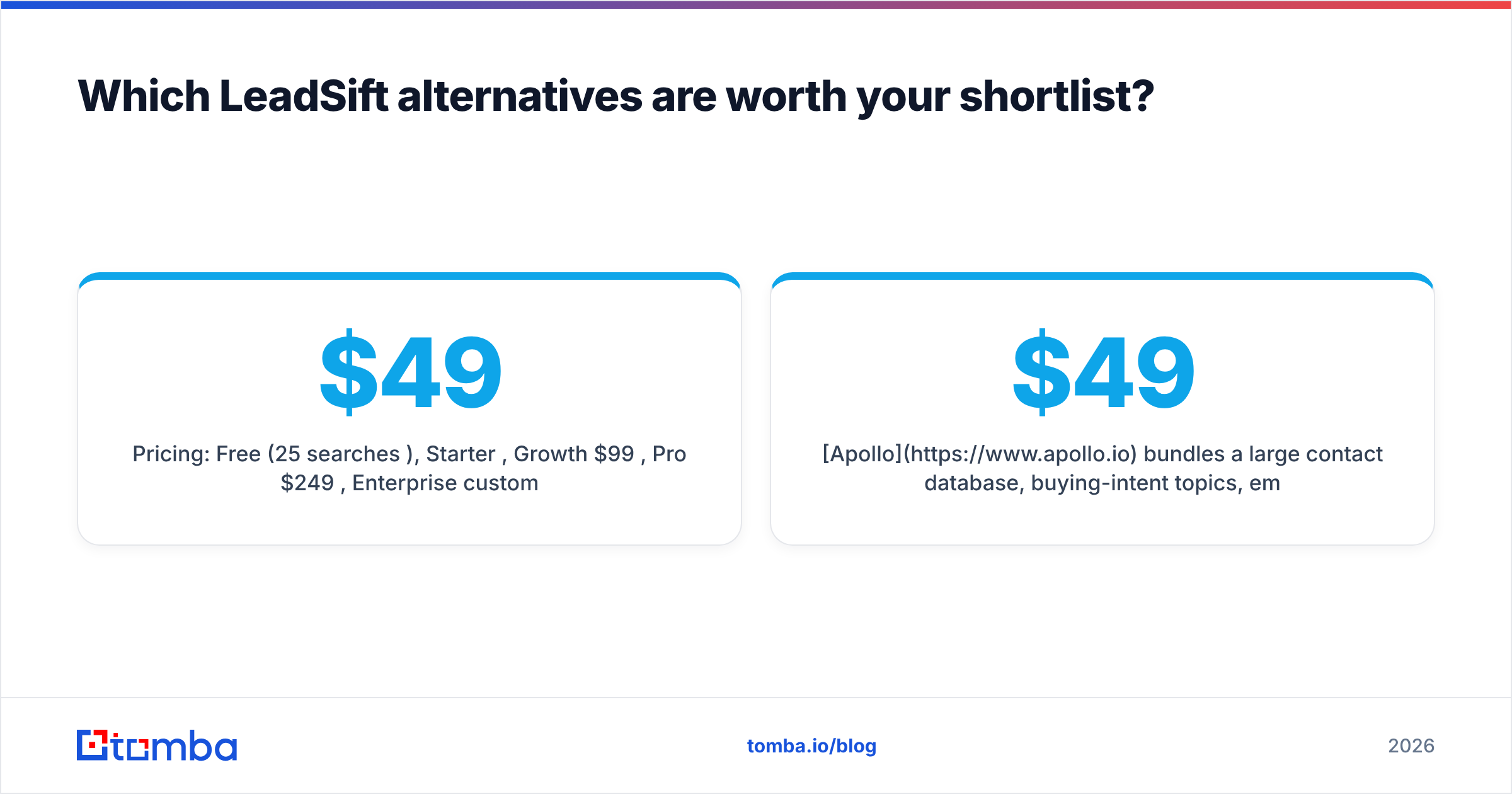
- Pricing: Free (25 searches/mo), Starter $49/mo, Growth $99/mo, Pro $249/mo, Enterprise custom.
- Best for: Teams that already have intent from another source (or from their own website) and need accurate contacts without an enterprise contract.
- Watch out for: No third-party topic intent. Pair it with Bombora or 6sense if you need that.
2. Apollo.io: best all-in-one for startups#
Apollo bundles a large contact database, buying-intent topics, email sequencing and a dialer into one product. The free plan is generous enough for real testing, and paid plans start around $49 per user per month on annual billing.
- Best for: Early-stage teams that want to prospect, filter by intent and send from one tool.
- Watch out for: Email accuracy varies by region and seniority. Many teams run Apollo exports through a separate verifier before sending at volume.
3. ZoomInfo: best for enterprise coverage#

ZoomInfo pairs one of the largest B2B contact databases with Streaming Intent, org charts, technographics and workflow automation. If budget isn't the constraint, it's the most complete single-vendor replacement for LeadSift.
- Best for: Enterprise sales orgs with RevOps support and multi-year budgets.
- Watch out for: Annual contracts, seat-based pricing and a steep learning curve. Smaller teams often pay for far more than they use.
4. Bombora: best pure intent data#
Bombora runs a data co-op of B2B publishers and reports "Company Surge" when an account consumes more content on a topic than its baseline. It's the intent engine behind many other tools on this list.
- Best for: ABM teams that already have contact data and want the cleanest account-level intent signal.
- Watch out for: No contacts. You still need an email finder or database to act on the surge.
5. 6sense: best for predictive ABM#
6sense combines intent, anonymous website identification and AI-driven buying-stage predictions, then activates them through ads and sales alerts. Compared with LeadSift's social-signal focus, it's more of an operating system for account-based marketing.
- Best for: Mid-market and enterprise teams running coordinated marketing + sales ABM.
- Watch out for: Implementation takes time, and pricing is firmly enterprise.
6. Cognism: best for EMEA and phone data#
Cognism is known for GDPR-conscious data practices and phone-verified mobile numbers. It offers intent through a Bombora partnership, so you get surge signals and contacts in one place.
- Best for: Teams selling into the UK and EU, especially phone-heavy outbound teams.
- Watch out for: Custom pricing. Its North American coverage is solid but not its main differentiator.
7. Lusha: best for quick, rep-level lookups#
Lusha is built around a browser extension. A rep opens a LinkedIn profile or company site and gets an email and phone number in one click. It has a free plan and per-user paid tiers.
- Best for: Individual reps and small teams who prospect manually.
- Watch out for: Less suited to large-scale list building or deep intent analysis.
8. BookYourData: best for ready-made verified lists#
BookYourData takes a different approach from subscription platforms. You filter its database by industry, title, location and company size, then buy the records you need with pay-as-you-go credits. It puts a lot of emphasis on list accuracy, which makes it a practical option when you want a clean, targeted list without committing to a monthly seat.
- Best for: Marketers and agencies running campaign-based outreach, or teams that prospect in bursts.
- Watch out for: It's list-first, not signal-first. Combine it with an intent source if timing matters to your motion.
Is intent data enough without verified contacts?#
No, and this is the most common mistake teams make after buying an intent tool. An intent signal tells you an account is warming up. It doesn't tell you the buying committee's email addresses, and it certainly doesn't guarantee those addresses won't bounce.
Bounces damage sender reputation. Once your domain's reputation drops, even your well-targeted, perfectly timed emails land in spam. So the intent you paid for gets wasted at the last step.
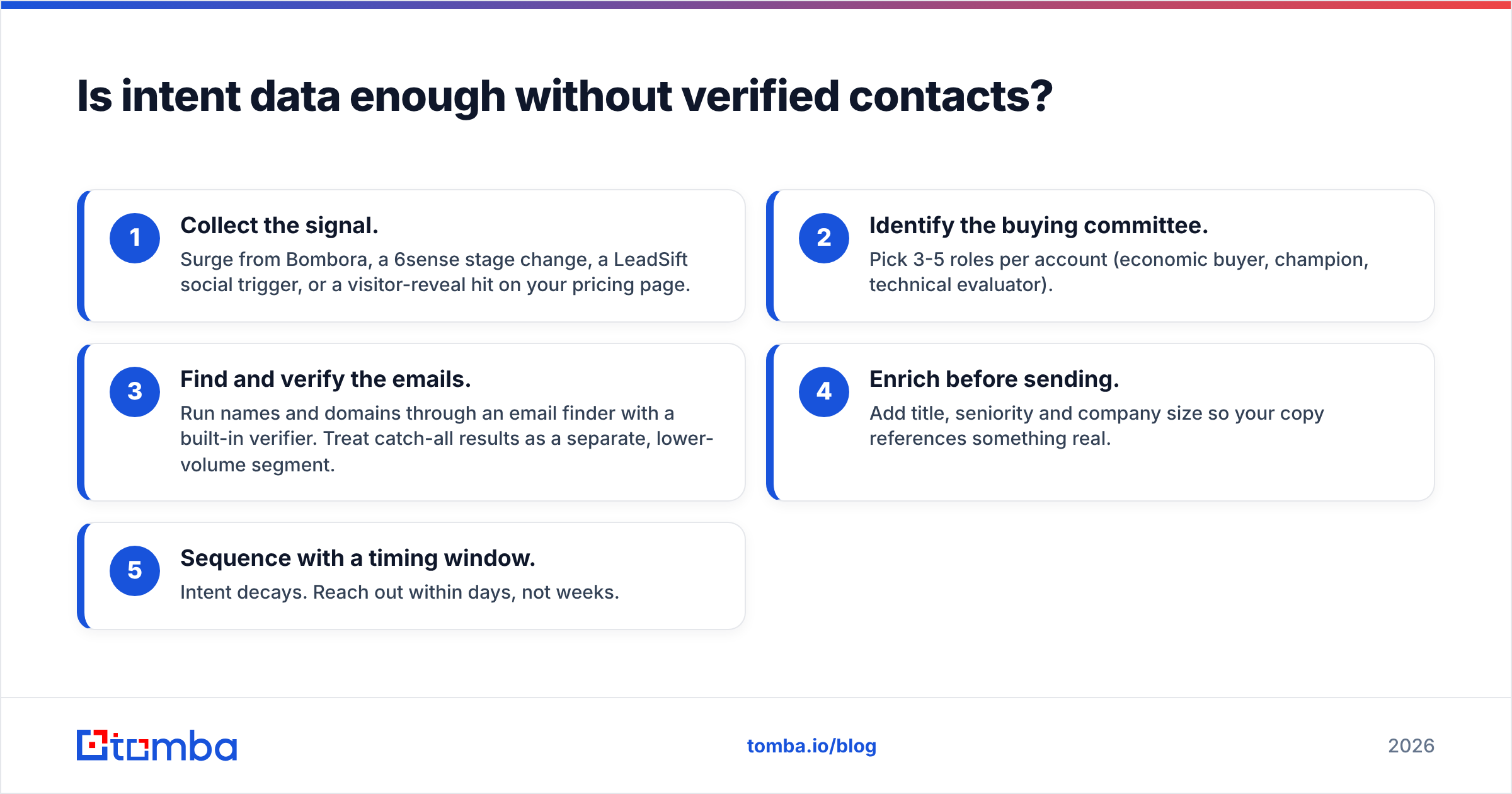
A practical workflow looks like this:
- Collect the signal. Surge from Bombora, a 6sense stage change, a LeadSift social trigger, or a visitor-reveal hit on your pricing page.
- Identify the buying committee. Pick 3-5 roles per account (economic buyer, champion, technical evaluator).
- Find and verify the emails. Run names and domains through an email finder with a built-in verifier. Treat catch-all results as a separate, lower-volume segment.
- Enrich before sending. Add title, seniority and company size so your copy references something real.
- Sequence with a timing window. Intent decays. Reach out within days, not weeks.
How should you choose between these LeadSift alternatives?#
Start from your constraint, not from the feature list.
If budget is your constraint: Combine a free or low-cost intent source (your own website visitors, Apollo's intent topics) with a pay-as-you-go or $49/mo contact tool. That usually costs a fraction of one enterprise seat.
If data coverage is your constraint: ZoomInfo or Apollo give you the widest single database. Cognism is the stronger pick if Europe is your main market.
If signal quality is your constraint: Bombora and 6sense produce the most mature intent models. LeadSift's social-signal angle is still useful for niches where buyers talk publicly, such as developer tools, marketing tech and hiring-heavy industries.
If rep adoption is your constraint: Choose tools that live where reps already work, like a browser extension, a CRM integration or Google Sheets. Tools that require a new tab and a new login tend to go unused after the first month.
If compliance is your constraint: Ask every vendor where its data comes from, how it handles opt-outs, and whether it supports GDPR and CCPA requests. Cognism and Tomba both publish their data-sourcing approach, and that transparency is worth weighing.
What does a realistic LeadSift replacement stack cost?#
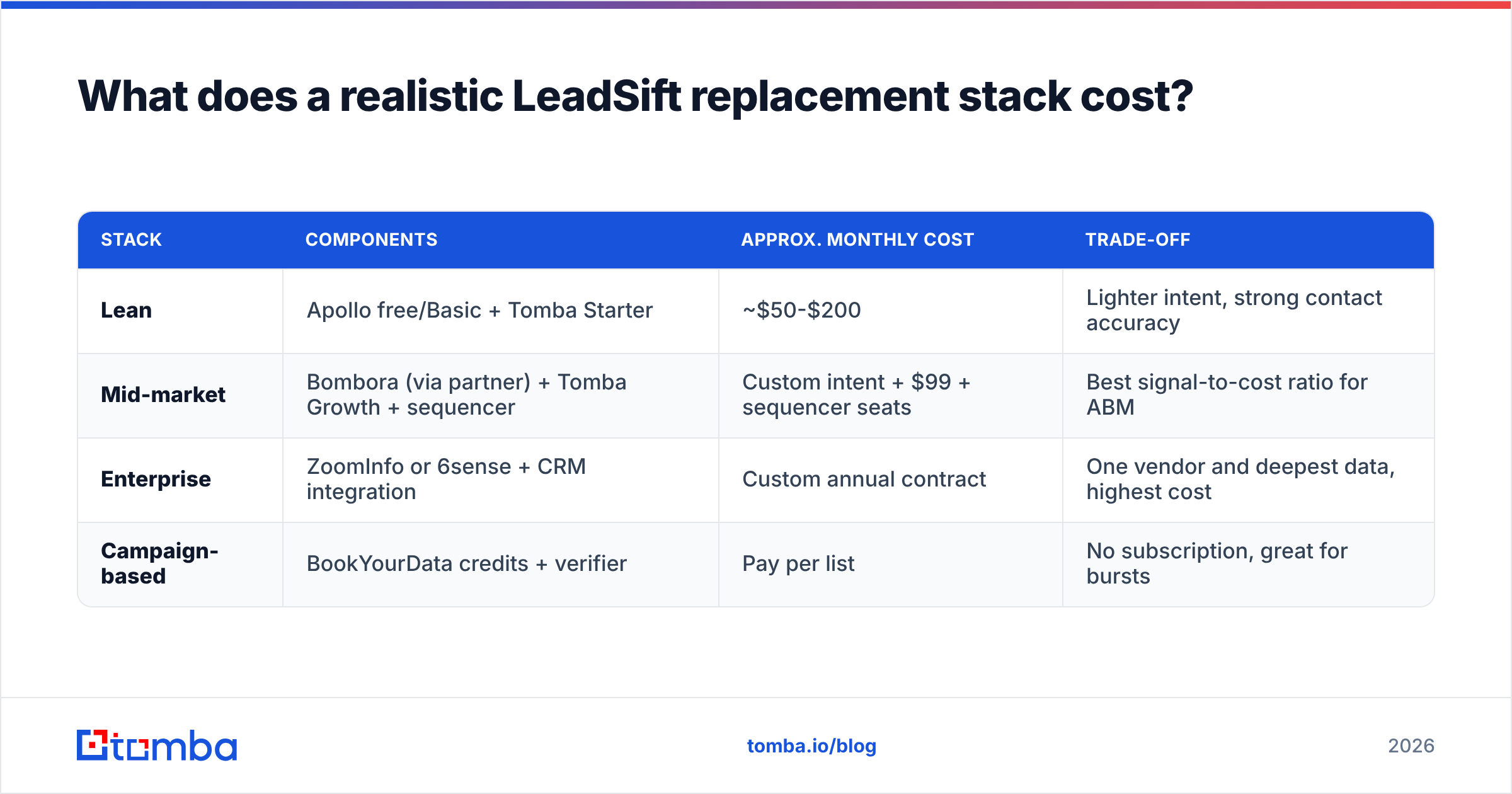
Here's how three common setups compare on approximate monthly cost for a 3-rep team. Use it as a sanity check, not a quote.
| Stack | Components | Approx. monthly cost | Trade-off |
|---|---|---|---|
| Lean | Apollo free/Basic + Tomba Starter | ~$50-$200 | Lighter intent, strong contact accuracy |
| Mid-market | Bombora (via partner) + Tomba Growth + sequencer | Custom intent + $99 + sequencer seats | Best signal-to-cost ratio for ABM |
| Enterprise | ZoomInfo or 6sense + CRM integration | Custom annual contract | One vendor and deepest data, highest cost |
| Campaign-based | BookYourData credits + verifier | Pay per list | No subscription, great for bursts |
Check current tiers on Tomba pricing and on each vendor's pricing page. Several vendors discount heavily for annual prepay.
Frequently asked questions about LeadSift alternatives#
Is there a free LeadSift alternative?#
There's no free product that fully matches LeadSift's intent signals. You can get close by combining Apollo's free plan (for intent topics and contacts) with Tomba's free tier (25 searches/mo) to verify the emails you plan to send.
Which LeadSift alternative has the best intent data?#
Bombora and 6sense are the most established intent providers. Bombora is the better choice for a raw account-level signal, and 6sense is better if you want predictive scoring and orchestration built on top of it.
Can I use an email finder instead of an intent platform?#
For some teams, yes. If you sell to a well-defined ICP and your website gets decent traffic, visitor identification plus a strong email finder can outperform third-party intent. That's because the signal comes from your own site, not from inferred behavior elsewhere.
Do I still need to verify emails from an all-in-one database?#
Yes. Databases decay as people change jobs, and B2B contact data can degrade quickly within a year. Verify before every send, especially for lists older than a few weeks.
Which Tomba tool fits a LeadSift workflow?#
Intent tools tell you when to reach out. Tomba Email Finder makes sure the message actually reaches someone. Plug in a name and company domain (or run a whole account list in bulk) to get professional emails with built-in verification. You can then push them to your CRM or sequencer. Start on the free plan with 25 searches a month and test it against the accounts your intent tool flagged this week. Upgrade to Starter at $49/mo once the reply rates justify it.
Related guides#
// get started
Find, verify and enrich your first contacts today
Start on the free plan with 25 searches a month, then scale when your team is ready.
Free plan · No credit card required · GDPR & CCPA
// about the author