7 Best LeadSigma Alternatives for Dental and Multi-Location Groups in 2026
LeadSigma is built for multi-location dental groups converting new-patient leads. If quote-only pricing or fit is the issue, here are 7 alternatives compared on scope, integrations and cost.
TL;DR
- LeadSigma is a new-patient CRM for multi-location dental groups, DSOs and specialty practices. It collects leads from your digital sources and follows up by text, email and phone. Pricing is quote-only, and Capterra lists no free trial.
- For a smaller practice that mainly needs patient communication, Weave, NexHealth and RevenueWell are the closest swaps. They're built around your practice management system (PMS), not around the ad funnel.
- If you want marketing, website and phones from one vendor, look at Adit. If reviews and messaging drive your growth, look at Podium or Birdeye.
- If you run a non-dental or mixed business, or you're an agency serving several clinics, HubSpot gives you a general CRM with published pricing.
- None of these tools finds B2B contacts: referral partners, employer benefits managers, vendors. Many groups pair their patient CRM with an email finder like Tomba for that side of growth.
What is LeadSigma, and who is it built for?#
LeadSigma calls itself a new-patient CRM for dental. It's aimed at multi-location healthcare organizations: dental service organizations (DSOs), dental partnership organizations, implant groups and specialty care groups. Its listings also mention veterinary and chiropractic practices.
The core job is simple to describe and hard to do well. Leads come in from paid search, social ads, web forms, call tracking and third-party directories. LeadSigma puts them all in one place and runs conversion automations over text, email and phone. The goal is that no inquiry sits untouched while the front desk is busy with patients who are already in the chair.
According to its Capterra listing, you have to contact the vendor for pricing, and there's no free trial. That's normal for enterprise-leaning healthcare software. It also explains why many people search for "LeadSigma alternatives": they want a number before they sit through a demo.
Why do teams look for LeadSigma alternatives?#
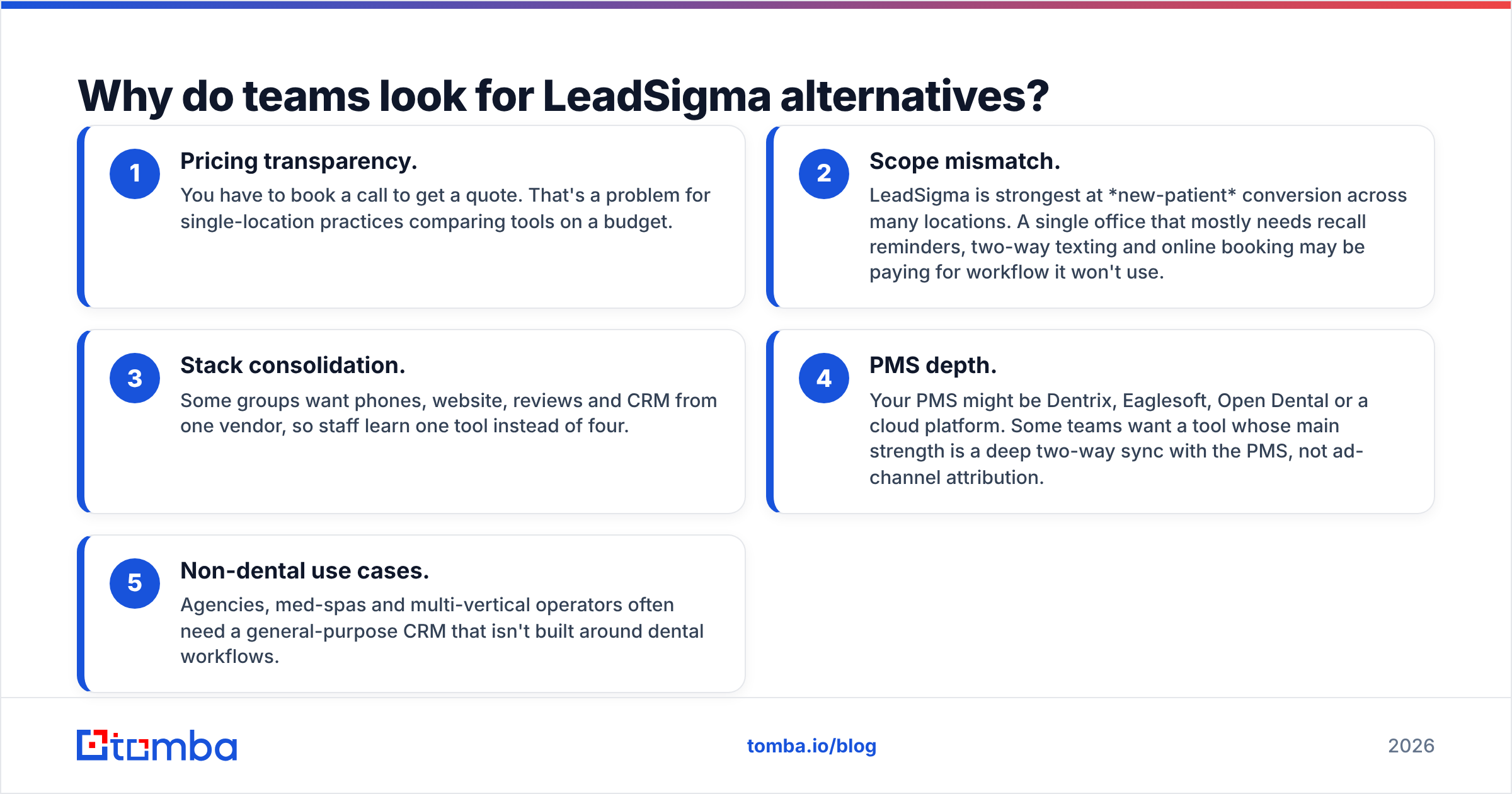
In practice, the reasons fall into five groups:
- Pricing transparency. You have to book a call to get a quote. That's a problem for single-location practices comparing tools on a budget.
- Scope mismatch. LeadSigma is strongest at new-patient conversion across many locations. A single office that mostly needs recall reminders, two-way texting and online booking may be paying for workflow it won't use.
- Stack consolidation. Some groups want phones, website, reviews and CRM from one vendor, so staff learn one tool instead of four.
- PMS depth. Your PMS might be Dentrix, Eaglesoft, Open Dental or a cloud platform. Some teams want a tool whose main strength is a deep two-way sync with the PMS, not ad-channel attribution.
- Non-dental use cases. Agencies, med-spas and multi-vertical operators often need a general-purpose CRM that isn't built around dental workflows.
What should you evaluate before switching?#
Before you look at vendor names, score each candidate on the five criteria below. Most switching regret comes from skipping one of them.
- Lead-source coverage. Can it pull in leads from Google Ads, Meta lead forms, call tracking, your website chat and directories without manual CSV imports? This is where LeadSigma is strongest, so check it carefully.
- Speed-to-lead automation. Does a new inquiry trigger an instant text and a task for a coordinator? Or does it wait in an inbox? Minutes matter here. HubSpot's own sales research has long shown that response time is one of the biggest drivers of conversion.
- PMS integration depth. One-way appointment reads aren't the same as a two-way sync that marks a lead "scheduled" and "showed" automatically. Without that loop, you can't measure cost per seated patient.
- Multi-location reporting. Can a regional manager compare conversion rates by location, by source and by coordinator on one screen?
- Total cost of ownership. Include onboarding fees, per-location pricing, phone hardware (for VoIP bundles) and contract length. The monthly headline price rarely tells you the whole cost.
Which LeadSigma alternatives are worth a look?#
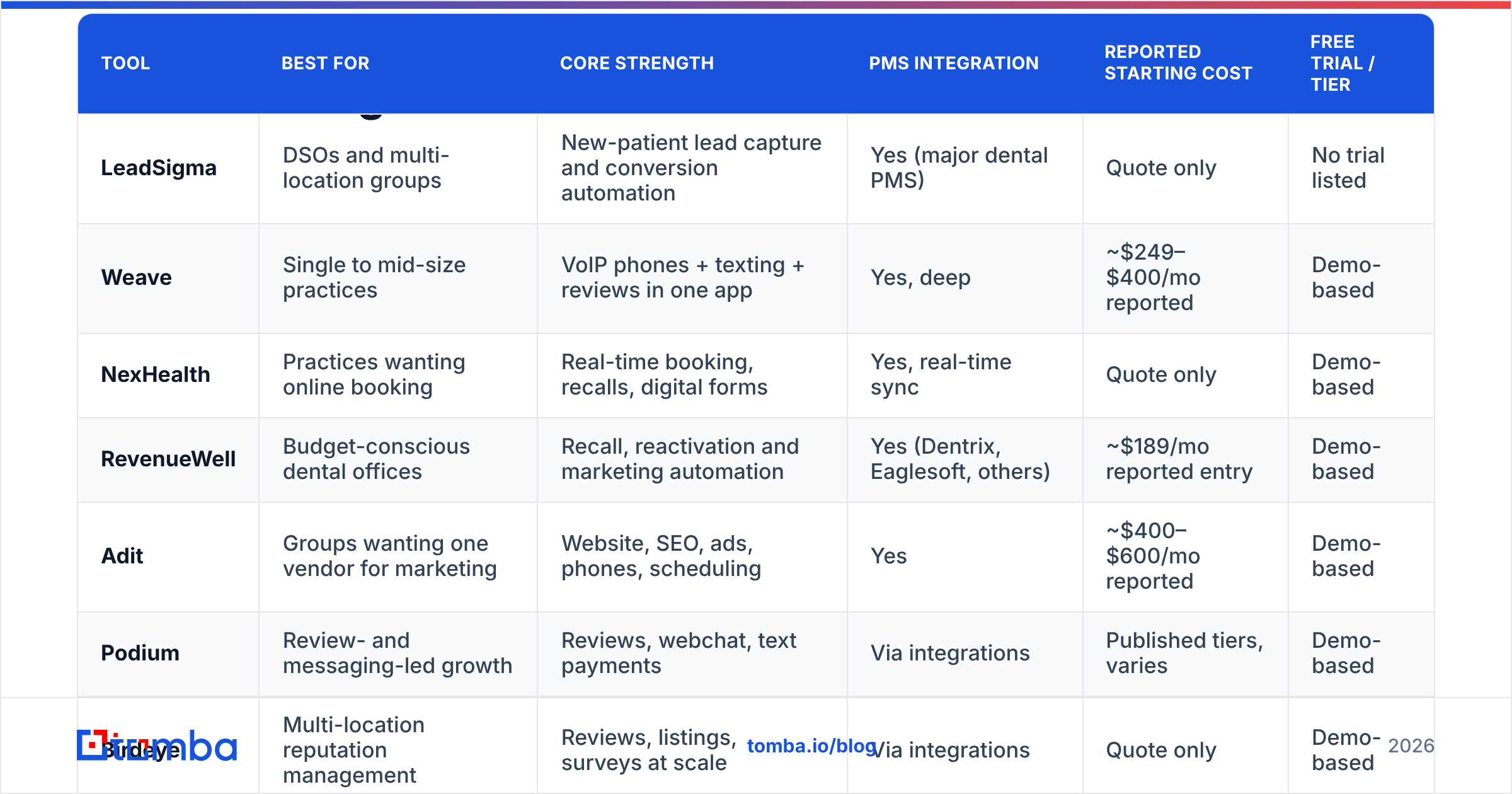
These are the seven platforms that come up most often when dental and specialty groups compare options. The pricing figures come from third-party comparisons and public listings as of 2026. Treat them as ballpark numbers and confirm with each vendor, because most healthcare tools quote by location count.
| Tool | Best for | Core strength | PMS integration | Reported starting cost | Free trial / tier |
|---|---|---|---|---|---|
| LeadSigma | DSOs and multi-location groups | New-patient lead capture and conversion automation | Yes (major dental PMS) | Quote only | No trial listed |
| Weave | Single to mid-size practices | VoIP phones + texting + reviews in one app | Yes, deep | ~$249–$400/mo reported | Demo-based |
| NexHealth | Practices wanting online booking | Real-time booking, recalls, digital forms | Yes, real-time sync | Quote only | Demo-based |
| RevenueWell | Budget-conscious dental offices | Recall, reactivation and marketing automation | Yes (Dentrix, Eaglesoft, others) | ~$189/mo reported entry | Demo-based |
| Adit | Groups wanting one vendor for marketing | Website, SEO, ads, phones, scheduling | Yes | ~$400–$600/mo reported | Demo-based |
| Podium | Review- and messaging-led growth | Reviews, webchat, text payments | Via integrations | Published tiers, varies | Demo-based |
| Birdeye | Multi-location reputation management | Reviews, listings, surveys at scale | Via integrations | Quote only | Demo-based |
| HubSpot | Agencies and non-dental operators | General CRM, marketing automation | Via integrations/API | Free CRM; paid Starter tier | Free tier |
1. Weave: best all-in-one communication hub#
Weave combines a VoIP phone system with two-way texting, reviews, payments and a patient CRM view. When a known patient calls, their record shows up on the front-desk screen. That alone changes how staff handle inbound calls. Weave is rated about 4.6 stars on G2 across several hundred reviews.
Pros: strong PMS sync, one app for phones and messaging, familiar to many dental staff. Cons: less focused on ad-channel lead attribution than LeadSigma. Moving your phones over is a real project.
2. NexHealth: best for online booking and patient self-service#
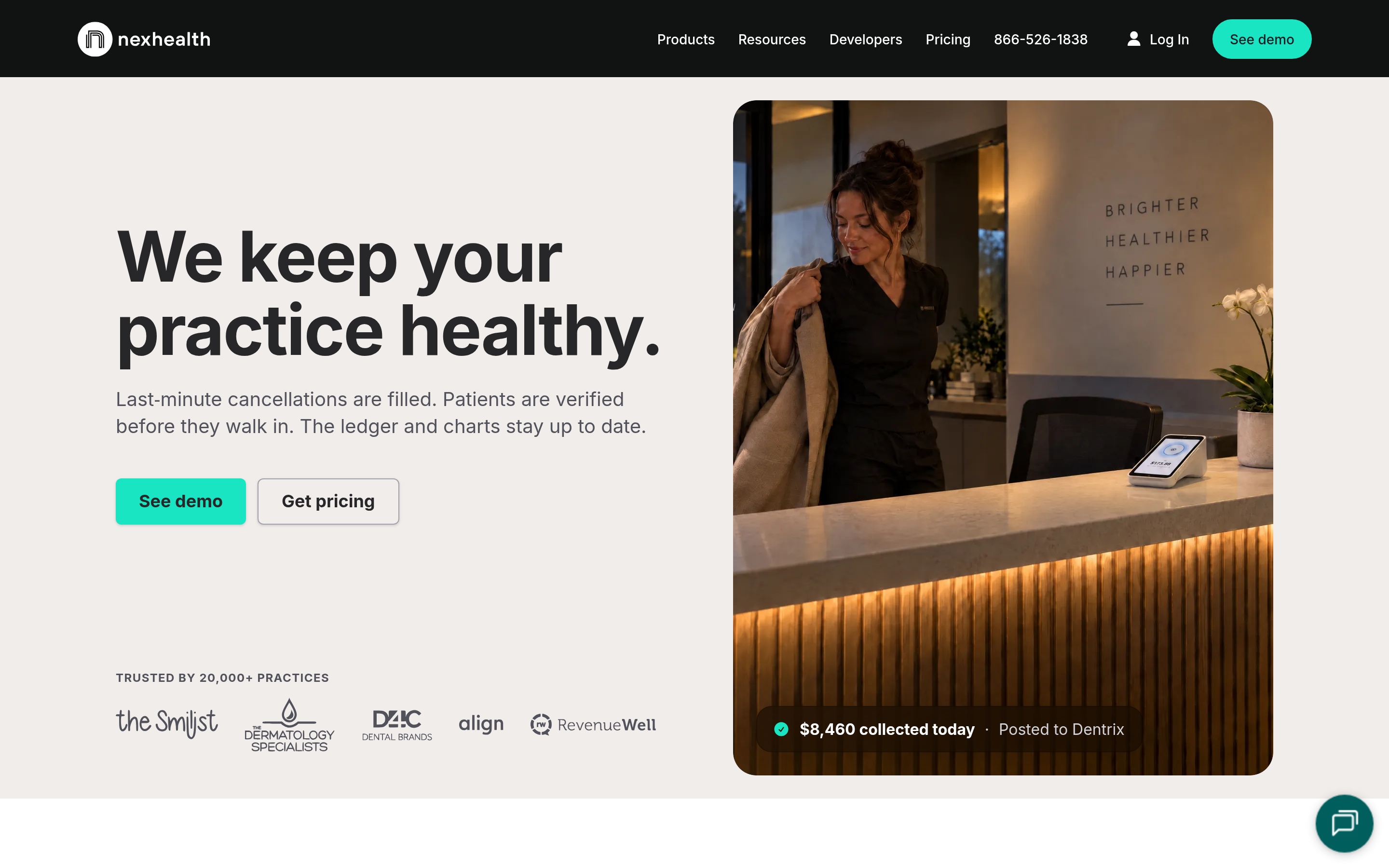
NexHealth connects directly to your PMS for real-time online booking, automated recalls, digital intake forms and messaging. If your "lead problem" is really a scheduling problem, where people want to book at 10pm without calling, NexHealth fixes it directly. The G2 NexHealth alternatives page is a useful way to see where it sits in the category.
Pros: modern patient experience, real-time availability, fewer no-shows. Cons: not a dedicated lead-nurturing CRM. Multi-touch new-patient follow-up is thinner than LeadSigma's.
3. RevenueWell: best budget pick for recall and reactivation#
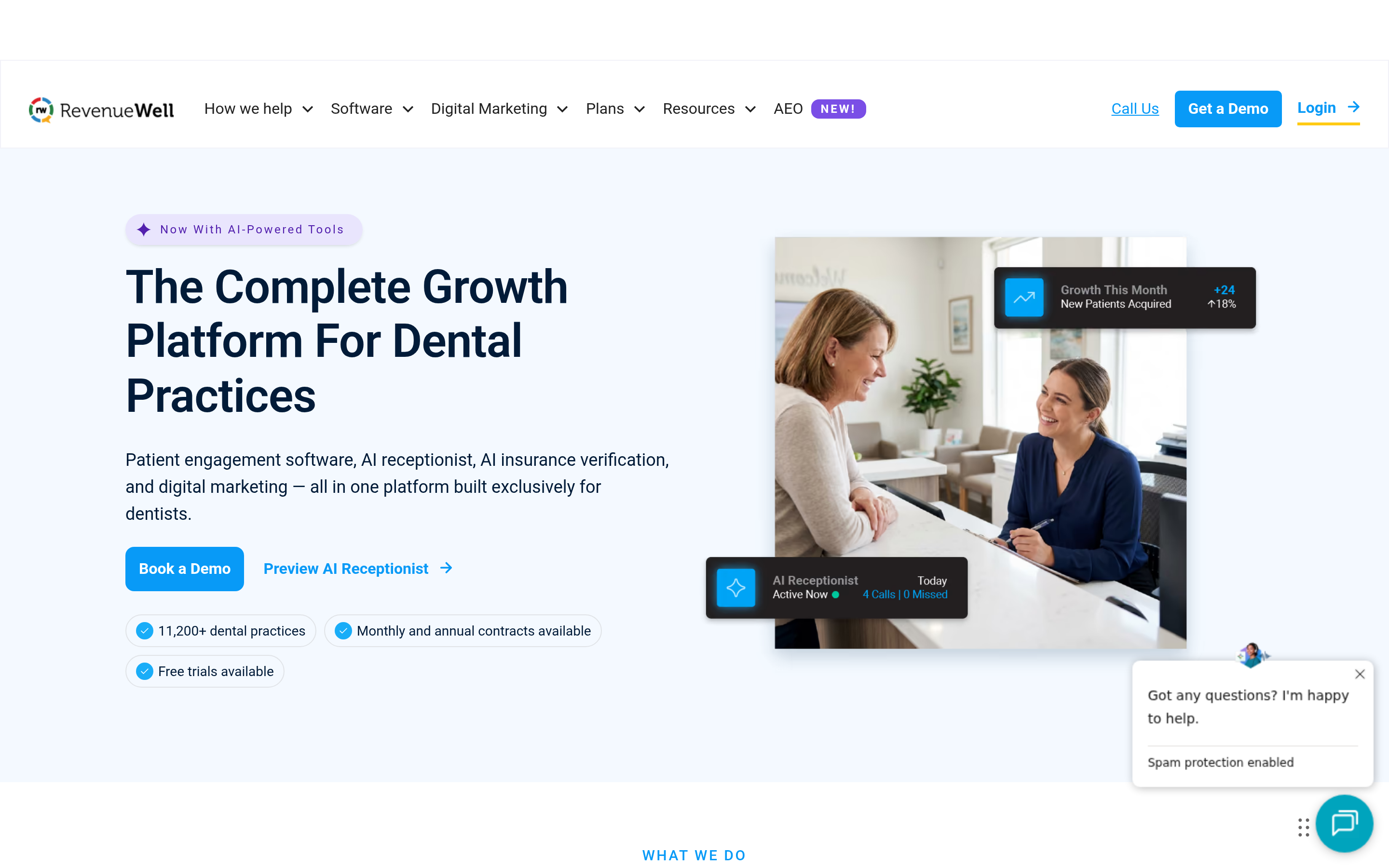
RevenueWell specializes in dental marketing automation: recall reminders, lapsed-patient reactivation, treatment follow-up and newsletters. Third-party comparisons put its entry tier around $189/month, which makes it one of the lower-cost options.
Pros: priced for single practices, strong at reactivating your existing patient base. Cons: focused more on existing patients than on converting new ones.
4. Adit: best for vendor consolidation#
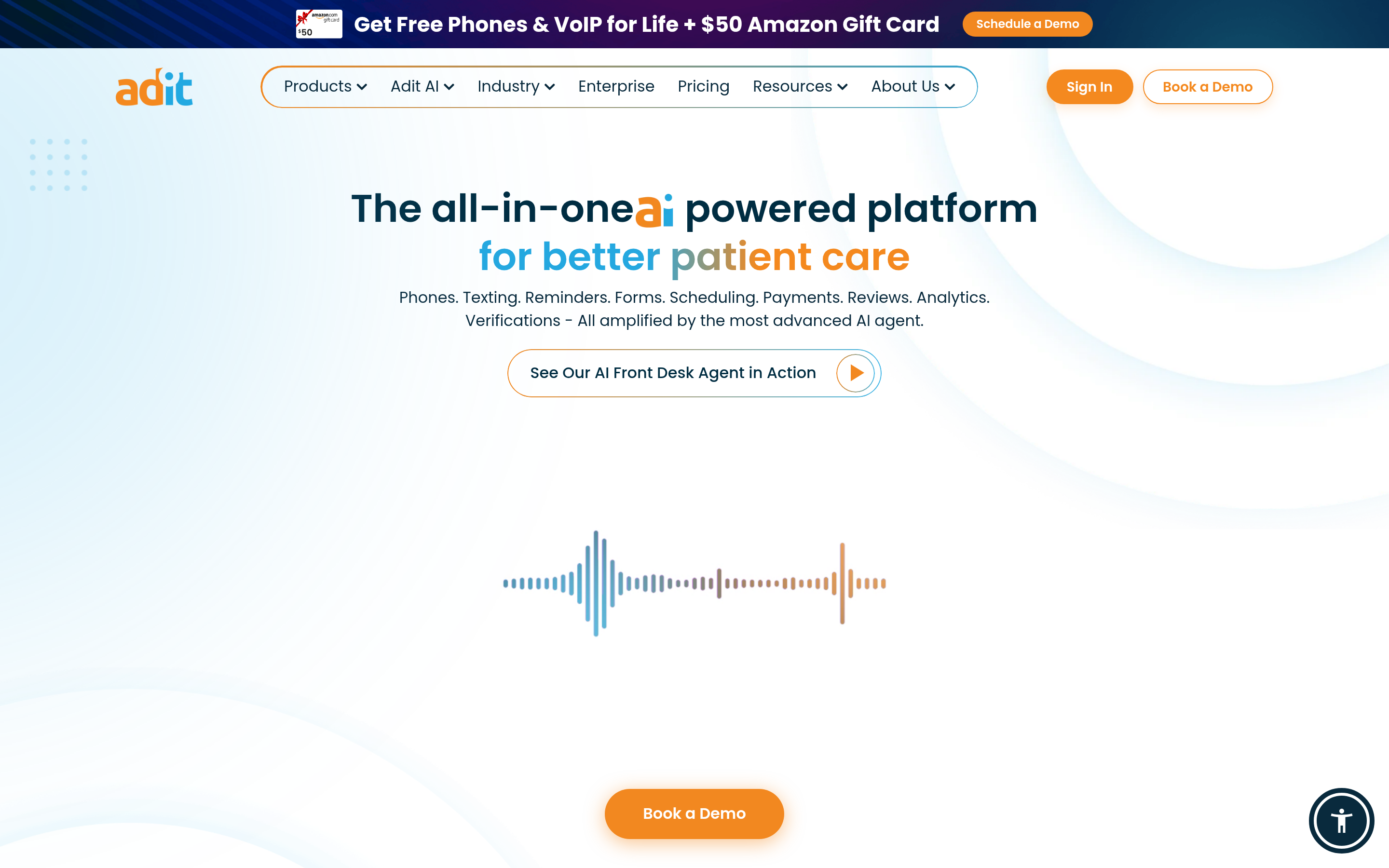
Adit puts websites, SEO, paid advertising, VoIP phones and online scheduling in one dashboard. For a growing group that's tired of five vendor invoices and five logins, that's the pitch. Reported pricing for the full marketing suite sits around $400–$600/month.
Pros: one vendor for most growth needs, dental-native. Cons: you're tied to its whole ecosystem. If you already have a strong agency, the overlap may waste money.
5. Podium: best for review-driven growth#
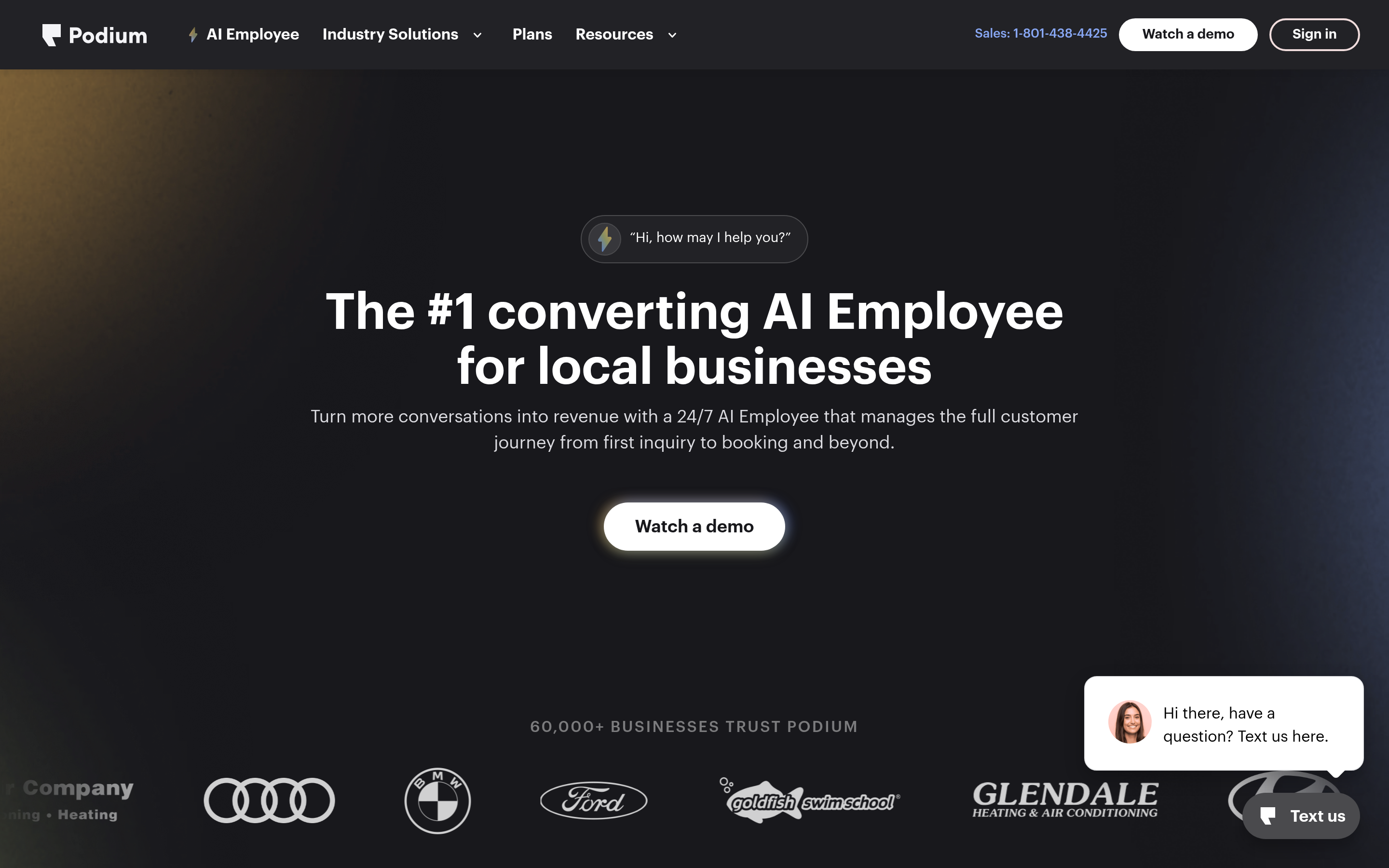
Podium started with reviews and messaging and grew into webchat, text-to-pay and lead capture across local-service businesses, not just dental. If most new patients find you through Google reviews, Podium matches where they come from.
Pros: excellent review generation, easy webchat-to-text handoff. Cons: general local-business tool, so dental-specific workflows need setup.
6. Birdeye: best for reputation at multi-location scale#
Birdeye covers reviews, listings management, surveys and messaging across dozens or hundreds of locations. It's a common pick for DSOs where brand consistency across locations matters as much as lead conversion.
Pros: built for scale, strong listings and reputation reporting. Cons: you'll probably still need a separate lead-conversion workflow.
7. HubSpot: best general-purpose CRM#
If you're an agency running campaigns for several clinics, or an operator with dental, med-spa and physio under one roof, a dental-specific CRM can feel limiting. HubSpot has a free CRM, published paid tiers, a large integration marketplace and marketing automation you can shape to any funnel.
Pros: transparent pricing, huge ecosystem, flexible pipelines. Cons: no native dental PMS sync. You'll need integrations or custom work to close the loop on showed appointments. It also isn't built for handling PHI out of the box, so check your compliance requirements before you pipe patient data into it.
Is LeadSigma better than Weave or NexHealth?#
It depends on where your leak is. Map your funnel first, then choose the tool.
- Leads arrive but aren't contacted fast enough. This is LeadSigma's home ground. Weave is a reasonable second if phones are the main channel.
- People want to book but can't do it themselves. NexHealth fixes this more directly than any lead CRM.
- Your existing patient base is going quiet. RevenueWell's recall and reactivation automations earn their cost here.
- Reviews are thin or uneven across locations. Podium or Birdeye before anything else.
- You aren't a dental business, or you manage many clients. HubSpot.
Many established DSOs run two of these side by side. A typical pairing is a lead-conversion CRM for new patients plus a communication hub for existing ones. That's fine as long as both write back to the PMS and you pick one source of truth for reporting.

How do you migrate off LeadSigma without losing leads?#
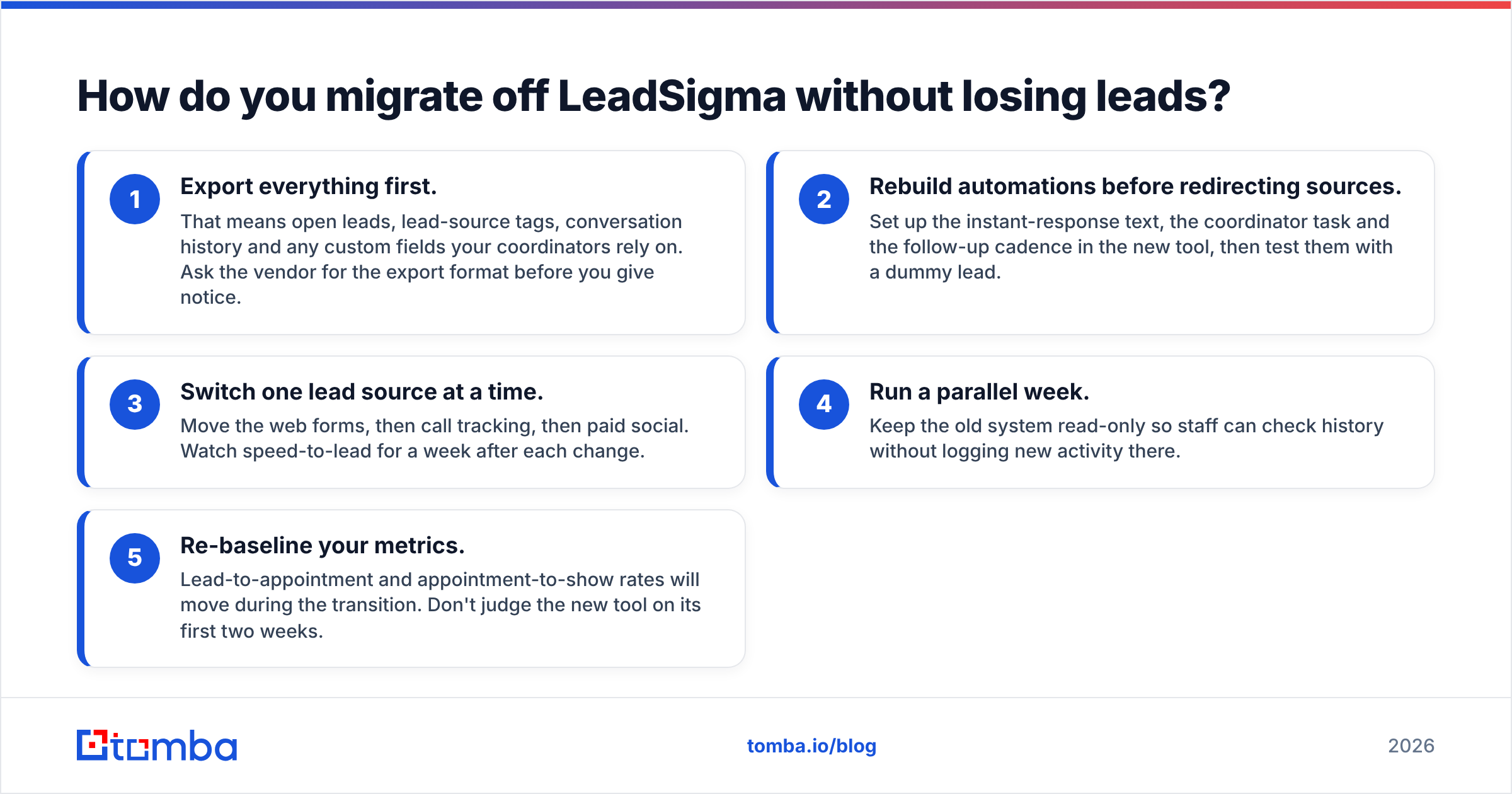
Switching lead CRMs mid-campaign is the riskiest part. A clean cutover looks like this:
- Export everything first. That means open leads, lead-source tags, conversation history and any custom fields your coordinators rely on. Ask the vendor for the export format before you give notice.
- Rebuild automations before redirecting sources. Set up the instant-response text, the coordinator task and the follow-up cadence in the new tool, then test them with a dummy lead.
- Switch one lead source at a time. Move the web forms, then call tracking, then paid social. Watch speed-to-lead for a week after each change.
- Run a parallel week. Keep the old system read-only so staff can check history without logging new activity there.
- Re-baseline your metrics. Lead-to-appointment and appointment-to-show rates will move during the transition. Don't judge the new tool on its first two weeks.
What about the B2B side of practice growth?#
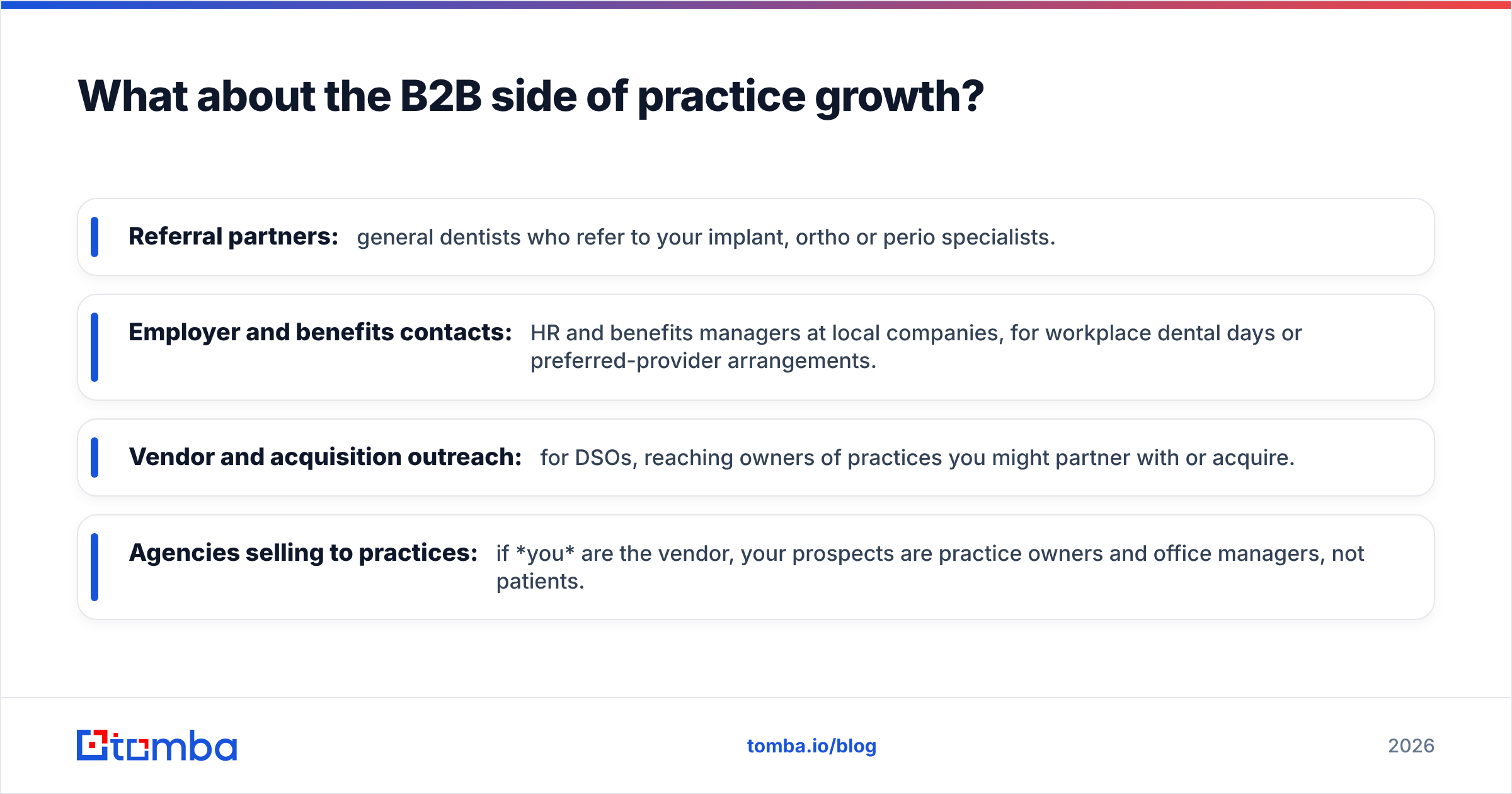
Patient CRMs, LeadSigma included, are built for consumers who fill in a form. A lot of dental group growth comes from B2B relationships these tools don't touch:
- Referral partners: general dentists who refer to your implant, ortho or perio specialists.
- Employer and benefits contacts: HR and benefits managers at local companies, for workplace dental days or preferred-provider arrangements.
- Vendor and acquisition outreach: for DSOs, reaching owners of practices you might partner with or acquire.
- Agencies selling to practices: if you are the vendor, your prospects are practice owners and office managers, not patients.
For these, you need professional email addresses and clean contact data. A patient CRM won't supply them. This is where a B2B tool like Tomba fits alongside whatever patient CRM you choose. You can use the email finder to find a practice owner or benefits manager by name and company. Then run your list through the email verifier before outreach so bounces don't damage your domain. If you already have a list of practices or companies, data enrichment fills in missing fields like role, LinkedIn URL and company size.
Keep this separate from patient data. B2B prospecting on business contacts and patient communication run under different consent and privacy rules, and they should live in different systems.
Which LeadSigma alternative should you choose?#
Here's the short answer, by situation:
- Multi-location DSO focused on new-patient conversion: stay on LeadSigma or pilot it against Weave. Few tools match its lead-source aggregation.
- Single or small practice on a budget: RevenueWell for recall, or NexHealth if online booking is the gap.
- Group that wants one vendor: Adit.
- Growth driven by reviews: Podium, or Birdeye at scale.
- Agency or mixed-vertical operator: HubSpot, plus integrations for each clinic's PMS.
Whichever you pick, measure it on cost per seated patient, not cost per lead. That number shows whether the CRM is doing its job or just recording leads that never book.
Ready to fill the B2B side of your pipeline?#
A patient CRM handles the people who come to you. For referral partners, employer contacts, acquisition targets or practice owners you want to sell to, you have to go out and find them. Tomba Email Finder finds verified professional email addresses by name, domain or company. The free tier gives you 25 searches a month to test it, and paid plans start at $49/month. Use it with whichever LeadSigma alternative you pick, and keep your patient pipeline and B2B pipeline running side by side.
Related guides#
// get started
Find, verify and enrich your first contacts today
Start on the free plan with 25 searches a month, then scale when your team is ready.
Free plan · No credit card required · GDPR & CCPA
// about the author