LeadSigma Pricing Reviews Pros and Cons: 2026 Buyer's Guide
LeadSigma doesn't publish a price list. Here's what the quote-based model means for dental and ortho groups, what reviewers actually praise, where it falls short, and when a cheaper setup does the job.
This LeadSigma pricing reviews pros and cons guide covers what the quote-based model costs, what users say, and who should book the demo.
TL;DR
- LeadSigma is a new-patient CRM and speed-to-lead platform for dental, orthodontic, veterinary, and chiropractic groups, especially multi-location ones. It isn't a general B2B sales tool.
- There's no public price list. Pricing is quote-based and, according to third-party listings, depends on lead volume, locations, and how much automation you switch on.
- Reviewers mostly praise how easy it is to use and how fast it follows up on leads. The main complaints are that you can't see the price upfront and that the product is built narrowly for healthcare.
- It suits DSOs and ortho groups that are losing booked consults to slow follow-up. Single-location practices and non-healthcare teams can usually get by with a general CRM.
- If you sell to dental practices instead of running one, you need contact data, not a patient CRM. That's a different tool category.
What is LeadSigma?#
LeadSigma is a lead-conversion platform for healthcare practices that live on inbound demand. Its own site calls it AI patient acquisition and scheduling. It's aimed at orthodontic practices, dental service organizations (DSOs), dental partnership organizations, implant groups, veterinary clinics, and chiropractors.
The core idea is simple. A new patient fills out a form, calls, or clicks an ad. LeadSigma tries to reach them within seconds by text, email, and phone. Every touch is logged on one patient record. The company cites the well-known finding that a reply in the first minute sharply lifts conversion. The whole product is built around closing that gap.
According to LeadSigma's website and its listing on Capterra, the platform covers:
- Lead aggregation: it pulls leads from many digital sources (web forms, ad platforms, landing pages) into one inbox. This matters most for groups running campaigns across dozens of locations.
- Automated follow-up: SMS, email, and call sequences start the moment a lead arrives, so the front desk isn't the bottleneck.
- Copilot AI voice: AI-assisted calling and conversation handling to qualify and book patients.
- PMS workflows: connects to practice management systems so appointment status flows back into the CRM.
- Patient reactivation: automated campaigns aimed at dormant patients and consults that never converted.
- Reporting: speed-to-lead, booked consults, show rates, and source attribution by location.
It's worth being clear about what LeadSigma is not. It isn't an email finder, a B2B contact database, or an outbound prospecting tool. It works with leads that come to you. It doesn't go out and find people for you to contact.
How much does LeadSigma cost in 2026?#
The short answer is that you have to ask. LeadSigma doesn't publish plan tiers or monthly prices. Third-party directories such as GetApp list the starting price as "available upon request." The same listings report that there's no free version, but there is a free trial that doesn't require a credit card.
Pricing aggregators that have looked at the model say the main value metric appears to be lead volume plus automation depth across channels. In practice, a quote for this kind of vertical CRM usually depends on:
- Number of locations: a 40-office DSO and a single ortho office aren't going to see the same number.
- Lead volume: how many inbound leads a month you route through the system.
- Channels enabled: SMS, voice, and AI calling usually cost more than email-only follow-up because of carrier and telephony fees.
- Integrations: PMS connections and custom workflows can add onboarding or setup costs.
- Contract length: annual commitments are the norm for healthcare CRMs sold through demos.
We couldn't verify real contract prices from customers, so we won't invent a number. What you can do is walk into the demo with the right questions (listed further down) so the quote doesn't catch you off guard.

How does LeadSigma's pricing model compare to alternatives?#
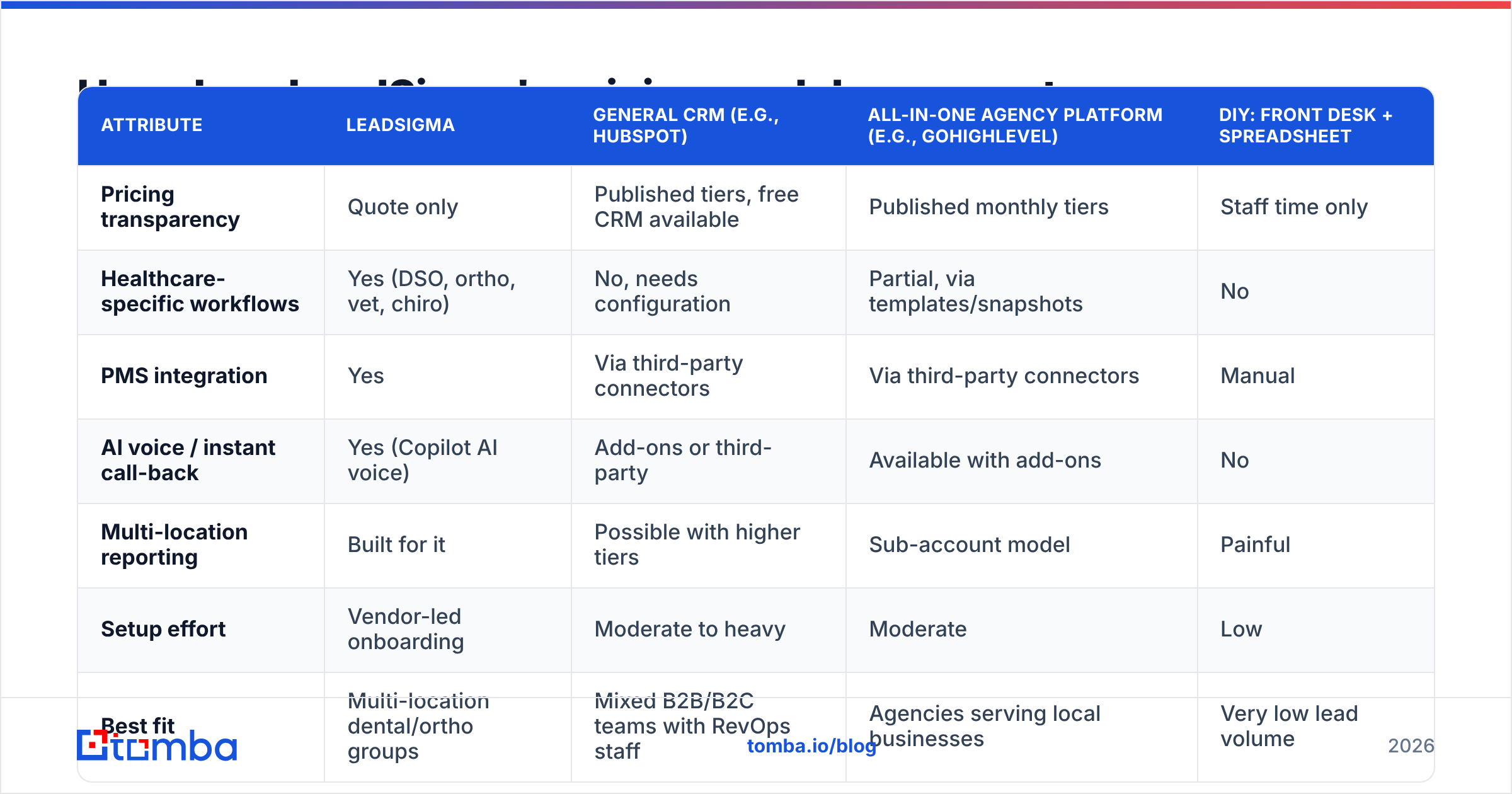
The fair way to judge LeadSigma pricing is against the other ways a practice could solve slow lead follow-up. Here's how the options compare:
| Attribute | LeadSigma | General CRM (e.g., HubSpot) | All-in-one agency platform (e.g., GoHighLevel) | DIY: front desk + spreadsheet |
|---|---|---|---|---|
| Pricing transparency | Quote only | Published tiers, free CRM available | Published monthly tiers | Staff time only |
| Healthcare-specific workflows | Yes (DSO, ortho, vet, chiro) | No, needs configuration | Partial, via templates/snapshots | No |
| PMS integration | Yes | Via third-party connectors | Via third-party connectors | Manual |
| AI voice / instant call-back | Yes (Copilot AI voice) | Add-ons or third-party | Available with add-ons | No |
| Multi-location reporting | Built for it | Possible with higher tiers | Sub-account model | Painful |
| Setup effort | Vendor-led onboarding | Moderate to heavy | Moderate | Low |
| Best fit | Multi-location dental/ortho groups | Mixed B2B/B2C teams with RevOps staff | Agencies serving local businesses | Very low lead volume |
The takeaway is that LeadSigma's higher, opaque price buys you specialization. With a general CRM, you'll spend weeks building what LeadSigma ships out of the box for ortho and dental workflows. Whether that's worth it depends on how many leads you currently lose to slow follow-up.
What do LeadSigma reviews say?#
LeadSigma has far fewer reviews than big horizontal CRMs. Read the listings on Capterra, GetApp, and Software Advice as signals, not proof. The themes that keep coming up:
What reviewers like
- Ease of use. Front-desk and treatment-coordinator staff can pick it up without much training, which matters when turnover is high.
- Immediate follow-up. Several reviewers say the product let them "level up" lead follow-up through automation and tracking, and that's the main reason to buy it.
- Visibility. Having calls, texts, emails, and appointment status on one patient record replaces the scatter of voicemails and sticky notes.
- Support and training. Listings mention in-person training, live online sessions, documentation, videos, phone, chat, and a knowledge base. That's more hand-holding than most SaaS tools offer.
What gives buyers pause
- No public pricing. You can't compare costs without sitting through a sales call.
- Narrow vertical focus. If you're outside dental, ortho, vet, or chiro, the templates and PMS integrations won't help you much.
- Limited independent review volume. With few reviews, a handful of experiences can swing the overall picture either way.
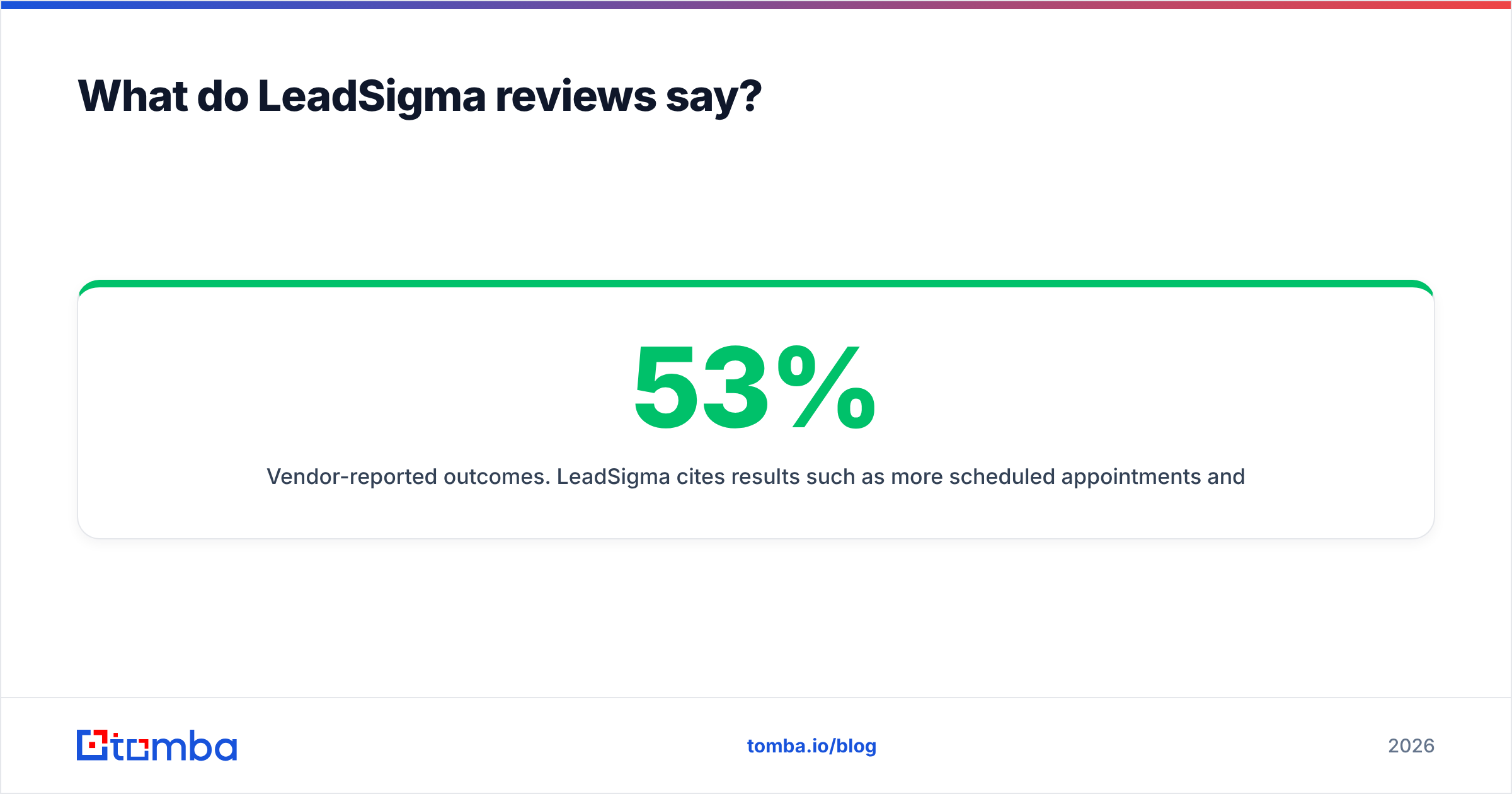
- Vendor-reported outcomes. LeadSigma cites results such as 53% more scheduled appointments and a 13% lift in show rates, plus a named ortho case study with a 17.4% production increase. These come from the vendor. Ask for references that look like your practice.
LeadSigma pricing reviews pros and cons at a glance#
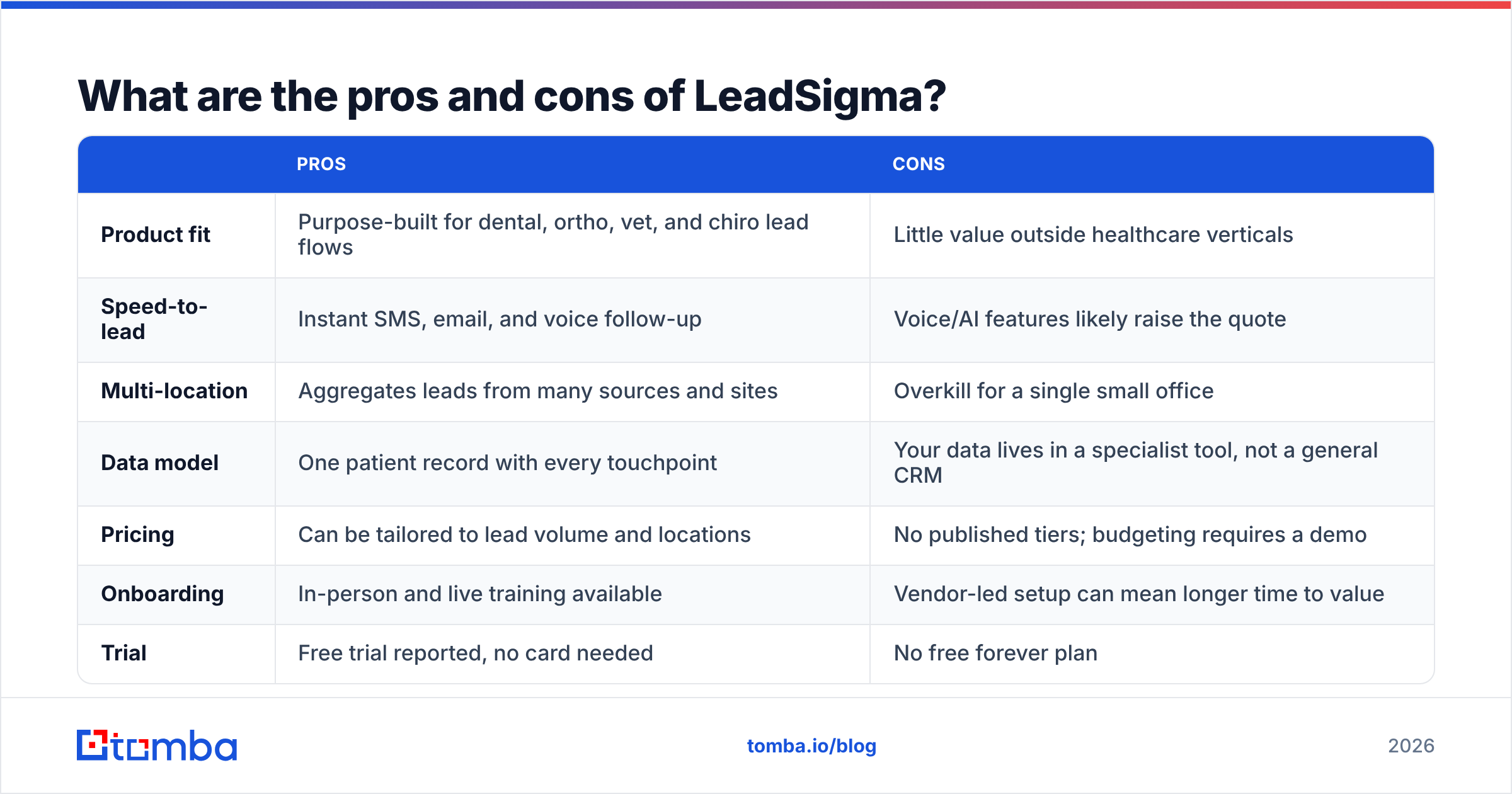
Here's the LeadSigma pricing reviews pros and cons summary in one place:
| Pros | Cons | |
|---|---|---|
| Product fit | Purpose-built for dental, ortho, vet, and chiro lead flows | Little value outside healthcare verticals |
| Speed-to-lead | Instant SMS, email, and voice follow-up | Voice/AI features likely raise the quote |
| Multi-location | Aggregates leads from many sources and sites | Overkill for a single small office |
| Data model | One patient record with every touchpoint | Your data lives in a specialist tool, not a general CRM |
| Pricing | Can be tailored to lead volume and locations | No published tiers; budgeting requires a demo |
| Onboarding | In-person and live training available | Vendor-led setup can mean longer time to value |
| Trial | Free trial reported, no card needed | No free forever plan |
Is LeadSigma worth it for your practice?#
Use your own numbers to decide. Here's a quick way to size the opportunity before the demo:
- Pull last quarter's inbound lead count and booked-consult count.
- Estimate your current average response time. Be honest about nights and weekends.
- Work out the value of one booked consult: case acceptance rate × average treatment value.
- Ask what happens if faster follow-up converts even 10% more of those leads.
Say that adds up to several new cases a month per location. Then a specialist platform can easily pay for itself, and LeadSigma belongs on your shortlist. A single office with 20 leads a month is different. A tight front-desk process and a general CRM will likely close most of the gap for far less money.
It helps to track your response rate and time-to-first-touch before and after any tool change. Otherwise you're relying on the vendor's dashboard to grade itself.
What should you ask LeadSigma on the demo call?#
Because pricing is quote-based, the demo is your negotiation. Go in with these questions:
- What's the pricing unit: per location, per lead, per user, or a flat platform fee?
- What's included in the base quote and what's an add-on: AI voice, SMS volume, PMS integration, reactivation campaigns?
- Are there setup or onboarding fees, and are they waived on annual terms?
- What happens if you go over your lead or message volume in a busy month?
- What are the contract length and cancellation terms, and can you export your data if you leave?
- Can you speak to two reference customers with a similar location count and PMS?
Get the answers in writing. That turns a vague "tailored" price into a set of numbers you can compare with the alternatives table above.

Who should skip LeadSigma?#
A few groups keep landing on LeadSigma pages when they actually need something else:
- Non-healthcare businesses. A home-services company or SaaS startup will get more from a horizontal CRM or a sales automation stack.
- Solo practices with low lead volume. The specialization premium is hard to justify at small scale.
- Agencies and vendors selling to dental practices. This is the most common mix-up. If you're a marketing agency, a dental supply rep, or a SaaS vendor targeting DSOs, you don't need a patient CRM. You need verified contact details for practice owners, office managers, and DSO operations leads.
For that last group, the job is outbound. You start with a list of practice websites, run a domain search to see who works there and what email pattern they use, then verify addresses before sequencing. An email finder is the right tool here, and it's also much cheaper to test. Tomba publishes its pricing: a free tier with 25 searches a month, then Starter at $49/mo, Growth at $99/mo, Pro at $249/mo, and custom Enterprise plans.
How does LeadSigma fit into a wider revenue stack?#
Even for a DSO that's a perfect fit, LeadSigma covers one stage: turning inbound interest into booked consults. Everything upstream (ad spend, SEO, referral programs) and downstream (treatment acceptance, billing) sits in other systems. Plan for:
- Attribution back to ad platforms, so marketing can see which campaigns produce patients and not just form fills.
- Clean handoff to your PMS, so staff don't enter appointments twice.
- Consistent location-level reporting, so regional managers can compare offices on speed-to-lead and show rates.
LeadSigma is designed around those handoffs, which is a big part of what you're paying for. Before you sign, confirm your specific PMS is supported natively and not through a workaround.
Frequently asked questions#
Does LeadSigma have a free plan? No. Third-party listings report a free trial with no credit card required, but no free-forever tier.
What is LeadSigma's starting price? LeadSigma doesn't publish it. Pricing is available on request and is tailored to lead volume, locations, and automation scope.
Who is LeadSigma best for? Multi-location dental, orthodontic, veterinary, and chiropractic organizations that get a high volume of inbound leads and lose bookings to slow follow-up.
Is LeadSigma a B2B prospecting tool? No. It converts inbound patient leads. For outbound B2B prospecting, such as reaching practice owners, you need an email finder and a verification tool.
Ready to reach the practices instead of their patients?#
If you landed here because you sell to dental groups, orthodontists, or clinics, LeadSigma isn't the tool you're looking for. You need accurate decision-maker contacts. Tomba Email Finder finds work emails from a name, a company, or just a practice's domain. Build a verified list of owners and office managers and start outreach the same day. Start on the free plan with 25 searches a month. Move to Starter at $49/mo when the list starts converting.
Related guides#
// get started
Find, verify and enrich your first contacts today
Start on the free plan with 25 searches a month, then scale when your team is ready.
Free plan · No credit card required · GDPR & CCPA
Get the Tomba newsletter
Product and data updates
// about the author