Leadspace Pricing Reviews Pros and Cons: 2026 Buyer's Guide
Leadspace doesn't publish prices, and its reviews are mixed on setup time. This guide covers what contracts tend to cost, what users praise and complain about, and when a lighter tool is the better buy.
This guide to Leadspace pricing reviews pros and cons covers what contracts cost, what users say, and when a cheaper tool is the better buy.
TL;DR
- Leadspace does not publish pricing. Every deal is a custom annual contract. Buyers report most deals in the five-figure range per year. Enterprise deals go higher.
- Reviewers like its data unification, AI-based ICP and persona modeling, and CRM/MAP integrations. Common complaints: onboarding time, the learning curve, and hard-to-predict cost.
- It fits mid-market and enterprise RevOps teams that need a B2B customer data platform. It's a poor fit for a small team that just needs verified emails for outbound.
- If you mostly want enrichment and contact data, lighter tools like Tomba, Apollo, or BookYourData cost far less and you can start the same day.
- Before you sign, ask about record volume caps, per-integration fees, intent-data add-ons, and renewal uplift terms.
What is Leadspace?#
Leadspace is a B2B customer data platform (CDP). In plain terms, it sits between your CRM, your marketing automation platform, and third-party data sources. It merges all of them into one clean, enriched view of every account and contact. Salesforce and HubSpot store your records. Leadspace tries to make those records complete, deduplicated, and scored.
If "customer data platform" is new to you, Wikipedia's overview of CDPs is a good neutral primer. Leadspace's version is built for B2B. It works at the account and buying-group level, not with individual consumer profiles.
The platform's main capabilities, as described on Leadspace's own site and in user reviews:
- Data unification and deduplication: merges CRM, MAP, and third-party records into one golden record per account and contact.
- Enrichment: fills in firmographics (industry, size, revenue), technographics, and contact attributes, both in bulk and in real time.
- AI-driven ICP and persona modeling: builds a model from your closed-won deals and scores new accounts and leads against it.
- Buyer intent signals: brings in intent data to show which accounts are researching topics you care about.
- Lead-to-account matching and routing: attaches inbound leads to the right account so they reach the right rep.
- Segmentation and audience building: builds target lists for ABM campaigns and ad platforms.
You can see the gap right away. Leadspace is a data infrastructure product. It isn't a prospecting tool you open to look up one person's email. That gap explains most of the pricing and most of the reviews.
How much does Leadspace cost in 2026?#
Leadspace uses quote-based pricing. There's no public price page, no self-serve checkout, and no free plan. To get a number you book a demo, go through discovery, and receive a proposal.
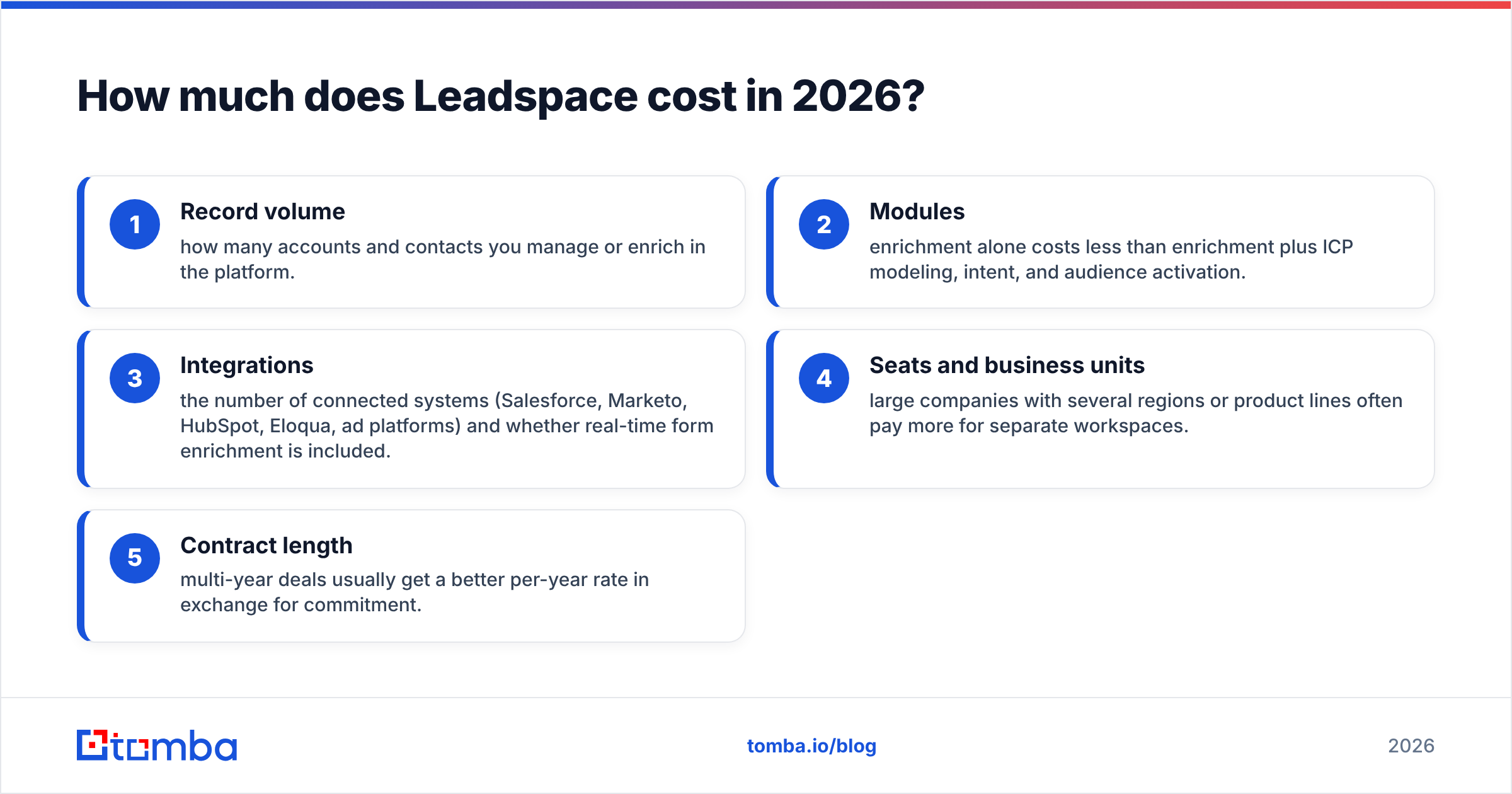
Pricing usually depends on these factors:
- Record volume: how many accounts and contacts you manage or enrich in the platform.
- Modules: enrichment alone costs less than enrichment plus ICP modeling, intent, and audience activation.
- Integrations: the number of connected systems (Salesforce, Marketo, HubSpot, Eloqua, ad platforms) and whether real-time form enrichment is included.
- Seats and business units: large companies with several regions or product lines often pay more for separate workspaces.
- Contract length: multi-year deals usually get a better per-year rate in exchange for commitment.
Leadspace doesn't publish figures. Any number you see online is an estimate from buyers, procurement marketplaces, or review sites. Across those sources the pattern holds steady. Entry contracts land in the low-to-mid five figures per year. Enterprise deployments with intent data and several integrations can go well past that. Take those ranges as directional and get your own quote.
The cost that catches teams out is internal. You need someone, usually RevOps or marketing ops, to own setup, field mapping, and ongoing hygiene. If nobody can own that, the license fee is only part of the real cost.

Is Leadspace pricing worth it compared with alternatives?#
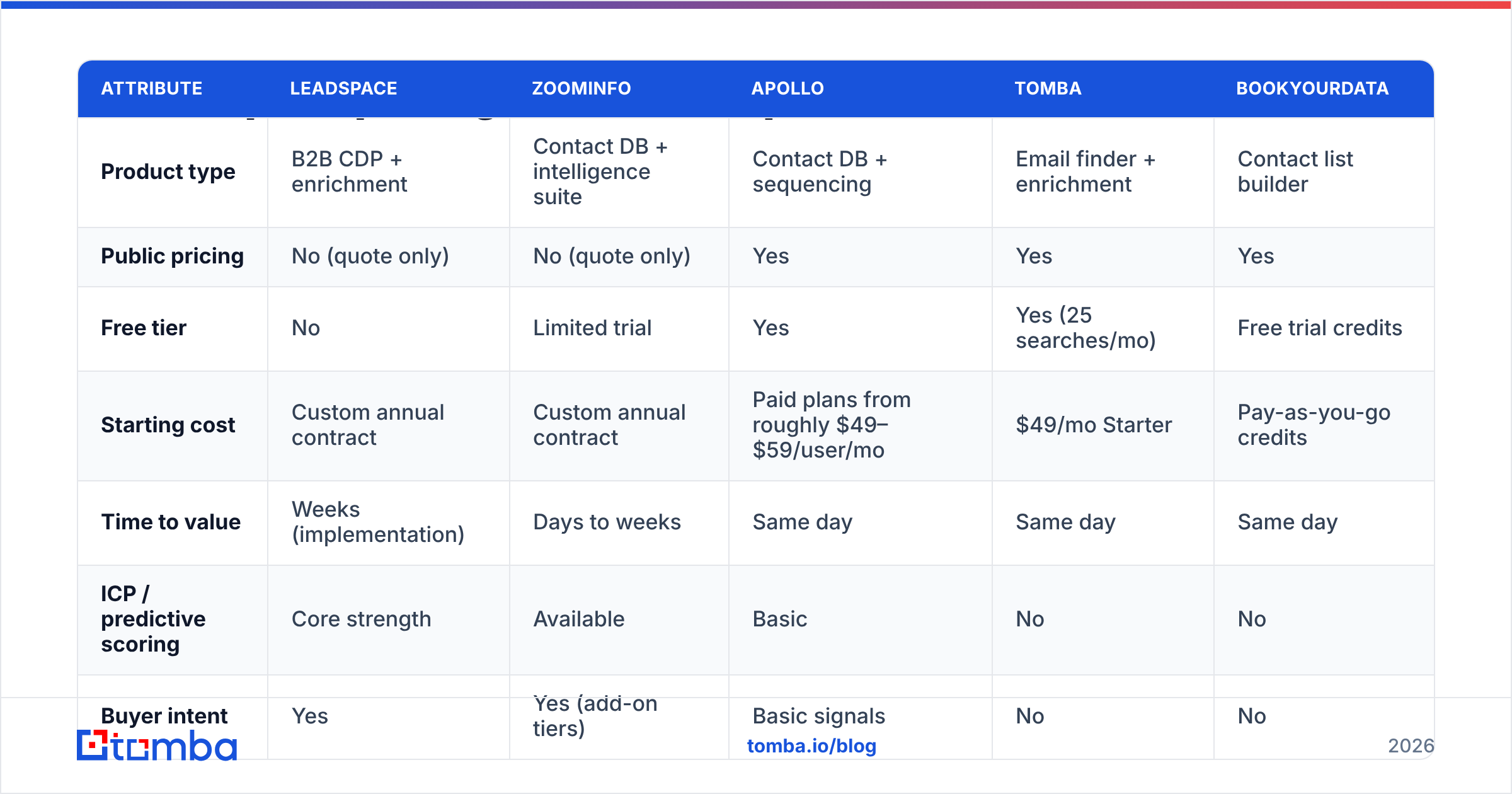
It depends on the job. The table below compares Leadspace with tools buyers often shortlist. Some are lighter tools for the "I just need better contact data" case.
| Attribute | Leadspace | ZoomInfo | Apollo | Tomba | BookYourData |
|---|---|---|---|---|---|
| Product type | B2B CDP + enrichment | Contact DB + intelligence suite | Contact DB + sequencing | Email finder + enrichment | Contact list builder |
| Public pricing | No (quote only) | No (quote only) | Yes | Yes | Yes |
| Free tier | No | Limited trial | Yes | Yes (25 searches/mo) | Free trial credits |
| Starting cost | Custom annual contract | Custom annual contract | Paid plans from roughly $49–$59/user/mo | $49/mo Starter | Pay-as-you-go credits |
| Time to value | Weeks (implementation) | Days to weeks | Same day | Same day | Same day |
| ICP / predictive scoring | Core strength | Available | Basic | No | No |
| Buyer intent | Yes | Yes (add-on tiers) | Basic signals | No | No |
| Email finding + verification | Via enrichment | Yes | Yes | Core strength | Yes |
| Best for | Enterprise RevOps data layer | Large sales orgs | SMB outbound teams | Outbound, enrichment, API use | Fast, accurate list purchases |
Read it this way:
- You need a unified, scored, deduplicated data layer across CRM and MAP. Leadspace belongs on the list, and so do enterprise suites like ZoomInfo, 6sense, and Demandbase. The price is justified if bad data is costing you pipeline.
- You need verified contacts to email. Leadspace is overkill. A self-serve email finder plus an email verifier gets you there for a small fraction of the cost.
- You need enrichment on inbound leads but not full CDP modeling. An API-first data enrichment tool is the middle option. It's predictable and cheap, and you can wire it into forms or your CRM in an afternoon.
What do Leadspace reviews say?#
Leadspace has a well-established presence on G2's Leadspace reviews page. Most reviewers are marketing ops, RevOps, and demand-gen staff at mid-market and enterprise B2B companies. Overall sentiment is positive, and the same themes come up again and again.
What reviewers praise#
- Data quality once it's running: users say match rates and firmographic completeness in their CRM clearly improve after deployment.
- Deduplication and lead-to-account matching: this solves a real headache for teams whose Salesforce instance has built up years of duplicate records.
- ICP modeling: marketing teams like being able to score leads against a model trained on their own won deals rather than generic rules.
- Real-time enrichment on forms: shorter forms with the missing fields filled in behind the scenes usually improve conversion rates.
- Customer success: many reviews mention responsive account teams during and after onboarding.
What reviewers criticize#
- Implementation effort: setup takes weeks, and you need internal ops resources to map fields and keep things running.
- Learning curve: the interface and configuration options are powerful but not intuitive for occasional users.
- Cost transparency: buyers find budgeting hard without public pricing, and expanding volume or modules at renewal raises the bill.
- Contact-level coverage for outbound: some users say that for direct email and phone data, they still use a dedicated contact data tool alongside Leadspace.
- Reporting: some reviewers want more flexible, built-in reporting on enrichment coverage and model performance.
The takeaway: users who bought Leadspace as a data platform are usually satisfied. Users who hoped it would double as a prospecting tool are the ones who end up disappointed.
Leadspace pricing reviews pros and cons at a glance#
Here is the balanced summary, putting the reviews next to the pricing model.
Pros#
- A real B2B CDP: it unifies, dedupes, and enriches across systems, which point tools don't try to do.
- Predictive ICP and persona modeling: scoring is based on your own conversion data, so leads get prioritized with less guesswork.
- Native integrations: deep connections with Salesforce, Marketo, HubSpot, Eloqua, and ad platforms help keep data synced.
- Intent plus fit in one view: you can combine "who matches our ICP" with "who is in market now."
- Enterprise-grade support: dedicated onboarding and account management for large deployments.
Cons#
- No public pricing: you can't compare costs without going through a sales cycle.
- High entry cost: annual contracts are usually out of reach for startups and small sales teams.
- Slow time to value: weeks of implementation before you see results.
- Needs internal ownership: without a RevOps or MOps owner, the platform gets underused.
- Not built for one-off lookups: a rep who needs one prospect's email right now will still reach for a separate tool.
Who should buy Leadspace, and who shouldn't?#
Leadspace makes sense when all of these are true:
- You have tens of thousands of CRM records or more, and duplicates or missing fields are causing measurable routing and scoring problems.
- Marketing and sales disagree about lead quality, and you need a shared, data-backed ICP score.
- You run ABM programs that depend on accurate account lists and intent signals.
- You have a RevOps or marketing ops person who can own the platform.
- Your budget covers an annual data-infrastructure contract.
Look elsewhere when:
- You're a founder, SDR team, or agency that mainly needs emails and phone numbers for outbound.
- You want to start today, not after a procurement cycle.
- You need predictable, usage-based costs you can scale up or down each month.
- Your CRM is small enough that a clean enrichment pass every quarter solves the problem.
For the second group, a combination like domain search to map a company's contacts, an email finder for specific people, and verification before sending covers most of what you need.
What are the best Leadspace alternatives?#
Match the alternative to the job.
For enterprise data and intent (like-for-like replacements):
- ZoomInfo: a large contact database with intent, org charts, and workflow tools. Also quote-based, and also a large annual commitment.
- 6sense: account-based orchestration built around predictive intent. Strong for ABM and priced for enterprise.
- Demandbase: an ABM platform with account intelligence, advertising, and intent. Similar buyer profile to Leadspace.
For contact data and enrichment without a CDP contract:
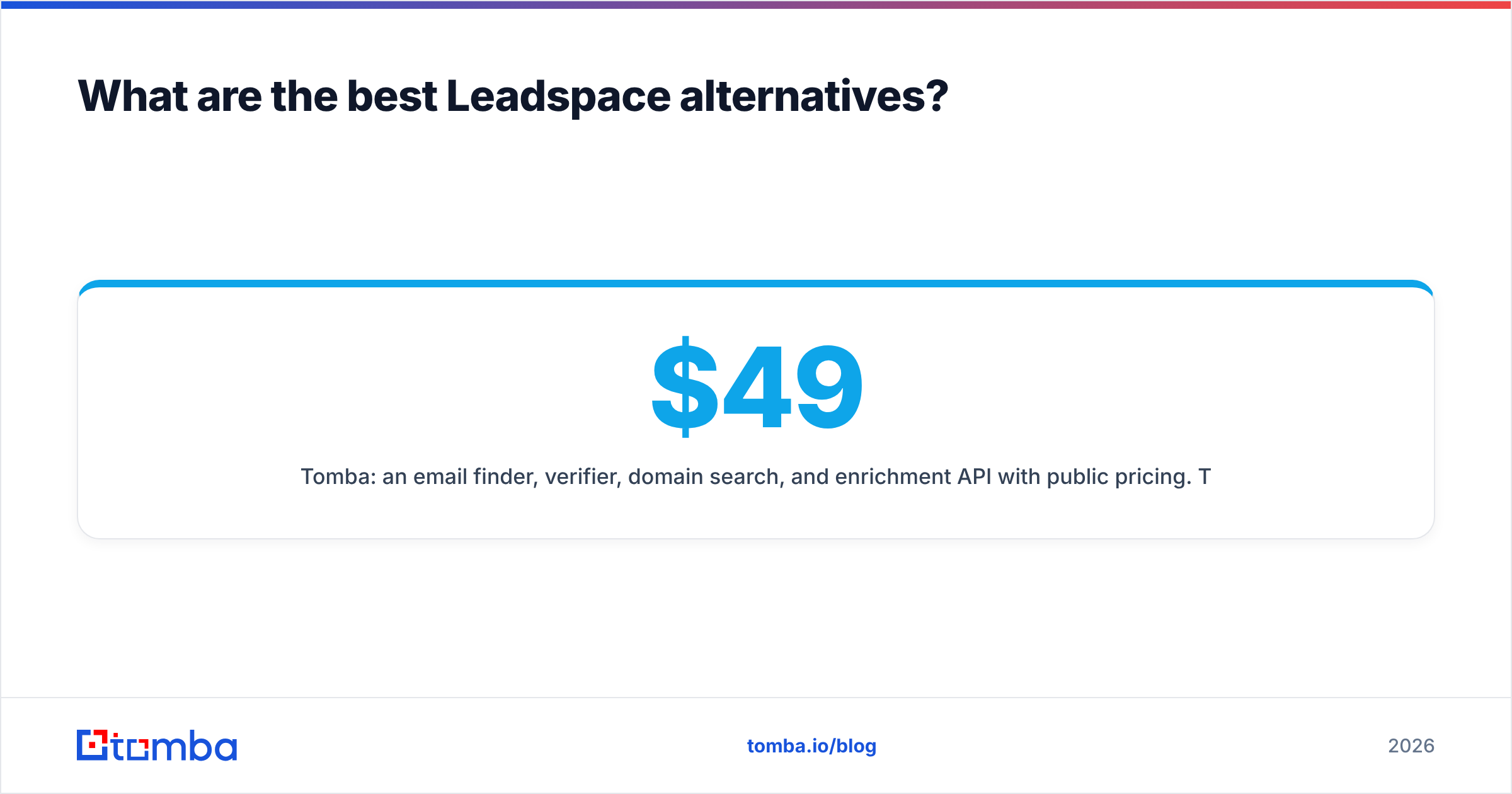
- Tomba: an email finder, verifier, domain search, and enrichment API with public pricing. The free tier gives 25 searches per month, Starter is $49/mo, Growth $99/mo, and Pro $249/mo. It fits teams that want verified contacts and inbound enrichment without implementation work. Full pricing details are published.
- Apollo: a combined database and sequencer with a free plan and per-seat paid tiers. Popular with SMB outbound teams that want everything in one tool.
- BookYourData: a well-regarded list-building platform with a pay-as-you-go credit model and a strong focus on data accuracy. A good fit if you want to buy targeted, verified lists without a subscription.
For CRM-native enrichment:
- HubSpot's built-in enrichment (the former Clearbit data, now part of HubSpot's platform): a sensible choice if you already run on HubSpot and want enrichment inside your existing contract.
What should you ask Leadspace sales before signing?#
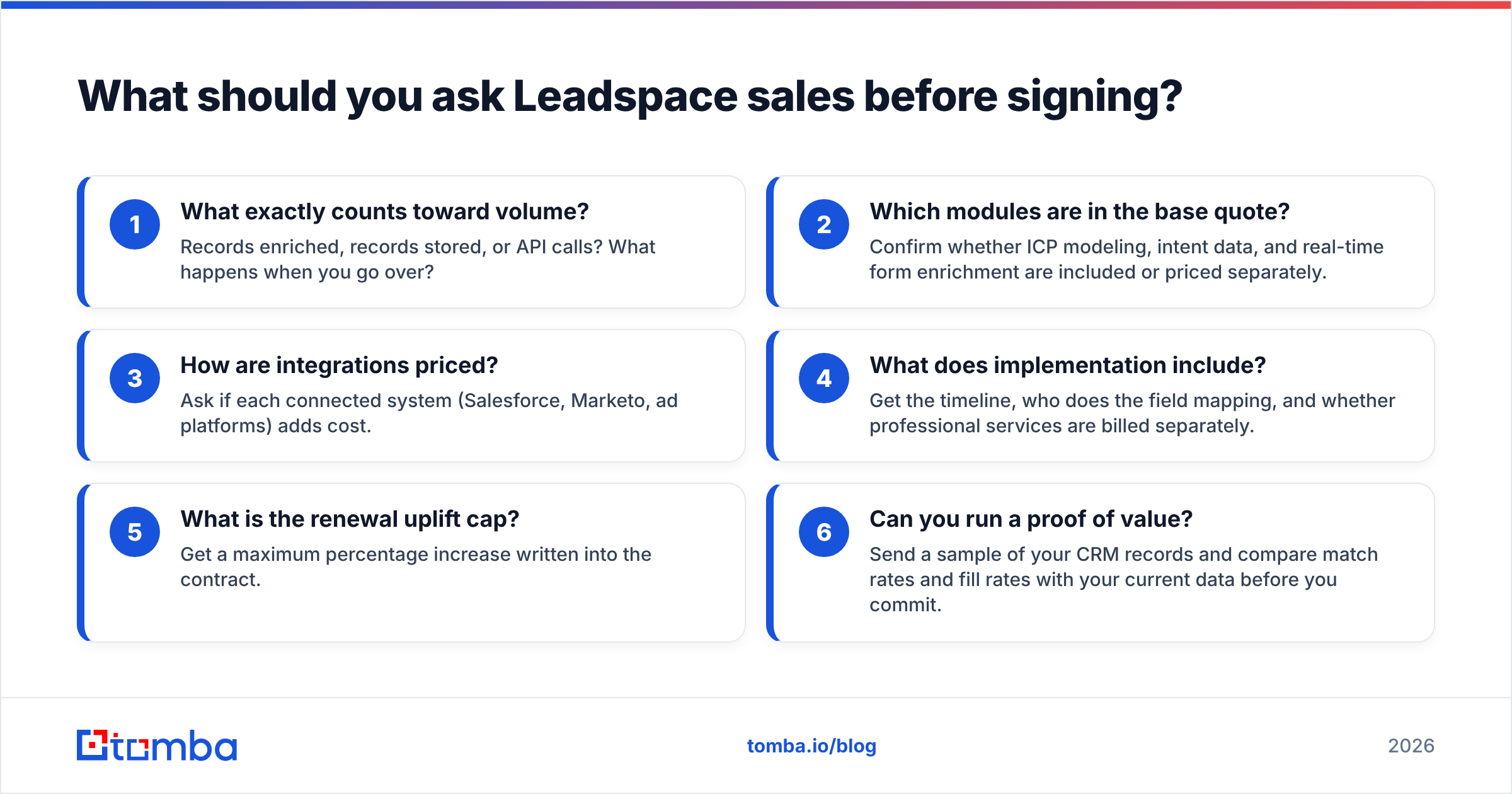
If Leadspace is on your shortlist, these questions help you avoid the surprises reviewers mention most:
- What exactly counts toward volume? Records enriched, records stored, or API calls? What happens when you go over?
- Which modules are in the base quote? Confirm whether ICP modeling, intent data, and real-time form enrichment are included or priced separately.
- How are integrations priced? Ask if each connected system (Salesforce, Marketo, ad platforms) adds cost.
- What does implementation include? Get the timeline, who does the field mapping, and whether professional services are billed separately.
- What is the renewal uplift cap? Get a maximum percentage increase written into the contract.
- Can you run a proof of value? Send a sample of your CRM records and compare match rates and fill rates with your current data before you commit.
That last one matters most. Any data vendor can show a strong demo on its own sample data. What you need to see is how it performs on your records.
Is Leadspace worth it in 2026?#
Yes, for enterprise RevOps teams with messy, duplicated, poorly scored CRM data. Leadspace is a capable B2B CDP with well-reviewed modeling and integrations. The annual price makes sense if cleaner data leads to better routing and more wins.
For everyone else, probably not. If your real problem is "we don't have accurate emails for the people we want to reach," you'd pay a CDP price for a job a contact data tool does for far less. Start with the simplest tool that fixes the problem you have. Move up to a platform like Leadspace when your data gets more complex.
That's the short version of Leadspace pricing reviews pros and cons: a strong data layer, a heavy setup, and a high price.
If you need verified contact data today and don't want to sit through a sales cycle for a quote, try the Tomba Email Finder. Search by name, company, or domain, verify before you send, and start on the free plan with 25 searches a month. When your volume grows, move to the $49/mo Starter plan, with no annual contract or implementation project required.
Related guides#
// get started
Find, verify and enrich your first contacts today
Start on the free plan with 25 searches a month, then scale when your team is ready.
Free plan · No credit card required · GDPR & CCPA
// about the author