LeadSquared Alternatives in 2026: 8 CRMs Compared for Sales Teams
LeadSquared is strong for high-volume, field-heavy sales in education, finance, and healthcare. If it's too heavy, too pricey, or too narrow for you, these 8 alternatives cover most team sizes, budgets, and ways of selling.
TL;DR
- LeadSquared is a strong fit for high-volume, process-heavy sales teams, especially in education, lending, insurance, and healthcare. It's often more than a small B2B team needs.
- HubSpot is the safest all-round alternative. Zoho CRM and Freshsales are the best-value picks. Pipedrive is the simplest option for deal-focused teams. Salesforce is the enterprise ceiling.
- Choose based on how you sell (inbound volume, outbound pipeline, or field teams), not on feature counts. Every tool on this list covers the basics.
- A new CRM won't fix bad contact data. Budget for an email finder and verifier alongside it, or the new system will fill up with bounces as fast as the old one did.
- Pricing below is the published entry-level pricing as of 2026. Check each vendor's page before you buy, because tiers and discounts change often.
What is LeadSquared, and why do teams look for alternatives?#
LeadSquared is a sales execution and marketing automation CRM. It became popular with teams that handle thousands of inbound leads a day: university admissions, loan origination, insurance distribution, and patient acquisition in healthcare. Its strengths are lead capture from many sources, rule-based lead distribution, field sales mobile apps, and workflow automation designed for regulated, high-volume industries.
Teams that leave it tend to give one of four reasons:
- Industry fit. LeadSquared's templates and workflows lean toward B2C-style volume selling. A 10-person B2B SaaS team running account-based outbound can find itself configuring around features it will never use.
- Pricing structure. The Sales CRM and Marketing Automation products are sold separately, and many plans are quote-based. Buyers often find it hard to predict the total cost as seats and modules grow.
- Implementation effort. Deployments usually need an implementation partner or a dedicated admin. Smaller teams want something they can set up in a week.
- Ecosystem. Compared with HubSpot or Salesforce, the third-party app marketplace and the pool of freelance admins are smaller, particularly outside India and Southeast Asia.
None of these makes LeadSquared a bad product. For a 300-person admissions team with complex routing rules, it's still one of the more capable options available. The question is whether that power matches the way you actually sell.
How should you evaluate LeadSquared alternatives?#
Before you open eight free trials, get clear on what you need. Most teams choose a CRM because of a slick demo and regret it within a year. These five criteria prevent most of those mistakes:
- Sales motion first. Inbound volume, outbound pipeline, and field sales each call for a different CRM. High-volume inbound needs strong routing and SLA timers. Outbound needs sequences and clean contact data. Field sales needs a usable offline mobile app.
- Total cost at 12 months. Add seats, required add-ons (calling, marketing contacts, AI features), and implementation. A $15/seat CRM that needs a $5,000 onboarding package isn't cheap.
- Admin burden. Ask who will maintain workflows once the champion leaves. Tools such as Salesforce assume a dedicated admin. Pipedrive assumes nobody.
- Integration coverage. List the five tools the CRM has to connect to on day one (email, calendar, calling, enrichment, billing) and confirm native integrations, not just "via Zapier."
- Data quality inputs. A CRM only stores and routes data. It doesn't make the data accurate. Decide how contacts will be sourced, verified, and enriched before migration day.
What are the best LeadSquared alternatives in 2026?#
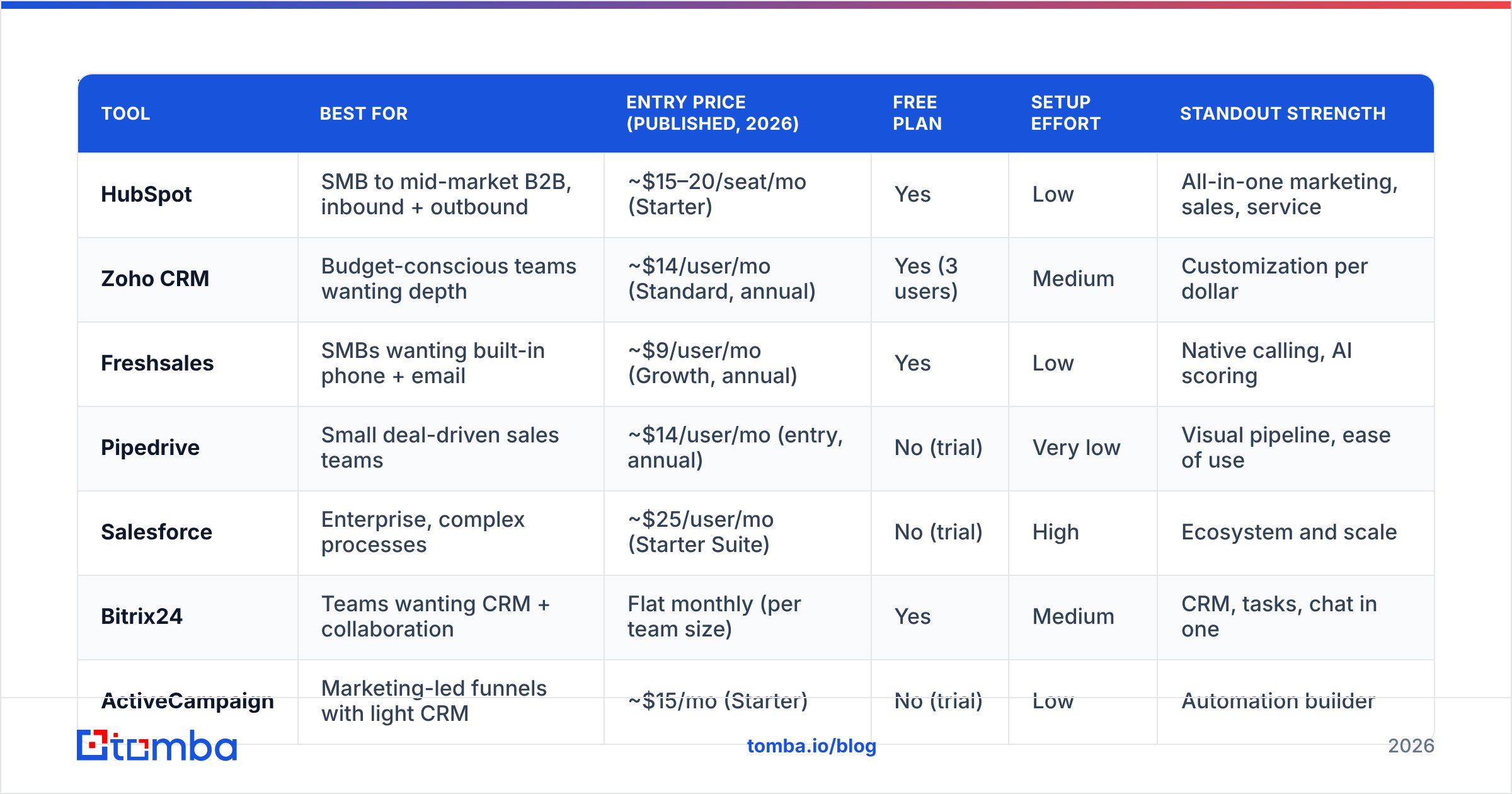
Here's the short list, ranked by how often each tool is the right answer for teams moving off LeadSquared.
| Tool | Best for | Entry price (published, 2026) | Free plan | Setup effort | Standout strength |
|---|---|---|---|---|---|
| HubSpot | SMB to mid-market B2B, inbound + outbound | ~$15–20/seat/mo (Starter) | Yes | Low | All-in-one marketing, sales, service |
| Zoho CRM | Budget-conscious teams wanting depth | ~$14/user/mo (Standard, annual) | Yes (3 users) | Medium | Customization per dollar |
| Freshsales | SMBs wanting built-in phone + email | ~$9/user/mo (Growth, annual) | Yes | Low | Native calling, AI scoring |
| Pipedrive | Small deal-driven sales teams | ~$14/user/mo (entry, annual) | No (trial) | Very low | Visual pipeline, ease of use |
| Salesforce | Enterprise, complex processes | ~$25/user/mo (Starter Suite) | No (trial) | High | Ecosystem and scale |
| Bitrix24 | Teams wanting CRM + collaboration | Flat monthly (per team size) | Yes | Medium | CRM, tasks, chat in one |
| ActiveCampaign | Marketing-led funnels with light CRM | ~$15/mo (Starter) | No (trial) | Low | Automation builder |
| Keap | Small service businesses | Quote/tiered, higher entry | No (trial) | Medium | Invoicing + automation |
Pricing changes often, and annual billing usually lowers the per-seat figure. Treat these numbers as starting points for comparison, not quotes.
Is HubSpot a better choice than LeadSquared?#
For most B2B teams under 200 people, yes. HubSpot Sales Hub gives you a free CRM tier, sequences, meeting scheduling, a large integrations marketplace, and marketing tools that share the same contact record. Onboarding is fast, and the pool of HubSpot-trained admins and agencies is huge.
Where it beats LeadSquared: ease of use, ecosystem, content and inbound marketing tooling, and a much easier path from free to paid.
Where LeadSquared still wins: complex lead distribution rules at very high volume, field-force features such as check-ins and territory routing, and industry-specific templates for lending and education.
Watch out for: marketing contact tiers and jumps between Professional and Enterprise, which can be steep. Model your costs at two to three times today's contact volume.
If you choose HubSpot, you can connect your prospecting data to it directly with the Tomba HubSpot integration, so new contacts arrive already enriched.
Is Zoho CRM a cheaper LeadSquared alternative?#
Zoho CRM is the strongest value play on this list. The Standard tier is inexpensive, the free plan covers up to three users, and the platform goes surprisingly deep: Blueprint for enforcing process, territory management, custom modules, and Zia AI for predictions. If you liked LeadSquared's workflow rigor but want a lower bill, Zoho CRM is the closest like-for-like replacement.
Pros: customization per dollar, a wide suite (Zoho Books, Desk, Campaigns), and strong process enforcement. Cons: the UI can feel dense, some advanced features need higher tiers, and good configuration still takes admin time.
Should small teams pick Freshsales or Pipedrive?#
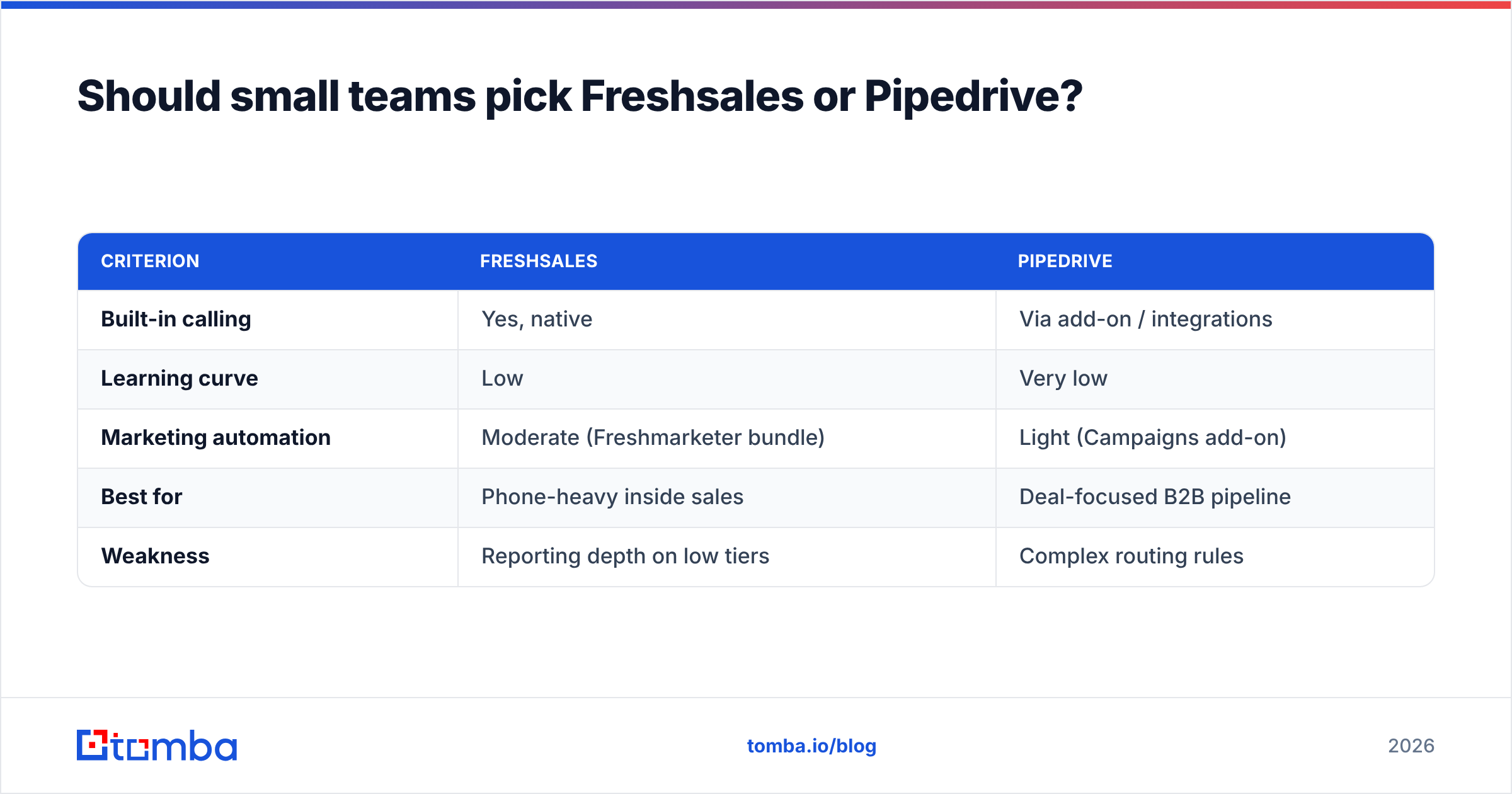
Both are designed for teams that want to sell, not administer software. The difference comes down to what you need built in.
Freshsales (from Freshworks) includes native calling, email sequences, and AI-based lead scoring at a low entry price. It suits inside sales teams that live on the phone and don't want to stitch together a separate dialer.
Pipedrive is the cleanest visual pipeline on the market. Reps understand it in an afternoon, and the marketplace covers most gaps. It's deliberately light on marketing automation, so pair it with a separate email tool if you run nurture campaigns.
| Criterion | Freshsales | Pipedrive |
|---|---|---|
| Built-in calling | Yes, native | Via add-on / integrations |
| Learning curve | Low | Very low |
| Marketing automation | Moderate (Freshmarketer bundle) | Light (Campaigns add-on) |
| Best for | Phone-heavy inside sales | Deal-focused B2B pipeline |
| Weakness | Reporting depth on low tiers | Complex routing rules |
Neither handles LeadSquared-style mass lead distribution as well, but most teams under 30 reps never need it.
When does Salesforce make sense instead?#
Salesforce makes sense when your process is complex enough to justify a dedicated admin and your roadmap includes CPQ, multi-entity reporting, or heavy custom objects. Salesforce has the deepest ecosystem of any CRM: an app marketplace, certified consultants in every region, and integrations for nearly every sales tool.
The Starter Suite lowered the entry price, but realistic enterprise deployments cost far more once you add Sales Cloud Professional or Enterprise seats, implementation, and add-ons. If you're leaving LeadSquared because it felt heavy, Salesforce will feel heavier. If you're leaving because you outgrew it, Salesforce is the natural next step. Tomba's Salesforce integration keeps prospect records enriched without manual imports.
What about Bitrix24, ActiveCampaign, and Keap?#
These three fill specific gaps rather than competing head-to-head across the board.
- Bitrix24 combines CRM with tasks, chat, video calls, and an intranet. Flat team pricing helps growing teams that don't want per-seat bills. The trade-off is a busy interface and a CRM that goes less deep than Zoho's.
- ActiveCampaign is a marketing automation platform first, with a capable CRM layered on top. If most of your LeadSquared usage was nurture journeys and lead scoring rather than sales execution, it can be a lighter and cheaper fit.
- Keap targets small service businesses that need CRM, invoicing, appointment booking, and automation in one place. It's less relevant for multi-rep B2B sales teams.
Why doesn't switching CRMs fix lead quality?#
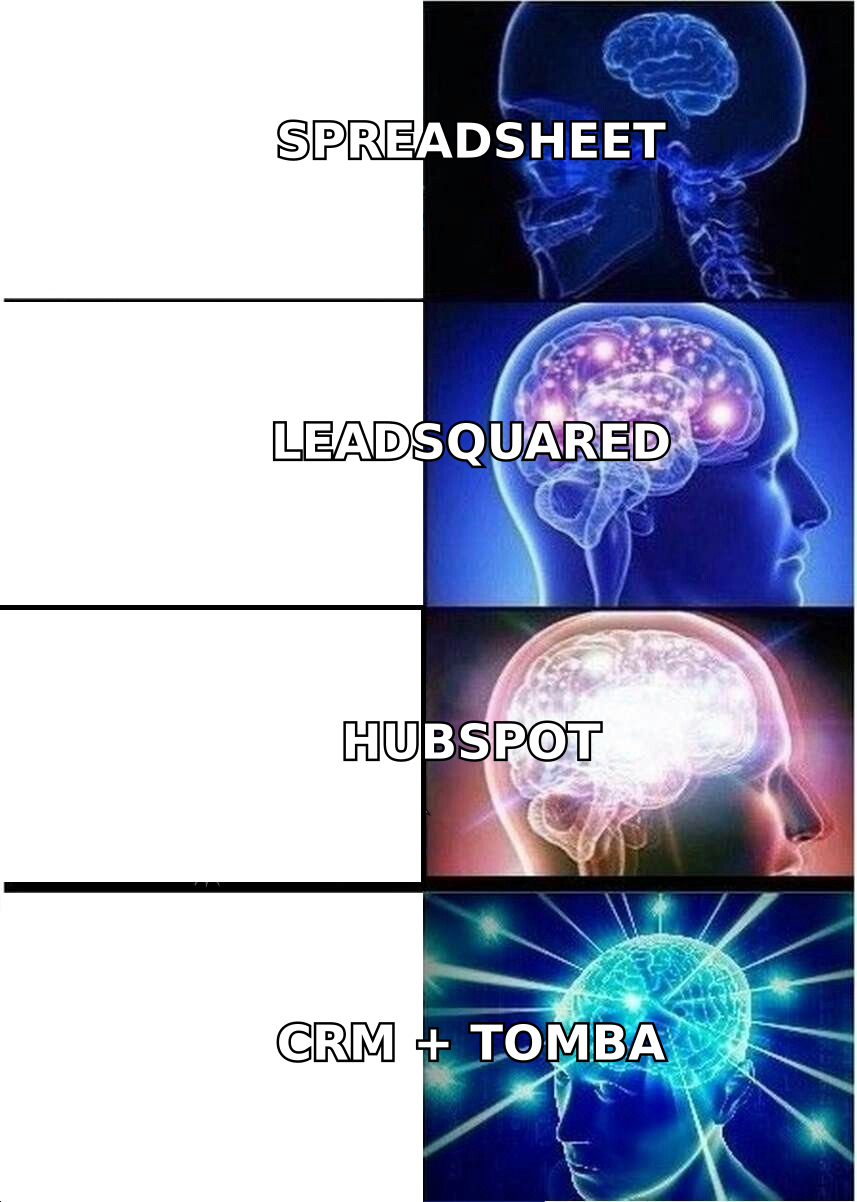
This is the part most migration plans skip. Teams leave LeadSquared expecting better conversion, move the same contact list into HubSpot or Zoho, and six months later they have the same bounce rates, the same dead records, and the same frustrated reps.
A CRM is a filing cabinet with automation. It routes, reminds, and reports. It doesn't know whether j.smith@company.com still works there. B2B contact data decays quickly as people change jobs and companies get acquired or rebrand. According to HubSpot's research on database decay, marketing databases lose a large share of their accuracy every year, so a list that was clean at migration is noticeably stale 12 months later.
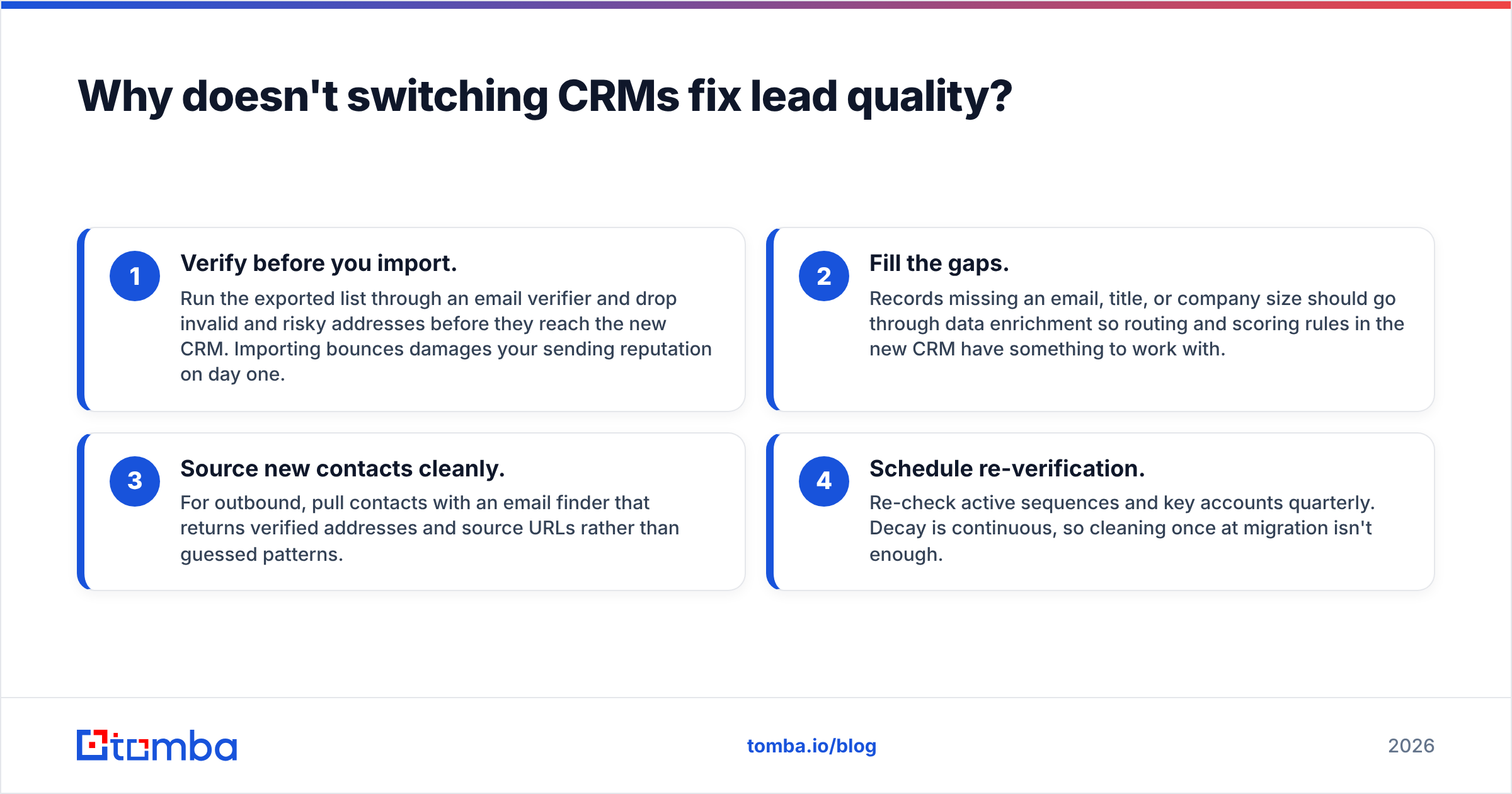
A realistic migration checklist includes a data layer:
- Verify before you import. Run the exported list through an email verifier and drop invalid and risky addresses before they reach the new CRM. Importing bounces damages your sending reputation on day one.
- Fill the gaps. Records missing an email, title, or company size should go through data enrichment so routing and scoring rules in the new CRM have something to work with.
- Source new contacts cleanly. For outbound, pull contacts with an email finder that returns verified addresses and source URLs rather than guessed patterns.
- Schedule re-verification. Re-check active sequences and key accounts quarterly. Decay is continuous, so cleaning once at migration isn't enough.
Getting this layer right is what makes any CRM on this list, LeadSquared included, perform the way the demo promised.
Which LeadSquared alternative should you choose?#
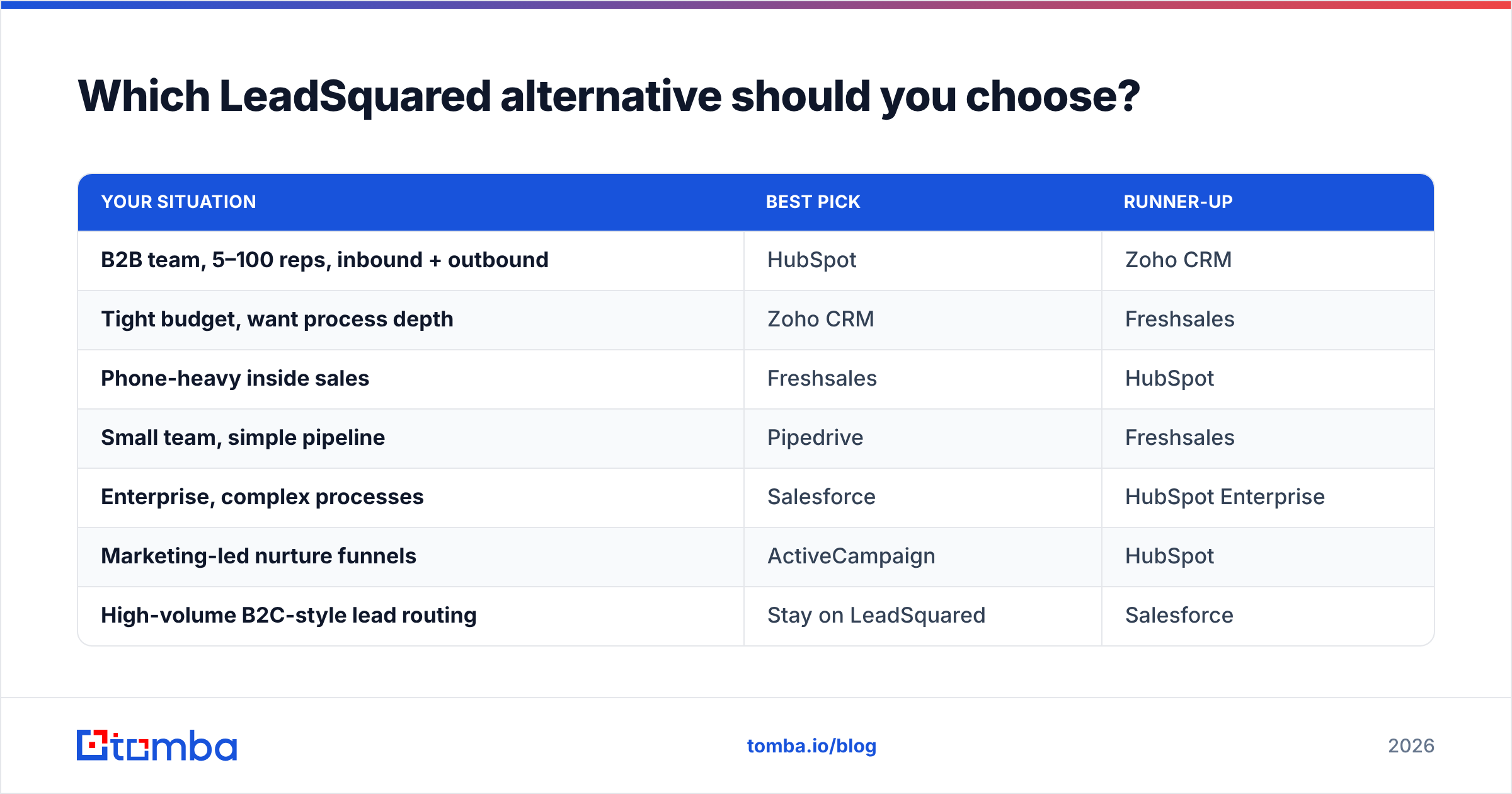
Match the tool to your situation:
| Your situation | Best pick | Runner-up |
|---|---|---|
| B2B team, 5–100 reps, inbound + outbound | HubSpot | Zoho CRM |
| Tight budget, want process depth | Zoho CRM | Freshsales |
| Phone-heavy inside sales | Freshsales | HubSpot |
| Small team, simple pipeline | Pipedrive | Freshsales |
| Enterprise, complex processes | Salesforce | HubSpot Enterprise |
| Marketing-led nurture funnels | ActiveCampaign | HubSpot |
| High-volume B2C-style lead routing | Stay on LeadSquared | Salesforce |
That last row matters. If your core problem is distributing 5,000 admissions or loan inquiries a day across branch teams with SLA timers, LeadSquared may already be the best tool for the job. Fix configuration and data quality before you pay migration costs.
For independent user feedback before you commit, compare verified reviews on G2, filtered by company size and industry. Aggregate star ratings hide the fact that a CRM loved by 20-person SaaS teams can frustrate a 500-seat call center.
How do you migrate off LeadSquared without losing pipeline?#
A clean migration usually takes two to six weeks, depending on how many custom workflows you rely on. Keep it low-risk:
- Audit before exporting. List every active automation, custom field, and integration in LeadSquared. Workflows that nobody can explain are candidates for deletion, not migration.
- Map fields deliberately. Decide which custom fields carry over, which merge, and which you drop. Migrating 400 custom fields means migrating 400 future headaches.
- Clean the data in transit. Deduplicate, verify emails, and enrich missing firmographics between export and import. It's the cheapest moment you'll get to fix data quality.
- Run in parallel briefly. Keep LeadSquared read-only for two to four weeks so reps can look up history while the new CRM beds in.
- Rebuild routing last. Get contacts, deals, and activity history right first, then recreate lead assignment and scoring rules once the data can be trusted.
Final take: get the data right, whichever CRM you choose#
The best LeadSquared alternative for most B2B teams is HubSpot, with Zoho CRM as the value pick and Pipedrive or Freshsales for small teams that want speed over configurability. Salesforce is the answer only when complexity justifies it. And if you run high-volume, routing-heavy inbound, staying on LeadSquared can be the right call.
Whatever you pick, the CRM will only be as good as the contacts inside it. Tomba Email Finder finds verified professional email addresses by name, domain, or company, and pushes them straight into HubSpot, Salesforce, Pipedrive, and other CRMs through native integrations. Start on the free plan with 25 searches a month, or move to Starter at $49/mo when your team is ready to build pipeline on data that doesn't bounce.
Related guides#
// get started
Find, verify and enrich your first contacts today
Start on the free plan with 25 searches a month, then scale when your team is ready.
Free plan · No credit card required · GDPR & CCPA
// about the author